QUANTUM MECHANICS
MPHYCC206: Unit 1
Lecture 1
TRANSITION FROM
CLASSICAL MECHANICS TO QUANTUM MECHANICS..
By Dr. Amrita
Assistant Professor
Department of Physics
Patna Women’s College, Patna University
CLASSICAL MECHANICS VS QUANTUM MECHANICS
■ Classical mechanics find its origin in early 17th century. Q.M is rather a
newer one, postulated in order to solve problems where C.M failed in
20th century.
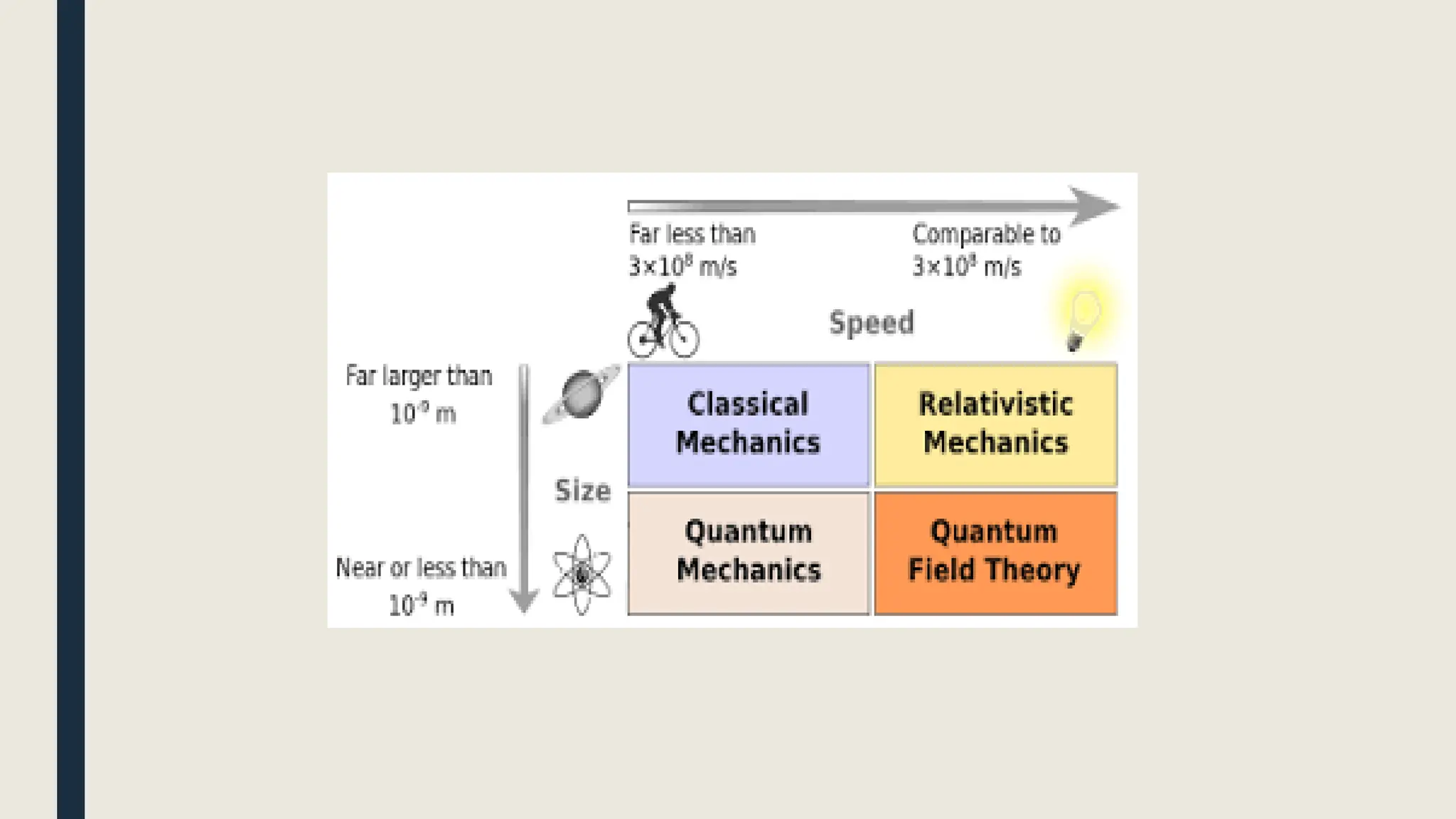
■ Classical mechanics describes the motion of macroscopic objects and
systems ..i.e. it deals with big systems whereas quantum mechanics
deals with the microscopic systems of atomic and subatomic regime;
the small systems.
■ In C.M we consider the physical quantities as of continuous nature,
whereas when we move to subatomic systems, they become quantized.
SYSTEMS AND OBSERVATION
■ In classical systems that we encounter, we can observe the system by fixing a co-
ordinate system which may be inertial and non- inertial. The equation of motion
formed for the system and solved to obtained the physical quantity.
■ In quantum mechanics , any act of observation creates a disturbance in the system.
So, in order to analyse the behaviour of the quantum system, their must be
interaction .
Origin of quantum mechanics
■ Quantum Mechanics along with relativity forms the basis of atomic and nuclear
physics as well as solid state physics and cosmology.
■ The implications of quantum mechanics solved various phenomenon such as
photoelectric effect, blackbody radiation, Compton effect in which the classical
theory failed.
History of Quantum Mechanics
■ The foundation stone of q.m was laid to solve the problem of blackbody radiation
which was propounded by Max Planck in which quanta was introduced.
■ Einstein brought the quantum theory of photoelectric effect and shown that the
photons are responsible for emission of photoelectrons.
■ Planck’s hypothesis and Einstein’s photons fitted well in the Bohr theory of H atom
which proved the validity of early quantum theory.
Quantum
Mechanics
The other great theory of modern physics
Deals with very small objects
➔ Electrons, atoms, molecules
Grew out of problems that seemed simple
➔ Black-body radiation
➔ Photoelectric Effect
➔ Atomic Spectra
Produces some very strange results…
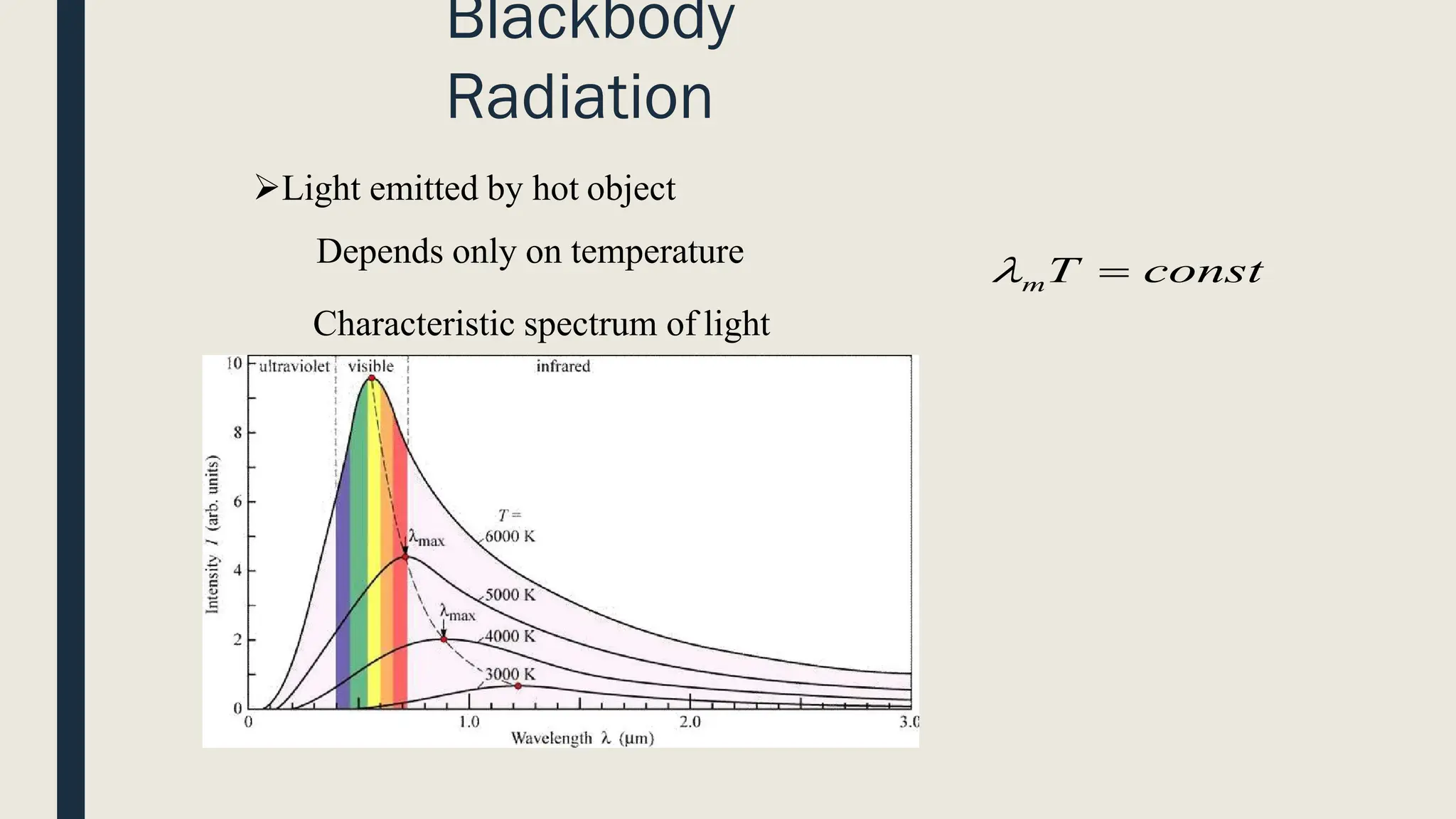
Blackbody
Radiation
➢Light emitted by hot object
Depends only on temperature
Characteristic spectrum of light
const
T
m =

Blackbody Radiation
▪When matter is heated, it
emits radiation.
▪As T increases, the object
becomes red, yellow then
white.
▪A blackbody is a perfect
absorber as well as a perfect
emitter.
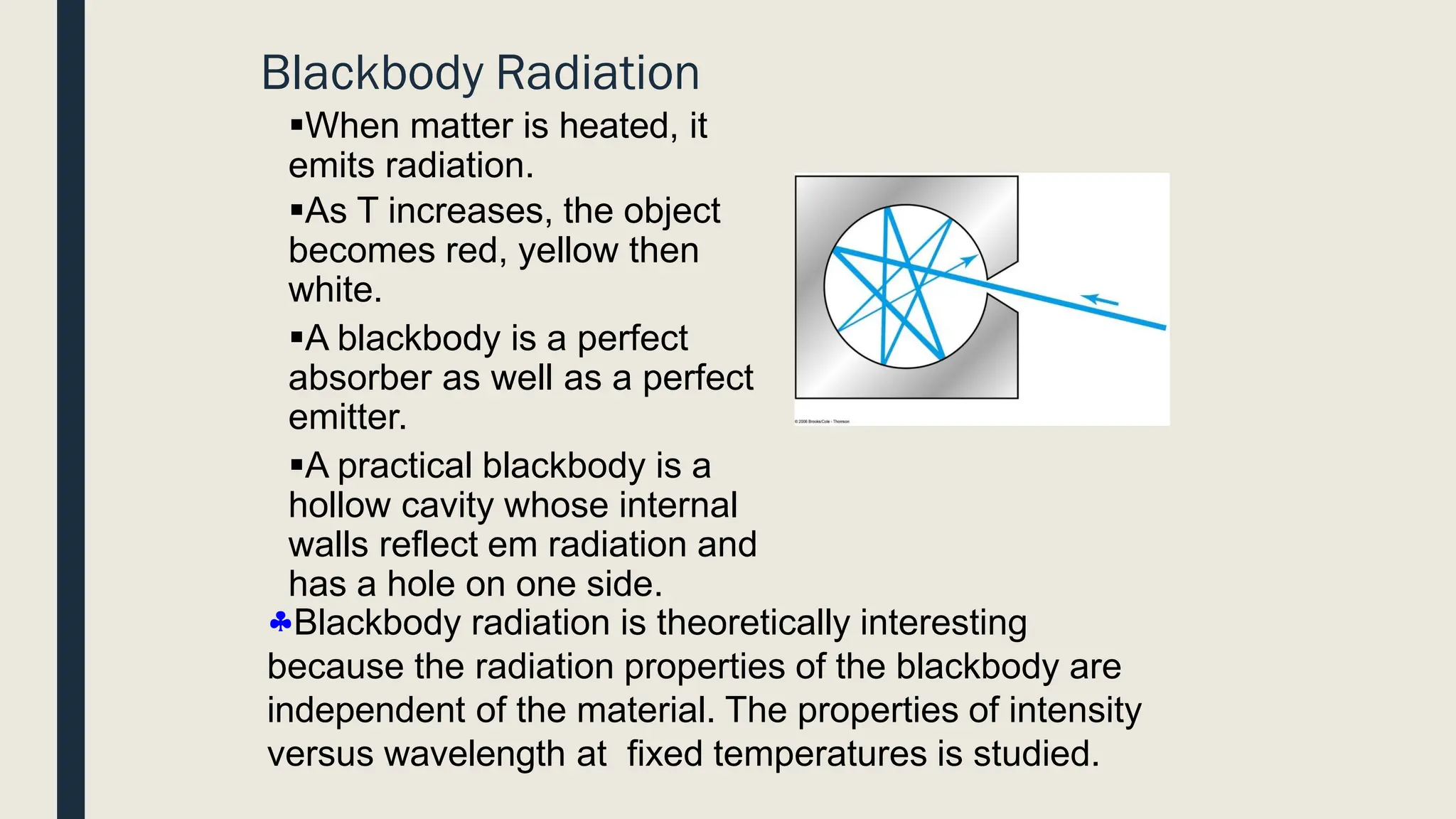
▪A practical blackbody is a
hollow cavity whose internal
walls reflect em radiation and
has a hole on one side.
Blackbody radiation is theoretically interesting
because the radiation properties of the blackbody are
independent of the material. The properties of intensity
versus wavelength at fixed temperatures is studied.
Wien’s Displacement Law
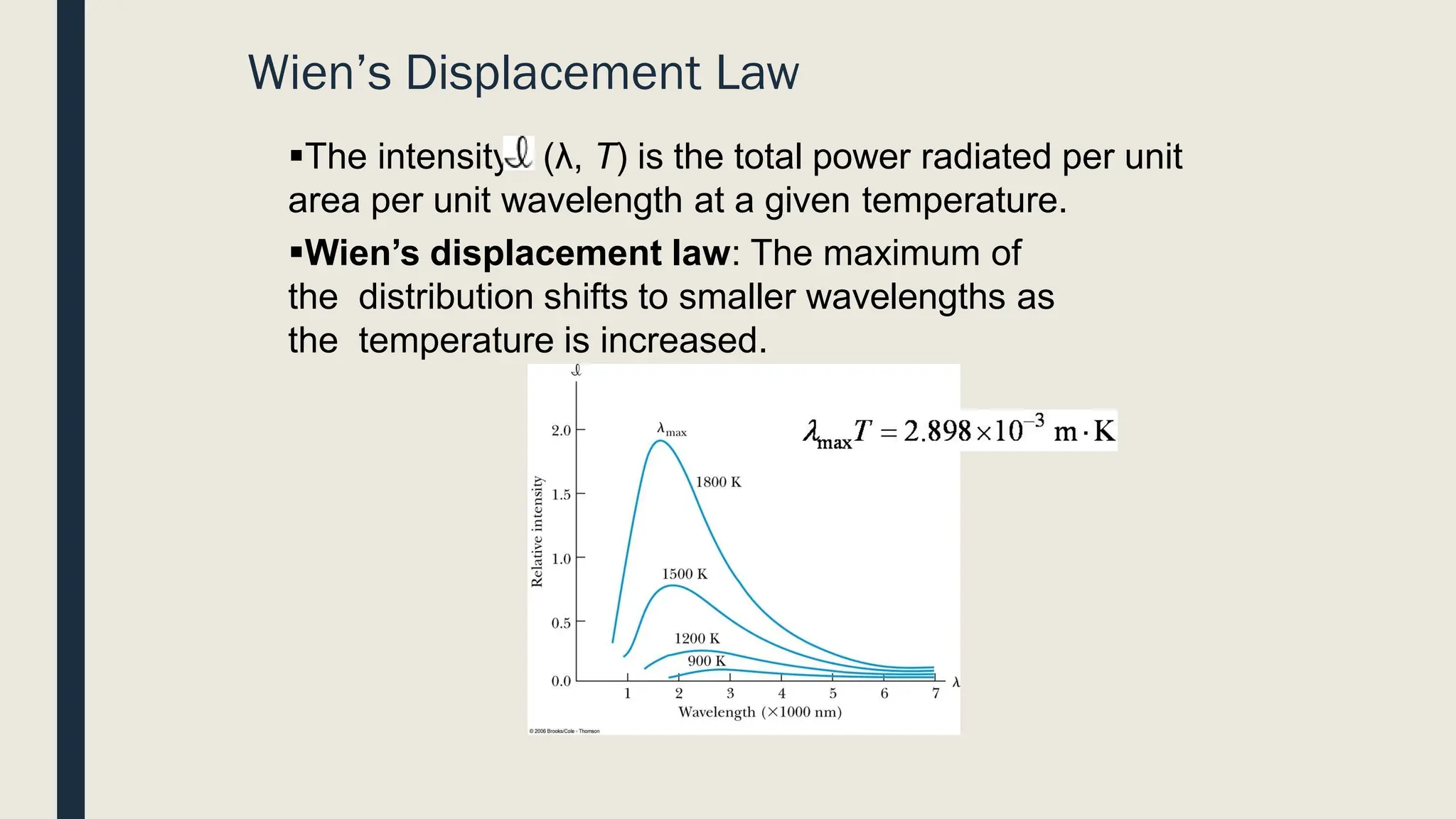
▪The intensity (λ, T) is the total power radiated per unit
area per unit wavelength at a given temperature.
▪Wien’s displacement law: The maximum of
the distribution shifts to smaller wavelengths as
the temperature is increased.
Stefan-Boltzmann Law
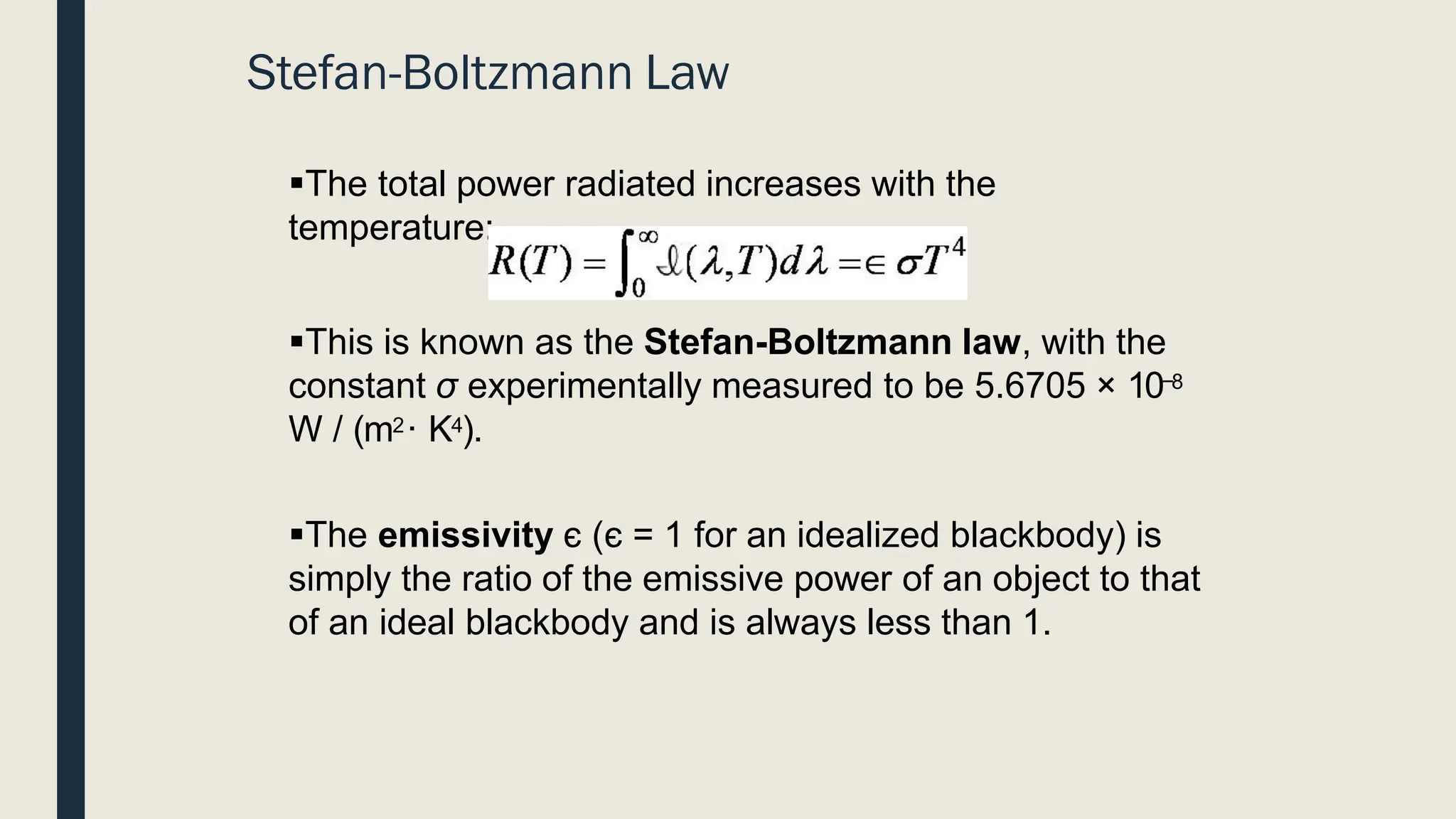
▪The total power radiated increases with the
temperature:
▪This is known as the Stefan-Boltzmann law, with the
constant σ experimentally measured to be 5.6705 × 10⁻⁸
W / (m2· K4).
▪The emissivity є (є = 1 for an idealized blackbody) is
simply the ratio of the emissive power of an object to that
of an ideal blackbody and is always less than 1.
Rayleigh-Jeans Formula
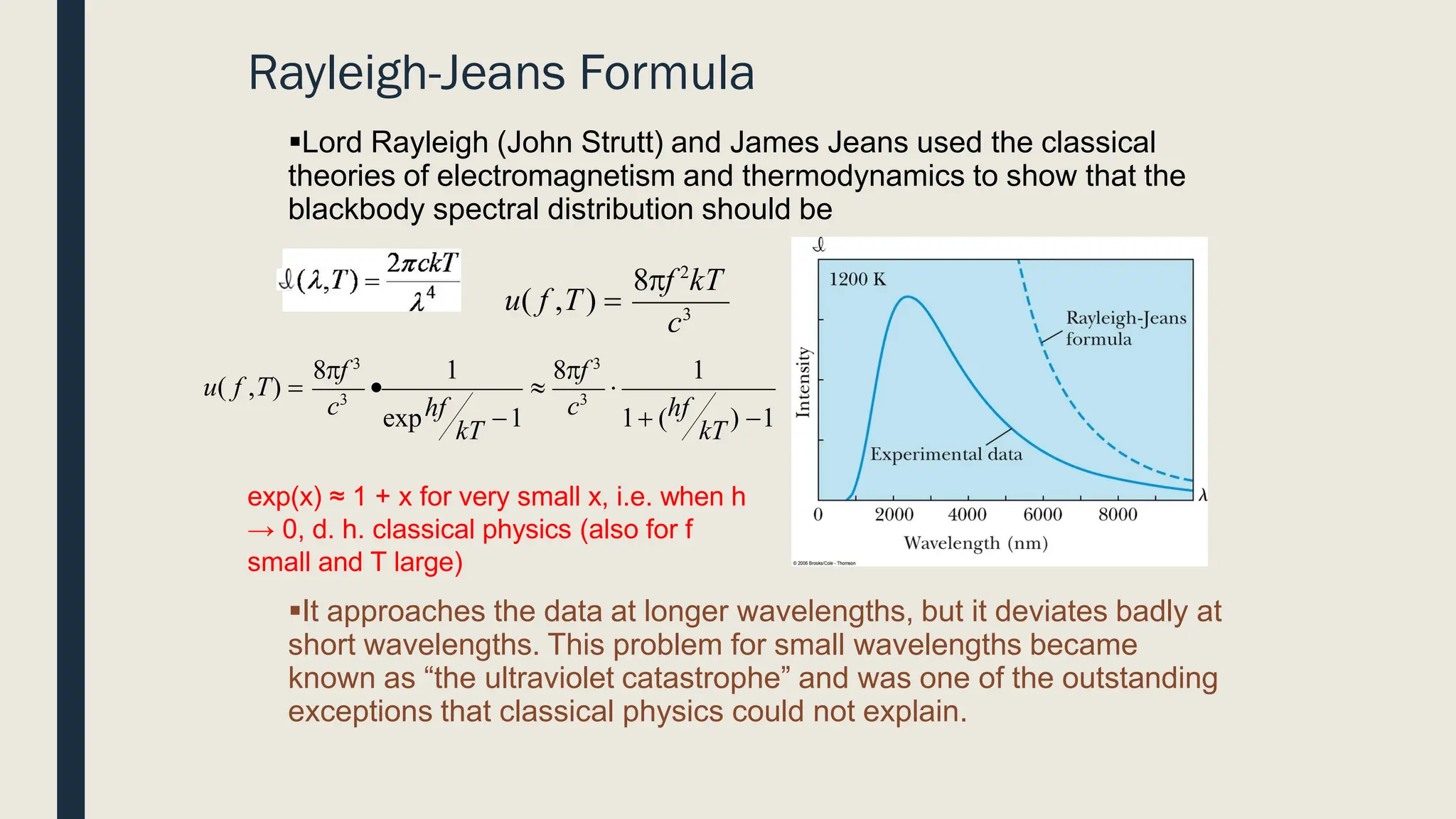
▪Lord Rayleigh (John Strutt) and James Jeans used the classical
theories of electromagnetism and thermodynamics to show that the
blackbody spectral distribution should be
▪It approaches the data at longer wavelengths, but it deviates badly at
short wavelengths. This problem for small wavelengths became
known as “the ultraviolet catastrophe” and was one of the outstanding
exceptions that classical physics could not explain.
c3
8f 2
kT
u( f ,T) =
1
1

1+ (hf ) −1
c3
kT kT
• 
exphf −1
c3
u( f ,T) =
8f 3
8f 3
exp(x) ≈ 1 + x for very small x, i.e. when h
→ 0, d. h. classical physics (also for f
small and T large)
Why the quantum theory??
■ Wien’s formula explained why the emissivity decreases as we approach the lower
wavelength region.
■ Rayleigh Jean’s considered the electromagnetic nature of radiation and described
why emissivity goes on increasing on increasing wavelength.
■ Thus, no theory could explain the radiation over the entire wavelength region. But
the experimental observations cannot be discarded, Max Planck put forward the
quantum theory.
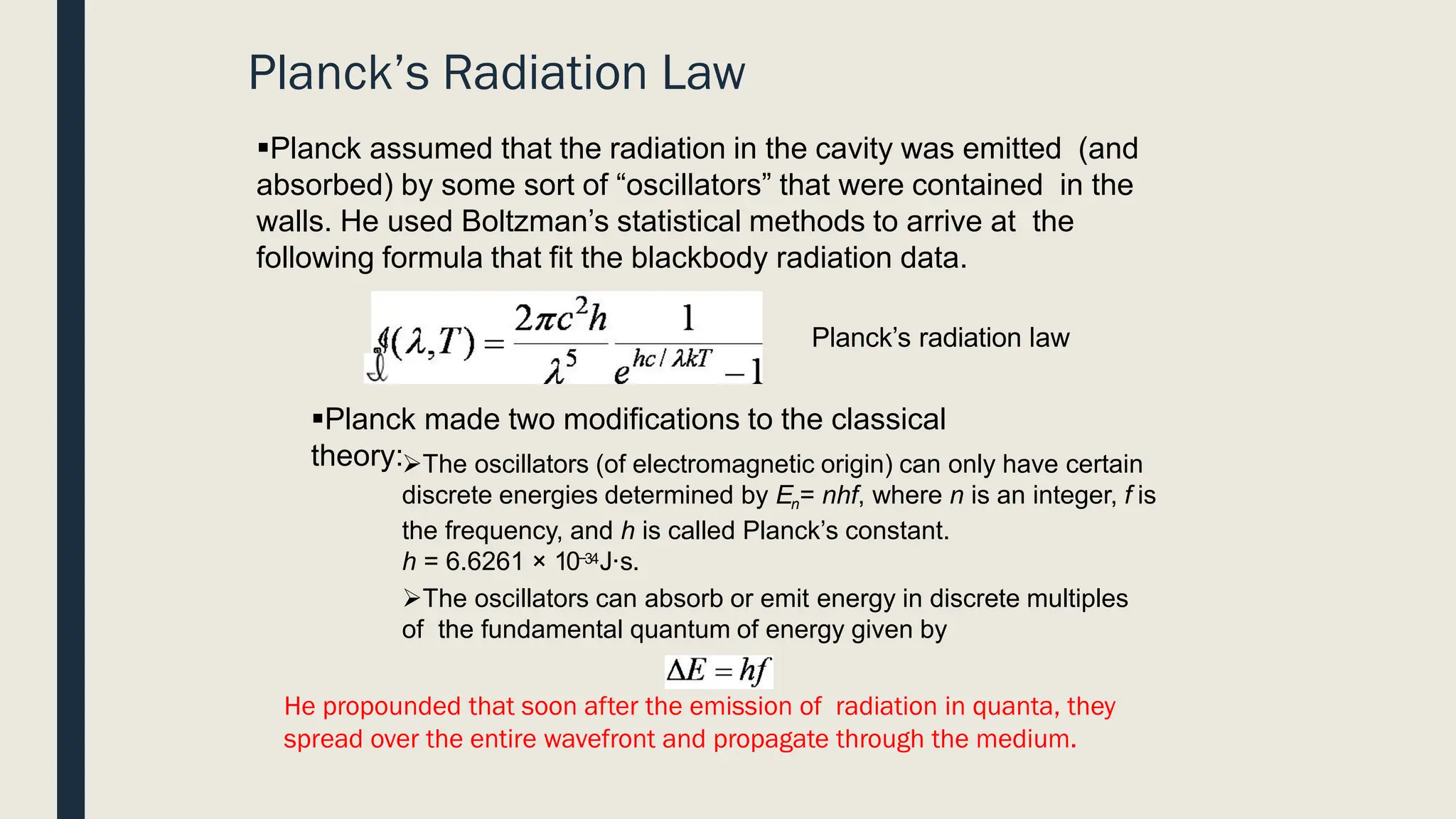
▪Planck assumed that the radiation in the cavity was emitted (and
absorbed) by some sort of “oscillators” that were contained in the
walls. He used Boltzman’s statistical methods to arrive at the
following formula that fit the blackbody radiation data.
▪Planck made two modifications to the classical
theory:➢The oscillators (of electromagnetic origin) can only have certain
discrete energies determined by En= nhf, where n is an integer, f is
the frequency, and h is called Planck’s constant.
h = 6.6261 × 10⁻³⁴J·s.
➢The oscillators can absorb or emit energy in discrete multiples
of the fundamental quantum of energy given by
Planck’s Radiation Law
Planck’s radiation law
He propounded that soon after the emission of radiation in quanta, they
spread over the entire wavefront and propagate through the medium.
Photoelectric
Effect
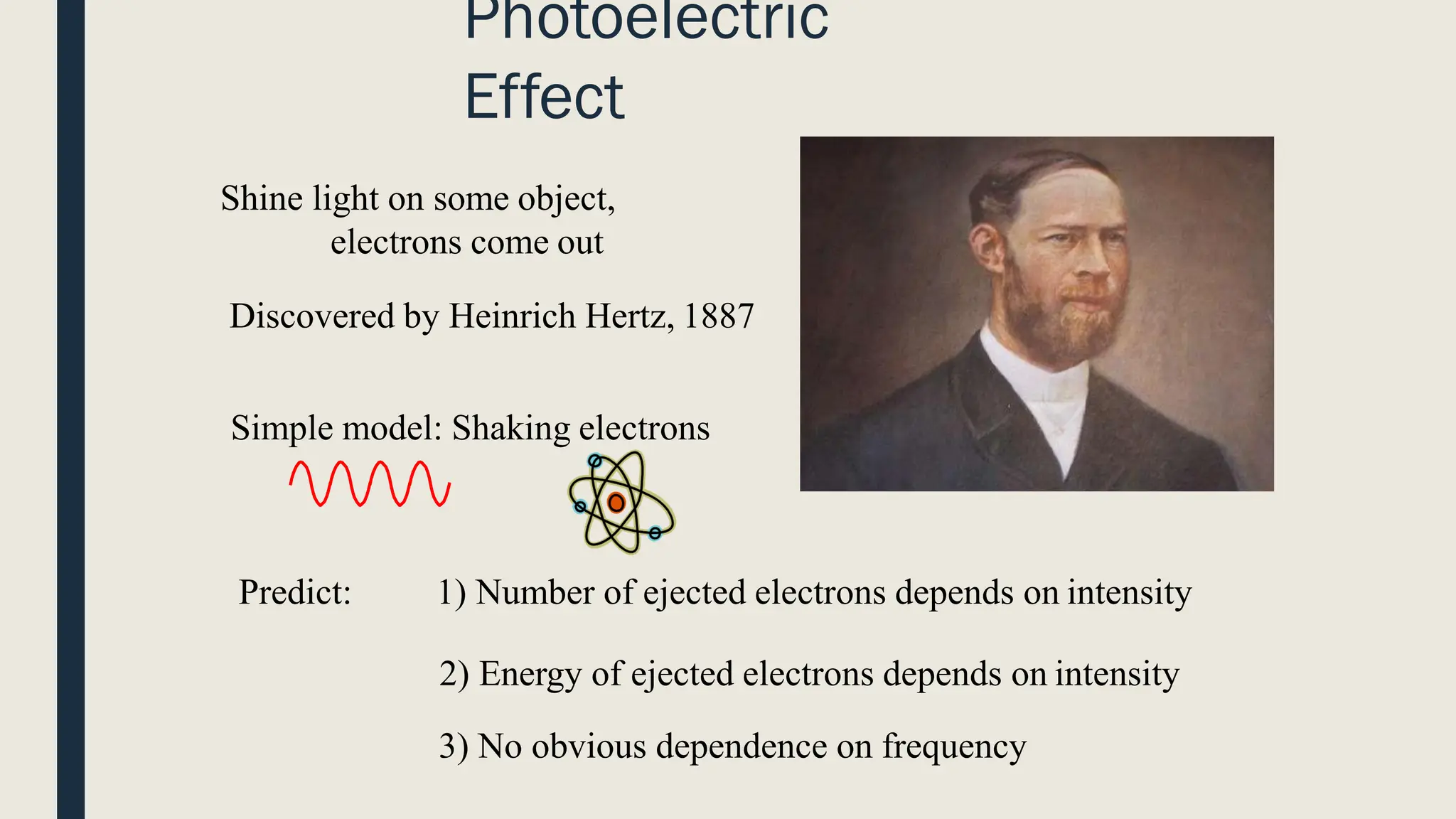
Shine light on some object,
electrons come out
Discovered by Heinrich Hertz, 1887
Simple model: Shaking electrons
Predict: 1) Number of ejected electrons depends on intensity
2) Energy of ejected electrons depends on intensity
3) No obvious dependence on frequency
Photoelectric Effect:
Experiment
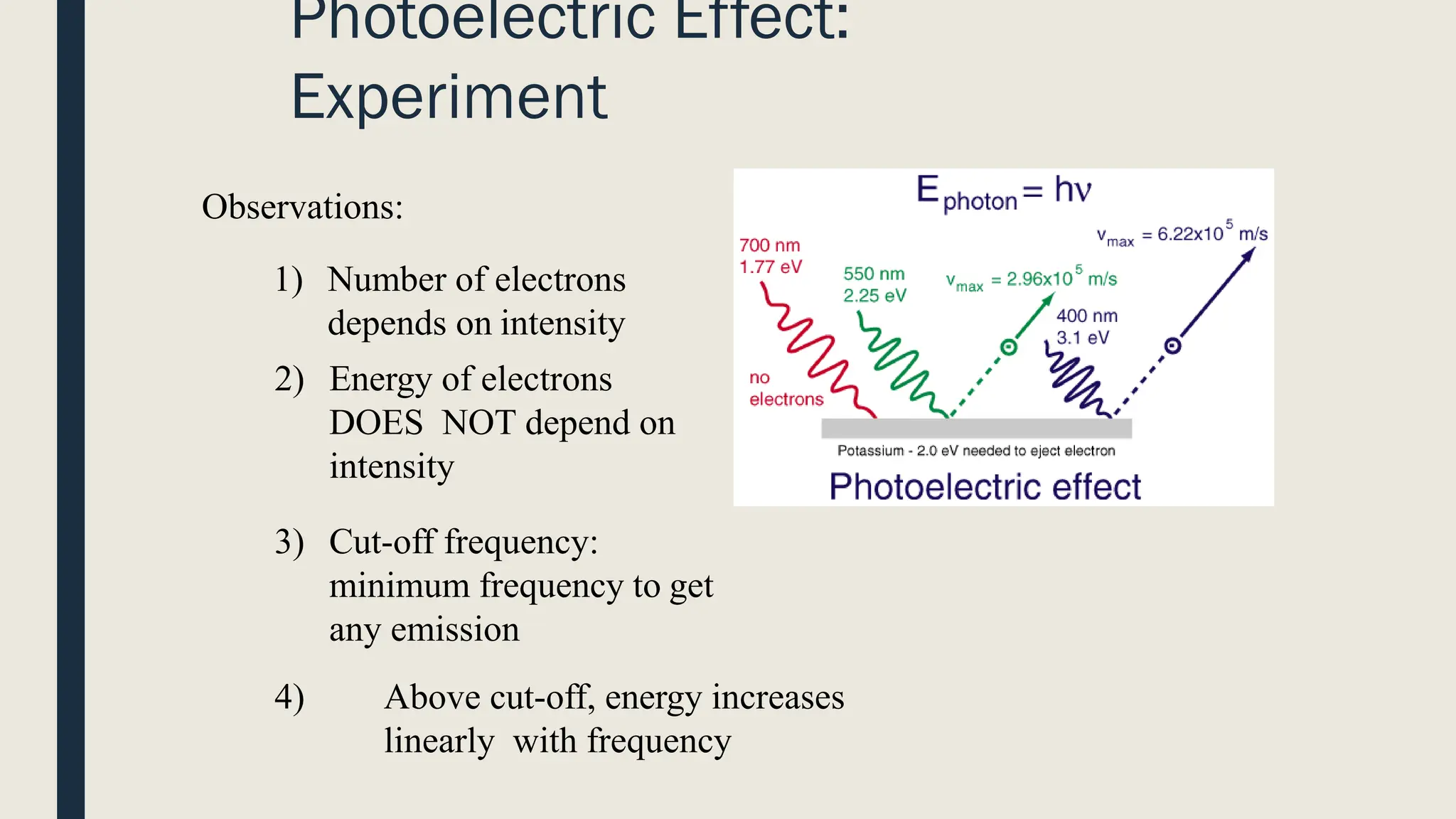
Observations:
1) Number of electrons
depends on intensity
2) Energy of electrons
DOES NOT depend on
intensity
3) Cut-off frequency:
minimum frequency to get
any emission
4) Above cut-off, energy increases
linearly with frequency
Photoelectric Effect:
Einstein
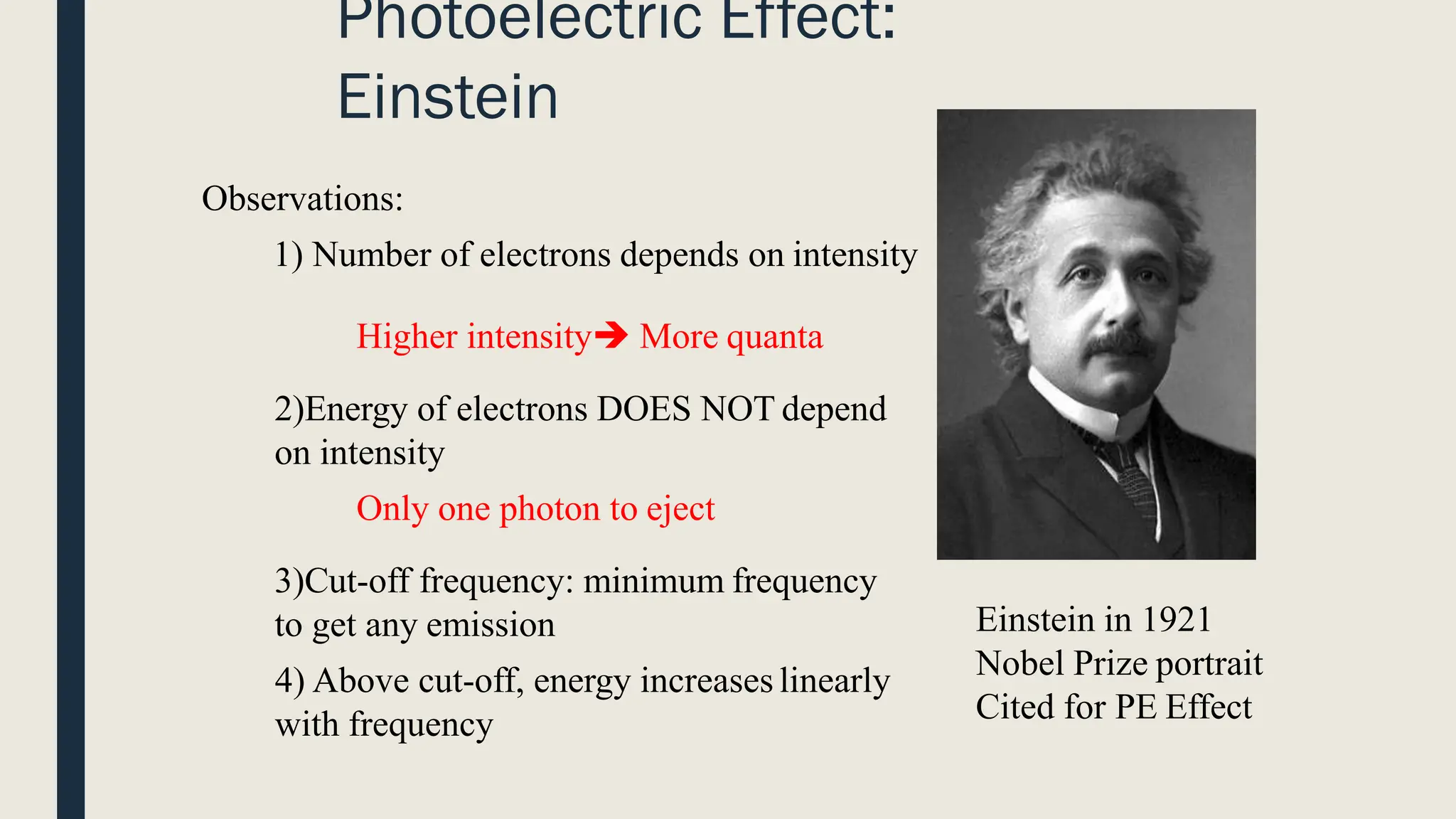
4) Above cut-off, energy increases linearly
with frequency
Observations:
1) Number of electrons depends on intensity
Higher intensity➔ More quanta
2)Energy of electrons DOES NOT depend
on intensity
Only one photon to eject
3)Cut-off frequency: minimum frequency
to get any emission Einstein in 1921
Nobel Prize portrait
Cited for PE Effect
Photon:
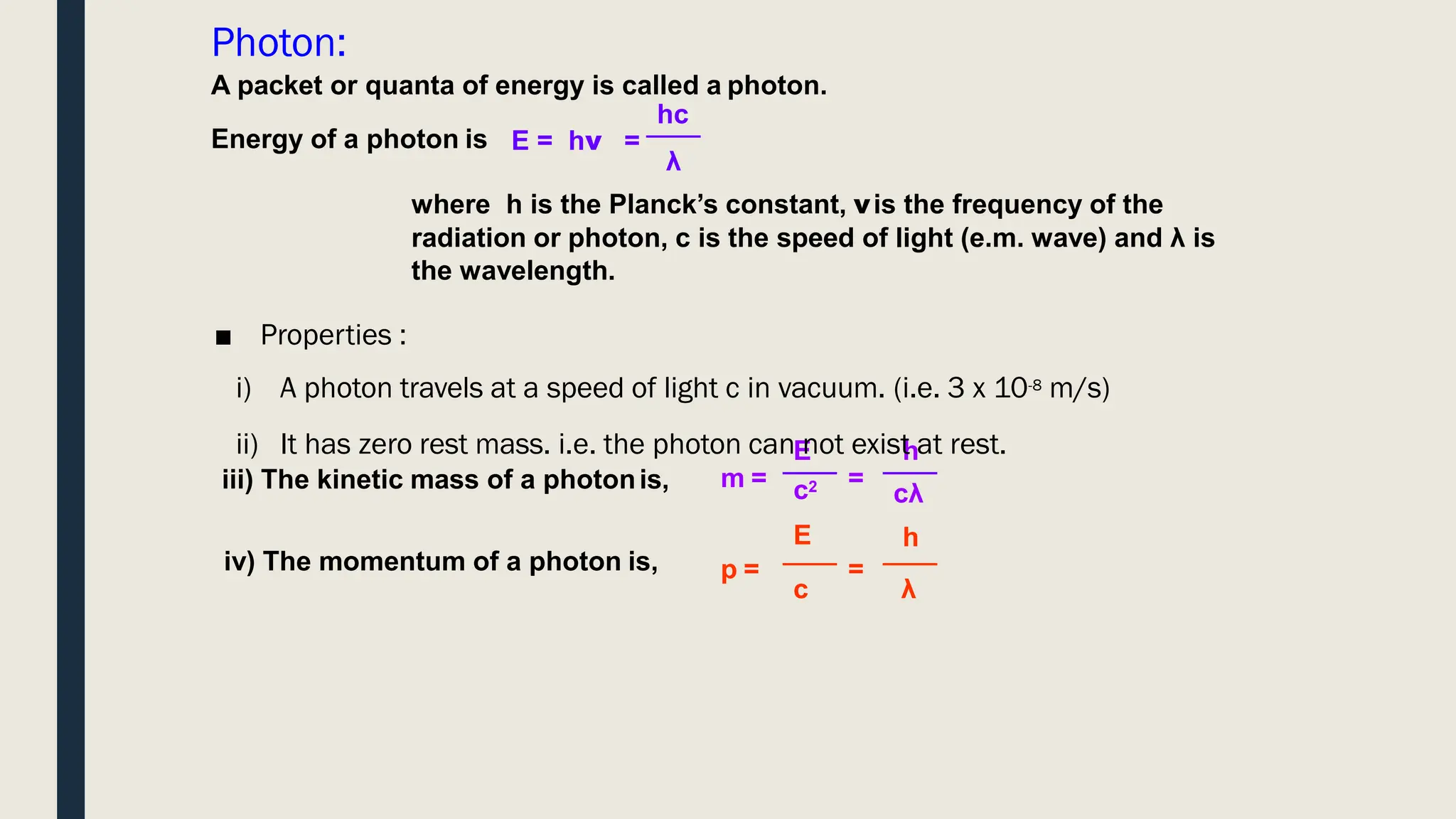
Energy of a photon is E = hν =
A packet or quanta of energy is called a photon.
hc
λ
where h is the Planck’s constant, νis the frequency of the
radiation or photon, c is the speed of light (e.m. wave) and λ is
the wavelength.
m =
E h
=
p =
cλ
h
λ
c2
E
c
=
■ Properties :
i) A photon travels at a speed of light c in vacuum. (i.e. 3 x 10⁻⁸ m/s)
ii) It has zero rest mass. i.e. the photon can not exist at rest.
iii) The kinetic mass of a photonis,
iv) The momentum of a photon is,
Photon: Properties..contd.
v)Photons travel in a straight line.
vi) Energy of a photon depends upon frequency of the
photon; so the energy of the photon does not change
when photon travels from one medium to another.
vii)Photons are electrically neutral.
viii)Photons may show diffraction under given conditions.
ix) Photons are not deviated by magnetic and electric
fields.
Photoelectric Effect:
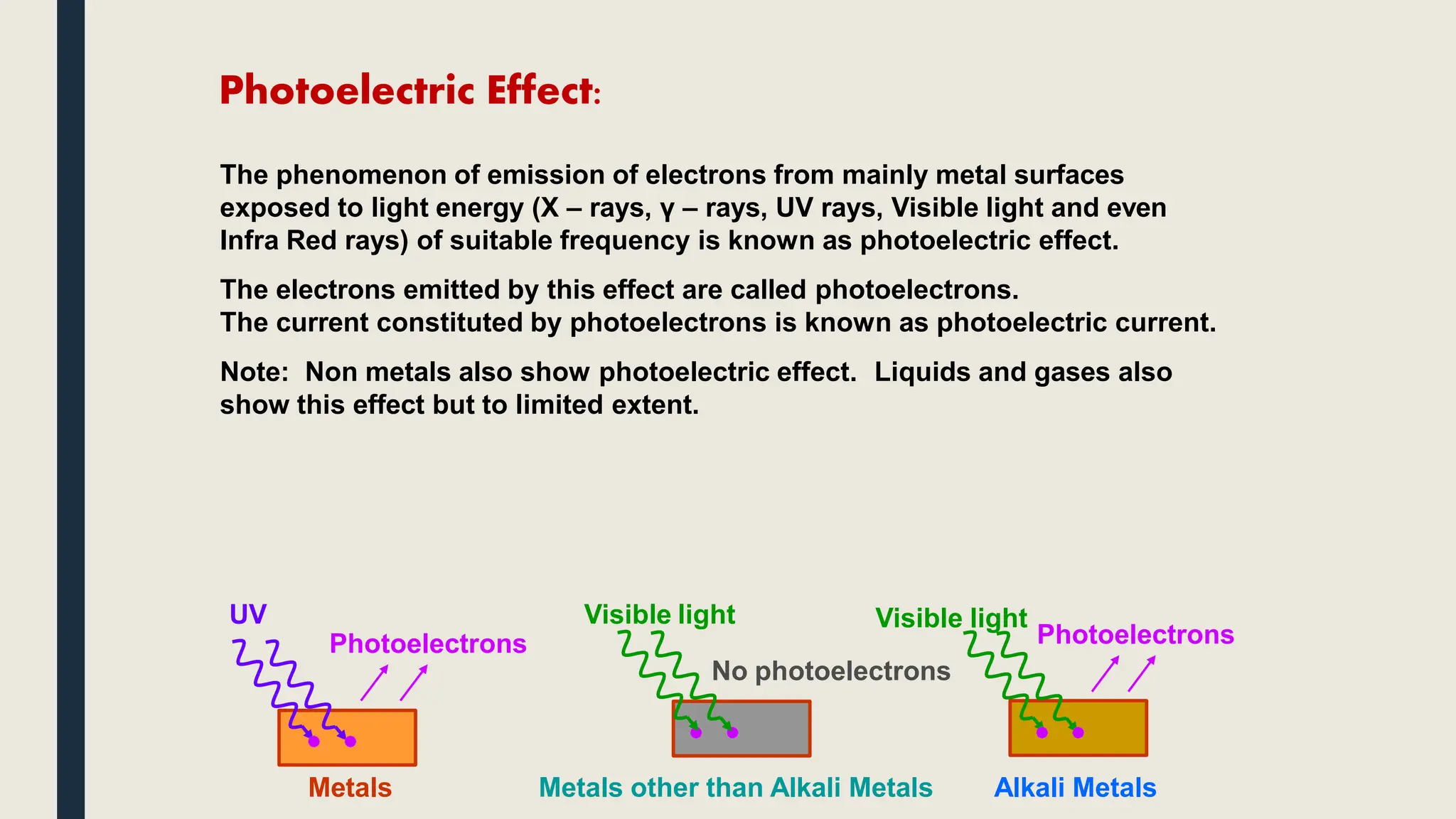
The phenomenon of emission of electrons from mainly metal surfaces
exposed to light energy (X – rays, γ – rays, UV rays, Visible light and even
Infra Red rays) of suitable frequency is known as photoelectric effect.
The electrons emitted by this effect are called photoelectrons.
The current constituted by photoelectrons is known as photoelectric current.
Note: Non metals also show photoelectric effect. Liquids and gases also
show this effect but to limited extent.
Metals Metals other than Alkali Metals Alkali Metals
UV Visible light
No photoelectrons
Photoelectrons
Visible light
Photoelectrons
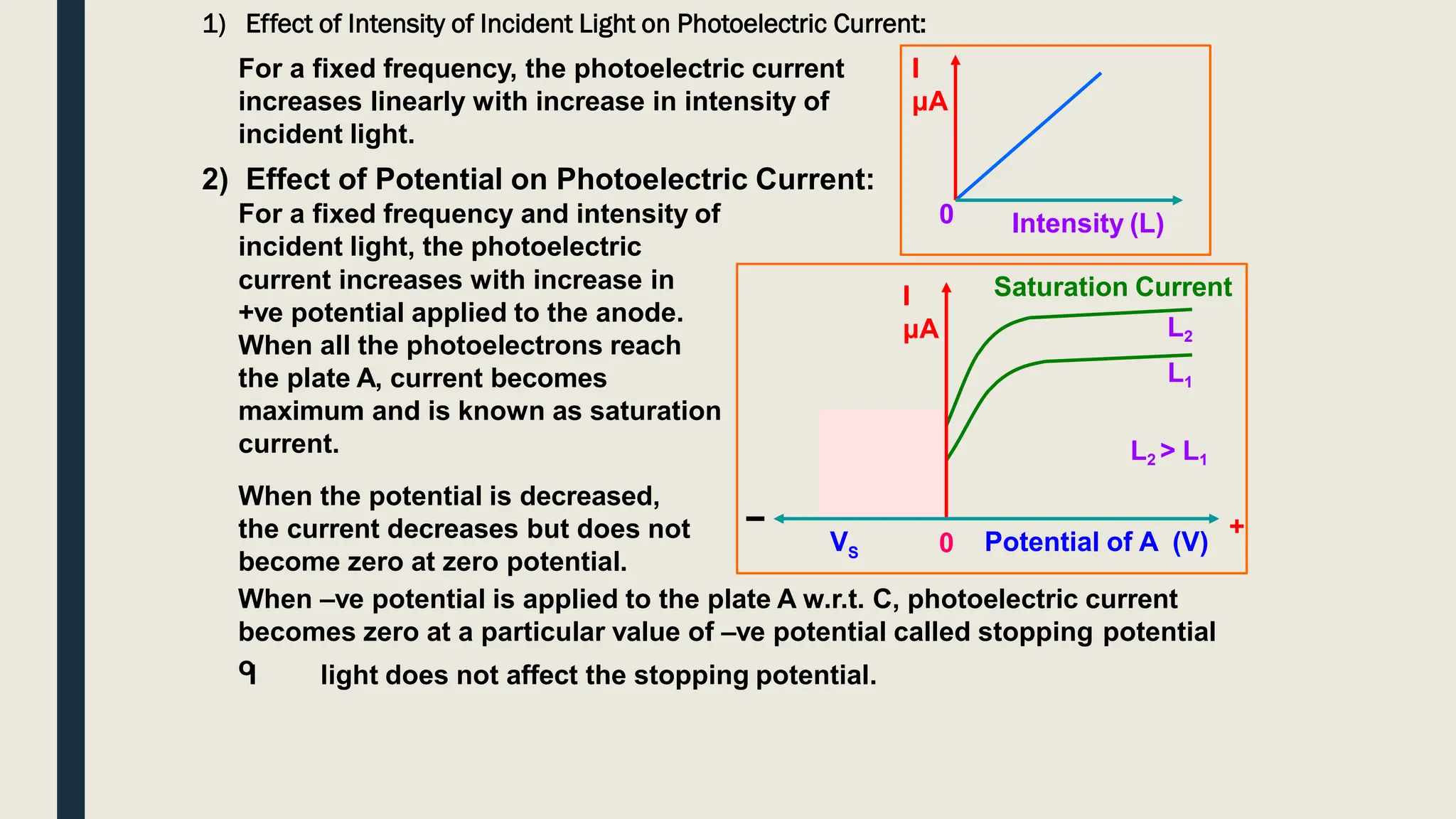
1) Effect of Intensity of Incident Light on Photoelectric Current:
For a fixed frequency, the photoelectric current
increases linearly with increase in intensity of
incident light.
2) Effect of Potential on Photoelectric Current:
For a fixed frequency and intensity of
incident light, the photoelectric
I
μA
Intensity (L)
0
Saturation Current
L2
L1
L2 > L1
current increases with increase in
+ve potential applied to the anode.
When all the photoelectrons reach
the plate A, current becomes
maximum and is known as saturation
current.
When the potential is decreased,
the current decreases but does not
become zero at zero potential.
When –ve potential is applied to the plate A w.r.t. C, photoelectric current
becomes zero at a particular value of –ve potential called stopping potential
o
I light does not affect the stopping potential.
I
μA
V 0 Potential of A (V)
+
S
3) Effect of Frequency of Incident Light on Photoelectric Current:
I
μA
Potential of A (V)
+
Saturation Current
ν
1
ν
2
ν2 > ν1
VS2
VS1 0
For a fixed intensity of incident light, the photoelectric current does not
depend on the frequency of the incident light. Because, the photoelectric
current simply depends on the number of photoelectrons emitted and in turn
on the number of photons incident and not on the energy of photons.
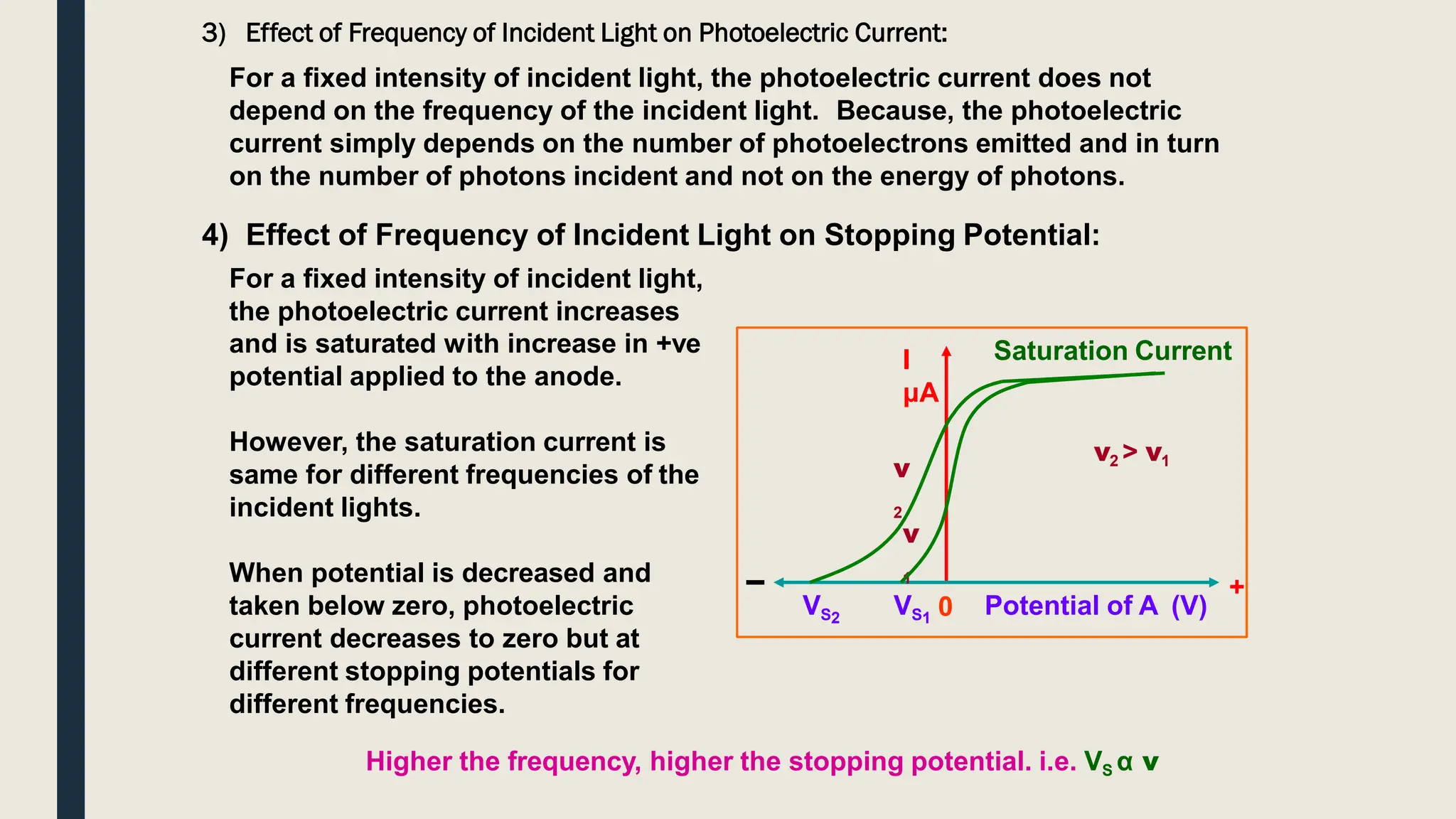
4) Effect of Frequency of Incident Light on Stopping Potential:
For a fixed intensity of incident light,
the photoelectric current increases
and is saturated with increase in +ve
potential applied to the anode.
However, the saturation current is
same for different frequencies of the
incident lights.
When potential is decreased and
taken below zero, photoelectric
current decreases to zero but at
different stopping potentials for
different frequencies.
Higher the frequency, higher the stopping potential. i.e. VS α ν
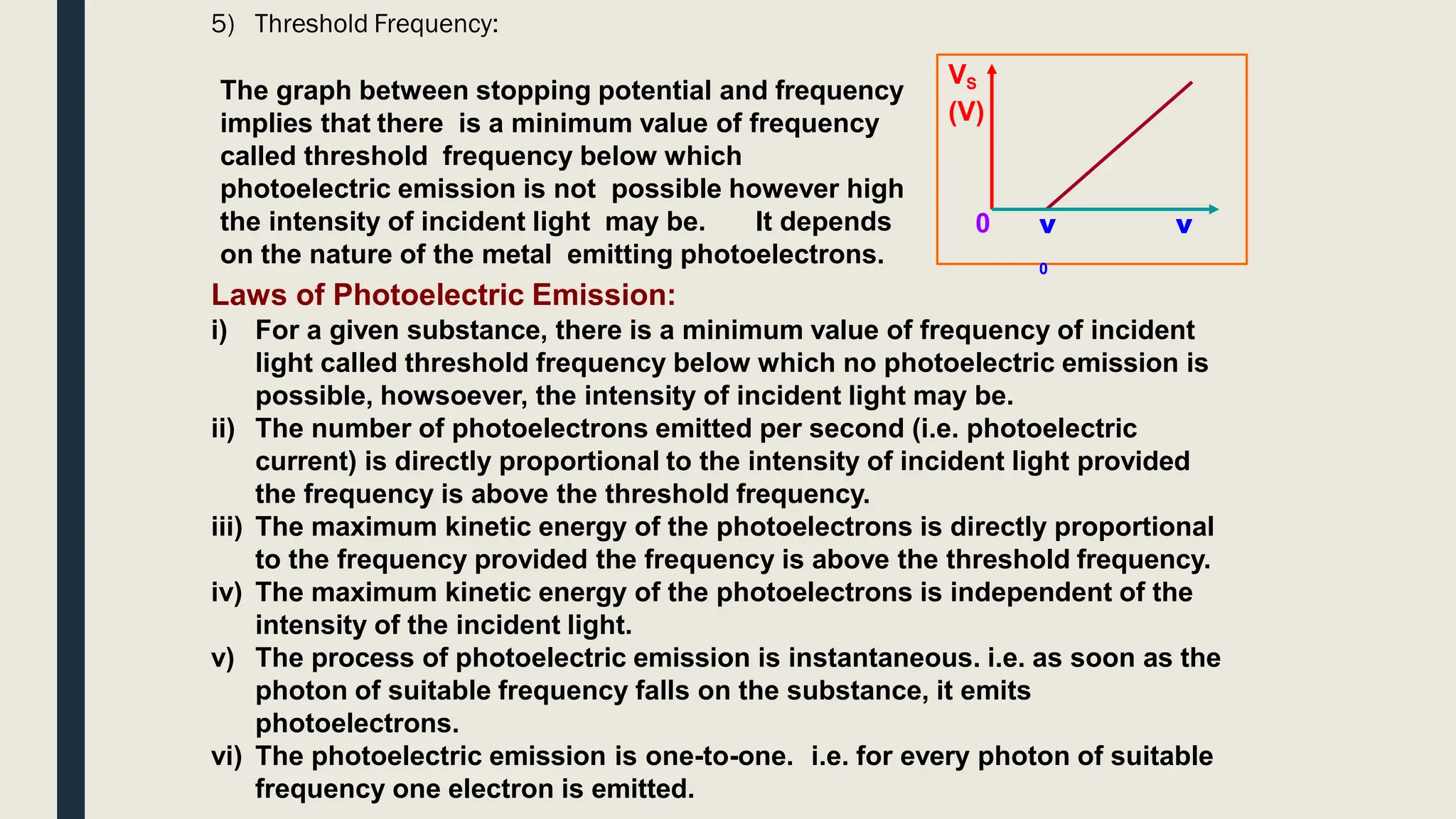
5) Threshold Frequency:
VS
(V)
0 ν
0
ν
i) For a given substance, there is a minimum value of frequency of incident
light called threshold frequency below which no photoelectric emission is
possible, howsoever, the intensity of incident light may be.
ii) The number of photoelectrons emitted per second (i.e. photoelectric
current) is directly proportional to the intensity of incident light provided
the frequency is above the threshold frequency.
iii) The maximum kinetic energy of the photoelectrons is directly proportional
to the frequency provided the frequency is above the threshold frequency.
iv) The maximum kinetic energy of the photoelectrons is independent of the
intensity of the incident light.
v) The process of photoelectric emission is instantaneous. i.e. as soon as the
photon of suitable frequency falls on the substance, it emits
photoelectrons.
vi) The photoelectric emission is one-to-one. i.e. for every photon of suitable
frequency one electron is emitted.
The graph between stopping potential and frequency
implies that there is a minimum value of frequency
called threshold frequency below which
photoelectric emission is not possible however high
the intensity of incident light may be. It depends
on the nature of the metal emitting photoelectrons.
Laws of Photoelectric Emission:
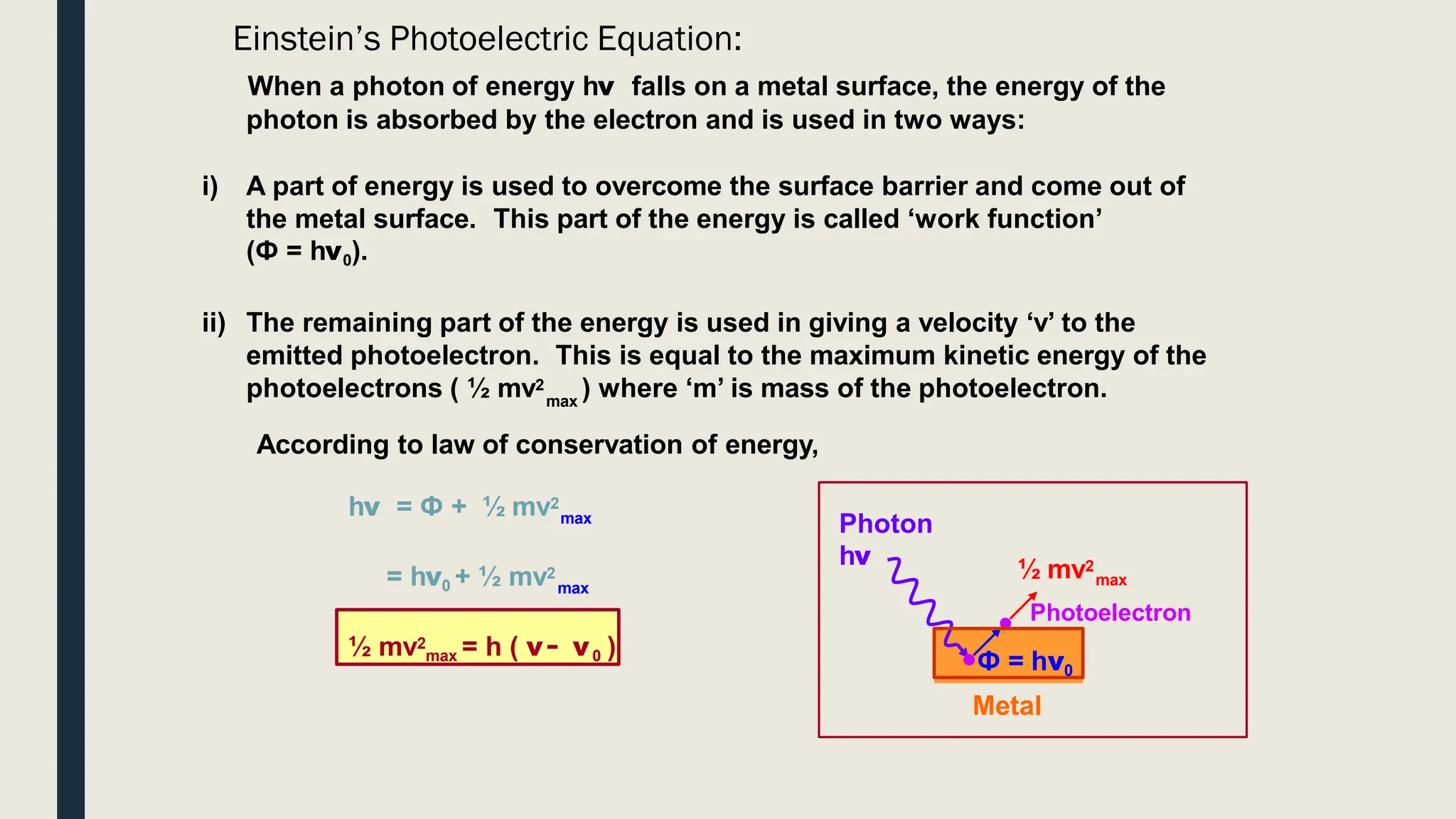
Einstein’s Photoelectric Equation:
Photon
hν
Metal
Photoelectron
When a photon of energy hν falls on a metal surface, the energy of the
photon is absorbed by the electron and is used in two ways:
i) A part of energy is used to overcome the surface barrier and come out of
the metal surface. This part of the energy is called ‘work function’
(Ф = hν0).
ii) The remaining part of the energy is used in giving a velocity ‘v’ to the
emitted photoelectron. This is equal to the maximum kinetic energy of the
photoelectrons ( ½ mv2 ) where ‘m’ is mass of the photoelectron.
max
According to law of conservation of energy,
hν = Ф + ½ mv2
max
= hν0 + ½ mv2
max
½ mv2
max = h ( ν- ν0 )
½ mv2
max
Ф = hν0
Verification of Laws of Photoelectric Emission based on Einstein’s
Photoelectric Equation:
max
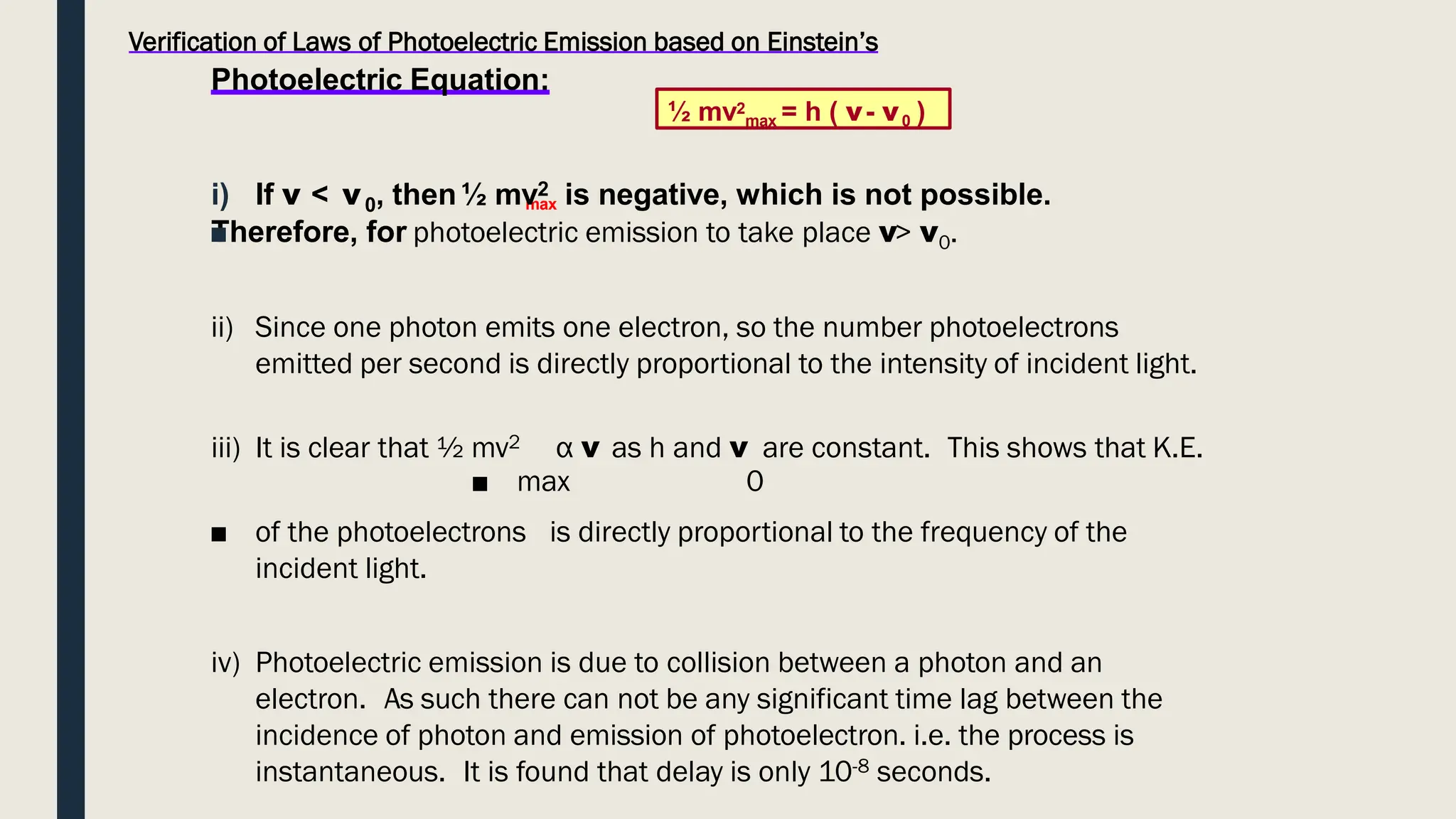
i) If ν < ν0, then½ mv2 is negative, which is not possible.
Therefore, for
■ photoelectric emission to take place ν> ν0.
ii) Since one photon emits one electron, so the number photoelectrons
emitted per second is directly proportional to the intensity of incident light.
iii) It is clear that ½ mv2 α ν as h and ν are constant. This shows that K.E.
■ max 0
■ of the photoelectrons is directly proportional to the frequency of the
incident light.
iv) Photoelectric emission is due to collision between a photon and an
electron. As such there can not be any significant time lag between the
incidence of photon and emission of photoelectron. i.e. the process is
instantaneous. It is found that delay is only 10-8 seconds.
½ mv2
max = h ( ν- ν0 )
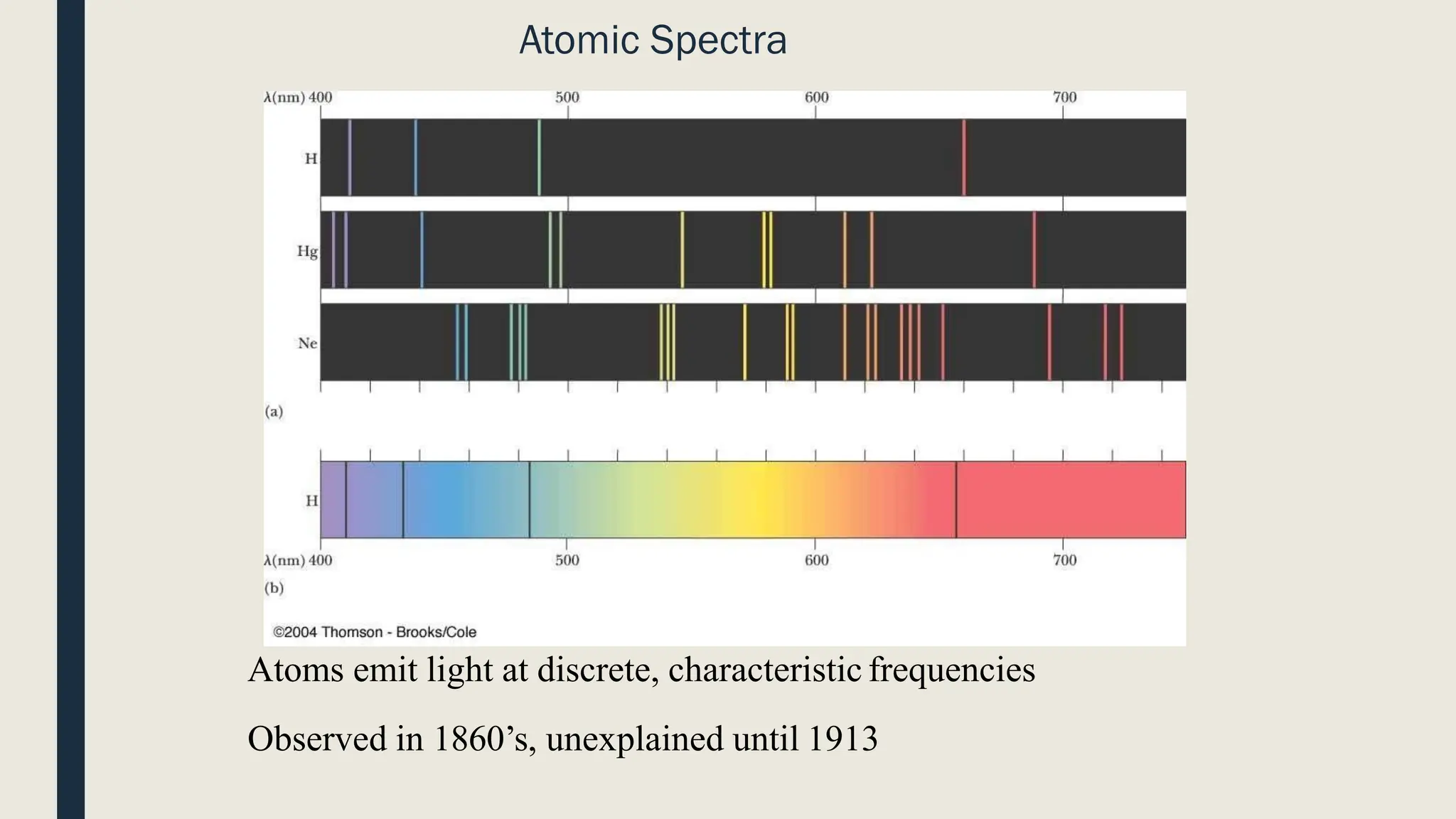
Atomic Spectra
Atoms emit light at discrete, characteristic frequencies
Observed in 1860’s, unexplained until 1913
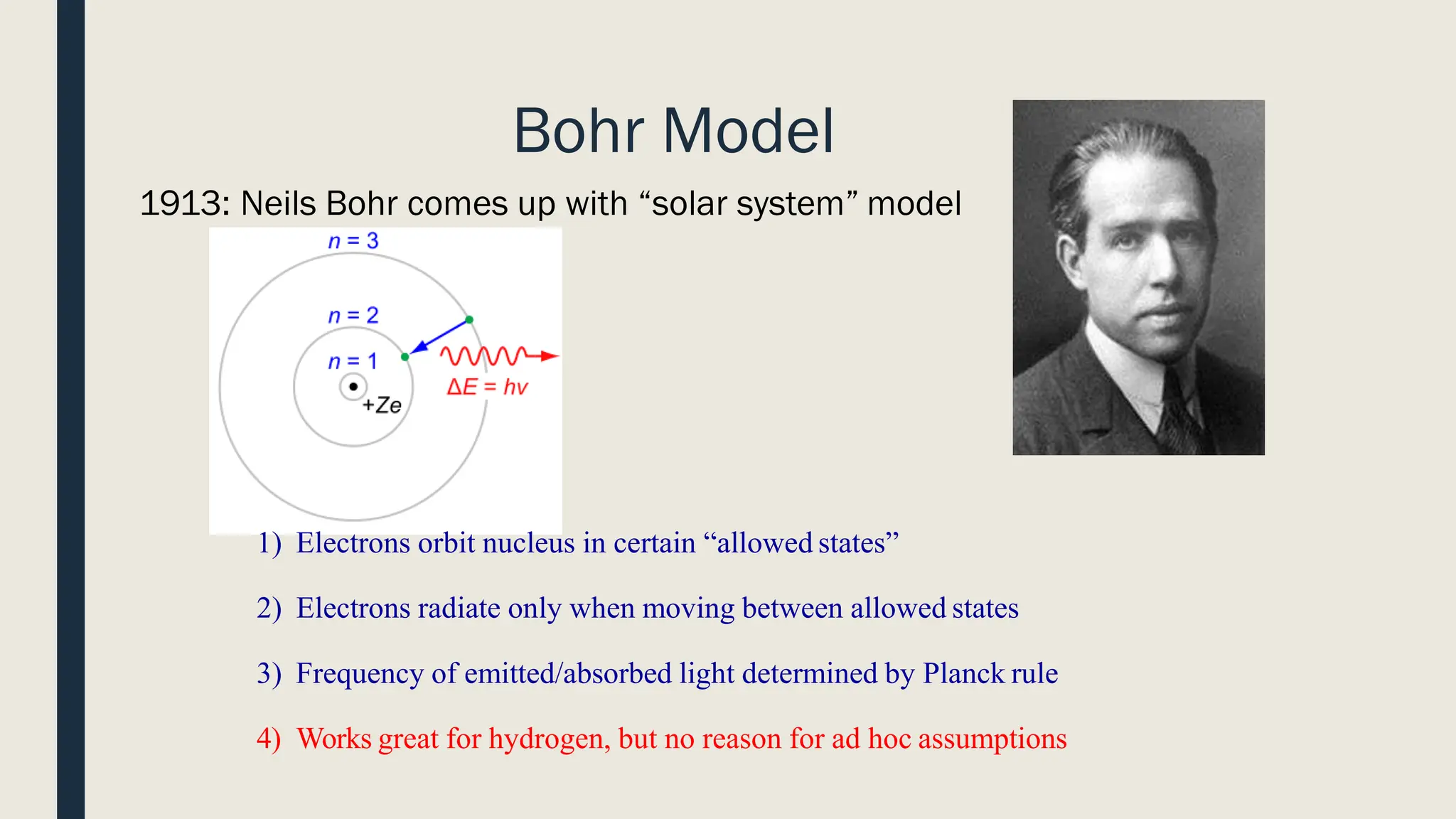
Bohr Model
1913: Neils Bohr comes up with “solar system” model
1) Electrons orbit nucleus in certain “allowed states”
2) Electrons radiate only when moving between allowed states
3) Frequency of emitted/absorbed light determined by Planck rule
4) Works great for hydrogen, but no reason for ad hoc assumptions
Transition from Classical Mechanics to Quantum Mechanics.pdf

  • 1.
    QUANTUM MECHANICS MPHYCC206: Unit1 Lecture 1 TRANSITION FROM CLASSICAL MECHANICS TO QUANTUM MECHANICS.. By Dr. Amrita Assistant Professor Department of Physics Patna Women’s College, Patna University
  • 2.
    CLASSICAL MECHANICS VSQUANTUM MECHANICS ■ Classical mechanics find its origin in early 17th century. Q.M is rather a newer one, postulated in order to solve problems where C.M failed in 20th century. ■ Classical mechanics describes the motion of macroscopic objects and systems ..i.e. it deals with big systems whereas quantum mechanics deals with the microscopic systems of atomic and subatomic regime; the small systems. ■ In C.M we consider the physical quantities as of continuous nature, whereas when we move to subatomic systems, they become quantized.
  • 4.
    SYSTEMS AND OBSERVATION ■In classical systems that we encounter, we can observe the system by fixing a co- ordinate system which may be inertial and non- inertial. The equation of motion formed for the system and solved to obtained the physical quantity. ■ In quantum mechanics , any act of observation creates a disturbance in the system. So, in order to analyse the behaviour of the quantum system, their must be interaction .
  • 5.
    Origin of quantummechanics ■ Quantum Mechanics along with relativity forms the basis of atomic and nuclear physics as well as solid state physics and cosmology. ■ The implications of quantum mechanics solved various phenomenon such as photoelectric effect, blackbody radiation, Compton effect in which the classical theory failed.
  • 6.
    History of QuantumMechanics ■ The foundation stone of q.m was laid to solve the problem of blackbody radiation which was propounded by Max Planck in which quanta was introduced. ■ Einstein brought the quantum theory of photoelectric effect and shown that the photons are responsible for emission of photoelectrons. ■ Planck’s hypothesis and Einstein’s photons fitted well in the Bohr theory of H atom which proved the validity of early quantum theory.
  • 7.
    Quantum Mechanics The other greattheory of modern physics Deals with very small objects ➔ Electrons, atoms, molecules Grew out of problems that seemed simple ➔ Black-body radiation ➔ Photoelectric Effect ➔ Atomic Spectra Produces some very strange results…
  • 8.
    Blackbody Radiation ➢Light emitted byhot object Depends only on temperature Characteristic spectrum of light const T m = 
  • 9.
    Blackbody Radiation ▪When matteris heated, it emits radiation. ▪As T increases, the object becomes red, yellow then white. ▪A blackbody is a perfect absorber as well as a perfect emitter. ▪A practical blackbody is a hollow cavity whose internal walls reflect em radiation and has a hole on one side. Blackbody radiation is theoretically interesting because the radiation properties of the blackbody are independent of the material. The properties of intensity versus wavelength at fixed temperatures is studied.
  • 10.
    Wien’s Displacement Law ▪Theintensity (λ, T) is the total power radiated per unit area per unit wavelength at a given temperature. ▪Wien’s displacement law: The maximum of the distribution shifts to smaller wavelengths as the temperature is increased.
  • 11.
    Stefan-Boltzmann Law ▪The totalpower radiated increases with the temperature: ▪This is known as the Stefan-Boltzmann law, with the constant σ experimentally measured to be 5.6705 × 10⁻⁸ W / (m2· K4). ▪The emissivity є (є = 1 for an idealized blackbody) is simply the ratio of the emissive power of an object to that of an ideal blackbody and is always less than 1.
  • 12.
    Rayleigh-Jeans Formula ▪Lord Rayleigh(John Strutt) and James Jeans used the classical theories of electromagnetism and thermodynamics to show that the blackbody spectral distribution should be ▪It approaches the data at longer wavelengths, but it deviates badly at short wavelengths. This problem for small wavelengths became known as “the ultraviolet catastrophe” and was one of the outstanding exceptions that classical physics could not explain. c3 8f 2 kT u( f ,T) = 1 1  1+ (hf ) −1 c3 kT kT •  exphf −1 c3 u( f ,T) = 8f 3 8f 3 exp(x) ≈ 1 + x for very small x, i.e. when h → 0, d. h. classical physics (also for f small and T large)
  • 13.
    Why the quantumtheory?? ■ Wien’s formula explained why the emissivity decreases as we approach the lower wavelength region. ■ Rayleigh Jean’s considered the electromagnetic nature of radiation and described why emissivity goes on increasing on increasing wavelength. ■ Thus, no theory could explain the radiation over the entire wavelength region. But the experimental observations cannot be discarded, Max Planck put forward the quantum theory.
  • 14.
    ▪Planck assumed thatthe radiation in the cavity was emitted (and absorbed) by some sort of “oscillators” that were contained in the walls. He used Boltzman’s statistical methods to arrive at the following formula that fit the blackbody radiation data. ▪Planck made two modifications to the classical theory:➢The oscillators (of electromagnetic origin) can only have certain discrete energies determined by En= nhf, where n is an integer, f is the frequency, and h is called Planck’s constant. h = 6.6261 × 10⁻³⁴J·s. ➢The oscillators can absorb or emit energy in discrete multiples of the fundamental quantum of energy given by Planck’s Radiation Law Planck’s radiation law He propounded that soon after the emission of radiation in quanta, they spread over the entire wavefront and propagate through the medium.
  • 15.
    Photoelectric Effect Shine light onsome object, electrons come out Discovered by Heinrich Hertz, 1887 Simple model: Shaking electrons Predict: 1) Number of ejected electrons depends on intensity 2) Energy of ejected electrons depends on intensity 3) No obvious dependence on frequency
  • 16.
    Photoelectric Effect: Experiment Observations: 1) Numberof electrons depends on intensity 2) Energy of electrons DOES NOT depend on intensity 3) Cut-off frequency: minimum frequency to get any emission 4) Above cut-off, energy increases linearly with frequency
  • 17.
    Photoelectric Effect: Einstein 4) Abovecut-off, energy increases linearly with frequency Observations: 1) Number of electrons depends on intensity Higher intensity➔ More quanta 2)Energy of electrons DOES NOT depend on intensity Only one photon to eject 3)Cut-off frequency: minimum frequency to get any emission Einstein in 1921 Nobel Prize portrait Cited for PE Effect
  • 18.
    Photon: Energy of aphoton is E = hν = A packet or quanta of energy is called a photon. hc λ where h is the Planck’s constant, νis the frequency of the radiation or photon, c is the speed of light (e.m. wave) and λ is the wavelength. m = E h = p = cλ h λ c2 E c = ■ Properties : i) A photon travels at a speed of light c in vacuum. (i.e. 3 x 10⁻⁸ m/s) ii) It has zero rest mass. i.e. the photon can not exist at rest. iii) The kinetic mass of a photonis, iv) The momentum of a photon is,
  • 19.
    Photon: Properties..contd. v)Photons travelin a straight line. vi) Energy of a photon depends upon frequency of the photon; so the energy of the photon does not change when photon travels from one medium to another. vii)Photons are electrically neutral. viii)Photons may show diffraction under given conditions. ix) Photons are not deviated by magnetic and electric fields.
  • 20.
    Photoelectric Effect: The phenomenonof emission of electrons from mainly metal surfaces exposed to light energy (X – rays, γ – rays, UV rays, Visible light and even Infra Red rays) of suitable frequency is known as photoelectric effect. The electrons emitted by this effect are called photoelectrons. The current constituted by photoelectrons is known as photoelectric current. Note: Non metals also show photoelectric effect. Liquids and gases also show this effect but to limited extent. Metals Metals other than Alkali Metals Alkali Metals UV Visible light No photoelectrons Photoelectrons Visible light Photoelectrons
  • 21.
    1) Effect ofIntensity of Incident Light on Photoelectric Current: For a fixed frequency, the photoelectric current increases linearly with increase in intensity of incident light. 2) Effect of Potential on Photoelectric Current: For a fixed frequency and intensity of incident light, the photoelectric I μA Intensity (L) 0 Saturation Current L2 L1 L2 > L1 current increases with increase in +ve potential applied to the anode. When all the photoelectrons reach the plate A, current becomes maximum and is known as saturation current. When the potential is decreased, the current decreases but does not become zero at zero potential. When –ve potential is applied to the plate A w.r.t. C, photoelectric current becomes zero at a particular value of –ve potential called stopping potential o I light does not affect the stopping potential. I μA V 0 Potential of A (V) + S
  • 22.
    3) Effect ofFrequency of Incident Light on Photoelectric Current: I μA Potential of A (V) + Saturation Current ν 1 ν 2 ν2 > ν1 VS2 VS1 0 For a fixed intensity of incident light, the photoelectric current does not depend on the frequency of the incident light. Because, the photoelectric current simply depends on the number of photoelectrons emitted and in turn on the number of photons incident and not on the energy of photons. 4) Effect of Frequency of Incident Light on Stopping Potential: For a fixed intensity of incident light, the photoelectric current increases and is saturated with increase in +ve potential applied to the anode. However, the saturation current is same for different frequencies of the incident lights. When potential is decreased and taken below zero, photoelectric current decreases to zero but at different stopping potentials for different frequencies. Higher the frequency, higher the stopping potential. i.e. VS α ν
  • 23.
    5) Threshold Frequency: VS (V) 0ν 0 ν i) For a given substance, there is a minimum value of frequency of incident light called threshold frequency below which no photoelectric emission is possible, howsoever, the intensity of incident light may be. ii) The number of photoelectrons emitted per second (i.e. photoelectric current) is directly proportional to the intensity of incident light provided the frequency is above the threshold frequency. iii) The maximum kinetic energy of the photoelectrons is directly proportional to the frequency provided the frequency is above the threshold frequency. iv) The maximum kinetic energy of the photoelectrons is independent of the intensity of the incident light. v) The process of photoelectric emission is instantaneous. i.e. as soon as the photon of suitable frequency falls on the substance, it emits photoelectrons. vi) The photoelectric emission is one-to-one. i.e. for every photon of suitable frequency one electron is emitted. The graph between stopping potential and frequency implies that there is a minimum value of frequency called threshold frequency below which photoelectric emission is not possible however high the intensity of incident light may be. It depends on the nature of the metal emitting photoelectrons. Laws of Photoelectric Emission:
  • 24.
    Einstein’s Photoelectric Equation: Photon hν Metal Photoelectron Whena photon of energy hν falls on a metal surface, the energy of the photon is absorbed by the electron and is used in two ways: i) A part of energy is used to overcome the surface barrier and come out of the metal surface. This part of the energy is called ‘work function’ (Ф = hν0). ii) The remaining part of the energy is used in giving a velocity ‘v’ to the emitted photoelectron. This is equal to the maximum kinetic energy of the photoelectrons ( ½ mv2 ) where ‘m’ is mass of the photoelectron. max According to law of conservation of energy, hν = Ф + ½ mv2 max = hν0 + ½ mv2 max ½ mv2 max = h ( ν- ν0 ) ½ mv2 max Ф = hν0
  • 25.
    Verification of Lawsof Photoelectric Emission based on Einstein’s Photoelectric Equation: max i) If ν < ν0, then½ mv2 is negative, which is not possible. Therefore, for ■ photoelectric emission to take place ν> ν0. ii) Since one photon emits one electron, so the number photoelectrons emitted per second is directly proportional to the intensity of incident light. iii) It is clear that ½ mv2 α ν as h and ν are constant. This shows that K.E. ■ max 0 ■ of the photoelectrons is directly proportional to the frequency of the incident light. iv) Photoelectric emission is due to collision between a photon and an electron. As such there can not be any significant time lag between the incidence of photon and emission of photoelectron. i.e. the process is instantaneous. It is found that delay is only 10-8 seconds. ½ mv2 max = h ( ν- ν0 )
  • 26.
    Atomic Spectra Atoms emitlight at discrete, characteristic frequencies Observed in 1860’s, unexplained until 1913
  • 27.
    Bohr Model 1913: NeilsBohr comes up with “solar system” model 1) Electrons orbit nucleus in certain “allowed states” 2) Electrons radiate only when moving between allowed states 3) Frequency of emitted/absorbed light determined by Planck rule 4) Works great for hydrogen, but no reason for ad hoc assumptions