PRESENTATION BY:
SANDEEP SAIKIA: A4450917004
TRILOK SHARMA: A4450917046
MANJEET SINGH: A4450917049
RAGHVENDRA : A4450917037
AARYAN TYAGI: A4450917077
M.SC. APPLIED CHEMISTRY
WHAT IS A LASER?
 Laser is a powerful source of light having extraordinary
properties which are not found in the normal light sources.
 The unique property of laser is that its light waves travel very
long distances with a very little divergence.
 Laser is an acronym for ‘light amplification by stimulated
emission of radiation’.
 Theodore Maiman invented the world’s first laser, known as
‘ruby laser’.
PROPERTIES OF LASER
 The light emitted from a laser is monochromatic. It is of one
colour /wavelength.
 Lasers emit light that is highly directional, that is, laser light is
emitted as a relatively narrow beam in a specific direction.
 The light from a laser is said to be coherent, which means
that the wavelength of the laser light are in phase in space
and time.
Basic concepts for a laser
 Absorption
 Spontaneous emission
 Stimulated emission
 Population inversion
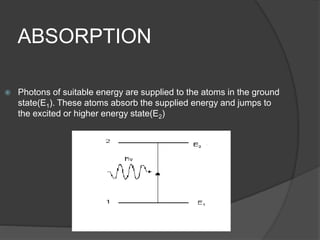
ABSORPTION
 Photons of suitable energy are supplied to the atoms in the ground
state(E1). These atoms absorb the supplied energy and jumps to
the excited or higher energy state(E2)
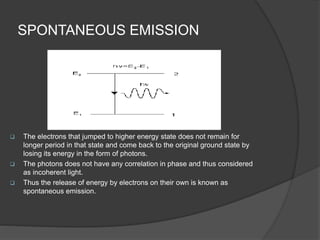
SPONTANEOUS EMISSION
 The electrons that jumped to higher energy state does not remain for
longer period in that state and come back to the original ground state by
losing its energy in the form of photons.
 The photons does not have any correlation in phase and thus considered
as incoherent light.
 Thus the release of energy by electrons on their own is known as
spontaneous emission.
STIMULATED EMISSION
 When photons of suitable energy is showered (made to fall) in an
excited atom in the higher energy state(E2),the atoms falls back to
the ground state (E1) by emitting a photons of energy which is in
phase with the stimulating (incident) photon.
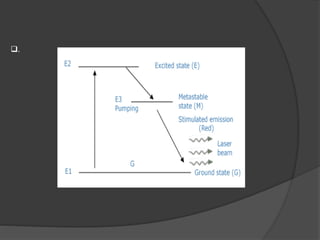
 The higher state must be a metastable state – a state in which the
electrons remain longer than usual so that the transition to the
lower state occurs by stimulated emission rather than
spontaneously.
 Coherent beam of light is obtained due to stimulated emission of
photons from the atoms jumping from meta stable state to lower
energy state.
.
POPULATION INVERSION
 Population inversion occurs when system (such as a group of
atoms or molecules) exists in a state with more members in an
excited state than in lower energy state.
 The concept is of fundamental importance in laser science because
the production of population inversion is a necessary step in the
working of a standard laser.
 The process of producing a population inversion is called pumping.
Components, Construction and
working of LASER:
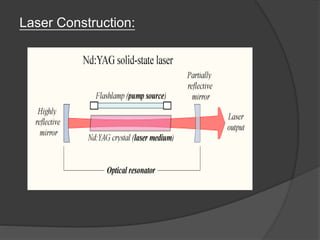
Components of a LASER:
 A pump source.
 A gain medium or laser medium.
 Mirrors forming an optical resonator.
Pump Source:
 Provides energy to the laser system
 Examples: electrical discharges, flashlamps,
arc lamps and chemical reactions.
 The type of pump source used depends on
the gain medium.
→A helium-neon (He-Ne) laser uses an
electrical discharge in the helium-neon
gas mixture.
→Excimer lasers use a chemical reaction.
Gain Medium:
 Major determining factor of the
wavelength of operation of the laser.
 Excited by the pump source to produce
a population inversion.
 Where spontaneous and stimulated
emission of photons takes place.
 Examples:
solid, liquid, gas and semiconductor.
Optical Resonator
 Two parallel mirrors placed around the gain
medium.
 Light is reflected by the mirrors back into the
medium and is amplified.
 The design and alignment of the mirrors with
respect to the medium is crucial.
 Spinning mirrors, modulators, filters and
absorbers may be added to produce a
variety of effects on the laser output.
Laser Construction:
TYPES OF LASERS:
 Solid State Laser-
In this kind of Lasers solid state, materials
are used as active medium. The solid state
materials can be ruby, neodymium-YAG
(yttrium aluminum garnet) etc.
 Gas Laser-
These Lasers contain a mixture of helium
and Neon. This mixture is packed up into a
glass tube. It acts as active medium. We
can use Argon or Krypton or Xenon as the
medium. CO2 and Nitrogen LASER can
also be made.
CONTINUED….
 Dye or Liquid Lasers-
In this kind of Lasers organic dyes like
Rhodamine 6G in liquid solution or
suspension used as active medium inside
the glass tube.
 Excimer Lasers-
Excimer Lasers (the name came from
excited and dimers) use reactive gases like
Chlorine and fluorine mixed with inert
gases like Argon or Krypton or Xenon.
These LASERs produce light in the
ultraviolet range.
CONTINUED….
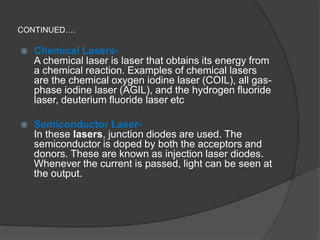
 Chemical Lasers-
A chemical laser is laser that obtains its energy from
a chemical reaction. Examples of chemical lasers
are the chemical oxygen iodine laser (COIL), all gas-
phase iodine laser (AGIL), and the hydrogen fluoride
laser, deuterium fluoride laser etc
 Semiconductor Laser-
In these lasers, junction diodes are used. The
semiconductor is doped by both the acceptors and
donors. These are known as injection laser diodes.
Whenever the current is passed, light can be seen at
the output.
APPLICATIONS OF
LASER:
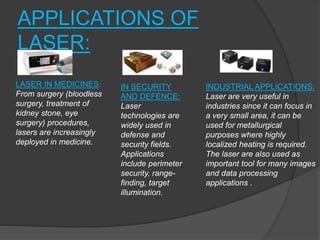
LASER IN MEDICINES:
From surgery (bloodless
surgery, treatment of
kidney stone, eye
surgery) procedures,
lasers are increasingly
deployed in medicine.
IN SECURITY
AND DEFENCE:
Laser
technologies are
widely used in
defense and
security fields.
Applications
include perimeter
security, range-
finding, target
illumination.
INDUSTRIAL APPLICATIONS:
Laser are very useful in
industries since it can focus in
a very small area, it can be
used for metallurgical
purposes where highly
localized heating is required.
The laser are also used as
important tool for many images
and data processing
applications .
CONTINUED….
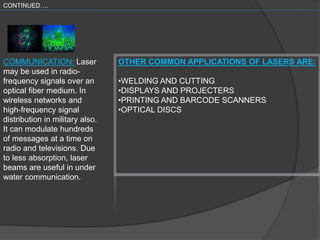
COMMUNICATION: Laser
may be used in radio-
frequency signals over an
optical fiber medium. In
wireless networks and
high-frequency signal
distribution in military also.
It can modulate hundreds
of messages at a time on
radio and televisions. Due
to less absorption, laser
beams are useful in under
water communication.
OTHER COMMON APPLICATIONS OF LASERS ARE:
•WELDING AND CUTTING
•DISPLAYS AND PROJECTERS
•PRINTING AND BARCODE SCANNERS
•OPTICAL DISCS

Laser ppt.

  • 2.
    PRESENTATION BY: SANDEEP SAIKIA:A4450917004 TRILOK SHARMA: A4450917046 MANJEET SINGH: A4450917049 RAGHVENDRA : A4450917037 AARYAN TYAGI: A4450917077 M.SC. APPLIED CHEMISTRY
  • 3.
    WHAT IS ALASER?  Laser is a powerful source of light having extraordinary properties which are not found in the normal light sources.  The unique property of laser is that its light waves travel very long distances with a very little divergence.  Laser is an acronym for ‘light amplification by stimulated emission of radiation’.  Theodore Maiman invented the world’s first laser, known as ‘ruby laser’.
  • 4.
    PROPERTIES OF LASER The light emitted from a laser is monochromatic. It is of one colour /wavelength.  Lasers emit light that is highly directional, that is, laser light is emitted as a relatively narrow beam in a specific direction.  The light from a laser is said to be coherent, which means that the wavelength of the laser light are in phase in space and time.
  • 5.
    Basic concepts fora laser  Absorption  Spontaneous emission  Stimulated emission  Population inversion
  • 6.
    ABSORPTION  Photons ofsuitable energy are supplied to the atoms in the ground state(E1). These atoms absorb the supplied energy and jumps to the excited or higher energy state(E2)
  • 7.
    SPONTANEOUS EMISSION  Theelectrons that jumped to higher energy state does not remain for longer period in that state and come back to the original ground state by losing its energy in the form of photons.  The photons does not have any correlation in phase and thus considered as incoherent light.  Thus the release of energy by electrons on their own is known as spontaneous emission.
  • 8.
    STIMULATED EMISSION  Whenphotons of suitable energy is showered (made to fall) in an excited atom in the higher energy state(E2),the atoms falls back to the ground state (E1) by emitting a photons of energy which is in phase with the stimulating (incident) photon.  The higher state must be a metastable state – a state in which the electrons remain longer than usual so that the transition to the lower state occurs by stimulated emission rather than spontaneously.  Coherent beam of light is obtained due to stimulated emission of photons from the atoms jumping from meta stable state to lower energy state.
  • 9.
  • 10.
    POPULATION INVERSION  Populationinversion occurs when system (such as a group of atoms or molecules) exists in a state with more members in an excited state than in lower energy state.  The concept is of fundamental importance in laser science because the production of population inversion is a necessary step in the working of a standard laser.  The process of producing a population inversion is called pumping.
  • 11.
    Components, Construction and workingof LASER: Components of a LASER:  A pump source.  A gain medium or laser medium.  Mirrors forming an optical resonator.
  • 12.
    Pump Source:  Providesenergy to the laser system  Examples: electrical discharges, flashlamps, arc lamps and chemical reactions.  The type of pump source used depends on the gain medium. →A helium-neon (He-Ne) laser uses an electrical discharge in the helium-neon gas mixture. →Excimer lasers use a chemical reaction.
  • 13.
    Gain Medium:  Majordetermining factor of the wavelength of operation of the laser.  Excited by the pump source to produce a population inversion.  Where spontaneous and stimulated emission of photons takes place.  Examples: solid, liquid, gas and semiconductor.
  • 14.
    Optical Resonator  Twoparallel mirrors placed around the gain medium.  Light is reflected by the mirrors back into the medium and is amplified.  The design and alignment of the mirrors with respect to the medium is crucial.  Spinning mirrors, modulators, filters and absorbers may be added to produce a variety of effects on the laser output.
  • 15.
  • 17.
    TYPES OF LASERS: Solid State Laser- In this kind of Lasers solid state, materials are used as active medium. The solid state materials can be ruby, neodymium-YAG (yttrium aluminum garnet) etc.  Gas Laser- These Lasers contain a mixture of helium and Neon. This mixture is packed up into a glass tube. It acts as active medium. We can use Argon or Krypton or Xenon as the medium. CO2 and Nitrogen LASER can also be made.
  • 18.
    CONTINUED….  Dye orLiquid Lasers- In this kind of Lasers organic dyes like Rhodamine 6G in liquid solution or suspension used as active medium inside the glass tube.  Excimer Lasers- Excimer Lasers (the name came from excited and dimers) use reactive gases like Chlorine and fluorine mixed with inert gases like Argon or Krypton or Xenon. These LASERs produce light in the ultraviolet range.
  • 19.
    CONTINUED….  Chemical Lasers- Achemical laser is laser that obtains its energy from a chemical reaction. Examples of chemical lasers are the chemical oxygen iodine laser (COIL), all gas- phase iodine laser (AGIL), and the hydrogen fluoride laser, deuterium fluoride laser etc  Semiconductor Laser- In these lasers, junction diodes are used. The semiconductor is doped by both the acceptors and donors. These are known as injection laser diodes. Whenever the current is passed, light can be seen at the output.
  • 20.
    APPLICATIONS OF LASER: LASER INMEDICINES: From surgery (bloodless surgery, treatment of kidney stone, eye surgery) procedures, lasers are increasingly deployed in medicine. IN SECURITY AND DEFENCE: Laser technologies are widely used in defense and security fields. Applications include perimeter security, range- finding, target illumination. INDUSTRIAL APPLICATIONS: Laser are very useful in industries since it can focus in a very small area, it can be used for metallurgical purposes where highly localized heating is required. The laser are also used as important tool for many images and data processing applications .
  • 21.
    CONTINUED…. COMMUNICATION: Laser may beused in radio- frequency signals over an optical fiber medium. In wireless networks and high-frequency signal distribution in military also. It can modulate hundreds of messages at a time on radio and televisions. Due to less absorption, laser beams are useful in under water communication. OTHER COMMON APPLICATIONS OF LASERS ARE: •WELDING AND CUTTING •DISPLAYS AND PROJECTERS •PRINTING AND BARCODE SCANNERS •OPTICAL DISCS