Heat, Light and Sound 
Sarah Jones 
news.softpedia.com
Heat 
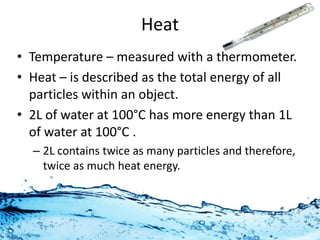
• Temperature – measured with a thermometer. 
• Heat – is described as the total energy of all 
particles within an object. 
• 2L of water at 100°C has more energy than 1L 
of water at 100°C . It has twice as many 
particles and therefore, twice as much heat 
energy.
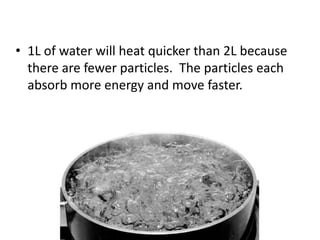
1L of water will heat quicker than 2L because 
there are fewer particles. The particles each 
absorb more energy and move faster.
Temperature 
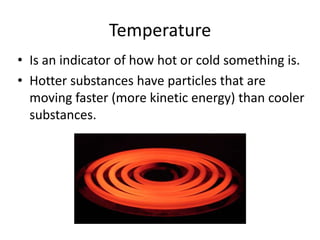
• Is an indicator of how hot or cold something is. 
• Hotter substances have particles that are 
moving faster (more kinetic energy) than cooler 
substances. 
allisonarchived.com
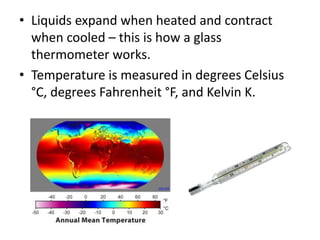
• Liquids expand when heated and contract 
when cooled – this is how a glass 
thermometer works. 
• Temperature is measured in degrees Celsius 
°C, degrees Fahrenheit °F, and Kelvin K. 
cnx.org
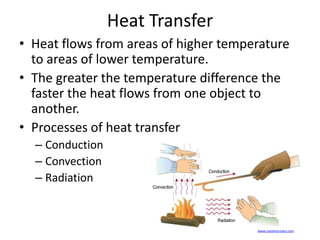
Heat Transfer 
• Heat flows from areas of higher temperature 
to areas of lower temperature. 
• The greater the temperature difference the 
faster the heat flows from one object to 
another. 
www.roasterproject.com
Conduction 
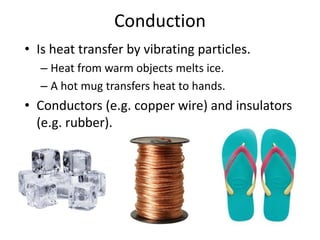
• Is heat transfer by vibrating particles. 
– Heat from warm objects melts ice. 
– A hot mug transfers heat to hands. 
• Conductors (e.g. copper wire) and insulators 
(e.g. rubber).
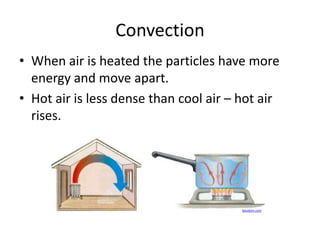
Convection 
• When air is heated the particles have more 
energy and move apart. 
• Hot air is less dense than cool air – hot air 
rises. 
beodom.com
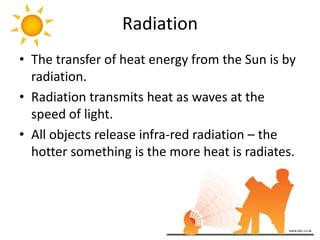
Radiation 
• The transfer of heat energy from the Sun is by 
radiation. 
• Radiation transmits heat as waves at the 
speed of light. 
• All objects release infra-red radiation – the 
hotter something is the more heat is radiates. 
www.bbc.co.uk
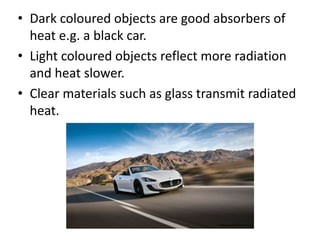
• Dark coloured objects are good absorbers of 
heat e.g. a black car. 
• Light coloured objects reflect more radiation 
and heat slower. 
• Clear materials such as glass transmit radiated 
heat. 
www.widewallz.comm
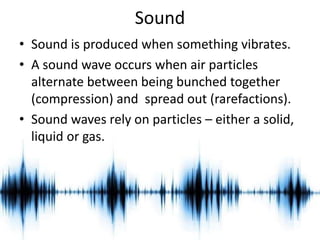
Sound 
• Sound is produced when something vibrates. 
• A sound wave occurs when air particles 
alternate between being bunched together 
(compression) and spread out (rarefactions). 
• Sound waves rely on particles – either a solid, 
liquid or gas.
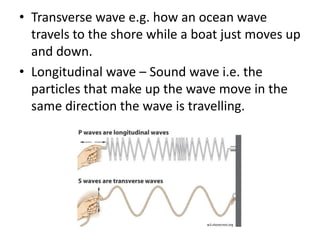
• Transverse wave e.g. how an ocean wave 
travels to the shore while a boat just moves up 
and down. 
• Longitudinal wave – Sound wave i.e. the 
particles that make up the wave move in the 
same direction the wave is travelling. 
w3.shorecrest.org
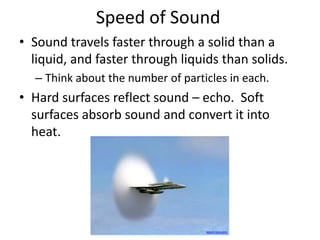
Speed of Sound 
• Sound travels faster through a solid than a 
liquid, and faster through liquids than gases. 
– Think about the number of particles in each. 
• Hard surfaces reflect sound – echo. Soft 
surfaces absorb sound and convert it into 
heat. 
apod.nasa.gov
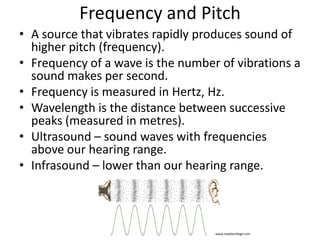
Frequency and Pitch 
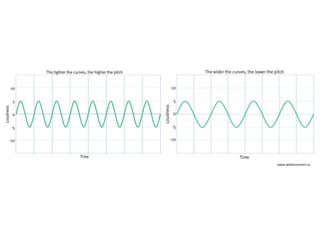
• A source that vibrates rapidly produces sound 
of higher pitch (frequency). 
• Frequency of a wave is the number of 
vibrations a sound makes per second. 
• Frequency is measured in Hertz, Hz. 
www.mediacollege.com
• Wavelength is the distance between 
successive peaks (measured in metres). 
• Ultrasound – sound waves with frequencies 
above our hearing range. 
• Infrasound – lower than our hearing range. 
www.widexconnect.ca
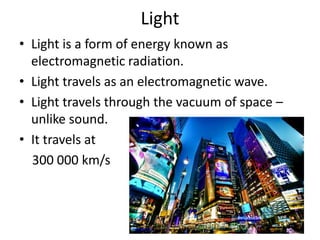
Light 
• Light is a form of energy known as 
electromagnetic radiation. 
• Light travels as an electromagnetic wave. 
• Light travels through the vacuum of space – 
unlike sound. 
• It travels at 
300 000 km/s 
thejetlife.com
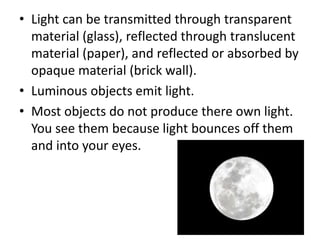
• Light can be transmitted through transparent 
material (glass), reflected through translucent 
material (paper), and reflected or absorbed by 
opaque material (brick wall). 
• Luminous objects emit light.
Most objects do not produce there own light. 
You see them because light bounces off them 
and into your eyes. 
www.universetoday.com
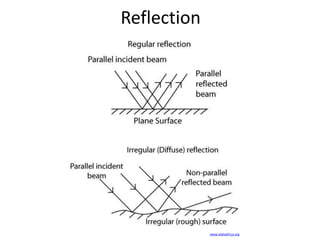
Reflection 
www.elateafrica.org
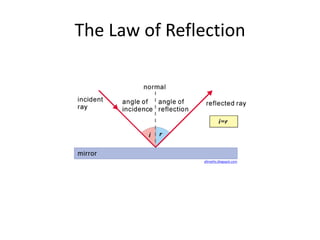
The Law of Reflection 
allmaths.blogspot.com
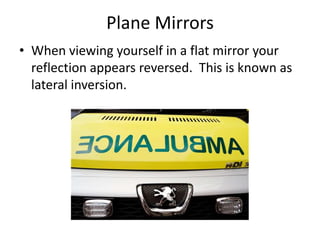
Plane Mirrors 
When viewing yourself in a flat mirror your 
reflection appears reversed. This is known as 
lateral inversion. 
www.telegraph.co.uk
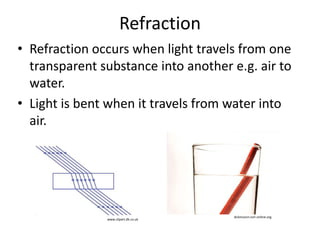
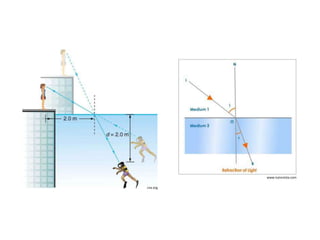
Refraction 
• Refraction occurs when light travels from one 
transparent substance into another e.g. air to 
water. 
• Light is bent when it travels from water into 
air. 
www.clipart.dk.co.uk 
dickinsonn.ism-online.org
cnx.org 
www.tutorvista.com
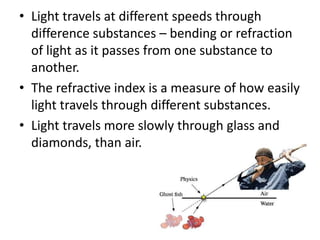
• Light travels at different speeds through 
difference substances – bending or refraction 
of light as it passes from one substance to 
another. 
• The refractive index is a measure of how easily 
light travels through different substances. 
• Light travels more slowly through glass and 
diamonds, than air.
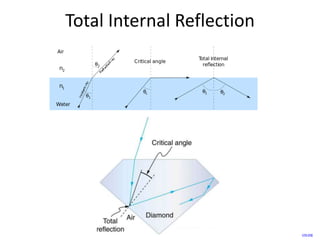
Total Internal Reflection 
cnx.org
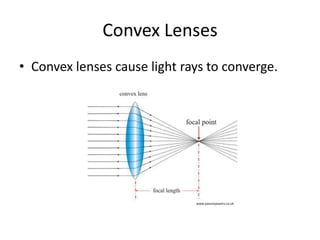
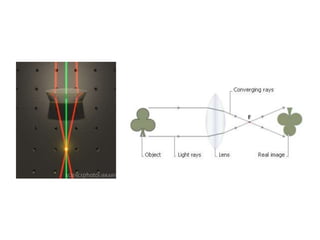
Convex Lenses 
Convex lenses cause light rays to converge. 
www.passmyexams.co.uk
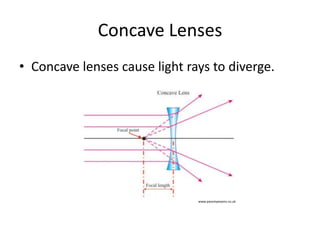
Concave Lenses 
Concave lenses cause light rays to diverge. 
www.passmyexams.co.uk
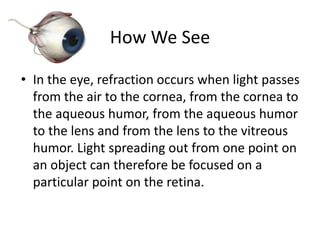
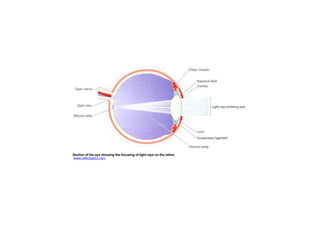
How We See 
In the eye, refraction occurs when light passes 
from the air to the cornea, from the cornea to 
the aqueous humor, from the aqueous humor to 
the lens and from the lens to the vitreous 
humor. Light spreading out from one point on an 
object can therefore be focused on a particular 
point on the retina.
www.selectspecs.com
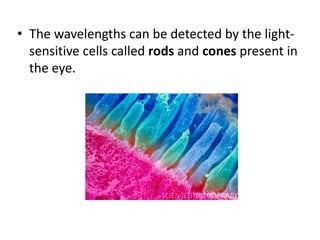
The wavelengths can be detected by the light-sensitive 
cells called rods and cones present in 
the eye.
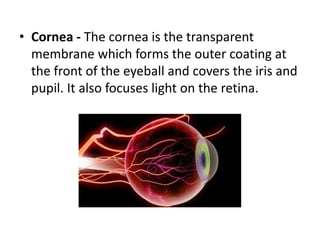
Cornea - The cornea is the transparent 
membrane which forms the outer coating at the 
front of the eyeball and covers the iris and pupil. 
It also focuses light on the retina. 
www.sciencephoto.com
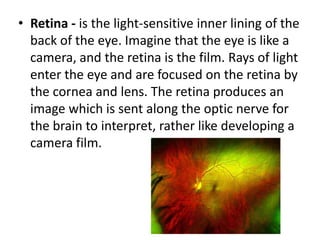
Retina - is the light-sensitive inner lining of the 
back of the eye. Rays of light enter the eye and 
are focused on the retina by the cornea and 
lens. The retina produces an image which is sent 
along the optic nerve for the brain to interpret.
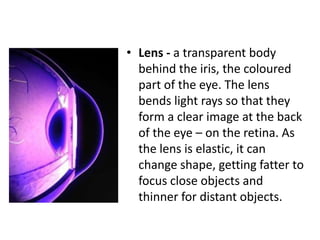
Lens - a transparent body 
behind the iris. The lens 
bends light rays so that they 
form a clear image at the 
back of the eye – on the 
retina. As the lens is elastic, 
it can change shape, getting 
fatter to focus close objects 
and thinner for distant 
objects.
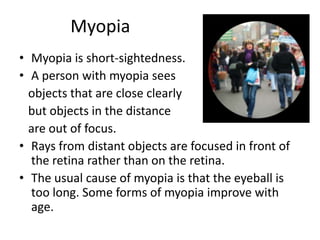
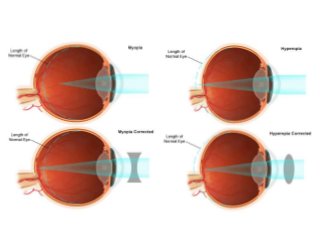
Myopia 
• Short-sightedness 
• See objects that are close clearly but objects 
in the distance are out of focus. 
fromdoctor.com
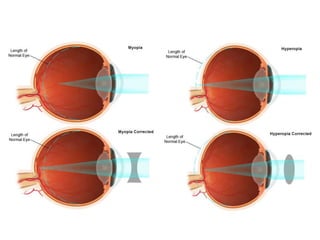
• Rays from distant objects are focused in front 
of the retina rather than on the retina. 
• The usual cause of myopia is that the eyeball 
is too long. Some forms of myopia improve 
with age. 
www.eyetalkonline.com
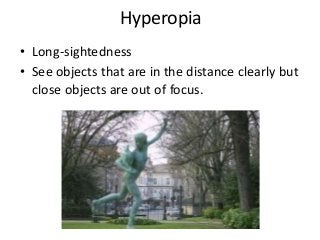
Hyperopia 
• Long-sightedness 
• See objects that are in the distance clearly but 
close objects are out of focus.
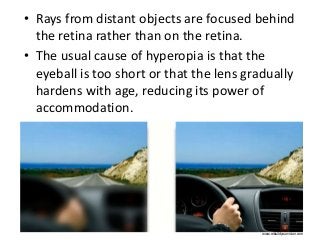
• Rays from distant objects are focused behind 
the retina rather than on the retina. 
• The usual cause of hyperopia is that the 
eyeball is too short or that the lens gradually 
hardens with age, reducing its power of 
accommodation. 
www.rebuildyourvision.com
Heat, Light and Sound

Heat, Light and Sound

  • 1.
    Heat, Light andSound Sarah Jones news.softpedia.com
  • 2.
    Heat • Temperature– measured with a thermometer. • Heat – is described as the total energy of all particles within an object. • 2L of water at 100°C has more energy than 1L of water at 100°C . It has twice as many particles and therefore, twice as much heat energy.
  • 3.
    1L of waterwill heat quicker than 2L because there are fewer particles. The particles each absorb more energy and move faster.
  • 4.
    Temperature • Isan indicator of how hot or cold something is. • Hotter substances have particles that are moving faster (more kinetic energy) than cooler substances. allisonarchived.com
  • 5.
    • Liquids expandwhen heated and contract when cooled – this is how a glass thermometer works. • Temperature is measured in degrees Celsius °C, degrees Fahrenheit °F, and Kelvin K. cnx.org
  • 6.
    Heat Transfer •Heat flows from areas of higher temperature to areas of lower temperature. • The greater the temperature difference the faster the heat flows from one object to another. www.roasterproject.com
  • 7.
    Conduction • Isheat transfer by vibrating particles. – Heat from warm objects melts ice. – A hot mug transfers heat to hands. • Conductors (e.g. copper wire) and insulators (e.g. rubber).
  • 8.
    Convection • Whenair is heated the particles have more energy and move apart. • Hot air is less dense than cool air – hot air rises. beodom.com
  • 9.
    Radiation • Thetransfer of heat energy from the Sun is by radiation. • Radiation transmits heat as waves at the speed of light. • All objects release infra-red radiation – the hotter something is the more heat is radiates. www.bbc.co.uk
  • 10.
    • Dark colouredobjects are good absorbers of heat e.g. a black car. • Light coloured objects reflect more radiation and heat slower. • Clear materials such as glass transmit radiated heat. www.widewallz.comm
  • 11.
    Sound • Soundis produced when something vibrates. • A sound wave occurs when air particles alternate between being bunched together (compression) and spread out (rarefactions). • Sound waves rely on particles – either a solid, liquid or gas.
  • 12.
    • Transverse wavee.g. how an ocean wave travels to the shore while a boat just moves up and down. • Longitudinal wave – Sound wave i.e. the particles that make up the wave move in the same direction the wave is travelling. w3.shorecrest.org
  • 13.
    Speed of Sound • Sound travels faster through a solid than a liquid, and faster through liquids than gases. – Think about the number of particles in each. • Hard surfaces reflect sound – echo. Soft surfaces absorb sound and convert it into heat. apod.nasa.gov
  • 14.
    Frequency and Pitch • A source that vibrates rapidly produces sound of higher pitch (frequency). • Frequency of a wave is the number of vibrations a sound makes per second. • Frequency is measured in Hertz, Hz. www.mediacollege.com
  • 15.
    • Wavelength isthe distance between successive peaks (measured in metres). • Ultrasound – sound waves with frequencies above our hearing range. • Infrasound – lower than our hearing range. www.widexconnect.ca
  • 16.
    Light • Lightis a form of energy known as electromagnetic radiation. • Light travels as an electromagnetic wave. • Light travels through the vacuum of space – unlike sound. • It travels at 300 000 km/s thejetlife.com
  • 17.
    • Light canbe transmitted through transparent material (glass), reflected through translucent material (paper), and reflected or absorbed by opaque material (brick wall). • Luminous objects emit light.
  • 18.
    Most objects donot produce there own light. You see them because light bounces off them and into your eyes. www.universetoday.com
  • 19.
  • 20.
    The Law ofReflection allmaths.blogspot.com
  • 21.
    Plane Mirrors Whenviewing yourself in a flat mirror your reflection appears reversed. This is known as lateral inversion. www.telegraph.co.uk
  • 22.
    Refraction • Refractionoccurs when light travels from one transparent substance into another e.g. air to water. • Light is bent when it travels from water into air. www.clipart.dk.co.uk dickinsonn.ism-online.org
  • 23.
  • 24.
    • Light travelsat different speeds through difference substances – bending or refraction of light as it passes from one substance to another. • The refractive index is a measure of how easily light travels through different substances. • Light travels more slowly through glass and diamonds, than air.
  • 25.
  • 26.
    Convex Lenses Convexlenses cause light rays to converge. www.passmyexams.co.uk
  • 28.
    Concave Lenses Concavelenses cause light rays to diverge. www.passmyexams.co.uk
  • 29.
    How We See In the eye, refraction occurs when light passes from the air to the cornea, from the cornea to the aqueous humor, from the aqueous humor to the lens and from the lens to the vitreous humor. Light spreading out from one point on an object can therefore be focused on a particular point on the retina.
  • 30.
  • 31.
    The wavelengths canbe detected by the light-sensitive cells called rods and cones present in the eye.
  • 32.
    Cornea - Thecornea is the transparent membrane which forms the outer coating at the front of the eyeball and covers the iris and pupil. It also focuses light on the retina. www.sciencephoto.com
  • 33.
    Retina - isthe light-sensitive inner lining of the back of the eye. Rays of light enter the eye and are focused on the retina by the cornea and lens. The retina produces an image which is sent along the optic nerve for the brain to interpret.
  • 34.
    Lens - atransparent body behind the iris. The lens bends light rays so that they form a clear image at the back of the eye – on the retina. As the lens is elastic, it can change shape, getting fatter to focus close objects and thinner for distant objects.
  • 35.
    Myopia • Short-sightedness • See objects that are close clearly but objects in the distance are out of focus. fromdoctor.com
  • 36.
    • Rays fromdistant objects are focused in front of the retina rather than on the retina. • The usual cause of myopia is that the eyeball is too long. Some forms of myopia improve with age. www.eyetalkonline.com
  • 37.
    Hyperopia • Long-sightedness • See objects that are in the distance clearly but close objects are out of focus.
  • 38.
    • Rays fromdistant objects are focused behind the retina rather than on the retina. • The usual cause of hyperopia is that the eyeball is too short or that the lens gradually hardens with age, reducing its power of accommodation. www.rebuildyourvision.com