 HEAT
 What is heat?
 Heat sources.
 Conductive and insulating materials.
 Measuring heat.
 Heat effects.
 LIGHT
 Why do we see what is around us?
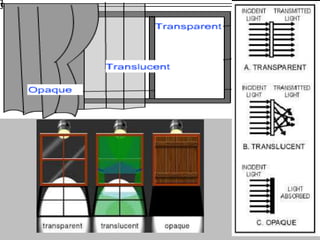
 Kinds of objects according to the light.
 Light colours
 Mirrors
 Lenses
 SOUND
 What is the sound?
 Echo
HEAT
WHAT IS HEAT?
Atoms and molecules movements produce energy that we
call heat or thermic energy, which exists in all the matter.
The molecules in a hot body collide and move faster than in
a colder body.
http://www.indiana.edu/~oso/animations/energytransf
er.html
Remember from unit 5:
Everything around us is
made of matter. Matter is
formed by molecules.
Molecules are formed by
atoms.
MATTER
MOLECULES
ATOMS
HEAT
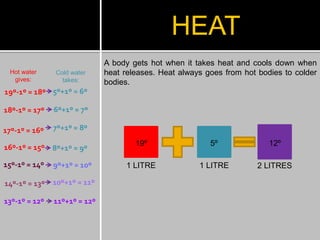
A body gets hot when it takes heat and cools down when
heat releases. Heat always goes from hot bodies to colder
bodies.
1 LITRE 1 LITRE 2 LITRES
19º 5º
5º+1º = 6º19º-1º = 18º
6º+1º = 7º18º-1º = 17º
7º+1º = 8º17º-1º = 16º
8º+1º = 9º16º-1º = 15º
9º+1º = 10º15º-1º = 14º
10º+1º = 11º14º-1º = 13º
11º+1º = 12º13º-1º = 12º
12º
Hot water
gives:
Cold water
takes:
HEAT SOURCES
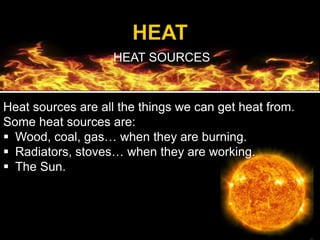
Heat sources are all the things we can get heat from.
Some heat sources are:
 Wood, coal, gas… when they are burning.
 Radiators, stoves… when they are working.
 The Sun.
CONDUCTIVE AND INSULATING
MATERIALS
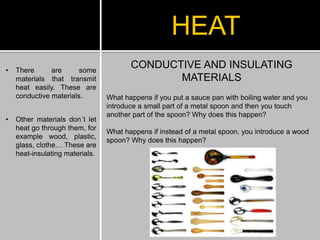
What happens if you put a sauce pan with boiling water and you
introduce a small part of a metal spoon and then you touch
another part of the spoon? Why does this happen?
What happens if instead of a metal spoon, you introduce a wood
spoon? Why does this happen?
HEAT
• There are some
materials that transmit
heat easily. These are
conductive materials.
• Other materials don´t let
heat go through them, for
example wood, plastic,
glass, clothe… These are
heat-insulating materials.
Heat is the only thing that
makes temperature rise or
fall. If we add heat,
temperature rises. If we
take heat away,
temperature falls.
There are high
temperatures when
molecules are moving and
vibrating quickly.
HEAT
MEASURING HEAT
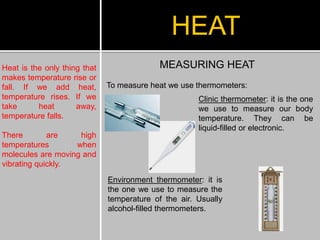
To measure heat we use thermometers:
Clinic thermometer: it is the one
we use to measure our body
temperature. They can be
liquid-filled or electronic.
Environment thermometer: it is
the one we use to measure the
temperature of the air. Usually
alcohol-filled thermometers.
HEAT EFFECTS
 OBJECTS TEMPERATURE CHANGES
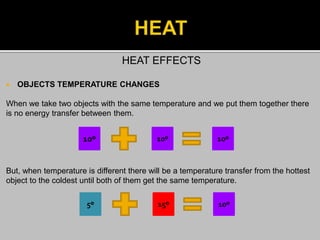
When we take two objects with the same temperature and we put them together there
is no energy transfer between them.
But, when temperature is different there will be a temperature transfer from the hottest
object to the coldest until both of them get the same temperature.
10º 10º 10º
5º 15º 10º
HEAT EFFECTS
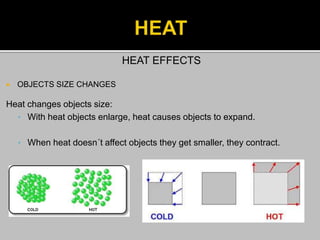
 OBJECTS SIZE CHANGES
Heat changes objects size:
• With heat objects enlarge, heat causes objects to expand.
• When heat doesn´t affect objects they get smaller, they contract.
HEAT EFFECTS
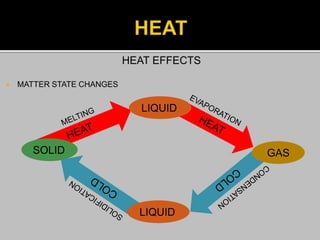
 MATTER STATE CHANGES
SOLID
LIQUID
GAS
LIQUID
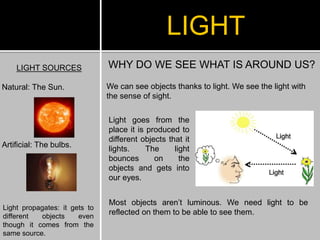
LIGHT SOURCES
Natural: The Sun.
Artificial: The bulbs.
LIGHT
WHY DO WE SEE WHAT IS AROUND US?
We can see objects thanks to light. We see the light with
the sense of sight.
Light goes from the
place it is produced to
different objects that it
lights. The light
bounces on the
objects and gets into
our eyes.
Light propagates: it gets to
different objects even
though it comes from the
same source.
Most objects aren’t luminous. We need light to be
reflected on them to be able to see them.
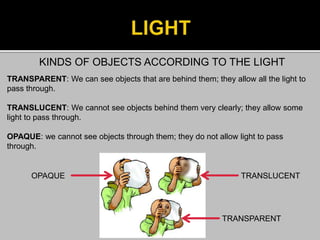
KINDS OF OBJECTS ACCORDING TO THE LIGHT
TRANSPARENT: We can see objects that are behind them; they allow all the light to
pass through.
TRANSLUCENT: We cannot see objects behind them very clearly; they allow some
light to pass through.
OPAQUE: we cannot see objects through them; they do not allow light to pass
through.
TRANSLUCENT
TRANSPARENT
OPAQUE
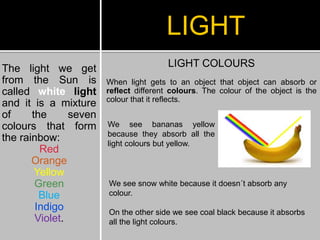
The light we get
from the Sun is
called white light
and it is a mixture
of the seven
colours that form
the rainbow:
Red
Orange
Yellow
Green
Blue
Indigo
Violet.
LIGHT
LIGHT COLOURS
When light gets to an object that object can absorb or
reflect different colours. The colour of the object is the
colour that it reflects.
We see bananas yellow
because they absorb all the
light colours but yellow.
We see snow white because it doesn´t absorb any
colour.
On the other side we see coal black because it absorbs
all the light colours.
LIGHT
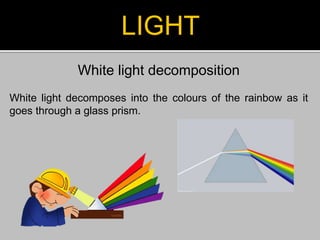
White light decomposition
White light decomposes into the colours of the rainbow as it
goes through a glass prism.
LENSES
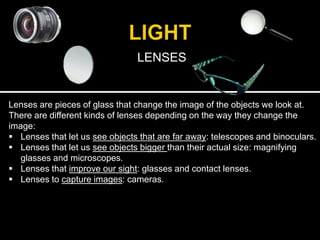
Lenses are pieces of glass that change the image of the objects we look at.
There are different kinds of lenses depending on the way they change the
image:
 Lenses that let us see objects that are far away: telescopes and binoculars.
 Lenses that let us see objects bigger than their actual size: magnifying
glasses and microscopes.
 Lenses that improve our sight: glasses and contact lenses.
 Lenses to capture images: cameras.
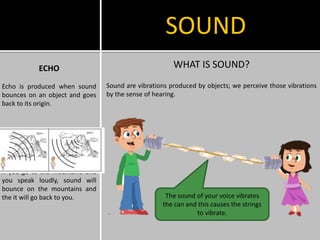
ECHO
Echo is produced when sound
bounces on an object and goes
back to its origin.
If you go to the mountains and
you speak loudly, sound will
bounce on the mountains and
the it will go back to you.
SOUND
WHAT IS SOUND?
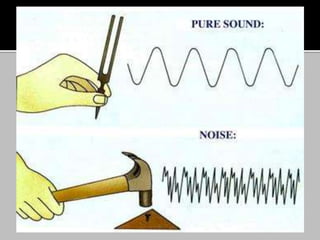
Sound are vibrations produced by objects; we perceive those vibrations
by the sense of hearing.
The sound of your voice vibrates
the can and this causes the strings
to vibrate.
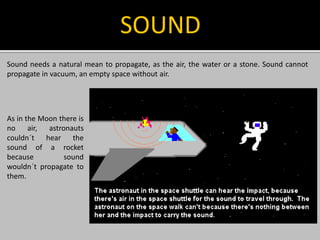
Sound needs a natural mean to propagate, as the air, the water or a stone. Sound cannot
propagate in vacuum, an empty space without air.
SOUND
As in the Moon there is
no air, astronauts
couldn´t hear the
sound of a rocket
because sound
wouldn´t propagate to
them.

Unit 6 heat, light and sound

  • 2.
     HEAT  Whatis heat?  Heat sources.  Conductive and insulating materials.  Measuring heat.  Heat effects.  LIGHT  Why do we see what is around us?  Kinds of objects according to the light.  Light colours  Mirrors  Lenses  SOUND  What is the sound?  Echo
  • 3.
    HEAT WHAT IS HEAT? Atomsand molecules movements produce energy that we call heat or thermic energy, which exists in all the matter. The molecules in a hot body collide and move faster than in a colder body. http://www.indiana.edu/~oso/animations/energytransf er.html Remember from unit 5: Everything around us is made of matter. Matter is formed by molecules. Molecules are formed by atoms. MATTER MOLECULES ATOMS
  • 4.
    HEAT A body getshot when it takes heat and cools down when heat releases. Heat always goes from hot bodies to colder bodies. 1 LITRE 1 LITRE 2 LITRES 19º 5º 5º+1º = 6º19º-1º = 18º 6º+1º = 7º18º-1º = 17º 7º+1º = 8º17º-1º = 16º 8º+1º = 9º16º-1º = 15º 9º+1º = 10º15º-1º = 14º 10º+1º = 11º14º-1º = 13º 11º+1º = 12º13º-1º = 12º 12º Hot water gives: Cold water takes:
  • 5.
    HEAT SOURCES Heat sourcesare all the things we can get heat from. Some heat sources are:  Wood, coal, gas… when they are burning.  Radiators, stoves… when they are working.  The Sun.
  • 6.
    CONDUCTIVE AND INSULATING MATERIALS Whathappens if you put a sauce pan with boiling water and you introduce a small part of a metal spoon and then you touch another part of the spoon? Why does this happen? What happens if instead of a metal spoon, you introduce a wood spoon? Why does this happen? HEAT • There are some materials that transmit heat easily. These are conductive materials. • Other materials don´t let heat go through them, for example wood, plastic, glass, clothe… These are heat-insulating materials.
  • 7.
    Heat is theonly thing that makes temperature rise or fall. If we add heat, temperature rises. If we take heat away, temperature falls. There are high temperatures when molecules are moving and vibrating quickly. HEAT MEASURING HEAT To measure heat we use thermometers: Clinic thermometer: it is the one we use to measure our body temperature. They can be liquid-filled or electronic. Environment thermometer: it is the one we use to measure the temperature of the air. Usually alcohol-filled thermometers.
  • 8.
    HEAT EFFECTS  OBJECTSTEMPERATURE CHANGES When we take two objects with the same temperature and we put them together there is no energy transfer between them. But, when temperature is different there will be a temperature transfer from the hottest object to the coldest until both of them get the same temperature. 10º 10º 10º 5º 15º 10º
  • 9.
    HEAT EFFECTS  OBJECTSSIZE CHANGES Heat changes objects size: • With heat objects enlarge, heat causes objects to expand. • When heat doesn´t affect objects they get smaller, they contract.
  • 10.
    HEAT EFFECTS  MATTERSTATE CHANGES SOLID LIQUID GAS LIQUID
  • 11.
    LIGHT SOURCES Natural: TheSun. Artificial: The bulbs. LIGHT WHY DO WE SEE WHAT IS AROUND US? We can see objects thanks to light. We see the light with the sense of sight. Light goes from the place it is produced to different objects that it lights. The light bounces on the objects and gets into our eyes. Light propagates: it gets to different objects even though it comes from the same source. Most objects aren’t luminous. We need light to be reflected on them to be able to see them.
  • 12.
    KINDS OF OBJECTSACCORDING TO THE LIGHT TRANSPARENT: We can see objects that are behind them; they allow all the light to pass through. TRANSLUCENT: We cannot see objects behind them very clearly; they allow some light to pass through. OPAQUE: we cannot see objects through them; they do not allow light to pass through. TRANSLUCENT TRANSPARENT OPAQUE
  • 14.
    The light weget from the Sun is called white light and it is a mixture of the seven colours that form the rainbow: Red Orange Yellow Green Blue Indigo Violet. LIGHT LIGHT COLOURS When light gets to an object that object can absorb or reflect different colours. The colour of the object is the colour that it reflects. We see bananas yellow because they absorb all the light colours but yellow. We see snow white because it doesn´t absorb any colour. On the other side we see coal black because it absorbs all the light colours.
  • 15.
    LIGHT White light decomposition Whitelight decomposes into the colours of the rainbow as it goes through a glass prism.
  • 16.
    LENSES Lenses are piecesof glass that change the image of the objects we look at. There are different kinds of lenses depending on the way they change the image:  Lenses that let us see objects that are far away: telescopes and binoculars.  Lenses that let us see objects bigger than their actual size: magnifying glasses and microscopes.  Lenses that improve our sight: glasses and contact lenses.  Lenses to capture images: cameras.
  • 17.
    ECHO Echo is producedwhen sound bounces on an object and goes back to its origin. If you go to the mountains and you speak loudly, sound will bounce on the mountains and the it will go back to you. SOUND WHAT IS SOUND? Sound are vibrations produced by objects; we perceive those vibrations by the sense of hearing. The sound of your voice vibrates the can and this causes the strings to vibrate.
  • 19.
    Sound needs anatural mean to propagate, as the air, the water or a stone. Sound cannot propagate in vacuum, an empty space without air. SOUND As in the Moon there is no air, astronauts couldn´t hear the sound of a rocket because sound wouldn´t propagate to them.