Introduction
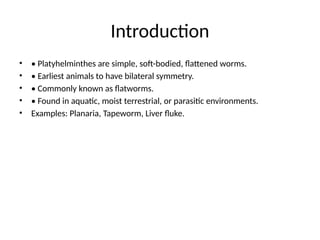
• • Platyhelminthesare simple, soft-bodied, flattened worms.
• • Earliest animals to have bilateral symmetry.
• • Commonly known as flatworms.
• • Found in aquatic, moist terrestrial, or parasitic environments.
• Examples: Planaria, Tapeworm, Liver fluke.
3.
General Characteristics
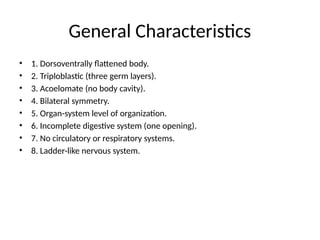
• 1.Dorsoventrally flattened body.
• 2. Triploblastic (three germ layers).
• 3. Acoelomate (no body cavity).
• 4. Bilateral symmetry.
• 5. Organ-system level of organization.
• 6. Incomplete digestive system (one opening).
• 7. No circulatory or respiratory systems.
• 8. Ladder-like nervous system.
4.
Mode of Nutrition
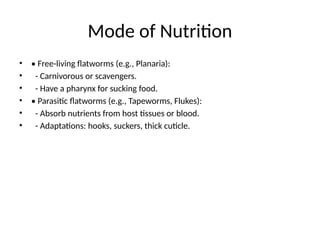
•• Free-living flatworms (e.g., Planaria):
• - Carnivorous or scavengers.
• - Have a pharynx for sucking food.
• • Parasitic flatworms (e.g., Tapeworms, Flukes):
• - Absorb nutrients from host tissues or blood.
• - Adaptations: hooks, suckers, thick cuticle.
5.
Mode of Reproduction
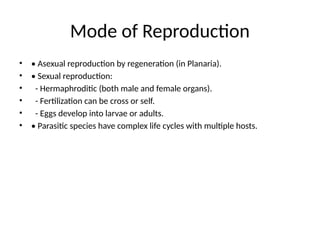
•• Asexual reproduction by regeneration (in Planaria).
• • Sexual reproduction:
• - Hermaphroditic (both male and female organs).
• - Fertilization can be cross or self.
• - Eggs develop into larvae or adults.
• • Parasitic species have complex life cycles with multiple hosts.
6.
Summary
• • Bilateralsymmetry, triploblastic, acoelomate.
• • Organ-system level of organization.
• • Nutrition: free-living (carnivorous) or parasitic (absorptive).
• • Reproduction: sexual and asexual with regeneration.
7.
Examples
• • Planaria– Dugesia tigrina (freshwater, free-living)
• • Liver fluke – Fasciola hepatica (in liver of sheep/cattle)
• • Tapeworm – Taenia solium (in human intestine).
8.
Fun Facts
• •Planarians can regrow their entire body from a small piece.
• • Some tapeworms can grow up to 30 feet long!
• • Among the first animals with a nervous system and bilateral symmetry.
![Phylum Platyhelminthes
(Flatworms)
Prepared by: [Your Name]
Subject: Biology / Zoology
Teacher: [Teacher’s Name]](https://image.slidesharecdn.com/phylumplatyhelminthesreport-251014163502-8dccf944/85/Phylum_Platyhelminthes_Report-general-characteristic-pptx-1-320.jpg)
![Phylum Platyhelminthes
(Flatworms)
Prepared by: [Your Name]
Subject: Biology / Zoology
Teacher: [Teacher’s Name]](https://image.slidesharecdn.com/phylumplatyhelminthesreport-251014163502-8dccf944/75/Phylum_Platyhelminthes_Report-general-characteristic-pptx-1-2048.jpg)