6.3 Water Beneath the Surface
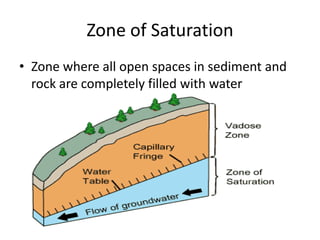
Zone of Saturation
• Zone where all open spaces in sediment and
  rock are completely filled with water
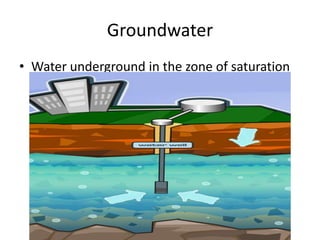
Groundwater
• Water underground in the zone of saturation
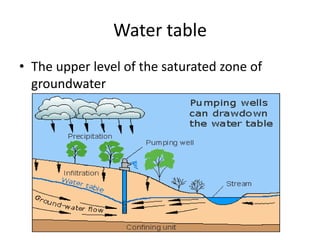
Water table
• The upper level of the saturated zone of
  groundwater
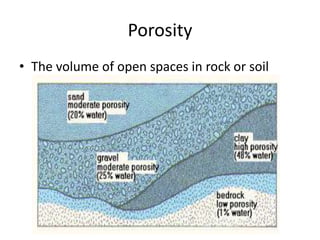
Porosity
• The volume of open spaces in rock or soil
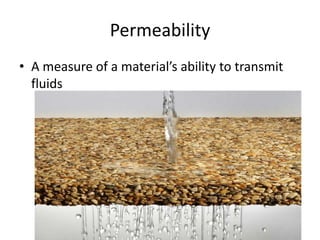
Permeability
• A measure of a material’s ability to transmit
  fluids
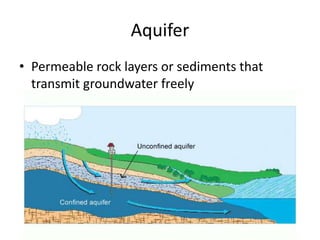
Aquifer
• Permeable rock layers or sediments that
  transmit groundwater freely
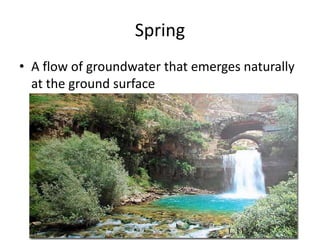
Spring
• A flow of groundwater that emerges naturally
  at the ground surface
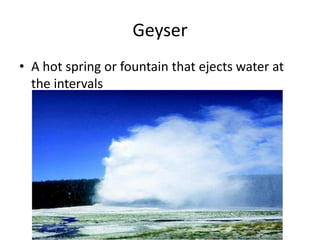
Geyser
• A hot spring or fountain that ejects water at
  the intervals
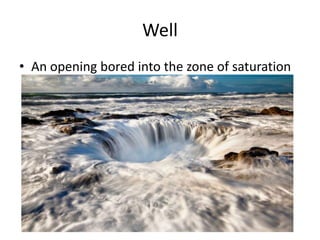
Well
• An opening bored into the zone of saturation
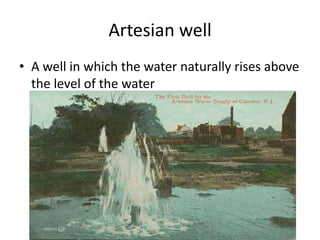
Artesian well
• A well in which the water naturally rises above
  the level of the water
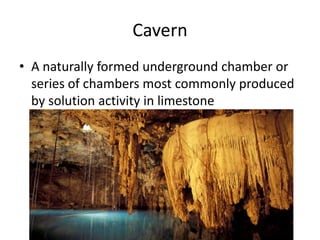
Cavern
• A naturally formed underground chamber or
  series of chambers most commonly produced
  by solution activity in limestone
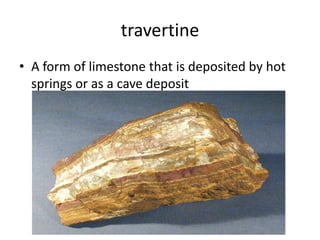
travertine
• A form of limestone that is deposited by hot
  springs or as a cave deposit
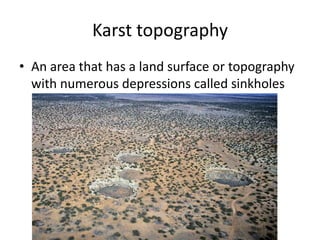
Karst topography
• An area that has a land surface or topography
  with numerous depressions called sinkholes
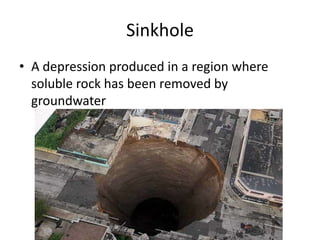
Sinkhole
• A depression produced in a region where
  soluble rock has been removed by
  groundwater
Key Concept
• Much of the water in soil seeps downward
  until it reaches the zone of saturation. The
  zone of saturation is the area where water fills
  all of the open spaces in sediment and rock.
  Groundwater is the water within this zone
Key Concept
• Groundwater moves by twisting and turning
  through interconnected small openings. The
  groundwater moves more slowly when the
  pore spaces are smaller
Key Concept
• A spring forms whenever the water table
  intersects the ground surface
Key Concept
• Overuse and contamination threatens
  groundwater supplies in some areas.
Key Concept
• Erosion forms most caverns at or below the
  water table in the zone of saturation
Key Concept
• Karst areas typically have irregular terrain,
  with many depressions called sinkholes

Earth science 6.3