ORIGIN OF
TETRAPODS
Dr. Sandeep Kumar Raghuvanshi
Assistant Professor
Department of Zoology
Bareilly College Bareilly
INTRODUCTION
• Tetrapoda is a superclass of animal kingdom, which includes all
living and extinct amphibians, reptiles, birds and mammals.
• The evolution of tetrapods began about 400 mya in
the Devonian Period from lobe-finned fishes.
• Little evidence supports the idea that any of the earliest
tetrapods could move on land. The specific ancestors of
tetrapods, and the process by which land colonization occurred,
remain unclear.
• Many groups of tetrapods have lost some or all of their limbs. In
addition, many tetrapods have returned to partially or fully aquatic
lives throughout the history of the group.
• The first returns to aquatic lifestyle may have occurred during
Carboniferous Period, whereas other returns occurred recently
during the Cenozoic (cetaceans and several modern amphibians).
• The change of a body plan from aquatic life to amphibious life is
one of the most profound evolutionary changes known. It is also
best understood, due to significant transitional fossil findings in
the late 20th
century combined with improved phylogenetic
analysis.
DENIZENS OF THE SWAMPS
• The first tetrapod probably evolved in coastal and brackish marine environments
as well as in shallow and swampy freshwater habitats.
• Formerly, researchers thought the timing was towards the end of the Devonian.
In 2010, this belief was changed to the Middle Devonian.
• Additionally, the tracks show that the animal was capable of thrusting its arms
and legs forward, a type of motion that would have been impossible in
tetrapodomorph fish like Tiktaalik.
• The animal that produced the tracks is estimated to have been up to 2.5 metres
(8.2 ft) long with footpads up to 26 cm (10 in) wide, although most tracks are
only 15 cm (5.9 in) wide.
• The new findings suggest that the first tetrapod may have lived as
opportunists on the tidal flats, feeding on marine animals that were
washed up by the tide.
• Currently, however, fish are stranded in significant numbers only at
certain times of year, as during spawning season. Such stranding
could not provide a significant supply of food for predators.
• There is no reason to suppose that Devonian fish were less prudent
than those of today.
LUNGS BEFORE LAND
• Lungs require a blood supply for gaseous exchange.
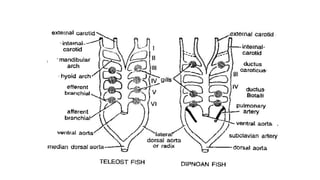
• In lungfishes, bowfin and bichirs, the swim bladder is supplied with
blood by paired pulmonary arteries branching off from the 6th
aortic arch.
• The same basic pattern is found in the lungfish Protopterus and in
terrestrial salamanders, and was probably the pattern found in the
tetrapods' immediate ancestors as well as the first tetrapods.
• In most other bony fishes the swim bladder is supplied with blood
by the dorsal aorta.
The Breath
• In modern tetrapods, two important breathing mechanisms are conserved from
early ancestors.
• The first mechanism is a CO2/H+ detection system. In modern tetrapods, the
impulse to take a breath is triggered by a buildup of CO2 in the bloodstream and
not a lack of O2. A similar CO2/H+ detection system is found in all Osteichthyes,
which implies that the last common ancestor of all Osteichthyes had a need of this
sort of detection system.
• The second mechanism is the actual motion of the breath. In Lampreys, this
mechanism takes the form of a "cough", where the lamprey shakes its body to
allow water flow across its gills. When CO2 levels in the lamprey's blood climb too
high, a signal is sent to a central pattern generator that causes the lamprey to
"cough" and allow CO2 to leave its body. This linkage between CO2 detection
system and central pattern generator is extremely similar to tetrapods, which
SKULL MORPHOLOGY
• The tetrapods have their root in the early Devonian tetrapodomorph fish.
• Primitive tetrapods developed from an osteolepid tetrapodomorph lobe-
finned fish sarcopterygian-crossopterygian), with a two-lobed brain in a
flattened skull.
• The coelacanth group represents marine sarcopterygians that never
acquired these shallow-water adaptations.
• The sarcopterygians apparently took two different lines of descent and
are accordingly separated into two major groups: the Actinistia (including
the coelacanths) and the Rhipidistia (which include extinct lines of lobe-
finned fishes that evolved into the lungfish and the tetrapodomorphs).
FROM FINS TO FEET
• The oldest known tetrapodomorph is Kenichthys from China, dated at
around 395 mya. Two of the earliest tetrapodomorphs, dating from 380
mya, were Gogonasus and Panderichthys. All of them used their fins to
move through tidal channels and shallow waters choked with dead
branches and rotting plants.
• The universal tetrapod characteristics of front limbs that bend forward
from the elbow and hind limbs that bend backward from the knee can
plausibly be traced to early tetrapods living in shallow water. Pelvic bone
fossils from Tiktaalik shows, that hind appendages and pelvic-propelled
locomotion originated in water before terrestrial adaptations.
• Another indication that feet and other tetrapod traits evolved while the animals
were still aquatic is how they were feeding. They did not have the modifications of
the skull and jaw that allowed them to swallow prey on land. Prey could be caught in
the shallows, at the water's edge or on land, but had to be eaten in water where
hydrodynamic forces from the expansion of their buccal cavity would force the food
into their esophagus.
• A 2012 study using 3D reconstructions of Ichthyostega concluded that it was
incapable of typical quadrupedal steps. The limbs could not move alternately as they
lacked the necessary rotary motion range. In addition, the hind limbs lacked the
necessary pelvic musculature for hindlimb-driven land movement. Their most likely
method of terrestrial locomotion is that of synchronous "crutching motions", similar
to modern mudskippers.
EXCRETION IN TETRAPODS
• When lungfishes are living in water, they produce ammonia, but when the water
dries up and they forced to burrow down in the mud, they switch to urea
production. Like cartilaginous fishes, the coelacanth can store urea in its blood, as
can the only known amphibians that can live for long periods of time in salt water (
Bufo marinus and Rana cancrivora). These are traits they have inherited from their
ancestors.
• If early tetrapods lived in freshwater, and if they lost the ability to produce urea and
used ammonia only, they would have to evolve it from scratch again later.
Terrestrial animals that can only produce ammonia would have to drink water
constantly, making a life on land impossible.
• This probably also was a problem at the start when the tetrapods started to spend
time out of water, but eventually the urea system would dominate completely.
Because of this it is not likely they emerged in freshwater, although some species
never left, or returned to, the water could of course have adapted to freshwater
lakes and rivers.
EARLIEST TETRAPODS
• Recent research showed that the very earliest tetrapods, similar to
Acanthostega, were wholly aquatic and quite unsuited to life on land. This is
in contrast to the earlier view that fish had first invaded the land — either in
search of prey or to find water when the pond they lived in dried out and
later evolved legs, lungs, etc.
• By the late Devonian, swampy habitats like shallow wetlands, coastal
lagoons and large brackish river deltas also existed, and there is much to
suggest that this is the kind of environment in which the tetrapods evolved.
Early fossil tetrapods have been found in marine sediments, and because
fossils of primitive tetrapods in general are found scattered all around the
world, they must have spread by following the coastal lines — they could
not have lived in freshwater only.
• The Devonian tetrapods went through two major bottlenecks
during what is known as the Late Devonian extinction. These
events of extinctions led to the disappearance of primitive
tetrapods with fish-like features like Ichthyostega and their
primary more aquatic relatives. When tetrapods reappear in
the fossil record after the Devonian extinctions, the adult
forms are all fully adapted to a terrestrial existence, with
later species secondary adapted to an aquatic lifestyle.
FOSSILS OF EARLY TETRAPODS
• The first Devonian tetrapod identified from Asia was recognized from a
fossil jaw-bone reported in 2002. The Chinese tetrapod Sinostega was
discovered among fossilized tropical plants and lobe-finned fish in the
red sandstone sediments of northwest China. This finding substantially
extended the geographical range of these animals.
• These earliest tetrapods were not terrestrial. The earliest confirmed
terrestrial forms are known from the early Carboniferous deposits, some
20 million years later. Still, they may have spent very brief periods out of
water and would have used their legs to paw their way through the mud.
• Why they went to land in the first place is still debated.
• One reason could be that the small juveniles who had completed
their metamorphosis had to make use of what land had to offer.
• Already adapted to breathe air and move around in shallow
waters near land as a protection, two very different niches
partially overlapped each other, with the young juveniles in the
diffuse line between.
• One of them was overcrowded and dangerous while the other
was much safer and much less crowded, offering less
competition over resources.
• The terrestrial niche was also a much more challenging place for
primarily aquatic animals, but because of the way evolution and
selection pressure work, those juveniles who could take
advantage of this would be rewarded. Once they gained a small
foothold on land, favourable variations in their descendants
gradually resulted in continuing evolution and diversification.
• At this time the abundance of invertebrates crawling around on
land and near water, in moist soil and wet litter, offered a food
supply. Some were even big enough to eat small tetrapods, but
the land was free from dangers common in the water.
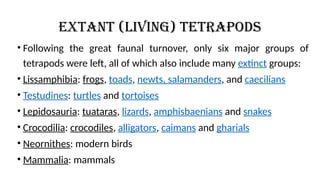
EXTANT (LIVING) TETRAPODS
• Following the great faunal turnover, only six major groups of
tetrapods were left, all of which also include many extinct groups:
• Lissamphibia: frogs, toads, newts, salamanders, and caecilians
• Testudines: turtles and tortoises
• Lepidosauria: tuataras, lizards, amphisbaenians and snakes
• Crocodilia: crocodiles, alligators, caimans and gharials
• Neornithes: modern birds
• Mammalia: mammals
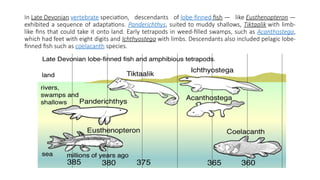
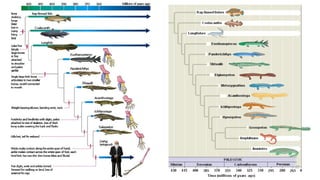
In Late Devonian vertebrate speciation, descendants of lobe-finned fish — like Eusthenopteron —
exhibited a sequence of adaptations. Panderichthys, suited to muddy shallows, Tiktaalik with limb-
like fins that could take it onto land. Early tetrapods in weed-filled swamps, such as Acanthostega,
which had feet with eight digits and Ichthyostega with limbs. Descendants also included pelagic lobe-
finned fish such as coelacanth species.
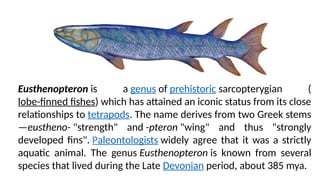
Eusthenopteron is a genus of prehistoric sarcopterygian (
lobe-finned fishes) which has attained an iconic status from its close
relationships to tetrapods. The name derives from two Greek stems
—eustheno- "strength" and -pteron "wing" and thus "strongly
developed fins". Paleontologists widely agree that it was a strictly
aquatic animal. The genus Eusthenopteron is known from several
species that lived during the Late Devonian period, about 385 mya.
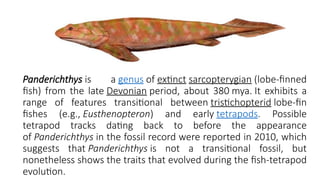
Panderichthys is a genus of extinct sarcopterygian (lobe-finned
fish) from the late Devonian period, about 380 mya. It exhibits a
range of features transitional between tristichopterid lobe-fin
fishes (e.g., Eusthenopteron) and early tetrapods. Possible
tetrapod tracks dating back to before the appearance
of Panderichthys in the fossil record were reported in 2010, which
suggests that Panderichthys is not a transitional fossil, but
nonetheless shows the traits that evolved during the fish-tetrapod
evolution.
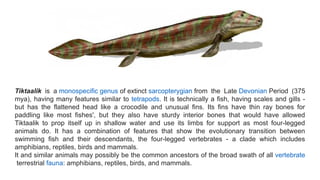
Tiktaalik is a monospecific genus of extinct sarcopterygian from the Late Devonian Period (375
mya), having many features similar to tetrapods. It is technically a fish, having scales and gills -
but has the flattened head like a crocodile and unusual fins. Its fins have thin ray bones for
paddling like most fishes', but they also have sturdy interior bones that would have allowed
Tiktaalik to prop itself up in shallow water and use its limbs for support as most four-legged
animals do. It has a combination of features that show the evolutionary transition between
swimming fish and their descendants, the four-legged vertebrates - a clade which includes
amphibians, reptiles, birds and mammals.
It and similar animals may possibly be the common ancestors of the broad swath of all vertebrate
terrestrial fauna: amphibians, reptiles, birds, and mammals.
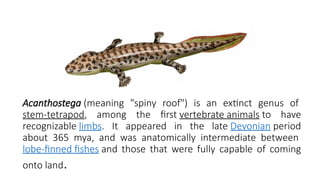
Acanthostega (meaning "spiny roof") is an extinct genus of
stem-tetrapod, among the first vertebrate animals to have
recognizable limbs. It appeared in the late Devonian period
about 365 mya, and was anatomically intermediate between
lobe-finned fishes and those that were fully capable of coming
onto land.
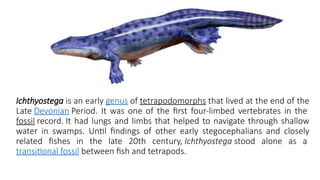
Ichthyostega is an early genus of tetrapodomorphs that lived at the end of the
Late Devonian Period. It was one of the first four-limbed vertebrates in the
fossil record. It had lungs and limbs that helped to navigate through shallow
water in swamps. Until findings of other early stegocephalians and closely
related fishes in the late 20th century, Ichthyostega stood alone as a
transitional fossil between fish and tetrapods.
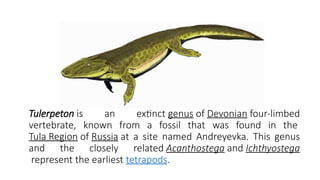
Tulerpeton is an extinct genus of Devonian four-limbed
vertebrate, known from a fossil that was found in the
Tula Region of Russia at a site named Andreyevka. This genus
and the closely related Acanthostega and Ichthyostega
represent the earliest tetrapods.
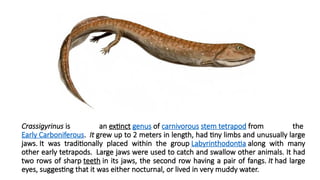
Crassigyrinus is an extinct genus of carnivorous stem tetrapod from the
Early Carboniferous. It grew up to 2 meters in length, had tiny limbs and unusually large
jaws. It was traditionally placed within the group Labyrinthodontia along with many
other early tetrapods. Large jaws were used to catch and swallow other animals. It had
two rows of sharp teeth in its jaws, the second row having a pair of fangs. It had large
eyes, suggesting that it was either nocturnal, or lived in very muddy water.
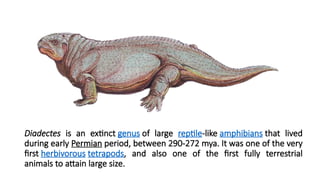
Diadectes is an extinct genus of large reptile-like amphibians that lived
during early Permian period, between 290-272 mya. It was one of the very
first herbivorous tetrapods, and also one of the first fully terrestrial
animals to attain large size.
8. Origin and characteristics of tetrapods.pptx