7.1 Glaciers
Ice Age
• A period of time when much of Earth’s land is
  covered by glaciers.
Glacier
• A thick mass of ice originating on land from
  the compaction and recrystallization of snow
  that shows evidence of past or present flow
Snowline
• Lowest elevation in a particular area that
  remains covered in snow all year.
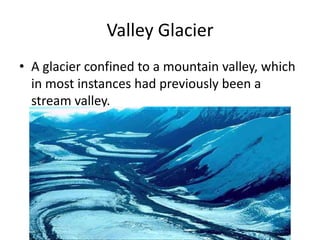
Valley Glacier
• A glacier confined to a mountain valley, which
  in most instances had previously been a
  stream valley.
Ice sheet
• Enormous ice masses that flow in all
  directions from one or more centers and cover
  everything but the highest land.
Till
• Sediment of different sizes deposited directly
  by a glacier
Moraine
• A ridge of unsorted sediment left by a glacier
Glacial trough
• V-shaped or U-shaped valley cut by glacial
  movement.
Key Concept
• A valley glacier is a stream of ice that flows
  between steep rock walls from a place near
  the top of the mountain valley
Key Concept
• Ice sheets are sometimes called continental
  ice sheets because they cover large regions
  where the climate is extremely cold. They are
  huge compared to valley glaciers.
Key Concept
• The movement of glaciers is referred to as
  flow. Glacial flow happens two ways : plastic
  flow and basal slip.
Key Concept
• The glacial budget is the balance or lack of
  balance between accumulation at the upper
  end of a glacier and loss, or wastage, at the
  lower end.
Key Concept
• Many landscapes were changed by the
  widespread glaciers of the recent ice age.
Key Concept
• Glaciers are responsible for a variety of
  erosional landscape features, such as glacial
  troughs, hanging valleys, cirques, arêtes, and
  horns.
Key Concept
• Glacial drift applies to all sediments of glacial
  origin, no matter how, where, or in what form
  they were deposited. There are two types of
  glacial drift: till and stratified drift.
Key Concept
• Glaciers are responsible for a variety of
  depositional features, including moraines,
  outwash plains, kettles, drumlins, and eskers.

Earth science 7.1

  • 1.
  • 2.
    Ice Age • Aperiod of time when much of Earth’s land is covered by glaciers.
  • 3.
    Glacier • A thickmass of ice originating on land from the compaction and recrystallization of snow that shows evidence of past or present flow
  • 4.
    Snowline • Lowest elevationin a particular area that remains covered in snow all year.
  • 5.
    Valley Glacier • Aglacier confined to a mountain valley, which in most instances had previously been a stream valley.
  • 6.
    Ice sheet • Enormousice masses that flow in all directions from one or more centers and cover everything but the highest land.
  • 7.
    Till • Sediment ofdifferent sizes deposited directly by a glacier
  • 8.
    Moraine • A ridgeof unsorted sediment left by a glacier
  • 9.
    Glacial trough • V-shapedor U-shaped valley cut by glacial movement.
  • 10.
    Key Concept • Avalley glacier is a stream of ice that flows between steep rock walls from a place near the top of the mountain valley
  • 11.
    Key Concept • Icesheets are sometimes called continental ice sheets because they cover large regions where the climate is extremely cold. They are huge compared to valley glaciers.
  • 12.
    Key Concept • Themovement of glaciers is referred to as flow. Glacial flow happens two ways : plastic flow and basal slip.
  • 13.
    Key Concept • Theglacial budget is the balance or lack of balance between accumulation at the upper end of a glacier and loss, or wastage, at the lower end.
  • 14.
    Key Concept • Manylandscapes were changed by the widespread glaciers of the recent ice age.
  • 15.
    Key Concept • Glaciersare responsible for a variety of erosional landscape features, such as glacial troughs, hanging valleys, cirques, arêtes, and horns.
  • 16.
    Key Concept • Glacialdrift applies to all sediments of glacial origin, no matter how, where, or in what form they were deposited. There are two types of glacial drift: till and stratified drift.
  • 17.
    Key Concept • Glaciersare responsible for a variety of depositional features, including moraines, outwash plains, kettles, drumlins, and eskers.