13.2 Paleozoic Era: Life Explodes
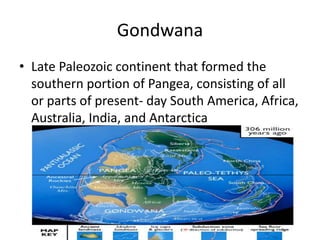
Gondwana
• Late Paleozoic continent that formed the
  southern portion of Pangea, consisting of all
  or parts of present- day South America, Africa,
  Australia, India, and Antarctica
Laurasia
• The continental mass that formed the
  northern portion of Pangea, consisting of
  present-day North America and Eurasia.
Key Concept
• Following the long Precambrian, the most
  recent 540 million years of Earth’s history are
  divided into three eras: Paleozoic, Mesozoic,
  and Cenozoic
Key Concept
• During the Cambrian, Ordovician, and Silurian
  periods, the vast southern continent of
  Gondwana encompassed five of today’s
  continents ( South America, Africa, Australia,
  Antarctica, and parts of Asia)
Key Concept
• Life in early Paleozoic time was restricted to
  the seas.
Key concept
• By the end of the Paleozoic, all the continents
  had fused into supercontinent of Pangea.
Key Concept
• Some 400 million years ago, plants that had
  adapted to survive at the water’s edge began
  to move inland, becoming land plants.
Key Concept
• The amphibians rapidly diversified because
  they had minimal competition from other land
  dwellers.

Earth science 13.2

  • 1.
    13.2 Paleozoic Era:Life Explodes
  • 2.
    Gondwana • Late Paleozoiccontinent that formed the southern portion of Pangea, consisting of all or parts of present- day South America, Africa, Australia, India, and Antarctica
  • 3.
    Laurasia • The continentalmass that formed the northern portion of Pangea, consisting of present-day North America and Eurasia.
  • 4.
    Key Concept • Followingthe long Precambrian, the most recent 540 million years of Earth’s history are divided into three eras: Paleozoic, Mesozoic, and Cenozoic
  • 5.
    Key Concept • Duringthe Cambrian, Ordovician, and Silurian periods, the vast southern continent of Gondwana encompassed five of today’s continents ( South America, Africa, Australia, Antarctica, and parts of Asia)
  • 6.
    Key Concept • Lifein early Paleozoic time was restricted to the seas.
  • 7.
    Key concept • Bythe end of the Paleozoic, all the continents had fused into supercontinent of Pangea.
  • 8.
    Key Concept • Some400 million years ago, plants that had adapted to survive at the water’s edge began to move inland, becoming land plants.
  • 9.
    Key Concept • Theamphibians rapidly diversified because they had minimal competition from other land dwellers.