26.1 Introduction to the Animal
           Kingdom
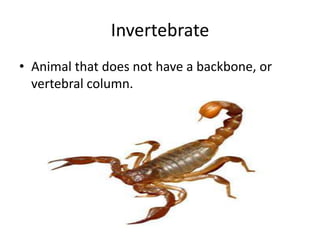
Invertebrate
• Animal that does not have a backbone, or
  vertebral column.
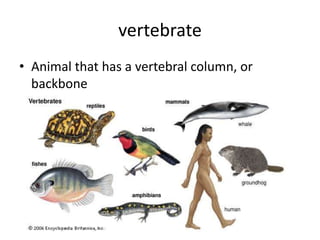
vertebrate
• Animal that has a vertebral column, or
  backbone
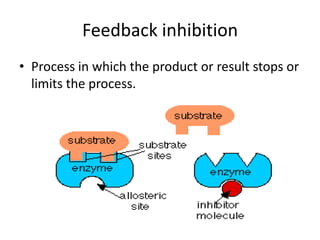
Feedback inhibition
• Process in which the product or result stops or
  limits the process.
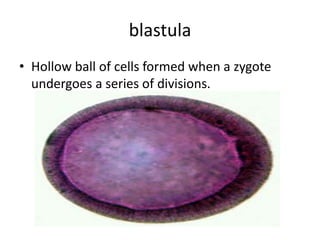
blastula
• Hollow ball of cells formed when a zygote
  undergoes a series of divisions.
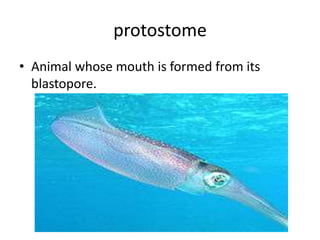
protostome
• Animal whose mouth is formed from its
  blastopore.
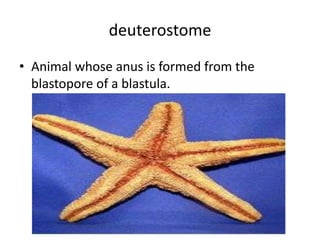
deuterostome
• Animal whose anus is formed from the
  blastopore of a blastula.
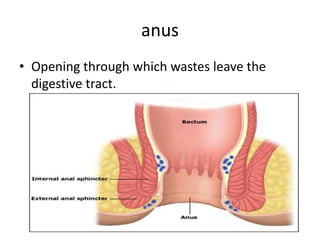
anus
• Opening through which wastes leave the
  digestive tract.
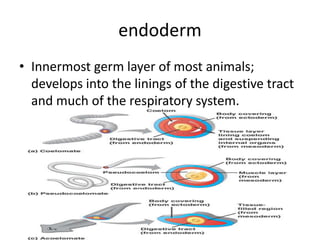
endoderm
• Innermost germ layer of most animals;
  develops into the linings of the digestive tract
  and much of the respiratory system.
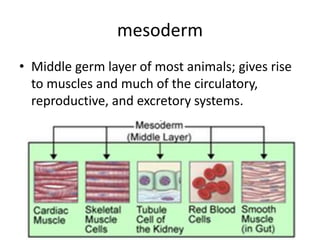
mesoderm
• Middle germ layer of most animals; gives rise
  to muscles and much of the circulatory,
  reproductive, and excretory systems.
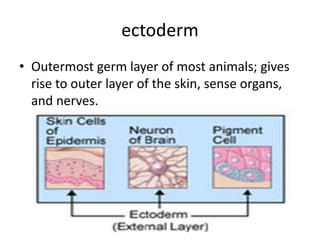
ectoderm
• Outermost germ layer of most animals; gives
  rise to outer layer of the skin, sense organs,
  and nerves.
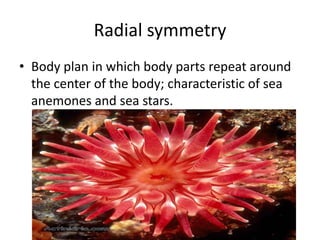
Radial symmetry
• Body plan in which body parts repeat around
  the center of the body; characteristic of sea
  anemones and sea stars.
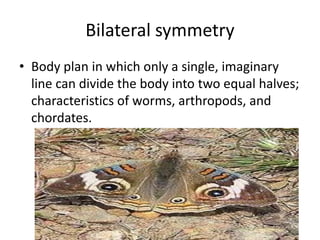
Bilateral symmetry
• Body plan in which only a single, imaginary
  line can divide the body into two equal halves;
  characteristics of worms, arthropods, and
  chordates.
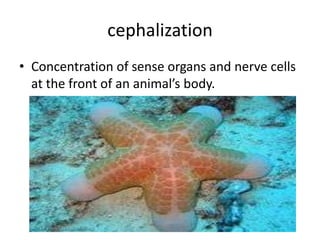
cephalization
• Concentration of sense organs and nerve cells
  at the front of an animal’s body.
Key Concept
• Animals, members of the kingdom Animalia,
  are multicellular, eukaryotic heterotrophs
  whose cells lack cell walls.
Key Concept
• Animals carry out the following essential
  functions: feeding, respiration, circulation,
  excretion, response, movement, and
  reproduction.
Key Concept
• Complex animals tend to have high levels of
  cell specialization and internal body
  organization, bilateral body symmetry, a front
  end or head with sense organs, and a body
  cavity.
Biology 26.1