CourseI : First semester


                                 PHYLUM ARTHROPODA
                                 (Animals with jointed legs)

    1. Arthropoda is the largest group of the animal kingdom containing more than 8, 00,000
       species.
    2. These are bilaterally symmetrical, triploblastic and metamerically segmented.
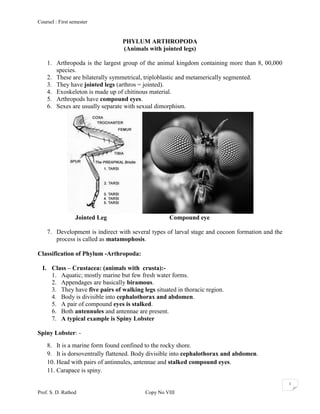
    3. They have jointed legs (arthros = jointed).
    4. Exoskeleton is made up of chitinous material.
    5. Arthropods have compound eyes.
    6. Sexes are usually separate with sexual dimorphism.


                  Jointed Leg                      Compound eye

    7. Development is indirect with several types of larval stage and cocoon formation and the
       process is called as matamophosis.

Classification of Phylum -Arthropoda:

  I. Class – Crustacea: (animals with crusta):-
     1. Aquatic; mostly marine but few fresh water forms.
     2. Appendages are basically biramous.
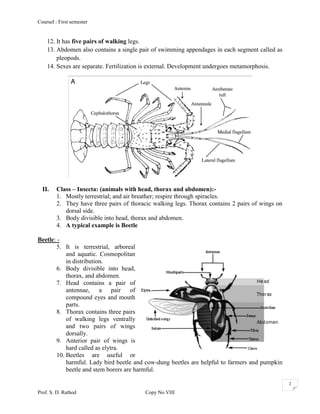
     3. They have five pairs of walking legs situated in thoracic region.
     4. Body is divisible into cephalothorax and abdomen.
     5. A pair of compound eyes is stalked.
     6. Both antennules and antennae are present.
     7. A typical example is Spiny Lobster

Spiny Lobster: -
    8. It is a marine form found confined to the rocky shore.
    9. It is dorsoventrally flattened. Body divisible into cephalothorax and abdomen.
    10. Head with pairs of antinnules, antennae and stalked compound eyes.
    11. Carapace is spiny.

                                                                                                 1

Prof. S. D. Rathod                        Copy No VIII
CourseI : First semester


    12. It has five pairs of walking legs.
    13. Abdomen also contains a single pair of swimming appendages in each segment called as
        pleopods.
    14. Sexes are separate. Fertilization is external. Development undergoes metamorphosis.


  II.    Class – Insecta: (animals with head, thorax and abdomen):-
         1. Mostly terrestrial; and air breather; respire through spiracles.
         2. They have three pairs of thoracic walking legs. Thorax contains 2 pairs of wings on
            dorsal side.
         3. Body divisible into head, thorax and abdomen.
         4. A typical example is Beetle

Beetle: -
       5. It is terrestrial, arboreal
           and aquatic. Cosmopolitan
           in distribution.
       6. Body divisible into head,
           thorax, and abdomen.
       7. Head contains a pair of
           antennae, a pair of
           compound eyes and mouth
           parts.
       8. Thorax contains three pairs
           of walking legs ventrally
           and two pairs of wings
           dorsally.
       9. Anterior pair of wings is
           hard called as elytra.
       10. Beetles are useful or
           harmful. Lady bird beetle and cow-dung beetles are helpful to farmers and pumpkin
           beetle and stem borers are harmful.

                                                                                                  2

Prof. S. D. Rathod                        Copy No VIII
CourseI : First semester


      I.  Class – Myriapoda (animals with head and trunk):-
      1. Mostly terrestrial;
      2. They have many pairs of walking legs. There may be one or two pairs of legs in a
          segment. Each leg is seven jointed.
      3. Body divisible into head and trunk. Head has a pair of antennae and compound eyes.
      4. Animals are armed with either poison claws or stink glands.
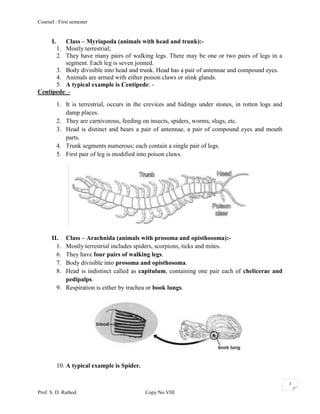
      5. A typical example is Centipede: -
Centipede: -
           1. It is terrestrial, occurs in the crevices and hidings under stones, in rotten logs and
              damp places.
           2. They are carnivorous, feeding on insects, spiders, worms, slugs, etc.
           3. Head is distinct and bears a pair of antennae, a pair of compound eyes and mouth
              parts.
           4. Trunk segments numerous; each contain a single pair of legs.
           5. First pair of leg is modified into poison claws.


      II.     Class – Arachnida (animals with prosoma and opisthosoma):-
        1.    Mostly terrestrial includes spiders, scorpions, ticks and mites.
        6.    They have four pairs of walking legs.
        7.    Body divisible into prosoma and opisthosoma.
        8.    Head is indistinct called as capitulum, containing one pair each of chelicerae and
              pedipalps.
           9. Respiration is either by trachea or book lungs.


           10. A typical example is Spider.

                                                                                                       3

Prof. S. D. Rathod                            Copy No VIII
CourseI : First semester


Spider: -
       1. These are terrestrial, arboreal, domestic and aquatic.
       2. They have four pairs of walking legs.
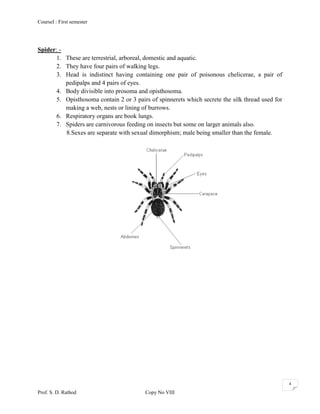
       3. Head is indistinct having containing one pair of poisonous chelicerae, a pair of
          pedipalps and 4 pairs of eyes.
       4. Body divisible into prosoma and opisthosoma.
       5. Opisthosoma contain 2 or 3 pairs of spinnerets which secrete the silk thread used for
          making a web, nests or lining of burrows.
       6. Respiratory organs are book lungs.
       7. Spiders are carnivorous feeding on insects but some on larger animals also.
          8.Sexes are separate with sexual dimorphism; male being smaller than the female.


                                                                                                  4

Prof. S. D. Rathod                       Copy No VIII

Phylum arthropoda

  • 1.
    CourseI : Firstsemester PHYLUM ARTHROPODA (Animals with jointed legs) 1. Arthropoda is the largest group of the animal kingdom containing more than 8, 00,000 species. 2. These are bilaterally symmetrical, triploblastic and metamerically segmented. 3. They have jointed legs (arthros = jointed). 4. Exoskeleton is made up of chitinous material. 5. Arthropods have compound eyes. 6. Sexes are usually separate with sexual dimorphism. Jointed Leg Compound eye 7. Development is indirect with several types of larval stage and cocoon formation and the process is called as matamophosis. Classification of Phylum -Arthropoda: I. Class – Crustacea: (animals with crusta):- 1. Aquatic; mostly marine but few fresh water forms. 2. Appendages are basically biramous. 3. They have five pairs of walking legs situated in thoracic region. 4. Body is divisible into cephalothorax and abdomen. 5. A pair of compound eyes is stalked. 6. Both antennules and antennae are present. 7. A typical example is Spiny Lobster Spiny Lobster: - 8. It is a marine form found confined to the rocky shore. 9. It is dorsoventrally flattened. Body divisible into cephalothorax and abdomen. 10. Head with pairs of antinnules, antennae and stalked compound eyes. 11. Carapace is spiny. 1 Prof. S. D. Rathod Copy No VIII
  • 2.
    CourseI : Firstsemester 12. It has five pairs of walking legs. 13. Abdomen also contains a single pair of swimming appendages in each segment called as pleopods. 14. Sexes are separate. Fertilization is external. Development undergoes metamorphosis. II. Class – Insecta: (animals with head, thorax and abdomen):- 1. Mostly terrestrial; and air breather; respire through spiracles. 2. They have three pairs of thoracic walking legs. Thorax contains 2 pairs of wings on dorsal side. 3. Body divisible into head, thorax and abdomen. 4. A typical example is Beetle Beetle: - 5. It is terrestrial, arboreal and aquatic. Cosmopolitan in distribution. 6. Body divisible into head, thorax, and abdomen. 7. Head contains a pair of antennae, a pair of compound eyes and mouth parts. 8. Thorax contains three pairs of walking legs ventrally and two pairs of wings dorsally. 9. Anterior pair of wings is hard called as elytra. 10. Beetles are useful or harmful. Lady bird beetle and cow-dung beetles are helpful to farmers and pumpkin beetle and stem borers are harmful. 2 Prof. S. D. Rathod Copy No VIII
  • 3.
    CourseI : Firstsemester I. Class – Myriapoda (animals with head and trunk):- 1. Mostly terrestrial; 2. They have many pairs of walking legs. There may be one or two pairs of legs in a segment. Each leg is seven jointed. 3. Body divisible into head and trunk. Head has a pair of antennae and compound eyes. 4. Animals are armed with either poison claws or stink glands. 5. A typical example is Centipede: - Centipede: - 1. It is terrestrial, occurs in the crevices and hidings under stones, in rotten logs and damp places. 2. They are carnivorous, feeding on insects, spiders, worms, slugs, etc. 3. Head is distinct and bears a pair of antennae, a pair of compound eyes and mouth parts. 4. Trunk segments numerous; each contain a single pair of legs. 5. First pair of leg is modified into poison claws. II. Class – Arachnida (animals with prosoma and opisthosoma):- 1. Mostly terrestrial includes spiders, scorpions, ticks and mites. 6. They have four pairs of walking legs. 7. Body divisible into prosoma and opisthosoma. 8. Head is indistinct called as capitulum, containing one pair each of chelicerae and pedipalps. 9. Respiration is either by trachea or book lungs. 10. A typical example is Spider. 3 Prof. S. D. Rathod Copy No VIII
  • 4.
    CourseI : Firstsemester Spider: - 1. These are terrestrial, arboreal, domestic and aquatic. 2. They have four pairs of walking legs. 3. Head is indistinct having containing one pair of poisonous chelicerae, a pair of pedipalps and 4 pairs of eyes. 4. Body divisible into prosoma and opisthosoma. 5. Opisthosoma contain 2 or 3 pairs of spinnerets which secrete the silk thread used for making a web, nests or lining of burrows. 6. Respiratory organs are book lungs. 7. Spiders are carnivorous feeding on insects but some on larger animals also. 8.Sexes are separate with sexual dimorphism; male being smaller than the female. 4 Prof. S. D. Rathod Copy No VIII