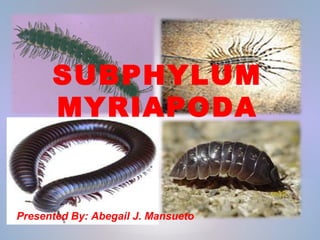
SUBPHYLUM
MYRIAPODA
Presented By: Abegail J. Mansueto
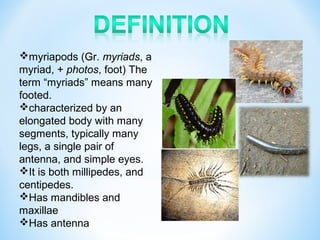
myriapods (Gr. myriads, a
myriad, + photos, foot) The
term “myriads” means many
footed.
characterized by an
elongated body with many
segments, typically many
legs, a single pair of
antenna, and simple eyes.
It is both millipedes, and
centipedes.
Has mandibles and
maxillae
Has antenna
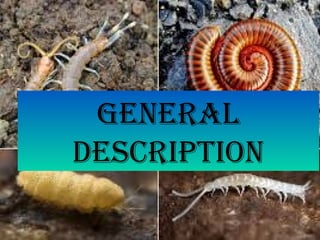
GENERAL
DESCRIPTION
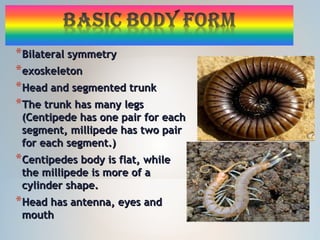
*Bilateral symmetryBilateral symmetry
*exoskeletonexoskeleton
*Head and segmented trunkHead and segmented trunk
*The trunk has many legsThe trunk has many legs
(Centipede has one pair for each(Centipede has one pair for each
segment, millipede has two pairsegment, millipede has two pair
for each segment.)for each segment.)
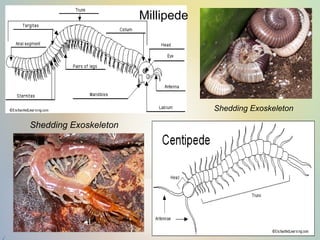
*Centipedes body is flat, whileCentipedes body is flat, while
the millipede is more of athe millipede is more of a
cylinder shape.cylinder shape.
*Head has antenna, eyes andHead has antenna, eyes and
mouthmouth
Millipede
Shedding Exoskeleton
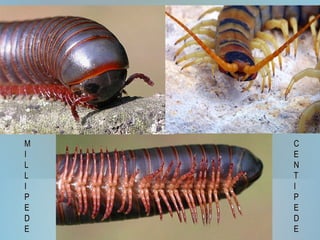
CC
EE
NN
TT
II
PP
EE
DD
EE
MM
II
LL
LL
II
PP
EE
DD
EE
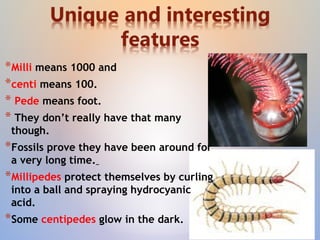
*Milli means 1000 and
*centi means 100.
* Pede means foot.
* They don’t really have that many
though.
*Fossils prove they have been around for
a very long time.
*Millipedes protect themselves by curling
into a ball and spraying hydrocyanic
acid.
*Some centipedes glow in the dark.
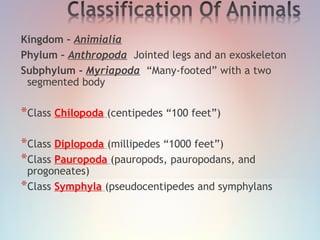
Kingdom – Animialia
Phylum – Anthropoda Jointed legs and an exoskeleton
Subphylum - Myriapoda “Many-footed” with a two
segmented body
*Class Chilopoda (centipedes “100 feet”)
 
*Class Diplopoda (millipedes “1000 feet”)  
*Class Pauropoda (pauropods, pauropodans, and
progoneates)  
*Class Symphyla (pseudocentipedes and symphylans
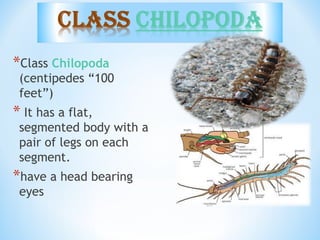
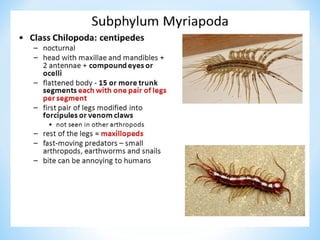
*Class Chilopoda
(centipedes “100
feet”)
* It has a flat,
segmented body with a
pair of legs on each
segment.
*have a head bearing
eyes
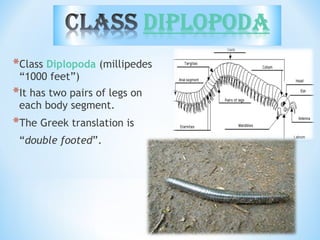
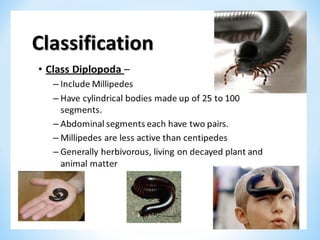
*Class Diplopoda (millipedes
“1000 feet”)
*It has two pairs of legs on
each body segment.
*The Greek translation is
“double footed”.
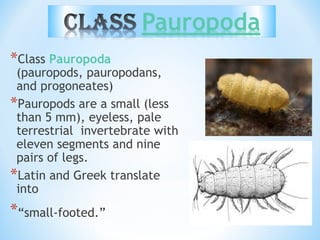
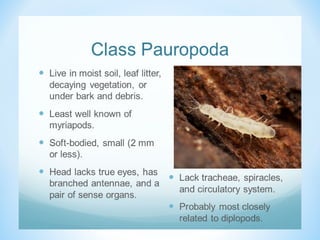
*Class Pauropoda
(pauropods, pauropodans,
and progoneates)
*Pauropods are a small (less
than 5 mm), eyeless, pale
terrestrial invertebrate with
eleven segments and nine
pairs of legs.
*Latin and Greek translate
into
*“small-footed.”
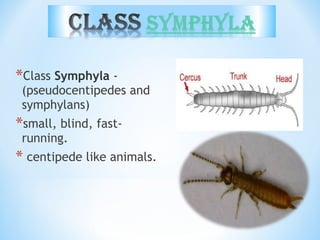
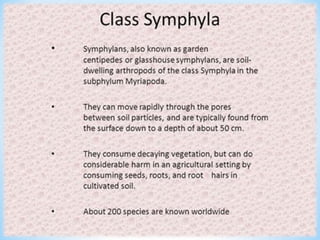
*Class Symphyla -
(pseudocentipedes and
symphylans)
*small, blind, fast-
running.
* centipede like animals.
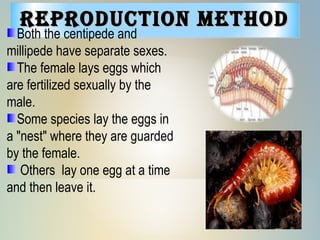
RepRoduction MethodRepRoduction Method
Both the centipede and
millipede have separate sexes.
The female lays eggs which
are fertilized sexually by the
male.
Some species lay the eggs in
a "nest" where they are guarded
by the female.
Others lay one egg at a time
and then leave it.
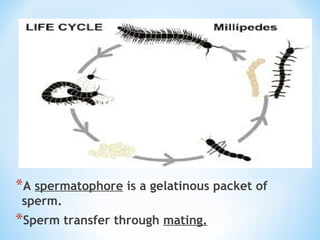
*A spermatophore is a gelatinous packet of
sperm.
*Sperm transfer through mating.
*Millipedes are herbivores mainly
eating dead vegetation.
*Centipedes are carnivores. Their
first pair of legs inject venom to
kill prey. They feed on insects,
earthworms, and slugs. They also
eat dead vegetation.
*The digestive system is a gut that
runs from the mouth to the anus.
*The gut is lined with a protective
outer covering called a chitin,
that is shed every so often.
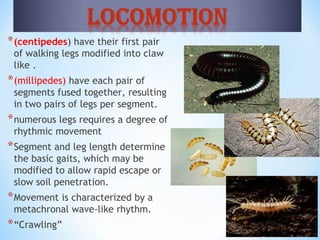
*(centipedes) have their first pair
of walking legs modified into claw
like .
*(millipedes) have each pair of
segments fused together, resulting
in two pairs of legs per segment.
*numerous legs requires a degree of
rhythmic movement
*Segment and leg length determine
the basic gaits, which may be
modified to allow rapid escape or
slow soil penetration.
*Movement is characterized by a
metachronal wave-like rhythm.
*“Crawling”
Living EnvironmEntLiving EnvironmEnt
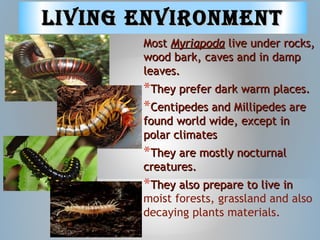
MostMost MyriapodaMyriapoda live under rocks,live under rocks,
wood bark, caves and in dampwood bark, caves and in damp
leaves.leaves.
*They prefer dark warm places.They prefer dark warm places.
*Centipedes and Millipedes areCentipedes and Millipedes are
found world wide, except infound world wide, except in
polar climatespolar climates
*They are mostly nocturnalThey are mostly nocturnal
creatures.creatures.
*They also prepare to live inThey also prepare to live in
moist forests, grassland and also
decaying plants materials.
•Author unknown. Centipedes and Millipedes May 23, 2009.
http://www.geocities.com/thera_maria/centipedesandmillipedes.html
•Photographer Unknown. Hatari Invertebrates May 21,2000. http://www.merkerreptiles.com/Hatarihome.htm
•Photographer Unknown. Centipede Stinger. May 21,2009. http://www.astrobargains.com/images/Gallery/Centipede.jpg
•George Grall/Getty. Images How it Works. May 22,2009. http://animals.howstuffworks.com/insects/insect-pictures9.htm
•Dembsky, Jill. Amazon Rainforest Animals. “Millipede” May 21, 2009.
http://www.dembsky.net/amazon/information3.html#ants
•Gustafson, Todd. Tanganyika train (millipede). May 22,2009. http://www.birdsasart.com/bn197.htm
References
•Chapin, Edward. “Millipede.” The World Book Encyclopedia M Volume12. Chicago: Field Enterprises Educational
Corporation: 1960. Page 472
•Ramel, Gordon. Earth-Life Web Productions. 5/22/2009 MrGordonRamel@yahoo.com
•Enchanted Learning. 5/23/2009. http://www.enchantedlearning.com/subjects/invertebrates/arthropod/Centipede.shtml
•Photo by Diltz, Jason. Seattle Bug Safari. 5/23/2009. www.seattlebugsafari.com/millipedes_centipede...
•Mike Janson and Joyce Pope (consultant editors). Go Pets America dot com. 5/22/2009
http://www.gopetsamerica.com/animals/arthropods.aspx
•Mader, Sylvia. Inquiry into Life 4th
edition. Dubuque, Iowa. Wm C. Brown Publishers, College Division. 1985. pages 608-610
•Microsoft Encarta Reference Library 2005 1993-2004 Microsoft Corporation
•Unknown Phtographer. May 23,2009. http://www.geneseo.edu/~Beary/millipede4shedding%20003.jpg
•R. Bessin & B. Newton. Department of Entomology, University of Kentucky. May 23,2009
http://www.uky.edu/Ag/Entomology/ythfacts/resourc/weebst/wb14/cent2.jpg
Mathew 4:16
The people who live in darkness will see a great light. On those who
live in the dark land of death the light will shine…….
GOD
BLESS
us ALL

Myriapoda 090602161209-phpapp02

  • 1.
  • 2.
    myriapods (Gr. myriads,a myriad, + photos, foot) The term “myriads” means many footed. characterized by an elongated body with many segments, typically many legs, a single pair of antenna, and simple eyes. It is both millipedes, and centipedes. Has mandibles and maxillae Has antenna
  • 3.
  • 4.
    *Bilateral symmetryBilateral symmetry *exoskeletonexoskeleton *Headand segmented trunkHead and segmented trunk *The trunk has many legsThe trunk has many legs (Centipede has one pair for each(Centipede has one pair for each segment, millipede has two pairsegment, millipede has two pair for each segment.)for each segment.) *Centipedes body is flat, whileCentipedes body is flat, while the millipede is more of athe millipede is more of a cylinder shape.cylinder shape. *Head has antenna, eyes andHead has antenna, eyes and mouthmouth
  • 5.
  • 6.
  • 7.
    *Milli means 1000and *centi means 100. * Pede means foot. * They don’t really have that many though. *Fossils prove they have been around for a very long time. *Millipedes protect themselves by curling into a ball and spraying hydrocyanic acid. *Some centipedes glow in the dark.
  • 8.
    Kingdom – Animialia Phylum– Anthropoda Jointed legs and an exoskeleton Subphylum - Myriapoda “Many-footed” with a two segmented body *Class Chilopoda (centipedes “100 feet”)   *Class Diplopoda (millipedes “1000 feet”)   *Class Pauropoda (pauropods, pauropodans, and progoneates)   *Class Symphyla (pseudocentipedes and symphylans
  • 9.
    *Class Chilopoda (centipedes “100 feet”) *It has a flat, segmented body with a pair of legs on each segment. *have a head bearing eyes
  • 11.
    *Class Diplopoda (millipedes “1000feet”) *It has two pairs of legs on each body segment. *The Greek translation is “double footed”.
  • 13.
    *Class Pauropoda (pauropods, pauropodans, andprogoneates) *Pauropods are a small (less than 5 mm), eyeless, pale terrestrial invertebrate with eleven segments and nine pairs of legs. *Latin and Greek translate into *“small-footed.”
  • 15.
    *Class Symphyla - (pseudocentipedesand symphylans) *small, blind, fast- running. * centipede like animals.
  • 17.
    RepRoduction MethodRepRoduction Method Boththe centipede and millipede have separate sexes. The female lays eggs which are fertilized sexually by the male. Some species lay the eggs in a "nest" where they are guarded by the female. Others lay one egg at a time and then leave it.
  • 18.
    *A spermatophore isa gelatinous packet of sperm. *Sperm transfer through mating.
  • 19.
    *Millipedes are herbivoresmainly eating dead vegetation. *Centipedes are carnivores. Their first pair of legs inject venom to kill prey. They feed on insects, earthworms, and slugs. They also eat dead vegetation. *The digestive system is a gut that runs from the mouth to the anus. *The gut is lined with a protective outer covering called a chitin, that is shed every so often.
  • 20.
    *(centipedes) have theirfirst pair of walking legs modified into claw like . *(millipedes) have each pair of segments fused together, resulting in two pairs of legs per segment. *numerous legs requires a degree of rhythmic movement *Segment and leg length determine the basic gaits, which may be modified to allow rapid escape or slow soil penetration. *Movement is characterized by a metachronal wave-like rhythm. *“Crawling”
  • 21.
    Living EnvironmEntLiving EnvironmEnt MostMostMyriapodaMyriapoda live under rocks,live under rocks, wood bark, caves and in dampwood bark, caves and in damp leaves.leaves. *They prefer dark warm places.They prefer dark warm places. *Centipedes and Millipedes areCentipedes and Millipedes are found world wide, except infound world wide, except in polar climatespolar climates *They are mostly nocturnalThey are mostly nocturnal creatures.creatures. *They also prepare to live inThey also prepare to live in moist forests, grassland and also decaying plants materials.
  • 22.
    •Author unknown. Centipedesand Millipedes May 23, 2009. http://www.geocities.com/thera_maria/centipedesandmillipedes.html •Photographer Unknown. Hatari Invertebrates May 21,2000. http://www.merkerreptiles.com/Hatarihome.htm •Photographer Unknown. Centipede Stinger. May 21,2009. http://www.astrobargains.com/images/Gallery/Centipede.jpg •George Grall/Getty. Images How it Works. May 22,2009. http://animals.howstuffworks.com/insects/insect-pictures9.htm •Dembsky, Jill. Amazon Rainforest Animals. “Millipede” May 21, 2009. http://www.dembsky.net/amazon/information3.html#ants •Gustafson, Todd. Tanganyika train (millipede). May 22,2009. http://www.birdsasart.com/bn197.htm References •Chapin, Edward. “Millipede.” The World Book Encyclopedia M Volume12. Chicago: Field Enterprises Educational Corporation: 1960. Page 472 •Ramel, Gordon. Earth-Life Web Productions. 5/22/2009 MrGordonRamel@yahoo.com •Enchanted Learning. 5/23/2009. http://www.enchantedlearning.com/subjects/invertebrates/arthropod/Centipede.shtml •Photo by Diltz, Jason. Seattle Bug Safari. 5/23/2009. www.seattlebugsafari.com/millipedes_centipede... •Mike Janson and Joyce Pope (consultant editors). Go Pets America dot com. 5/22/2009 http://www.gopetsamerica.com/animals/arthropods.aspx •Mader, Sylvia. Inquiry into Life 4th edition. Dubuque, Iowa. Wm C. Brown Publishers, College Division. 1985. pages 608-610 •Microsoft Encarta Reference Library 2005 1993-2004 Microsoft Corporation •Unknown Phtographer. May 23,2009. http://www.geneseo.edu/~Beary/millipede4shedding%20003.jpg •R. Bessin & B. Newton. Department of Entomology, University of Kentucky. May 23,2009 http://www.uky.edu/Ag/Entomology/ythfacts/resourc/weebst/wb14/cent2.jpg
  • 23.
    Mathew 4:16 The peoplewho live in darkness will see a great light. On those who live in the dark land of death the light will shine……. GOD BLESS us ALL