ROLE OF VECTORS & ANIMAL
Reservoir IN TRANSMISSION OF
PLAGUE
Presented by :
ANIL
KUMAR
M.Sc. PHE IIND
ROLE OF VECTORS AND ANIMAL RESORVOIR IN TRANSMISSION OF PLAGUE
INTRODUCTION
Plague is a zoonotic disease caused by highly virulent bacteria Yersinia
pestis.
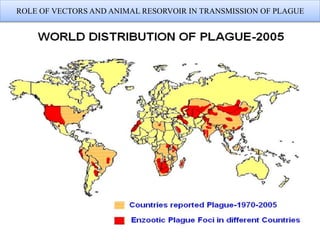
Distribution of plague is worldwide maintained by wild rodents and
their fleas in the natural foci and localized infection.
Disease takes three main forms: Bubonic, Septicemic and Pneumonic.
Untreated bubonic plague can lead to secondary pneumonic stage
with 100% mortality.
Plague has lead to three pandemics.
 Yersinia pestis bacteria can also be used as biological weapon.
WHO identify plague as emerging disease.
ROLE OF VECTORS AND ANIMAL RESORVOIR IN TRANSMISSION OF PLAGUE
HISTORY
540-750 AD: Justinian’s plague
50% - 60% people died of Rome along with the death of rats
Fall of the Roman Empire
1346-1400 AD: Black Death pandemic
Quarantine
~30 million European population died
Fall of the feudal system
1660 : Great Plague of London
1865 : Third epidemic in China and India
12 million people died
1894 : Alexandre Yersin and Shibasaburo Kitasato independently find the plague
bacterium in samples from humans and rats during the Hong Kong epidemic
1895 : Wild rodents are confirmed as hosts of plague when wild marmots in Mongolia
and Russia are found infected.
1896 : Waldemar Haffkine develops a partially effective heat-killed vaccine and uses it
during an outbreak in Bombay.
1897 : Yersin proposes a link between rats and plague
1905 : William Glenn Liston provides proof of fleas as the vector of plague.
1914 : Charles James Martin and William Bacot describe transmission of Y. pestis by
rat fleas, Xenopsylla cheopis, with blocked foreguts.
ROLE OF VECTORS AND ANIMAL RESORVOIR IN TRANSMISSION OF PLAGUE
Taxonomical hierarchy of Yersinia
KINGDOM : Eubacteria
PHYLUM : Proteobacteria
CLASS : Gammaproteobacteria
ORDER : Enterobacteriales
FAMILY : Enterobacteriaceae
GENUS : Yersinia
SPECIES : pestis, enterocolitica, pseudotuberclosis
ROLE OF VECTORS AND ANIMAL RESORVOIR IN TRANSMISSION OF PLAGUE
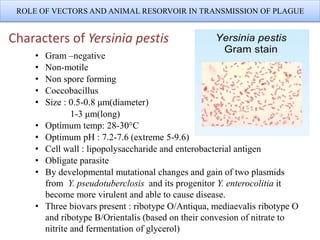
Characters of Yersinia pestis
• Gram –negative
• Non-motile
• Non spore forming
• Coccobacillus
• Size : 0.5-0.8 μm(diameter)
1-3 μm(long)
• Optimum temp: 28-30°C
• Optimum pH : 7.2-7.6 (extreme 5-9.6)
• Cell wall : lipopolysaccharide and enterobacterial antigen
• Obligate parasite
• By developmental mutational changes and gain of two plasmids
from Y. pseudotuberclosis and its progenitor Y. enterocolitia it
become more virulent and able to cause disease.
• Three biovars present : ribotype O/Antiqua, mediaevalis ribotype O
and ribotype B/Orientalis (based on their convesion of nitrate to
nitrite and fermentation of glycerol)
DISTRIBUTION
ROLE OF VECTORS AND ANIMAL RESORVOIR IN TRANSMISSION OF PLAGUE
Group Number of species
Rodents More than 200
Carnivores 20
Lagomorphs 14
Insectivores 4
Artiodactyla 3
Primates 2
Marsupials 2
Animals naturally infected with Y. pestis
(Data represent relative number of species in each
group and may not include all species ever found
to have been infected : Poland and Barnes, 1979;
Pollitzer,1954)
Region Animal resorvoir Primary vector
Common name Scientific name Common name Scientific name
INDIA
Indian gerbil Tatera indica Rat fleas Xenopsylla cheopis
Rat Rattus rattus Gerbil fleas Xenopsylla astia
Nosopsyllus punjabensis
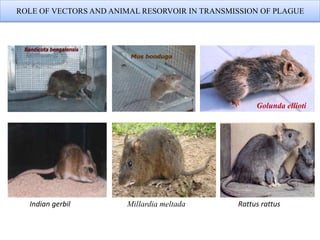
Bandicoot rat Bandicota bengalensis
Bandicota indica
Metad Millardia meltada
Indian field
mouse
Mus booduga
Spiny field
mouse
Mus platythrix
Indian bush rat Golunda ellioti
Palm squirrel Funambulus species
ROLE OF VECTORS AND ANIMAL RESORVOIR IN TRANSMISSION OF PLAGUE
Major wild rodents and flea vectors of natural foci
*Sentinal animal :
ROLE OF VECTORS AND ANIMAL RESORVOIR IN TRANSMISSION OF PLAGUE
Indian gerbil Millardia meltada Rattus rattus
Golunda ellioti
ROLE OF VECTORS AND ANIMAL RESORVOIR IN TRANSMISSION OF PLAGUE
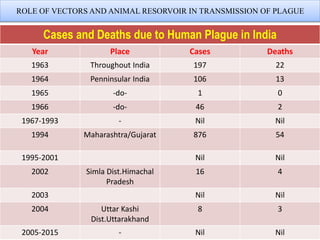
Cases and Deaths due to Human Plague in India
Year Place Cases Deaths
1963 Throughout India 197 22
1964 Penninsular India 106 13
1965 -do- 1 0
1966 -do- 46 2
1967-1993 - Nil Nil
1994 Maharashtra/Gujarat 876 54
1995-2001 Nil Nil
2002 Simla Dist.Himachal
Pradesh
16 4
2003 Nil Nil
2004 Uttar Kashi
Dist.Uttarakhand
8 3
2005-2015 - Nil Nil
ROLE OF VECTORS AND ANIMAL RESORVOIR IN TRANSMISSION OF PLAGUE
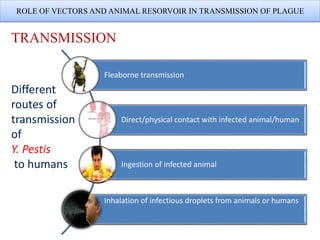
Fleaborne transmission
Direct/physical contact with infected animal/human
Ingestion of infected animal
Inhalation of infectious droplets from animals or humans
Different
routes of
transmission
of
Y. Pestis
to humans
TRANSMISSION
ROLE OF VECTORS AND ANIMAL RESORVOIR IN TRANSMISSION OF PLAGUE
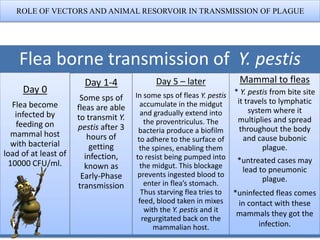
Flea borne transmission of Y. pestis
Day 0
Flea become
infected by
feeding on
mammal host
with bacterial
load of at least of
10000 CFU/ml.
Day 1-4
Some sps of
fleas are able
to transmit Y.
pestis after 3
hours of
getting
infection,
known as
Early-Phase
transmission
Day 5 – later
In some sps of fleas Y. pestis
accumulate in the midgut
and gradually extend into
the proventriculus. The
bacteria produce a biofilm
to adhere to the surface of
the spines, enabling them
to resist being pumped into
the midgut. This blockage
prevents ingested blood to
enter in flea’s stomach.
Thus starving flea tries to
feed, blood taken in mixes
with the Y. pestis and it
regurgitated back on the
mammalian host.
Mammal to fleas
* Y. pestis from bite site
it travels to lymphatic
system where it
multiplies and spread
throughout the body
and cause bubonic
plague.
*untreated cases may
lead to pneumonic
plague.
*uninfected fleas comes
in contact with these
mammals they got the
infection.
ROLE OF VECTORS AND ANIMAL RESORVOIR IN TRANSMISSION OF PLAGUE
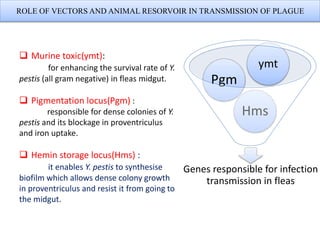
Genes responsible for infection
transmission in fleas
Hms
Pgm
ymt
 Murine toxic(ymt):
for enhancing the survival rate of Y.
pestis (all gram negative) in fleas midgut.
 Pigmentation locus(Pgm) :
responsible for dense colonies of Y.
pestis and its blockage in proventriculus
and iron uptake.
 Hemin storage locus(Hms) :
it enables Y. pestis to synthesise
biofilm which allows dense colony growth
in proventriculus and resist it from going to
the midgut.
ROLE OF VECTORS AND ANIMAL RESORVOIR IN TRANSMISSION OF PLAGUE
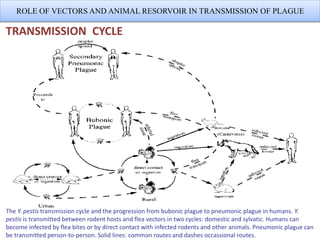
TRANSMISSION CYCLE
The Y. pestis transmission cycle and the progression from bubonic plague to pneumonic plague in humans. Y.
pestis is transmitted between rodent hosts and flea vectors in two cycles: domestic and sylvatic. Humans can
become infected by flea bites or by direct contact with infected rodents and other animals. Pneumonic plague can
be transmitted person-to-person. Solid lines: common routes and dashes occassional routes.
ROLE OF VECTORS AND ANIMAL RESORVOIR IN TRANSMISSION OF PLAGUE
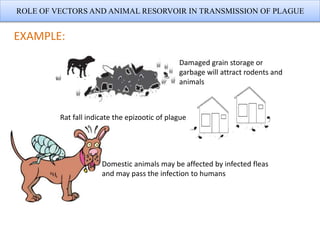
EXAMPLE:
Damaged grain storage or
garbage will attract rodents and
animals
Domestic animals may be affected by infected fleas
and may pass the infection to humans
Rat fall indicate the epizootic of plague
ROLE OF VECTORS AND ANIMAL RESORVOIR IN TRANSMISSION OF PLAGUE
Continued…
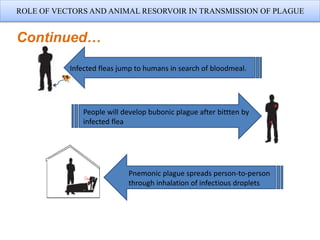
Infected fleas jump to humans in search of bloodmeal.
People will develop bubonic plague after bittten by
infected flea
Pnemonic plague spreads person-to-person
through inhalation of infectious droplets
Reference
s : Plague by Rachel C. Abbott and Tonie E. Rocke , National
Wildlife Health Centre, Circular 1372, US department of
Interior and US department of geological survey,2012
Robert D. Perry and Jacqueline D. Fetherston, Yersinia
pestis – Etiology Agent of plague, Clinical Microbiology
Reviews, Jan. 1997, p. 35-66., Vol 10(1)
Angela Clem and S Galwankar., plague: A Decade Since
the 1994 Outbreaks in India , JAPI, Vol. 53., May 2005
Plague, N. Balakrishnan., National Centre for Disease
Control
Plague
Plague

Plague

  • 1.
    ROLE OF VECTORS& ANIMAL Reservoir IN TRANSMISSION OF PLAGUE Presented by : ANIL KUMAR M.Sc. PHE IIND
  • 2.
    ROLE OF VECTORSAND ANIMAL RESORVOIR IN TRANSMISSION OF PLAGUE INTRODUCTION Plague is a zoonotic disease caused by highly virulent bacteria Yersinia pestis. Distribution of plague is worldwide maintained by wild rodents and their fleas in the natural foci and localized infection. Disease takes three main forms: Bubonic, Septicemic and Pneumonic. Untreated bubonic plague can lead to secondary pneumonic stage with 100% mortality. Plague has lead to three pandemics.  Yersinia pestis bacteria can also be used as biological weapon. WHO identify plague as emerging disease.
  • 3.
    ROLE OF VECTORSAND ANIMAL RESORVOIR IN TRANSMISSION OF PLAGUE HISTORY 540-750 AD: Justinian’s plague 50% - 60% people died of Rome along with the death of rats Fall of the Roman Empire 1346-1400 AD: Black Death pandemic Quarantine ~30 million European population died Fall of the feudal system 1660 : Great Plague of London 1865 : Third epidemic in China and India 12 million people died 1894 : Alexandre Yersin and Shibasaburo Kitasato independently find the plague bacterium in samples from humans and rats during the Hong Kong epidemic 1895 : Wild rodents are confirmed as hosts of plague when wild marmots in Mongolia and Russia are found infected. 1896 : Waldemar Haffkine develops a partially effective heat-killed vaccine and uses it during an outbreak in Bombay. 1897 : Yersin proposes a link between rats and plague 1905 : William Glenn Liston provides proof of fleas as the vector of plague. 1914 : Charles James Martin and William Bacot describe transmission of Y. pestis by rat fleas, Xenopsylla cheopis, with blocked foreguts.
  • 5.
    ROLE OF VECTORSAND ANIMAL RESORVOIR IN TRANSMISSION OF PLAGUE Taxonomical hierarchy of Yersinia KINGDOM : Eubacteria PHYLUM : Proteobacteria CLASS : Gammaproteobacteria ORDER : Enterobacteriales FAMILY : Enterobacteriaceae GENUS : Yersinia SPECIES : pestis, enterocolitica, pseudotuberclosis
  • 6.
    ROLE OF VECTORSAND ANIMAL RESORVOIR IN TRANSMISSION OF PLAGUE Characters of Yersinia pestis • Gram –negative • Non-motile • Non spore forming • Coccobacillus • Size : 0.5-0.8 μm(diameter) 1-3 μm(long) • Optimum temp: 28-30°C • Optimum pH : 7.2-7.6 (extreme 5-9.6) • Cell wall : lipopolysaccharide and enterobacterial antigen • Obligate parasite • By developmental mutational changes and gain of two plasmids from Y. pseudotuberclosis and its progenitor Y. enterocolitia it become more virulent and able to cause disease. • Three biovars present : ribotype O/Antiqua, mediaevalis ribotype O and ribotype B/Orientalis (based on their convesion of nitrate to nitrite and fermentation of glycerol)
  • 7.
    DISTRIBUTION ROLE OF VECTORSAND ANIMAL RESORVOIR IN TRANSMISSION OF PLAGUE Group Number of species Rodents More than 200 Carnivores 20 Lagomorphs 14 Insectivores 4 Artiodactyla 3 Primates 2 Marsupials 2 Animals naturally infected with Y. pestis (Data represent relative number of species in each group and may not include all species ever found to have been infected : Poland and Barnes, 1979; Pollitzer,1954)
  • 8.
    Region Animal resorvoirPrimary vector Common name Scientific name Common name Scientific name INDIA Indian gerbil Tatera indica Rat fleas Xenopsylla cheopis Rat Rattus rattus Gerbil fleas Xenopsylla astia Nosopsyllus punjabensis Bandicoot rat Bandicota bengalensis Bandicota indica Metad Millardia meltada Indian field mouse Mus booduga Spiny field mouse Mus platythrix Indian bush rat Golunda ellioti Palm squirrel Funambulus species ROLE OF VECTORS AND ANIMAL RESORVOIR IN TRANSMISSION OF PLAGUE Major wild rodents and flea vectors of natural foci *Sentinal animal :
  • 9.
    ROLE OF VECTORSAND ANIMAL RESORVOIR IN TRANSMISSION OF PLAGUE Indian gerbil Millardia meltada Rattus rattus Golunda ellioti
  • 10.
    ROLE OF VECTORSAND ANIMAL RESORVOIR IN TRANSMISSION OF PLAGUE
  • 11.
    ROLE OF VECTORSAND ANIMAL RESORVOIR IN TRANSMISSION OF PLAGUE Cases and Deaths due to Human Plague in India Year Place Cases Deaths 1963 Throughout India 197 22 1964 Penninsular India 106 13 1965 -do- 1 0 1966 -do- 46 2 1967-1993 - Nil Nil 1994 Maharashtra/Gujarat 876 54 1995-2001 Nil Nil 2002 Simla Dist.Himachal Pradesh 16 4 2003 Nil Nil 2004 Uttar Kashi Dist.Uttarakhand 8 3 2005-2015 - Nil Nil
  • 12.
    ROLE OF VECTORSAND ANIMAL RESORVOIR IN TRANSMISSION OF PLAGUE Fleaborne transmission Direct/physical contact with infected animal/human Ingestion of infected animal Inhalation of infectious droplets from animals or humans Different routes of transmission of Y. Pestis to humans TRANSMISSION
  • 13.
    ROLE OF VECTORSAND ANIMAL RESORVOIR IN TRANSMISSION OF PLAGUE Flea borne transmission of Y. pestis Day 0 Flea become infected by feeding on mammal host with bacterial load of at least of 10000 CFU/ml. Day 1-4 Some sps of fleas are able to transmit Y. pestis after 3 hours of getting infection, known as Early-Phase transmission Day 5 – later In some sps of fleas Y. pestis accumulate in the midgut and gradually extend into the proventriculus. The bacteria produce a biofilm to adhere to the surface of the spines, enabling them to resist being pumped into the midgut. This blockage prevents ingested blood to enter in flea’s stomach. Thus starving flea tries to feed, blood taken in mixes with the Y. pestis and it regurgitated back on the mammalian host. Mammal to fleas * Y. pestis from bite site it travels to lymphatic system where it multiplies and spread throughout the body and cause bubonic plague. *untreated cases may lead to pneumonic plague. *uninfected fleas comes in contact with these mammals they got the infection.
  • 14.
    ROLE OF VECTORSAND ANIMAL RESORVOIR IN TRANSMISSION OF PLAGUE Genes responsible for infection transmission in fleas Hms Pgm ymt  Murine toxic(ymt): for enhancing the survival rate of Y. pestis (all gram negative) in fleas midgut.  Pigmentation locus(Pgm) : responsible for dense colonies of Y. pestis and its blockage in proventriculus and iron uptake.  Hemin storage locus(Hms) : it enables Y. pestis to synthesise biofilm which allows dense colony growth in proventriculus and resist it from going to the midgut.
  • 15.
    ROLE OF VECTORSAND ANIMAL RESORVOIR IN TRANSMISSION OF PLAGUE TRANSMISSION CYCLE The Y. pestis transmission cycle and the progression from bubonic plague to pneumonic plague in humans. Y. pestis is transmitted between rodent hosts and flea vectors in two cycles: domestic and sylvatic. Humans can become infected by flea bites or by direct contact with infected rodents and other animals. Pneumonic plague can be transmitted person-to-person. Solid lines: common routes and dashes occassional routes.
  • 16.
    ROLE OF VECTORSAND ANIMAL RESORVOIR IN TRANSMISSION OF PLAGUE EXAMPLE: Damaged grain storage or garbage will attract rodents and animals Domestic animals may be affected by infected fleas and may pass the infection to humans Rat fall indicate the epizootic of plague
  • 17.
    ROLE OF VECTORSAND ANIMAL RESORVOIR IN TRANSMISSION OF PLAGUE Continued… Infected fleas jump to humans in search of bloodmeal. People will develop bubonic plague after bittten by infected flea Pnemonic plague spreads person-to-person through inhalation of infectious droplets
  • 18.
    Reference s : Plagueby Rachel C. Abbott and Tonie E. Rocke , National Wildlife Health Centre, Circular 1372, US department of Interior and US department of geological survey,2012 Robert D. Perry and Jacqueline D. Fetherston, Yersinia pestis – Etiology Agent of plague, Clinical Microbiology Reviews, Jan. 1997, p. 35-66., Vol 10(1) Angela Clem and S Galwankar., plague: A Decade Since the 1994 Outbreaks in India , JAPI, Vol. 53., May 2005 Plague, N. Balakrishnan., National Centre for Disease Control