
Plague: Introduction, History,
Microbiology, Epidemiology
Plague
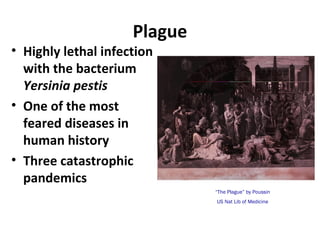
• Highly lethal infection
with the bacterium
Yersinia pestis
• One of the most
feared diseases in
human history
• Three catastrophic
pandemics
“The Plague” by Poussin
US Nat Lib of Medicine
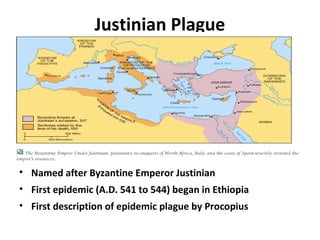
Justinian Plague
• Named after Byzantine Emperor Justinian
• First epidemic (A.D. 541 to 544) began in Ethiopia
• First description of epidemic plague by Procopius
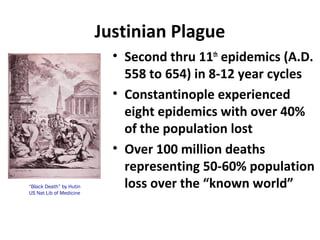
Justinian Plague
• Second thru 11th
epidemics (A.D.
558 to 654) in 8-12 year cycles
• Constantinople experienced
eight epidemics with over 40%
of the population lost
• Over 100 million deaths
representing 50-60% population
loss over the “known world”“Black Death” by Hutin
US Nat Lib of Medicine
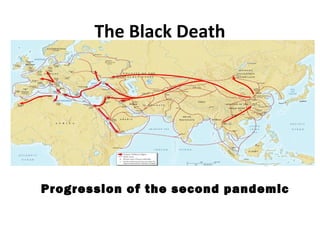
The Black Death
• Imported into Europe from western
movement on trans-Asian silk road
– Siege of Caffa?
• First epidemic (1347 to 1351) killed 17-28
million in Europe, another 20 million by the
end of the 14th
century
– Approximately 40% of the European population
• Cyclical epidemics lasting into the 17th
century
The Black Death
Progression of the second pandemic
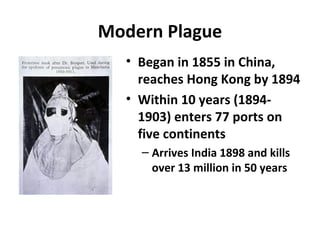
Modern Plague
• Began in 1855 in China,
reaches Hong Kong by 1894
• Within 10 years (1894-
1903) enters 77 ports on
five continents
– Arrives India 1898 and kills
over 13 million in 50 years
Modern Plague
• Epizootic foci now well-established worldwide
except Australia
– Three periods of increased activity
• Mid- 1960’s
• 1973 – 1978
• Mid- 1980’s
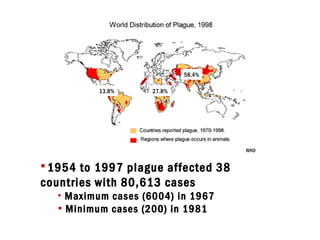
 1954 to 1997 plague affected 38
countries with 80,613 cases
• Maximum cases (6004) in 1967
• Minimum cases (200) in 1981
58.4%
27.8%13.8%
WHO
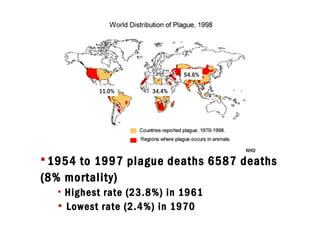
 1954 to 1997 plague deaths 6587 deaths
(8% mortality)
• Highest rate (23.8%) in 1961
• Lowest rate (2.4%) in 1970
54.6%
34.4%11.0%
WHO
Modern Plague
• 1998-2006 cases have totaled 14,424 with
1,244 deaths (8.6% mortality)
• Africa represented over 90% of the world’s
total cases
• Four areas have had recent human plague
outbreaks
– India – 1994, 2002
– Indonesia – 1997
– Algeria – 2003
– Democratic Republic of Congo – 2005
BW Agent
• General Shiro Ishii (Dr.), leader of Japanese Unit
731, WW II
– Infected POWs and performed vivisection (some while
living)
– Experimented weaponizing plague
• Dropped infected fleas in at least three separate occasions on
Chinese cities with subsequent plague outbreaks
• Mission “Cherry Blossoms at Night” was a plan to repeat in
California
• Plague researched or developed by former US and
Soviet Union BW programs
– US abandoned plague work
Microbiology - History
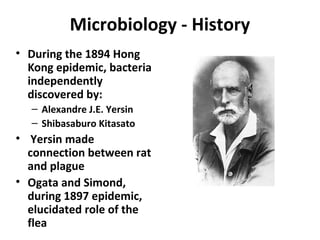
• During the 1894 Hong
Kong epidemic, bacteria
independently
discovered by:
– Alexandre J.E. Yersin
– Shibasaburo Kitasato
• Yersin made
connection between rat
and plague
• Ogata and Simond,
during 1897 epidemic,
elucidated role of the
flea
History
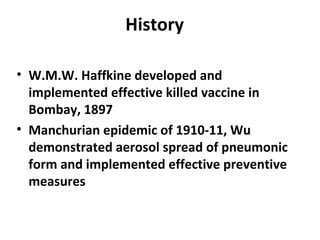
• W.M.W. Haffkine developed and
implemented effective killed vaccine in
Bombay, 1897
• Manchurian epidemic of 1910-11, Wu
demonstrated aerosol spread of pneumonic
form and implemented effective preventive
measures
Microbiology
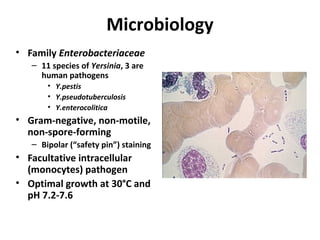
• Family Enterobacteriaceae
– 11 species of Yersinia, 3 are
human pathogens
• Y.pestis
• Y.pseudotuberculosis
• Y.enterocolitica
• Gram-negative, non-motile,
non-spore-forming
– Bipolar (“safety pin”) staining
• Facultative intracellular
(monocytes) pathogen
• Optimal growth at 30°C and
pH 7.2-7.6
Microbiology
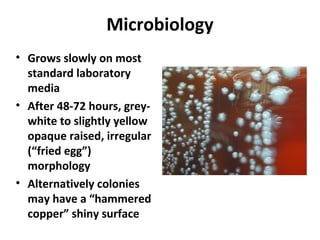
• Grows slowly on most
standard laboratory
media
• After 48-72 hours, grey-
white to slightly yellow
opaque raised, irregular
(“fried egg”)
morphology
• Alternatively colonies
may have a “hammered
copper” shiny surface
Plague Epidemiology
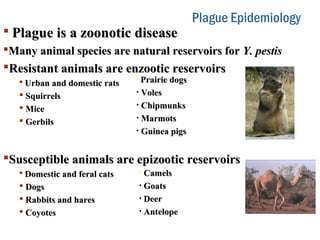
 Plague is a zoonotic diseasePlague is a zoonotic disease
Many animal species are natural reservoirs forMany animal species are natural reservoirs for Y. pestisY. pestis
Resistant animals are enzootic reservoirsResistant animals are enzootic reservoirs
 Urban and domestic ratsUrban and domestic rats
 SquirrelsSquirrels
 MiceMice
 GerbilsGerbils
Susceptible animals are epizootic reservoirsSusceptible animals are epizootic reservoirs
 Domestic and feral catsDomestic and feral cats
 DogsDogs
 Rabbits and haresRabbits and hares
 CoyotesCoyotes
• Prairie dogsPrairie dogs
• VolesVoles
• ChipmunksChipmunks
• MarmotsMarmots
• Guinea pigsGuinea pigs
• CamelsCamels
• GoatsGoats
• DeerDeer
• AntelopeAntelope
Epidemiology
Epidemiology
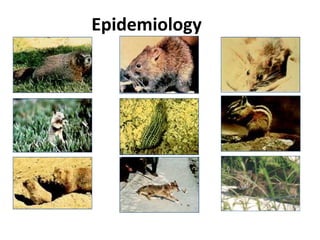
• More than 200 mammalian species in 73
genera are of epidemiological importance
• Humans are accidental hosts
• Fleas transmit -- feed on bacteremic animals
– Only 30 (of over 1500) flea species are proven
vectors of plague
– Not transmitted transovarially
Yersinia pestis
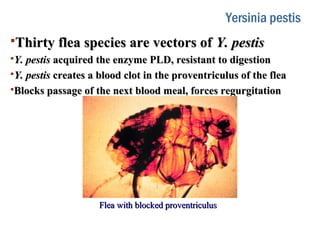
Thirty flea species are vectors ofThirty flea species are vectors of Y. pestisY. pestis
Y. pestisY. pestis acquired the enzyme PLD, resistant to digestionacquired the enzyme PLD, resistant to digestion
Y. pestisY. pestis creates a blood clot in the proventriculus of the fleacreates a blood clot in the proventriculus of the flea
Blocks passage of the next blood meal, forces regurgitationBlocks passage of the next blood meal, forces regurgitation
Flea with blocked proventriculusFlea with blocked proventriculus
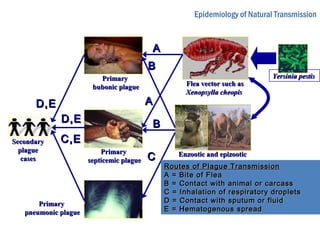
Epidemiology of Natural Transmission
Flea vector such asFlea vector such as
Xenopsylla cheopisXenopsylla cheopis
Enzootic and epizooticEnzootic and epizootic
animal reservoirsanimal reservoirs
Yersinia pestisYersinia pestisPrimaryPrimary
bubonic plaguebubonic plague
PrimaryPrimary
septicemic plaguesepticemic plague
PrimaryPrimary
pneumonic plaguepneumonic plague
AA
AA
SecondarySecondary
plagueplague
casescases
BB
BB
CC
C,EC,E
D,ED,E
D,ED,E
Routes of Plague TransmissionRoutes of Plague Transmission
A = Bite of FleaA = Bite of Flea
B = Contact with animal or carcassB = Contact with animal or carcass
C = Inhalation of respiratory dropletsC = Inhalation of respiratory droplets
D = Contact with sputum or fluidD = Contact with sputum or fluid
E = Hematogenous spreadE = Hematogenous spread
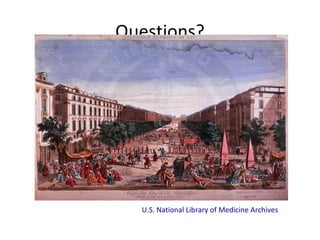
Questions?
U.S. National Library of Medicine Archives
Plague: Diagnosis and
Treatment
Course Number
TRNHUM-00343
Rev.00
Document prepared by: USAMRIID/J. Lawler
Info Works # 24914-101-G8L-GEG-00343
Activated June 2006
Differential Diagnosis for
Septicemic Plague
• Meningococcemia
• Gram-negative sepsis
• Rickettsiosis
• For Pneumonic plague: Gram negative
bacteria recovered from sputum, fulminate
pneumonia and bloody sputum in a healthy,
non-immunocompromised patient
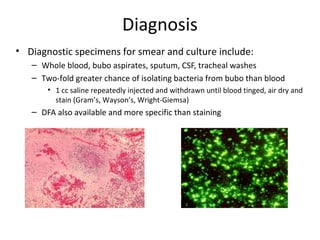
Diagnosis
• Diagnostic specimens for smear and culture include:
– Whole blood, bubo aspirates, sputum, CSF, tracheal washes
– Two-fold greater chance of isolating bacteria from bubo than blood
• 1 cc saline repeatedly injected and withdrawn until blood tinged, air dry and
stain (Gram’s, Wayson’s, Wright-Giemsa)
– DFA also available and more specific than staining
Diagnosis
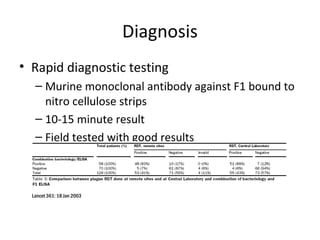
• Rapid diagnostic testing
– Murine monoclonal antibody against F1 bound to
nitro cellulose strips
– 10-15 minute result
– Field tested with good results
Lancet 361: 18 Jan 2003
Management
 Standard precautions PLUS:
 Suspect pneumonic plague:
 Droplet precautions
 Until 48-72 hrs of appropriate antibiotics therapy
 Confirmed pneumonic plague:
 Droplet precautions
 Until sputum cultures negative
 Aspirate bubo, do not I&D
MMWR 1996;45:RR-14
Management
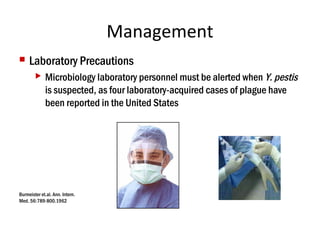
 Laboratory Precautions
 Microbiology laboratory personnel must be alerted when Y. pestis
is suspected, as four laboratory-acquired cases of plague have
been reported in the United States
Burmeister et.al. Ann. Intern.
Med. 56:789-800.1962
Treatment
• Since 1948, streptomycin has remained the drug of
choice for bubonic, septicemic and pneumonic
plague and is FDA approved
• Streptomycin is rarely used in U.S. due to limited
supply
• Gentamicin is used instead
• No controlled comparative trials for plague therapy,
but a recent review of 75 cases in New Mexico,
demonstrated that gentamicin alone or in
combination with doxycycline was as efficacious as
streptomycin for treating humans with plague
Boulangerf et. Al. Clin. Infect. Dis 38:663-669.2004
Treatment
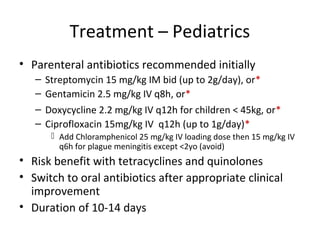
• Parenteral antibiotics recommended initially
– Streptomycin 1gm IM bid; or*
– Gentamicin 5 mg/kg IV daily or 2mg/kg loading dose then
1.7 mg/kg IV q8h; or*
– Doxycycline 200 mg load followed by 100mg q12h; or*
– Ciprofloxacin 400 mg IV or 500mg PO q12h*
 Add Chloramphenicol 25 mg/kg IV loading dose then 15 mg/kg IV
q6h for plague meningitis
• Switch to oral antibiotics after clinical improvement
• Duration of 10-14 days
Treatment – Pediatrics
• Parenteral antibiotics recommended initially
– Streptomycin 15 mg/kg IM bid (up to 2g/day), or*
– Gentamicin 2.5 mg/kg IV q8h, or*
– Doxycycline 2.2 mg/kg IV q12h for children < 45kg, or*
– Ciprofloxacin 15mg/kg IV q12h (up to 1g/day)*
 Add Chloramphenicol 25 mg/kg IV loading dose then 15 mg/kg IV
q6h for plague meningitis except <2yo (avoid)
• Risk benefit with tetracyclines and quinolones
• Switch to oral antibiotics after appropriate clinical
improvement
• Duration of 10-14 days
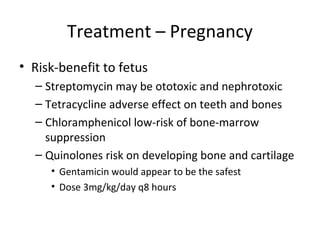
Treatment – Pregnancy
• Risk-benefit to fetus
– Streptomycin may be ototoxic and nephrotoxic
– Tetracycline adverse effect on teeth and bones
– Chloramphenicol low-risk of bone-marrow
suppression
– Quinolones risk on developing bone and cartilage
• Gentamicin would appear to be the safest
• Dose 3mg/kg/day q8 hours
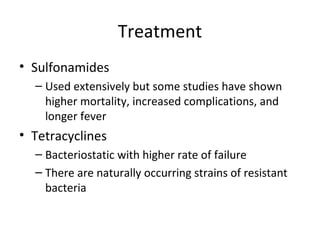
Treatment
• Sulfonamides
– Used extensively but some studies have shown
higher mortality, increased complications, and
longer fever
• Tetracyclines
– Bacteriostatic with higher rate of failure
– There are naturally occurring strains of resistant
bacteria
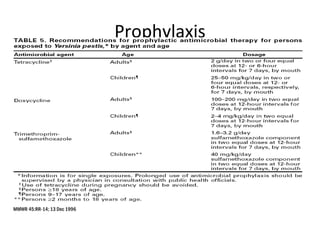
Prophylaxis
MMWR 45:RR-14; 13 Dec 1996
Prophylaxis
• Asymptomatic individuals such as family
members health care providers or other close
contacts with persons with untreated
pneumonic plague should receive antibiotic
prophylaxis for 7 days
• Close contact is contact with a patient at < 2
meters
• Laboratory workers exposed to an accident
which may have generated an infectious
aerosol need prophylaxis
Prophylaxis
• Hospital personnel who are observing
recommended isolation procedures do not
require prophylactic therapy, nor do contacts
of patients with bubonic plague
• However, people who were in the same
environment and who were potentially
exposed to the same source of infection as
the contact cases should be given prophylactic
antibiotics

Plague kaki 2016 11 30

  • 1.
  • 2.
    Plague • Highly lethalinfection with the bacterium Yersinia pestis • One of the most feared diseases in human history • Three catastrophic pandemics “The Plague” by Poussin US Nat Lib of Medicine
  • 3.
    Justinian Plague • Namedafter Byzantine Emperor Justinian • First epidemic (A.D. 541 to 544) began in Ethiopia • First description of epidemic plague by Procopius
  • 4.
    Justinian Plague • Secondthru 11th epidemics (A.D. 558 to 654) in 8-12 year cycles • Constantinople experienced eight epidemics with over 40% of the population lost • Over 100 million deaths representing 50-60% population loss over the “known world”“Black Death” by Hutin US Nat Lib of Medicine
  • 5.
    The Black Death •Imported into Europe from western movement on trans-Asian silk road – Siege of Caffa? • First epidemic (1347 to 1351) killed 17-28 million in Europe, another 20 million by the end of the 14th century – Approximately 40% of the European population • Cyclical epidemics lasting into the 17th century
  • 6.
    The Black Death Progressionof the second pandemic
  • 7.
    Modern Plague • Beganin 1855 in China, reaches Hong Kong by 1894 • Within 10 years (1894- 1903) enters 77 ports on five continents – Arrives India 1898 and kills over 13 million in 50 years
  • 8.
    Modern Plague • Epizooticfoci now well-established worldwide except Australia – Three periods of increased activity • Mid- 1960’s • 1973 – 1978 • Mid- 1980’s
  • 9.
     1954 to1997 plague affected 38 countries with 80,613 cases • Maximum cases (6004) in 1967 • Minimum cases (200) in 1981 58.4% 27.8%13.8% WHO
  • 10.
     1954 to1997 plague deaths 6587 deaths (8% mortality) • Highest rate (23.8%) in 1961 • Lowest rate (2.4%) in 1970 54.6% 34.4%11.0% WHO
  • 11.
    Modern Plague • 1998-2006cases have totaled 14,424 with 1,244 deaths (8.6% mortality) • Africa represented over 90% of the world’s total cases • Four areas have had recent human plague outbreaks – India – 1994, 2002 – Indonesia – 1997 – Algeria – 2003 – Democratic Republic of Congo – 2005
  • 12.
    BW Agent • GeneralShiro Ishii (Dr.), leader of Japanese Unit 731, WW II – Infected POWs and performed vivisection (some while living) – Experimented weaponizing plague • Dropped infected fleas in at least three separate occasions on Chinese cities with subsequent plague outbreaks • Mission “Cherry Blossoms at Night” was a plan to repeat in California • Plague researched or developed by former US and Soviet Union BW programs – US abandoned plague work
  • 13.
    Microbiology - History •During the 1894 Hong Kong epidemic, bacteria independently discovered by: – Alexandre J.E. Yersin – Shibasaburo Kitasato • Yersin made connection between rat and plague • Ogata and Simond, during 1897 epidemic, elucidated role of the flea
  • 14.
    History • W.M.W. Haffkinedeveloped and implemented effective killed vaccine in Bombay, 1897 • Manchurian epidemic of 1910-11, Wu demonstrated aerosol spread of pneumonic form and implemented effective preventive measures
  • 15.
    Microbiology • Family Enterobacteriaceae –11 species of Yersinia, 3 are human pathogens • Y.pestis • Y.pseudotuberculosis • Y.enterocolitica • Gram-negative, non-motile, non-spore-forming – Bipolar (“safety pin”) staining • Facultative intracellular (monocytes) pathogen • Optimal growth at 30°C and pH 7.2-7.6
  • 16.
    Microbiology • Grows slowlyon most standard laboratory media • After 48-72 hours, grey- white to slightly yellow opaque raised, irregular (“fried egg”) morphology • Alternatively colonies may have a “hammered copper” shiny surface
  • 17.
    Plague Epidemiology  Plagueis a zoonotic diseasePlague is a zoonotic disease Many animal species are natural reservoirs forMany animal species are natural reservoirs for Y. pestisY. pestis Resistant animals are enzootic reservoirsResistant animals are enzootic reservoirs  Urban and domestic ratsUrban and domestic rats  SquirrelsSquirrels  MiceMice  GerbilsGerbils Susceptible animals are epizootic reservoirsSusceptible animals are epizootic reservoirs  Domestic and feral catsDomestic and feral cats  DogsDogs  Rabbits and haresRabbits and hares  CoyotesCoyotes • Prairie dogsPrairie dogs • VolesVoles • ChipmunksChipmunks • MarmotsMarmots • Guinea pigsGuinea pigs • CamelsCamels • GoatsGoats • DeerDeer • AntelopeAntelope
  • 18.
  • 19.
    Epidemiology • More than200 mammalian species in 73 genera are of epidemiological importance • Humans are accidental hosts • Fleas transmit -- feed on bacteremic animals – Only 30 (of over 1500) flea species are proven vectors of plague – Not transmitted transovarially
  • 20.
    Yersinia pestis Thirty fleaspecies are vectors ofThirty flea species are vectors of Y. pestisY. pestis Y. pestisY. pestis acquired the enzyme PLD, resistant to digestionacquired the enzyme PLD, resistant to digestion Y. pestisY. pestis creates a blood clot in the proventriculus of the fleacreates a blood clot in the proventriculus of the flea Blocks passage of the next blood meal, forces regurgitationBlocks passage of the next blood meal, forces regurgitation Flea with blocked proventriculusFlea with blocked proventriculus
  • 21.
    Epidemiology of NaturalTransmission Flea vector such asFlea vector such as Xenopsylla cheopisXenopsylla cheopis Enzootic and epizooticEnzootic and epizootic animal reservoirsanimal reservoirs Yersinia pestisYersinia pestisPrimaryPrimary bubonic plaguebubonic plague PrimaryPrimary septicemic plaguesepticemic plague PrimaryPrimary pneumonic plaguepneumonic plague AA AA SecondarySecondary plagueplague casescases BB BB CC C,EC,E D,ED,E D,ED,E Routes of Plague TransmissionRoutes of Plague Transmission A = Bite of FleaA = Bite of Flea B = Contact with animal or carcassB = Contact with animal or carcass C = Inhalation of respiratory dropletsC = Inhalation of respiratory droplets D = Contact with sputum or fluidD = Contact with sputum or fluid E = Hematogenous spreadE = Hematogenous spread
  • 22.
  • 23.
    Plague: Diagnosis and Treatment CourseNumber TRNHUM-00343 Rev.00 Document prepared by: USAMRIID/J. Lawler Info Works # 24914-101-G8L-GEG-00343 Activated June 2006
  • 24.
    Differential Diagnosis for SepticemicPlague • Meningococcemia • Gram-negative sepsis • Rickettsiosis • For Pneumonic plague: Gram negative bacteria recovered from sputum, fulminate pneumonia and bloody sputum in a healthy, non-immunocompromised patient
  • 25.
    Diagnosis • Diagnostic specimensfor smear and culture include: – Whole blood, bubo aspirates, sputum, CSF, tracheal washes – Two-fold greater chance of isolating bacteria from bubo than blood • 1 cc saline repeatedly injected and withdrawn until blood tinged, air dry and stain (Gram’s, Wayson’s, Wright-Giemsa) – DFA also available and more specific than staining
  • 26.
    Diagnosis • Rapid diagnostictesting – Murine monoclonal antibody against F1 bound to nitro cellulose strips – 10-15 minute result – Field tested with good results Lancet 361: 18 Jan 2003
  • 27.
    Management  Standard precautionsPLUS:  Suspect pneumonic plague:  Droplet precautions  Until 48-72 hrs of appropriate antibiotics therapy  Confirmed pneumonic plague:  Droplet precautions  Until sputum cultures negative  Aspirate bubo, do not I&D MMWR 1996;45:RR-14
  • 28.
    Management  Laboratory Precautions Microbiology laboratory personnel must be alerted when Y. pestis is suspected, as four laboratory-acquired cases of plague have been reported in the United States Burmeister et.al. Ann. Intern. Med. 56:789-800.1962
  • 29.
    Treatment • Since 1948,streptomycin has remained the drug of choice for bubonic, septicemic and pneumonic plague and is FDA approved • Streptomycin is rarely used in U.S. due to limited supply • Gentamicin is used instead • No controlled comparative trials for plague therapy, but a recent review of 75 cases in New Mexico, demonstrated that gentamicin alone or in combination with doxycycline was as efficacious as streptomycin for treating humans with plague Boulangerf et. Al. Clin. Infect. Dis 38:663-669.2004
  • 30.
    Treatment • Parenteral antibioticsrecommended initially – Streptomycin 1gm IM bid; or* – Gentamicin 5 mg/kg IV daily or 2mg/kg loading dose then 1.7 mg/kg IV q8h; or* – Doxycycline 200 mg load followed by 100mg q12h; or* – Ciprofloxacin 400 mg IV or 500mg PO q12h*  Add Chloramphenicol 25 mg/kg IV loading dose then 15 mg/kg IV q6h for plague meningitis • Switch to oral antibiotics after clinical improvement • Duration of 10-14 days
  • 31.
    Treatment – Pediatrics •Parenteral antibiotics recommended initially – Streptomycin 15 mg/kg IM bid (up to 2g/day), or* – Gentamicin 2.5 mg/kg IV q8h, or* – Doxycycline 2.2 mg/kg IV q12h for children < 45kg, or* – Ciprofloxacin 15mg/kg IV q12h (up to 1g/day)*  Add Chloramphenicol 25 mg/kg IV loading dose then 15 mg/kg IV q6h for plague meningitis except <2yo (avoid) • Risk benefit with tetracyclines and quinolones • Switch to oral antibiotics after appropriate clinical improvement • Duration of 10-14 days
  • 32.
    Treatment – Pregnancy •Risk-benefit to fetus – Streptomycin may be ototoxic and nephrotoxic – Tetracycline adverse effect on teeth and bones – Chloramphenicol low-risk of bone-marrow suppression – Quinolones risk on developing bone and cartilage • Gentamicin would appear to be the safest • Dose 3mg/kg/day q8 hours
  • 33.
    Treatment • Sulfonamides – Usedextensively but some studies have shown higher mortality, increased complications, and longer fever • Tetracyclines – Bacteriostatic with higher rate of failure – There are naturally occurring strains of resistant bacteria
  • 34.
  • 35.
    Prophylaxis • Asymptomatic individualssuch as family members health care providers or other close contacts with persons with untreated pneumonic plague should receive antibiotic prophylaxis for 7 days • Close contact is contact with a patient at < 2 meters • Laboratory workers exposed to an accident which may have generated an infectious aerosol need prophylaxis
  • 36.
    Prophylaxis • Hospital personnelwho are observing recommended isolation procedures do not require prophylactic therapy, nor do contacts of patients with bubonic plague • However, people who were in the same environment and who were potentially exposed to the same source of infection as the contact cases should be given prophylactic antibiotics

Editor's Notes

  • #18 Humans are not part of natural life cycle for Y pestis. Many different animal species (mostly wild rodents) are natural reservoirs for Y pestis. Some animal populations are relatively resistant to the effects of Y pestis infection and serve as the enzootic reservoirs. Other animal species are more susceptible to disease caused by Y pestis and serve as epizootic hosts. Disease occurrence in humans is dependent on the frequency of infection in local rodent populations and the degree of contact between rodents and humans. Human outbreaks usually are preceded by epizootics with increased deaths in susceptible animal hosts. Like humans, mammalian species other than rodents generally are incidental hosts for Y pestis. However, such animals also can serve as sources of human exposure (either through direct contact or through flea vectors).
  • #21 Thirty species of flea are known to be vectors of Y. pestis. In order to survive in the flea gut, Y pestis organisms require phospholipase D (PLD), which allows the organisms to be resistant to a cytotoxic digestion product of blood plasma in the flea gut. Y pestis acquired the PLD gene at some point in the past, which allowed transformation from a rather benign species of gut bacteria to a major global pathogen. After a flea initially ingests Y pestis, the organisms elaborate a coagulase that clots ingested blood in the proventriculus (an organ between the esophagus and stomach) of the flea, thus blocking passage of the next blood meal into the flea&amp;apos;s stomach. Fleas with this blockage regurgitate Y pestis into the bite wound while attempting to feed. Between 25,000 and 100,000 Y pestis organisms are inoculated into the skin via the bite of an infected flea. The infectious dose by inhalation is estimated to be 100 to 500 organisms. Xenopsylla cheopis (worldwide in moderate climates) Oropsylla montanus (United States) Nosopsyllus fasciatus (worldwide in temperate climates) Xenopsylla brasiliensis (Africa, India, South America) Xenopsylla astia (Indonesia and Southeast Asia) Xenopsylla vexabilis (Pacific Islands)
  • #22 Yersinia pestis is most commonly transmitted between animal reservoirs and to humans via bites of infected fleas. Primary Bubonic plague is transmitted from animal reservoirs to humans via bites from flea vectors (A), bites or scratches from infected animals such as cats, or direct contact with infected animal carcasses, such as rodents (especially marmots), rabbits, hares, carnivores (eg., wild cats, coyotes), and goats (B). Primary septicemic plague is defined as systemic toxicity caused by Y pestis infection but without apparent preceding lymph node involvement. This can also occur from bites from flea vectors (A) or bites, scratches or contact with infected animals or carcasses (B). Primary pneumonic plague is naturally acquired from the inhalation of respiratory droplets from infected animals such as cats. (C) Secondary bubonic and septicemic plague cases may occur via person to person transmission that results from contact with infected sputum or fluid from a buboe (D). Secondary septicemic plague occurs commonly with either untreated bubonic or primary pneumonic plague (E). Secondary pneumonic plague occurs from the inhalation of respiratory droplets from a person with primary or secondary pneumonic plague (C) or through hematogenous spread as a complication of bubonic or septicemic plague (E).