







INFLUENZA
Dr. Deepak Upadhyay
Department of Community Medicine
Also know as ‘’SEASONAL
FLU’’
 Influenza is an ‘acute Respiratory tract
infection’ caused by influenza virus
characterized by sudden onset of chills,
malaise, fever, muscular pain and cough.
 Can occur as
Sporadic case / seasonal case
Epidemic case
Pandemic case
PROBLEM STATEMENT
• Its an international disease
• Occur in all countries and affect millions of
people
• May occur pandemic every 10-40 years due to
major antigenic changes as occurred in
-1918 - SPANISH INFLUENZA
-1957 - ASIAN INFLUENZA
-1968 - HONG KONG INFLUENZA
-2009 – H1N1 FLU
Epidemiological
Determinants
AGENT FACTOR
AGENT FACTOR
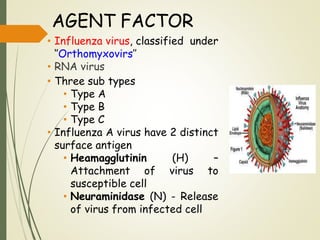
• Influenza virus, classified under
‘’Orthomyxovirs’’
• RNA virus
• Three sub types
• Type A
• Type B
• Type C
• Influenza A virus have 2 distinct
surface antigen
• Heamagglutinin (H) –
Attachment of virus to
susceptible cell
• Neuraminidase (N) - Release
of virus from infected cell
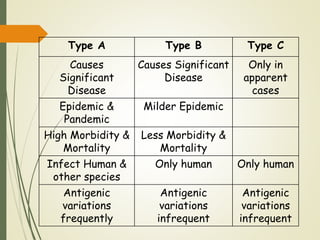
Type A Type B Type C
Causes
Significant
Disease
Causes Significant
Disease
Only in
apparent
cases
Epidemic &
Pandemic
Milder Epidemic
High Morbidity &
Mortality
Less Morbidity &
Mortality
Infect Human &
other species
Only human Only human
Antigenic
variations
frequently
Antigenic
variations
infrequent
Antigenic
variations
infrequent
What is antigenic shift
and drift
• Antigenic shift results from genetic
recombination of human and animal or avian
virus
• Antigenic Drift involve point mutation in the
gene
• Type B show lessor degree changes and Type C
is antigenically stable
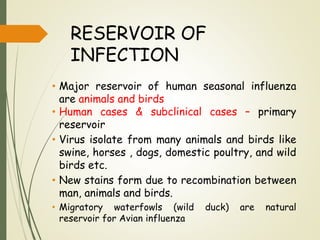
RESERVOIR OF
INFECTION
• Major reservoir of human seasonal influenza
are animals and birds
• Human cases & subclinical cases – primary
reservoir
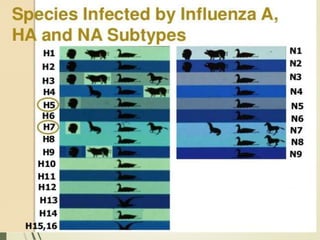
• Virus isolate from many animals and birds like
swine, horses , dogs, domestic poultry, and wild
birds etc.
• New stains form due to recombination between
man, animals and birds.
• Migratory waterfowls (wild duck) are natural
reservoir for Avian influenza
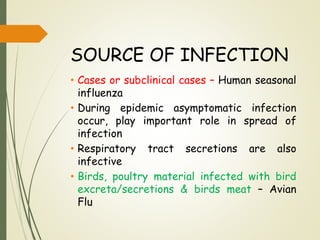
SOURCE OF INFECTION
• Cases or subclinical cases – Human seasonal
influenza
• During epidemic asymptomatic infection
occur, play important role in spread of
infection
• Respiratory tract secretions are also
infective
• Birds, poultry material infected with bird
excreta/secretions & birds meat – Avian
Flu
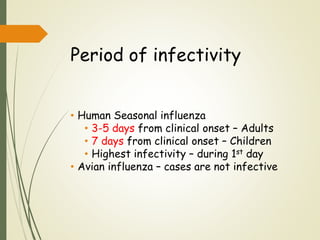
Period of infectivity
• Human Seasonal influenza
• 3-5 days from clinical onset – Adults
• 7 days from clinical onset – Children
• Highest infectivity – during 1st day
• Avian influenza – cases are not infective
HOST FACTOR
AGE and SEX
• All age groups and both sexes are affected
• Attack rate is lower among adults
• Children constitute an important link in
transmission chain
Mortality rate
• Highest mortality rate during epidemic
among
• Old People (generally over 85)
• Children under 18 months
• Person with systemic diseases such as:
- chronic heart disease CHD
- respiratory diseases
- renal disease
- diabetics person
IMMUNITY
• Appear – 7 days
• Drops to pre infection level – 12 months
• Specific antibodies against HA and NA
• Resistance to initiation of infection is
related to antibody against HA
• Decrease severity of disease and decrease
transmission related to NA
ENVIONMENTAL
FACTIOR
• SEASON
• Epidemic usually occur in winter month in
Temperate zone
• In Tropical zone outbreaks occur in rainy
season
• OVERCROWDING
- Enhance transmission
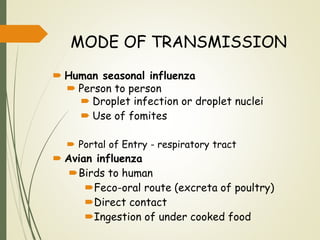
MODE OF TRANSMISSION
 Human seasonal influenza
 Person to person
 Droplet infection or droplet nuclei
 Use of fomites
 Portal of Entry - respiratory tract
 Avian influenza
Birds to human
Feco-oral route (excreta of poultry)
Direct contact
Ingestion of under cooked food
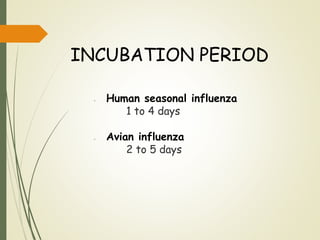
INCUBATION PERIOD
• Human seasonal influenza
1 to 4 days
• Avian influenza
2 to 5 days
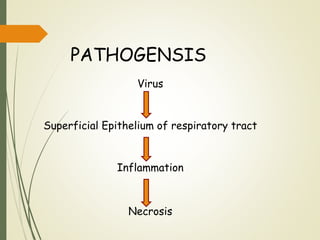
PATHOGENSIS
Virus
Superficial Epithelium of respiratory tract
Inflammation
Necrosis
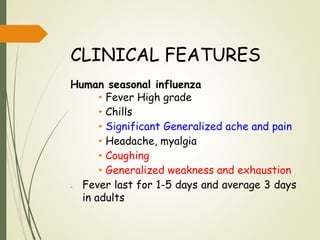
CLINICAL FEATURES
Human seasonal influenza
• Fever High grade
• Chills
• Significant Generalized ache and pain
• Headache, myalgia
• Coughing
• Generalized weakness and exhaustion
 Fever last for 1-5 days and average 3 days
in adults
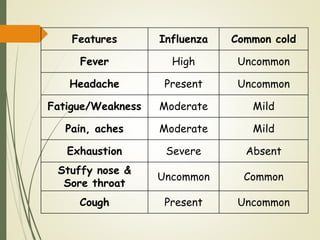
Features Influenza Common cold
Fever High Uncommon
Headache Present Uncommon
Fatigue/Weakness Moderate Mild
Pain, aches Moderate Mild
Exhaustion Severe Absent
Stuffy nose &
Sore throat
Uncommon Common
Cough Present Uncommon
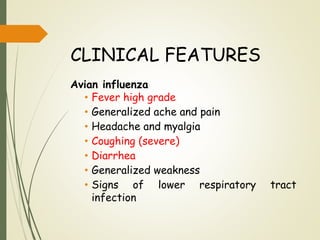
CLINICAL FEATURES
Avian influenza
• Fever high grade
• Generalized ache and pain
• Headache and myalgia
• Coughing (severe)
• Diarrhea
• Generalized weakness
• Signs of lower respiratory tract
infection
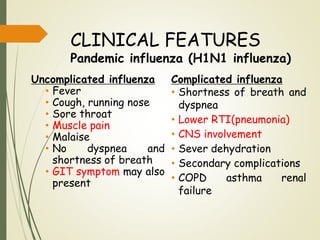
CLINICAL FEATURES
Pandemic influenza (H1N1 influenza)
Uncomplicated influenza
• Fever
• Cough, running nose
• Sore throat
• Muscle pain
• Malaise
• No dyspnea and
shortness of breath
• GIT symptom may also
present
Complicated influenza
• Shortness of breath and
dyspnea
• Lower RTI(pneumonia)
• CNS involvement
• Sever dehydration
• Secondary complications
• COPD asthma renal
failure
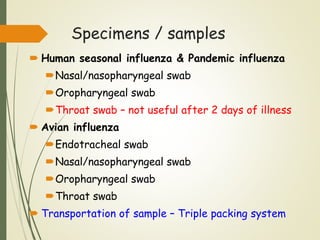
Specimens / samples
 Human seasonal influenza & Pandemic influenza
Nasal/nasopharyngeal swab
Oropharyngeal swab
Throat swab – not useful after 2 days of illness
 Avian influenza
Endotracheal swab
Nasal/nasopharyngeal swab
Oropharyngeal swab
Throat swab
 Transportation of sample – Triple packing system
LAB DIAGNOSIS
• VIRUS ISOLATION –
• Viral culture in egg culture (Gold Standard)
• Viral RNA can be detected by
• RT-PCR (best method for initial diagnosis)
• SERIOLOGY – antibodies detection by
 Heamagglutination inhibition (HI)
 ELISA
4 folds increase in titer between acute &
convalescent phase indicate the influenza
infection
Case management
 Symptomatic management
Cough suppression
Decongestants
Paracetamol for fever (Salicylates must be
avoided)
 Antiviral drugs
M2 inhibitors –Amantadine, Rimantadine
Neuraminidase inhibitors – Oseltamivir,
Zanamivir
Influenza A is treated with zanamivir or
combination of oseltamivir and rimantadine
Influenza B is treated with osaltamivir
 Supportive management
Oxygen therapy, Antibiotics, steroids etc.
PREVENTION
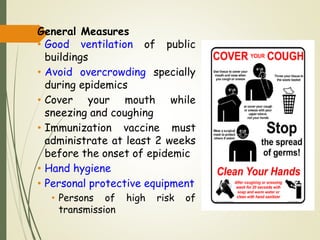
General Measures
• Good ventilation of public
buildings
• Avoid overcrowding specially
during epidemics
• Cover your mouth while
sneezing and coughing
• Immunization vaccine must
administrate at least 2 weeks
before the onset of epidemic
• Hand hygiene
• Personal protective equipment
• Persons of high risk of
transmission
VACCINE FOR SELECTED
POPULATION
• In industries to reduce absenteeism
• In public servants to prevent critical public
services
• Certain age groups like elders and children
under 18 month to prevent from sever
complications
• Also the people with chronic illness like systemic
diseased to prevent death
• Peoples travelling to epidemic/outbreak area
Killed vaccine (For Human
seasonal influenza)
• Required strains of vaccine are grown in allantonic
cavity of chick embryo
• Harvested purified and killed by beta-
propiolacton
• Formulation: Aqueous or Oil adjuvant
• Dose: (1/2 dose for Oil adjuvant)
• 0.5 ml for adults and children over 3 years
• 0.25 ml for children from 6 to 3 years
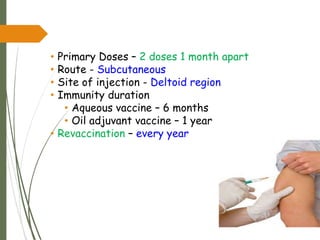
• Primary Doses – 2 doses 1 month apart
• Route - Subcutaneous
• Site of injection - Deltoid region
• Immunity duration
• Aqueous vaccine – 6 months
• Oil adjuvant vaccine – 1 year
• Revaccination – every year
Live Attanuated
Vaccine (For Human
seasonal influenza)
• Live attenuated
• Freeze dried
• Diluent – Distilled water
• Single dose
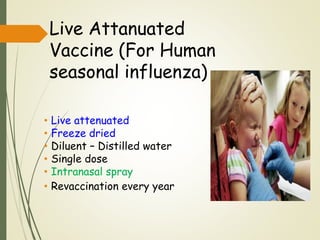
• Intranasal spray
• Revaccination every year
CONTRAINDICATION
OF VACCINE
• People with h/o anaphylactic shock
• People with h/o sever reaction to influenza
vaccine
• Who develop Guillain-Barre syndrome
• Children less then 6 month of age
(inactivated influenza vaccine is not
approved)
• People with moderate to sever fever
Killed vaccine (For H1N1
Influenza)
• Split virion, Inactivated vaccine
• Route – Intramuscular
• Site of injection – Anterolateral Thigh or Deltoid
region
• Dose: (1/2 dose for Oil adjuvant)
• 0.5 ml for adults and children over 3 years
• 0.25 ml for children from 6 to 3 years
Schedule :
6 months to 9 years – 2 doses one month apart
> 9 years – 1 dose
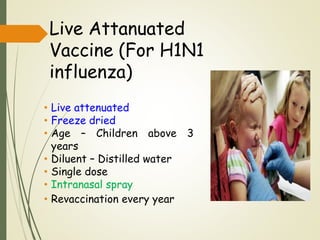
Live Attanuated
Vaccine (For H1N1
influenza)
• Live attenuated
• Freeze dried
• Age – Children above 3
years
• Diluent – Distilled water
• Single dose
• Intranasal spray
• Revaccination every year
THANK YOU FOR YOUR
ATTENTION!

Influenza

  • 1.
  • 2.
    Also know as‘’SEASONAL FLU’’  Influenza is an ‘acute Respiratory tract infection’ caused by influenza virus characterized by sudden onset of chills, malaise, fever, muscular pain and cough.  Can occur as Sporadic case / seasonal case Epidemic case Pandemic case
  • 3.
    PROBLEM STATEMENT • Itsan international disease • Occur in all countries and affect millions of people • May occur pandemic every 10-40 years due to major antigenic changes as occurred in -1918 - SPANISH INFLUENZA -1957 - ASIAN INFLUENZA -1968 - HONG KONG INFLUENZA -2009 – H1N1 FLU
  • 4.
  • 5.
  • 6.
    AGENT FACTOR • Influenzavirus, classified under ‘’Orthomyxovirs’’ • RNA virus • Three sub types • Type A • Type B • Type C • Influenza A virus have 2 distinct surface antigen • Heamagglutinin (H) – Attachment of virus to susceptible cell • Neuraminidase (N) - Release of virus from infected cell
  • 8.
    Type A TypeB Type C Causes Significant Disease Causes Significant Disease Only in apparent cases Epidemic & Pandemic Milder Epidemic High Morbidity & Mortality Less Morbidity & Mortality Infect Human & other species Only human Only human Antigenic variations frequently Antigenic variations infrequent Antigenic variations infrequent
  • 9.
    What is antigenicshift and drift • Antigenic shift results from genetic recombination of human and animal or avian virus • Antigenic Drift involve point mutation in the gene • Type B show lessor degree changes and Type C is antigenically stable
  • 10.
    RESERVOIR OF INFECTION • Majorreservoir of human seasonal influenza are animals and birds • Human cases & subclinical cases – primary reservoir • Virus isolate from many animals and birds like swine, horses , dogs, domestic poultry, and wild birds etc. • New stains form due to recombination between man, animals and birds. • Migratory waterfowls (wild duck) are natural reservoir for Avian influenza
  • 11.
    SOURCE OF INFECTION •Cases or subclinical cases – Human seasonal influenza • During epidemic asymptomatic infection occur, play important role in spread of infection • Respiratory tract secretions are also infective • Birds, poultry material infected with bird excreta/secretions & birds meat – Avian Flu
  • 12.
    Period of infectivity •Human Seasonal influenza • 3-5 days from clinical onset – Adults • 7 days from clinical onset – Children • Highest infectivity – during 1st day • Avian influenza – cases are not infective
  • 13.
  • 14.
    AGE and SEX •All age groups and both sexes are affected • Attack rate is lower among adults • Children constitute an important link in transmission chain
  • 15.
    Mortality rate • Highestmortality rate during epidemic among • Old People (generally over 85) • Children under 18 months • Person with systemic diseases such as: - chronic heart disease CHD - respiratory diseases - renal disease - diabetics person
  • 16.
    IMMUNITY • Appear –7 days • Drops to pre infection level – 12 months • Specific antibodies against HA and NA • Resistance to initiation of infection is related to antibody against HA • Decrease severity of disease and decrease transmission related to NA
  • 17.
  • 18.
    • SEASON • Epidemicusually occur in winter month in Temperate zone • In Tropical zone outbreaks occur in rainy season • OVERCROWDING - Enhance transmission
  • 19.
    MODE OF TRANSMISSION Human seasonal influenza  Person to person  Droplet infection or droplet nuclei  Use of fomites  Portal of Entry - respiratory tract  Avian influenza Birds to human Feco-oral route (excreta of poultry) Direct contact Ingestion of under cooked food
  • 20.
    INCUBATION PERIOD • Humanseasonal influenza 1 to 4 days • Avian influenza 2 to 5 days
  • 21.
    PATHOGENSIS Virus Superficial Epithelium ofrespiratory tract Inflammation Necrosis
  • 22.
    CLINICAL FEATURES Human seasonalinfluenza • Fever High grade • Chills • Significant Generalized ache and pain • Headache, myalgia • Coughing • Generalized weakness and exhaustion  Fever last for 1-5 days and average 3 days in adults
  • 23.
    Features Influenza Commoncold Fever High Uncommon Headache Present Uncommon Fatigue/Weakness Moderate Mild Pain, aches Moderate Mild Exhaustion Severe Absent Stuffy nose & Sore throat Uncommon Common Cough Present Uncommon
  • 24.
    CLINICAL FEATURES Avian influenza •Fever high grade • Generalized ache and pain • Headache and myalgia • Coughing (severe) • Diarrhea • Generalized weakness • Signs of lower respiratory tract infection
  • 25.
    CLINICAL FEATURES Pandemic influenza(H1N1 influenza) Uncomplicated influenza • Fever • Cough, running nose • Sore throat • Muscle pain • Malaise • No dyspnea and shortness of breath • GIT symptom may also present Complicated influenza • Shortness of breath and dyspnea • Lower RTI(pneumonia) • CNS involvement • Sever dehydration • Secondary complications • COPD asthma renal failure
  • 26.
    Specimens / samples Human seasonal influenza & Pandemic influenza Nasal/nasopharyngeal swab Oropharyngeal swab Throat swab – not useful after 2 days of illness  Avian influenza Endotracheal swab Nasal/nasopharyngeal swab Oropharyngeal swab Throat swab  Transportation of sample – Triple packing system
  • 27.
    LAB DIAGNOSIS • VIRUSISOLATION – • Viral culture in egg culture (Gold Standard) • Viral RNA can be detected by • RT-PCR (best method for initial diagnosis) • SERIOLOGY – antibodies detection by  Heamagglutination inhibition (HI)  ELISA 4 folds increase in titer between acute & convalescent phase indicate the influenza infection
  • 28.
  • 29.
     Symptomatic management Coughsuppression Decongestants Paracetamol for fever (Salicylates must be avoided)  Antiviral drugs M2 inhibitors –Amantadine, Rimantadine Neuraminidase inhibitors – Oseltamivir, Zanamivir Influenza A is treated with zanamivir or combination of oseltamivir and rimantadine Influenza B is treated with osaltamivir  Supportive management Oxygen therapy, Antibiotics, steroids etc.
  • 30.
  • 31.
    General Measures • Goodventilation of public buildings • Avoid overcrowding specially during epidemics • Cover your mouth while sneezing and coughing • Immunization vaccine must administrate at least 2 weeks before the onset of epidemic • Hand hygiene • Personal protective equipment • Persons of high risk of transmission
  • 32.
    VACCINE FOR SELECTED POPULATION •In industries to reduce absenteeism • In public servants to prevent critical public services • Certain age groups like elders and children under 18 month to prevent from sever complications • Also the people with chronic illness like systemic diseased to prevent death • Peoples travelling to epidemic/outbreak area
  • 34.
    Killed vaccine (ForHuman seasonal influenza) • Required strains of vaccine are grown in allantonic cavity of chick embryo • Harvested purified and killed by beta- propiolacton • Formulation: Aqueous or Oil adjuvant • Dose: (1/2 dose for Oil adjuvant) • 0.5 ml for adults and children over 3 years • 0.25 ml for children from 6 to 3 years
  • 35.
    • Primary Doses– 2 doses 1 month apart • Route - Subcutaneous • Site of injection - Deltoid region • Immunity duration • Aqueous vaccine – 6 months • Oil adjuvant vaccine – 1 year • Revaccination – every year
  • 36.
    Live Attanuated Vaccine (ForHuman seasonal influenza) • Live attenuated • Freeze dried • Diluent – Distilled water • Single dose • Intranasal spray • Revaccination every year
  • 37.
    CONTRAINDICATION OF VACCINE • Peoplewith h/o anaphylactic shock • People with h/o sever reaction to influenza vaccine • Who develop Guillain-Barre syndrome • Children less then 6 month of age (inactivated influenza vaccine is not approved) • People with moderate to sever fever
  • 38.
    Killed vaccine (ForH1N1 Influenza) • Split virion, Inactivated vaccine • Route – Intramuscular • Site of injection – Anterolateral Thigh or Deltoid region • Dose: (1/2 dose for Oil adjuvant) • 0.5 ml for adults and children over 3 years • 0.25 ml for children from 6 to 3 years Schedule : 6 months to 9 years – 2 doses one month apart > 9 years – 1 dose
  • 39.
    Live Attanuated Vaccine (ForH1N1 influenza) • Live attenuated • Freeze dried • Age – Children above 3 years • Diluent – Distilled water • Single dose • Intranasal spray • Revaccination every year
  • 40.
    THANK YOU FORYOUR ATTENTION!