RABIES
PRESENTED BY
Pooja Vaghela
.
Joshi Abhishek Ashvinbhai
F.Y.P.B.B.Sc.Nursing
Govt College of Nursing
Jamnagar
CONTENT
1. Definition
2. Introduction
3. Diagnosis
4. Sign & Symptoms
5. Prognosis
6. Treatment
7. Prevention
DEFINITION
 Rabies is a viral disease
that causes
acute encephalitis (inflamm
ation of the brain) in warm-
blooded animals
 Rabies is a zoonotic
disease (a disease that is
transmitted to humans from
animals) that is caused by a
virus
INTRODUCTION
 The disease infects domestic and wild
animals, and is spread to people through
close contact with infected saliva via bites or
scratches.
 Dogs are the source of 99% of human rabies
deaths
 Once symptoms of the disease develop,
rabies is nearly always fatal.
HOST & RESERVOIR
SOURCE OF INFECTION
 The source of infection to man is the saliva of
rabid animals.
 In dogs & cats, the virus may be present in
the saliva for 3-4 days before the clinical
onset & during the course of illness till death.
Cause > 90% of the
Human cases
3 – 5% of Human
cases
INCUBATION PERIOD
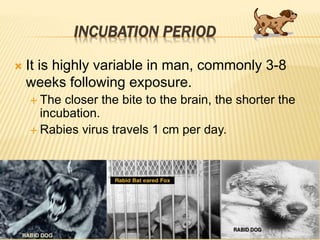
 It is highly variable in man, commonly 3-8
weeks following exposure.
 The closer the bite to the brain, the shorter the
incubation.
 Rabies virus travels 1 cm per day.
PATHOGENESIS
Live virus Epidermis, Mucus membrane
Peripheral nerve
CNS ( gray matter )
Other tissue (salivary glands,…)
centripetally
centrifugally
SIGN & SYMPTOMS
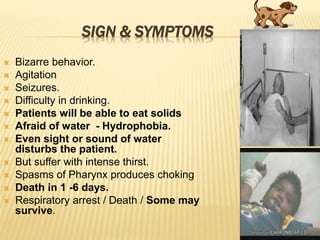
 Bizarre behavior.
 Agitation
 Seizures.
 Difficulty in drinking.
 Patients will be able to eat solids
 Afraid of water - Hydrophobia.
 Even sight or sound of water
disturbs the patient.
 But suffer with intense thirst.
 Spasms of Pharynx produces choking
 Death in 1 -6 days.
 Respiratory arrest / Death / Some may
survive.
CONTI….
 Headache, fever, sore throat
 Nervousness, confusion
 Pain or tingling at the site of the bite
 Hallucinations
 Seeing things that are not really there
 Hydrophobia
 “Fear of water" due to spasms in the throat
 Paralysis
 Unable to move parts of the body
 Coma and death
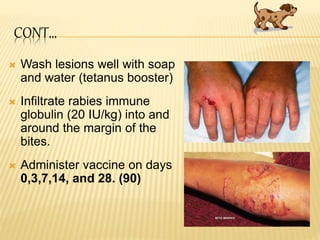
BITE MARKS
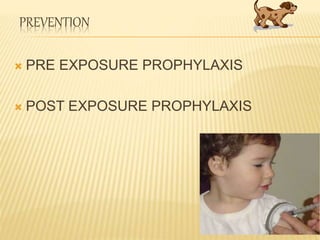
PREVENTION
 PRE EXPOSURE PROPHYLAXIS
 POST EXPOSURE PROPHYLAXIS
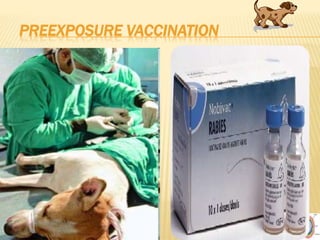
PREEXPOSURE VACCINATION
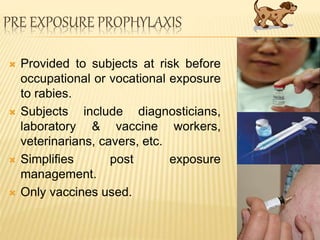
PRE EXPOSURE PROPHYLAXIS
 Provided to subjects at risk before
occupational or vocational exposure
to rabies.
 Subjects include diagnosticians,
laboratory & vaccine workers,
veterinarians, cavers, etc.
 Simplifies post exposure
management.
 Only vaccines used.
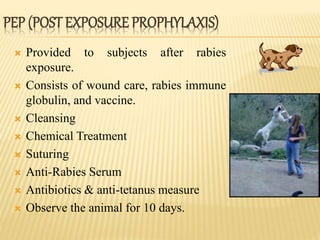
PEP (POST EXPOSURE PROPHYLAXIS)
 Provided to subjects after rabies
exposure.
 Consists of wound care, rabies immune
globulin, and vaccine.
 Cleansing
 Chemical Treatment
 Suturing
 Anti-Rabies Serum
 Antibiotics & anti-tetanus measure
 Observe the animal for 10 days.
CONT…
 Wash lesions well with soap
and water (tetanus booster)
 Infiltrate rabies immune
globulin (20 IU/kg) into and
around the margin of the
bites.
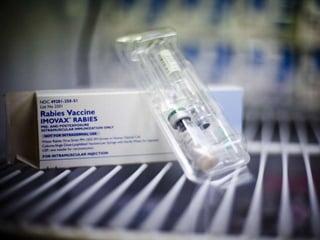
 Administer vaccine on days
0,3,7,14, and 28. (90)
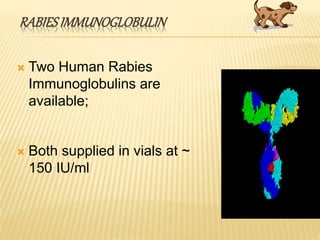
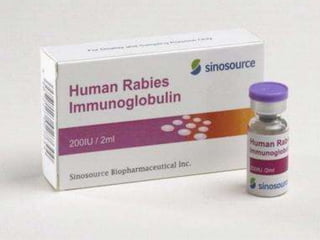
RABIESIMMUNOGLOBULIN
 Two Human Rabies
Immunoglobulins are
available;
 Both supplied in vials at ~
150 IU/ml
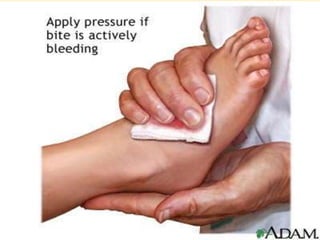
Wound cleaning & treatment
TREATMENT
 POST-EXPOSURE TREATMENT (PET)
A. LOCAL WOUND TREATMENT
- Wash with soap/detergent and water
preferably for 10 mins.
- Apply alcohol, povidone iodine/ any
antiseptic
- Anti-Tetanus
*Avoid suturing wounds
*Don’t apply ointment, cream/ wound dressing
 ANTIMICROBIAL
- Amoxicillin
- Cloxacillin
- Cefuroxime
*For those instances where there’s no
obvious signs of infection( Amoxicillin as
prophylaxis )
***Educate the public simple local wound
treatment & warn not to use procedures
that may further contaminate the wounds
VACCINE ADMINISTRATION
1. Intramuscular Schedules
 6 doses schedule
 Reduced multisite intramuscular
regimen (2-1-1)
2. Intradermal Schedules
2-Site Intradermal schedule(2-2-
2-0-1-1)
8-Site intradermal schedule(8-0-
4-0-1-1)
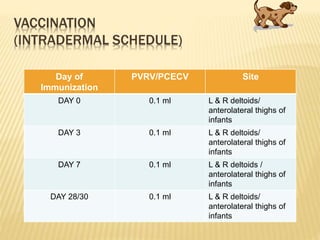
VACCINATION
(INTRADERMAL SCHEDULE)
Day of
Immunization
PVRV/PCECV Site
DAY 0 0.1 ml L & R deltoids/
anterolateral thighs of
infants
DAY 3 0.1 ml L & R deltoids/
anterolateral thighs of
infants
DAY 7 0.1 ml L & R deltoids /
anterolateral thighs of
infants
DAY 28/30 0.1 ml L & R deltoids/
anterolateral thighs of
infants
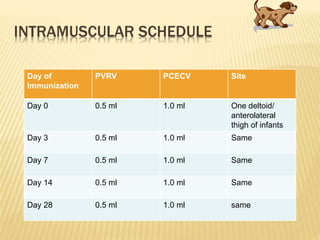
INTRAMUSCULAR SCHEDULE
Day of
Immunization
PVRV PCECV Site
Day 0 0.5 ml 1.0 ml One deltoid/
anterolateral
thigh of infants
Day 3 0.5 ml 1.0 ml Same
Day 7 0.5 ml 1.0 ml Same
Day 14 0.5 ml 1.0 ml Same
Day 28 0.5 ml 1.0 ml same
MANAGEMENT OF RABIES PATIENT
 Once symptoms start, treatment should center
on comfort care, using sedation & avoidance of
intubation & life support measures once
diagnosis is certain
1. MEDICATIONS
a. Diazepam
b. Midazolam
c. Haloperidol + Dipenhydramine
2. SUPPORTIVE CARE
- Pts w/ confirmed rabies should receive
adequate sedation & comfort care in an
appropriate medical facility.
a. Once rabies diagnosis has been confirmed,
invasive procedures must be avoided
b. Provide suitable emotional and physical
support
c. Discuss & provide important info. to
relatives concerning transmission of dse. &
indication for PET of contacts
d. Honest gentle communication concerning
prognosis should be provided to relatives of
pt
3. INFECTION CONTROL
a. Patient should be admitted in a quiet,
draft-free, isolation room
b. HLCR workers & relatives in contact w/
pt should wear proper personal
protective equipment (gown, gloves,
mask, goggles)
4. DISPOSAL OF DEAD BODIES
Rabies

Rabies

  • 1.
    RABIES PRESENTED BY Pooja Vaghela . JoshiAbhishek Ashvinbhai F.Y.P.B.B.Sc.Nursing Govt College of Nursing Jamnagar
  • 2.
    CONTENT 1. Definition 2. Introduction 3.Diagnosis 4. Sign & Symptoms 5. Prognosis 6. Treatment 7. Prevention
  • 3.
    DEFINITION  Rabies isa viral disease that causes acute encephalitis (inflamm ation of the brain) in warm- blooded animals  Rabies is a zoonotic disease (a disease that is transmitted to humans from animals) that is caused by a virus
  • 5.
    INTRODUCTION  The diseaseinfects domestic and wild animals, and is spread to people through close contact with infected saliva via bites or scratches.  Dogs are the source of 99% of human rabies deaths  Once symptoms of the disease develop, rabies is nearly always fatal.
  • 6.
  • 8.
    SOURCE OF INFECTION The source of infection to man is the saliva of rabid animals.  In dogs & cats, the virus may be present in the saliva for 3-4 days before the clinical onset & during the course of illness till death. Cause > 90% of the Human cases 3 – 5% of Human cases
  • 9.
    INCUBATION PERIOD  Itis highly variable in man, commonly 3-8 weeks following exposure.  The closer the bite to the brain, the shorter the incubation.  Rabies virus travels 1 cm per day.
  • 11.
    PATHOGENESIS Live virus Epidermis,Mucus membrane Peripheral nerve CNS ( gray matter ) Other tissue (salivary glands,…) centripetally centrifugally
  • 13.
    SIGN & SYMPTOMS Bizarre behavior.  Agitation  Seizures.  Difficulty in drinking.  Patients will be able to eat solids  Afraid of water - Hydrophobia.  Even sight or sound of water disturbs the patient.  But suffer with intense thirst.  Spasms of Pharynx produces choking  Death in 1 -6 days.  Respiratory arrest / Death / Some may survive.
  • 14.
    CONTI….  Headache, fever,sore throat  Nervousness, confusion  Pain or tingling at the site of the bite  Hallucinations  Seeing things that are not really there  Hydrophobia  “Fear of water" due to spasms in the throat  Paralysis  Unable to move parts of the body  Coma and death
  • 16.
  • 17.
    PREVENTION  PRE EXPOSUREPROPHYLAXIS  POST EXPOSURE PROPHYLAXIS
  • 18.
  • 19.
    PRE EXPOSURE PROPHYLAXIS Provided to subjects at risk before occupational or vocational exposure to rabies.  Subjects include diagnosticians, laboratory & vaccine workers, veterinarians, cavers, etc.  Simplifies post exposure management.  Only vaccines used.
  • 20.
    PEP (POST EXPOSUREPROPHYLAXIS)  Provided to subjects after rabies exposure.  Consists of wound care, rabies immune globulin, and vaccine.  Cleansing  Chemical Treatment  Suturing  Anti-Rabies Serum  Antibiotics & anti-tetanus measure  Observe the animal for 10 days.
  • 22.
    CONT…  Wash lesionswell with soap and water (tetanus booster)  Infiltrate rabies immune globulin (20 IU/kg) into and around the margin of the bites.  Administer vaccine on days 0,3,7,14, and 28. (90)
  • 23.
    RABIESIMMUNOGLOBULIN  Two HumanRabies Immunoglobulins are available;  Both supplied in vials at ~ 150 IU/ml
  • 24.
  • 29.
    TREATMENT  POST-EXPOSURE TREATMENT(PET) A. LOCAL WOUND TREATMENT - Wash with soap/detergent and water preferably for 10 mins. - Apply alcohol, povidone iodine/ any antiseptic - Anti-Tetanus *Avoid suturing wounds *Don’t apply ointment, cream/ wound dressing
  • 30.
     ANTIMICROBIAL - Amoxicillin -Cloxacillin - Cefuroxime *For those instances where there’s no obvious signs of infection( Amoxicillin as prophylaxis ) ***Educate the public simple local wound treatment & warn not to use procedures that may further contaminate the wounds
  • 31.
    VACCINE ADMINISTRATION 1. IntramuscularSchedules  6 doses schedule  Reduced multisite intramuscular regimen (2-1-1) 2. Intradermal Schedules 2-Site Intradermal schedule(2-2- 2-0-1-1) 8-Site intradermal schedule(8-0- 4-0-1-1)
  • 32.
    VACCINATION (INTRADERMAL SCHEDULE) Day of Immunization PVRV/PCECVSite DAY 0 0.1 ml L & R deltoids/ anterolateral thighs of infants DAY 3 0.1 ml L & R deltoids/ anterolateral thighs of infants DAY 7 0.1 ml L & R deltoids / anterolateral thighs of infants DAY 28/30 0.1 ml L & R deltoids/ anterolateral thighs of infants
  • 33.
    INTRAMUSCULAR SCHEDULE Day of Immunization PVRVPCECV Site Day 0 0.5 ml 1.0 ml One deltoid/ anterolateral thigh of infants Day 3 0.5 ml 1.0 ml Same Day 7 0.5 ml 1.0 ml Same Day 14 0.5 ml 1.0 ml Same Day 28 0.5 ml 1.0 ml same
  • 34.
    MANAGEMENT OF RABIESPATIENT  Once symptoms start, treatment should center on comfort care, using sedation & avoidance of intubation & life support measures once diagnosis is certain 1. MEDICATIONS a. Diazepam b. Midazolam c. Haloperidol + Dipenhydramine
  • 35.
    2. SUPPORTIVE CARE -Pts w/ confirmed rabies should receive adequate sedation & comfort care in an appropriate medical facility. a. Once rabies diagnosis has been confirmed, invasive procedures must be avoided b. Provide suitable emotional and physical support c. Discuss & provide important info. to relatives concerning transmission of dse. & indication for PET of contacts d. Honest gentle communication concerning prognosis should be provided to relatives of pt
  • 36.
    3. INFECTION CONTROL a.Patient should be admitted in a quiet, draft-free, isolation room b. HLCR workers & relatives in contact w/ pt should wear proper personal protective equipment (gown, gloves, mask, goggles) 4. DISPOSAL OF DEAD BODIES