
By NAJIB ULLAH KHAN  MPhil Institute of Biotechnology and Genetic Engineering KPK Agricultural University Peshawar, Pakistan. 2011
The learning objectives of this presentation are to: Understand what is Dengue Fever, Dengue Hemorrhagic fever and Dengue Shock Syndrome Understand the modes of transmission and how to prevent exposure Understand the geographic importance of the disease Understand the importance of dengue from a public health point of view
Is an acute fever producing infectious disease Mostly found in the tropics Complications can be fatal It is also known as Dengue fever , break bone fever or Dengue hemorrhagic fever  Bauman, R., (2006). Microbiology disease by systems. San Francisco , CA: Pearson Benjamin Cumming Publishers
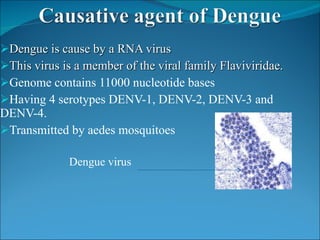
Dengue is cause by a RNA virus This virus is a member of the viral family Flaviviridae.  Genome contains 11000 nucleotide bases Having 4 serotypes  DENV-1, DENV-2, DENV-3 and DENV-4. Transmitted by aedes mosquitoes Dengue virus
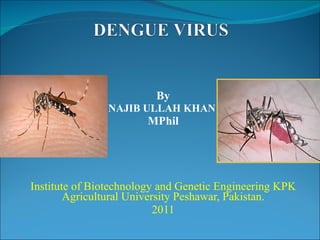
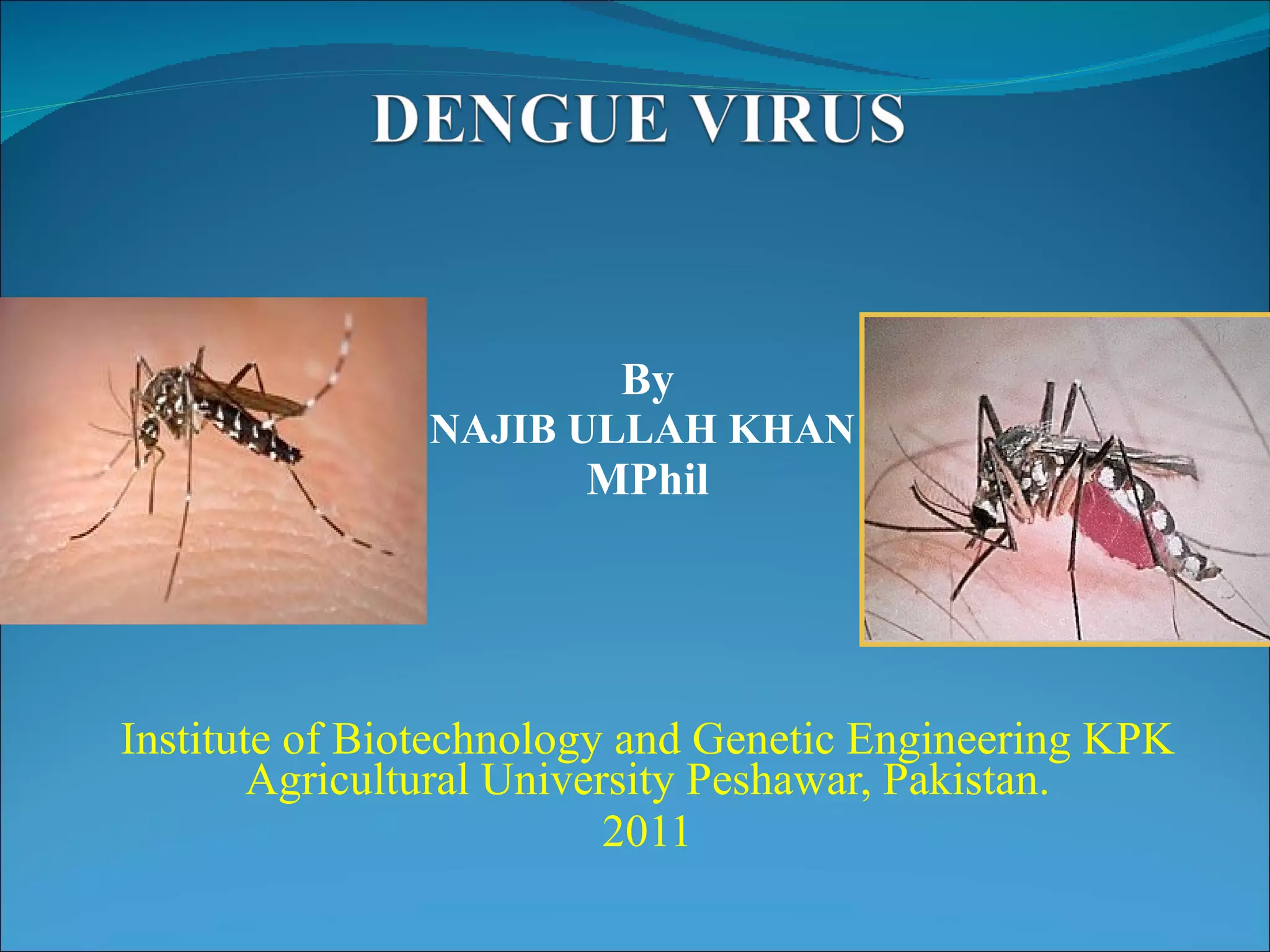
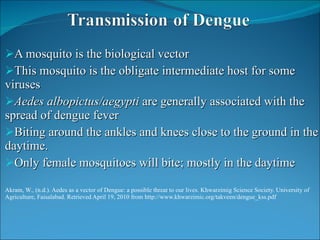
A mosquito is the biological vector  This mosquito is the obligate intermediate host for some viruses Aedes albopictus/aegypti  are generally associated with the spread of dengue fever Biting around the ankles and knees close to the ground in the daytime. Only female mosquitoes will bite; mostly in the daytime Akram, W., (n.d.). Aedes as a vector of Dengue: a possible threat to our lives. Khwarzimig Science Society. University of  Agriculture, Faisalabad. Retrieved April 19, 2010 from http://www.khwarzimic.org/takveen/dengue_kss.pdf
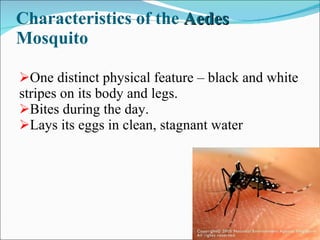
Characteristics of the  Aedes  Mosquito One distinct physical feature – black and white stripes on its body and legs. Bites during the day. Lays its eggs in clean, stagnant water
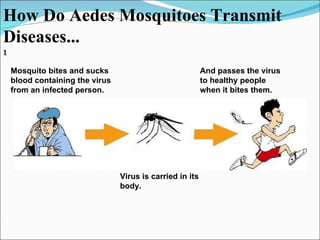
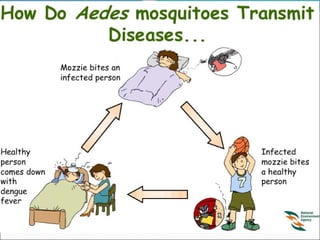
1 How Do Aedes Mosquitoes Transmit Diseases... Mosquito bites and sucks blood containing the virus from an infected person. Virus is carried in its body. And passes the virus to healthy people when it bites them.
 
Dengue disease occurs in tropical and subtropical areas Endemic in over 100 countries in the Caribbean, South, Central and North America, Africa, the Pacific Islands, Hawaii, Asia, Eastern Mediterranean and Australia Before 1970 only nine countries had experience dengue hemorrhagic fever epidemics, a number that had increased more than four-fold by 1995 World Health Organization, (2009). Dengue and Dengue haemorrhagic fever. Retrieved April 19, 2010 from http://www.who.int/mediacentre/factsheets/fs117/en/
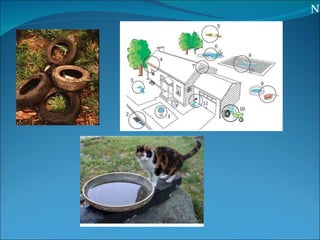
Dengue cases usually increase during the rainy season The spread of the mosquito is attributed  to poor environmental sanitation When it rains the water gets stored in any place such as discarded tires, broken bottles, and even in shoes Other examples are soda cans, birdbaths, rain gutters, toys, pool covers, tree stumps, and garbage cans.  Illinois Environmental Protection Agency, (2007).  Mosquito-Borne illnesses prevention techniques . Retrieved April 22, 2010 from  http://www.epa.st.il.us  /land/tires/mosquito-borne-illness.html
N
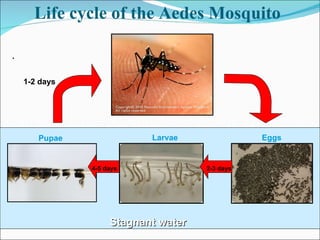
Life cycle of the Aedes Mosquito . 1-2 days Stagnant water Pupae 4-5 days Larvae Eggs 2-3 days
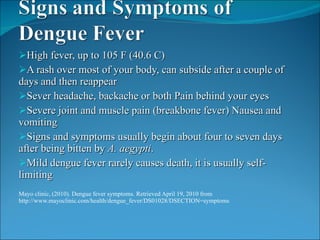
High fever, up to 105 F (40.6 C) A rash over most of your body, can subside after a couple of days and then reappear Sever headache, backache or both Pain behind your eyes Severe joint and muscle pain (breakbone fever) Nausea and vomiting Signs and symptoms usually begin about four to seven days after being bitten by  A. aegypti .  Mild dengue fever rarely causes death, it is usually self-limiting Mayo clinic, (2010). Dengue fever symptoms. Retrieved April 19, 2010 from http://www.mayoclinic.com/health/dengue_fever/DS01028/DSECTION=symptoms
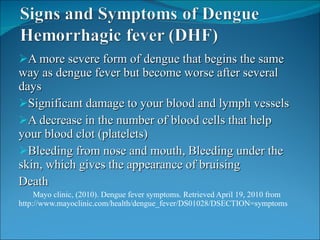
A more severe form of dengue that begins the same way as dengue fever but become worse after several days Significant damage to your blood and lymph vessels A decrease in the number of blood cells that help your blood clot (platelets) Bleeding from nose and mouth, Bleeding under the skin, which gives the appearance of bruising Death Mayo clinic, (2010). Dengue fever symptoms. Retrieved April 19, 2010 from http://www.mayoclinic.com/health/dengue_fever/DS01028/DSECTION=symptoms
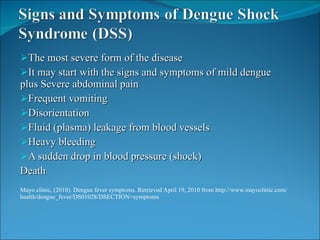
The most severe form of the disease It may start with the signs and symptoms of mild dengue plus Severe abdominal pain  Frequent vomiting Disorientation Fluid (plasma) leakage from blood vessels Heavy bleeding A sudden drop in blood pressure (shock)   Death Mayo clinic, (2010). Dengue fever symptoms. Retrieved April 19, 2010 from http://www.mayoclinic.com/health/dengue_fever/DS01028/DSECTION=symptoms
Travel history and symptom profile Detection of antibodies against the virus Complete blood count Chemistry panel Liver function test Etc  Price, D.D., Wilson, S.R., (2009). Dengue fever: differential diagnoses and workout. Medscape. Retrieved April 19, 2010 from http://emedicine.medscape.com/article/781961-diagnosis
No specific therapeutic agents exist for dengue infections  Bed rest and hydration therapy Fever control with acetaminophen. Narcotics may be necessary if headaches are very severe Aspirin should be avoid because of anticoagulant properties, children should avoid aspirin when a viral infection is suspected Monitoring of signs and symptoms for warning signs of DHF or DSS Price, D.D., Wilson, S.R., (2009). Dengue fever: differential diagnoses and workout. Medscape. Retrieved April 19, 2010 from http://emedicine.medscape.com/article/781961-diagnosis
No vaccine or drugs are available for the prevention of dengue Preventive measure should be taken to avoid the bite of the mosquito  Well screen accommodations or air conditioning Use of insecticide indoors Apply insect repellent to skin and clothing. The most effective are the ones with DEET Empty , clean or cover any standing water  that can be a mosquito-breeding site  Center for Disease Control and Prevention, (2009). Other infectious disease related to travel, dengue fever (DF) and dengue hemorrhagic fever (DHF). Retrieved April 19, 2010 from http://wwwnc.cdc.gov/travel/yellowbook/2010/chapter-5/dengue-fever-dengue-hemorrhagic-fever.aspx
The times of higher risk of being bitten by the female mosquito is 2 to 3 hours after daybreak and 3 to 4 hours before nightfall The mosquito can feed indoors as well as outdoors Precautions as mention before should be taken especially at peak biting activity time Gubler, D., (1998). Dengue and dengue hemorrhagic fever . Clinical Microbiology Reviews, July 1998, p.480-496. Retrieved April 24, 2010 from http:/www.cmr.asm.org/cgi/repreint/11/3/480
Thanks!

Dengue virus

  • 1.
    By NAJIB ULLAHKHAN MPhil Institute of Biotechnology and Genetic Engineering KPK Agricultural University Peshawar, Pakistan. 2011
  • 2.
    The learning objectivesof this presentation are to: Understand what is Dengue Fever, Dengue Hemorrhagic fever and Dengue Shock Syndrome Understand the modes of transmission and how to prevent exposure Understand the geographic importance of the disease Understand the importance of dengue from a public health point of view
  • 3.
    Is an acutefever producing infectious disease Mostly found in the tropics Complications can be fatal It is also known as Dengue fever , break bone fever or Dengue hemorrhagic fever Bauman, R., (2006). Microbiology disease by systems. San Francisco , CA: Pearson Benjamin Cumming Publishers
  • 4.
    Dengue is causeby a RNA virus This virus is a member of the viral family Flaviviridae. Genome contains 11000 nucleotide bases Having 4 serotypes DENV-1, DENV-2, DENV-3 and DENV-4. Transmitted by aedes mosquitoes Dengue virus
  • 5.
    A mosquito isthe biological vector This mosquito is the obligate intermediate host for some viruses Aedes albopictus/aegypti are generally associated with the spread of dengue fever Biting around the ankles and knees close to the ground in the daytime. Only female mosquitoes will bite; mostly in the daytime Akram, W., (n.d.). Aedes as a vector of Dengue: a possible threat to our lives. Khwarzimig Science Society. University of Agriculture, Faisalabad. Retrieved April 19, 2010 from http://www.khwarzimic.org/takveen/dengue_kss.pdf
  • 6.
    Characteristics of the Aedes Mosquito One distinct physical feature – black and white stripes on its body and legs. Bites during the day. Lays its eggs in clean, stagnant water
  • 7.
    1 How DoAedes Mosquitoes Transmit Diseases... Mosquito bites and sucks blood containing the virus from an infected person. Virus is carried in its body. And passes the virus to healthy people when it bites them.
  • 8.
  • 9.
    Dengue disease occursin tropical and subtropical areas Endemic in over 100 countries in the Caribbean, South, Central and North America, Africa, the Pacific Islands, Hawaii, Asia, Eastern Mediterranean and Australia Before 1970 only nine countries had experience dengue hemorrhagic fever epidemics, a number that had increased more than four-fold by 1995 World Health Organization, (2009). Dengue and Dengue haemorrhagic fever. Retrieved April 19, 2010 from http://www.who.int/mediacentre/factsheets/fs117/en/
  • 10.
    Dengue cases usuallyincrease during the rainy season The spread of the mosquito is attributed to poor environmental sanitation When it rains the water gets stored in any place such as discarded tires, broken bottles, and even in shoes Other examples are soda cans, birdbaths, rain gutters, toys, pool covers, tree stumps, and garbage cans. Illinois Environmental Protection Agency, (2007). Mosquito-Borne illnesses prevention techniques . Retrieved April 22, 2010 from http://www.epa.st.il.us /land/tires/mosquito-borne-illness.html
  • 11.
  • 12.
    Life cycle ofthe Aedes Mosquito . 1-2 days Stagnant water Pupae 4-5 days Larvae Eggs 2-3 days
  • 13.
    High fever, upto 105 F (40.6 C) A rash over most of your body, can subside after a couple of days and then reappear Sever headache, backache or both Pain behind your eyes Severe joint and muscle pain (breakbone fever) Nausea and vomiting Signs and symptoms usually begin about four to seven days after being bitten by A. aegypti . Mild dengue fever rarely causes death, it is usually self-limiting Mayo clinic, (2010). Dengue fever symptoms. Retrieved April 19, 2010 from http://www.mayoclinic.com/health/dengue_fever/DS01028/DSECTION=symptoms
  • 14.
    A more severeform of dengue that begins the same way as dengue fever but become worse after several days Significant damage to your blood and lymph vessels A decrease in the number of blood cells that help your blood clot (platelets) Bleeding from nose and mouth, Bleeding under the skin, which gives the appearance of bruising Death Mayo clinic, (2010). Dengue fever symptoms. Retrieved April 19, 2010 from http://www.mayoclinic.com/health/dengue_fever/DS01028/DSECTION=symptoms
  • 15.
    The most severeform of the disease It may start with the signs and symptoms of mild dengue plus Severe abdominal pain Frequent vomiting Disorientation Fluid (plasma) leakage from blood vessels Heavy bleeding A sudden drop in blood pressure (shock) Death Mayo clinic, (2010). Dengue fever symptoms. Retrieved April 19, 2010 from http://www.mayoclinic.com/health/dengue_fever/DS01028/DSECTION=symptoms
  • 16.
    Travel history andsymptom profile Detection of antibodies against the virus Complete blood count Chemistry panel Liver function test Etc Price, D.D., Wilson, S.R., (2009). Dengue fever: differential diagnoses and workout. Medscape. Retrieved April 19, 2010 from http://emedicine.medscape.com/article/781961-diagnosis
  • 17.
    No specific therapeuticagents exist for dengue infections Bed rest and hydration therapy Fever control with acetaminophen. Narcotics may be necessary if headaches are very severe Aspirin should be avoid because of anticoagulant properties, children should avoid aspirin when a viral infection is suspected Monitoring of signs and symptoms for warning signs of DHF or DSS Price, D.D., Wilson, S.R., (2009). Dengue fever: differential diagnoses and workout. Medscape. Retrieved April 19, 2010 from http://emedicine.medscape.com/article/781961-diagnosis
  • 18.
    No vaccine ordrugs are available for the prevention of dengue Preventive measure should be taken to avoid the bite of the mosquito Well screen accommodations or air conditioning Use of insecticide indoors Apply insect repellent to skin and clothing. The most effective are the ones with DEET Empty , clean or cover any standing water that can be a mosquito-breeding site Center for Disease Control and Prevention, (2009). Other infectious disease related to travel, dengue fever (DF) and dengue hemorrhagic fever (DHF). Retrieved April 19, 2010 from http://wwwnc.cdc.gov/travel/yellowbook/2010/chapter-5/dengue-fever-dengue-hemorrhagic-fever.aspx
  • 19.
    The times ofhigher risk of being bitten by the female mosquito is 2 to 3 hours after daybreak and 3 to 4 hours before nightfall The mosquito can feed indoors as well as outdoors Precautions as mention before should be taken especially at peak biting activity time Gubler, D., (1998). Dengue and dengue hemorrhagic fever . Clinical Microbiology Reviews, July 1998, p.480-496. Retrieved April 24, 2010 from http:/www.cmr.asm.org/cgi/repreint/11/3/480
  • 20.