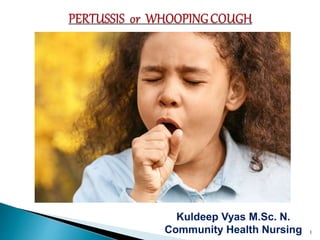

Kuldeep Vyas M.Sc. N.
Community Health Nursing 1
 Pertussis is also called as Whooping cough is a
highly contagious disease mainly of children
caused by Bordetella pertussis.
 It is characterized by severe uncontrollable
coughing spells which can sometimes end in a
“whoop” sound when person breathes in.
 Also called as “100 day cough” by Chinese.
2Kuldeep Vyas M.Sc. N. CHN
 In 2012, 2.49 cases were reported by WHO
globally when the DPT immunization was 83%.
 In India after launch of immunization programme
in 1987, the reported cases dropped from 1.63
lakh to only 36,661 cases in 2013 ( 77% decline)
 Underlying malnutrition and other respiratory
infections in children make then prone to this
disease.
 Recently the disease shows increase incidence in
older children, adolescents and adults.(21%
adults had pertussis after serological studies of
adults with cough for more than 2 weeks)
3Kuldeep Vyas M.Sc. N. CHN
 AGENT FACTORS-
Agent -Causative agent is Bordetella pertussis.
Also caused by B.parapertussis,
Viruses(parainfluenzae, adenovirus)
4Kuldeep Vyas M.Sc. N. CHN
 Source of infection- Only man is the known
source of infection.
Pervious case of pertussis which may be mild,
missed and unrecognised case is usually the
source of infection.
No chronic carrier state exist
 Infective material –Nasopharyngeal and bronchial
secretion.
Fomites contaminated by such discharge are
also infective.
5Kuldeep Vyas M.Sc. N. CHN
Infective period- Catarrhal stage most infective.
Extends from week after exposure to about 3
weeks after onset of paroxysmal stage.
 Secondary attack rate- Average 90% in
unimmunized people.
6Kuldeep Vyas M.Sc. N. CHN
 HOST FACTORS
Age- Infants and pre-school (<5 years)
- Developing countries (20-30 months)
and developed countries (50 months)
-Highest mortality below 6 months.
Sex- More common among females.
Immunity-Immunity develops after a case or
immunization.
No cross immunity.
Secondary attack occur in declining
immune
person.
7Kuldeep Vyas M.Sc. N. CHN
 ENVIRONMENT
More cases occur during winter and spring.
Lower socio-economic group more prone than
well to do
groups due to overcrowding.
8Kuldeep Vyas M.Sc. N. CHN
 Close person to person contact via aerosolized droplets fromrespiratory
secretions of patients with disease.
 90% of non immune household contacts acquire thedisease.
 Adolescents and adults (27 of reported cases in 2004) are the major source of
infection in unvaccinated children.
 Infants and young children are infected by older siblings who have mildto
asymptomatic disease (43% of reported cases).
TRANSMISSION
9Kuldeep Vyas M.Sc. N. CHN
 Pertussis is primarily a toxin-mediated disease.
 The bacteria attach to the cilia of the respiratory
epithelial cells, produce toxins that paralyze the cilia,
and cause inflammation of the respiratory tract, which
interferes with the clearing of pulmonary secretions.
 Until recently, scientists thought that B. pertussis did
not invade the tissues; however, recent studies have
suggested that the bacteria are present in alveolar
macrophages.
PATHOGENESIS
10Kuldeep Vyas M.Sc. N. CHN
 Usually 7-14 days but not more than 3 weeks
11Kuldeep Vyas M.Sc. N. CHN
 Causes local infection by multiplying in the
surface epithelium of respiratory mucosa.
 Leads to inflammation and necrosis of mucosa.
 Occurs in 3 stages-
1. Catarrhal stage
2. Paroxysmal stage
3. Convalescent stage
12Kuldeep Vyas M.Sc. N. CHN
 1. Catarrhal stage-
- Lasts for 10 days.
- Characterized by:
Insidious onset
Lacrimation
Sneezing
Coryza
Anorexia
Malaise
Hacking night cough that becomes
diurnal
13Kuldeep Vyas M.Sc. N. CHN
 2. Paroxysmal stage
-Lasts for 2-4 weeks
-Characterized by burst of rapid,
consecutive coughs followed by a
deep, deep pitched inspiration (whoop)
- Followed by vomiting
In infants- Causes cyanosis and apnoea In
adults and adolescents-
Uncharacteristic,persistent cough
14Kuldeep Vyas M.Sc. N. CHN
 3. Convalescent stage-
Lasts for 1-2 weeks
Decrease in paroxysms of coughing both in
freq and severity
Cessation of Vomiting
15Kuldeep Vyas M.Sc. N. CHN
Increase of pertussis antibody:
I. IgA antibody titer to pertussis is becoming the method of choice.
II. IgG antibody to pertussis toxin indicative of recent infection.
III. Single serum test for significantly high pertussis specific
antibody can confirm the diagnosis.
 Blood Count
I. Absolute Lymphocytosis (15,000-100,000 cells/mm3( .
 Cultures: nasopharyngeal (NP) swab or
aspirate from all persons with suspected
cases.
 X-Ray chest
DIAGNOSIS
16Kuldeep Vyas M.Sc. N. CHN
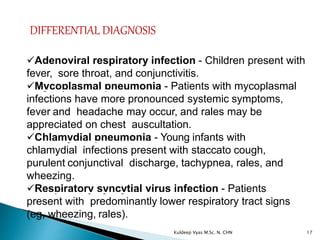
Adenoviral respiratory infection - Children present with
fever, sore throat, and conjunctivitis.
Mycoplasmal pneumonia - Patients with mycoplasmal
infections have more pronounced systemic symptoms,
fever and headache may occur, and rales may be
appreciated on chest auscultation.
Chlamydial pneumonia - Young infants with
chlamydial infections present with staccato cough,
purulent conjunctival discharge, tachypnea, rales, and
wheezing.
Respiratory syncytial virus infection - Patients
present with predominantly lower respiratory tract signs
(eg, wheezing, rales).
DIFFERENTIAL DIAGNOSIS
17Kuldeep Vyas M.Sc. N. CHN
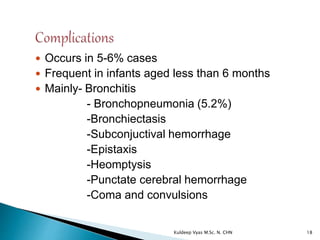
 Occurs in 5-6% cases
 Frequent in infants aged less than 6 months
 Mainly- Bronchitis
- Bronchopneumonia (5.2%)
-Bronchiectasis
-Subconjuctival hemorrhage
-Epistaxis
-Heomptysis
-Punctate cerebral hemorrhage
-Coma and convulsions
18Kuldeep Vyas M.Sc. N. CHN
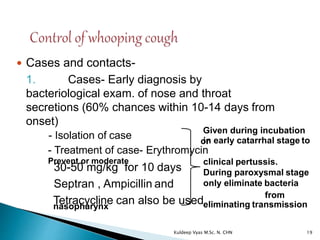
 Cases and contacts-
1. Cases- Early diagnosis by
bacteriological exam. of nose and throat
secretions (60% chances within 10-14 days from
onset)
- Isolation of case
30-50 mg/kg for 10 days
Septran , Ampicillin and
in early catarrhal stage to
- Treatment of case- Erythromycin
Prevent or moderate clinical pertussis.
During paroxysmal stage
only eliminate bacteria
Tetracycline can also be used
from
nasopharynx eliminating transmission
Given during incubation
or
19Kuldeep Vyas M.Sc. N. CHN
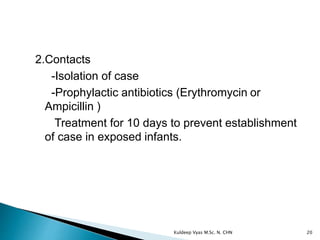
2.Contacts
-Isolation of case
-Prophylactic antibiotics (Erythromycin or
Ampicillin )
Treatment for 10 days to prevent establishment
of case in exposed infants.
20Kuldeep Vyas M.Sc. N. CHN
 Active immunization
- Covered under National Immunization Programme
-Combined as DPT, DTWP or DTaP vaccine.
-Administered as 3 dose ( each dose 0.5 ml) IM at
1 month interval starting at 6 weeks.
-Booster dose at 18-24 months
-Acellular vaccine for older children and adults
21Kuldeep Vyas M.Sc. N. CHN
 Efficacy 85%
 Duration of protection 6-12 years following complete
dose+ booster
 HIV positive individuals should also be immunized
 Adverse reactions- Early vaccine caused screaming
and collapse.
-Give rise to local reactions at site of injection,
mild fever and irritability
-Rare vaccine reaction are- Inconsolable
screaming, seizures, hypotonic hypo-responsive
episode,
22Kuldeep Vyas M.Sc. N. CHN
Contraindications- Anaphylactic reactions,
encephalopathy, history of epilepsy, convulsions
or similar CNS disorders , any febrile episode and
reaction to previous triple vaccine
• Passive immunization-
Hyperimmune globulin is given but efficacy no
established yet.
23Kuldeep Vyas M.Sc. N. CHN
24Kuldeep Vyas M.Sc. N. CHN

Whooping cough (pertussis)

  • 1.
    Kuldeep Vyas M.Sc.N. Community Health Nursing 1
  • 2.
     Pertussis isalso called as Whooping cough is a highly contagious disease mainly of children caused by Bordetella pertussis.  It is characterized by severe uncontrollable coughing spells which can sometimes end in a “whoop” sound when person breathes in.  Also called as “100 day cough” by Chinese. 2Kuldeep Vyas M.Sc. N. CHN
  • 3.
     In 2012,2.49 cases were reported by WHO globally when the DPT immunization was 83%.  In India after launch of immunization programme in 1987, the reported cases dropped from 1.63 lakh to only 36,661 cases in 2013 ( 77% decline)  Underlying malnutrition and other respiratory infections in children make then prone to this disease.  Recently the disease shows increase incidence in older children, adolescents and adults.(21% adults had pertussis after serological studies of adults with cough for more than 2 weeks) 3Kuldeep Vyas M.Sc. N. CHN
  • 4.
     AGENT FACTORS- Agent-Causative agent is Bordetella pertussis. Also caused by B.parapertussis, Viruses(parainfluenzae, adenovirus) 4Kuldeep Vyas M.Sc. N. CHN
  • 5.
     Source ofinfection- Only man is the known source of infection. Pervious case of pertussis which may be mild, missed and unrecognised case is usually the source of infection. No chronic carrier state exist  Infective material –Nasopharyngeal and bronchial secretion. Fomites contaminated by such discharge are also infective. 5Kuldeep Vyas M.Sc. N. CHN
  • 6.
    Infective period- Catarrhalstage most infective. Extends from week after exposure to about 3 weeks after onset of paroxysmal stage.  Secondary attack rate- Average 90% in unimmunized people. 6Kuldeep Vyas M.Sc. N. CHN
  • 7.
     HOST FACTORS Age-Infants and pre-school (<5 years) - Developing countries (20-30 months) and developed countries (50 months) -Highest mortality below 6 months. Sex- More common among females. Immunity-Immunity develops after a case or immunization. No cross immunity. Secondary attack occur in declining immune person. 7Kuldeep Vyas M.Sc. N. CHN
  • 8.
     ENVIRONMENT More casesoccur during winter and spring. Lower socio-economic group more prone than well to do groups due to overcrowding. 8Kuldeep Vyas M.Sc. N. CHN
  • 9.
     Close personto person contact via aerosolized droplets fromrespiratory secretions of patients with disease.  90% of non immune household contacts acquire thedisease.  Adolescents and adults (27 of reported cases in 2004) are the major source of infection in unvaccinated children.  Infants and young children are infected by older siblings who have mildto asymptomatic disease (43% of reported cases). TRANSMISSION 9Kuldeep Vyas M.Sc. N. CHN
  • 10.
     Pertussis isprimarily a toxin-mediated disease.  The bacteria attach to the cilia of the respiratory epithelial cells, produce toxins that paralyze the cilia, and cause inflammation of the respiratory tract, which interferes with the clearing of pulmonary secretions.  Until recently, scientists thought that B. pertussis did not invade the tissues; however, recent studies have suggested that the bacteria are present in alveolar macrophages. PATHOGENESIS 10Kuldeep Vyas M.Sc. N. CHN
  • 11.
     Usually 7-14days but not more than 3 weeks 11Kuldeep Vyas M.Sc. N. CHN
  • 12.
     Causes localinfection by multiplying in the surface epithelium of respiratory mucosa.  Leads to inflammation and necrosis of mucosa.  Occurs in 3 stages- 1. Catarrhal stage 2. Paroxysmal stage 3. Convalescent stage 12Kuldeep Vyas M.Sc. N. CHN
  • 13.
     1. Catarrhalstage- - Lasts for 10 days. - Characterized by: Insidious onset Lacrimation Sneezing Coryza Anorexia Malaise Hacking night cough that becomes diurnal 13Kuldeep Vyas M.Sc. N. CHN
  • 14.
     2. Paroxysmalstage -Lasts for 2-4 weeks -Characterized by burst of rapid, consecutive coughs followed by a deep, deep pitched inspiration (whoop) - Followed by vomiting In infants- Causes cyanosis and apnoea In adults and adolescents- Uncharacteristic,persistent cough 14Kuldeep Vyas M.Sc. N. CHN
  • 15.
     3. Convalescentstage- Lasts for 1-2 weeks Decrease in paroxysms of coughing both in freq and severity Cessation of Vomiting 15Kuldeep Vyas M.Sc. N. CHN
  • 16.
    Increase of pertussisantibody: I. IgA antibody titer to pertussis is becoming the method of choice. II. IgG antibody to pertussis toxin indicative of recent infection. III. Single serum test for significantly high pertussis specific antibody can confirm the diagnosis.  Blood Count I. Absolute Lymphocytosis (15,000-100,000 cells/mm3( .  Cultures: nasopharyngeal (NP) swab or aspirate from all persons with suspected cases.  X-Ray chest DIAGNOSIS 16Kuldeep Vyas M.Sc. N. CHN
  • 17.
    Adenoviral respiratory infection- Children present with fever, sore throat, and conjunctivitis. Mycoplasmal pneumonia - Patients with mycoplasmal infections have more pronounced systemic symptoms, fever and headache may occur, and rales may be appreciated on chest auscultation. Chlamydial pneumonia - Young infants with chlamydial infections present with staccato cough, purulent conjunctival discharge, tachypnea, rales, and wheezing. Respiratory syncytial virus infection - Patients present with predominantly lower respiratory tract signs (eg, wheezing, rales). DIFFERENTIAL DIAGNOSIS 17Kuldeep Vyas M.Sc. N. CHN
  • 18.
     Occurs in5-6% cases  Frequent in infants aged less than 6 months  Mainly- Bronchitis - Bronchopneumonia (5.2%) -Bronchiectasis -Subconjuctival hemorrhage -Epistaxis -Heomptysis -Punctate cerebral hemorrhage -Coma and convulsions 18Kuldeep Vyas M.Sc. N. CHN
  • 19.
     Cases andcontacts- 1. Cases- Early diagnosis by bacteriological exam. of nose and throat secretions (60% chances within 10-14 days from onset) - Isolation of case 30-50 mg/kg for 10 days Septran , Ampicillin and in early catarrhal stage to - Treatment of case- Erythromycin Prevent or moderate clinical pertussis. During paroxysmal stage only eliminate bacteria Tetracycline can also be used from nasopharynx eliminating transmission Given during incubation or 19Kuldeep Vyas M.Sc. N. CHN
  • 20.
    2.Contacts -Isolation of case -Prophylacticantibiotics (Erythromycin or Ampicillin ) Treatment for 10 days to prevent establishment of case in exposed infants. 20Kuldeep Vyas M.Sc. N. CHN
  • 21.
     Active immunization -Covered under National Immunization Programme -Combined as DPT, DTWP or DTaP vaccine. -Administered as 3 dose ( each dose 0.5 ml) IM at 1 month interval starting at 6 weeks. -Booster dose at 18-24 months -Acellular vaccine for older children and adults 21Kuldeep Vyas M.Sc. N. CHN
  • 22.
     Efficacy 85% Duration of protection 6-12 years following complete dose+ booster  HIV positive individuals should also be immunized  Adverse reactions- Early vaccine caused screaming and collapse. -Give rise to local reactions at site of injection, mild fever and irritability -Rare vaccine reaction are- Inconsolable screaming, seizures, hypotonic hypo-responsive episode, 22Kuldeep Vyas M.Sc. N. CHN
  • 23.
    Contraindications- Anaphylactic reactions, encephalopathy,history of epilepsy, convulsions or similar CNS disorders , any febrile episode and reaction to previous triple vaccine • Passive immunization- Hyperimmune globulin is given but efficacy no established yet. 23Kuldeep Vyas M.Sc. N. CHN
  • 24.