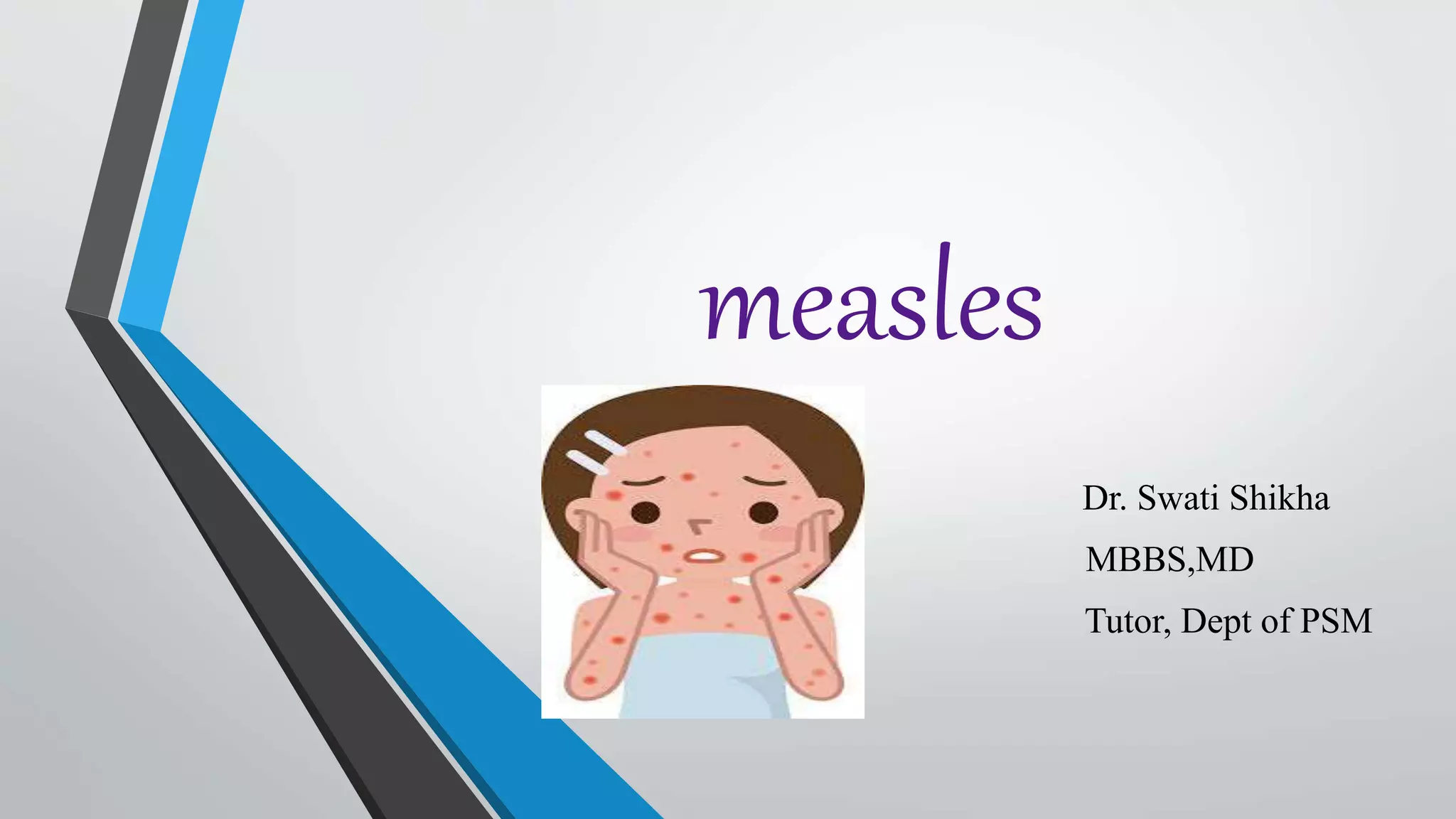
measles
Dr. Swati Shikha
MBBS,MD
Tutor, Dept of PSM
Learning Objectives
• Introduction
• Burden of the disease
• Epidemiological factors
• Clinical features
• Complications
• Treatment
• Prevention
2
Introduction
• Also called as Rubeola meaning red spots
• Highly infectious viral disease (group : myxovirus)
• Occurs only in humans
• Has high morbidity and mortality in developing countries
3
Burden of the Disease
• Endemic in all parts of the world
• Epidemic occurs when the proportion of susceptible children reaches about
40%
• When introduced in a virgin community, >90% of that community will be
infected
4
Challenges for measles elimination
• Weak immunization system
• High infectious nature of measles
• Increasing refusal of immunization by some population
• Changing epidemiology of measles
• Gap in human and financial resource at country, regional and global level
5
Epidemiological determinants
• AGENT FACTORS
• Agent: caused by RNA paramyxovirus
• Source of infection: a case of measles
• Infective material: secretion of nose, throat and respiratory tract of a case
• Communicability: highly infectious during prodromal period and at the time
of eruption, communicability declines after appearance of rash
6
• Host factors
• Age: 6 months to 3 years of age in developing countries
• Gender: male = female
• Immunity: one attack of measles confers lifelong immunity, infants are
protected from maternal antibodies upto 6 months of age
• Nutrition: more severe in malnourished children
• Environmental factors
• The virus can spread in any season
7
Transmission
• Directly from person to person mainly by droplet infection
• From 4 days before the appearance of rash to 4 days thereafter
• Portal of entry: respiratory tract
• Entry can also occur through conjunctiva
8
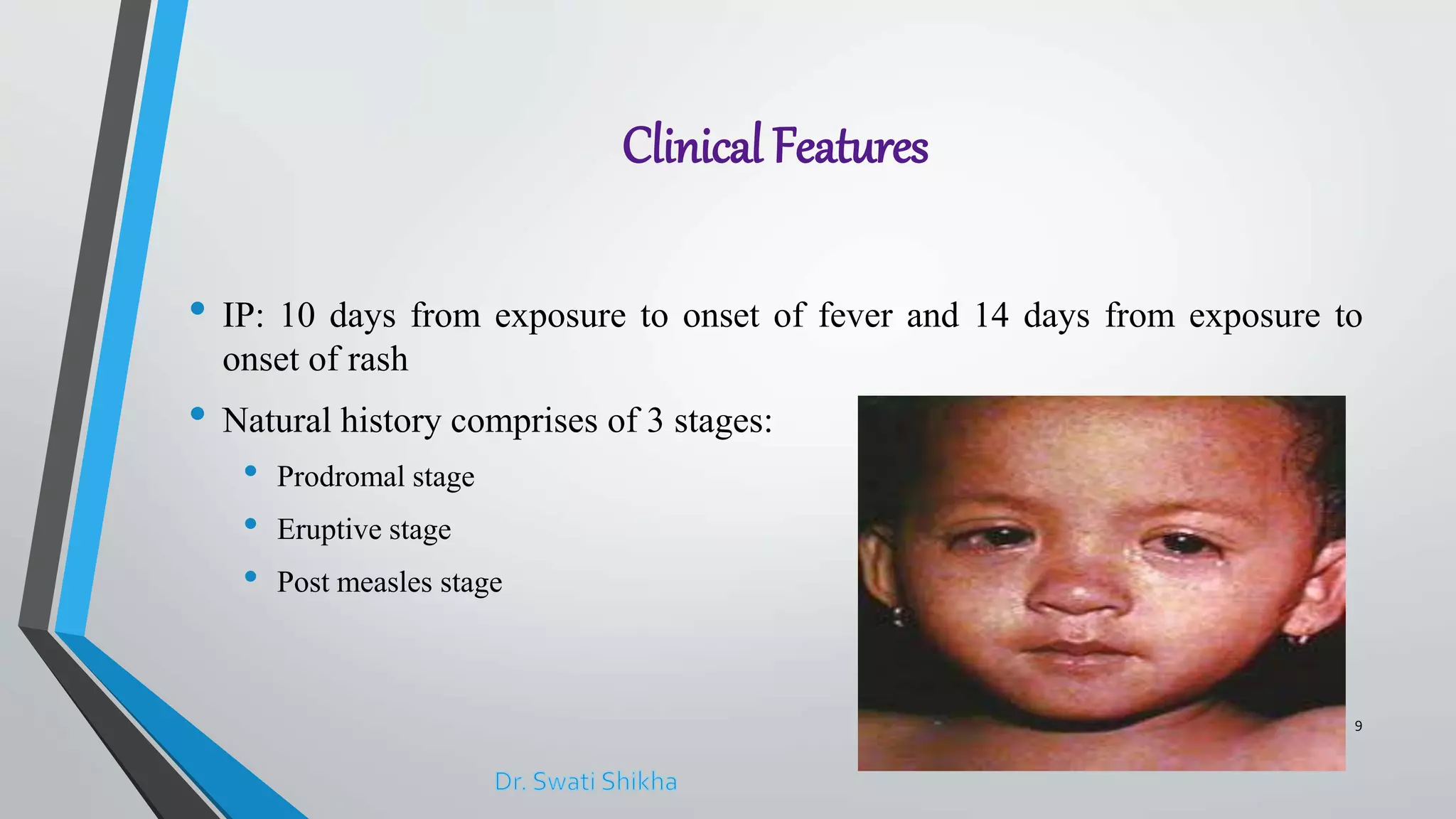
Clinical Features
• IP: 10 days from exposure to onset of fever and 14 days from exposure to
onset of rash
• Natural history comprises of 3 stages:
• Prodromal stage
• Eruptive stage
• Post measles stage
9
Prodromal stage
• Begins 10 days after infection and lasts untill day 14.
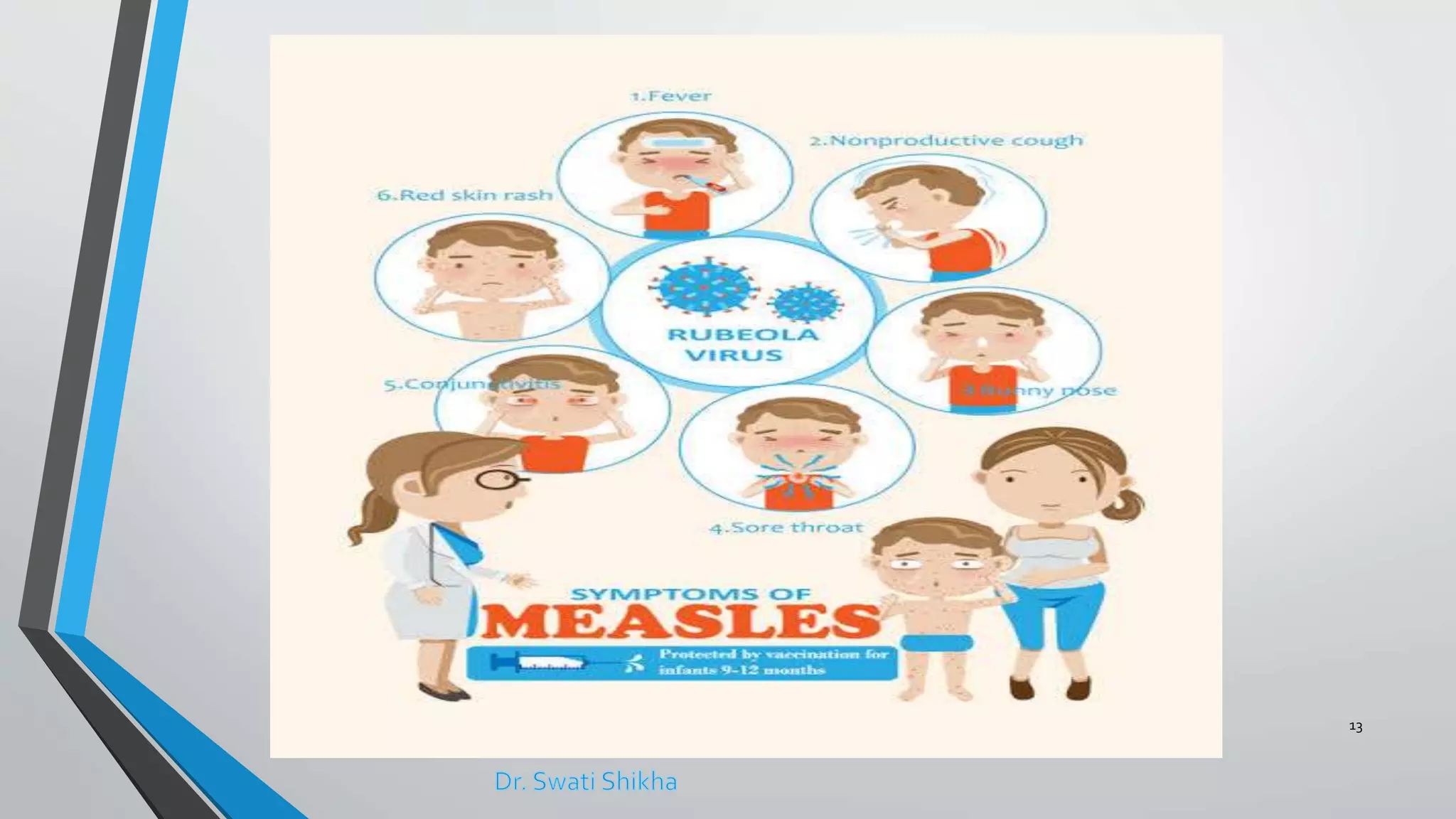
• c/f: fever, coryza with sneezing and nasal discharge, cough, redness of eyes,
lacrimation and photophobia.
• Koplik’s spot (pathognomonic sign) appears a day or 2 before the appearance
of rash.
10
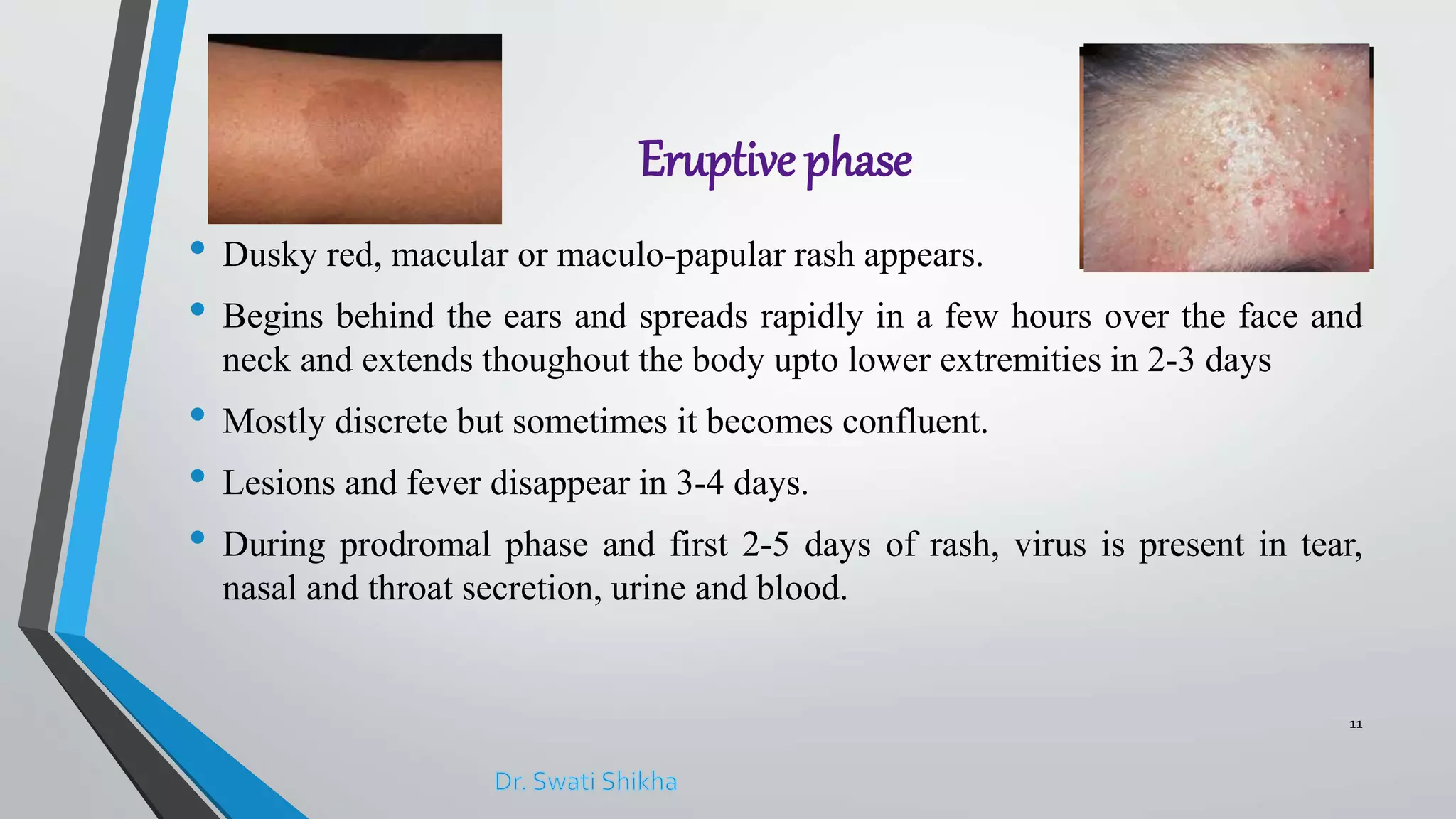
Eruptive phase
• Dusky red, macular or maculo-papular rash appears.
• Begins behind the ears and spreads rapidly in a few hours over the face and
neck and extends thoughout the body upto lower extremities in 2-3 days
• Mostly discrete but sometimes it becomes confluent.
• Lesions and fever disappear in 3-4 days.
• During prodromal phase and first 2-5 days of rash, virus is present in tear,
nasal and throat secretion, urine and blood.
11
Post measles stage
• Weight loss, weakness
• Gradual deterioration into chronic illness – due to increased susceptibility to
other bacterial and viral infections, nutritional and metabolic effects etc
• May lead to growth retardation, diarrhoea and several other infections.
12
13
Complications
• Occur in approximately 30% of reported cases
• Factors increasing the risk of complications:
• Age <5 years
• Overcrowding
• Malnourishment ( vitamin A deficiency)
• Immunological disorder - AIDS
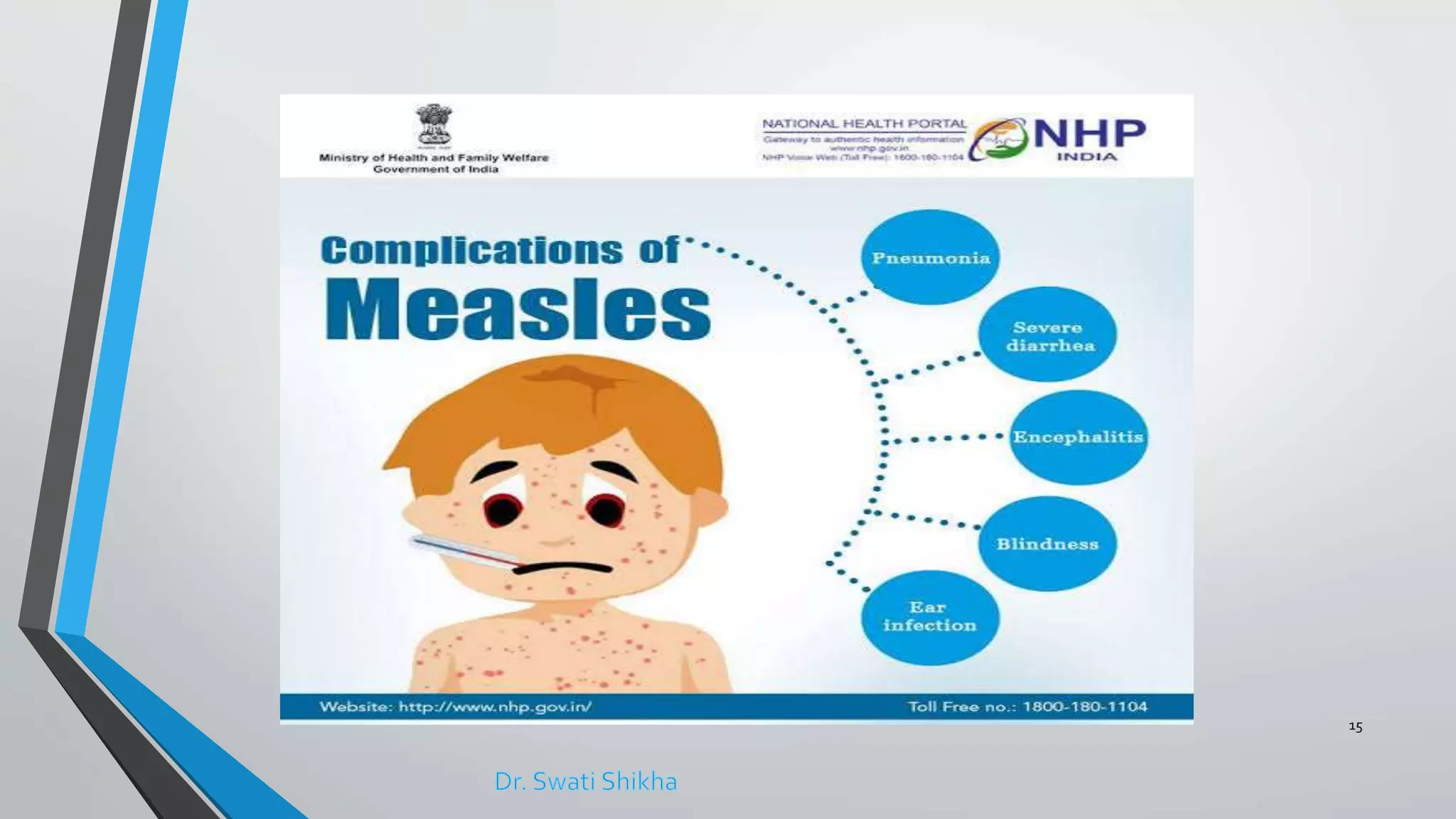
• Common complications includes: otitis media, laryngo-tracheo-bronchitis, diarrhoea and
pneumonia.
• Rare complication: SSPE
• Severe complication occuring in immunocompromised individuals are acute progressive
encephalitis and giant cell pneumonia.
14
15
Treatment
• No specific treatment
• Management includes- supportive care and prevention and treatment of
complications and secondary infections
• All cases of measles should be treated with vitamin A because many children
develop acute deficiency of vitamin A
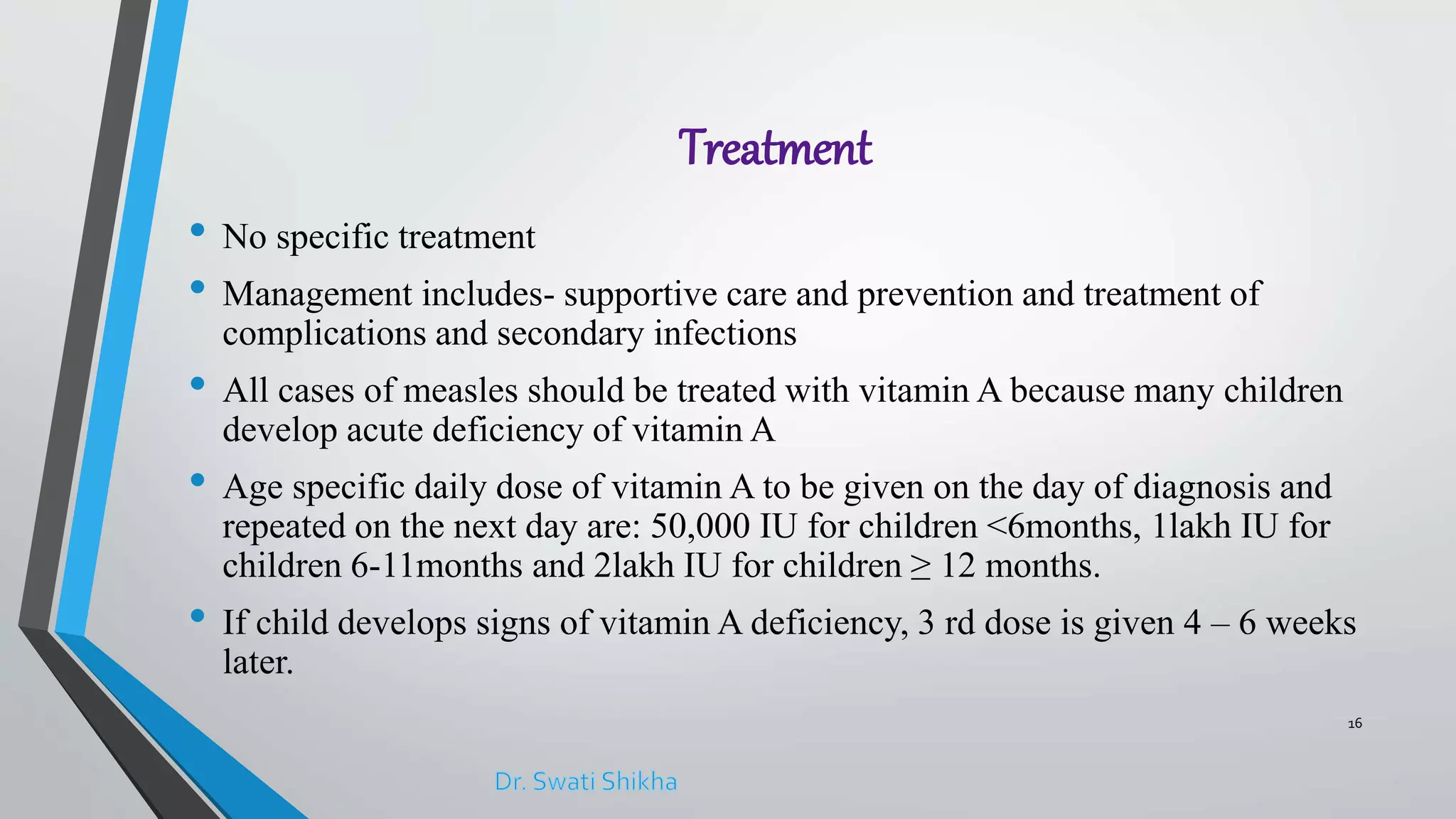
• Age specific daily dose of vitamin A to be given on the day of diagnosis and
repeated on the next day are: 50,000 IU for children <6months, 1lakh IU for
children 6-11months and 2lakh IU for children ≥ 12 months.
• If child develops signs of vitamin A deficiency, 3 rd dose is given 4 – 6 weeks
later.
16
Prevention- vaccination
17
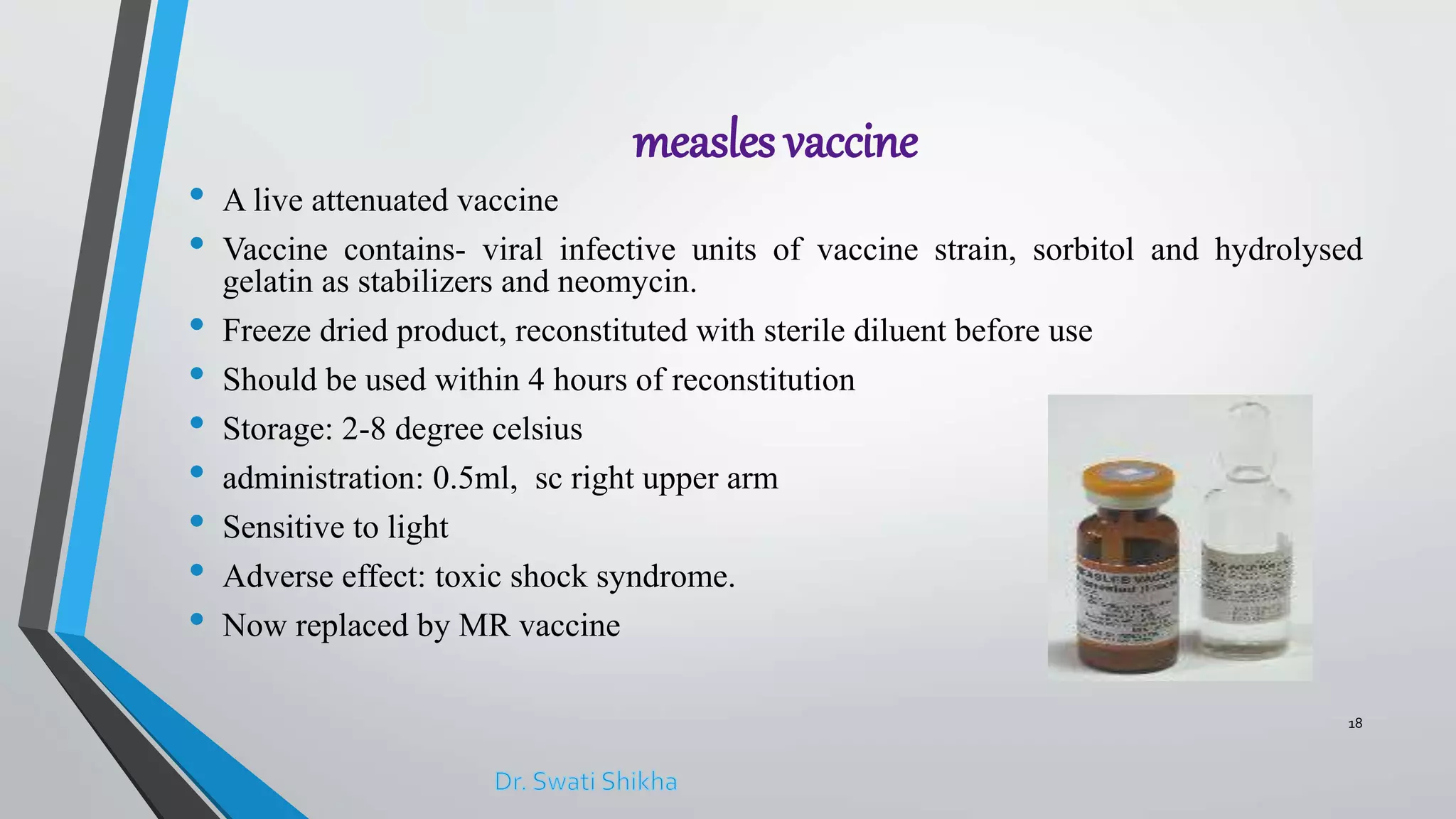
measles vaccine
• A live attenuated vaccine
• Vaccine contains- viral infective units of vaccine strain, sorbitol and hydrolysed
gelatin as stabilizers and neomycin.
• Freeze dried product, reconstituted with sterile diluent before use
• Should be used within 4 hours of reconstitution
• Storage: 2-8 degree celsius
• administration: 0.5ml, sc right upper arm
• Sensitive to light
• Adverse effect: toxic shock syndrome.
• Now replaced by MR vaccine
18
19

Measles

  • 1.
  • 2.
    Learning Objectives • Introduction •Burden of the disease • Epidemiological factors • Clinical features • Complications • Treatment • Prevention 2
  • 3.
    Introduction • Also calledas Rubeola meaning red spots • Highly infectious viral disease (group : myxovirus) • Occurs only in humans • Has high morbidity and mortality in developing countries 3
  • 4.
    Burden of theDisease • Endemic in all parts of the world • Epidemic occurs when the proportion of susceptible children reaches about 40% • When introduced in a virgin community, >90% of that community will be infected 4
  • 5.
    Challenges for measleselimination • Weak immunization system • High infectious nature of measles • Increasing refusal of immunization by some population • Changing epidemiology of measles • Gap in human and financial resource at country, regional and global level 5
  • 6.
    Epidemiological determinants • AGENTFACTORS • Agent: caused by RNA paramyxovirus • Source of infection: a case of measles • Infective material: secretion of nose, throat and respiratory tract of a case • Communicability: highly infectious during prodromal period and at the time of eruption, communicability declines after appearance of rash 6
  • 7.
    • Host factors •Age: 6 months to 3 years of age in developing countries • Gender: male = female • Immunity: one attack of measles confers lifelong immunity, infants are protected from maternal antibodies upto 6 months of age • Nutrition: more severe in malnourished children • Environmental factors • The virus can spread in any season 7
  • 8.
    Transmission • Directly fromperson to person mainly by droplet infection • From 4 days before the appearance of rash to 4 days thereafter • Portal of entry: respiratory tract • Entry can also occur through conjunctiva 8
  • 9.
    Clinical Features • IP:10 days from exposure to onset of fever and 14 days from exposure to onset of rash • Natural history comprises of 3 stages: • Prodromal stage • Eruptive stage • Post measles stage 9
  • 10.
    Prodromal stage • Begins10 days after infection and lasts untill day 14. • c/f: fever, coryza with sneezing and nasal discharge, cough, redness of eyes, lacrimation and photophobia. • Koplik’s spot (pathognomonic sign) appears a day or 2 before the appearance of rash. 10
  • 11.
    Eruptive phase • Duskyred, macular or maculo-papular rash appears. • Begins behind the ears and spreads rapidly in a few hours over the face and neck and extends thoughout the body upto lower extremities in 2-3 days • Mostly discrete but sometimes it becomes confluent. • Lesions and fever disappear in 3-4 days. • During prodromal phase and first 2-5 days of rash, virus is present in tear, nasal and throat secretion, urine and blood. 11
  • 12.
    Post measles stage •Weight loss, weakness • Gradual deterioration into chronic illness – due to increased susceptibility to other bacterial and viral infections, nutritional and metabolic effects etc • May lead to growth retardation, diarrhoea and several other infections. 12
  • 13.
  • 14.
    Complications • Occur inapproximately 30% of reported cases • Factors increasing the risk of complications: • Age <5 years • Overcrowding • Malnourishment ( vitamin A deficiency) • Immunological disorder - AIDS • Common complications includes: otitis media, laryngo-tracheo-bronchitis, diarrhoea and pneumonia. • Rare complication: SSPE • Severe complication occuring in immunocompromised individuals are acute progressive encephalitis and giant cell pneumonia. 14
  • 15.
  • 16.
    Treatment • No specifictreatment • Management includes- supportive care and prevention and treatment of complications and secondary infections • All cases of measles should be treated with vitamin A because many children develop acute deficiency of vitamin A • Age specific daily dose of vitamin A to be given on the day of diagnosis and repeated on the next day are: 50,000 IU for children <6months, 1lakh IU for children 6-11months and 2lakh IU for children ≥ 12 months. • If child develops signs of vitamin A deficiency, 3 rd dose is given 4 – 6 weeks later. 16
  • 17.
  • 18.
    measles vaccine • Alive attenuated vaccine • Vaccine contains- viral infective units of vaccine strain, sorbitol and hydrolysed gelatin as stabilizers and neomycin. • Freeze dried product, reconstituted with sterile diluent before use • Should be used within 4 hours of reconstitution • Storage: 2-8 degree celsius • administration: 0.5ml, sc right upper arm • Sensitive to light • Adverse effect: toxic shock syndrome. • Now replaced by MR vaccine 18
  • 19.