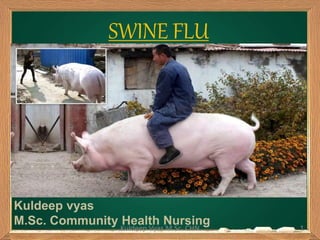
SWINE FLU
Kuldeep vyas
M.Sc. Community Health Nursing
Kuldeep Vyas M.Sc. CHN 1
INTRODUCTION
It is a respiratory disease caused by H1 N1
Type A Influenza Virus.
It is like ordinary flu.
The Swine flu was initially seen in humans in
Mexico in 2009, where the strand of the
particular virus was a marriage of 3 types of
strands.
Kuldeep Vyas M.Sc. CHN 2
CONT…
Kuldeep Vyas M.Sc. CHN 3
CONT…
Kuldeep Vyas M.Sc. CHN 4
CONT…
 The major reason of its world wide spread is
the lack of immunity against the virus in a
large population.
WHO declares swine flu as pandemic on 11
June 2009.
Kuldeep Vyas M.Sc. CHN 5
SYMPTOMS
Kuldeep Vyas M.Sc. CHN 6
SYMPTOMS
 Fever
 Sore Throat
 Cough
 Headache
 Body ache
 Lethargy
 Diarrhoea and Vomiting
Kuldeep Vyas M.Sc. CHN 7
Mode of Transmission
Kuldeep Vyas M.Sc. CHN 8
Mode of Transmission
 Cough and Sneezing by Infected Indl
 Virus deposited on any Surface
 Healthy indl touches the contaminated surface
 Healthy Indl touches his Eyes, Nose or Mouth
 Healthy Indl becomes infected
Kuldeep Vyas M.Sc. CHN 9
Period of Communicability
1 Day 7 Days
Kuldeep Vyas M.Sc. CHN 10
Incubation Period
2 Days
(1-4 Days)
Kuldeep Vyas M.Sc. CHN 11
High Risk Group
 Children with mild illness
but with predisposing risk factors.
 Pregnant women;
 Persons aged 65 years or older;
 Patients with lung diseases,
heart disease, liver disease, kidney disease, blood
disorders, diabetes, neurological disorders, cancer and
HIV/AIDS;
 Patients on long term cortisone therapy.
Kuldeep Vyas M.Sc. CHN 12
Warning Signals in Adults
 Breathlessness,
 chest pain,
 drowsiness,
 fall in blood pressure,
 sputum mixed with blood,
 bluish discolouration of nails;
 Confusion
Kuldeep Vyas M.Sc. CHN 13
Warning Signals in Children
(Red Flag Signs)
 high and persistent fever,
 inability to feed well,
 convulsions,
 shortness of breath,
 difficulty in breathing,
 Inconsolable cry, etc.
Kuldeep Vyas M.Sc. CHN 14
Prevention and control
 In order to prevent and contain outbreak of
Influenza virus the following guidelines for
screening, testing and isolation are to be followed:
 At first all individuals seeking consultations for flu
like symptoms should be screened at healthcare
facilities both Government and private or examined
by a doctor and these will be categorized as under:
Kuldeep Vyas M.Sc. CHN 15
Category A
 Patients with mild fever + cough / sore throat with
or without bodyache, headache, diarrhoea and
vomiting will be categorized as Category-A.
 They do not require Oseltamivir and should be
treated for the symptoms mentioned above. The
patients should be monitored for their progress and
reassessed at 24 to 48 hours by the doctor.
 No testing of the patient for Influenza is required.
 Patients should confine themselves at home and
avoid mixing up with public and high risk members
in the family.
Kuldeep Vyas M.Sc. CHN 16
Category B
 (i) In addition to all the signs and symptoms
mentioned under Category-A, if the patient has high
grade fever and severe sore throat, may require
home isolation and Oseltamivir;
 (ii) In addition to all the signs and symptoms
mentioned under Category-A, individuals having
one or more of the following high risk conditions
shall be treated with Oseltamivir:
Kuldeep Vyas M.Sc. CHN 17
Category B
 Children with mild illness but with predisposing risk
factors.
 Pregnant women;
 Persons aged 65 years or older;
 Patients with lung diseases, heart disease, liver
disease, kidney disease, blood disorders, diabetes,
neurological disorders, cancer and HIV/AIDS;
 Patients on long term cortisone therapy
Kuldeep Vyas M.Sc. CHN 18
Category B
 No tests for Influenza is required for Category-B (i)
and (ii).
 All patients of Category-B (i) and (ii) should confine
themselves at home and avoid mixing with public
and high risk members in the family.
 Broad Spectrum antibiotics as per the Guideline for
Community-acquired pneumonia (CAP) may be
prescribed.
Kuldeep Vyas M.Sc. CHN 19
Category C
 In addition to the above signs and symptoms of
Category-A and B, if the patient has one or more of
the following:
 Breathlessness, chest pain, drowsiness, fall in blood
pressure, sputum mixed with blood, bluish
discolouration of nails;
Kuldeep Vyas M.Sc. CHN 20
Category C
 Children with influenza like illness who had a severe
disease as manifested by the red flag signs
(Somnolence, high and persistent fever, inability to
feed well, convulsions, shortness of breath,
difficulty in breathing, etc).
 Worsening of underlying chronic conditions.
 All these patients mentioned above in Category-C
require testing, immediate hospitalization and
treatment.
Kuldeep Vyas M.Sc. CHN 21
Prevention
Kuldeep Vyas M.Sc. CHN 22
Vaccine
 While declaring the Pandemic to be over in August
2010, WHO conveyed that Pandemic Influenza A
(HINI) virus that caused Pandemic [2009-2010]
would circulate as Seasonal Influenza virus and
would continue to do so for years to come.
 WHO recommended vaccine only for High Risk Group
 Ministry of Health and Family Welfare recommends
the trivalent inactivated influenza vaccine.
Kuldeep Vyas M.Sc. CHN 23
Vaccine
 The ICMR has recommended on the following
Seasonal Influenza vaccine composition, for the
period 2017-2018. The recommended Trivalent
vaccine should have:
 an A/Michigan/45/2015 (H1N1)pdm09-like virus
 an A/Hong Kong/4801/2014 (H3N2) – like virus
 a B/Brisbane/60/2008-like virus
Kuldeep Vyas M.Sc. CHN 24
Vaccine
 The available vaccine takes about 2-3 weeks for
development of immunity. Hence for the health care
workers working in an environment with likelihood of
exposure to Influenza virus, vaccine should be
administered at least 1 month prior to the
commencement of the season, till such time use of
chemoprophylaxis may be considered.
Kuldeep Vyas M.Sc. CHN 25
Cont…
1. children who are 6 months to 9 years of age are
given 2 doses of the swine flu vaccine. These two
doses of the swine flu vaccination should be
separated by 4 weeks. For anyone above 10 years
of age should receive 1 dose of the swine flu
vaccine.
2. The swine flu vaccination needs to be stored in the
cooler at 35° to 46°F (2° to 8°C), with a desired
average temperature of 40°F (5°C).
Kuldeep Vyas M.Sc. CHN 26
Limitations of the Influenza
Vaccination
 Influenza vaccination is most effective when
circulating viruses are well-matched with vaccine
viruses.
 Even with appropriate matching, efficacy of vaccine
may be about 70% to 80%.
 In case the locally circulating virus is different from
vaccine virus recommended by WHO, it may be
partially effective or not be effective at all.
 Hence, vaccine should not give a false sense of
security.
Kuldeep Vyas M.Sc. CHN 27
High Risk Groups for whom
vaccine is recommended by WHO
 Health Care workers, working in hospital / institutional
settings (doctors, nurses, paramedics) with likelihood
of exposure to Influenza virus
 Young children
 Pregnant women;
 Persons aged 65 years or older;
 Patients with Comorbidity
 Patients with compromised immunity
Kuldeep Vyas M.Sc. CHN 28
USE OF MASKS
 There are two types of masks which are recommended
for various categories of personnel depending upon the
work environment;
1. Triple layer surgical mask 2. N 95 Respirator
 Change the mask after six hours or as soon as they
become wet.
 Disposable masks are never to be reused and should be
disposed off.
 Never touch the potentially infected outer surface of
the mask while removing it.
Kuldeep Vyas M.Sc. CHN 29
USE OF MASKS
 There is no scientific evidence to show health benefit of
using masks for members of public. In fact erroneous
use of masks or continuous use of a disposable mask
for longer than 6 hours or repeated use of same mask
may actually increase risk of infection further.
 In the hospital setting used masks should be disposed
off in the identified infectious waste disposal
bag/container.
 In community settings, it may be disposed off either by
burning or deep burial.
Kuldeep Vyas M.Sc. CHN 30
Triple layer surgical mask
 Suspect/ probable/confirmed cases of influenza.
 The care provider in home care settings
 Close family contacts of such cases undergoing home
care should also use Triple layer surgical mask.
 All medical personnel (Doctor, nursing and paramedical
staff) would use Disposable Triple layer surgical mask
while interacting with patients in screening area.
 All patients, Medical and nursing staff in the isolation
wards.
Kuldeep Vyas M.Sc. CHN 31
Triple layer surgical mask
 Personnel involved in handling dead bodies of
suspect/confirmed cases (Mortuary)
 Ambulance Staff including driver.
 Doctors /Private practitioners with other health
workers in screening centres / general practice
 Health workers involved in community surveillance
 Security personnel working in an infected/ potentially
infected area for example Influenza ward in a hospital,
screening centre etc.
Kuldeep Vyas M.Sc. CHN 32
N 95 Respirator
 Staff involved in any aerosol generating procedures
like suction, intubation, nebulization, etc. they must
use N95 Respirator
 Medical personnel need to collect clinical samples from
patients.
 Medical personnel in ICU
 Medical personnel in laboratory
Kuldeep Vyas M.Sc. CHN 33
Tamiflu (Oseltamivir)
Oseltamivir is the recommended drug for treatment.
Dose for treatment is as follows -
 By Weight:
 o For weight <15kg
 o 15-23kg
 o 24-<40kg
 o >40kg
30 mg BD for 5 days
45 mg BD for 5 days
60 mg BD for 5 days
75 mg BD for 5 days
Kuldeep Vyas M.Sc. CHN 34
Tamiflu (Oseltamivir)
 For infants:
 o < 3 months
 o 3-5 months
 o 6-11 months
12 mg BD for 5 days
20 mg BD for 5 days
25 mg BD for 5 days
 It is also available as syrup (12mg per ml)
Kuldeep Vyas M.Sc. CHN 35
Kuldeep Vyas M.Sc. CHN 36

Swine Flu

  • 1.
    SWINE FLU Kuldeep vyas M.Sc.Community Health Nursing Kuldeep Vyas M.Sc. CHN 1
  • 2.
    INTRODUCTION It is arespiratory disease caused by H1 N1 Type A Influenza Virus. It is like ordinary flu. The Swine flu was initially seen in humans in Mexico in 2009, where the strand of the particular virus was a marriage of 3 types of strands. Kuldeep Vyas M.Sc. CHN 2
  • 3.
  • 4.
  • 5.
    CONT…  The majorreason of its world wide spread is the lack of immunity against the virus in a large population. WHO declares swine flu as pandemic on 11 June 2009. Kuldeep Vyas M.Sc. CHN 5
  • 6.
  • 7.
    SYMPTOMS  Fever  SoreThroat  Cough  Headache  Body ache  Lethargy  Diarrhoea and Vomiting Kuldeep Vyas M.Sc. CHN 7
  • 8.
  • 9.
    Mode of Transmission Cough and Sneezing by Infected Indl  Virus deposited on any Surface  Healthy indl touches the contaminated surface  Healthy Indl touches his Eyes, Nose or Mouth  Healthy Indl becomes infected Kuldeep Vyas M.Sc. CHN 9
  • 10.
    Period of Communicability 1Day 7 Days Kuldeep Vyas M.Sc. CHN 10
  • 11.
    Incubation Period 2 Days (1-4Days) Kuldeep Vyas M.Sc. CHN 11
  • 12.
    High Risk Group Children with mild illness but with predisposing risk factors.  Pregnant women;  Persons aged 65 years or older;  Patients with lung diseases, heart disease, liver disease, kidney disease, blood disorders, diabetes, neurological disorders, cancer and HIV/AIDS;  Patients on long term cortisone therapy. Kuldeep Vyas M.Sc. CHN 12
  • 13.
    Warning Signals inAdults  Breathlessness,  chest pain,  drowsiness,  fall in blood pressure,  sputum mixed with blood,  bluish discolouration of nails;  Confusion Kuldeep Vyas M.Sc. CHN 13
  • 14.
    Warning Signals inChildren (Red Flag Signs)  high and persistent fever,  inability to feed well,  convulsions,  shortness of breath,  difficulty in breathing,  Inconsolable cry, etc. Kuldeep Vyas M.Sc. CHN 14
  • 15.
    Prevention and control In order to prevent and contain outbreak of Influenza virus the following guidelines for screening, testing and isolation are to be followed:  At first all individuals seeking consultations for flu like symptoms should be screened at healthcare facilities both Government and private or examined by a doctor and these will be categorized as under: Kuldeep Vyas M.Sc. CHN 15
  • 16.
    Category A  Patientswith mild fever + cough / sore throat with or without bodyache, headache, diarrhoea and vomiting will be categorized as Category-A.  They do not require Oseltamivir and should be treated for the symptoms mentioned above. The patients should be monitored for their progress and reassessed at 24 to 48 hours by the doctor.  No testing of the patient for Influenza is required.  Patients should confine themselves at home and avoid mixing up with public and high risk members in the family. Kuldeep Vyas M.Sc. CHN 16
  • 17.
    Category B  (i)In addition to all the signs and symptoms mentioned under Category-A, if the patient has high grade fever and severe sore throat, may require home isolation and Oseltamivir;  (ii) In addition to all the signs and symptoms mentioned under Category-A, individuals having one or more of the following high risk conditions shall be treated with Oseltamivir: Kuldeep Vyas M.Sc. CHN 17
  • 18.
    Category B  Childrenwith mild illness but with predisposing risk factors.  Pregnant women;  Persons aged 65 years or older;  Patients with lung diseases, heart disease, liver disease, kidney disease, blood disorders, diabetes, neurological disorders, cancer and HIV/AIDS;  Patients on long term cortisone therapy Kuldeep Vyas M.Sc. CHN 18
  • 19.
    Category B  Notests for Influenza is required for Category-B (i) and (ii).  All patients of Category-B (i) and (ii) should confine themselves at home and avoid mixing with public and high risk members in the family.  Broad Spectrum antibiotics as per the Guideline for Community-acquired pneumonia (CAP) may be prescribed. Kuldeep Vyas M.Sc. CHN 19
  • 20.
    Category C  Inaddition to the above signs and symptoms of Category-A and B, if the patient has one or more of the following:  Breathlessness, chest pain, drowsiness, fall in blood pressure, sputum mixed with blood, bluish discolouration of nails; Kuldeep Vyas M.Sc. CHN 20
  • 21.
    Category C  Childrenwith influenza like illness who had a severe disease as manifested by the red flag signs (Somnolence, high and persistent fever, inability to feed well, convulsions, shortness of breath, difficulty in breathing, etc).  Worsening of underlying chronic conditions.  All these patients mentioned above in Category-C require testing, immediate hospitalization and treatment. Kuldeep Vyas M.Sc. CHN 21
  • 22.
  • 23.
    Vaccine  While declaringthe Pandemic to be over in August 2010, WHO conveyed that Pandemic Influenza A (HINI) virus that caused Pandemic [2009-2010] would circulate as Seasonal Influenza virus and would continue to do so for years to come.  WHO recommended vaccine only for High Risk Group  Ministry of Health and Family Welfare recommends the trivalent inactivated influenza vaccine. Kuldeep Vyas M.Sc. CHN 23
  • 24.
    Vaccine  The ICMRhas recommended on the following Seasonal Influenza vaccine composition, for the period 2017-2018. The recommended Trivalent vaccine should have:  an A/Michigan/45/2015 (H1N1)pdm09-like virus  an A/Hong Kong/4801/2014 (H3N2) – like virus  a B/Brisbane/60/2008-like virus Kuldeep Vyas M.Sc. CHN 24
  • 25.
    Vaccine  The availablevaccine takes about 2-3 weeks for development of immunity. Hence for the health care workers working in an environment with likelihood of exposure to Influenza virus, vaccine should be administered at least 1 month prior to the commencement of the season, till such time use of chemoprophylaxis may be considered. Kuldeep Vyas M.Sc. CHN 25
  • 26.
    Cont… 1. children whoare 6 months to 9 years of age are given 2 doses of the swine flu vaccine. These two doses of the swine flu vaccination should be separated by 4 weeks. For anyone above 10 years of age should receive 1 dose of the swine flu vaccine. 2. The swine flu vaccination needs to be stored in the cooler at 35° to 46°F (2° to 8°C), with a desired average temperature of 40°F (5°C). Kuldeep Vyas M.Sc. CHN 26
  • 27.
    Limitations of theInfluenza Vaccination  Influenza vaccination is most effective when circulating viruses are well-matched with vaccine viruses.  Even with appropriate matching, efficacy of vaccine may be about 70% to 80%.  In case the locally circulating virus is different from vaccine virus recommended by WHO, it may be partially effective or not be effective at all.  Hence, vaccine should not give a false sense of security. Kuldeep Vyas M.Sc. CHN 27
  • 28.
    High Risk Groupsfor whom vaccine is recommended by WHO  Health Care workers, working in hospital / institutional settings (doctors, nurses, paramedics) with likelihood of exposure to Influenza virus  Young children  Pregnant women;  Persons aged 65 years or older;  Patients with Comorbidity  Patients with compromised immunity Kuldeep Vyas M.Sc. CHN 28
  • 29.
    USE OF MASKS There are two types of masks which are recommended for various categories of personnel depending upon the work environment; 1. Triple layer surgical mask 2. N 95 Respirator  Change the mask after six hours or as soon as they become wet.  Disposable masks are never to be reused and should be disposed off.  Never touch the potentially infected outer surface of the mask while removing it. Kuldeep Vyas M.Sc. CHN 29
  • 30.
    USE OF MASKS There is no scientific evidence to show health benefit of using masks for members of public. In fact erroneous use of masks or continuous use of a disposable mask for longer than 6 hours or repeated use of same mask may actually increase risk of infection further.  In the hospital setting used masks should be disposed off in the identified infectious waste disposal bag/container.  In community settings, it may be disposed off either by burning or deep burial. Kuldeep Vyas M.Sc. CHN 30
  • 31.
    Triple layer surgicalmask  Suspect/ probable/confirmed cases of influenza.  The care provider in home care settings  Close family contacts of such cases undergoing home care should also use Triple layer surgical mask.  All medical personnel (Doctor, nursing and paramedical staff) would use Disposable Triple layer surgical mask while interacting with patients in screening area.  All patients, Medical and nursing staff in the isolation wards. Kuldeep Vyas M.Sc. CHN 31
  • 32.
    Triple layer surgicalmask  Personnel involved in handling dead bodies of suspect/confirmed cases (Mortuary)  Ambulance Staff including driver.  Doctors /Private practitioners with other health workers in screening centres / general practice  Health workers involved in community surveillance  Security personnel working in an infected/ potentially infected area for example Influenza ward in a hospital, screening centre etc. Kuldeep Vyas M.Sc. CHN 32
  • 33.
    N 95 Respirator Staff involved in any aerosol generating procedures like suction, intubation, nebulization, etc. they must use N95 Respirator  Medical personnel need to collect clinical samples from patients.  Medical personnel in ICU  Medical personnel in laboratory Kuldeep Vyas M.Sc. CHN 33
  • 34.
    Tamiflu (Oseltamivir) Oseltamivir isthe recommended drug for treatment. Dose for treatment is as follows -  By Weight:  o For weight <15kg  o 15-23kg  o 24-<40kg  o >40kg 30 mg BD for 5 days 45 mg BD for 5 days 60 mg BD for 5 days 75 mg BD for 5 days Kuldeep Vyas M.Sc. CHN 34
  • 35.
    Tamiflu (Oseltamivir)  Forinfants:  o < 3 months  o 3-5 months  o 6-11 months 12 mg BD for 5 days 20 mg BD for 5 days 25 mg BD for 5 days  It is also available as syrup (12mg per ml) Kuldeep Vyas M.Sc. CHN 35
  • 36.