Presented by :
Anil Kumar
M.Sc PHE 2nd yr
VCRC (ICMR)
2015-17
EMERGING & RE-EMERGING
VECTOR BORNE DISEASES
KALA-AZAR JAPANESE ENCEHALITIS
EBOLA CHIKUNGUEA LEPTOSPIROSIS
WEST NILE VIRUS YELLOW FEVER
HUNTA VIRUS AVIAN INFLUENZA
ZIKA AES CCHF
TRICHENELLOSIS
PLAGUE KFD
H1N1 NIPAH
CHANDIPURA
VIRUS DENGUE
CONTENTS
Terminologies
Introduction
Factors influencing E/RE VBDs
Evidences
IDSP, GOARN & IHR
Summary
References
Difficulties & Suggestion
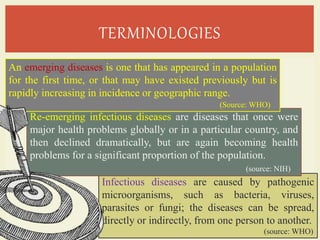
Infectious diseases are caused by pathogenic
microorganisms, such as bacteria, viruses,
parasites or fungi; the diseases can be spread,
directly or indirectly, from one person to another.
(source: WHO)
TERMINOLOGIES
Re-emerging infectious diseases are diseases that once were
major health problems globally or in a particular country, and
then declined dramatically, but are again becoming health
problems for a significant proportion of the population.
(source: NIH)
An emerging diseases is one that has appeared in a population
for the first time, or that may have existed previously but is
rapidly increasing in incidence or geographic range.
(Source: WHO)
INTRODUCTION
• There had been a worldwide explosion of infectious diseases.
• Emerging/Re-emerging diseases are becoming pandemic and
may lead to threat to the stability of nations worldwide.
• As per WHO 2007, World Health Report, more than 40
infectious diseases have been discovered since 1970s.
• Infectious diseases accounted for about 26 percent of 57 million
deaths worldwide in 2002. (source: World Health Report 2004, WHO)
• The driving factors for emergence/re-emergence of infectious
diseases are complex and interrelated.
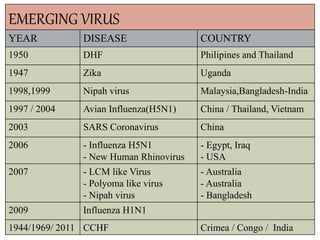
EMERGING VIRUS
YEAR DISEASE COUNTRY
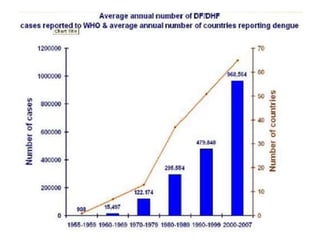
1950 DHF Philipines and Thailand
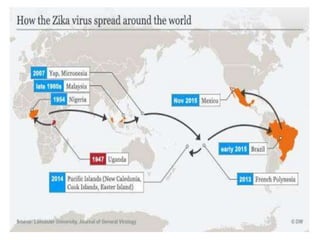
1947 Zika Uganda
1998,1999 Nipah virus Malaysia,Bangladesh-India
1997 / 2004 Avian Influenza(H5N1) China / Thailand, Vietnam
2003 SARS Coronavirus China
2006 - Influenza H5N1
- New Human Rhinovirus
- Egypt, Iraq
- USA
2007 - LCM like Virus
- Polyoma like virus
- Nipah virus
- Australia
- Australia
- Bangladesh
2009 Influenza H1N1
1944/1969/ 2011 CCHF Crimea / Congo / India
RE-EMERGING DISEASES
 Plague
 West Nile Virus
 Yellow fever
 Japanese Encephalitis
 KFD
 Leptospirosis
 Scrub Typhus
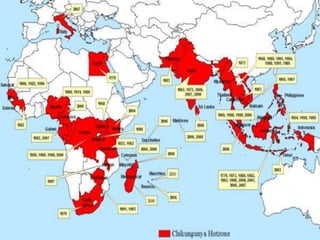
 Chikungunya
 Ebola
 Marbug HE/HF
 Drug resistant malaria
 Rift valley fever
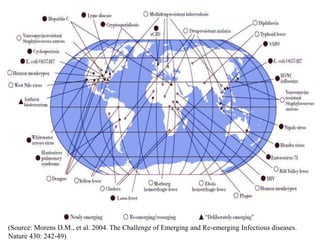
(Source: Morens D.M., et al. 2004. The Challenge of Emerging and Re-emerging Infectious diseases.
Nature 430: 242-49)
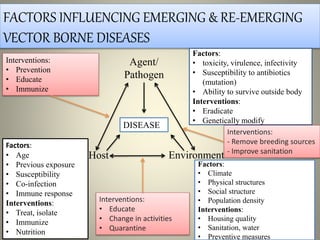
FACTORS INFLUENCING EMERGING & RE-EMERGING
VECTOR BORNE DISEASES
Agent/
Pathogen
EnvironmentHost
Interventions:
- Remove breeding sources
- Improve sanitation
DISEASE
Factors:
• toxicity, virulence, infectivity
• Susceptibility to antibiotics
(mutation)
• Ability to survive outside body
Interventions:
• Eradicate
• Genetically modify
Factors:
• Climate
• Physical structures
• Social structure
• Population density
Interventions:
• Housing quality
• Sanitation, water
• Preventive measures
Factors:
• Age
• Previous exposure
• Susceptibility
• Co-infection
• Immune response
Interventions:
• Treat, isolate
• Immunize
• Nutrition
Interventions:
• Educate
• Change in activities
• Quarantine
Interventions:
• Prevention
• Educate
• Immunize
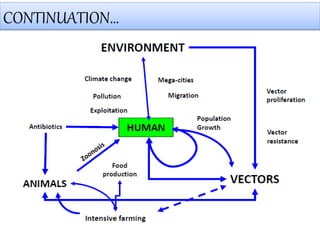
CONTINUATION…
OTHER FACTORS INFLUENCING VECTOR BORNE
EMERGING & RE-EMERGING DISEASES
Extreme events
- Disaster and Hazard
- War
 Travelling
 Urbanization
 Population migration
 Change in human behavior
 Ecological pressure (non vector becoming vector)
 Bioterrorism
It involves interaction of multiple complex factors between
the host and pathogen, each driven factor need to secure
the success of the species in changing environments.
 Adaptation of one partner to exploit new environmental
changes will often stimulate the other to modify its
characteristics to take advantage of the change.
The human encroachment into habitat especially in tropical
regions and interface with wildlife can lead to creation of
“hot spots” for emergence of new pathogens, with a
potential for rapid spread among susceptible human
populations, facilitated by rapid means of travel and
wildlife trafficking.
HOST PATHOGEN RELATIONSHIP
The mutation can create the parasite , pathogen
virulent strain, and non vector became vector as
making it infectious to humans, is a common cause of
new illnesses in humans.
CONTINUED…
EVIDENCES
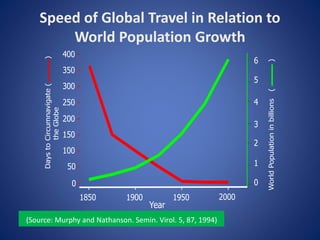
WorldPopulationinbillions()
DaystoCircumnavigate()
theGlobe
Year
1850
0
400
350
300
250
200
150
100
50
2000
0
1900 1950
1
2
3
4
5
6
Speed of Global Travel in Relation to
World Population Growth
(Source: Murphy and Nathanson. Semin. Virol. 5, 87, 1994)
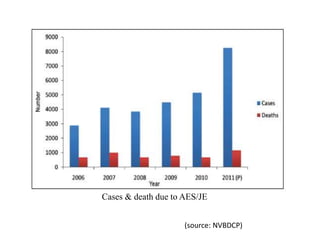
Cases & death due to AES/JE
(source: NVBDCP)
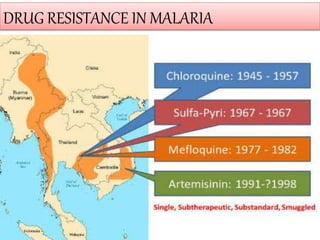
DRUG RESISTANCE IN MALARIA
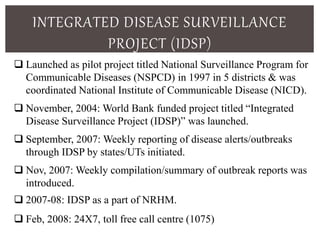
INTEGRATED DISEASE SURVEILLANCE
PROJECT (IDSP)
 Launched as pilot project titled National Surveillance Program for
Communicable Diseases (NSPCD) in 1997 in 5 districts & was
coordinated National Institute of Communicable Disease (NICD).
 November, 2004: World Bank funded project titled “Integrated
Disease Surveillance Project (IDSP)” was launched.
 September, 2007: Weekly reporting of disease alerts/outbreaks
through IDSP by states/UTs initiated.
 Nov, 2007: Weekly compilation/summary of outbreak reports was
introduced.
 2007-08: IDSP as a part of NRHM.
 Feb, 2008: 24X7, toll free call centre (1075)
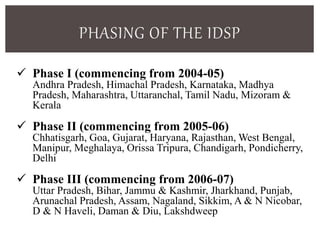
PHASING OF THE IDSP
 Phase I (commencing from 2004-05)
Andhra Pradesh, Himachal Pradesh, Karnataka, Madhya
Pradesh, Maharashtra, Uttaranchal, Tamil Nadu, Mizoram &
Kerala
 Phase II (commencing from 2005-06)
Chhatisgarh, Goa, Gujarat, Haryana, Rajasthan, West Bengal,
Manipur, Meghalaya, Orissa Tripura, Chandigarh, Pondicherry,
Delhi
 Phase III (commencing from 2006-07)
Uttar Pradesh, Bihar, Jammu & Kashmir, Jharkhand, Punjab,
Arunachal Pradesh, Assam, Nagaland, Sikkim, A & N Nicobar,
D & N Haveli, Daman & Diu, Lakshdweep
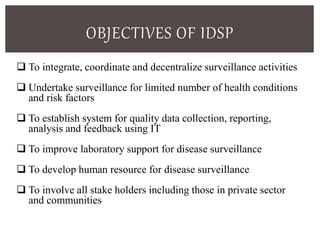
OBJECTIVES OF IDSP
 To integrate, coordinate and decentralize surveillance activities
 Undertake surveillance for limited number of health conditions
and risk factors
 To establish system for quality data collection, reporting,
analysis and feedback using IT
 To improve laboratory support for disease surveillance
 To develop human resource for disease surveillance
 To involve all stake holders including those in private sector
and communities
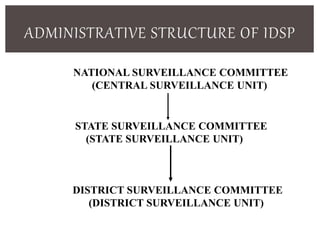
ADMINISTRATIVE STRUCTURE OF IDSP
NATIONAL SURVEILLANCE COMMITTEE
(CENTRAL SURVEILLANCE UNIT)
STATE SURVEILLANCE COMMITTEE
(STATE SURVEILLANCE UNIT)
DISTRICT SURVEILLANCE COMMITTEE
(DISTRICT SURVEILLANCE UNIT)
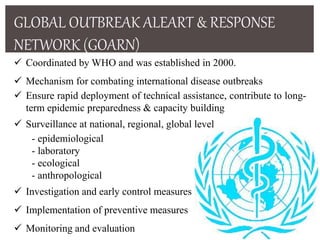
GLOBAL OUTBREAK ALEART & RESPONSE
NETWORK (GOARN)
 Coordinated by WHO and was established in 2000.
 Mechanism for combating international disease outbreaks
 Ensure rapid deployment of technical assistance, contribute to long-
term epidemic preparedness & capacity building
 Surveillance at national, regional, global level
- epidemiological
- laboratory
- ecological
- anthropological
 Investigation and early control measures
 Implementation of preventive measures
 Monitoring and evaluation
INTERNATIONAL HEALTH REGULATIONS
(IHR)
 This legally-binding agreement.
 It significantly contributes to global public health
security.
 providing a new framework for the coordination
of the management of events that may constitute
a public health emergency of international
concern.
 improve the capacity of all countries to detect,
assess, notify and respond to public health
threats.
CONTINUED…
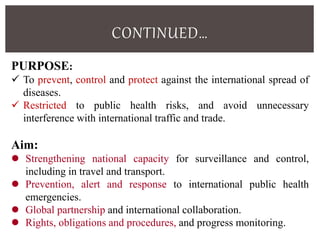
PURPOSE:
 To prevent, control and protect against the international spread of
diseases.
 Restricted to public health risks, and avoid unnecessary
interference with international traffic and trade.
Aim:
 Strengthening national capacity for surveillance and control,
including in travel and transport.
 Prevention, alert and response to international public health
emergencies.
 Global partnership and international collaboration.
 Rights, obligations and procedures, and progress monitoring.
CONTINUED…
Updates:
 From three diseases to all public health threats.
 From preset measures to adapted response.
 From control of borders to, also, containment at source.
 Scope has been expanded from cholera, plague and yellow
fever to all public health emergencies of international
concern (PHEIC)
 Poor implementation
 Poor surveillance and monitoring
 Limited range of drugs and insecticides
 Inadequate dosage of drugs and insecticides
 Lack of treatment for some VBDs
 Lack of dependable vaccine candidate for immunization
 Inadequate funding
 Insecticide resistance/Drug resistance
 Inadequate skilled man power
 Low community acceptance
 Difficult to change human behavior
 Lack of political will
PROBLEMS LEAD TO FAILURE OF VBD
CONTROL PROGRAM
PREVENTION & CONTROL OF EMERGING
INFECTIOUS DISEASES WILL REQUIRE
ACTION IN EACH OF THESE AREAS
 Surveillance and Response
 Ensure political support
 Applied Research
 Infrastructure and Training
 Prevention and Control
 Strict legislation
 Increase global collaboration
continued….
 Vaccination for all
 Enhanced communication with and within the Heath
department: locally, regionally, nationally and globally
 Judicial use of antibiotics
 strengthen IEC and BCC activities
REFERENCES
 Dikid, T. and et al. "Emerging and Re-emerging Infections in
India: An overview." INDIAN J RES MED 138 (JULY 2013): 19-31
 Gupta, Sanjeev K and et al. "Emerging and Re-emerging
Infectious Diseases, Future Challenges and Strategy." Journal of
Clinical and Diagnostic Research, Vol-6(6) (August, 2012): 1095-
1100.
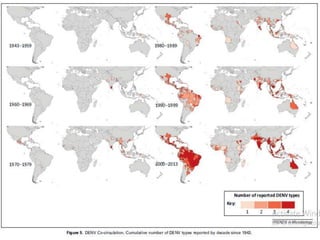
 Jane, P. Messina and et al. "Global spread of dengue virus types:
mapping the 70 year history." Trends in Microbiology (March
2014): Vol. 22, No. 3., pgg: 139-146.
 Lim, Victor K E. "Emerging and Re-emerging infections." leJSME
7(Suppl 1) (2013): S51-56.
 Morens, D M. and Folker, G K. “The Challenge of Emerging and
Re-emerging Infectious Disease.” The Nature, 2004.
 WHO. INTERNATIONAL HEALTH REGULATIONS . WHO Library
Cataloguing-in-Publication Data, 2005
 www.idsp.nic.in
emerging and re-emerging vector borne diseases

emerging and re-emerging vector borne diseases

  • 1.
    Presented by : AnilKumar M.Sc PHE 2nd yr VCRC (ICMR) 2015-17 EMERGING & RE-EMERGING VECTOR BORNE DISEASES KALA-AZAR JAPANESE ENCEHALITIS EBOLA CHIKUNGUEA LEPTOSPIROSIS WEST NILE VIRUS YELLOW FEVER HUNTA VIRUS AVIAN INFLUENZA ZIKA AES CCHF TRICHENELLOSIS PLAGUE KFD H1N1 NIPAH CHANDIPURA VIRUS DENGUE
  • 2.
    CONTENTS Terminologies Introduction Factors influencing E/REVBDs Evidences IDSP, GOARN & IHR Summary References Difficulties & Suggestion
  • 3.
    Infectious diseases arecaused by pathogenic microorganisms, such as bacteria, viruses, parasites or fungi; the diseases can be spread, directly or indirectly, from one person to another. (source: WHO) TERMINOLOGIES Re-emerging infectious diseases are diseases that once were major health problems globally or in a particular country, and then declined dramatically, but are again becoming health problems for a significant proportion of the population. (source: NIH) An emerging diseases is one that has appeared in a population for the first time, or that may have existed previously but is rapidly increasing in incidence or geographic range. (Source: WHO)
  • 4.
    INTRODUCTION • There hadbeen a worldwide explosion of infectious diseases. • Emerging/Re-emerging diseases are becoming pandemic and may lead to threat to the stability of nations worldwide. • As per WHO 2007, World Health Report, more than 40 infectious diseases have been discovered since 1970s. • Infectious diseases accounted for about 26 percent of 57 million deaths worldwide in 2002. (source: World Health Report 2004, WHO) • The driving factors for emergence/re-emergence of infectious diseases are complex and interrelated.
  • 5.
    EMERGING VIRUS YEAR DISEASECOUNTRY 1950 DHF Philipines and Thailand 1947 Zika Uganda 1998,1999 Nipah virus Malaysia,Bangladesh-India 1997 / 2004 Avian Influenza(H5N1) China / Thailand, Vietnam 2003 SARS Coronavirus China 2006 - Influenza H5N1 - New Human Rhinovirus - Egypt, Iraq - USA 2007 - LCM like Virus - Polyoma like virus - Nipah virus - Australia - Australia - Bangladesh 2009 Influenza H1N1 1944/1969/ 2011 CCHF Crimea / Congo / India
  • 6.
    RE-EMERGING DISEASES  Plague West Nile Virus  Yellow fever  Japanese Encephalitis  KFD  Leptospirosis  Scrub Typhus  Chikungunya  Ebola  Marbug HE/HF  Drug resistant malaria  Rift valley fever
  • 7.
    (Source: Morens D.M.,et al. 2004. The Challenge of Emerging and Re-emerging Infectious diseases. Nature 430: 242-49)
  • 8.
    FACTORS INFLUENCING EMERGING& RE-EMERGING VECTOR BORNE DISEASES Agent/ Pathogen EnvironmentHost Interventions: - Remove breeding sources - Improve sanitation DISEASE Factors: • toxicity, virulence, infectivity • Susceptibility to antibiotics (mutation) • Ability to survive outside body Interventions: • Eradicate • Genetically modify Factors: • Climate • Physical structures • Social structure • Population density Interventions: • Housing quality • Sanitation, water • Preventive measures Factors: • Age • Previous exposure • Susceptibility • Co-infection • Immune response Interventions: • Treat, isolate • Immunize • Nutrition Interventions: • Educate • Change in activities • Quarantine Interventions: • Prevention • Educate • Immunize
  • 9.
  • 10.
    OTHER FACTORS INFLUENCINGVECTOR BORNE EMERGING & RE-EMERGING DISEASES Extreme events - Disaster and Hazard - War  Travelling  Urbanization  Population migration  Change in human behavior  Ecological pressure (non vector becoming vector)  Bioterrorism
  • 11.
    It involves interactionof multiple complex factors between the host and pathogen, each driven factor need to secure the success of the species in changing environments.  Adaptation of one partner to exploit new environmental changes will often stimulate the other to modify its characteristics to take advantage of the change. The human encroachment into habitat especially in tropical regions and interface with wildlife can lead to creation of “hot spots” for emergence of new pathogens, with a potential for rapid spread among susceptible human populations, facilitated by rapid means of travel and wildlife trafficking. HOST PATHOGEN RELATIONSHIP
  • 12.
    The mutation cancreate the parasite , pathogen virulent strain, and non vector became vector as making it infectious to humans, is a common cause of new illnesses in humans. CONTINUED…
  • 13.
  • 14.
    WorldPopulationinbillions() DaystoCircumnavigate() theGlobe Year 1850 0 400 350 300 250 200 150 100 50 2000 0 1900 1950 1 2 3 4 5 6 Speed ofGlobal Travel in Relation to World Population Growth (Source: Murphy and Nathanson. Semin. Virol. 5, 87, 1994)
  • 19.
    Cases & deathdue to AES/JE (source: NVBDCP)
  • 20.
  • 21.
    INTEGRATED DISEASE SURVEILLANCE PROJECT(IDSP)  Launched as pilot project titled National Surveillance Program for Communicable Diseases (NSPCD) in 1997 in 5 districts & was coordinated National Institute of Communicable Disease (NICD).  November, 2004: World Bank funded project titled “Integrated Disease Surveillance Project (IDSP)” was launched.  September, 2007: Weekly reporting of disease alerts/outbreaks through IDSP by states/UTs initiated.  Nov, 2007: Weekly compilation/summary of outbreak reports was introduced.  2007-08: IDSP as a part of NRHM.  Feb, 2008: 24X7, toll free call centre (1075)
  • 22.
    PHASING OF THEIDSP  Phase I (commencing from 2004-05) Andhra Pradesh, Himachal Pradesh, Karnataka, Madhya Pradesh, Maharashtra, Uttaranchal, Tamil Nadu, Mizoram & Kerala  Phase II (commencing from 2005-06) Chhatisgarh, Goa, Gujarat, Haryana, Rajasthan, West Bengal, Manipur, Meghalaya, Orissa Tripura, Chandigarh, Pondicherry, Delhi  Phase III (commencing from 2006-07) Uttar Pradesh, Bihar, Jammu & Kashmir, Jharkhand, Punjab, Arunachal Pradesh, Assam, Nagaland, Sikkim, A & N Nicobar, D & N Haveli, Daman & Diu, Lakshdweep
  • 23.
    OBJECTIVES OF IDSP To integrate, coordinate and decentralize surveillance activities  Undertake surveillance for limited number of health conditions and risk factors  To establish system for quality data collection, reporting, analysis and feedback using IT  To improve laboratory support for disease surveillance  To develop human resource for disease surveillance  To involve all stake holders including those in private sector and communities
  • 24.
    ADMINISTRATIVE STRUCTURE OFIDSP NATIONAL SURVEILLANCE COMMITTEE (CENTRAL SURVEILLANCE UNIT) STATE SURVEILLANCE COMMITTEE (STATE SURVEILLANCE UNIT) DISTRICT SURVEILLANCE COMMITTEE (DISTRICT SURVEILLANCE UNIT)
  • 25.
    GLOBAL OUTBREAK ALEART& RESPONSE NETWORK (GOARN)  Coordinated by WHO and was established in 2000.  Mechanism for combating international disease outbreaks  Ensure rapid deployment of technical assistance, contribute to long- term epidemic preparedness & capacity building  Surveillance at national, regional, global level - epidemiological - laboratory - ecological - anthropological  Investigation and early control measures  Implementation of preventive measures  Monitoring and evaluation
  • 26.
    INTERNATIONAL HEALTH REGULATIONS (IHR) This legally-binding agreement.  It significantly contributes to global public health security.  providing a new framework for the coordination of the management of events that may constitute a public health emergency of international concern.  improve the capacity of all countries to detect, assess, notify and respond to public health threats.
  • 27.
    CONTINUED… PURPOSE:  To prevent,control and protect against the international spread of diseases.  Restricted to public health risks, and avoid unnecessary interference with international traffic and trade. Aim:  Strengthening national capacity for surveillance and control, including in travel and transport.  Prevention, alert and response to international public health emergencies.  Global partnership and international collaboration.  Rights, obligations and procedures, and progress monitoring.
  • 28.
    CONTINUED… Updates:  From threediseases to all public health threats.  From preset measures to adapted response.  From control of borders to, also, containment at source.  Scope has been expanded from cholera, plague and yellow fever to all public health emergencies of international concern (PHEIC)
  • 29.
     Poor implementation Poor surveillance and monitoring  Limited range of drugs and insecticides  Inadequate dosage of drugs and insecticides  Lack of treatment for some VBDs  Lack of dependable vaccine candidate for immunization  Inadequate funding  Insecticide resistance/Drug resistance  Inadequate skilled man power  Low community acceptance  Difficult to change human behavior  Lack of political will PROBLEMS LEAD TO FAILURE OF VBD CONTROL PROGRAM
  • 30.
    PREVENTION & CONTROLOF EMERGING INFECTIOUS DISEASES WILL REQUIRE ACTION IN EACH OF THESE AREAS  Surveillance and Response  Ensure political support  Applied Research  Infrastructure and Training  Prevention and Control  Strict legislation  Increase global collaboration
  • 31.
    continued….  Vaccination forall  Enhanced communication with and within the Heath department: locally, regionally, nationally and globally  Judicial use of antibiotics  strengthen IEC and BCC activities
  • 32.
    REFERENCES  Dikid, T.and et al. "Emerging and Re-emerging Infections in India: An overview." INDIAN J RES MED 138 (JULY 2013): 19-31  Gupta, Sanjeev K and et al. "Emerging and Re-emerging Infectious Diseases, Future Challenges and Strategy." Journal of Clinical and Diagnostic Research, Vol-6(6) (August, 2012): 1095- 1100.  Jane, P. Messina and et al. "Global spread of dengue virus types: mapping the 70 year history." Trends in Microbiology (March 2014): Vol. 22, No. 3., pgg: 139-146.  Lim, Victor K E. "Emerging and Re-emerging infections." leJSME 7(Suppl 1) (2013): S51-56.  Morens, D M. and Folker, G K. “The Challenge of Emerging and Re-emerging Infectious Disease.” The Nature, 2004.  WHO. INTERNATIONAL HEALTH REGULATIONS . WHO Library Cataloguing-in-Publication Data, 2005  www.idsp.nic.in

Editor's Notes

  • #5 In addition to this, infectious diseases account for 30.7 percent loss of DALYs(disability adjusted life years) which reflects the number of healthy years lost to illness.
  • #6 Hemagglutinin type and Neuraminidase Type SARS- Severe Acute Respiratory Syndrome Lymphocytic choriomeningiitis virus, Arenaviridae Crimea: 1944 Congo: 1969
  • #7 WNV: Uganda,1937 Yellow fever: tropical & subtropical areas in south America & Africa KFD: March 1957, karnatka Shimoga Scrub typhus: 1930, Japan Ebola virus: 1976, Russia MHF: 1967, south africa RVF: 1910/ outbreak -2000, Africa MadagascarSaudi Arabia, Yemen