Module 4
Angle Modulation
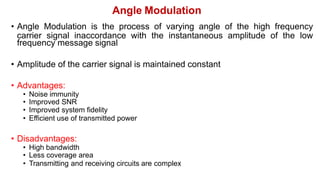
Angle Modulation
• Angle Modulation is the process of varying angle of the high frequency
carrier signal inaccordance with the instantaneous amplitude of the low
frequency message signal
• Amplitude of the carrier signal is maintained constant
• Advantages:
• Noise immunity
• Improved SNR
• Improved system fidelity
• Efficient use of transmitted power
• Disadvantages:
• High bandwidth
• Less coverage area
• Transmitting and receiving circuits are complex
Definition of angle Modulation
• Angle – Frequency and phase
• The angle modulated wave is mathematically expressed as
s(t)  Ac cos[i (t)]    (1)
• AC - Amplitude of the carrier signal
• θi(t) – Angle of modulated sinusoidal carrier
• If θi(t) increases monotonically with time over an interval range from t to
(t+Δt), the average frequency is given as
(t) 
i (t  t) i (t)
    (2)
2t
ff
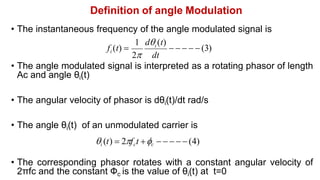
Definition of angle Modulation
• The instantaneous frequency of the angle modulated signal is
• The angle modulated signal is interpreted as a rotating phasor of length
Ac and angle θi(t)
• The angular velocity of phasor is dθi(t)/dt rad/s
• The angle θi(t) of an unmodulated carrier is
i (t)  2fct c     (4)
• The corresponding phasor rotates with a constant angular velocity of
2πfc and the constant Фc is the value of θi(t) at t=0
     (3)
f (t)  i
1 d (t)
2 dt
i
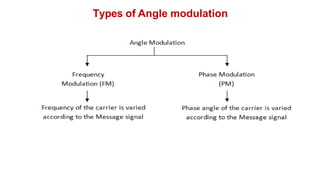
Types of Angle modulation
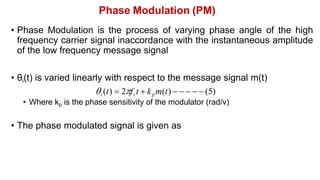
Phase Modulation (PM)
• Phase Modulation is the process of varying phase angle of the high
frequency carrier signal inaccordance with the instantaneous amplitude
of the low frequency message signal
• θi(t) is varied linearly with respect to the message signal m(t)
i (t)  2fct  kpm(t)      (5)
• Where kp is the phase sensitivity of the modulator (rad/v)
• The phase modulated signal is given as
Phase Modulation (PM)
• Phase Modulation is the process of varying phase angle of the high
frequency carrier signal inaccordance with the instantaneous amplitude
of the low frequency message signal
• θi(t) is varied linearly with respect to the message signal m(t)
i (t)  2fct  kpm(t)      (5)
• Where kp is the phase sensitivity of the modulator (rad/v)
• The phase modulated signal is given as
s(t)  Ac cos[2fct  kpm(t)]     (6)
Phase Modulation (PM)
• Phase Modulation is the process of varying phase angle of the high
frequency carrier signal inaccordance with the instantaneous amplitude
of the low frequency message signal
• θi(t) is varied linearly with respect to the message signal m(t)
i (t)  2fct  kpm(t)      (5)
• Where kp is the phase sensitivity of the modulator (rad/v)
• The phase modulated signal is given as
s(t)  Ac cos[2fct  kpm(t)]     (6)
s(t)  Ac cos[2fct  mp cosmt]     (7)
• Modulation index(mp) or Phase deviation(Δθ) mp k pAm (rad)
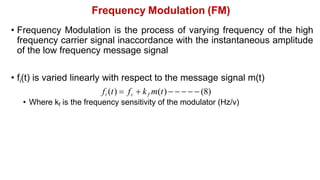
Frequency Modulation (FM)
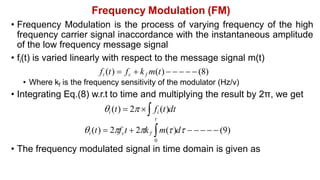
• Frequency Modulation is the process of varying frequency of the high
frequency carrier signal inaccordance with the instantaneous amplitude
of the low frequency message signal
• fi(t) is varied linearly with respect to the message signal m(t)
fi (t)  fc  kf m(t)      (8)
• Where kf is the frequency sensitivity of the modulator (Hz/v)
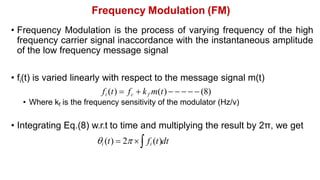
Frequency Modulation (FM)
• Frequency Modulation is the process of varying frequency of the high
frequency carrier signal inaccordance with the instantaneous amplitude
of the low frequency message signal
• fi(t) is varied linearly with respect to the message signal m(t)
fi (t)  fc  kf m(t)      (8)
• Where kf is the frequency sensitivity of the modulator (Hz/v)
• Integrating Eq.(8) w.r.t to time and multiplying the result by 2π, we get
i (t)  2  fi (t)dt
Frequency Modulation (FM)
• Frequency Modulation is the process of varying frequency of the high
frequency carrier signal inaccordance with the instantaneous amplitude
of the low frequency message signal
• fi(t) is varied linearly with respect to the message signal m(t)
fi (t)  fc  kf m(t)      (8)
• Where kf is the frequency sensitivity of the modulator (Hz/v)
• Integrating Eq.(8) w.r.t to time and multiplying the result by 2π, we get
i (t)  2  fi (t)dt
t
i (t)  2fct  2kf m()d      (9)
0
• The frequency modulated signal in time domain is given as
Frequency Modulation (FM)
• Frequency Modulation is the process of varying frequency of the high
frequency carrier signal inaccordance with the instantaneous amplitude
of the low frequency message signal
• fi(t) is varied linearly with respect to the message signal m(t)
fi (t)  fc  kf m(t)      (8)
• Where kf is the frequency sensitivity of the modulator (Hz/v)
• Integrating Eq.(8) w.r.t to time and multiplying the result by 2π, we get
i (t)  2  fi (t)dt
t
i (t)  2fct  2kf m()d      (9)
0
• The frequency modulated signal in time domain is given as
t
s(t)  Ac cos[2fct  2kf m()d]     (10)
0
Frequency modulation by single frequency message
signal
• The frequency modulated signal in time domain is given as
t
s(t)  Ac cos[2fct  2k f m()d]     (1)
0
• The above equation is nonlinear function of message signal
• The analysis of FM signal is much more difficult than AM signal
• Consider a sinusoidal message signal defined as
Frequency modulation by single frequency message
signal
• The frequency modulated signal in time domain is given as
t
s(t)  Ac cos[2fct  2k f m()d]     (1)
0
• The above equation is nonlinear function of message signal
• The analysis of FM signal is much more difficult than AM signal
• Consider a sinusoidal message signal defined as
m(t)  Am cos2fmt     (2)
• The instantaneous frequency of the FM signal is given as
Frequency modulation by single frequency message
signal
• The frequency modulated signal in time domain is given as
t
s(t)  Ac cos[2fct  2k f m()d]     (1)
0
• The above equation is nonlinear function of message signal
• The analysis of FM signal is much more difficult than AM signal
• Consider a sinusoidal message signal defined as
m(t)  Am cos2fmt     (2)
• The instantaneous frequency of the FM signal is given as
fi (t)  fc  kf Am cos2fmt
fi (t)  fc  f cos2fmt      (3)
FrequencyDeviation f  k f Am (Hz)
Frequency modulation by single frequency message
signal
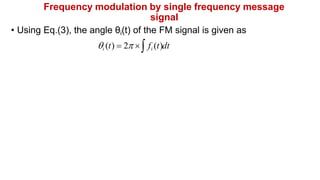
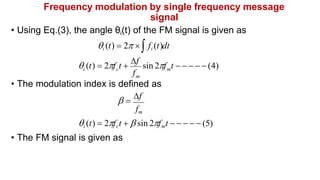
• Using Eq.(3), the angle θi(t) of the FM signal is given as
Frequency modulation by single frequency message
signal
• Using Eq.(3), the angle θi(t) of the FM signal is given as
i (t)  2  fi (t)dt
Frequency modulation by single frequency message
signal
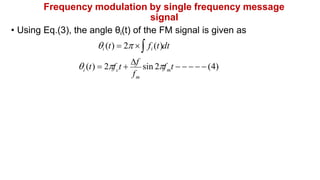
• Using Eq.(3), the angle θi(t) of the FM signal is given as
i (t)  2  fi (t)dt
f
m
m
i c
 (t)  2f t 
f
sin 2f t      (4)
Frequency modulation by single frequency message
signal
• Using Eq.(3), the angle θi(t) of the FM signal is given as
i (t)  2  fi (t)dt
f
m
m
i c
 (t)  2f t 
f
sin 2f t      (4)
• The modulation index is defined as
 
f
fm
i (t)  2fct   sin 2fmt      (5)
• The FM signal is given as
Frequency modulation by single frequency message
signal
• Using Eq.(3), the angle θi(t) of the FM signal is given as
i (t)  2  fi (t)dt
f
m
m
i c
 (t)  2f t 
f
sin 2f t      (4)
• The modulation index is defined as
 
f
fm
i (t)  2fct   sin 2fmt      (5)
• The FM signal is given as
VFM (t)  Ac cos[2fct   sin 2fmt]     (6)
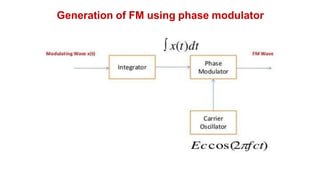
Generation of FM using phase modulator
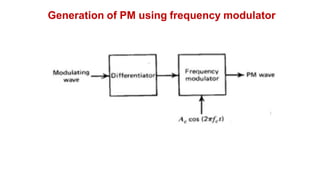
Generation of PM using frequency modulator
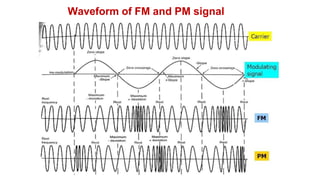
Waveform of FM and PM signal

10 Angle_modulation.pdf

  • 1.
  • 2.
    Angle Modulation • AngleModulation is the process of varying angle of the high frequency carrier signal inaccordance with the instantaneous amplitude of the low frequency message signal • Amplitude of the carrier signal is maintained constant • Advantages: • Noise immunity • Improved SNR • Improved system fidelity • Efficient use of transmitted power • Disadvantages: • High bandwidth • Less coverage area • Transmitting and receiving circuits are complex
  • 3.
    Definition of angleModulation • Angle – Frequency and phase • The angle modulated wave is mathematically expressed as s(t)  Ac cos[i (t)]    (1) • AC - Amplitude of the carrier signal • θi(t) – Angle of modulated sinusoidal carrier • If θi(t) increases monotonically with time over an interval range from t to (t+Δt), the average frequency is given as (t)  i (t  t) i (t)     (2) 2t ff
  • 4.
    Definition of angleModulation • The instantaneous frequency of the angle modulated signal is • The angle modulated signal is interpreted as a rotating phasor of length Ac and angle θi(t) • The angular velocity of phasor is dθi(t)/dt rad/s • The angle θi(t) of an unmodulated carrier is i (t)  2fct c     (4) • The corresponding phasor rotates with a constant angular velocity of 2πfc and the constant Фc is the value of θi(t) at t=0      (3) f (t)  i 1 d (t) 2 dt i
  • 5.
    Types of Anglemodulation
  • 6.
    Phase Modulation (PM) •Phase Modulation is the process of varying phase angle of the high frequency carrier signal inaccordance with the instantaneous amplitude of the low frequency message signal • θi(t) is varied linearly with respect to the message signal m(t) i (t)  2fct  kpm(t)      (5) • Where kp is the phase sensitivity of the modulator (rad/v) • The phase modulated signal is given as
  • 7.
    Phase Modulation (PM) •Phase Modulation is the process of varying phase angle of the high frequency carrier signal inaccordance with the instantaneous amplitude of the low frequency message signal • θi(t) is varied linearly with respect to the message signal m(t) i (t)  2fct  kpm(t)      (5) • Where kp is the phase sensitivity of the modulator (rad/v) • The phase modulated signal is given as s(t)  Ac cos[2fct  kpm(t)]     (6)
  • 8.
    Phase Modulation (PM) •Phase Modulation is the process of varying phase angle of the high frequency carrier signal inaccordance with the instantaneous amplitude of the low frequency message signal • θi(t) is varied linearly with respect to the message signal m(t) i (t)  2fct  kpm(t)      (5) • Where kp is the phase sensitivity of the modulator (rad/v) • The phase modulated signal is given as s(t)  Ac cos[2fct  kpm(t)]     (6) s(t)  Ac cos[2fct  mp cosmt]     (7) • Modulation index(mp) or Phase deviation(Δθ) mp k pAm (rad)
  • 9.
    Frequency Modulation (FM) •Frequency Modulation is the process of varying frequency of the high frequency carrier signal inaccordance with the instantaneous amplitude of the low frequency message signal • fi(t) is varied linearly with respect to the message signal m(t) fi (t)  fc  kf m(t)      (8) • Where kf is the frequency sensitivity of the modulator (Hz/v)
  • 10.
    Frequency Modulation (FM) •Frequency Modulation is the process of varying frequency of the high frequency carrier signal inaccordance with the instantaneous amplitude of the low frequency message signal • fi(t) is varied linearly with respect to the message signal m(t) fi (t)  fc  kf m(t)      (8) • Where kf is the frequency sensitivity of the modulator (Hz/v) • Integrating Eq.(8) w.r.t to time and multiplying the result by 2π, we get i (t)  2  fi (t)dt
  • 11.
    Frequency Modulation (FM) •Frequency Modulation is the process of varying frequency of the high frequency carrier signal inaccordance with the instantaneous amplitude of the low frequency message signal • fi(t) is varied linearly with respect to the message signal m(t) fi (t)  fc  kf m(t)      (8) • Where kf is the frequency sensitivity of the modulator (Hz/v) • Integrating Eq.(8) w.r.t to time and multiplying the result by 2π, we get i (t)  2  fi (t)dt t i (t)  2fct  2kf m()d      (9) 0 • The frequency modulated signal in time domain is given as
  • 12.
    Frequency Modulation (FM) •Frequency Modulation is the process of varying frequency of the high frequency carrier signal inaccordance with the instantaneous amplitude of the low frequency message signal • fi(t) is varied linearly with respect to the message signal m(t) fi (t)  fc  kf m(t)      (8) • Where kf is the frequency sensitivity of the modulator (Hz/v) • Integrating Eq.(8) w.r.t to time and multiplying the result by 2π, we get i (t)  2  fi (t)dt t i (t)  2fct  2kf m()d      (9) 0 • The frequency modulated signal in time domain is given as t s(t)  Ac cos[2fct  2kf m()d]     (10) 0
  • 13.
    Frequency modulation bysingle frequency message signal • The frequency modulated signal in time domain is given as t s(t)  Ac cos[2fct  2k f m()d]     (1) 0 • The above equation is nonlinear function of message signal • The analysis of FM signal is much more difficult than AM signal • Consider a sinusoidal message signal defined as
  • 14.
    Frequency modulation bysingle frequency message signal • The frequency modulated signal in time domain is given as t s(t)  Ac cos[2fct  2k f m()d]     (1) 0 • The above equation is nonlinear function of message signal • The analysis of FM signal is much more difficult than AM signal • Consider a sinusoidal message signal defined as m(t)  Am cos2fmt     (2) • The instantaneous frequency of the FM signal is given as
  • 15.
    Frequency modulation bysingle frequency message signal • The frequency modulated signal in time domain is given as t s(t)  Ac cos[2fct  2k f m()d]     (1) 0 • The above equation is nonlinear function of message signal • The analysis of FM signal is much more difficult than AM signal • Consider a sinusoidal message signal defined as m(t)  Am cos2fmt     (2) • The instantaneous frequency of the FM signal is given as fi (t)  fc  kf Am cos2fmt fi (t)  fc  f cos2fmt      (3) FrequencyDeviation f  k f Am (Hz)
  • 16.
    Frequency modulation bysingle frequency message signal • Using Eq.(3), the angle θi(t) of the FM signal is given as
  • 17.
    Frequency modulation bysingle frequency message signal • Using Eq.(3), the angle θi(t) of the FM signal is given as i (t)  2  fi (t)dt
  • 18.
    Frequency modulation bysingle frequency message signal • Using Eq.(3), the angle θi(t) of the FM signal is given as i (t)  2  fi (t)dt f m m i c  (t)  2f t  f sin 2f t      (4)
  • 19.
    Frequency modulation bysingle frequency message signal • Using Eq.(3), the angle θi(t) of the FM signal is given as i (t)  2  fi (t)dt f m m i c  (t)  2f t  f sin 2f t      (4) • The modulation index is defined as   f fm i (t)  2fct   sin 2fmt      (5) • The FM signal is given as
  • 20.
    Frequency modulation bysingle frequency message signal • Using Eq.(3), the angle θi(t) of the FM signal is given as i (t)  2  fi (t)dt f m m i c  (t)  2f t  f sin 2f t      (4) • The modulation index is defined as   f fm i (t)  2fct   sin 2fmt      (5) • The FM signal is given as VFM (t)  Ac cos[2fct   sin 2fmt]     (6)
  • 21.
    Generation of FMusing phase modulator
  • 22.
    Generation of PMusing frequency modulator
  • 23.
    Waveform of FMand PM signal