Amplitude Modulation
1
Content
• What is Modulation
• Amplitude Modulation (AM)
• Demodulation of AM signals
• Calculation and Examples
• Summary
2
What is Modulation
• Modulation
• In the modulation process, some characteristic of a high-
frequency carrier signal (bandpass), is changed according to
the instantaneous amplitude of the information (baseband)
signal.
• Why Modulation
• Suitable for signal transmission (distance…etc)
• Multiple signals transmitted on the same channel
• Capacitive or inductive devices require high frequency AC
input (carrier) to operate.
• Stability and noise rejection
3
About Modulation
• Application Examples
• broadcasting of both audio and video
signals.
• Mobile radio communications, such as
cell phone.
4
• Basic Modulation Types
– Amplitude Modulation: changes the amplitude.
– Frequency Modulation: changes the frequency.
– Phase Modulation: changes the phase.
AM Modulation/Demodulation
5
Modulator Demodulator
Baseband Signal
with frequency
fm
(Modulating Signal)
Bandpass Signal
with frequency
fc
(Modulated Signal)
Channel
Original Signal
with frequency
fm
Source Sink
fc >> fm
Voice: 300-3400Hz GSM Cell phone: 900/1800MHz
Amplitude Modulation
•The amplitude of high-carrier signal is varied according
to the instantaneous amplitude of the modulating
message signal m(t).
Carrier Signal: or
Modulating Message Signal: or
The AM Signal:
cos(2 ) cos( )
( ) : cos(2 ) cos( )
( ) [ ( )]cos(2 )
c c
m m
AM c c
f t t
m t f t t
s t A m t f t
π ω
π ω
π= +
6
* AM Signal Math Expression*
• Mathematical expression for AM: time domain
• expanding this produces:
• In the frequency domain this gives:
7
( ) (1 cos ) cosAM m cS t k t tω ω= +
( ) cos cos cosc cAM mS t t k t tω ω ω= +
[ ])cos()cos(coscos:using 2
1 BABABA ++−=
2 2( ) cos cos( ) cos( )c c c
k k
AM m mS t t t tω ω ω ω ω= + − + +
frequency
k/2
k/2
Carrier, A=1.
upper sideband
lower
sideband
Amplitude
fcfc-fm fc+fm
AM Power Frequency Spectrum
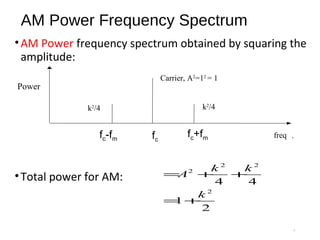
•AM Power frequency spectrum obtained by squaring the
amplitude:
•Total power for AM:
8
.
2 2
2
2
4 4
1
2
k k
A
k
= + +
= +
freq
k2
/4k2
/4
Carrier, A2
=12
= 1
Power
fc
fc-fm
fc+fm
Amplitude Modulation
• The AM signal is generated using a multiplier.
• All info is carried in the amplitude of the carrier, AM carrier signal has
time-varying envelope.
• In frequency domain the AM waveform are the lower-side
frequency/band (fc - fm), the carrier frequency fc, the upper-side
frequency/band (fc + fm).
9
AM Modulation – Example
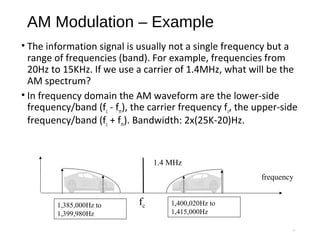
• The information signal is usually not a single frequency but a
range of frequencies (band). For example, frequencies from
20Hz to 15KHz. If we use a carrier of 1.4MHz, what will be the
AM spectrum?
• In frequency domain the AM waveform are the lower-side
frequency/band (fc - fm), the carrier frequency fc, the upper-side
frequency/band (fc + fm). Bandwidth: 2x(25K-20)Hz.
10
frequency
1.4 MHz
1,385,000Hz to
1,399,980Hz
1,400,020Hz to
1,415,000Hz
fc
Modulation Index of AM Signal
m
c
A
k
A
=
)2cos()( tfAtm mm π=
Carrier Signal: cos(2 ) DC:c Cf t Aπ
Modulated Signal: ( ) [ cos(2 )]cos(2 )
[1 cos(2 )]cos(2 )
AM c m m c
c m c
S t A A f t f t
A k f t f t
π π
π π
= +
= +
11
For a sinusoidal message signal
Modulation Index is defined as:
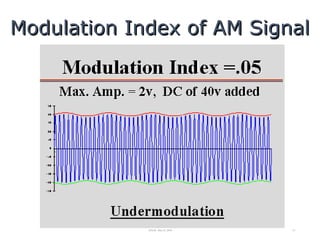
Modulation index k is a measure of the extent to
which a carrier voltage is varied by the modulating
signal. When k=0 no modulation, when k=1 100%
modulation, when k>1 over modulation.
12
Modulation Index of AM SignalModulation Index of AM Signal
CSULB May 22, 2006 13
Modulation Index of AM SignalModulation Index of AM Signal
14
Modulation Index of AM SignalModulation Index of AM Signal
Modulation Depth
CSULB May 22, 2006 15
Ac
Am
2Amax2Amin
2Amax = maximum peak-to-peak of waveform
2Amin = minimum peak-to-peak of waveform
This may be shown to equal
m
C
A
k
A
= as follows:
2 2 2min C mA = A A−
max min max min
max min
2 2
2 2
m
C C
A A A A A
k
A A A A
− −
= = =
+
2 2 2max C mA = A + A
High Percentage Modulation
• It is important to use as high percentage of modulation as
possible (k=1) while ensuring that over modulation (k>1)
does not occur.
• The sidebands contain the information and have maximum
power at 100% modulation.
• Useful equation
Pt = Pc(1 + k2
/2)
Pt=Total transmitted power (sidebands and carrier)
Pc= Carrier power
16
Example
• Determine the maximum sideband power if the carrier
output is 1 kW and calculate the total maximum
transmitted power.
• Max sideband power occurs when k = 1. At this percentage
modulation each side frequency is ½ of the carrier
amplitude. Since power is proportional to the square of the
voltage, each has ¼ of the carrier power. ¼ x 1kW = 250W
Total sideband power = 2 x 250 = 500W. Total transmitted
power = 1kW + 500W = 1.5kW
17
Demodulation of AM Signals
18
Demodulation extracting the baseband message from
the carrier.
•There are 2 main methods of AM Demodulation:
• Envelope or non-coherent detection or demodulation.
• Synchronised or coherent demodulation.
Envelope/Diode AM Detector
19
If the modulation depth is > 1, the distortion below occurs
K>1
Synchronous or Coherent Demodulation
20
This is relatively more complex and more expensive. The
Local Oscillator (LO) must be synchronised or coherent, i.e.
at the same frequency and in phase with the carrier in the
AM input signal.
Synchronous or Coherent Demodulation
21
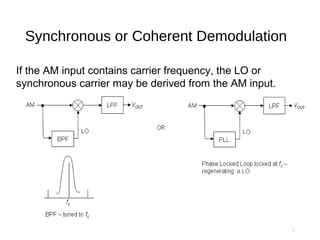
If the AM input contains carrier frequency, the LO or
synchronous carrier may be derived from the AM input.
Synchronous or Coherent Demodulation
22
If we assume zero path delay between the modulator and
demodulator, then the ideal LO signal is cos(ωct).
Analysing this for a AM input =  ( )( ) ( )tωtm+V cDC cos
Coherent Detection
23
VX = AM input x LO
( )( ) ( ) ( )tωtωtm+V ccDC coscos ∗
( )( ) ( )tωtm+V cDC
2
cos
( )( ) ( )





tω+tm+V cDC 2cos
2
1
2
1
=
( )
( )
( )
( )cos 2 co
2
s 2
22 2
DC C
cx
D
cV =
m tVm tV
ω+ t +ω+ t
=
=
Note – the AM input has been 'split into two' – ‘red part' has
moved or shifted up to higher frequency: ( )
( ) ( )cos 2 cos 2
2
c DC c
m t
ω t +V ω t
 
 ÷
 
and blue part shifted down to baseband:
( )
2 2
DC
m tV
+
Assume zero path delay between the modulator and demodulator:
Coherent Detection
24
Diode v.s Coherent
1. Diode-: Unable to follow fast-modulation properly
2. Diode-: Power is absorbed from the tuned circuit by the
diode circuit.
3. Diode-: Distortion produced is not acceptable for some
communications.
4. Diode+: Obviously simple, low cost.
5. Coherent+: Low Distortion
6. Coherent+: Greater ability to follow fast-modulation.
7. Coherent+: The ability to provide power gain
8. Coherent-: Complex and expensive
25
Exercises: Draw the Spectrums
a) cos(ωct)cos(ω1t)
from cosAcosB= 1/2[cos(A-B)+cos(A+B)]
we get: cos(ωct)cos(ω1t)=1/2[cos(ωc-ω1)t + cos(ωc+ω1)t]
Hence the spectrum of this is:
b) cos2
ωt
from cos2
A=1/2[1+cos2A]
we get: cos2
ωt=1/2[1+cos2ωt]
The spectrum is thus:
26
ωc-ω1 ωc+ω1
1/2 1/2
frequency
amplitude
1/2
freq
2ω
1/2
DC=0Hz
Example
27
Suppose you have a portable (for example you carry it in your ' back
pack') AM transmitter which needs to transmit an average power of 10
Watts in each sideband when modulation depth k = 0.3. Assume that
the transmitter is powered by a 12 Volt battery. The total power will be
2 2
4 4
T c c c
k k
P = P + P +P where
2
10 Watts
4
c
k
P =
( )
( )
22
4 10 40
444.44 Watts
0.3
cP = =
k
=
Hence, total power PT = 444.44 + 10 + 10 = 464.44 Watts.
Hence, battery current (assuming ideal transmitter) = Power / Volts =
464.44
Amps
12
= A large and heavy 12 Volt battery!!!!
Suppose we could remove one sideband and the carrier, power transmitted
would be 10 Watts, i.e. 0.833 amps from a 12 Volt battery, which is more
reasonable for a portable radio transmitter. (Single Side Band)
AM Transmitter and Receiver
28
( ) ( ) ( )
( ) ( )
( )( ) ( )
[ cos ]cos
1 cos cos
1 kcos cos
AM C m m c
m
C m c
C
C m c
S t = A + Aω t ω t
A
A +ω t ω t
A
A +ω t ω t
 
=  ÷
 
=
AM Transmitter and Receiver
29

Amplitude modulation

  • 1.
  • 2.
    Content • What isModulation • Amplitude Modulation (AM) • Demodulation of AM signals • Calculation and Examples • Summary 2
  • 3.
    What is Modulation •Modulation • In the modulation process, some characteristic of a high- frequency carrier signal (bandpass), is changed according to the instantaneous amplitude of the information (baseband) signal. • Why Modulation • Suitable for signal transmission (distance…etc) • Multiple signals transmitted on the same channel • Capacitive or inductive devices require high frequency AC input (carrier) to operate. • Stability and noise rejection 3
  • 4.
    About Modulation • ApplicationExamples • broadcasting of both audio and video signals. • Mobile radio communications, such as cell phone. 4 • Basic Modulation Types – Amplitude Modulation: changes the amplitude. – Frequency Modulation: changes the frequency. – Phase Modulation: changes the phase.
  • 5.
    AM Modulation/Demodulation 5 Modulator Demodulator BasebandSignal with frequency fm (Modulating Signal) Bandpass Signal with frequency fc (Modulated Signal) Channel Original Signal with frequency fm Source Sink fc >> fm Voice: 300-3400Hz GSM Cell phone: 900/1800MHz
  • 6.
    Amplitude Modulation •The amplitudeof high-carrier signal is varied according to the instantaneous amplitude of the modulating message signal m(t). Carrier Signal: or Modulating Message Signal: or The AM Signal: cos(2 ) cos( ) ( ) : cos(2 ) cos( ) ( ) [ ( )]cos(2 ) c c m m AM c c f t t m t f t t s t A m t f t π ω π ω π= + 6
  • 7.
    * AM SignalMath Expression* • Mathematical expression for AM: time domain • expanding this produces: • In the frequency domain this gives: 7 ( ) (1 cos ) cosAM m cS t k t tω ω= + ( ) cos cos cosc cAM mS t t k t tω ω ω= + [ ])cos()cos(coscos:using 2 1 BABABA ++−= 2 2( ) cos cos( ) cos( )c c c k k AM m mS t t t tω ω ω ω ω= + − + + frequency k/2 k/2 Carrier, A=1. upper sideband lower sideband Amplitude fcfc-fm fc+fm
  • 8.
    AM Power FrequencySpectrum •AM Power frequency spectrum obtained by squaring the amplitude: •Total power for AM: 8 . 2 2 2 2 4 4 1 2 k k A k = + + = + freq k2 /4k2 /4 Carrier, A2 =12 = 1 Power fc fc-fm fc+fm
  • 9.
    Amplitude Modulation • TheAM signal is generated using a multiplier. • All info is carried in the amplitude of the carrier, AM carrier signal has time-varying envelope. • In frequency domain the AM waveform are the lower-side frequency/band (fc - fm), the carrier frequency fc, the upper-side frequency/band (fc + fm). 9
  • 10.
    AM Modulation –Example • The information signal is usually not a single frequency but a range of frequencies (band). For example, frequencies from 20Hz to 15KHz. If we use a carrier of 1.4MHz, what will be the AM spectrum? • In frequency domain the AM waveform are the lower-side frequency/band (fc - fm), the carrier frequency fc, the upper-side frequency/band (fc + fm). Bandwidth: 2x(25K-20)Hz. 10 frequency 1.4 MHz 1,385,000Hz to 1,399,980Hz 1,400,020Hz to 1,415,000Hz fc
  • 11.
    Modulation Index ofAM Signal m c A k A = )2cos()( tfAtm mm π= Carrier Signal: cos(2 ) DC:c Cf t Aπ Modulated Signal: ( ) [ cos(2 )]cos(2 ) [1 cos(2 )]cos(2 ) AM c m m c c m c S t A A f t f t A k f t f t π π π π = + = + 11 For a sinusoidal message signal Modulation Index is defined as: Modulation index k is a measure of the extent to which a carrier voltage is varied by the modulating signal. When k=0 no modulation, when k=1 100% modulation, when k>1 over modulation.
  • 12.
    12 Modulation Index ofAM SignalModulation Index of AM Signal
  • 13.
    CSULB May 22,2006 13 Modulation Index of AM SignalModulation Index of AM Signal
  • 14.
    14 Modulation Index ofAM SignalModulation Index of AM Signal
  • 15.
    Modulation Depth CSULB May22, 2006 15 Ac Am 2Amax2Amin 2Amax = maximum peak-to-peak of waveform 2Amin = minimum peak-to-peak of waveform This may be shown to equal m C A k A = as follows: 2 2 2min C mA = A A− max min max min max min 2 2 2 2 m C C A A A A A k A A A A − − = = = + 2 2 2max C mA = A + A
  • 16.
    High Percentage Modulation •It is important to use as high percentage of modulation as possible (k=1) while ensuring that over modulation (k>1) does not occur. • The sidebands contain the information and have maximum power at 100% modulation. • Useful equation Pt = Pc(1 + k2 /2) Pt=Total transmitted power (sidebands and carrier) Pc= Carrier power 16
  • 17.
    Example • Determine themaximum sideband power if the carrier output is 1 kW and calculate the total maximum transmitted power. • Max sideband power occurs when k = 1. At this percentage modulation each side frequency is ½ of the carrier amplitude. Since power is proportional to the square of the voltage, each has ¼ of the carrier power. ¼ x 1kW = 250W Total sideband power = 2 x 250 = 500W. Total transmitted power = 1kW + 500W = 1.5kW 17
  • 18.
    Demodulation of AMSignals 18 Demodulation extracting the baseband message from the carrier. •There are 2 main methods of AM Demodulation: • Envelope or non-coherent detection or demodulation. • Synchronised or coherent demodulation.
  • 19.
    Envelope/Diode AM Detector 19 Ifthe modulation depth is > 1, the distortion below occurs K>1
  • 20.
    Synchronous or CoherentDemodulation 20 This is relatively more complex and more expensive. The Local Oscillator (LO) must be synchronised or coherent, i.e. at the same frequency and in phase with the carrier in the AM input signal.
  • 21.
    Synchronous or CoherentDemodulation 21 If the AM input contains carrier frequency, the LO or synchronous carrier may be derived from the AM input.
  • 22.
    Synchronous or CoherentDemodulation 22 If we assume zero path delay between the modulator and demodulator, then the ideal LO signal is cos(ωct). Analysing this for a AM input =  ( )( ) ( )tωtm+V cDC cos
  • 23.
    Coherent Detection 23 VX =AM input x LO ( )( ) ( ) ( )tωtωtm+V ccDC coscos ∗ ( )( ) ( )tωtm+V cDC 2 cos ( )( ) ( )      tω+tm+V cDC 2cos 2 1 2 1 = ( ) ( ) ( ) ( )cos 2 co 2 s 2 22 2 DC C cx D cV = m tVm tV ω+ t +ω+ t = = Note – the AM input has been 'split into two' – ‘red part' has moved or shifted up to higher frequency: ( ) ( ) ( )cos 2 cos 2 2 c DC c m t ω t +V ω t    ÷   and blue part shifted down to baseband: ( ) 2 2 DC m tV + Assume zero path delay between the modulator and demodulator:
  • 24.
  • 25.
    Diode v.s Coherent 1.Diode-: Unable to follow fast-modulation properly 2. Diode-: Power is absorbed from the tuned circuit by the diode circuit. 3. Diode-: Distortion produced is not acceptable for some communications. 4. Diode+: Obviously simple, low cost. 5. Coherent+: Low Distortion 6. Coherent+: Greater ability to follow fast-modulation. 7. Coherent+: The ability to provide power gain 8. Coherent-: Complex and expensive 25
  • 26.
    Exercises: Draw theSpectrums a) cos(ωct)cos(ω1t) from cosAcosB= 1/2[cos(A-B)+cos(A+B)] we get: cos(ωct)cos(ω1t)=1/2[cos(ωc-ω1)t + cos(ωc+ω1)t] Hence the spectrum of this is: b) cos2 ωt from cos2 A=1/2[1+cos2A] we get: cos2 ωt=1/2[1+cos2ωt] The spectrum is thus: 26 ωc-ω1 ωc+ω1 1/2 1/2 frequency amplitude 1/2 freq 2ω 1/2 DC=0Hz
  • 27.
    Example 27 Suppose you havea portable (for example you carry it in your ' back pack') AM transmitter which needs to transmit an average power of 10 Watts in each sideband when modulation depth k = 0.3. Assume that the transmitter is powered by a 12 Volt battery. The total power will be 2 2 4 4 T c c c k k P = P + P +P where 2 10 Watts 4 c k P = ( ) ( ) 22 4 10 40 444.44 Watts 0.3 cP = = k = Hence, total power PT = 444.44 + 10 + 10 = 464.44 Watts. Hence, battery current (assuming ideal transmitter) = Power / Volts = 464.44 Amps 12 = A large and heavy 12 Volt battery!!!! Suppose we could remove one sideband and the carrier, power transmitted would be 10 Watts, i.e. 0.833 amps from a 12 Volt battery, which is more reasonable for a portable radio transmitter. (Single Side Band)
  • 28.
    AM Transmitter andReceiver 28 ( ) ( ) ( ) ( ) ( ) ( )( ) ( ) [ cos ]cos 1 cos cos 1 kcos cos AM C m m c m C m c C C m c S t = A + Aω t ω t A A +ω t ω t A A +ω t ω t   =  ÷   =
  • 29.
    AM Transmitter andReceiver 29