SUZUKI REACTION
Presented by
Ashvini.B.Tanpure
Department of Pharmacetical Technology
(Process Chemistry)
M.Tech.(Pharm),Sem-II
National Institute of Pharmaceutical Education and
Research SAS,Nagar. 1
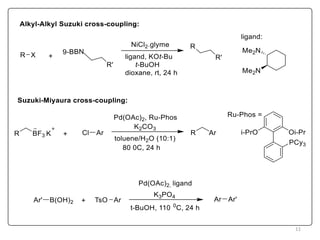
 The Suzuki reaction is an organic reaction, classified as a cross-coupling reaction, where
the coupling partners are a boronic acid and an organohalide and the catalyst is
a palladium(0) complex.
 It was first published in 1979 by Akira Suzuki, and he shared the 2010 Nobel Prize in
Chemistry with Richard F. Heck and Ei-ichi Negishi for their contribution to the
discovery and development of palladium-catalyzed cross-couplings in organic synthesis.
 This reaction is also known as the Suzuki–Miyaura reaction or simply as the Suzuki
coupling. It is widely used to synthesize polyolefins, styrenes, and substituted biphenyls.
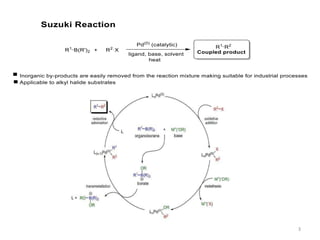
 The general scheme for the Suzuki reaction is a carbon-carbon single bond is formed by
coupling an organoboron species (R1-BY2) with a halide (R2-X) using
a palladium catalyst and a base.
What is Suzuki Reaction….
2
3
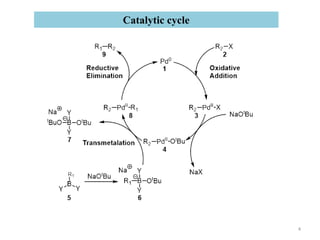
Catalytic cycle
4
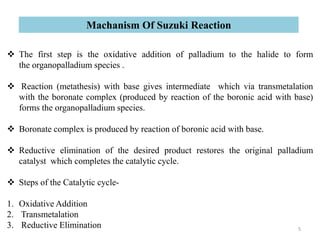
 The first step is the oxidative addition of palladium to the halide to form
the organopalladium species .
 Reaction (metathesis) with base gives intermediate which via transmetalation
with the boronate complex (produced by reaction of the boronic acid with base)
forms the organopalladium species.
 Boronate complex is produced by reaction of boronic acid with base.
 Reductive elimination of the desired product restores the original palladium
catalyst which completes the catalytic cycle.
 Steps of the Catalytic cycle-
1. Oxidative Addition
2. Transmetalation
3. Reductive Elimination
Machanism Of Suzuki Reaction
5
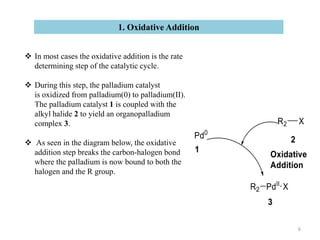
 In most cases the oxidative addition is the rate
determining step of the catalytic cycle.
 During this step, the palladium catalyst
is oxidized from palladium(0) to palladium(II).
The palladium catalyst 1 is coupled with the
alkyl halide 2 to yield an organopalladium
complex 3.
 As seen in the diagram below, the oxidative
addition step breaks the carbon-halogen bond
where the palladium is now bound to both the
halogen and the R group.
1. Oxidative Addition
6
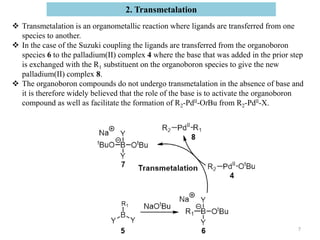
 Transmetalation is an organometallic reaction where ligands are transferred from one
species to another.
 In the case of the Suzuki coupling the ligands are transferred from the organoboron
species 6 to the palladium(II) complex 4 where the base that was added in the prior step
is exchanged with the R1 substituent on the organoboron species to give the new
palladium(II) complex 8.
 The organoboron compounds do not undergo transmetalation in the absence of base and
it is therefore widely believed that the role of the base is to activate the organoboron
compound as well as facilitate the formation of R2-Pdll-OtBu from R2-Pdll-X.
2. Transmetalation
7
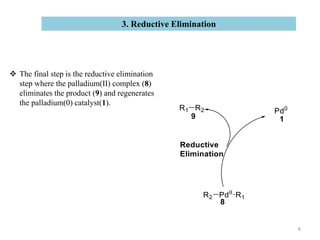
 The final step is the reductive elimination
step where the palladium(II) complex (8)
eliminates the product (9) and regenerates
the palladium(0) catalyst(1).
3. Reductive Elimination
8
 The ligand plays an important role in the Suzuki reaction. Typically, the
phosphine ligand is used in the Suzuki reaction.
 Phosphine ligand increases the electron density at the metal center of the
complex and therefore helps in the oxidative addition step.
 In addition, the bulkiness of substitution of the phosphine ligand helps in the
reductive elimination step. However, N-heterocyclic carbenes ligand has
recently been used in this cross coupling, due to the instability of the phosphine
ligand under Suzuki reaction conditions.
 N-Heterocyclic carbenes are more electron rich and more bulkier than the
phosphine ligand. Therefore, both the steric and electronic factors of the N-
heterocyclic carbene ligand help to stabilize active Pd(0) catalyst.
Role of Ligands
9
 The Suzuki coupling reaction is different from other coupling reactions in that it
can be run in biphasic organic-water, water-only, or no solvent.
 Use of water as a solvent system is also attractive because of the economic and
safety advantages. Frequently used in solvent systems for Suzuki coupling
are toluene ,THF, dioxane, and DMF.
 The main role of the base in the reaction mechanism is to increase the reactivity
of the boronic acid toward the Pd–halide complex by converting it into the
respective organoborate.
 The most frequently used bases are K2CO3,KOtBu,Cs2CO3, K3PO4, NaOH,
and NEt3.
Role of Solvent & Base.
10
11
12
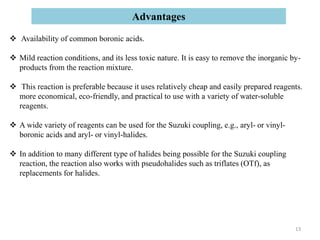
 Availability of common boronic acids.
 Mild reaction conditions, and its less toxic nature. It is easy to remove the inorganic by-
products from the reaction mixture.
 This reaction is preferable because it uses relatively cheap and easily prepared reagents.
more economical, eco-friendly, and practical to use with a variety of water-soluble
reagents.
 A wide variety of reagents can be used for the Suzuki coupling, e.g., aryl- or vinyl-
boronic acids and aryl- or vinyl-halides.
 In addition to many different type of halides being possible for the Suzuki coupling
reaction, the reaction also works with pseudohalides such as triflates (OTf), as
replacements for halides.
Advantages
13
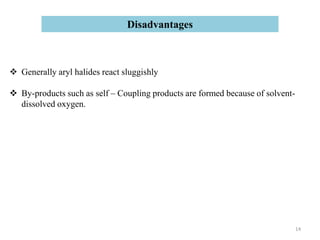
 Generally aryl halides react sluggishly
 By-products such as self – Coupling products are formed because of solvent-
dissolved oxygen.
Disadvantages
14
15

Suzuki Reaction.

  • 1.
    SUZUKI REACTION Presented by Ashvini.B.Tanpure Departmentof Pharmacetical Technology (Process Chemistry) M.Tech.(Pharm),Sem-II National Institute of Pharmaceutical Education and Research SAS,Nagar. 1
  • 2.
     The Suzukireaction is an organic reaction, classified as a cross-coupling reaction, where the coupling partners are a boronic acid and an organohalide and the catalyst is a palladium(0) complex.  It was first published in 1979 by Akira Suzuki, and he shared the 2010 Nobel Prize in Chemistry with Richard F. Heck and Ei-ichi Negishi for their contribution to the discovery and development of palladium-catalyzed cross-couplings in organic synthesis.  This reaction is also known as the Suzuki–Miyaura reaction or simply as the Suzuki coupling. It is widely used to synthesize polyolefins, styrenes, and substituted biphenyls.  The general scheme for the Suzuki reaction is a carbon-carbon single bond is formed by coupling an organoboron species (R1-BY2) with a halide (R2-X) using a palladium catalyst and a base. What is Suzuki Reaction…. 2
  • 3.
  • 4.
  • 5.
     The firststep is the oxidative addition of palladium to the halide to form the organopalladium species .  Reaction (metathesis) with base gives intermediate which via transmetalation with the boronate complex (produced by reaction of the boronic acid with base) forms the organopalladium species.  Boronate complex is produced by reaction of boronic acid with base.  Reductive elimination of the desired product restores the original palladium catalyst which completes the catalytic cycle.  Steps of the Catalytic cycle- 1. Oxidative Addition 2. Transmetalation 3. Reductive Elimination Machanism Of Suzuki Reaction 5
  • 6.
     In mostcases the oxidative addition is the rate determining step of the catalytic cycle.  During this step, the palladium catalyst is oxidized from palladium(0) to palladium(II). The palladium catalyst 1 is coupled with the alkyl halide 2 to yield an organopalladium complex 3.  As seen in the diagram below, the oxidative addition step breaks the carbon-halogen bond where the palladium is now bound to both the halogen and the R group. 1. Oxidative Addition 6
  • 7.
     Transmetalation isan organometallic reaction where ligands are transferred from one species to another.  In the case of the Suzuki coupling the ligands are transferred from the organoboron species 6 to the palladium(II) complex 4 where the base that was added in the prior step is exchanged with the R1 substituent on the organoboron species to give the new palladium(II) complex 8.  The organoboron compounds do not undergo transmetalation in the absence of base and it is therefore widely believed that the role of the base is to activate the organoboron compound as well as facilitate the formation of R2-Pdll-OtBu from R2-Pdll-X. 2. Transmetalation 7
  • 8.
     The finalstep is the reductive elimination step where the palladium(II) complex (8) eliminates the product (9) and regenerates the palladium(0) catalyst(1). 3. Reductive Elimination 8
  • 9.
     The ligandplays an important role in the Suzuki reaction. Typically, the phosphine ligand is used in the Suzuki reaction.  Phosphine ligand increases the electron density at the metal center of the complex and therefore helps in the oxidative addition step.  In addition, the bulkiness of substitution of the phosphine ligand helps in the reductive elimination step. However, N-heterocyclic carbenes ligand has recently been used in this cross coupling, due to the instability of the phosphine ligand under Suzuki reaction conditions.  N-Heterocyclic carbenes are more electron rich and more bulkier than the phosphine ligand. Therefore, both the steric and electronic factors of the N- heterocyclic carbene ligand help to stabilize active Pd(0) catalyst. Role of Ligands 9
  • 10.
     The Suzukicoupling reaction is different from other coupling reactions in that it can be run in biphasic organic-water, water-only, or no solvent.  Use of water as a solvent system is also attractive because of the economic and safety advantages. Frequently used in solvent systems for Suzuki coupling are toluene ,THF, dioxane, and DMF.  The main role of the base in the reaction mechanism is to increase the reactivity of the boronic acid toward the Pd–halide complex by converting it into the respective organoborate.  The most frequently used bases are K2CO3,KOtBu,Cs2CO3, K3PO4, NaOH, and NEt3. Role of Solvent & Base. 10
  • 11.
  • 12.
  • 13.
     Availability ofcommon boronic acids.  Mild reaction conditions, and its less toxic nature. It is easy to remove the inorganic by- products from the reaction mixture.  This reaction is preferable because it uses relatively cheap and easily prepared reagents. more economical, eco-friendly, and practical to use with a variety of water-soluble reagents.  A wide variety of reagents can be used for the Suzuki coupling, e.g., aryl- or vinyl- boronic acids and aryl- or vinyl-halides.  In addition to many different type of halides being possible for the Suzuki coupling reaction, the reaction also works with pseudohalides such as triflates (OTf), as replacements for halides. Advantages 13
  • 14.
     Generally arylhalides react sluggishly  By-products such as self – Coupling products are formed because of solvent- dissolved oxygen. Disadvantages 14
  • 15.