Pericyclic reactions
Dr. Anita Goswami-Giri
Professor and Head
Department of Chemistry
B. N Bandodkar College of Science (Autonomous),
Thane-1
transferring electrons around a circle
1
Definition:
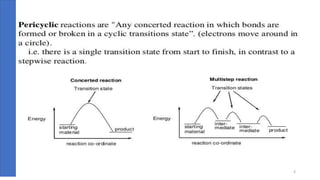
The organic reactions involve one step concerted reactions featuring a
cyclic flow of electrons via a single transition state without forming any
intermediate are referred to as “pericyclic.”
Transition states are cyclic and the reactions are attended by a high
degree of stereo selectivity.
Unaffected by polar reagents, solvent change radical initiator
2
Characteristics: The reaction -
Ø Reversible reactions involving ring closure or ring opening
Ø Single transition structure (TS) with no intermediates
Ø Forward or reverse reactions provide the same analysis
Ø Mechanisms explained through analysis of frontier molecular orbitals (FMOs)
Ø initiated by the action of light (photolysis) & heat ( thermolysis).
Ø Not sensitive to the presence or absence of solvents and catalysts
Ø Bond breaking and formation take place simultaneously (concerted)
Ø Stereospecific depending on whether initiated by heat or light. If thermolysis gives
a cis-product, then photolysis gives trans-product and vice versa.
3
4
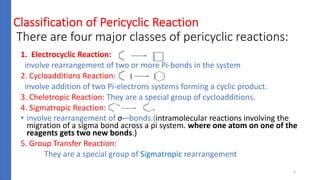
Classification of Pericyclic Reaction
There are four major classes of pericyclic reactions:
1. Electrocyclic Reaction:
involve rearrangement of two or more Pi-bonds in the system
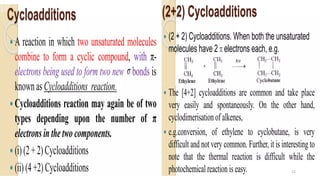
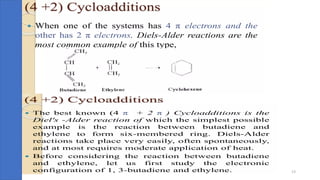
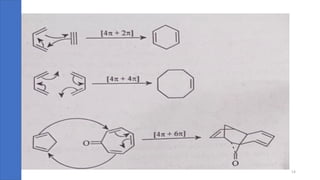
2. Cycloadditions Reaction:
involve addition of two Pi-electrons systems forming a cyclic product.
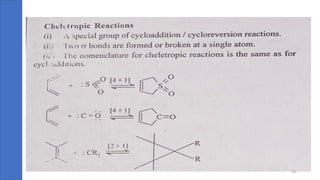
3. Cheletropic Reaction: They are a special group of cycloadditions.
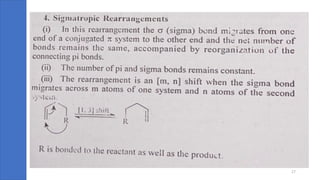
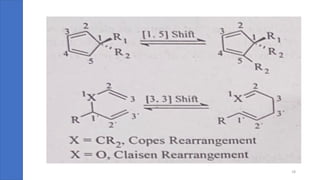
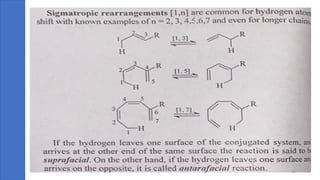
4. Sigmatropic Reaction:
• involve rearrangement of σ-–bonds.(intramolecular reactions involving the
migration of a sigma bond across a pi system. where one atom on one of the
reagents gets two new bonds.)
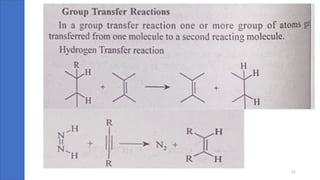
5. Group Transfer Reaction:
They are a special group of Sigmatropic rearrangement
5
6
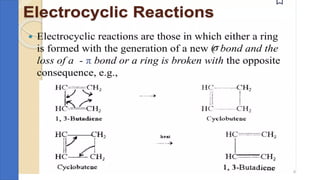
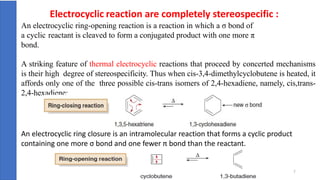
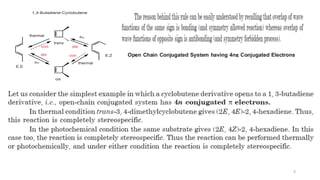
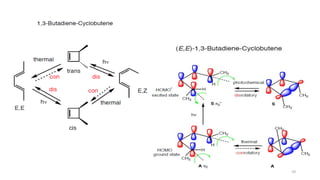
An electrocyclic ring-opening reaction is a reaction in which a σ bond of
a cyclic reactant is cleaved to form a conjugated product with one more π
bond.
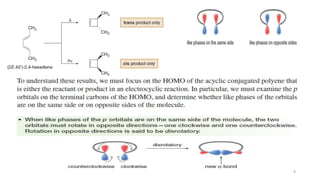
A striking feature of thermal electrocyclic reactions that proceed by concerted mechanisms
is their high degree of stereospecificity. Thus when cis-3,4-dimethylcyclobutene is heated, it
affords only one of the three possible cis-trans isomers of 2,4-hexadiene, namely, cis,trans-
2,4-hexadiene:
An electrocyclic ring closure is an intramolecular reaction that forms a cyclic product
containing one more σ bond and one fewer π bond than the reactant.
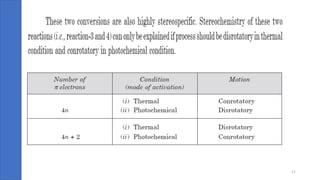
Electrocyclic reaction are completely stereospecific :
7
8
9
10
11
12
13
14
15
16
17
18
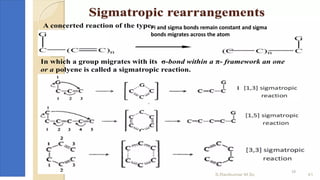
Pi and sigma bonds remain constant and sigma
bonds migrates across the atom
19
20
21
22
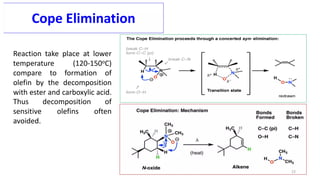
Reaction take place at lower
temperature (120-150oC)
compare to formation of
olefin by the decomposition
with ester and carboxylic acid.
Thus decomposition of
sensitive olefins often
avoided.
23
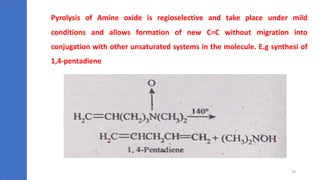
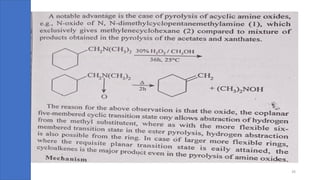
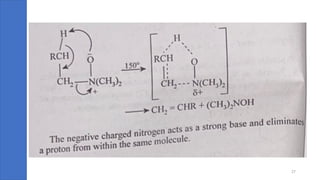
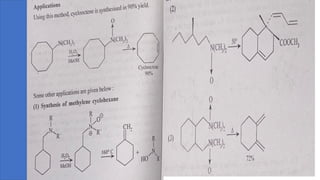
Pyrolysis of Amine oxide is regioselective and take place under mild
conditions and allows formation of new C=C without migration into
conjugation with other unsaturated systems in the molecule. E.g synthesi of
1,4-pentadiene
24
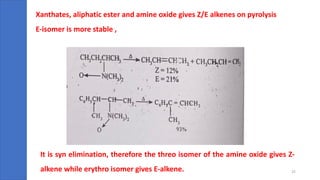
Xanthates, aliphatic ester and amine oxide gives Z/E alkenes on pyrolysis
E-isomer is more stable ,
It is syn elimination, therefore the threo isomer of the amine oxide gives Z-
alkene while erythro isomer gives E-alkene. 25
26
27
28
29
30
31

Pericyclic reaction - Classification, stereochemistry

  • 1.
    Pericyclic reactions Dr. AnitaGoswami-Giri Professor and Head Department of Chemistry B. N Bandodkar College of Science (Autonomous), Thane-1 transferring electrons around a circle 1
  • 2.
    Definition: The organic reactionsinvolve one step concerted reactions featuring a cyclic flow of electrons via a single transition state without forming any intermediate are referred to as “pericyclic.” Transition states are cyclic and the reactions are attended by a high degree of stereo selectivity. Unaffected by polar reagents, solvent change radical initiator 2
  • 3.
    Characteristics: The reaction- Ø Reversible reactions involving ring closure or ring opening Ø Single transition structure (TS) with no intermediates Ø Forward or reverse reactions provide the same analysis Ø Mechanisms explained through analysis of frontier molecular orbitals (FMOs) Ø initiated by the action of light (photolysis) & heat ( thermolysis). Ø Not sensitive to the presence or absence of solvents and catalysts Ø Bond breaking and formation take place simultaneously (concerted) Ø Stereospecific depending on whether initiated by heat or light. If thermolysis gives a cis-product, then photolysis gives trans-product and vice versa. 3
  • 4.
  • 5.
    Classification of PericyclicReaction There are four major classes of pericyclic reactions: 1. Electrocyclic Reaction: involve rearrangement of two or more Pi-bonds in the system 2. Cycloadditions Reaction: involve addition of two Pi-electrons systems forming a cyclic product. 3. Cheletropic Reaction: They are a special group of cycloadditions. 4. Sigmatropic Reaction: • involve rearrangement of σ-–bonds.(intramolecular reactions involving the migration of a sigma bond across a pi system. where one atom on one of the reagents gets two new bonds.) 5. Group Transfer Reaction: They are a special group of Sigmatropic rearrangement 5
  • 6.
  • 7.
    An electrocyclic ring-openingreaction is a reaction in which a σ bond of a cyclic reactant is cleaved to form a conjugated product with one more π bond. A striking feature of thermal electrocyclic reactions that proceed by concerted mechanisms is their high degree of stereospecificity. Thus when cis-3,4-dimethylcyclobutene is heated, it affords only one of the three possible cis-trans isomers of 2,4-hexadiene, namely, cis,trans- 2,4-hexadiene: An electrocyclic ring closure is an intramolecular reaction that forms a cyclic product containing one more σ bond and one fewer π bond than the reactant. Electrocyclic reaction are completely stereospecific : 7
  • 8.
  • 9.
  • 10.
  • 11.
  • 12.
  • 13.
  • 14.
  • 15.
  • 16.
  • 17.
  • 18.
  • 19.
    Pi and sigmabonds remain constant and sigma bonds migrates across the atom 19
  • 20.
  • 21.
  • 22.
  • 23.
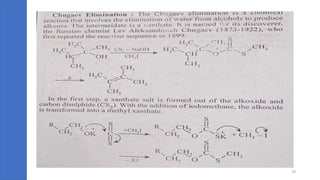
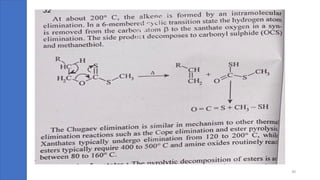
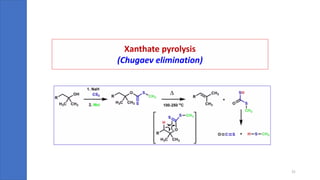
    Reaction take placeat lower temperature (120-150oC) compare to formation of olefin by the decomposition with ester and carboxylic acid. Thus decomposition of sensitive olefins often avoided. 23
  • 24.
    Pyrolysis of Amineoxide is regioselective and take place under mild conditions and allows formation of new C=C without migration into conjugation with other unsaturated systems in the molecule. E.g synthesi of 1,4-pentadiene 24
  • 25.
    Xanthates, aliphatic esterand amine oxide gives Z/E alkenes on pyrolysis E-isomer is more stable , It is syn elimination, therefore the threo isomer of the amine oxide gives Z- alkene while erythro isomer gives E-alkene. 25
  • 26.
  • 27.
  • 28.
  • 29.
  • 30.
  • 31.