By
Bapu R. Thorat
M.Sc. SET. NET. MS-CIT
Assit. Professor
Dept of Chemistry &Dept of Biotechnology,
Governmentof Maharashtra,
IsmailYusufCollegeofArts,ScienceandCommerce,Jogeshwari (East),
Mumbai-60
Pericyclic Reactions
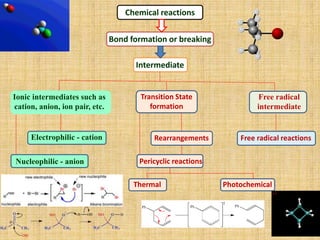
Chemical reactions
Bond formation or breaking
Intermediate
Ionic intermediates such as
cation, anion, ion pair, etc.
Free radical
intermediate
Transition State
formation
Electrophilic - cation
Nucleophilic - anion Pericyclic reactions
Rearrangements Free radical reactions
Thermal Photochemical
Transition State
formation
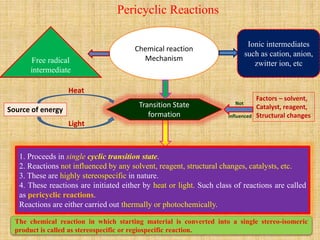
Pericyclic Reactions
Chemical reaction
MechanismFree radical
intermediate
Ionic intermediates
such as cation, anion,
zwitter ion, etc
1. Proceeds in single cyclic transition state.
2. Reactions not influenced by any solvent, reagent, structural changes, catalysts, etc.
3. These are highly stereospecific in nature.
4. These reactions are initiated either by heat or light. Such class of reactions are called
as pericyclic reactions.
Reactions are either carried out thermally or photochemically.
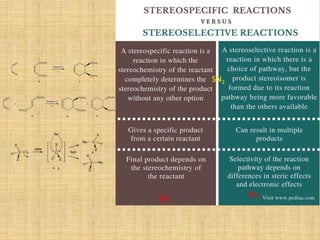
The chemical reaction in which starting material is converted into a single stereo-isomeric
product is called as stereospecific or regiospecific reaction.
Factors – solvent,
Catalyst, reagent,
Structural changes
Not
influenced
Source of energy
Heat
Light
SNi
SN1
SN2
Pericyclic Reactions
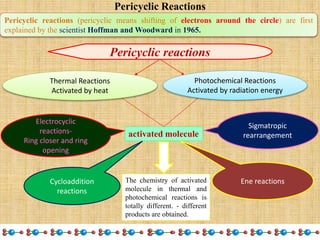
Pericyclic reactions (pericyclic means shifting of electrons around the circle) are first
explained by the scientist Hoffman and Woodward in 1965.
Sigmatropic
rearrangement
Ene reactionsCycloaddition
reactions
Electrocyclic
reactions-
Ring closer and ring
opening
Pericyclic reactions
Photochemical Reactions
Activated by radiation energy
Thermal Reactions
Activated by heat
activated molecule
The chemistry of activated
molecule in thermal and
photochemical reactions is
totally different. - different
products are obtained.
Pericyclic Reactions
+2
hv
Ketonic Sensitizer
Cis- Trans-
2
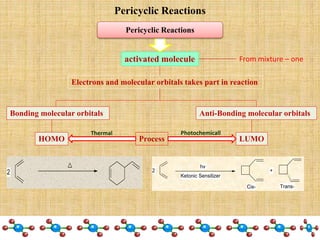
activated molecule
Pericyclic Reactions
Electrons and molecular orbitals takes part in reaction
LUMO
Bonding molecular orbitals Anti-Bonding molecular orbitals
HOMO Process
Thermal Photochemicall
From mixture – one
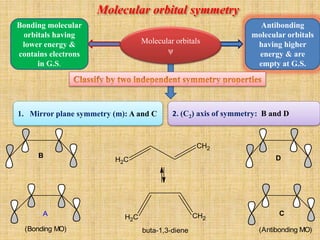
Molecular orbital symmetry
Molecular orbitals
ψ
Antibonding
molecular orbitals
having higher
energy & are
empty at G.S.
Bonding molecular
orbitals having
lower energy &
contains electrons
in G.S.
1. Mirror plane symmetry (m): A and C 2. (C2) axis of symmetry: B and D
CH2CH2
buta-1,3-diene
CH2
CH2
(Bonding MO) (Antibonding MO)
B
C
D
A
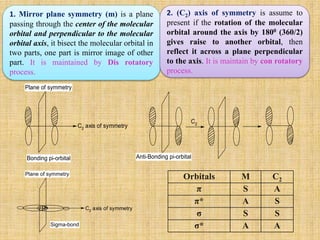
1. Mirror plane symmetry (m) is a plane
passing through the center of the molecular
orbital and perpendicular to the molecular
orbital axis, it bisect the molecular orbital in
two parts, one part is mirror image of other
part. It is maintained by Dis rotatory
process.
2. (C2) axis of symmetry is assume to
present if the rotation of the molecular
orbital around the axis by 1800 (360/2)
gives raise to another orbital, then
reflect it across a plane perpendicular
to the axis. It is maintain by con rotatory
process.
C2
axis of symmetry
C2
Plane of symmetry
Bonding pi-orbital Anti-Bonding pi-orbital
C2
axis of symmetry
Plane of symmetry
Sigma-bond
Orbitals M C2
π S A
π* A S
σ S S
σ* A A
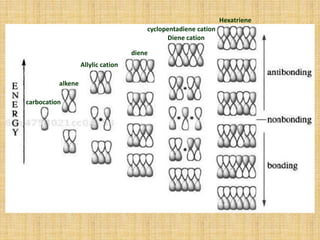
carbocation
alkene
Allylic cation
diene
Diene cation
cyclopentadiene cation
Hexatriene
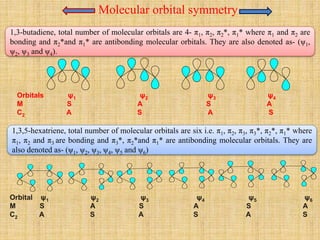
Molecular orbital symmetry
1,3-butadiene, total number of molecular orbitals are 4- π1, π2, π2*, π1* where π1 and π2 are
bonding and π2*and π1* are antibonding molecular orbitals. They are also denoted as- (ψ1,
ψ2, ψ3 and ψ4).
1,3,5-hexatriene, total number of molecular orbitals are six i.e. π1, π2, π3, π3*, π2*, π1* where
π1, π2 and π3 are bonding and π3*, π2*and π1* are antibonding molecular orbitals. They are
also denoted as- (ψ1, ψ2, ψ3, ψ4, ψ5 and ψ6)
Orbitals ψ1 ψ2 ψ3 ψ4
M S A S A
C2 A S A S
Orbital ψ1 ψ2 ψ3 ψ4 ψ5 ψ6
M S A S A S A
C2 A S A S A S
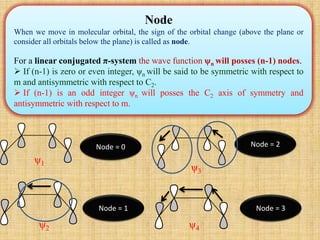
Node
When we move in molecular orbital, the sign of the orbital change (above the plane or
consider all orbitals below the plane) is called as node.
For a linear conjugated π-system the wave function ψn will posses (n-1) nodes.
 If (n-1) is zero or even integer, ψn will be said to be symmetric with respect to
m and antisymmetric with respect to C2.
 If (n-1) is an odd integer ψn will posses the C2 axis of symmetry and
antisymmetric with respect to m.
Node = 0
Node = 1
Node = 2
Node = 3
ψ1
ψ2
ψ3
ψ4
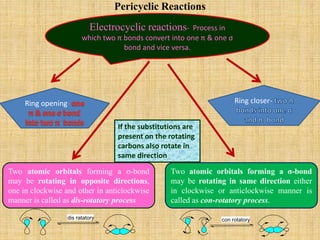
Pericyclic Reactions
Electrocyclic reactions- Process in
which two π bonds convert into one π & one σ
bond and vice versa.
Ring opening- Ring closer-
Two atomic orbitals forming a σ-bond
may be rotating in opposite directions,
one in clockwise and other in anticlockwise
manner is called as dis-rotatory process
Two atomic orbitals forming a σ-bond
may be rotating in same direction either
in clockwise or anticlockwise manner is
called as con-rotatory process.
dis ratatory con rotatory
If the substitutions are
present on the rotating
carbons also rotate in
same direction
Frontier Molecular Orbital [FMO] Method
Molecular orbital model for analyzing pericyclic reactions has been proposed by Kenichi
Fukui of Japan.
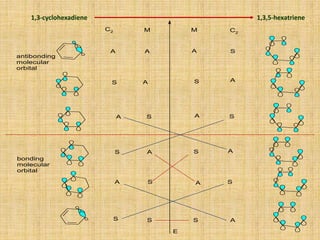
The correlation diagram is useful for the detail analysis of an Electrocyclic reactions.
A
B
C
D
X
Y
W
Z
CH2CH2
A
B
C
D
X
Y
W
Z
Bonding MO
Antibonding MO
Mirror (m) of symmetry
C2 axis of symmetry
A
S
A
S
A
S
A
S
A
B
C
D
X
Y
W
Z
A
S
A
S A
S
A
S
1,3-butadiene cyclobutene
1,3,5-hexatriene1,3-cyclohexadiene
C2 C2
M M
E
A
S
A
S
A
S
A
A
S
A
S
S
A
S
A
S
A
S
S
A
S
A
S
A
antibonding
molecular
orbital
bonding
molecular
orbital
Frontier Molecular Orbital [FMO] Method
The correlation diagram is useful for the detail analysis of an Electrocyclic reactions.
A similar conclusion is obtained by considering the symmetry of highest occupied
molecular orbital [HOMO] of open chain partner in Electrocyclic reactions.
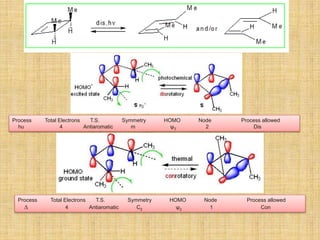
If the HOMO having C2-axis of symmetry (node is odd), then reaction will follow con-
rotatory path.
If HOMO posses a mirror plane symmetry (node is zero or even number), a reaction will
follows dis-rotatory path.
Thermal
Reactions
Transition State Configurational Preference
4n + 2 (aromatic) Disrotatory
4n (antiaromatic) Conrotatory
Photochemical
Reactions
Transition State Configurational Preference
4n + 2 (aromatic) Conrotatory
4n (antiaromatic) Disrotatory
Frontier Molecular Orbital [FMO] Method
A similar conclusion is obtained by considering the symmetry of highest occupied molecular
orbital [HOMO] of open chain partner in Electrocyclic reactions.
A
B
C
D
X
Y
W
Z
CH2CH2
A
B
C
D
X
Y
W
Z
Bonding MO
Antibonding MO
Mirror (m) of symmetry
C2 axis of symmetry
A
S
A
S
A
S
A
S
A
B
C
D
X
Y
W
Z
A
S
A
S A
S
A
S
Thermal
HOMO
Con-rotatory
Frontier Molecular Orbital [FMO] Method
A similar conclusion is obtained by considering the symmetry of highest occupied molecular
orbital [HOMO] of open chain partner in Electrocyclic reactions.
A
B
C
D
X
Y
W
Z
CH2CH2
A
B
C
D
X
Y
W
Z
Bonding MO
Antibonding MO
Mirror (m) of symmetry
C2 axis of symmetry
A
S
A
S
A
S
A
S
A
B
C
D
X
Y
W
Z
A
S
A
S A
S
A
S
Photochemical
HOMO
Dis-rotatory
Process Total Electrons T.S. Symmetry HOMO Node Process allowed
hυ 4 Antiaromatic m ψ3 2 Dis
Process Total Electrons T.S. Symmetry HOMO Node Process allowed
∆ 4 Antiaromatic C2 ψ2 1 Con
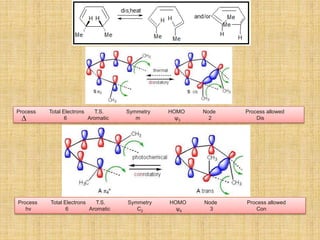
Process Total Electrons T.S. Symmetry HOMO Node Process allowed
6 Aromatic m ψ3 2 Dis
Process Total Electrons T.S. Symmetry HOMO Node Process allowed
hv 6 Aromatic C2 ψ4 3 Con
∆
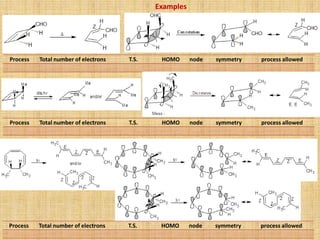
Examples
Process Total number of electrons T.S. HOMO node symmetry process allowed
Examples
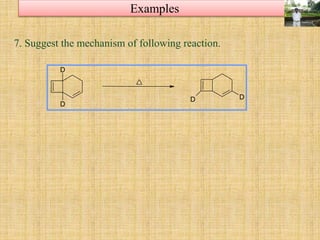
7. Suggest the mechanism of following reaction.
D
D
DD
D
D D
D
D
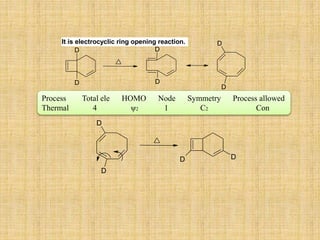
DIt is electrocyclic ring opening reaction.
Process Total ele HOMO Node Symmetry Process allowed
Thermal 4 ψ2 1 C2 Con
DD
D
D
Examples
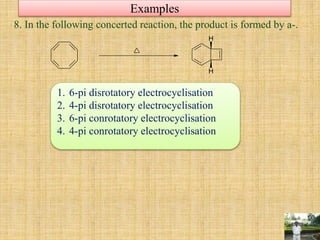
8. In the following concerted reaction, the product is formed by a-.
H
H
1. 6-pi disrotatory electrocyclisation
2. 4-pi disrotatory electrocyclisation
3. 6-pi conrotatory electrocyclisation
4. 4-pi conrotatory electrocyclisation
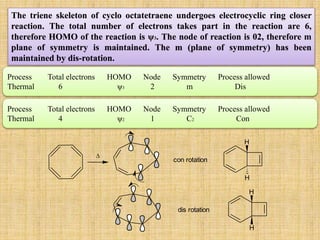
Process Total electrons HOMO Node Symmetry Process allowed
Thermal 6 ψ3 2 m Dis
The triene skeleton of cyclo octatetraene undergoes electrocyclic ring closer
reaction. The total number of electrons takes part in the reaction are 6,
therefore HOMO of the reaction is ψ3. The node of reaction is 02, therefore m
plane of symmetry is maintained. The m (plane of symmetry) has been
maintained by dis-rotation.
Process Total electrons HOMO Node Symmetry Process allowed
Thermal 4 ψ2 1 C2 Con

con rotation
H
H
dis rotation
H
H
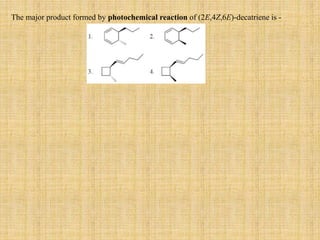
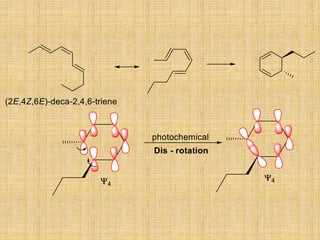
The major product formed by photochemical reaction of (2E,4Z,6E)-decatriene is -
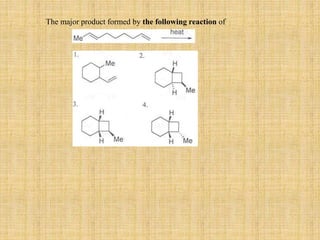
The major product formed by the following reaction of
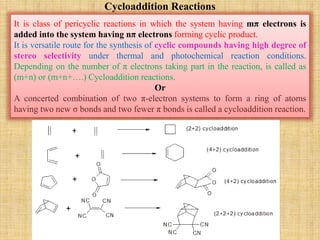
Cycloaddition Reactions
It is class of pericyclic reactions in which the system having mπ electrons is
added into the system having nπ electrons forming cyclic product.
It is versatile route for the synthesis of cyclic compounds having high degree of
stereo selectivity under thermal and photochemical reaction conditions.
Depending on the number of π electrons taking part in the reaction, is called as
(m+n) or (m+n+….) Cycloaddition reactions.
Or
A concerted combination of two π-electron systems to form a ring of atoms
having two new σ bonds and two fewer π bonds is called a cycloaddition reaction.
Cycloaddition Reactions
In cycloaddition reactions, addition of two systems having double bonds take-
place either in same or opposite side of the system. Such mode of addition is very
important to decide the stereo chemistry of product. These different numbers of
modes are named as suprafacial (on the same side) and antrafacial (on the
opposite side).
This specification is usually carried out by keeping a suitable subscript (s or a) after
the number referring to the pi-components. E.g. The Diels-Alder reaction is also
called as (4s+2s) cycloaddition.
[suprafcial] [antrafacial]
R
R
R
R
H
H
+
heat
(4s+2s)
Frontier Molecular Orbital [FMO] Method
[Cycloaddition Reactions]
A cycloaddition reaction is allowed or not which can be found to depends on the symmetry
properties of the highest occupied molecular orbital (HOMO) of one reactant and the
lowest unoccupied molecular orbital (LUMO) of other molecule.
The favorable interaction can be predicted from the sign of HOMO and LUMO.
e.g. During Cycloaddition of ethylene to cyclobutane (2s+2s) addition is thermally forbidden
because lopes of HOMO of one ethylene molecule and that of other LUMO of another
ethylene molecule are not having corresponding similar signs, it (2a+2s) thermally allowed.
But when one ethylene molecule is irradiated, on electron get excited to excited state
(antibonding molecular orbital) which is now become HOMO which is then correlated to
LUMO of other unexcited ethylene molecule. Therefore, it is photochemically (2s+2s)
allowed.
HOMO
LUMO
HOMO of excited state.
LUMO of unexcited state.
(2s + 2s)
(Ground state)
[ , forbidden]
(Excited state)
[ hv, allowed]
Frontier Molecular Orbital [FMO] Method
[Cycloaddition Reactions]
In Diels-Alder reaction as sign of the 1,4-lopes of butadiene HOMO have been found to be
matching those in the LUMO of ethylene. The (4s+2s) addition is thermally allowed and
photochemically forbidden whereas (4a+2s) or (4s+2a) is photochemically allowed and
thermally forbidden.
The Diels-Alder reaction of cyclpentadiene to forming dicyclopentadiene. Invariably, the
endo-dimer is formed rather that exo-dimer because of favorable secondary force due to
interaction of frontier orbitals of diene and dienophile compounds which leads to lower the
energy of the transition.
(4s + 2s, , allowed) (4s + 2s, , allowed)
(4s + 2a or 4a + 2s, hv , allowed)
HOMO
LUMO
HOMO
+
LUMO
(endo form)
(exo form)
Cycloaddition Reactions
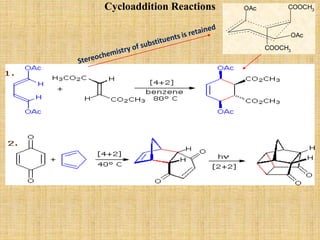
The most common cycloaddition reaction is the [4π+2π] cyclization known as the Diels-
Alder reaction in which cyclic product is formed from alkene and a diene.
The stereochemistry of the substituent attached to double bonded carbon atom is
maintained.
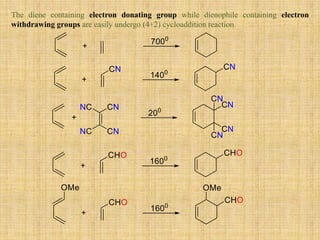
The diene containing electron donating group while dienophile containing electron
withdrawing groups are easily undergo (4+2) cycloaddition reaction.
O
O
O
CN
CNNC
NC
O
O
O
CN
CNNC
NC
+ +
(4+2) cycloaddition
(2+2+2) cycloaddition
+ one step mechanism
+ or+ - .
two step mechanism zwitterions diradicals
Cycloaddition Reactions OAc
OAc
COOCH3
COOCH3
The diene containing electron donating group while dienophile containing electron
withdrawing groups are easily undergo (4+2) cycloaddition reaction.
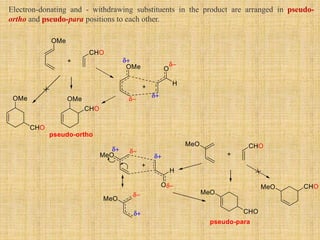
Electron-donating and - withdrawing substituents in the product are arranged in pseudo-
ortho and pseudo-para positions to each other.
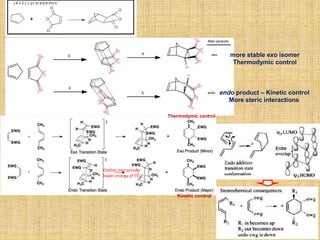
Orbital interactions
lower energy of TS
more stable exo isomer
Thermodymic control
endo product – Kinetic control
More steric interactions
Thermodymic control
Kinetic control
SO2
CH3
CH3
CH3
CH3

SO2
CH3
CH3
CH3
CH3

CH3
CH3
SO2 SO2+
LUMO
HOMO
Example
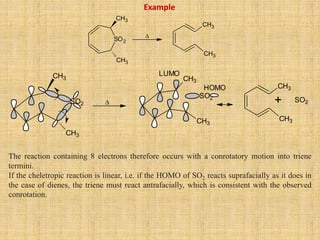
The reaction containing 8 electrons therefore occurs with a conrotatory motion into triene
termini.
If the cheletropic reaction is linear, i.e. if the HOMO of SO2 reacts suprafacially as it does in
the case of dienes, the triene must react antrafacially, which is consistent with the observed
conrotation.
Examples
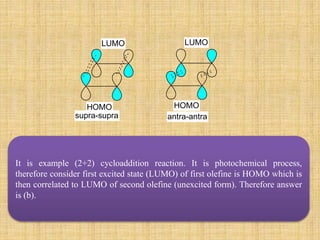
1. The concerted photochemical reaction between two olefins
leading to a cyclobutane ring is-
a. π2
s + π2
a cycloaddition. b. π2
s + π2
s cycloaddition.
c. σ2
s + σ2
s cycloaddition. d. π2
s + σ2
a cycloaddition.
HOMO HOMO
LUMO LUMO
supra-supra antra-antra
It is example (2+2) cycloaddition reaction. It is photochemical process,
therefore consider first excited state (LUMO) of first olefine is HOMO which is
then correlated to LUMO of second olefine (unexcited form). Therefore answer
is (b).
HOMO HOMO
LUMO LUMO
supra-supra antra-antra
Examples
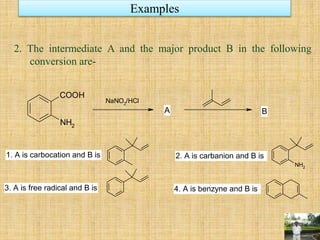
2. The intermediate A and the major product B in the following
conversion are-
NH2
COOH
NaNO2
/HCl
A B
NH2
1. A is carbocation and B is 2. A is carbanion and B is
3. A is free radical and B is 4. A is benzyne and B is
It is combination of two reactions- Benzyne formation and Diel’s Alder reaction. The
anthranilic acid undergoes diazotizing followed by decarboxylation forming benzyne. It
shows [4+2] cycloaddition reaction [Diel’s Alder reaction] forming cyclic product (4).
NH2
COOH
NaNO2 ClH HNO2
NaCl
HNO2
N2
Cl
COOH
O
O
H
N2
Cl
+ +
+
A
+
[4+2] cycloaddition rea.
Diel's Alder reaction
B
Examples
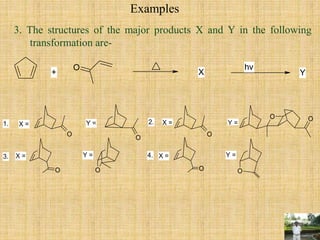
3. The structures of the major products X and Y in the following
transformation are-
O
+
hv
X Y
O O
O O
O
O O
O O
1. 2.
3. 4.
X = Y = X = Y =
X = Y = X = Y =
During Diel’s Alder reaction between cyclic diene and substituted dienophile
forming endo product rather than exo because of favorable secondary force due to
interaction of frontier orbitals of diene and dienophile compounds which leads to lower
the energy of the transition (3).
The X further undergoes photochemical [2+2] cycloaddition reaction of alkene and
carbonyl group (Paterno-Buchi reaction) forming oxetane [four membered cyclic ether].
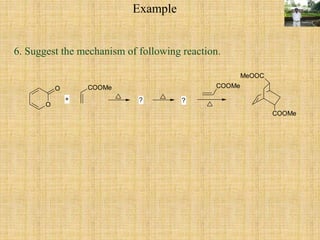
Example
6. Suggest the mechanism of following reaction.
O
O COOMe COOMe
MeOOC
COOMe
+ ? ?
O
O COOMe
O
O
COOMe
+Step I
HOMO
LUMO
Total electrons - 6, node- 2,
Aromatic T.S., Supra-supra
process allowed
O
O
COOMe COOMe
COOMe
CO2
or It is electrocyclic ring opening
reaction.Step II
COOMe
MeOOC
COOMe
COOMe
COOMe
+orStep III.
It is [4+2] cycloaddition reaction
called Diel's Alder reaction. The
substituent on dienophile is endo
when using cyclic diene.
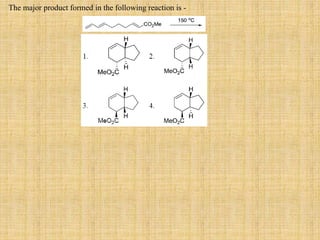
The major product formed in the following reaction is -
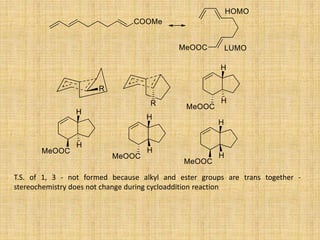
T.S. of 1, 3 - not formed because alkyl and ester groups are trans together -
stereochemistry does not change during cycloaddition reaction
Sigmatropic Rearrangement
Many thermal and photochemical rearrangements are known which involve the
shifting of a σ-bond flanked by one or more π-electron systems to a new position
[i,j] with in the molecule.
It is an uncatalyzed intramoleculer process.
This rearrangement involve shifting of the σ-bond, hence called as sigmatropic
rearrangement of the order [i,j]. The i and j are two number set in the square
bracket and the numbering of system is done by starting with atoms from which the
migration of the σ-bond started.
In some rearrangements, the migrating σ-bonds lie between two conjugated bond
systems. e.g. Cope & Claisen rearrangements.
R1
R1
R1
R1
e.g. 1.
2.
[1,3] shift
[1,5] shift
X
X
1
2 3
1'
2' 3'
(3,3) shift
(X - C<, O)
Sigmatropic Rearrangement
Suprafacial and Antrafacial processes
In sigmatropic rearrangement, the σ-bond migrates across the π-bonds through the
two different stereo-chemical sources.
 Migrated σ-bond gets moved across the same face of the conjugated system,
suprafacial process
migrating σ-bond get reformed on the opposite π-electron face of the
conjugated system, antrafacial process i.e. migrating group migrate at opposite
face of the conjugated system.
e.g. [1,5] sigmatropic shift shows both these stereo-chemical consequences as-
BA A B
H
C D
H
C D
BA
A B
HC D
H
C D
suprafacial
antrafacial
As lengthing of the migrating system increases, antrafacial shift also increases. The
antrafacial [1,3] shift is thermally impossible.
FMO Methods (Sigmatropic Rearrangement)
The analysis of the sigmatropic rearrangement shows that the migrating bond gets
cleaved homolytically resulting pair of radicals. The migrating group get migrates
over the HOMO’s of the conjugated system.
e.g. Analysis of suprafacial [1,5] sigmatropic shift of hydrogen in which the
homolytic cleavage gives rise to the production of hydrogen atom and pentadienly
radical.
The ground state electronic configuration of pentadienly radical is ψ1
2ψ2
2ψ3
1 and
HOMO is ψ3
1 of this radical possess same sign on the terminal lopes (plane
symmetry). Therefore thermally [1,5] migration is suprafacially allowed.
H
H H
H
3
FMO Methods (Sigmatropic Rearrangement)
The first excited state electronic configuration of pentadienly radical is ψ1
2ψ2
2ψ4
1
and HOMO is ψ4
1 of this radical possess opposite sign on the terminal lopes (C2
axis of symmetry). Therefore photochemically [1,5] migration is antrafacially
allowed.
ψ1
2ψ2
2ψ3
1 ψ4
0ψ5
0 → ψ1
2ψ2
2ψ3
0 ψ4
1ψ5
0
Ground state Excited state
A similar analysis shows that, for the system [i,j] possess i+j=4n+2 electrons, the
thermal reaction should be suprafacial and photochemical process should be
antrafacial but for those cases i+j=4n, the thermal reaction should be antrafacial
and photochemical process should be suprafacial. These rules are summarized as
follow-
i+j Δ-allowed hυ-allowed
4n antrafacial suprafacial
4n+2 suprafacial antrafacial
H H
H
4
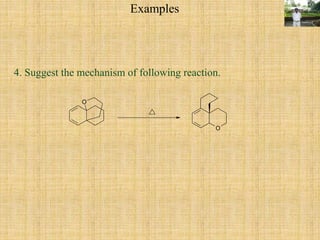
Examples
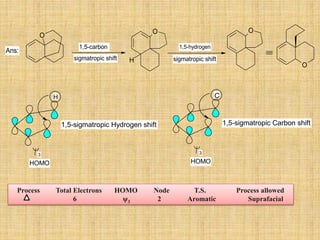
4. Suggest the mechanism of following reaction.
O
O
O
O
O
H
O
Ans:
1,5-carbon
sigmatropic shift
1,5-hydrogen
sigmatropic shift
3
HOMO
H
1,5-sigmatropic Hydrogen shift
3
HOMO
C
1,5-sigmatropic Carbon shift
Process Total Electrons HOMO Node T.S. Process allowed
6 ψ3 2 Aromatic Suprafacial
A concerted [1,3]-sigmatropic rearrangement took place in the reaction shown below. The
structure of the resulting product is
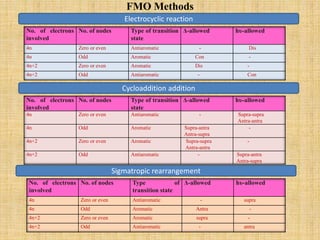
FMO Methods
No. of electrons
involved
No. of nodes Type of transition
state
Δ-allowed hυ-allowed
4n Zero or even Antiaromatic - Dis
4n Odd Aromatic Con -
4n+2 Zero or even Aromatic Dis -
4n+2 Odd Antiaromatic - Con
No. of electrons
involved
No. of nodes Type of transition
state
Δ-allowed hυ-allowed
4n Zero or even Antiaromatic - Supra-supra
Antra-antra
4n Odd Aromatic Supra-antra
Antra-supra
-
4n+2 Zero or even Aromatic Supra-supra
Antra-antra
-
4n+2 Odd Antiaromatic - Supra-antra
Antra-supra
No. of electrons
involved
No. of nodes Type of
transition state
Δ-allowed hυ-allowed
4n Zero or even Antiaromatic - supra
4n Odd Aromatic Antra -
4n+2 Zero or even Aromatic supra -
4n+2 Odd Antiaromatic - antra
Cycloaddition addition
Electrocyclic reaction
Sigmatropic rearrangement
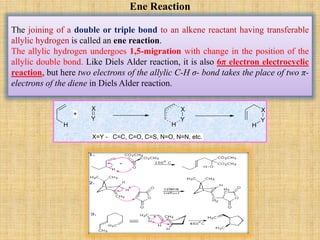
Ene Reaction
The joining of a double or triple bond to an alkene reactant having transferable
allylic hydrogen is called an ene reaction.
The allylic hydrogen undergoes 1,5-migration with change in the position of the
allylic double bond. Like Diels Alder reaction, it is also 6π electron electrocyclic
reaction, but here two electrons of the allylic C-H σ- bond takes the place of two π-
electrons of the diene in Diels Alder reaction.
H
X
Y
H
X
Y
X
Y
H
+
X=Y - C=C, C=O, C=S, N=O, N=N, etc.
Cope Rearrangement
The 1,5-dienes isomerizes {[3,3] rearrangement} on heating up to 3000C. Reaction
is normally reversible and gives mixture of starting material and product. The
position of equilibrium is depends on the stability of the starting material and the
products. The temperature needed for the reaction is depends on the substituents
and relative strain of the double bonds of 1,5-system. If the substituent R is
attached to double bonded carbon then energy of the transition state is lowered and
reaction occurs at 165 – 1850C.
1
2
3
1
2
3
'
'
'
[3,3] rearrangement
OH OH
O
1
2
3
1
2
3'
'
'
[3,3] rearrangement
O O
O
H
1
2
3
1
2
3'
'
'
[3,3] rearrangement +
OH O
OH
O
H
H
1
2
3
1
2
3
'
'
'
[3,3] rearrangement4.
5. [3,3] rearrangement
6. [3,3] rearrangement
100%
90%
98%
150 C, 1hr
320 C
KH, THF, reflux 18 hrs.
0
0
Cope Rearrangement
A common example of Cope rearrangement involving [3,3] sigmatropic
rearrangement in 1,5-diene (meso-3,4-dimethyl-1,5-hexadiene) on heating
(pyrolysis) giving exclusively cis,trans-isomer of 2,6-octadiene. This reaction
proceeds through six membered six electron transition state.
CH3
CH3
CH3
CH3
CH3
CH3
CH3
CH3
meso-3,4-
dimethyl-1,5-
hexadiene
Z,E-2,6-octadiene
E
Z
Bu-n
Bu-n
Bu-n
15 C
0
CH3
CH3
CH3
OH
CH3
O
CH3
CH3
CH3 CH3
CH3
OHC
KH, THF, RT
18-crown-6
CH3
CH3
CH3
OH
CH3
O
CH3
CH3
CH3
CH3
CH3
OHC
KH, THF, RT
18-crown-6
Examples
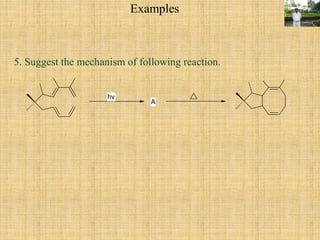
5. Suggest the mechanism of following reaction.
A
hv
Step I is [2+2] cycloaddition reaction forming cyclobutane. It is [2s + 2s] process.
Step II is [3+3] sigmatropic rearrangement reaction called Cope rearrangement proceeds through
six membered cyclic (chair form) transition state.
H
H
hv
A HOMO HOMO
LUMO LUMO
supra-supra antra-antra
node 2, antiaromatic transition state, suprafacial allowed
H
H
H
H
H
H
A
Cyclic chair form six membered
transition state
Claisen Rearrangement
The Claisen rearrangement provides an excellent stereoselective route for the
synthesis of γ,δ-unsaturated carbonyl compounds from allylic alcohols through
allyl vinyl ethers. This reaction involves [3,3]-sigmatropic rearrangement and
takes place through a cyclic six membered transition state. The importance of
this reaction is the formation of carbon-carbon bond due to expense of carbon-
oxygen bond. It is highly stereoselective leading predominantly E-configuration of
the new double bond. The cyclic transition state preferred chair conformation with
the substituent R1 in the less hindered pseudoequatorial position.
O
R1
R2
R1
O
R2
O
R2
R1
(R2 = H, alkyl, OR, OSiR3, NR2)
Heat
The aromatic Claisen rearrangement involves [3,3] sigmatropic rearrangement of allyl
aryl ethers with migration of the allyl group (with allylic transposition) to the ortho position
of the aromatic ring. If ortho-position of the ring is substituted then double rearrangement is
occur and gives para-substituted product instead of ortho-substitution.
Br
CH3
O
OMe
Br
CH3
O
OMe
Br
CH3
OH
OMe0
190 C
decalin
Examples
9. The product formed and the process involved in the following
reaction is - OK
OK
O
O
O
1.
2.
3.
4.
[3,3] sigmatropic rearrangement
[1,3] sigmatropic rearrangement
[5,5] sigmatropic rearrangement
[1,5] sigmatropic rearrangement
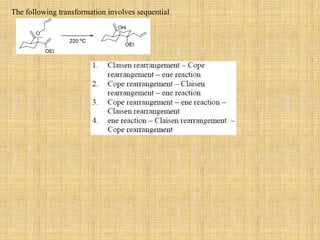
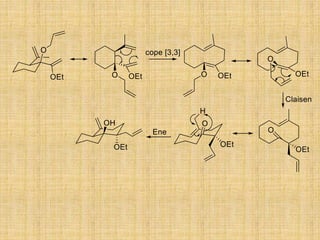
The following transformation involves sequential
CH2
CH2
OK

CH2
CH2
OK
CH2
CH2
OK

OK
O
O
CH2
CH2
OK
CH2
CH2
O
CH2
CH2
O
1
2
3
4
5
1
2
3
4
5
[3,3] sigmatropic rearrangement [5,5] sigmatropic rearrangement
The selection rule for sigmatropic rearrangement is –
The total number of electron involved for the sigma-tropic rearrangement is
(4n +2) electron, then it is thermally suprafacial and photochemically
antrafacial through the aromatic transition state.
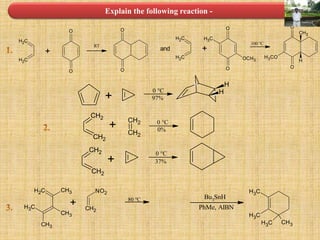
Explain the following reaction -
+
H
H
CH2
CH2
CH2
CH2
+
CH2
CH2
+
0 °C
97%
0 °C
37%
0 °C
0%
CH2
CH2
O
O
+
O
O
RT
CH2
CH2
O
O
CH3
OCH3
+
O
O
H3CO
CH3
H
and
100 °C
CH2 CH3
CH3
CH3
CH3
NO2
CH2
+ 80 °C Bu3SnH
PhMe, AIBN
CH3
CH3
CH3 CH3
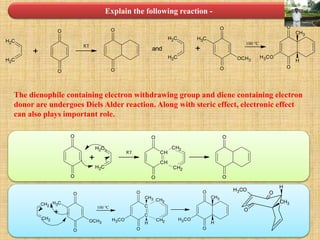
Explain the following reaction -
CH2
CH2
O
O
+
O
O
RT
CH2
CH2
O
O
CH3
OCH3
+
O
O
H3CO
CH3
H
and
100 °C
CH2
CH2
O
O
+
O
O
RT CH
CH
O
O
CH2
CH2
CH2
CH2
O
O
CH3
OCH3
+
O
O
H3CO
CH3
H
100 °C C
C
O
O
CH2
CH2H3CO
CH3
H
H
CH3
O
O
H3CO
The dienophile containing electron withdrawing group and diene containing electron
donor are undergoes Diels Alder reaction. Along with steric effect, electronic effect
can also plays important role.
Explain the following reaction -
+
H
H
CH2
CH2
CH2
CH2
+
CH2
CH2
+
0 °C
97%
0 °C
37%
0 °C
0%
The isolated double bond and diene do not usually take part in intermolecular
Diels Alder reactions, but number of cyclic alkenes ( and alkynes) with
considerable angle strain are reactive dienophiles or dienes. The drawing
force for these reactions is though to be the reduction in angle strain
associated with the transition state for the addition.
Explain the following reaction -
CH2 CH3
CH3
CH3
CH3
NO2
CH2
+ 80 °C Bu3SnH
PhMe, AIBN
CH3
CH3
CH3 CH3
CH3
CH3
CH3
CH3
HSteric
repulsion
CH2
-
CH3
CH3
CH2
CH3
H
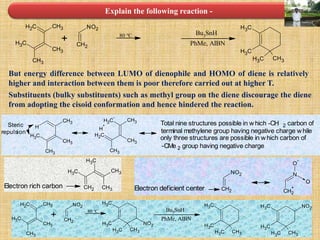
+ Total nine structures possible in which -CH 2 carbon of
terminal methylene group having negative charge while
only three structures are possible in which carbon of
-CMe 2 group having negative charge
CH2
CH3
CH3
CH3
CH3
Electron rich carbon
NO2
CH2
N
CH2
+
O
-
O
Electron deficient center
But energy difference between LUMO of dienophile and HOMO of diene is relatively
higher and interaction between them is poor therefore carried out at higher T.
Substituents (bulky substituents) such as methyl group on the diene discourage the diene
from adopting the cisoid conformation and hence hindered the reaction.
CH2 CH3
CH3
CH3
CH3
NO2
CH2
+
80 °C Bu3SnH
PhMe, AIBN
CH3
CH3
CH3 CH3
CH3
CH3
CH3 CH3
NO2
CH3
CH3
CH3 CH3
NO2
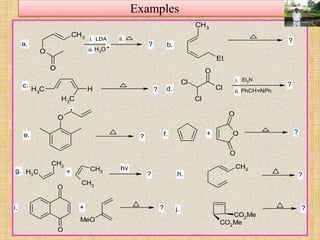
Examples
H3
OO
CH3
O
CH3
Et
CH3
H
CH3
O
Cl
Cl
Cl
Et3N
PhCH=NPh
O
O
O
O
CH3
CH3
CH3
CH3
CH3
CO2Me
CO2Me
O
O
MeO
+
i. ii.
iii.
i.
ii.
LDA
a.
c.
b.
d.
?
?
?
?
?e. f. ?+
*
g. h.
i.
? ?
?
hv
j. ?
+
+
Pericyclic reactions

Pericyclic reactions

  • 2.
    By Bapu R. Thorat M.Sc.SET. NET. MS-CIT Assit. Professor Dept of Chemistry &Dept of Biotechnology, Governmentof Maharashtra, IsmailYusufCollegeofArts,ScienceandCommerce,Jogeshwari (East), Mumbai-60 Pericyclic Reactions
  • 3.
    Chemical reactions Bond formationor breaking Intermediate Ionic intermediates such as cation, anion, ion pair, etc. Free radical intermediate Transition State formation Electrophilic - cation Nucleophilic - anion Pericyclic reactions Rearrangements Free radical reactions Thermal Photochemical
  • 4.
    Transition State formation Pericyclic Reactions Chemicalreaction MechanismFree radical intermediate Ionic intermediates such as cation, anion, zwitter ion, etc 1. Proceeds in single cyclic transition state. 2. Reactions not influenced by any solvent, reagent, structural changes, catalysts, etc. 3. These are highly stereospecific in nature. 4. These reactions are initiated either by heat or light. Such class of reactions are called as pericyclic reactions. Reactions are either carried out thermally or photochemically. The chemical reaction in which starting material is converted into a single stereo-isomeric product is called as stereospecific or regiospecific reaction. Factors – solvent, Catalyst, reagent, Structural changes Not influenced Source of energy Heat Light
  • 5.
  • 6.
    Pericyclic Reactions Pericyclic reactions(pericyclic means shifting of electrons around the circle) are first explained by the scientist Hoffman and Woodward in 1965. Sigmatropic rearrangement Ene reactionsCycloaddition reactions Electrocyclic reactions- Ring closer and ring opening Pericyclic reactions Photochemical Reactions Activated by radiation energy Thermal Reactions Activated by heat activated molecule The chemistry of activated molecule in thermal and photochemical reactions is totally different. - different products are obtained.
  • 7.
    Pericyclic Reactions +2 hv Ketonic Sensitizer Cis-Trans- 2 activated molecule Pericyclic Reactions Electrons and molecular orbitals takes part in reaction LUMO Bonding molecular orbitals Anti-Bonding molecular orbitals HOMO Process Thermal Photochemicall From mixture – one
  • 8.
    Molecular orbital symmetry Molecularorbitals ψ Antibonding molecular orbitals having higher energy & are empty at G.S. Bonding molecular orbitals having lower energy & contains electrons in G.S. 1. Mirror plane symmetry (m): A and C 2. (C2) axis of symmetry: B and D CH2CH2 buta-1,3-diene CH2 CH2 (Bonding MO) (Antibonding MO) B C D A
  • 9.
    1. Mirror planesymmetry (m) is a plane passing through the center of the molecular orbital and perpendicular to the molecular orbital axis, it bisect the molecular orbital in two parts, one part is mirror image of other part. It is maintained by Dis rotatory process. 2. (C2) axis of symmetry is assume to present if the rotation of the molecular orbital around the axis by 1800 (360/2) gives raise to another orbital, then reflect it across a plane perpendicular to the axis. It is maintain by con rotatory process. C2 axis of symmetry C2 Plane of symmetry Bonding pi-orbital Anti-Bonding pi-orbital C2 axis of symmetry Plane of symmetry Sigma-bond Orbitals M C2 π S A π* A S σ S S σ* A A
  • 10.
  • 11.
    Molecular orbital symmetry 1,3-butadiene,total number of molecular orbitals are 4- π1, π2, π2*, π1* where π1 and π2 are bonding and π2*and π1* are antibonding molecular orbitals. They are also denoted as- (ψ1, ψ2, ψ3 and ψ4). 1,3,5-hexatriene, total number of molecular orbitals are six i.e. π1, π2, π3, π3*, π2*, π1* where π1, π2 and π3 are bonding and π3*, π2*and π1* are antibonding molecular orbitals. They are also denoted as- (ψ1, ψ2, ψ3, ψ4, ψ5 and ψ6) Orbitals ψ1 ψ2 ψ3 ψ4 M S A S A C2 A S A S Orbital ψ1 ψ2 ψ3 ψ4 ψ5 ψ6 M S A S A S A C2 A S A S A S
  • 12.
    Node When we movein molecular orbital, the sign of the orbital change (above the plane or consider all orbitals below the plane) is called as node. For a linear conjugated π-system the wave function ψn will posses (n-1) nodes.  If (n-1) is zero or even integer, ψn will be said to be symmetric with respect to m and antisymmetric with respect to C2.  If (n-1) is an odd integer ψn will posses the C2 axis of symmetry and antisymmetric with respect to m. Node = 0 Node = 1 Node = 2 Node = 3 ψ1 ψ2 ψ3 ψ4
  • 13.
    Pericyclic Reactions Electrocyclic reactions-Process in which two π bonds convert into one π & one σ bond and vice versa. Ring opening- Ring closer- Two atomic orbitals forming a σ-bond may be rotating in opposite directions, one in clockwise and other in anticlockwise manner is called as dis-rotatory process Two atomic orbitals forming a σ-bond may be rotating in same direction either in clockwise or anticlockwise manner is called as con-rotatory process. dis ratatory con rotatory If the substitutions are present on the rotating carbons also rotate in same direction
  • 14.
    Frontier Molecular Orbital[FMO] Method Molecular orbital model for analyzing pericyclic reactions has been proposed by Kenichi Fukui of Japan. The correlation diagram is useful for the detail analysis of an Electrocyclic reactions. A B C D X Y W Z CH2CH2 A B C D X Y W Z Bonding MO Antibonding MO Mirror (m) of symmetry C2 axis of symmetry A S A S A S A S A B C D X Y W Z A S A S A S A S 1,3-butadiene cyclobutene
  • 15.
  • 16.
    Frontier Molecular Orbital[FMO] Method The correlation diagram is useful for the detail analysis of an Electrocyclic reactions. A similar conclusion is obtained by considering the symmetry of highest occupied molecular orbital [HOMO] of open chain partner in Electrocyclic reactions. If the HOMO having C2-axis of symmetry (node is odd), then reaction will follow con- rotatory path. If HOMO posses a mirror plane symmetry (node is zero or even number), a reaction will follows dis-rotatory path. Thermal Reactions Transition State Configurational Preference 4n + 2 (aromatic) Disrotatory 4n (antiaromatic) Conrotatory Photochemical Reactions Transition State Configurational Preference 4n + 2 (aromatic) Conrotatory 4n (antiaromatic) Disrotatory
  • 17.
    Frontier Molecular Orbital[FMO] Method A similar conclusion is obtained by considering the symmetry of highest occupied molecular orbital [HOMO] of open chain partner in Electrocyclic reactions. A B C D X Y W Z CH2CH2 A B C D X Y W Z Bonding MO Antibonding MO Mirror (m) of symmetry C2 axis of symmetry A S A S A S A S A B C D X Y W Z A S A S A S A S Thermal HOMO Con-rotatory
  • 18.
    Frontier Molecular Orbital[FMO] Method A similar conclusion is obtained by considering the symmetry of highest occupied molecular orbital [HOMO] of open chain partner in Electrocyclic reactions. A B C D X Y W Z CH2CH2 A B C D X Y W Z Bonding MO Antibonding MO Mirror (m) of symmetry C2 axis of symmetry A S A S A S A S A B C D X Y W Z A S A S A S A S Photochemical HOMO Dis-rotatory
  • 19.
    Process Total ElectronsT.S. Symmetry HOMO Node Process allowed hυ 4 Antiaromatic m ψ3 2 Dis Process Total Electrons T.S. Symmetry HOMO Node Process allowed ∆ 4 Antiaromatic C2 ψ2 1 Con
  • 20.
    Process Total ElectronsT.S. Symmetry HOMO Node Process allowed 6 Aromatic m ψ3 2 Dis Process Total Electrons T.S. Symmetry HOMO Node Process allowed hv 6 Aromatic C2 ψ4 3 Con ∆
  • 21.
    Examples Process Total numberof electrons T.S. HOMO node symmetry process allowed Process Total number of electrons T.S. HOMO node symmetry process allowed Process Total number of electrons T.S. HOMO node symmetry process allowed
  • 22.
    Examples 7. Suggest themechanism of following reaction. D D DD
  • 23.
    D D D D D DIt iselectrocyclic ring opening reaction. Process Total ele HOMO Node Symmetry Process allowed Thermal 4 ψ2 1 C2 Con DD D D
  • 24.
    Examples 8. In thefollowing concerted reaction, the product is formed by a-. H H 1. 6-pi disrotatory electrocyclisation 2. 4-pi disrotatory electrocyclisation 3. 6-pi conrotatory electrocyclisation 4. 4-pi conrotatory electrocyclisation
  • 25.
    Process Total electronsHOMO Node Symmetry Process allowed Thermal 6 ψ3 2 m Dis The triene skeleton of cyclo octatetraene undergoes electrocyclic ring closer reaction. The total number of electrons takes part in the reaction are 6, therefore HOMO of the reaction is ψ3. The node of reaction is 02, therefore m plane of symmetry is maintained. The m (plane of symmetry) has been maintained by dis-rotation. Process Total electrons HOMO Node Symmetry Process allowed Thermal 4 ψ2 1 C2 Con  con rotation H H dis rotation H H
  • 26.
    The major productformed by photochemical reaction of (2E,4Z,6E)-decatriene is -
  • 28.
    The major productformed by the following reaction of
  • 29.
    Cycloaddition Reactions It isclass of pericyclic reactions in which the system having mπ electrons is added into the system having nπ electrons forming cyclic product. It is versatile route for the synthesis of cyclic compounds having high degree of stereo selectivity under thermal and photochemical reaction conditions. Depending on the number of π electrons taking part in the reaction, is called as (m+n) or (m+n+….) Cycloaddition reactions. Or A concerted combination of two π-electron systems to form a ring of atoms having two new σ bonds and two fewer π bonds is called a cycloaddition reaction.
  • 30.
    Cycloaddition Reactions In cycloadditionreactions, addition of two systems having double bonds take- place either in same or opposite side of the system. Such mode of addition is very important to decide the stereo chemistry of product. These different numbers of modes are named as suprafacial (on the same side) and antrafacial (on the opposite side). This specification is usually carried out by keeping a suitable subscript (s or a) after the number referring to the pi-components. E.g. The Diels-Alder reaction is also called as (4s+2s) cycloaddition. [suprafcial] [antrafacial] R R R R H H + heat (4s+2s)
  • 31.
    Frontier Molecular Orbital[FMO] Method [Cycloaddition Reactions] A cycloaddition reaction is allowed or not which can be found to depends on the symmetry properties of the highest occupied molecular orbital (HOMO) of one reactant and the lowest unoccupied molecular orbital (LUMO) of other molecule. The favorable interaction can be predicted from the sign of HOMO and LUMO. e.g. During Cycloaddition of ethylene to cyclobutane (2s+2s) addition is thermally forbidden because lopes of HOMO of one ethylene molecule and that of other LUMO of another ethylene molecule are not having corresponding similar signs, it (2a+2s) thermally allowed. But when one ethylene molecule is irradiated, on electron get excited to excited state (antibonding molecular orbital) which is now become HOMO which is then correlated to LUMO of other unexcited ethylene molecule. Therefore, it is photochemically (2s+2s) allowed. HOMO LUMO HOMO of excited state. LUMO of unexcited state. (2s + 2s) (Ground state) [ , forbidden] (Excited state) [ hv, allowed]
  • 32.
    Frontier Molecular Orbital[FMO] Method [Cycloaddition Reactions] In Diels-Alder reaction as sign of the 1,4-lopes of butadiene HOMO have been found to be matching those in the LUMO of ethylene. The (4s+2s) addition is thermally allowed and photochemically forbidden whereas (4a+2s) or (4s+2a) is photochemically allowed and thermally forbidden. The Diels-Alder reaction of cyclpentadiene to forming dicyclopentadiene. Invariably, the endo-dimer is formed rather that exo-dimer because of favorable secondary force due to interaction of frontier orbitals of diene and dienophile compounds which leads to lower the energy of the transition. (4s + 2s, , allowed) (4s + 2s, , allowed) (4s + 2a or 4a + 2s, hv , allowed) HOMO LUMO HOMO + LUMO (endo form) (exo form)
  • 33.
    Cycloaddition Reactions The mostcommon cycloaddition reaction is the [4π+2π] cyclization known as the Diels- Alder reaction in which cyclic product is formed from alkene and a diene. The stereochemistry of the substituent attached to double bonded carbon atom is maintained. The diene containing electron donating group while dienophile containing electron withdrawing groups are easily undergo (4+2) cycloaddition reaction. O O O CN CNNC NC O O O CN CNNC NC + + (4+2) cycloaddition (2+2+2) cycloaddition + one step mechanism + or+ - . two step mechanism zwitterions diradicals
  • 34.
  • 35.
    The diene containingelectron donating group while dienophile containing electron withdrawing groups are easily undergo (4+2) cycloaddition reaction.
  • 36.
    Electron-donating and -withdrawing substituents in the product are arranged in pseudo- ortho and pseudo-para positions to each other.
  • 37.
    Orbital interactions lower energyof TS more stable exo isomer Thermodymic control endo product – Kinetic control More steric interactions Thermodymic control Kinetic control
  • 38.
    SO2 CH3 CH3 CH3 CH3  SO2 CH3 CH3 CH3 CH3  CH3 CH3 SO2 SO2+ LUMO HOMO Example The reactioncontaining 8 electrons therefore occurs with a conrotatory motion into triene termini. If the cheletropic reaction is linear, i.e. if the HOMO of SO2 reacts suprafacially as it does in the case of dienes, the triene must react antrafacially, which is consistent with the observed conrotation.
  • 39.
    Examples 1. The concertedphotochemical reaction between two olefins leading to a cyclobutane ring is- a. π2 s + π2 a cycloaddition. b. π2 s + π2 s cycloaddition. c. σ2 s + σ2 s cycloaddition. d. π2 s + σ2 a cycloaddition. HOMO HOMO LUMO LUMO supra-supra antra-antra
  • 40.
    It is example(2+2) cycloaddition reaction. It is photochemical process, therefore consider first excited state (LUMO) of first olefine is HOMO which is then correlated to LUMO of second olefine (unexcited form). Therefore answer is (b). HOMO HOMO LUMO LUMO supra-supra antra-antra
  • 41.
    Examples 2. The intermediateA and the major product B in the following conversion are- NH2 COOH NaNO2 /HCl A B NH2 1. A is carbocation and B is 2. A is carbanion and B is 3. A is free radical and B is 4. A is benzyne and B is
  • 42.
    It is combinationof two reactions- Benzyne formation and Diel’s Alder reaction. The anthranilic acid undergoes diazotizing followed by decarboxylation forming benzyne. It shows [4+2] cycloaddition reaction [Diel’s Alder reaction] forming cyclic product (4). NH2 COOH NaNO2 ClH HNO2 NaCl HNO2 N2 Cl COOH O O H N2 Cl + + + A + [4+2] cycloaddition rea. Diel's Alder reaction B
  • 43.
    Examples 3. The structuresof the major products X and Y in the following transformation are- O + hv X Y O O O O O O O O O 1. 2. 3. 4. X = Y = X = Y = X = Y = X = Y =
  • 44.
    During Diel’s Alderreaction between cyclic diene and substituted dienophile forming endo product rather than exo because of favorable secondary force due to interaction of frontier orbitals of diene and dienophile compounds which leads to lower the energy of the transition (3). The X further undergoes photochemical [2+2] cycloaddition reaction of alkene and carbonyl group (Paterno-Buchi reaction) forming oxetane [four membered cyclic ether].
  • 45.
    Example 6. Suggest themechanism of following reaction. O O COOMe COOMe MeOOC COOMe + ? ?
  • 46.
    O O COOMe O O COOMe +Step I HOMO LUMO Totalelectrons - 6, node- 2, Aromatic T.S., Supra-supra process allowed O O COOMe COOMe COOMe CO2 or It is electrocyclic ring opening reaction.Step II COOMe MeOOC COOMe COOMe COOMe +orStep III. It is [4+2] cycloaddition reaction called Diel's Alder reaction. The substituent on dienophile is endo when using cyclic diene.
  • 47.
    The major productformed in the following reaction is -
  • 48.
    T.S. of 1,3 - not formed because alkyl and ester groups are trans together - stereochemistry does not change during cycloaddition reaction
  • 49.
    Sigmatropic Rearrangement Many thermaland photochemical rearrangements are known which involve the shifting of a σ-bond flanked by one or more π-electron systems to a new position [i,j] with in the molecule. It is an uncatalyzed intramoleculer process. This rearrangement involve shifting of the σ-bond, hence called as sigmatropic rearrangement of the order [i,j]. The i and j are two number set in the square bracket and the numbering of system is done by starting with atoms from which the migration of the σ-bond started. In some rearrangements, the migrating σ-bonds lie between two conjugated bond systems. e.g. Cope & Claisen rearrangements. R1 R1 R1 R1 e.g. 1. 2. [1,3] shift [1,5] shift X X 1 2 3 1' 2' 3' (3,3) shift (X - C<, O)
  • 50.
    Sigmatropic Rearrangement Suprafacial andAntrafacial processes In sigmatropic rearrangement, the σ-bond migrates across the π-bonds through the two different stereo-chemical sources.  Migrated σ-bond gets moved across the same face of the conjugated system, suprafacial process migrating σ-bond get reformed on the opposite π-electron face of the conjugated system, antrafacial process i.e. migrating group migrate at opposite face of the conjugated system. e.g. [1,5] sigmatropic shift shows both these stereo-chemical consequences as- BA A B H C D H C D BA A B HC D H C D suprafacial antrafacial As lengthing of the migrating system increases, antrafacial shift also increases. The antrafacial [1,3] shift is thermally impossible.
  • 51.
    FMO Methods (SigmatropicRearrangement) The analysis of the sigmatropic rearrangement shows that the migrating bond gets cleaved homolytically resulting pair of radicals. The migrating group get migrates over the HOMO’s of the conjugated system. e.g. Analysis of suprafacial [1,5] sigmatropic shift of hydrogen in which the homolytic cleavage gives rise to the production of hydrogen atom and pentadienly radical. The ground state electronic configuration of pentadienly radical is ψ1 2ψ2 2ψ3 1 and HOMO is ψ3 1 of this radical possess same sign on the terminal lopes (plane symmetry). Therefore thermally [1,5] migration is suprafacially allowed. H H H H 3
  • 52.
    FMO Methods (SigmatropicRearrangement) The first excited state electronic configuration of pentadienly radical is ψ1 2ψ2 2ψ4 1 and HOMO is ψ4 1 of this radical possess opposite sign on the terminal lopes (C2 axis of symmetry). Therefore photochemically [1,5] migration is antrafacially allowed. ψ1 2ψ2 2ψ3 1 ψ4 0ψ5 0 → ψ1 2ψ2 2ψ3 0 ψ4 1ψ5 0 Ground state Excited state A similar analysis shows that, for the system [i,j] possess i+j=4n+2 electrons, the thermal reaction should be suprafacial and photochemical process should be antrafacial but for those cases i+j=4n, the thermal reaction should be antrafacial and photochemical process should be suprafacial. These rules are summarized as follow- i+j Δ-allowed hυ-allowed 4n antrafacial suprafacial 4n+2 suprafacial antrafacial H H H 4
  • 53.
    Examples 4. Suggest themechanism of following reaction. O O
  • 54.
    O O O H O Ans: 1,5-carbon sigmatropic shift 1,5-hydrogen sigmatropic shift 3 HOMO H 1,5-sigmatropicHydrogen shift 3 HOMO C 1,5-sigmatropic Carbon shift Process Total Electrons HOMO Node T.S. Process allowed 6 ψ3 2 Aromatic Suprafacial
  • 55.
    A concerted [1,3]-sigmatropicrearrangement took place in the reaction shown below. The structure of the resulting product is
  • 56.
    FMO Methods No. ofelectrons involved No. of nodes Type of transition state Δ-allowed hυ-allowed 4n Zero or even Antiaromatic - Dis 4n Odd Aromatic Con - 4n+2 Zero or even Aromatic Dis - 4n+2 Odd Antiaromatic - Con No. of electrons involved No. of nodes Type of transition state Δ-allowed hυ-allowed 4n Zero or even Antiaromatic - Supra-supra Antra-antra 4n Odd Aromatic Supra-antra Antra-supra - 4n+2 Zero or even Aromatic Supra-supra Antra-antra - 4n+2 Odd Antiaromatic - Supra-antra Antra-supra No. of electrons involved No. of nodes Type of transition state Δ-allowed hυ-allowed 4n Zero or even Antiaromatic - supra 4n Odd Aromatic Antra - 4n+2 Zero or even Aromatic supra - 4n+2 Odd Antiaromatic - antra Cycloaddition addition Electrocyclic reaction Sigmatropic rearrangement
  • 57.
    Ene Reaction The joiningof a double or triple bond to an alkene reactant having transferable allylic hydrogen is called an ene reaction. The allylic hydrogen undergoes 1,5-migration with change in the position of the allylic double bond. Like Diels Alder reaction, it is also 6π electron electrocyclic reaction, but here two electrons of the allylic C-H σ- bond takes the place of two π- electrons of the diene in Diels Alder reaction. H X Y H X Y X Y H + X=Y - C=C, C=O, C=S, N=O, N=N, etc.
  • 58.
    Cope Rearrangement The 1,5-dienesisomerizes {[3,3] rearrangement} on heating up to 3000C. Reaction is normally reversible and gives mixture of starting material and product. The position of equilibrium is depends on the stability of the starting material and the products. The temperature needed for the reaction is depends on the substituents and relative strain of the double bonds of 1,5-system. If the substituent R is attached to double bonded carbon then energy of the transition state is lowered and reaction occurs at 165 – 1850C. 1 2 3 1 2 3 ' ' ' [3,3] rearrangement OH OH O 1 2 3 1 2 3' ' ' [3,3] rearrangement O O O H 1 2 3 1 2 3' ' ' [3,3] rearrangement + OH O OH O H H 1 2 3 1 2 3 ' ' ' [3,3] rearrangement4. 5. [3,3] rearrangement 6. [3,3] rearrangement 100% 90% 98% 150 C, 1hr 320 C KH, THF, reflux 18 hrs. 0 0
  • 59.
    Cope Rearrangement A commonexample of Cope rearrangement involving [3,3] sigmatropic rearrangement in 1,5-diene (meso-3,4-dimethyl-1,5-hexadiene) on heating (pyrolysis) giving exclusively cis,trans-isomer of 2,6-octadiene. This reaction proceeds through six membered six electron transition state. CH3 CH3 CH3 CH3 CH3 CH3 CH3 CH3 meso-3,4- dimethyl-1,5- hexadiene Z,E-2,6-octadiene E Z Bu-n Bu-n Bu-n 15 C 0 CH3 CH3 CH3 OH CH3 O CH3 CH3 CH3 CH3 CH3 OHC KH, THF, RT 18-crown-6 CH3 CH3 CH3 OH CH3 O CH3 CH3 CH3 CH3 CH3 OHC KH, THF, RT 18-crown-6
  • 60.
    Examples 5. Suggest themechanism of following reaction. A hv
  • 61.
    Step I is[2+2] cycloaddition reaction forming cyclobutane. It is [2s + 2s] process. Step II is [3+3] sigmatropic rearrangement reaction called Cope rearrangement proceeds through six membered cyclic (chair form) transition state. H H hv A HOMO HOMO LUMO LUMO supra-supra antra-antra node 2, antiaromatic transition state, suprafacial allowed H H H H H H A Cyclic chair form six membered transition state
  • 62.
    Claisen Rearrangement The Claisenrearrangement provides an excellent stereoselective route for the synthesis of γ,δ-unsaturated carbonyl compounds from allylic alcohols through allyl vinyl ethers. This reaction involves [3,3]-sigmatropic rearrangement and takes place through a cyclic six membered transition state. The importance of this reaction is the formation of carbon-carbon bond due to expense of carbon- oxygen bond. It is highly stereoselective leading predominantly E-configuration of the new double bond. The cyclic transition state preferred chair conformation with the substituent R1 in the less hindered pseudoequatorial position. O R1 R2 R1 O R2 O R2 R1 (R2 = H, alkyl, OR, OSiR3, NR2) Heat The aromatic Claisen rearrangement involves [3,3] sigmatropic rearrangement of allyl aryl ethers with migration of the allyl group (with allylic transposition) to the ortho position of the aromatic ring. If ortho-position of the ring is substituted then double rearrangement is occur and gives para-substituted product instead of ortho-substitution. Br CH3 O OMe Br CH3 O OMe Br CH3 OH OMe0 190 C decalin
  • 63.
    Examples 9. The productformed and the process involved in the following reaction is - OK OK O O O 1. 2. 3. 4. [3,3] sigmatropic rearrangement [1,3] sigmatropic rearrangement [5,5] sigmatropic rearrangement [1,5] sigmatropic rearrangement
  • 64.
    The following transformationinvolves sequential
  • 66.
    CH2 CH2 OK  CH2 CH2 OK CH2 CH2 OK  OK O O CH2 CH2 OK CH2 CH2 O CH2 CH2 O 1 2 3 4 5 1 2 3 4 5 [3,3] sigmatropic rearrangement[5,5] sigmatropic rearrangement The selection rule for sigmatropic rearrangement is – The total number of electron involved for the sigma-tropic rearrangement is (4n +2) electron, then it is thermally suprafacial and photochemically antrafacial through the aromatic transition state.
  • 67.
    Explain the followingreaction - + H H CH2 CH2 CH2 CH2 + CH2 CH2 + 0 °C 97% 0 °C 37% 0 °C 0% CH2 CH2 O O + O O RT CH2 CH2 O O CH3 OCH3 + O O H3CO CH3 H and 100 °C CH2 CH3 CH3 CH3 CH3 NO2 CH2 + 80 °C Bu3SnH PhMe, AIBN CH3 CH3 CH3 CH3
  • 68.
    Explain the followingreaction - CH2 CH2 O O + O O RT CH2 CH2 O O CH3 OCH3 + O O H3CO CH3 H and 100 °C CH2 CH2 O O + O O RT CH CH O O CH2 CH2 CH2 CH2 O O CH3 OCH3 + O O H3CO CH3 H 100 °C C C O O CH2 CH2H3CO CH3 H H CH3 O O H3CO The dienophile containing electron withdrawing group and diene containing electron donor are undergoes Diels Alder reaction. Along with steric effect, electronic effect can also plays important role.
  • 69.
    Explain the followingreaction - + H H CH2 CH2 CH2 CH2 + CH2 CH2 + 0 °C 97% 0 °C 37% 0 °C 0% The isolated double bond and diene do not usually take part in intermolecular Diels Alder reactions, but number of cyclic alkenes ( and alkynes) with considerable angle strain are reactive dienophiles or dienes. The drawing force for these reactions is though to be the reduction in angle strain associated with the transition state for the addition.
  • 70.
    Explain the followingreaction - CH2 CH3 CH3 CH3 CH3 NO2 CH2 + 80 °C Bu3SnH PhMe, AIBN CH3 CH3 CH3 CH3 CH3 CH3 CH3 CH3 HSteric repulsion CH2 - CH3 CH3 CH2 CH3 H + Total nine structures possible in which -CH 2 carbon of terminal methylene group having negative charge while only three structures are possible in which carbon of -CMe 2 group having negative charge CH2 CH3 CH3 CH3 CH3 Electron rich carbon NO2 CH2 N CH2 + O - O Electron deficient center But energy difference between LUMO of dienophile and HOMO of diene is relatively higher and interaction between them is poor therefore carried out at higher T. Substituents (bulky substituents) such as methyl group on the diene discourage the diene from adopting the cisoid conformation and hence hindered the reaction. CH2 CH3 CH3 CH3 CH3 NO2 CH2 + 80 °C Bu3SnH PhMe, AIBN CH3 CH3 CH3 CH3 CH3 CH3 CH3 CH3 NO2 CH3 CH3 CH3 CH3 NO2
  • 71.