REACTION INTERMEDIATES
By
Dr. G. Krishnaswamy
Faculty
DOS & R in Organic Chemistry
Tumkur University
Tumakuru
REACTION INTERMEDIATES
 A reaction intermediate or an intermediate molecular entity (atom, ion,
molecule..) with a lifetime appreciably longer than a molecular vibration that is
formed (directly or in directly) from the reactants and reacts further to give
(either directly or indirectly) the products of a chemical reaction.
 Examples of reactive intermediates are carbocations, carbanions, reactive
oxygen species (including hydroxyl radical, superoxide radical anion, and
hydroperoxyl radical), carbenes and nitrenes. Study of these transient species
not only provide detailed understanding of the potential energy surface for the
specific reaction, but also find numerous applications in fields such as organic
synthesis, photo-lithography, photo-crosslinking and photoaffinity labeling.
 Potential energy surfaces (PES) for the hypothetical reaction A + B → D, via two different
pathways is shown in the figure. The upper surface indicates the formation of a metastable
complex [A--B]≠, known as the transition state, which is a saddle point in the PES. The
lower surface shows that a transient species C is formed through a transition state TS-1,
which yields the product D, via transition state TS-2. Species C is an example of a reactive
intermediate.
 Low concentration
 Does not obey the Lewis octet rule with the exception of carbanioins, hence the high
reactivity
 Often generated on chemical decomposition
 It is often possible to prove the existence of this species by spectroscopic means
 Often stabilization by conjugation or resonance
 Often difficult to distinguish from a transition state
 Prove existence by means of chemical trapping
Common Features
Main carbon reactive intermediates:
Carbocations and their stabilized equivalents such
as oxonium ions.
Carbanions and their stabilized equivalents such as
enolates.
Carbenes
Free radicals
Nitrenes and
 Nitrenium ions.
Beginning in the 1920s much evidence began to accumulate implicating simple
alkyl cations as intermediates in a variety of ionic reactions. However, because
alkyl cations are highly unstable and highly reactive, they were, in all instances
studied before 1962, very short-lived, transient species that could not be
observed directly.* However, in 1962 George A. Olah (University of Southern
California) and co-workers published the first of a series of papers describing
experiments in which alkyl cations were prepared in an environment in which
they were reasonably stable and in which they could be observed by a number of
spectroscopic techniques.
A carbocation is an ion with a positively-charged carbon atom.
Carbenium ion (trivalent positive
species) CH3, C2H5
Carbonium ion (pentavalent
positive species, non classical
carbocation)
Carbocation
Generation of carbocation
1) Heterolytic fission of neutral species or direct ionization
The group attached to the carbon departs with its bonding electrons to form an
ion pair.
R OH + H
+
R O
+
H
H R + H2O
+
R O R1+ H
+
R O
+
H
R1 R +
+
OHR1
R NH2 + H
+
R N
+
H
H
H
R + NH3
+
R SH + H
+
R S
+
H
H R + SH2
+
2) Addition of a positive species to an unsaturated system
O
R
R
H
+
C
+
OH
R
R
+
CH2 CH2 + H
+
CH3 CH2
+
O
RR + CH3 F BF3
O
+
CH3
R
R
+ BF4
_
R R O
CH3
++
By the addition of a cation to a neutral molecule
10
3) By the heterolysis of alkyl diazonium salt
R N2
+
R
+
N2+
R R R R R R
R R
+ +
-e
-e
+
.
.
.
+
4) By the removal of an electron from a neutral molecule or a free radical
In solution, the carbocation may be free (this is more likely in polar
solvents, in which it is solvated) or it may exist as an ion pair. Ion
pairs are more likely in nonpolar solvents.
A. Simple alkyl carbocations
Stability: tertiary > secondary > primary
The electron-donating effect of alkyl groups increases the electron density at the charge-
bearing carbon, reducing the net charge on the carbon, and in effect spreading the charge
over the α carbons.
:
CH3
+
CH3 CH2
+
CH
+
CH3CH3 C
+
CH3CH3
CH3
+I effect
Tertiary carbocations are more stable (and form more readily) than secondary
carbocations; primary carbocations are highly unstable because, while ionized higher
order carbons are stabilized by hyperconjugation, unsubstituted (primary) carbons are
not.
:
• +R groups stabilize the carbocations
CH3 O CH2
+
CH3 O
+
CH2
CH2
+
CH
+
CH2
CH
+
CH2
CH
+
CH2 CH2
+
R
CH2
+
R CH
+
CH2
CH2
+
CH2
+
CH2
• Some carbocations are stabilized due to aromatization.
+
+
Cyclopropenyl cation is stable due to aromatization
 Combination with a nucleophile
R
+
cation act as an electrophile to react with nucleophiles.
Carbocations are found to undergo four basic types of reaction
1) Combination with a nucleophile
2) Elimination of a proton
3) Addition to an unsaturated linkage
4) Rearrangement
H
C
+
H
R
R
R R
R R
R
H
+
+
 Elimination of a proton
Some carbocations act as Bronsted acid to lose a proton .
 Carbocation rearrangement
• Rearrangement without change in carbon skeleton
1-propyl cation reaarnged to 2-propyl cation by the migration of a
hydrogen atom with its electron pair i.e 1,2-hydride shift
• Rearrangement with change in carbon skeleton
Neopentyl rearrangement hydrolysis of 1-bromo-2,2-
dimethylpropane (neopentyl bromide)
C CH2BrMe
Me
Me
C CH2Me
Me
Me
C
H2
C
Me
Me
Me
C
H
C
Me
Me
Me
-H+
C CH2OHMe
Me
Me
X
H2O
Non-classical ions are a special type of carbonium ions displaying
delocalization of sigma bonds in 3-center-2-electron bonds of
bridged systems.
S. Winstein (1949): Acylation (solvoysis) of norbornyl brosylate
In a Non-classical carbocations, the positive charge is delocalized
by a double or triple bond that is not in the allylic position or by a
single bond.
• Formation of carbocation can be detected by NMR spectroscopy as
the cation formation shifts the proton signals appreciably downfield
due to deshielding of protons. For example;
F
CH3
CH3
CH3
SbF5
C
+
CH3
CH3
CH3 SbF6
-
21
• A carbanion is an anion in which carbon has an unshared
pair of electrons and bears a negative charge usually with
three substituents for a total of eight valence electrons.
• Formally a carbanion is the conjugate base of a carbon acid.
• Stable carbanions do however exist although in most cases
they are reactive.
• Olmstead(1984):
• A group attached to a carbon leaves without its electron pair.
• A negative ion adds to a carbon-carbon double or triple bond.
• Strongly reduced metals like Na or Li or Mg can convert alkyl
halide to alkyl sodium or alkyl lithium or Grignard reagent.
R Cl
R Cl
+
+
Li Li R Li Li Cl+
Mg
2+ Mg
ClR
Carboanions often act as a nucleophiles to react with electrophones species.
+ +R CH3 Cl R CH3
Cl
--
R CH2
-
O
+ Br Br R
O
Br + Br
-
• Pyramidal - sp3 hybridised
bond angle 109.28.geometery is thus tetrahedral
• Has eight electrons
• Stabilized by resonance or by inductive effect.
. . sp3 hybrid orbital
containing lone pair
Tetrahedral structure of carboanion
•The efficient generation of a significant equilibrium concentration of
a carbanion requires choice of a proper base.
•The equilibrium will favor carbanion formation only when the
acidity of the carbon acid is greater than that of the conjugate acid
corresponding to the base used for deprotonation.
O
CH3R
+ + H2OOH-
O-
R CH2
Stability of Carbanions
Carbanions are stabilized by a field effect if there is any
heteroatom (O, N or S) connected to the carbanionic carbon,
provided that the hetero atom bears a positive charge in at least one
important canonical form
O
C
-
R
R
CH3
O
-
R
R
CH3
H
-
H
-
H
Cyclopentadienyl carbanion
By resonance
CH3
C H
CH3
CH3
CH3
C
CH3
H
C
CH3
H
3° 2° 1°
By inductive
Electron-donating groups destabilize a carbanion while electron-
withdrawing groups stabilize it.
NO2 3OCH
>

2CH 
2CH
• Carboanions are type of CH3
-
, where the negative charge is not
delocalized, due to conjugation can be distinguished from
their 1H NMR spectra.
• Formation of carbanions can be detected by the UV and
Visible spectra of the different from the starting compounds.
• Trapping of carboanions with an electrophile may also show
their formation of reaction.
• A carbene is a highly reactive species containing a carbon
atom with six valence electrons and having the general
formula RR′C:, practically all having lifetimes considerably
under 1 sec.
• Structure and bonding
the total spin=0
Bond angle=102º
For single
Methylene
the total spin=1
Paramagnetic, may be observed by
electron spin resonance spectroscopy
• Triplet carbenes are generally stable in the gaseous state, while
singlet carbenes occur more often in aqueous media.
• The C-atom in singlet carbene is sp2 - hybridized in which the
spin –paired electrons occupy an sp2 orbital.
• Shape of carbenes is planar.
• Disintegration of diazoalkanes and their analogs, via
photolytic,thermal, or transition metal (Rh, Cu)-catalyzed
routes.
• Base-induced α-elimination
• Carbenes are intermediates in the Wolff rearrangement.
• Carbenes being the electrons-deficient species may take part in
electrophilic aromatic substitution reactions. For eg; in Riemer
–Tiemann reaction.
• Electron paramagnetic resonance spectroscopy(EPRS) can be
used to detect the formation of the triplet carbenes.
• Rotational fine structure of the UV and Visible spectra can
detect the formation of the singlet (bent form) or triplet (linear
form) carbenes.
• π- Insertion reaction also can detect and distinguish the
formation of singlet and triplet.
Reactions of Carbenes and Carbenoids
Four typical reactions
Cyclopropanation: Simon-Smith reaction
Singlet and triplet carbenes exhibit divergent reactivity.
Singlet carbenes generally participate in cheletropic reactions. Singlet carbenes
with unfilled p-orbital should be electrophilic. Triplet carbenes can be
considered to be diradicals, and participate in stepwise radical additions.
Insertion into a C--‐H
Insertion into a N--‐H and O--‐H
Combination with a nucleophile (that have a reactive lone pairs)
1,2-shift rearrangement
A group on the adjacent Carbon migrates to the carbene carbon with its lone pair of
electrons giving an alkene.
Carbenoids (Metal stabilized carbenes)
A transition metal carbene complex is an organometallic compound containing a
divalent organic ligand.
N-heterocyclic carbenes (NHCs)
NHCs are singlet carbenes. Examples of the most frequent NHCs and their
nomenclature
 A nitrene (R-N:) is the nitrogen analogue of a carbene.
 The nitrogen atom has only 6 electrons available and is therefore considered
an electrophile.
 A nitrene is a reactive intermediate and is involved in many chemical
reactions.
NITRENES
From 1,1-elimination reaction
From thermolysis or photolysis of azides and isothcyanates
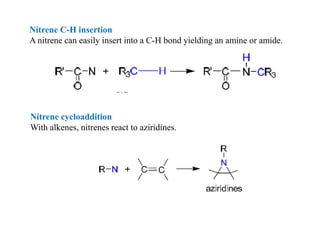
Nitrene C-H insertion
A nitrene can easily insert into a C-H bond yielding an amine or amide.
Nitrene cycloaddition
With alkenes, nitrenes react to aziridines.
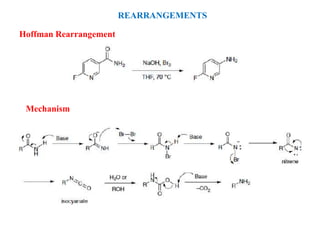
Hoffman Rearrangement
REARRANGEMENTS
Mechanism
Curtius Rearrangement
Mechanism
Lossen Rearrangement
Mechanism
Schmidt Rearrangement
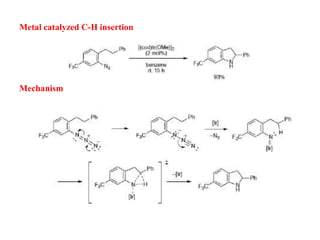
Metal catalyzed C-H insertion
Mechanism
Detection of nitrenes
• Triplet nitrenes can be detected and distinguished from singlet
nitrenes, like carbenes by EPR.
A free radical may be defined as a species that contains one or more unpaired
electrons.
Radicals play an important role in combustion, atmospheric chemistry,
polymerization, plasma chemistry, biochemistry, and many other chemical
processes, including human physiology.
The first organic free radical identified was triphenylmethyl radical, by
Moses Gomberg (the founder of radical chemistry) in 1900.
FREE RADICAL
Alkyl radical intermediates are stabilised by similar criteria as carbocations: the
more substituted the radical center is, the more stable it is.
The stability order for radical: tertiary > secondary > primary
Radicals next to functional groups, such as carbonyl, nitrile, and ether are even
more stable than tertiary alkyl radicals.
STABILITY AND STRUCTURE
PERSISTENT RADICAL Compounds are those whose longevity is due to
steric crowding around the radical center and makes it Physically difficult for
the radical to react with another molecule.
Examples: Gomberg's triphenylmethyl radical
2,2-Diphenyl-1-picrylhydrazyl (DPPH)
2,2,6,6-Tetramethylpiperidine-1-oxyl (TEMPO)
Application of TEMPO: as a radical trap, as a structural probe for biological
systems in conjunction with electron spin resonance spectroscopy, as a reagent
in organic synthesis and as a mediator in controlled free radical synthesis,
polymerization.
THE GENERATION AND FATE OF FREE RADICALS
The formation of radicals may involve breaking of covalent bonds
homolytically, a process that requires significant amounts of
energy.
Homolytic bond cleavage most often happens between two atoms of similar
electronegativity.
Free radicals take part in radical addition and radical substitution as reactive
intermediates.
Chain reactions involving free radicals can usually be divided into three
distinct processes: initiation, propagation, and termination.
Abstraction of another atom or group, usually a hydrogen atom
Addition to a multiple bond
DETECTION OF FREE RADICALS
• By using electron spin resonance (ESR)
• Highly stabilized free radicals may be detected UV and
visible spectroscopy.
• NMR spectroscopy can detect free radicals (by studying the
overhauser effect ).
• The unpaired electron in a free radical is accommodated in a
single occupied molecular orbital(SOMO).
• If the SOMO is a high-energy orbital, the free radical shows a
tendency to loose an electron.
• If the SOMO is a low-energy orbital ,it shows a tendency to
accept an electron.
Ylides
A ylide or ylid is a neutral dipolar molecule containing a formally negatively
charged atom (usually a carbanion) directly attached to a heteroatom (usually
nitrogen, phosphorus or sulphur), with a formal positive charge and in which
both atoms have full octets of electrons.
Ylides are thus 1,2-dipolar compounds
 As the electron-donating ability of substituents bonded to the heteroatom
increases, the stability of the ylide increases and its reactivity decreases.
• As the elctron-withdrawing ability of substituents bonded to the cabanion
increases the stability of the ylide increases and its reactivity
Stability and Reactivity
1. Proton abstraction from the corresponding "onium" salt by a strong base
ex) (C6H5)3P + CH3Br (C6H5)3P CH3
+
Br
-
phosphonium salt
C4H9Li
ether
(C6H5)3P CH2
+
+ LiBr
S
H3C
H3C
O + CH3Br (CH3)3S O
+
Br
-
sulfoxonium salt
NaH
SH3C
CH3
O
CH2 + H2
2. Addition of a carbanion to a vinyl "onium" salt
ex) (C6H5)3P
+
CH CH2
X
-
+ CH3Li
ether
(C6H5)3P
+
CH CH2CH3 + LiX
3. Addition of a carbene to a phosphine
ex) (C6H5)3P + CCl2 (C6H5)3P CCl2
+
+ C4H10
+ NaBr
+
_
_
_
• Proton abstraction from the corresponding onium salt by a strong base
• Addition of a carbanion to a vinyl onium salt
1. Proton abstraction from the corresponding "onium" salt by a strong base
ex) (C6H5)3P + CH3Br (C6H5)3P CH3
+
Br
-
phosphonium salt
C4H9Li
ether
(C6H5)3P CH2
+
+ LiBr
S
H3C
H3C
O + CH3Br (CH3)3S O
+
Br
-
sulfoxonium salt
NaH
SH3C
CH3
O
CH2 + H2
2. Addition of a carbanion to a vinyl "onium" salt
ex) (C6H5)3P
+
CH CH2
X
-
+ CH3Li
ether
(C6H5)3P
+
CH CH2CH3 + LiX
3. Addition of a carbene to a phosphine
ex) (C6H5)3P + CCl2 (C6H5)3P CCl2
+
+ C4H10
+ NaBr
+
_
_
_
• Addition of a carbene to a phosphine
1. Proton abstraction from the corresponding "onium" salt by a strong base
ex) (C6H5)3P + CH3Br (C6H5)3P CH3
+
Br
-
phosphonium salt
C4H9Li
ether
(C6H5)3P CH
+
+ LiB
S
H3C
H3C
O + CH3Br (CH3)3S O
+
Br
-
sulfoxonium salt
NaH
SH3C
CH3
O
CH2 + H2
2. Addition of a carbanion to a vinyl "onium" salt
ex) (C6H5)3P
+
CH CH2
X
-
+ CH3Li
ether
(C6H5)3P
+
CH CH2CH3 + LiX
3. Addition of a carbene to a phosphine
ex) (C6H5)3P + CCl2 (C6H5)3P CCl2
+
+ C4H10
+
+
_
_
_
Formation of phosphorus ylides
One of the most celebrated reactions for converting aldehydes and ketones to
alkenes employs phosphorus ylides.
The driving force is the formation of a strong P=O bond. The reaction
is exothermic.
The phosphorus ylide is sometimes referred to as the Wittig reagent.
Phosphorus ylides are divided into two categories:
Stabilized Ylides
PHOSPHORUS YLIDES
Unstabilized ylides
Preparation of unstabilized phosphorus ylides
Preparation of stabilized phosphorus ylides
SULPHUR YLIDES
The most important sulphur ylides are dimethylsulfonium methylide and
dimethlysulfoxonium methylide.
These ylides are prepared by deprotonation of the corresponding sulfonium
salts, which can be prepared from the reaction of wither dimethylsulphide or
dimethylsulphoxide with methyl iodide.
Sulphur ylides react with saturated aldehydes and ketones to provide epoxides
a) Reaction with a
carbonyl group
R3N CH2
_+
+ CH3 C
O
CH3
H
+
R3N CH2 C
CH3
CH3
OH
+
b) Stevens rearrangement NH3C
CH3
CH3
CH3
+
X
-
strong
base
NH3C
CH3
CH3
CH2
+
X
-
_
NH3C
CH3
CH2CH3
c) Sommelet rearrangement
CH
CH3
N
CH3H3C
CH3
+
strong
base
CH
CH3
N
CH3
CH3
H2C
+
_
CH2
CH
CH3
N(CH3)2
HH
+
transfer
CH2 N(CH3)2
CH2CH3
d) Reac tions of diazo
compounds
CH2 N N
_ +
+ R C
O
R CH2 N N
C
R
RO
+
_
CH2 CR2
O
+ N2
CH2 N N
_ +
+ CCl2 CH2 N N
CCl2
+
Cl2C CH2 + N2
Nitrogen Ylide
Singlet oxygen (1O2) was first observed in 1924 and then defined as a more
reactive form of oxygen. The main method of production of 1O2 is by
photosensitization reactions.
Singlet oxygen
1. Photosensitization method and biologic effect in PDT: The most popular
photosensitizer is Photofrin. Photofrin absorbs in the UV and in the visible
region. Photodynamic Therapy (PDT) using Photofrin is performed by
irradiating at 630 nm regions, because red light most easily penetrate to tissue.
Photofrin, when activated by light, undergoes a chemical reaction, which
produces a cytotoxicity agent, leading to cell death. For most application of
PDT, the cytotoxic agent is produced by one of two different processes called
Type I or Type II.
Generation of singlet oxygen
Both physical and chemical methods can generate singlet oxygen.
Physical methods
2. Another physical method is microwave or radiofrequency discharge that
generates up to 10% concentration of singlet oxygen (1Δg) in an oxygen
atmosphere.
Several chemical methods can generate 1O2. One of the biologically
singnificant reactions is hydrogen peroxide and hypochlorite ions reaction
because OCl- can be formed by the enzyme myeloperoxidase during
phagocytosis.
This reaction is OCl- + H2O2
1O2 + Cl- + H2O.
Chemical methods
Reactions of singlet oxygen
Alder-ene reaction (Schenck reaction)
In this reaction, oxygen adds to the alkyl substituted olefins to form allylic
hydroperoxides with a migration of the double bond. The resulting allylic
hydroperoxides can be easily converted into α,β-unsaturated carbonyl
compounds and allyl alcohols
Diels-Alder reaction:
With acceptors such as cis dienes or aromatic hydrocarbons, 1O2 can react as a
good dienophile. This reaction is similar to the well-known Diels-Alder
reaction
Reaction with electron rich systems
Singlet oxygen can also react with electron rich systems, in which carbon-
carbon double bonds have adjacent electron donating atoms (nitrogen, sulfur).
In these reactions, an oxetane type adduct is formed. These dioxetanes may be
unstable and decompose to give carbonyl compounds

Reaction intermediates

  • 1.
    REACTION INTERMEDIATES By Dr. G.Krishnaswamy Faculty DOS & R in Organic Chemistry Tumkur University Tumakuru
  • 2.
    REACTION INTERMEDIATES  Areaction intermediate or an intermediate molecular entity (atom, ion, molecule..) with a lifetime appreciably longer than a molecular vibration that is formed (directly or in directly) from the reactants and reacts further to give (either directly or indirectly) the products of a chemical reaction.  Examples of reactive intermediates are carbocations, carbanions, reactive oxygen species (including hydroxyl radical, superoxide radical anion, and hydroperoxyl radical), carbenes and nitrenes. Study of these transient species not only provide detailed understanding of the potential energy surface for the specific reaction, but also find numerous applications in fields such as organic synthesis, photo-lithography, photo-crosslinking and photoaffinity labeling.
  • 3.
     Potential energysurfaces (PES) for the hypothetical reaction A + B → D, via two different pathways is shown in the figure. The upper surface indicates the formation of a metastable complex [A--B]≠, known as the transition state, which is a saddle point in the PES. The lower surface shows that a transient species C is formed through a transition state TS-1, which yields the product D, via transition state TS-2. Species C is an example of a reactive intermediate.
  • 4.
     Low concentration Does not obey the Lewis octet rule with the exception of carbanioins, hence the high reactivity  Often generated on chemical decomposition  It is often possible to prove the existence of this species by spectroscopic means  Often stabilization by conjugation or resonance  Often difficult to distinguish from a transition state  Prove existence by means of chemical trapping Common Features
  • 5.
    Main carbon reactiveintermediates: Carbocations and their stabilized equivalents such as oxonium ions. Carbanions and their stabilized equivalents such as enolates. Carbenes Free radicals Nitrenes and  Nitrenium ions.
  • 6.
    Beginning in the1920s much evidence began to accumulate implicating simple alkyl cations as intermediates in a variety of ionic reactions. However, because alkyl cations are highly unstable and highly reactive, they were, in all instances studied before 1962, very short-lived, transient species that could not be observed directly.* However, in 1962 George A. Olah (University of Southern California) and co-workers published the first of a series of papers describing experiments in which alkyl cations were prepared in an environment in which they were reasonably stable and in which they could be observed by a number of spectroscopic techniques. A carbocation is an ion with a positively-charged carbon atom. Carbenium ion (trivalent positive species) CH3, C2H5 Carbonium ion (pentavalent positive species, non classical carbocation) Carbocation
  • 8.
    Generation of carbocation 1)Heterolytic fission of neutral species or direct ionization The group attached to the carbon departs with its bonding electrons to form an ion pair. R OH + H + R O + H H R + H2O + R O R1+ H + R O + H R1 R + + OHR1 R NH2 + H + R N + H H H R + NH3 + R SH + H + R S + H H R + SH2 +
  • 9.
    2) Addition ofa positive species to an unsaturated system O R R H + C + OH R R + CH2 CH2 + H + CH3 CH2 + O RR + CH3 F BF3 O + CH3 R R + BF4 _ R R O CH3 ++ By the addition of a cation to a neutral molecule
  • 10.
    10 3) By theheterolysis of alkyl diazonium salt R N2 + R + N2+ R R R R R R R R + + -e -e + . . . + 4) By the removal of an electron from a neutral molecule or a free radical
  • 11.
    In solution, thecarbocation may be free (this is more likely in polar solvents, in which it is solvated) or it may exist as an ion pair. Ion pairs are more likely in nonpolar solvents. A. Simple alkyl carbocations Stability: tertiary > secondary > primary
  • 12.
    The electron-donating effectof alkyl groups increases the electron density at the charge- bearing carbon, reducing the net charge on the carbon, and in effect spreading the charge over the α carbons. : CH3 + CH3 CH2 + CH + CH3CH3 C + CH3CH3 CH3 +I effect
  • 13.
    Tertiary carbocations aremore stable (and form more readily) than secondary carbocations; primary carbocations are highly unstable because, while ionized higher order carbons are stabilized by hyperconjugation, unsubstituted (primary) carbons are not. :
  • 14.
    • +R groupsstabilize the carbocations CH3 O CH2 + CH3 O + CH2 CH2 + CH + CH2 CH + CH2 CH + CH2 CH2 + R CH2 + R CH + CH2 CH2 + CH2 + CH2 • Some carbocations are stabilized due to aromatization. + + Cyclopropenyl cation is stable due to aromatization
  • 15.
     Combination witha nucleophile R + cation act as an electrophile to react with nucleophiles. Carbocations are found to undergo four basic types of reaction 1) Combination with a nucleophile 2) Elimination of a proton 3) Addition to an unsaturated linkage 4) Rearrangement
  • 16.
    H C + H R R R R R R R H + + Elimination of a proton Some carbocations act as Bronsted acid to lose a proton .  Carbocation rearrangement • Rearrangement without change in carbon skeleton 1-propyl cation reaarnged to 2-propyl cation by the migration of a hydrogen atom with its electron pair i.e 1,2-hydride shift
  • 17.
    • Rearrangement withchange in carbon skeleton Neopentyl rearrangement hydrolysis of 1-bromo-2,2- dimethylpropane (neopentyl bromide) C CH2BrMe Me Me C CH2Me Me Me C H2 C Me Me Me C H C Me Me Me -H+ C CH2OHMe Me Me X H2O
  • 18.
    Non-classical ions area special type of carbonium ions displaying delocalization of sigma bonds in 3-center-2-electron bonds of bridged systems. S. Winstein (1949): Acylation (solvoysis) of norbornyl brosylate
  • 19.
    In a Non-classicalcarbocations, the positive charge is delocalized by a double or triple bond that is not in the allylic position or by a single bond.
  • 20.
    • Formation ofcarbocation can be detected by NMR spectroscopy as the cation formation shifts the proton signals appreciably downfield due to deshielding of protons. For example; F CH3 CH3 CH3 SbF5 C + CH3 CH3 CH3 SbF6 -
  • 21.
    21 • A carbanionis an anion in which carbon has an unshared pair of electrons and bears a negative charge usually with three substituents for a total of eight valence electrons. • Formally a carbanion is the conjugate base of a carbon acid. • Stable carbanions do however exist although in most cases they are reactive. • Olmstead(1984):
  • 22.
    • A groupattached to a carbon leaves without its electron pair. • A negative ion adds to a carbon-carbon double or triple bond.
  • 23.
    • Strongly reducedmetals like Na or Li or Mg can convert alkyl halide to alkyl sodium or alkyl lithium or Grignard reagent. R Cl R Cl + + Li Li R Li Li Cl+ Mg 2+ Mg ClR
  • 24.
    Carboanions often actas a nucleophiles to react with electrophones species. + +R CH3 Cl R CH3 Cl -- R CH2 - O + Br Br R O Br + Br -
  • 25.
    • Pyramidal -sp3 hybridised bond angle 109.28.geometery is thus tetrahedral • Has eight electrons • Stabilized by resonance or by inductive effect. . . sp3 hybrid orbital containing lone pair Tetrahedral structure of carboanion
  • 26.
    •The efficient generationof a significant equilibrium concentration of a carbanion requires choice of a proper base. •The equilibrium will favor carbanion formation only when the acidity of the carbon acid is greater than that of the conjugate acid corresponding to the base used for deprotonation. O CH3R + + H2OOH- O- R CH2
  • 27.
    Stability of Carbanions Carbanionsare stabilized by a field effect if there is any heteroatom (O, N or S) connected to the carbanionic carbon, provided that the hetero atom bears a positive charge in at least one important canonical form O C - R R CH3 O - R R CH3
  • 28.
  • 29.
  • 30.
    Electron-donating groups destabilizea carbanion while electron- withdrawing groups stabilize it. NO2 3OCH >  2CH  2CH
  • 31.
    • Carboanions aretype of CH3 - , where the negative charge is not delocalized, due to conjugation can be distinguished from their 1H NMR spectra. • Formation of carbanions can be detected by the UV and Visible spectra of the different from the starting compounds. • Trapping of carboanions with an electrophile may also show their formation of reaction.
  • 32.
    • A carbeneis a highly reactive species containing a carbon atom with six valence electrons and having the general formula RR′C:, practically all having lifetimes considerably under 1 sec. • Structure and bonding the total spin=0 Bond angle=102º For single Methylene the total spin=1 Paramagnetic, may be observed by electron spin resonance spectroscopy
  • 33.
    • Triplet carbenesare generally stable in the gaseous state, while singlet carbenes occur more often in aqueous media. • The C-atom in singlet carbene is sp2 - hybridized in which the spin –paired electrons occupy an sp2 orbital. • Shape of carbenes is planar.
  • 34.
    • Disintegration ofdiazoalkanes and their analogs, via photolytic,thermal, or transition metal (Rh, Cu)-catalyzed routes.
  • 35.
    • Base-induced α-elimination •Carbenes are intermediates in the Wolff rearrangement.
  • 36.
    • Carbenes beingthe electrons-deficient species may take part in electrophilic aromatic substitution reactions. For eg; in Riemer –Tiemann reaction.
  • 37.
    • Electron paramagneticresonance spectroscopy(EPRS) can be used to detect the formation of the triplet carbenes. • Rotational fine structure of the UV and Visible spectra can detect the formation of the singlet (bent form) or triplet (linear form) carbenes. • π- Insertion reaction also can detect and distinguish the formation of singlet and triplet.
  • 38.
    Reactions of Carbenesand Carbenoids Four typical reactions Cyclopropanation: Simon-Smith reaction Singlet and triplet carbenes exhibit divergent reactivity. Singlet carbenes generally participate in cheletropic reactions. Singlet carbenes with unfilled p-orbital should be electrophilic. Triplet carbenes can be considered to be diradicals, and participate in stepwise radical additions.
  • 39.
  • 40.
    Insertion into aN--‐H and O--‐H
  • 41.
    Combination with anucleophile (that have a reactive lone pairs)
  • 42.
    1,2-shift rearrangement A groupon the adjacent Carbon migrates to the carbene carbon with its lone pair of electrons giving an alkene.
  • 43.
    Carbenoids (Metal stabilizedcarbenes) A transition metal carbene complex is an organometallic compound containing a divalent organic ligand. N-heterocyclic carbenes (NHCs) NHCs are singlet carbenes. Examples of the most frequent NHCs and their nomenclature
  • 44.
     A nitrene(R-N:) is the nitrogen analogue of a carbene.  The nitrogen atom has only 6 electrons available and is therefore considered an electrophile.  A nitrene is a reactive intermediate and is involved in many chemical reactions. NITRENES From 1,1-elimination reaction From thermolysis or photolysis of azides and isothcyanates
  • 45.
    Nitrene C-H insertion Anitrene can easily insert into a C-H bond yielding an amine or amide. Nitrene cycloaddition With alkenes, nitrenes react to aziridines.
  • 46.
  • 47.
  • 48.
  • 49.
  • 50.
    Metal catalyzed C-Hinsertion Mechanism
  • 51.
    Detection of nitrenes •Triplet nitrenes can be detected and distinguished from singlet nitrenes, like carbenes by EPR.
  • 52.
    A free radicalmay be defined as a species that contains one or more unpaired electrons. Radicals play an important role in combustion, atmospheric chemistry, polymerization, plasma chemistry, biochemistry, and many other chemical processes, including human physiology. The first organic free radical identified was triphenylmethyl radical, by Moses Gomberg (the founder of radical chemistry) in 1900. FREE RADICAL
  • 53.
    Alkyl radical intermediatesare stabilised by similar criteria as carbocations: the more substituted the radical center is, the more stable it is. The stability order for radical: tertiary > secondary > primary Radicals next to functional groups, such as carbonyl, nitrile, and ether are even more stable than tertiary alkyl radicals. STABILITY AND STRUCTURE
  • 54.
    PERSISTENT RADICAL Compoundsare those whose longevity is due to steric crowding around the radical center and makes it Physically difficult for the radical to react with another molecule. Examples: Gomberg's triphenylmethyl radical 2,2-Diphenyl-1-picrylhydrazyl (DPPH) 2,2,6,6-Tetramethylpiperidine-1-oxyl (TEMPO) Application of TEMPO: as a radical trap, as a structural probe for biological systems in conjunction with electron spin resonance spectroscopy, as a reagent in organic synthesis and as a mediator in controlled free radical synthesis, polymerization.
  • 55.
    THE GENERATION ANDFATE OF FREE RADICALS The formation of radicals may involve breaking of covalent bonds homolytically, a process that requires significant amounts of energy. Homolytic bond cleavage most often happens between two atoms of similar electronegativity.
  • 56.
    Free radicals takepart in radical addition and radical substitution as reactive intermediates. Chain reactions involving free radicals can usually be divided into three distinct processes: initiation, propagation, and termination. Abstraction of another atom or group, usually a hydrogen atom Addition to a multiple bond
  • 57.
    DETECTION OF FREERADICALS • By using electron spin resonance (ESR) • Highly stabilized free radicals may be detected UV and visible spectroscopy. • NMR spectroscopy can detect free radicals (by studying the overhauser effect ). • The unpaired electron in a free radical is accommodated in a single occupied molecular orbital(SOMO). • If the SOMO is a high-energy orbital, the free radical shows a tendency to loose an electron. • If the SOMO is a low-energy orbital ,it shows a tendency to accept an electron.
  • 58.
    Ylides A ylide orylid is a neutral dipolar molecule containing a formally negatively charged atom (usually a carbanion) directly attached to a heteroatom (usually nitrogen, phosphorus or sulphur), with a formal positive charge and in which both atoms have full octets of electrons. Ylides are thus 1,2-dipolar compounds  As the electron-donating ability of substituents bonded to the heteroatom increases, the stability of the ylide increases and its reactivity decreases. • As the elctron-withdrawing ability of substituents bonded to the cabanion increases the stability of the ylide increases and its reactivity Stability and Reactivity
  • 59.
    1. Proton abstractionfrom the corresponding "onium" salt by a strong base ex) (C6H5)3P + CH3Br (C6H5)3P CH3 + Br - phosphonium salt C4H9Li ether (C6H5)3P CH2 + + LiBr S H3C H3C O + CH3Br (CH3)3S O + Br - sulfoxonium salt NaH SH3C CH3 O CH2 + H2 2. Addition of a carbanion to a vinyl "onium" salt ex) (C6H5)3P + CH CH2 X - + CH3Li ether (C6H5)3P + CH CH2CH3 + LiX 3. Addition of a carbene to a phosphine ex) (C6H5)3P + CCl2 (C6H5)3P CCl2 + + C4H10 + NaBr + _ _ _ • Proton abstraction from the corresponding onium salt by a strong base • Addition of a carbanion to a vinyl onium salt 1. Proton abstraction from the corresponding "onium" salt by a strong base ex) (C6H5)3P + CH3Br (C6H5)3P CH3 + Br - phosphonium salt C4H9Li ether (C6H5)3P CH2 + + LiBr S H3C H3C O + CH3Br (CH3)3S O + Br - sulfoxonium salt NaH SH3C CH3 O CH2 + H2 2. Addition of a carbanion to a vinyl "onium" salt ex) (C6H5)3P + CH CH2 X - + CH3Li ether (C6H5)3P + CH CH2CH3 + LiX 3. Addition of a carbene to a phosphine ex) (C6H5)3P + CCl2 (C6H5)3P CCl2 + + C4H10 + NaBr + _ _ _ • Addition of a carbene to a phosphine 1. Proton abstraction from the corresponding "onium" salt by a strong base ex) (C6H5)3P + CH3Br (C6H5)3P CH3 + Br - phosphonium salt C4H9Li ether (C6H5)3P CH + + LiB S H3C H3C O + CH3Br (CH3)3S O + Br - sulfoxonium salt NaH SH3C CH3 O CH2 + H2 2. Addition of a carbanion to a vinyl "onium" salt ex) (C6H5)3P + CH CH2 X - + CH3Li ether (C6H5)3P + CH CH2CH3 + LiX 3. Addition of a carbene to a phosphine ex) (C6H5)3P + CCl2 (C6H5)3P CCl2 + + C4H10 + + _ _ _ Formation of phosphorus ylides
  • 60.
    One of themost celebrated reactions for converting aldehydes and ketones to alkenes employs phosphorus ylides. The driving force is the formation of a strong P=O bond. The reaction is exothermic. The phosphorus ylide is sometimes referred to as the Wittig reagent. Phosphorus ylides are divided into two categories: Stabilized Ylides PHOSPHORUS YLIDES
  • 61.
    Unstabilized ylides Preparation ofunstabilized phosphorus ylides Preparation of stabilized phosphorus ylides
  • 62.
    SULPHUR YLIDES The mostimportant sulphur ylides are dimethylsulfonium methylide and dimethlysulfoxonium methylide. These ylides are prepared by deprotonation of the corresponding sulfonium salts, which can be prepared from the reaction of wither dimethylsulphide or dimethylsulphoxide with methyl iodide.
  • 63.
    Sulphur ylides reactwith saturated aldehydes and ketones to provide epoxides
  • 64.
    a) Reaction witha carbonyl group R3N CH2 _+ + CH3 C O CH3 H + R3N CH2 C CH3 CH3 OH + b) Stevens rearrangement NH3C CH3 CH3 CH3 + X - strong base NH3C CH3 CH3 CH2 + X - _ NH3C CH3 CH2CH3 c) Sommelet rearrangement CH CH3 N CH3H3C CH3 + strong base CH CH3 N CH3 CH3 H2C + _ CH2 CH CH3 N(CH3)2 HH + transfer CH2 N(CH3)2 CH2CH3 d) Reac tions of diazo compounds CH2 N N _ + + R C O R CH2 N N C R RO + _ CH2 CR2 O + N2 CH2 N N _ + + CCl2 CH2 N N CCl2 + Cl2C CH2 + N2 Nitrogen Ylide
  • 65.
    Singlet oxygen (1O2)was first observed in 1924 and then defined as a more reactive form of oxygen. The main method of production of 1O2 is by photosensitization reactions. Singlet oxygen 1. Photosensitization method and biologic effect in PDT: The most popular photosensitizer is Photofrin. Photofrin absorbs in the UV and in the visible region. Photodynamic Therapy (PDT) using Photofrin is performed by irradiating at 630 nm regions, because red light most easily penetrate to tissue. Photofrin, when activated by light, undergoes a chemical reaction, which produces a cytotoxicity agent, leading to cell death. For most application of PDT, the cytotoxic agent is produced by one of two different processes called Type I or Type II. Generation of singlet oxygen Both physical and chemical methods can generate singlet oxygen. Physical methods
  • 66.
    2. Another physicalmethod is microwave or radiofrequency discharge that generates up to 10% concentration of singlet oxygen (1Δg) in an oxygen atmosphere. Several chemical methods can generate 1O2. One of the biologically singnificant reactions is hydrogen peroxide and hypochlorite ions reaction because OCl- can be formed by the enzyme myeloperoxidase during phagocytosis. This reaction is OCl- + H2O2 1O2 + Cl- + H2O. Chemical methods
  • 67.
    Reactions of singletoxygen Alder-ene reaction (Schenck reaction) In this reaction, oxygen adds to the alkyl substituted olefins to form allylic hydroperoxides with a migration of the double bond. The resulting allylic hydroperoxides can be easily converted into α,β-unsaturated carbonyl compounds and allyl alcohols Diels-Alder reaction: With acceptors such as cis dienes or aromatic hydrocarbons, 1O2 can react as a good dienophile. This reaction is similar to the well-known Diels-Alder reaction
  • 68.
    Reaction with electronrich systems Singlet oxygen can also react with electron rich systems, in which carbon- carbon double bonds have adjacent electron donating atoms (nitrogen, sulfur). In these reactions, an oxetane type adduct is formed. These dioxetanes may be unstable and decompose to give carbonyl compounds