Pallavi Kumbhar
Roll No: SMCHEM2122009
Msc Part-II (Paper-1)
Pericyclic
Reactions
Contents
01 What are Pericyclic Reactions?
02 Classification
03 Electrocyclic Reaction
04 Stereochemistry
05 Woodward-Hofmann Rules
06 Electrocyclic Reaction in Allylic Systems
07 Naturally Occurring Electrocyclic Reaction
08 Cycloaddition Reaction
09 Alder-Ene Reactions
10 Carbonyl-Ene Reactions
11 Ketene Cycloaddition
12 Synthesis Of Beta Lactams
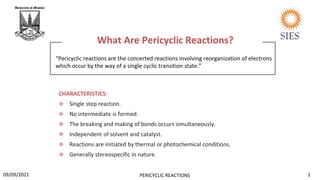
What Are Pericyclic Reactions?
CHARACTERISTICS:
 Single step reaction.
 No intermediate is formed.
 The breaking and making of bonds occurs simultaneously.
 Independent of solvent and catalyst.
 Reactions are initiated by thermal or photochemical conditions.
 Generally stereospecific in nature.
“Pericyclic reactions are the concerted reactions involving reorganization of electrons
which occur by the way of a single cyclic transition state.”
1
PERICYCLIC REACTIONS
09/09/2021
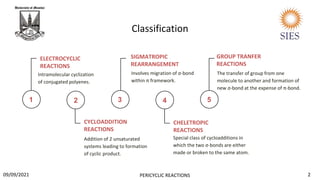
Classification
Intramolecular cyclization
of conjugated polyenes.
ELECTROCYCLIC
REACTIONS
Addition of 2 unsaturated
systems leading to formation
of cyclic product.
CYCLOADDITION
REACTIONS
Involves migration of σ-bond
within π framework.
SIGMATROPIC
REARRANGEMENT
The transfer of group from one
molecule to another and formation of
new σ-bond at the expense of π-bond.
GROUP TRANFER
REACTIONS
Special class of cycloadditions in
which the two σ-bonds are either
made or broken to the same atom.
CHELETROPIC
REACTIONS
1 2 3 4 5
2
PERICYCLIC REACTIONS
09/09/2021
It is a reversible reaction that involves ring closure of a conjugated polyene to
a cycloalkene, or ring opening of a cycloalkene to a conjugated polyene.
RING-CLOSING REACTION:
Electrocyclic Reactions
RING-OPENING REACTION:
3
PERICYCLIC REACTIONS
09/09/2021
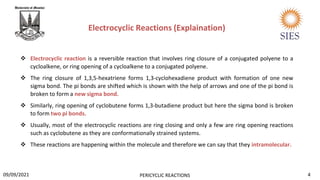
 Electrocyclic reaction is a reversible reaction that involves ring closure of a conjugated polyene to a
cycloalkene, or ring opening of a cycloalkene to a conjugated polyene.
 The ring closure of 1,3,5-hexatriene forms 1,3-cyclohexadiene product with formation of one new
sigma bond. The pi bonds are shifted which is shown with the help of arrows and one of the pi bond is
broken to form a new sigma bond.
 Similarly, ring opening of cyclobutene forms 1,3-butadiene product but here the sigma bond is broken
to form two pi bonds.
 Usually, most of the electrocyclic reactions are ring closing and only a few are ring opening reactions
such as cyclobutene as they are conformationally strained systems.
 These reactions are happening within the molecule and therefore we can say that they intramolecular.
Electrocyclic Reactions (Explaination)
4
PERICYCLIC REACTIONS
09/09/2021
It is a special kind of stereo selectivity observed in electrocyclic
reactions as the preference for inward or outward rotation of
substituents in disrotatory or conrotatory reactions.
Torquoselectivity
Disrotatory Conrotatory
5
PERICYCLIC REACTIONS
09/09/2021
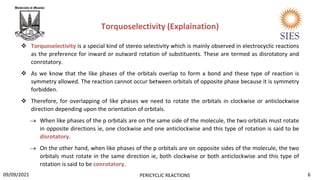
 Torquoselectivity is a special kind of stereo selectivity which is mainly observed in electrocyclic reactions
as the preference for inward or outward rotation of substituents. These are termed as disrotatory and
conrotatory.
 As we know that the like phases of the orbitals overlap to form a bond and these type of reaction is
symmetry allowed. The reaction cannot occur between orbitals of opposite phase because it is symmetry
forbidden.
 Therefore, for overlapping of like phases we need to rotate the orbitals in clockwise or anticlockwise
direction depending upon the orientation of orbitals.
 When like phases of the p orbitals are on the same side of the molecule, the two orbitals must rotate
in opposite directions ie, one clockwise and one anticlockwise and this type of rotation is said to be
disrotatory.
 On the other hand, when like phases of the p orbitals are on opposite sides of the molecule, the two
orbitals must rotate in the same direction ie, both clockwise or both anticlockwise and this type of
rotation is said to be conrotatory.
Torquoselectivity (Explaination)
6
PERICYCLIC REACTIONS
09/09/2021
Stereoselectivity
Cis product only
Trans product only
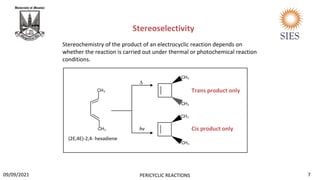
Stereochemistry of the product of an electrocyclic reaction depends on
whether the reaction is carried out under thermal or photochemical reaction
conditions.
hv
∆
(2E,4E)-2,4- hexadiene
7
PERICYCLIC REACTIONS
09/09/2021
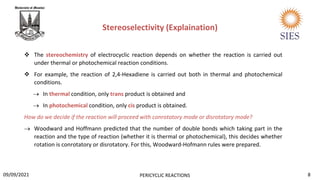
 The stereochemistry of electrocyclic reaction depends on whether the reaction is carried out
under thermal or photochemical reaction conditions.
 For example, the reaction of 2,4-Hexadiene is carried out both in thermal and photochemical
conditions.
 In thermal condition, only trans product is obtained and
 In photochemical condition, only cis product is obtained.
How do we decide if the reaction will proceed with conrotatory mode or disrotatory mode?
 Woodward and Hoffmann predicted that the number of double bonds which taking part in the
reaction and the type of reaction (whether it is thermal or photochemical), this decides whether
rotation is conrotatory or disrotatory. For this, Woodward-Hofmann rules were prepared.
Stereoselectivity (Explaination)
8
PERICYCLIC REACTIONS
09/09/2021
Woodward-Hoffmann Rules
(4n)π
[Even Π Bonds]
Thermal
(4n+2)π
[Odd Π Bonds]
Photochemical
Conrotatory
Reaction Conditions Allowed Mode Of Ring Closure
No. Of Π Electrons
Thermal
Photochemical
Disrotatory
Disrotatory
Conrotatory
9
PERICYCLIC REACTIONS
09/09/2021
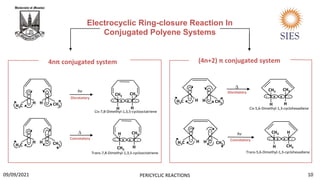
Electrocyclic Ring-closure Reaction In
Conjugated Polyene Systems
4nπ conjugated system (4n+2) π conjugated system
10
PERICYCLIC REACTIONS
09/09/2021
∆
hv
Disrotatory
hv
Conrotatory
∆
Disrotatory
Conrotatory
H H CH3
H3C
+ +
- -
H
H
CH3
CH3
+ +
- -
Cis-7,8-Dimethyl-1,3,5-cyclooctatriene
H H CH3
H3C
+
+
-
-
H
H CH3
CH3
+ +
- -
Trans-7,8-Dimethyl-1,3,5-cyclooctatriene
H H CH3
H3C
+ +
- -
H H CH3
H3C
+
+
-
-
CH3
H
H
+ +
- -
CH3
Cis-5,6-Dimethyl-1,3-cyclohexadiene
Trans-5,6-Dimethyl-1,3-cyclohexadiene
CH3
H
H
+ +
- -
CH3
Cis Product Trans Product Trans Product Cis Product
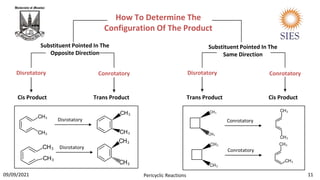
How To Determine The
Configuration Of The Product
Substituent Pointed In The
Opposite Direction
Substituent Pointed In The
Same Direction
Disrotatory Disrotatory
Conrotatory Conrotatory
Disrotatory
Disrotatory
Conrotatory
Conrotatory
11
Pericyclic Reactions
09/09/2021
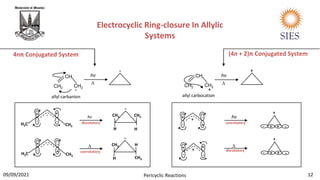
Electrocyclic Ring-closure In Allylic
Systems
4nπ Conjugated System (4n + 2)π Conjugated System
allyl carbanion allyl carbocation
hv
∆
CH
CH2
CH2
-
CH
CH2
CH2
+
hv
∆
hv
∆
-
12
Pericyclic Reactions
09/09/2021
hv
disrotatory
conrotatory
∆
conrotatory
disrotatory
+
+ +
- -
CH3
H3C
-
H H
CH3
CH3
-
+
+
-
-
CH3
H3C
-
H
H
CH3
CH3
-
+
+
-
-
+
+ +
- -
+
+
+
- -
+
+
+
- -
+
Electrocyclic Reactions In Cationic Allyl
Systems
 Cyclization of allyl cation is an intermediate step in Favorskii rearrangement also. For cyclic α-halo
ketones, the Favorskii rearrangement constitutes a ring contraction step, as shown below;
 Opening of a cyclopropyl cation to an allylic cation.
13
PERICYCLIC REACTIONS
09/09/2021
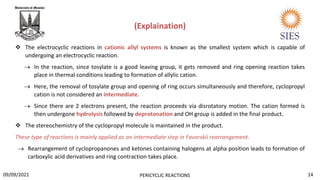
 The electrocyclic reactions in cationic allyl systems is known as the smallest system which is capable of
undergoing an electrocyclic reaction.
 In the reaction, since tosylate is a good leaving group, it gets removed and ring opening reaction takes
place in thermal conditions leading to formation of allylic cation.
 Here, the removal of tosylate group and opening of ring occurs simultaneously and therefore, cyclopropyl
cation is not considered an intermediate.
 Since there are 2 electrons present, the reaction proceeds via disrotatory motion. The cation formed is
then undergone hydrolysis followed by deprotonation and OH group is added in the final product.
 The stereochemistry of the cyclopropyl molecule is maintained in the product.
These type of reactions is mainly applied as an intermediate step in Favorskii rearrangement.
 Rearrangement of cyclopropanones and ketones containing halogens at alpha position leads to formation of
carboxylic acid derivatives and ring contraction takes place.
(Explaination)
14
PERICYCLIC REACTIONS
09/09/2021
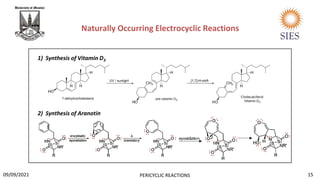
Naturally Occurring Electrocyclic Reactions
1) Synthesis of Vitamin D3
2) Synthesis of Aranotin
15
PERICYCLIC REACTIONS
09/09/2021
..
..
..
..
..
..
..
.. ..
..
..
.. ..
..
..
..
..
.. ..
..
..
..
..
..
..
..
..
..
..
..
..
..
 Biosynthesis of vitamin D3.
 It is sub element of vitamin D which is essential for our bones. It is also called “sunshine vitamin” as
sunlight is a great source of vitamin D.
 The first step involves a photochemically induced conrotatory ring opening of 7-dehydrocholesterol
to form pre vitamin D3, then a [1,7]-hydride shift then forms vitamin D3.
 Biosynthesis of Aranotin.
 Aranotin is an organic heterohexacyclic compound which is known for having antiviral and antibiotic
properties.
 1st enzymatic epoxidation of the starting material takes place. In the 2nd step, disrotatory ring
opening electrocyclization reaction takes place containin 6pi e-. Then 2nd epoxidation of the ring
takes place and the nearby nucleophilic nitrogen attacks the electrophilic carbon, forming a five
membered ring. The resulting ring system is a common ring system found in aranotin and its
derivatives.
(Explaination)
16
PERICYCLIC REACTIONS
09/09/2021
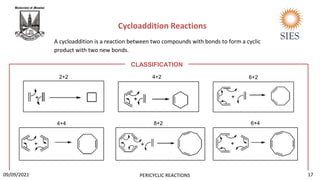
Cycloaddition Reactions
2+2 4+2 6+2
4+4 8+2 6+4
CLASSIFICATION
A cycloaddition is a reaction between two compounds with bonds to form a cyclic
product with two new bonds.
17
PERICYCLIC REACTIONS
09/09/2021
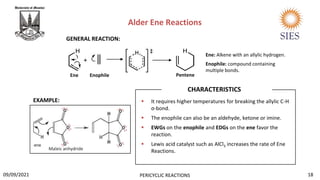
Ene: Alkene with an allylic hydrogen.
Enophile: compound containing
multiple bonds.
CHARACTERISTICS
 It requires higher temperatures for breaking the allylic C-H
σ-bond.
 The enophile can also be an aldehyde, ketone or imine.
 EWGs on the enophile and EDGs on the ene favor the
reaction.
 Lewis acid catalyst such as AlCl3 increases the rate of Ene
Reactions.
Alder Ene Reactions
GENERAL REACTION:
Enophile Pentene
EXAMPLE:
+
Ene
18
PERICYCLIC REACTIONS
09/09/2021
Maleic anhydride
 Alder ene is a type of group transfer reactions.
 It is a special class of cycloaddition reaction taking place between an alkene having an allylic hydrogen
which is called ene and a compound containing a multiple bond which is called the enophile.
 A new σ-bond is formed with migration of the ene double bond.
Now lets study some characteristics of ene reaction,
 It requires higher temperatures because of the higher activation energy and stereoelectronic
requirement for breaking the allylic C-H σ-bond.
 The enophile can also be an aldehyde, ketone or imine.
 Electron withdrawing groups on the enophile and electron donating groups on the ene favor the reaction.
 Like the Diels-Alder, some Ene Reactions can also be catalyzed by Lewis Acids. Lewis acid catalyst such as
AlCl3 increases rate of Ene Reactions.
Alder Ene Reactions (Explainantion)
19
PERICYCLIC REACTIONS
09/09/2021
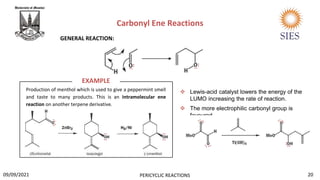
Production of menthol which is used to give a peppermint smell
and taste to many products. This is an intramolecular ene
reaction on another terpene derivative.
Carbonyl Ene Reactions
 Lewis-acid catalyst lowers the energy of the
LUMO increasing the rate of reaction.
 The more electrophilic carbonyl group is
favoured.
EXAMPLE
GENERAL REACTION:
20
PERICYCLIC REACTIONS
09/09/2021
..
..
..
..
..
..
..
..
..
..
 Carbonyl ene reactions is a type of alder ene reaction where the carbonyl group acts as enophile.
 These reactions are more affective because here carbonyl groups act as a good enophile due to
inductive effect of Oxygen.
Now what if there are more than one carbonyl group present in the enophile molecule?
 In such cases more electrophilic carbonyl group is preferred. The electrophilic Carbonyl group
then acts as enophile.
 The Ti(OR)4 acts as lewis acid to increase the rate of reaction.
 Lewis-acid catalyst lowers the energy of the LUMO increasing the rate of reaction.
 One of the major application of carbonyl ene reaction is synthesis of menthol which is used to
give a peppermint smell and taste to many products. This is an intramolecular carbonyl ene
reaction.
Carbonyl Ene Reactions (Explaination)
21
PERICYCLIC REACTIONS
09/09/2021
Ketene [2 + 2] Cycloaddition
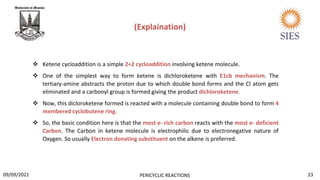
 Preparation of dichloroketene follows E1cB elimination reaction.
 The most e- rich end of alkene forms bond with e- deficient central Carbon atom of
Ketene.
Cl
Cl
Dichloroketene
EtO
+ C
O
Cl
Cl
O
Cl
Cl
EtO
Most electron
deficient
Most
electron rich
22
PERICYCLIC REACTIONS
09/09/2021
..
..
 Ketene cycloaddition is a simple 2+2 cycloaddition involving ketene molecule.
 One of the simplest way to form ketene is dichloroketene with E1cb mechanism. The
tertiary-amine abstracts the proton due to which double bond forms and the Cl atom gets
eliminated and a carbonyl group is formed giving the product dichloroketene.
 Now, this dicloroketene formed is reacted with a molecule containing double bond to form 4
membered cyclobutene ring.
 So, the basic condition here is that the most e- rich carbon reacts with the most e- deficient
Carbon. The Carbon in ketene molecule is electrophilic due to electronegative nature of
Oxygen. So usually Electron donating substituent on the alkene is preferred.
(Explaination)
23
PERICYCLIC REACTIONS
09/09/2021
Regio-stereo Selectivity
Et
+ C
O O
Me Me
Me
Me
Me
Me
Et
Et
+ C
O O
Me Me
Me
Me
Me
Me
Et
Z-Alkene E-Alkene
Cis- product Trans- product
 Geometry of alkene is maintained in cyclobutanone product.
C
O
Et
+
O
Et
H
H
C
O
Ph
+
O
Ph
H
H
X
X
X =Cl, Br, Me, Et Endo
Endo
 Reaction of ketene with cyclopentadiene gives adduct with larger ketene substituent in the endo position.
Exo
24
PERICYCLIC REACTIONS
09/09/2021
..
..
..
..
..
..
 The stereochemistry of alkene is maintained in cyclobutanone product.
 So if Z configuration of alkene is present in the reactant, the product gives the cis product and in
case of E alkene, trans product is formed.
 Another stereochemical condition is that the substituents which are present on the ketene
molecule, the bulky group is substituted on the endo position.
 For example, in the given reaction, ethyl is bulky so it is present in the endo position and Ph
group is bulky so endo product is obtained.
 This is one of the exceptional case in ketene cycloadditions.
(Explaination)
25
PERICYCLIC REACTIONS
09/09/2021
Synthesis Of -Lactams
Cl
Cl
Cl
O
Et3N
C
O
Cl
Cl
NPh
Ph
Cl
N
Ph
Cl
O
O
Cl
C N
SO2Cl
N
O SO2Cl
Cl
N
O
S
Cl
O
O
O
OH
NH
O
Cl
NaHCO3
H2O
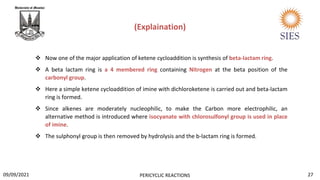
 The isocyanate with chlorosulfonyl group as substituent increases the electrophilicity of carbon. The
chlorosulfonyl group can be removed simply by hydrolysis under mild conditions via the sulfonic acid.
26
PERICYCLIC REACTIONS
09/09/2021
Ph
 The dichloroketene reacts with imine to give beta-lactam derivative.
..
..
..
..
..
..
..
..
..
..
..
..
..
..
..
..
..
..
..
 Now one of the major application of ketene cycloaddition is synthesis of beta-lactam ring.
 A beta lactam ring is a 4 membered ring containing Nitrogen at the beta position of the
carbonyl group.
 Here a simple ketene cycloaddition of imine with dichloroketene is carried out and beta-lactam
ring is formed.
 Since alkenes are moderately nucleophilic, to make the Carbon more electrophilic, an
alternative method is introduced where isocyanate with chlorosulfonyl group is used in place
of imine.
 The sulphonyl group is then removed by hydrolysis and the b-lactam ring is formed.
(Explaination)
27
PERICYCLIC REACTIONS
09/09/2021
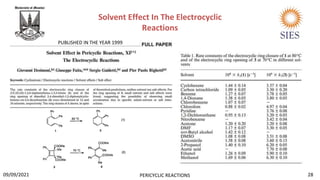
Solvent Effect In The Electrocyclic
Reactions
PUBLISHED IN THE YEAR 1999
28
PERICYCLIC REACTIONS
09/09/2021
Aim: To study the solvent effects on electrocyclic ring closing and ring opening reactions’
Theory: In this, the electrocyclic ring closing and opening reaction was carried out using 18 different
solvents and there rate constant were determined and result was obtained.
The 1st reaction is ring closing reaction which involves a totally aliphatic system and the 2nd reaction
which is ring opening contains carbonyl substituents which are polar.
Procedure: So according to this paper, the kinetic determination was done using UV-vis
spectrophotometer and the product formation was detected by using H-NMR spectrum and the
observations were recorded.
Observations: So from the table, it was seen that in 1st the reaction no major deviation was
observed, but in case of 2nd reaction alcohol and acetic acid solvent showed more deviation.
Research Paper
29
PERICYCLIC REACTIONS
09/09/2021
Conclusion: The conclusion was made that this maybe due to the hydrogen bond donor ability of alcohol
and acetic acid.
So then, further study was done and the two reactions was then carried out in the acetonic solutions of
lithium and magnesium perchlorate. And then according to its observations, 1st reaction was ineffective
toward inorganic solvents but 2nd reaction was effective.
So finally the conclusion was made that electrocyclic reactions can be termed as pericyclic reactions with
no solvent and no cationic catalysis effect in case of totally aliphatic substrates. But substituents with
polar properties showed some significant effects with inorganic solvents acting as lewis acids.
Research Paper (Continuation)
30
PERICYCLIC REACTIONS
09/09/2021
BOOKS
■ Organic Chemistry; Clayden, Greeves, Warren and Wothers; Page No- 905, 943
■ Modern methods of organic synthesis; William Carruthers & Iain Coldham; 4th edition; Page No- 231, 259
■ Photochemistry & Pericyclic reactions; Jagdamba Singh, Jaya Singh; 3rd edition; Page No-17, 58
■ Pericyclic reactions by Ian Fleming; Page No- 7, 57, 84
■ Advanced Organic Chemistry Part B (Reaction and synthesis); Francis Carey and Richard Sundberg; 5th
edition; Page No- 539
■ RESEARCH PAPER: file:///C:/Users/pykum/Downloads/(sici)1099-0690(199908)1999_8_1921__aid-
ejoc1921_3.0.co%3B2-n.pdf
WEBSITES
■ https://www.asu.edu/courses/chm332/PericyclicReactions.pdf
■ http://epgp.inflibnet.ac.in/epgpdata/uploads/epgp_content/chemistry/organic_chemistry_iii/29.electrocy
clic_reactions/et/4823_et_et.pdf
■ https://www.stereoelectronics.org/webPR/PR_05.html
■ http://epgp.inflibnet.ac.in/epgpdata/uploads/epgp_content/chemistry/09.organic_chemistry-
iii/35.ene_reaction/et/5522_et_et.pdf
Bibliography
31
PERICYCLIC REACTIONS
09/09/2021
Does anyone have any questions?

Pericyclic Reactions.pptx

  • 1.
    Pallavi Kumbhar Roll No:SMCHEM2122009 Msc Part-II (Paper-1) Pericyclic Reactions
  • 2.
    Contents 01 What arePericyclic Reactions? 02 Classification 03 Electrocyclic Reaction 04 Stereochemistry 05 Woodward-Hofmann Rules 06 Electrocyclic Reaction in Allylic Systems 07 Naturally Occurring Electrocyclic Reaction 08 Cycloaddition Reaction 09 Alder-Ene Reactions 10 Carbonyl-Ene Reactions 11 Ketene Cycloaddition 12 Synthesis Of Beta Lactams
  • 3.
    What Are PericyclicReactions? CHARACTERISTICS:  Single step reaction.  No intermediate is formed.  The breaking and making of bonds occurs simultaneously.  Independent of solvent and catalyst.  Reactions are initiated by thermal or photochemical conditions.  Generally stereospecific in nature. “Pericyclic reactions are the concerted reactions involving reorganization of electrons which occur by the way of a single cyclic transition state.” 1 PERICYCLIC REACTIONS 09/09/2021
  • 4.
    Classification Intramolecular cyclization of conjugatedpolyenes. ELECTROCYCLIC REACTIONS Addition of 2 unsaturated systems leading to formation of cyclic product. CYCLOADDITION REACTIONS Involves migration of σ-bond within π framework. SIGMATROPIC REARRANGEMENT The transfer of group from one molecule to another and formation of new σ-bond at the expense of π-bond. GROUP TRANFER REACTIONS Special class of cycloadditions in which the two σ-bonds are either made or broken to the same atom. CHELETROPIC REACTIONS 1 2 3 4 5 2 PERICYCLIC REACTIONS 09/09/2021
  • 5.
    It is areversible reaction that involves ring closure of a conjugated polyene to a cycloalkene, or ring opening of a cycloalkene to a conjugated polyene. RING-CLOSING REACTION: Electrocyclic Reactions RING-OPENING REACTION: 3 PERICYCLIC REACTIONS 09/09/2021
  • 6.
     Electrocyclic reactionis a reversible reaction that involves ring closure of a conjugated polyene to a cycloalkene, or ring opening of a cycloalkene to a conjugated polyene.  The ring closure of 1,3,5-hexatriene forms 1,3-cyclohexadiene product with formation of one new sigma bond. The pi bonds are shifted which is shown with the help of arrows and one of the pi bond is broken to form a new sigma bond.  Similarly, ring opening of cyclobutene forms 1,3-butadiene product but here the sigma bond is broken to form two pi bonds.  Usually, most of the electrocyclic reactions are ring closing and only a few are ring opening reactions such as cyclobutene as they are conformationally strained systems.  These reactions are happening within the molecule and therefore we can say that they intramolecular. Electrocyclic Reactions (Explaination) 4 PERICYCLIC REACTIONS 09/09/2021
  • 7.
    It is aspecial kind of stereo selectivity observed in electrocyclic reactions as the preference for inward or outward rotation of substituents in disrotatory or conrotatory reactions. Torquoselectivity Disrotatory Conrotatory 5 PERICYCLIC REACTIONS 09/09/2021
  • 8.
     Torquoselectivity isa special kind of stereo selectivity which is mainly observed in electrocyclic reactions as the preference for inward or outward rotation of substituents. These are termed as disrotatory and conrotatory.  As we know that the like phases of the orbitals overlap to form a bond and these type of reaction is symmetry allowed. The reaction cannot occur between orbitals of opposite phase because it is symmetry forbidden.  Therefore, for overlapping of like phases we need to rotate the orbitals in clockwise or anticlockwise direction depending upon the orientation of orbitals.  When like phases of the p orbitals are on the same side of the molecule, the two orbitals must rotate in opposite directions ie, one clockwise and one anticlockwise and this type of rotation is said to be disrotatory.  On the other hand, when like phases of the p orbitals are on opposite sides of the molecule, the two orbitals must rotate in the same direction ie, both clockwise or both anticlockwise and this type of rotation is said to be conrotatory. Torquoselectivity (Explaination) 6 PERICYCLIC REACTIONS 09/09/2021
  • 9.
    Stereoselectivity Cis product only Transproduct only Stereochemistry of the product of an electrocyclic reaction depends on whether the reaction is carried out under thermal or photochemical reaction conditions. hv ∆ (2E,4E)-2,4- hexadiene 7 PERICYCLIC REACTIONS 09/09/2021
  • 10.
     The stereochemistryof electrocyclic reaction depends on whether the reaction is carried out under thermal or photochemical reaction conditions.  For example, the reaction of 2,4-Hexadiene is carried out both in thermal and photochemical conditions.  In thermal condition, only trans product is obtained and  In photochemical condition, only cis product is obtained. How do we decide if the reaction will proceed with conrotatory mode or disrotatory mode?  Woodward and Hoffmann predicted that the number of double bonds which taking part in the reaction and the type of reaction (whether it is thermal or photochemical), this decides whether rotation is conrotatory or disrotatory. For this, Woodward-Hofmann rules were prepared. Stereoselectivity (Explaination) 8 PERICYCLIC REACTIONS 09/09/2021
  • 11.
    Woodward-Hoffmann Rules (4n)π [Even ΠBonds] Thermal (4n+2)π [Odd Π Bonds] Photochemical Conrotatory Reaction Conditions Allowed Mode Of Ring Closure No. Of Π Electrons Thermal Photochemical Disrotatory Disrotatory Conrotatory 9 PERICYCLIC REACTIONS 09/09/2021
  • 12.
    Electrocyclic Ring-closure ReactionIn Conjugated Polyene Systems 4nπ conjugated system (4n+2) π conjugated system 10 PERICYCLIC REACTIONS 09/09/2021 ∆ hv Disrotatory hv Conrotatory ∆ Disrotatory Conrotatory H H CH3 H3C + + - - H H CH3 CH3 + + - - Cis-7,8-Dimethyl-1,3,5-cyclooctatriene H H CH3 H3C + + - - H H CH3 CH3 + + - - Trans-7,8-Dimethyl-1,3,5-cyclooctatriene H H CH3 H3C + + - - H H CH3 H3C + + - - CH3 H H + + - - CH3 Cis-5,6-Dimethyl-1,3-cyclohexadiene Trans-5,6-Dimethyl-1,3-cyclohexadiene CH3 H H + + - - CH3
  • 13.
    Cis Product TransProduct Trans Product Cis Product How To Determine The Configuration Of The Product Substituent Pointed In The Opposite Direction Substituent Pointed In The Same Direction Disrotatory Disrotatory Conrotatory Conrotatory Disrotatory Disrotatory Conrotatory Conrotatory 11 Pericyclic Reactions 09/09/2021
  • 14.
    Electrocyclic Ring-closure InAllylic Systems 4nπ Conjugated System (4n + 2)π Conjugated System allyl carbanion allyl carbocation hv ∆ CH CH2 CH2 - CH CH2 CH2 + hv ∆ hv ∆ - 12 Pericyclic Reactions 09/09/2021 hv disrotatory conrotatory ∆ conrotatory disrotatory + + + - - CH3 H3C - H H CH3 CH3 - + + - - CH3 H3C - H H CH3 CH3 - + + - - + + + - - + + + - - + + + - - +
  • 15.
    Electrocyclic Reactions InCationic Allyl Systems  Cyclization of allyl cation is an intermediate step in Favorskii rearrangement also. For cyclic α-halo ketones, the Favorskii rearrangement constitutes a ring contraction step, as shown below;  Opening of a cyclopropyl cation to an allylic cation. 13 PERICYCLIC REACTIONS 09/09/2021
  • 16.
     The electrocyclicreactions in cationic allyl systems is known as the smallest system which is capable of undergoing an electrocyclic reaction.  In the reaction, since tosylate is a good leaving group, it gets removed and ring opening reaction takes place in thermal conditions leading to formation of allylic cation.  Here, the removal of tosylate group and opening of ring occurs simultaneously and therefore, cyclopropyl cation is not considered an intermediate.  Since there are 2 electrons present, the reaction proceeds via disrotatory motion. The cation formed is then undergone hydrolysis followed by deprotonation and OH group is added in the final product.  The stereochemistry of the cyclopropyl molecule is maintained in the product. These type of reactions is mainly applied as an intermediate step in Favorskii rearrangement.  Rearrangement of cyclopropanones and ketones containing halogens at alpha position leads to formation of carboxylic acid derivatives and ring contraction takes place. (Explaination) 14 PERICYCLIC REACTIONS 09/09/2021
  • 17.
    Naturally Occurring ElectrocyclicReactions 1) Synthesis of Vitamin D3 2) Synthesis of Aranotin 15 PERICYCLIC REACTIONS 09/09/2021 .. .. .. .. .. .. .. .. .. .. .. .. .. .. .. .. .. .. .. .. .. .. .. .. .. .. .. .. .. .. .. ..
  • 18.
     Biosynthesis ofvitamin D3.  It is sub element of vitamin D which is essential for our bones. It is also called “sunshine vitamin” as sunlight is a great source of vitamin D.  The first step involves a photochemically induced conrotatory ring opening of 7-dehydrocholesterol to form pre vitamin D3, then a [1,7]-hydride shift then forms vitamin D3.  Biosynthesis of Aranotin.  Aranotin is an organic heterohexacyclic compound which is known for having antiviral and antibiotic properties.  1st enzymatic epoxidation of the starting material takes place. In the 2nd step, disrotatory ring opening electrocyclization reaction takes place containin 6pi e-. Then 2nd epoxidation of the ring takes place and the nearby nucleophilic nitrogen attacks the electrophilic carbon, forming a five membered ring. The resulting ring system is a common ring system found in aranotin and its derivatives. (Explaination) 16 PERICYCLIC REACTIONS 09/09/2021
  • 19.
    Cycloaddition Reactions 2+2 4+26+2 4+4 8+2 6+4 CLASSIFICATION A cycloaddition is a reaction between two compounds with bonds to form a cyclic product with two new bonds. 17 PERICYCLIC REACTIONS 09/09/2021
  • 20.
    Ene: Alkene withan allylic hydrogen. Enophile: compound containing multiple bonds. CHARACTERISTICS  It requires higher temperatures for breaking the allylic C-H σ-bond.  The enophile can also be an aldehyde, ketone or imine.  EWGs on the enophile and EDGs on the ene favor the reaction.  Lewis acid catalyst such as AlCl3 increases the rate of Ene Reactions. Alder Ene Reactions GENERAL REACTION: Enophile Pentene EXAMPLE: + Ene 18 PERICYCLIC REACTIONS 09/09/2021 Maleic anhydride
  • 21.
     Alder eneis a type of group transfer reactions.  It is a special class of cycloaddition reaction taking place between an alkene having an allylic hydrogen which is called ene and a compound containing a multiple bond which is called the enophile.  A new σ-bond is formed with migration of the ene double bond. Now lets study some characteristics of ene reaction,  It requires higher temperatures because of the higher activation energy and stereoelectronic requirement for breaking the allylic C-H σ-bond.  The enophile can also be an aldehyde, ketone or imine.  Electron withdrawing groups on the enophile and electron donating groups on the ene favor the reaction.  Like the Diels-Alder, some Ene Reactions can also be catalyzed by Lewis Acids. Lewis acid catalyst such as AlCl3 increases rate of Ene Reactions. Alder Ene Reactions (Explainantion) 19 PERICYCLIC REACTIONS 09/09/2021
  • 22.
    Production of mentholwhich is used to give a peppermint smell and taste to many products. This is an intramolecular ene reaction on another terpene derivative. Carbonyl Ene Reactions  Lewis-acid catalyst lowers the energy of the LUMO increasing the rate of reaction.  The more electrophilic carbonyl group is favoured. EXAMPLE GENERAL REACTION: 20 PERICYCLIC REACTIONS 09/09/2021 .. .. .. .. .. .. .. .. .. ..
  • 23.
     Carbonyl enereactions is a type of alder ene reaction where the carbonyl group acts as enophile.  These reactions are more affective because here carbonyl groups act as a good enophile due to inductive effect of Oxygen. Now what if there are more than one carbonyl group present in the enophile molecule?  In such cases more electrophilic carbonyl group is preferred. The electrophilic Carbonyl group then acts as enophile.  The Ti(OR)4 acts as lewis acid to increase the rate of reaction.  Lewis-acid catalyst lowers the energy of the LUMO increasing the rate of reaction.  One of the major application of carbonyl ene reaction is synthesis of menthol which is used to give a peppermint smell and taste to many products. This is an intramolecular carbonyl ene reaction. Carbonyl Ene Reactions (Explaination) 21 PERICYCLIC REACTIONS 09/09/2021
  • 24.
    Ketene [2 +2] Cycloaddition  Preparation of dichloroketene follows E1cB elimination reaction.  The most e- rich end of alkene forms bond with e- deficient central Carbon atom of Ketene. Cl Cl Dichloroketene EtO + C O Cl Cl O Cl Cl EtO Most electron deficient Most electron rich 22 PERICYCLIC REACTIONS 09/09/2021 .. ..
  • 25.
     Ketene cycloadditionis a simple 2+2 cycloaddition involving ketene molecule.  One of the simplest way to form ketene is dichloroketene with E1cb mechanism. The tertiary-amine abstracts the proton due to which double bond forms and the Cl atom gets eliminated and a carbonyl group is formed giving the product dichloroketene.  Now, this dicloroketene formed is reacted with a molecule containing double bond to form 4 membered cyclobutene ring.  So, the basic condition here is that the most e- rich carbon reacts with the most e- deficient Carbon. The Carbon in ketene molecule is electrophilic due to electronegative nature of Oxygen. So usually Electron donating substituent on the alkene is preferred. (Explaination) 23 PERICYCLIC REACTIONS 09/09/2021
  • 26.
    Regio-stereo Selectivity Et + C OO Me Me Me Me Me Me Et Et + C O O Me Me Me Me Me Me Et Z-Alkene E-Alkene Cis- product Trans- product  Geometry of alkene is maintained in cyclobutanone product. C O Et + O Et H H C O Ph + O Ph H H X X X =Cl, Br, Me, Et Endo Endo  Reaction of ketene with cyclopentadiene gives adduct with larger ketene substituent in the endo position. Exo 24 PERICYCLIC REACTIONS 09/09/2021 .. .. .. .. .. ..
  • 27.
     The stereochemistryof alkene is maintained in cyclobutanone product.  So if Z configuration of alkene is present in the reactant, the product gives the cis product and in case of E alkene, trans product is formed.  Another stereochemical condition is that the substituents which are present on the ketene molecule, the bulky group is substituted on the endo position.  For example, in the given reaction, ethyl is bulky so it is present in the endo position and Ph group is bulky so endo product is obtained.  This is one of the exceptional case in ketene cycloadditions. (Explaination) 25 PERICYCLIC REACTIONS 09/09/2021
  • 28.
    Synthesis Of -Lactams Cl Cl Cl O Et3N C O Cl Cl NPh Ph Cl N Ph Cl O O Cl CN SO2Cl N O SO2Cl Cl N O S Cl O O O OH NH O Cl NaHCO3 H2O  The isocyanate with chlorosulfonyl group as substituent increases the electrophilicity of carbon. The chlorosulfonyl group can be removed simply by hydrolysis under mild conditions via the sulfonic acid. 26 PERICYCLIC REACTIONS 09/09/2021 Ph  The dichloroketene reacts with imine to give beta-lactam derivative. .. .. .. .. .. .. .. .. .. .. .. .. .. .. .. .. .. .. ..
  • 29.
     Now oneof the major application of ketene cycloaddition is synthesis of beta-lactam ring.  A beta lactam ring is a 4 membered ring containing Nitrogen at the beta position of the carbonyl group.  Here a simple ketene cycloaddition of imine with dichloroketene is carried out and beta-lactam ring is formed.  Since alkenes are moderately nucleophilic, to make the Carbon more electrophilic, an alternative method is introduced where isocyanate with chlorosulfonyl group is used in place of imine.  The sulphonyl group is then removed by hydrolysis and the b-lactam ring is formed. (Explaination) 27 PERICYCLIC REACTIONS 09/09/2021
  • 30.
    Solvent Effect InThe Electrocyclic Reactions PUBLISHED IN THE YEAR 1999 28 PERICYCLIC REACTIONS 09/09/2021
  • 31.
    Aim: To studythe solvent effects on electrocyclic ring closing and ring opening reactions’ Theory: In this, the electrocyclic ring closing and opening reaction was carried out using 18 different solvents and there rate constant were determined and result was obtained. The 1st reaction is ring closing reaction which involves a totally aliphatic system and the 2nd reaction which is ring opening contains carbonyl substituents which are polar. Procedure: So according to this paper, the kinetic determination was done using UV-vis spectrophotometer and the product formation was detected by using H-NMR spectrum and the observations were recorded. Observations: So from the table, it was seen that in 1st the reaction no major deviation was observed, but in case of 2nd reaction alcohol and acetic acid solvent showed more deviation. Research Paper 29 PERICYCLIC REACTIONS 09/09/2021
  • 32.
    Conclusion: The conclusionwas made that this maybe due to the hydrogen bond donor ability of alcohol and acetic acid. So then, further study was done and the two reactions was then carried out in the acetonic solutions of lithium and magnesium perchlorate. And then according to its observations, 1st reaction was ineffective toward inorganic solvents but 2nd reaction was effective. So finally the conclusion was made that electrocyclic reactions can be termed as pericyclic reactions with no solvent and no cationic catalysis effect in case of totally aliphatic substrates. But substituents with polar properties showed some significant effects with inorganic solvents acting as lewis acids. Research Paper (Continuation) 30 PERICYCLIC REACTIONS 09/09/2021
  • 33.
    BOOKS ■ Organic Chemistry;Clayden, Greeves, Warren and Wothers; Page No- 905, 943 ■ Modern methods of organic synthesis; William Carruthers & Iain Coldham; 4th edition; Page No- 231, 259 ■ Photochemistry & Pericyclic reactions; Jagdamba Singh, Jaya Singh; 3rd edition; Page No-17, 58 ■ Pericyclic reactions by Ian Fleming; Page No- 7, 57, 84 ■ Advanced Organic Chemistry Part B (Reaction and synthesis); Francis Carey and Richard Sundberg; 5th edition; Page No- 539 ■ RESEARCH PAPER: file:///C:/Users/pykum/Downloads/(sici)1099-0690(199908)1999_8_1921__aid- ejoc1921_3.0.co%3B2-n.pdf WEBSITES ■ https://www.asu.edu/courses/chm332/PericyclicReactions.pdf ■ http://epgp.inflibnet.ac.in/epgpdata/uploads/epgp_content/chemistry/organic_chemistry_iii/29.electrocy clic_reactions/et/4823_et_et.pdf ■ https://www.stereoelectronics.org/webPR/PR_05.html ■ http://epgp.inflibnet.ac.in/epgpdata/uploads/epgp_content/chemistry/09.organic_chemistry- iii/35.ene_reaction/et/5522_et_et.pdf Bibliography 31 PERICYCLIC REACTIONS 09/09/2021
  • 34.
    Does anyone haveany questions?

Editor's Notes

  • #6 An Electrocyclic reaction is a reversible reaction that involves ring closure of a conjugated polyene to a cycloalkene, or ring opening of a cycloalkene to a conjugated polyene.
  • #10 Stereochemistry of the product of an electrocyclic reaction depends on whether the reaction is carried out under thermal or photochemical reaction conditions.
  • #23 The reactions where the carbonyl group acts as enophile are called carbonyl ene reactions. Carbonyl groups act as a good enophile due to –I effect of Oxygen. The interaction is between the HOMO of the ene system and the LUMO of the carbonyl group, and a Lewis-acid catalyst can lower the energy of the LUMO still further. If there is a choice, the more electrophilic carbonyl group (the one with the lower LUMO) reacts. Production of menthol which is used to give a peppermint smell and taste to many products. This is an intramolecular ene reaction on another terpene derivative.