ULTRASOUND ASSISTED REACTION
PRESENTED BY – PRIYANSHI R. SAHU
M.PHARM 1ST YEAR (PHARMACEUTICAL CHEMISTRY)
SEMESTER-II
GURUNANAK COLLEGE OF PHARMACY, NAGPUR 440026
CONTENTS.
• 1. Introduction.
• 2. Sonochemistry.
• 3. Mechanism of Sonochemistry.
• 4. Phenomenon of acoustic cavitation.
• 5. Types of Sonochemical reaction
 Heterogenous Solid/Liquid Phase reaction.
 Heterogenous Liquid/Liquid Phase reaction.
 Homogenous Liquid Phase reaction.
• 6. Synthetic Applications.
• 7. Refrences.
INTRODUCTION
What is ultrasound?
Ultrasound waves are sound waves with frequencies above the upper audible limit of human hearing, typically
above 20 kHz.The normal range of hearing is between 16Hz to 16kHz, and ultrasound is generally considered to
lie between 20kHz to 500MHz.
The ultrasound is generated with the help of an instrument having an ultrasonic transducer, a device by which
electrical or mechanical energy can be coverted ito sound energy
Ultrasound-assisted reactions refer to chemical reactions that are facilitated or enhanced by the application of
ultrasound waves.
Ultrasonic chemistry is a research field where the reaction is dependent on the acoustic cavitation, that is, the
formation, growth, and implosive collapse of the bubbles in the solution.
Cavitation is the process in which mechanical activation destroys the attractive forces of molecules in the liquid
phase.
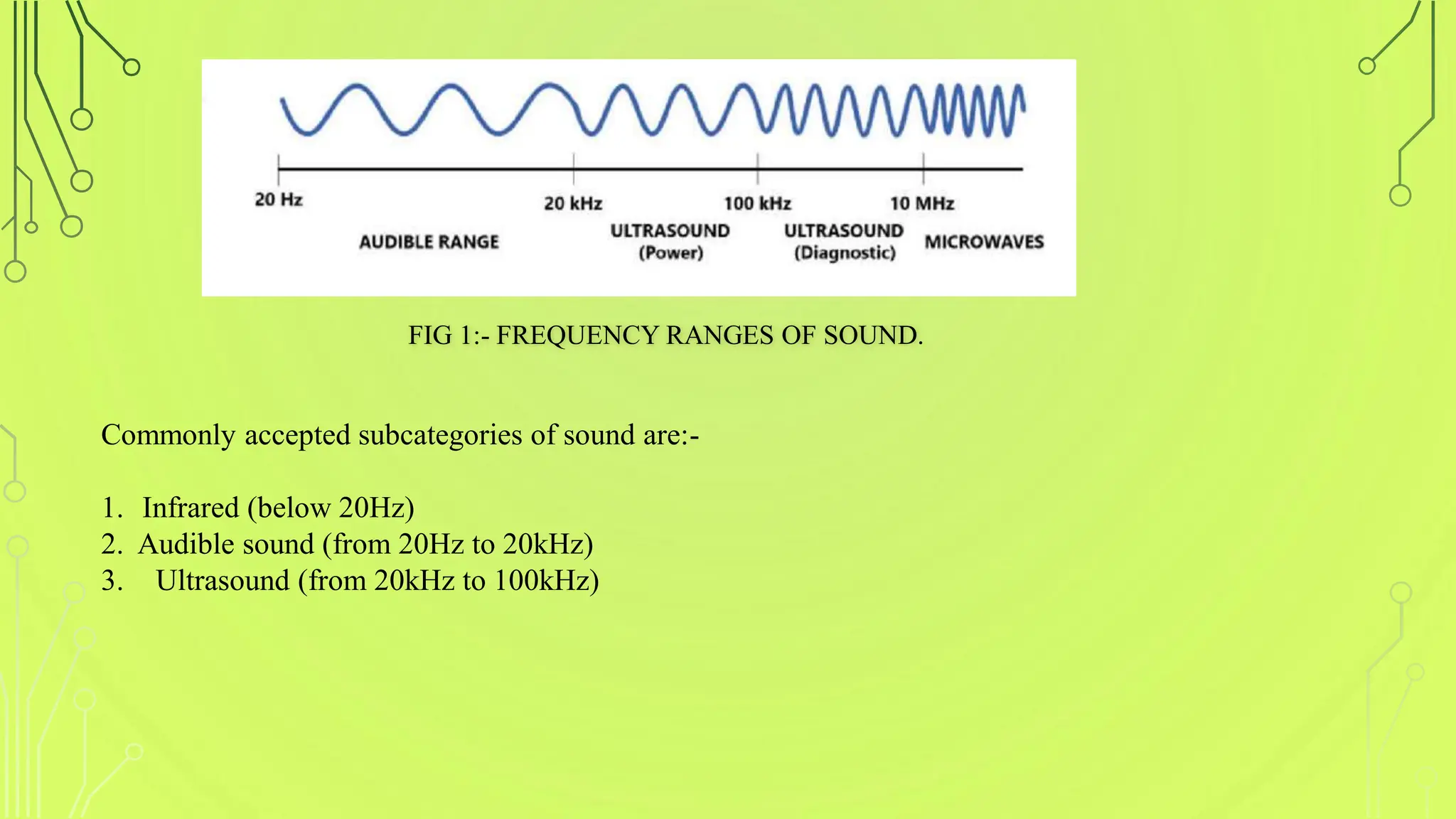
FIG 1:- FREQUENCY RANGES OF SOUND.
Commonly accepted subcategories of sound are:-
1. Infrared (below 20Hz)
2. Audible sound (from 20Hz to 20kHz)
3. Ultrasound (from 20kHz to 100kHz)
SONOCHEMISTRY.
• The branch of chemistry dealing with the study of the effect of ultrasound waves, on chemical activity is
known as sonochemistry.
• Sonochemistry is a green approach which is being used to accelerate synthesis of organic compounds and
involves the use of ultrasound technique to promote chemical reactions.
•
• Sonochemistry is the term used to describe the effect of ultrasonic sound waves on chemical reactions. The
terminology is in keeping with that of the longer established techniques which use light (photochemistry) and
electricity (electrochemistry) to achieve chemical activation
• The principle of sonochemistry arises from acoustic cavitation (formation, growth and implosion of
bubbles).
• Power ultrasound enhances chemical reactivity in a liquid medium through the generation and destruction of
cavitation bubbles.
• Sound travels through a medium as a series of compression and rarefaction motion of molecules.
Sound travels through a medium as a series of compression and rarefaction motion of molecules.
During the compression cycle, the average distance between the molecules is reduced and during
rarefaction the average distance between the molecules is increases.
Fig 2:- Schematic representation of compression and refraction.
• MECHANISM OF SONOCHEMISTRY:-+
Fig 3:- Schematic representation of the acoustic cavitation
phenomenon.
Fig 4:- Cavitation dynamics.
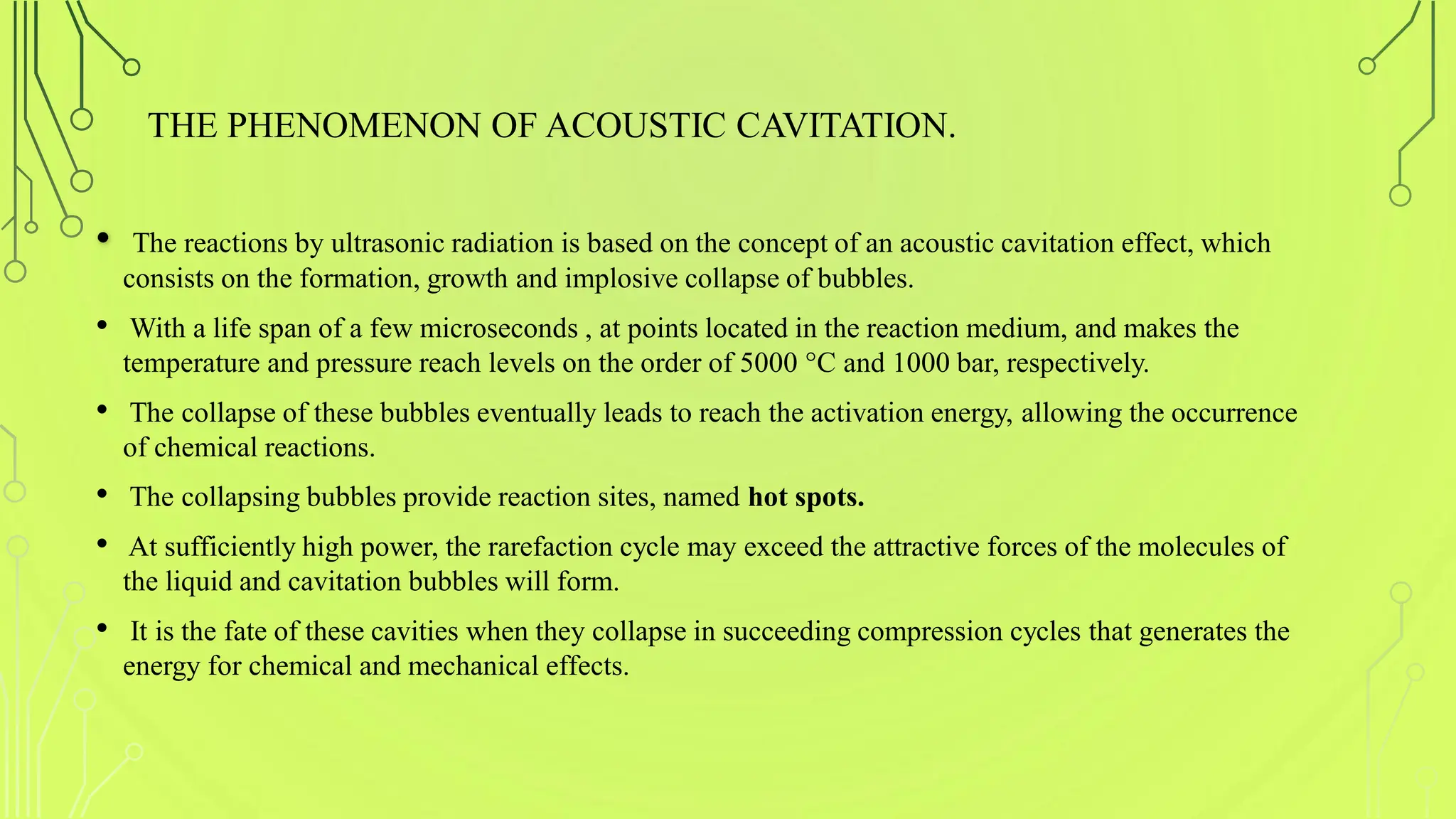
THE PHENOMENON OF ACOUSTIC CAVITATION.
• The reactions by ultrasonic radiation is based on the concept of an acoustic cavitation effect, which
consists on the formation, growth and implosive collapse of bubbles.
• With a life span of a few microseconds , at points located in the reaction medium, and makes the
temperature and pressure reach levels on the order of 5000 °C and 1000 bar, respectively.
• The collapse of these bubbles eventually leads to reach the activation energy, allowing the occurrence
of chemical reactions.
• The collapsing bubbles provide reaction sites, named hot spots.
• At sufficiently high power, the rarefaction cycle may exceed the attractive forces of the molecules of
the liquid and cavitation bubbles will form.
• It is the fate of these cavities when they collapse in succeeding compression cycles that generates the
energy for chemical and mechanical effects.
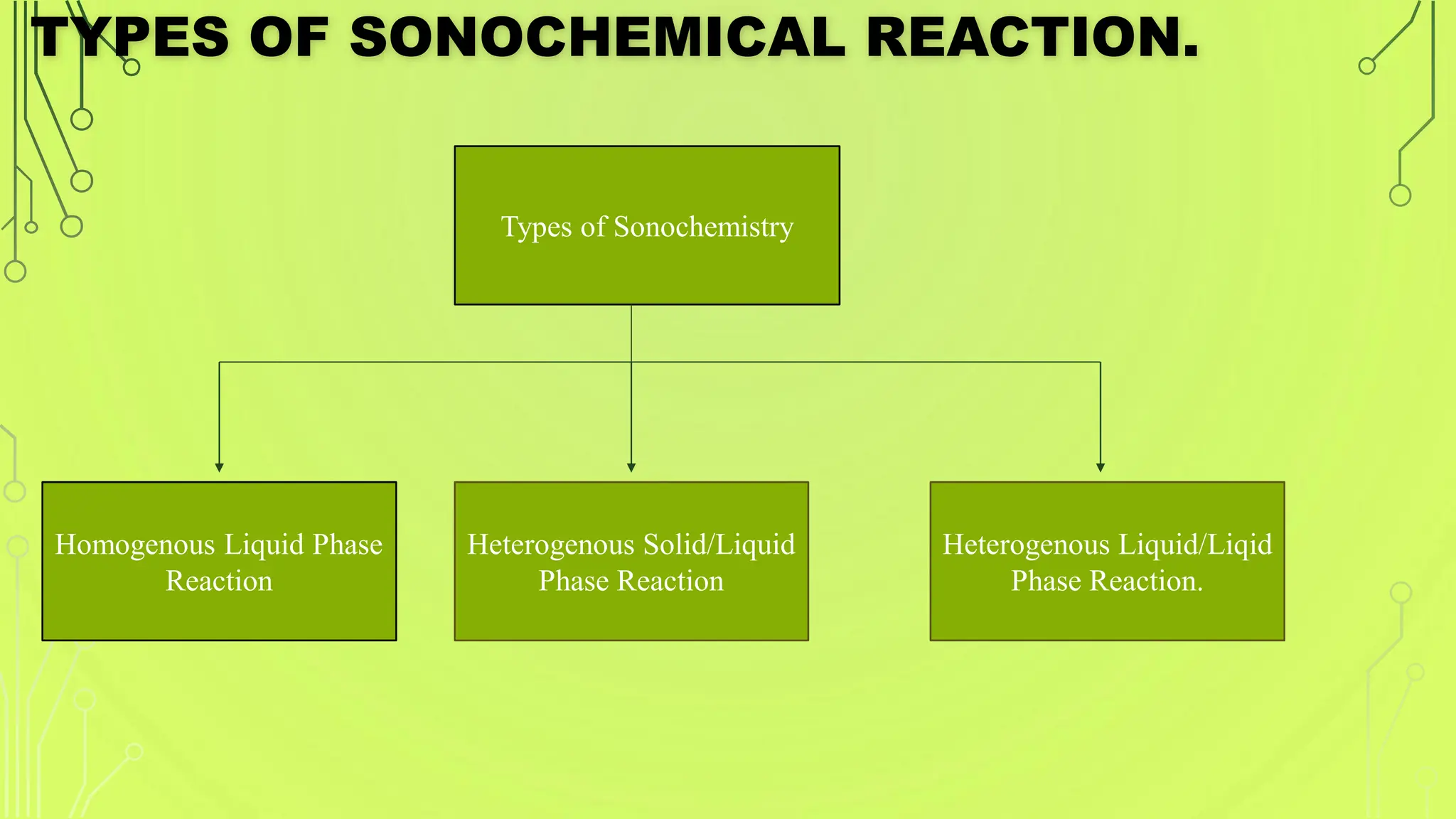
TYPES OF SONOCHEMICAL REACTION.
Types of Sonochemistry
Homogenous Liquid Phase
Reaction
Heterogenous Solid/Liquid
Phase Reaction
Heterogenous Liquid/Liqid
Phase Reaction.
HOMOGENOUS LIQUID PHASE REACTION.
Homogeneous reaction, any of a class of chemical reactions that occur in a single phase (gaseous,
liquid, or solid).
The most important of homogeneous reactions are the reactions between gases (e.g., the combination
of common household gas and oxygen to produce a flame) and the reactions between liquid or
substances dissolved in liquids (e.g., the reactions between aqueous solutions of acids and bases).
Homogeneous Liquid Phase Reaction is a reaction in which, all reactants and products are in the
liquid phase. The reaction occurs uniformly throughout the liquid mixture, with no distinct interfaces
or phases. Many organic reactions, such as esterification or hydrolysis reactions in solution, are
examples of homogeneous liquid phase reactions.
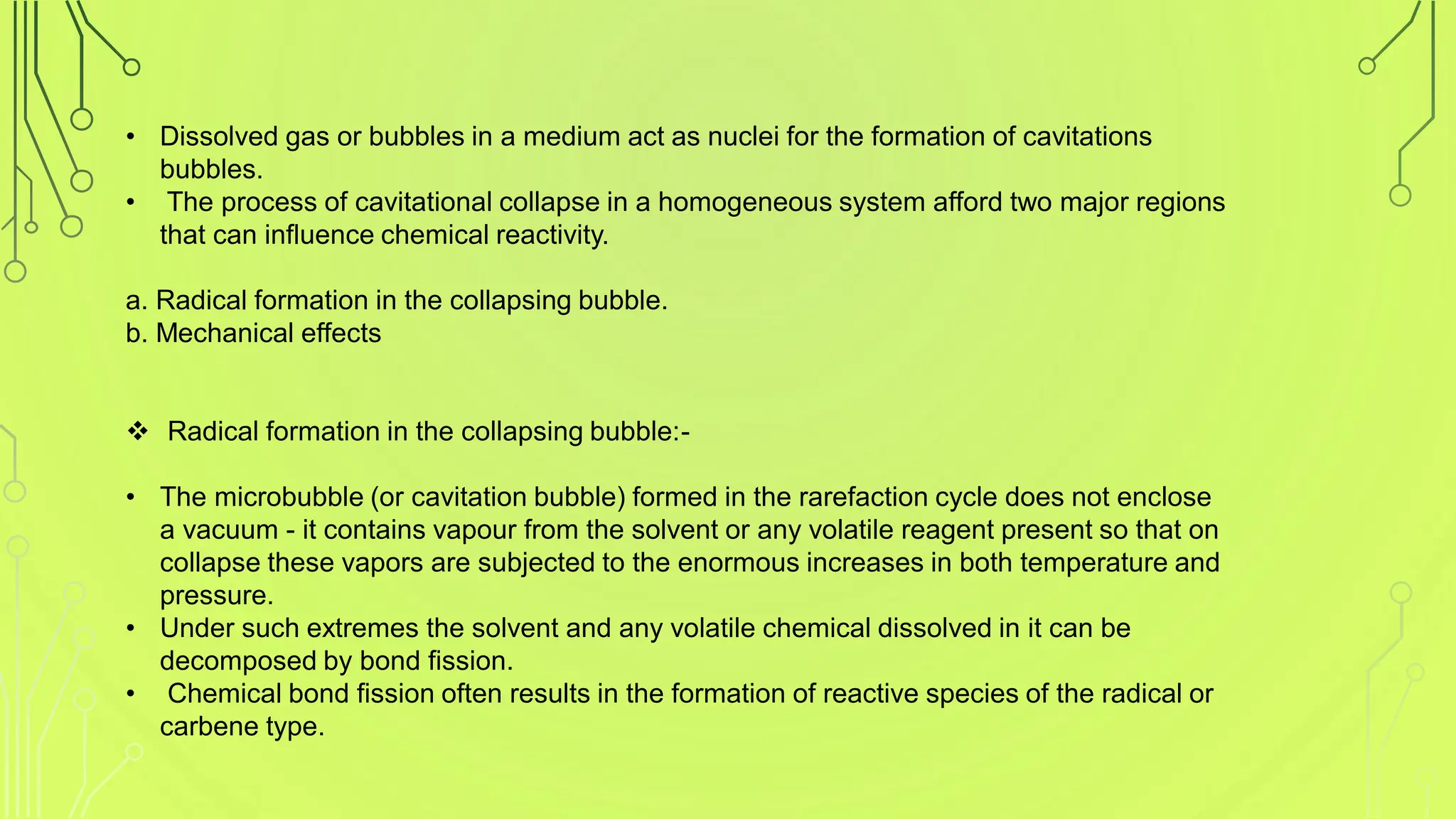
• Dissolved gas or bubbles in a medium act as nuclei for the formation of cavitations
bubbles.
• The process of cavitational collapse in a homogeneous system afford two major regions
that can influence chemical reactivity.
a. Radical formation in the collapsing bubble.
b. Mechanical effects
 Radical formation in the collapsing bubble:-
• The microbubble (or cavitation bubble) formed in the rarefaction cycle does not enclose
a vacuum - it contains vapour from the solvent or any volatile reagent present so that on
collapse these vapors are subjected to the enormous increases in both temperature and
pressure.
• Under such extremes the solvent and any volatile chemical dissolved in it can be
decomposed by bond fission.
• Chemical bond fission often results in the formation of reactive species of the radical or
carbene type.
Mechanical effect:-
• The sudden collapse of a cavitation bubble in an acoustic field result in an inrush of liquid to fill the
partial vacum enclosed by the bubble.
• The shock wave produced by this bubble collapse can disrupt the weak intermolecular forces that
contribute to the structure characteristics of solvents.
• One direct result is the temporary reduction in viscosity that occurs in liquids subject to sonication.
• The disruption can also influence chemical reactivity by altering solvation of the reactive present.
Heterogenous Phase Reaction.
A heterogeneous reaction is a class of reaction that happens between two or more reactants that are
present in two or more different phases, for instance, the phases of the reactants can be solid-liquid, solid-
gas or two immiscible liquids.
There are certain reactions that take place on the surface of another substance. To be more specific, when
two reactants undergo a chemical
HETEROGENOUS SOLID/LIQUID PHASE REACTION.
•Types : Type I
Type II
•Type I : Solid serves as one of the reagents , and is consumed during reaction.
Improves yield , due to dispersing and microsteaming effect of ultrasound.
•Type II: Solid acts as a catalyst or gets consumed.
• Cavitational erosion is major effect which is observed when ultrasonic waves propagate towards or in
the vicinity of solid.
• Example: Oxidaton ,reduction ,coupling reaction, hydroboration .
•Examples include catalytic reactions where a solid catalyst facilitates the reaction of a liquid reactant,
such as hydrogenation of oils using a metal catalyst.
In this type of reaction, at least one reactant is in a solid phase, while the other is in a liquid phase.
The reaction occurs at the interface between the solid and liquid phases.
HETEROGENOUS LIQUID/LIQUID PHASE REACTION.
In this type of reaction, two or more immiscible liquid phases react with each other.
The reaction takes place at the interface between the liquid phases.
Ultrasound much more effective here, because ultrasound generate extremely fine emulsions which
results in very large interfacial contact areas between liquids .
Results are increase in reactivity between species dissolved in separate liquids .
Hence, reacts much faster than conventional phase transfer condition.
Example: Esterification , saponification , hydrolysis ,substitutions , etc.
An example is liquid-liquid extraction, where a solute is transferred from one liquid phase (usually an
organic solvent) to another immiscible liquid phase (usually aqueous) containing the extracting agent.
SYNTHETIC APPLICATIONS :-
1.Esterification:-
Saponification:-
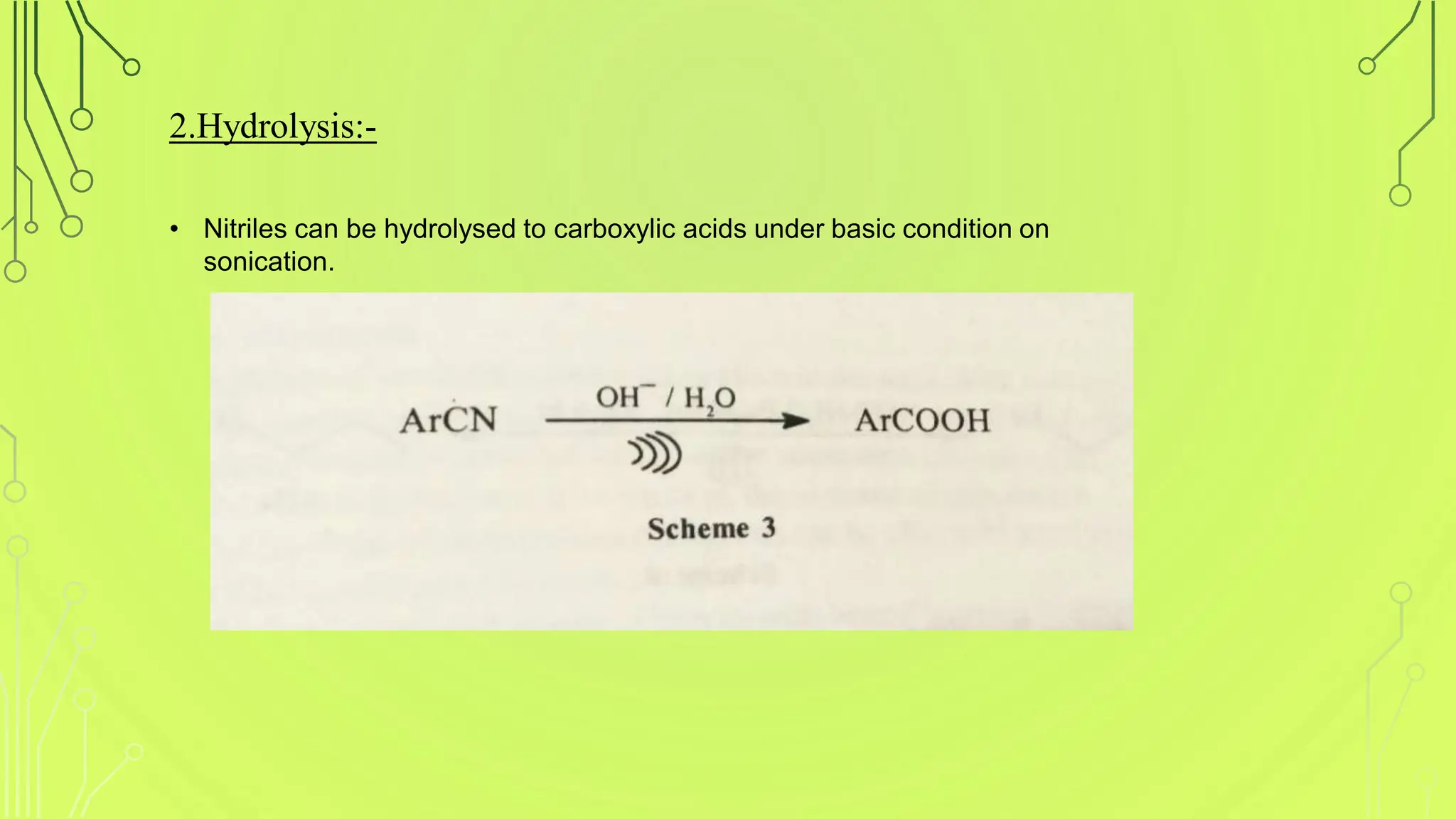
2.Hydrolysis:-
• Nitriles can be hydrolysed to carboxylic acids under basic condition on
sonication.
3.SUBSTITUTION REACTION:-
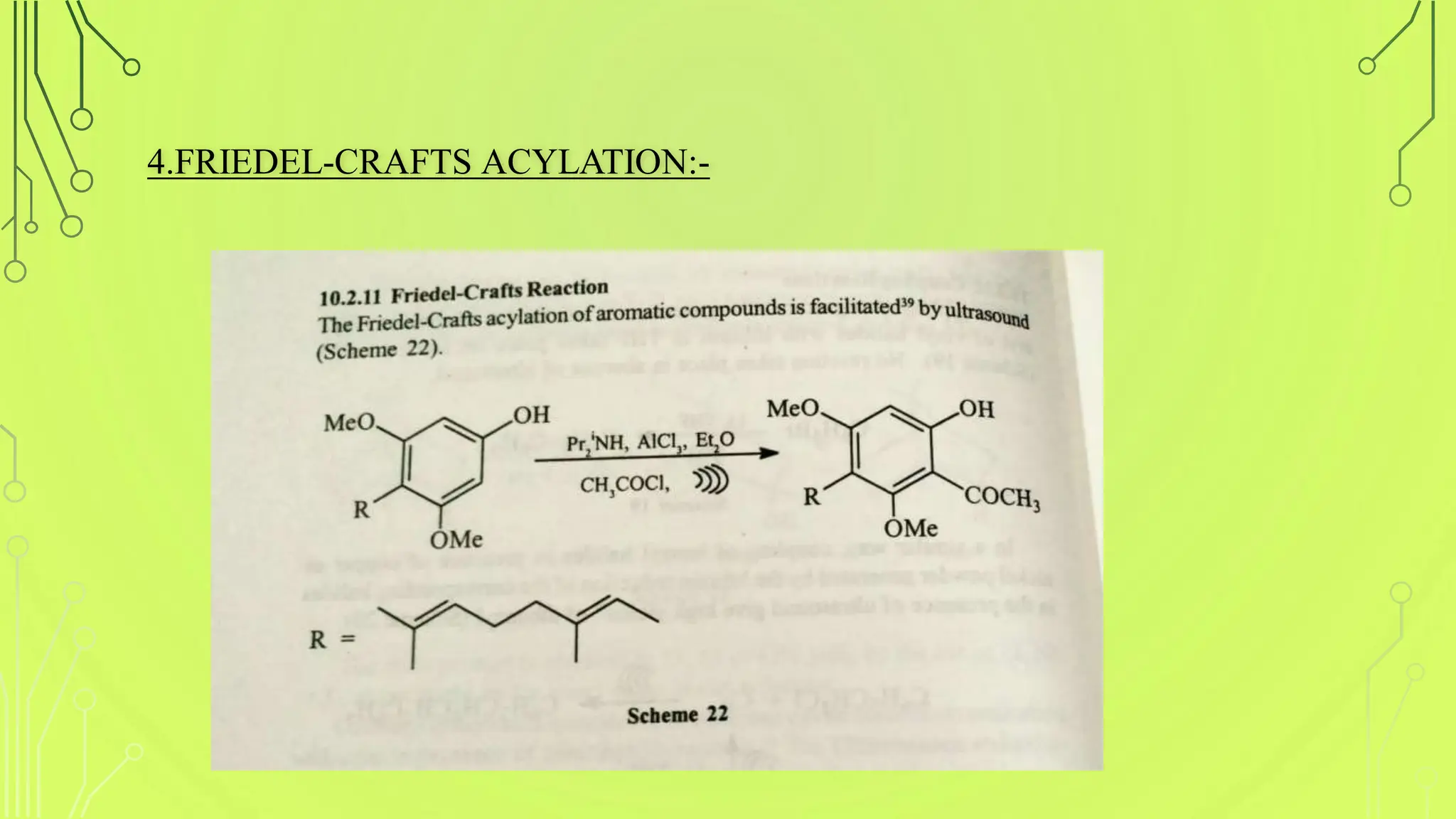
4.FRIEDEL-CRAFTS ACYLATION:-
5.OXIDATION:-
ADVANTAGES OF SONOCHEMISTRY.
 It enhanced properties were observed in the field of kinetics, selectivity,
extraction, dissolution, filtration, crystallinity.
 It acts as a catalyst and thus doesn't have a need to change or replace on a
regular interval. It is environment friendly.
 Certain nanoparticles were produced using sonochemical method conventional
method and the following were the conclusions.
1. Time consuming as its optimum reaction time was 20 min whereas that of
conventional method was 4 hours.
2. Increased yields and average particle size which was due to rapid micromixing
and thus faster reaction.
3. Energy efficient as it saved 92% of the energy.
REFRENCES:-
1. New trends in Green Chemistry, second edition by V.K.Ahluwalia and M.Kidwai.
2. Bhangu, S.K., Ashokkumar, M. (2017). Theory of Sonochemistry. In: Colmenares,
J., Chatel, G. (eds) Sonochemistry. Topics in Current Chemistry Collections.
3. Department of Pharmaceutical Chemistry, College of Pharmacy, Prince Sattam Bin
Abdulaziz University, P.O. Box- 173, Al-Kharj 11942, Saudi Arabia. /bDepartment of
Organic Chemistry, Faculty of Pharmacy, Al-Azhar University, Cairo, Egypt
4. Mason, T.J. (1996). Sonochemistry: Uses of Ultrasound in Chemistry and Related
Disciplines. In: Siegel, R.J. (eds) Ultrasound Angioplasty. Developments in
Cardiovascular Medicine, vol 178. Springer, Boston, MA.
https://doi.org/10.1007/978-1-4613-1243-7_2
Ultrasound Assisted Reaction of M.pharm semester 2

Ultrasound Assisted Reaction of M.pharm semester 2

  • 1.
    ULTRASOUND ASSISTED REACTION PRESENTEDBY – PRIYANSHI R. SAHU M.PHARM 1ST YEAR (PHARMACEUTICAL CHEMISTRY) SEMESTER-II GURUNANAK COLLEGE OF PHARMACY, NAGPUR 440026
  • 2.
    CONTENTS. • 1. Introduction. •2. Sonochemistry. • 3. Mechanism of Sonochemistry. • 4. Phenomenon of acoustic cavitation. • 5. Types of Sonochemical reaction  Heterogenous Solid/Liquid Phase reaction.  Heterogenous Liquid/Liquid Phase reaction.  Homogenous Liquid Phase reaction. • 6. Synthetic Applications. • 7. Refrences.
  • 3.
    INTRODUCTION What is ultrasound? Ultrasoundwaves are sound waves with frequencies above the upper audible limit of human hearing, typically above 20 kHz.The normal range of hearing is between 16Hz to 16kHz, and ultrasound is generally considered to lie between 20kHz to 500MHz. The ultrasound is generated with the help of an instrument having an ultrasonic transducer, a device by which electrical or mechanical energy can be coverted ito sound energy Ultrasound-assisted reactions refer to chemical reactions that are facilitated or enhanced by the application of ultrasound waves. Ultrasonic chemistry is a research field where the reaction is dependent on the acoustic cavitation, that is, the formation, growth, and implosive collapse of the bubbles in the solution. Cavitation is the process in which mechanical activation destroys the attractive forces of molecules in the liquid phase.
  • 4.
    FIG 1:- FREQUENCYRANGES OF SOUND. Commonly accepted subcategories of sound are:- 1. Infrared (below 20Hz) 2. Audible sound (from 20Hz to 20kHz) 3. Ultrasound (from 20kHz to 100kHz)
  • 5.
    SONOCHEMISTRY. • The branchof chemistry dealing with the study of the effect of ultrasound waves, on chemical activity is known as sonochemistry. • Sonochemistry is a green approach which is being used to accelerate synthesis of organic compounds and involves the use of ultrasound technique to promote chemical reactions. • • Sonochemistry is the term used to describe the effect of ultrasonic sound waves on chemical reactions. The terminology is in keeping with that of the longer established techniques which use light (photochemistry) and electricity (electrochemistry) to achieve chemical activation • The principle of sonochemistry arises from acoustic cavitation (formation, growth and implosion of bubbles). • Power ultrasound enhances chemical reactivity in a liquid medium through the generation and destruction of cavitation bubbles. • Sound travels through a medium as a series of compression and rarefaction motion of molecules.
  • 6.
    Sound travels througha medium as a series of compression and rarefaction motion of molecules. During the compression cycle, the average distance between the molecules is reduced and during rarefaction the average distance between the molecules is increases. Fig 2:- Schematic representation of compression and refraction.
  • 8.
    • MECHANISM OFSONOCHEMISTRY:-+ Fig 3:- Schematic representation of the acoustic cavitation phenomenon. Fig 4:- Cavitation dynamics.
  • 9.
    THE PHENOMENON OFACOUSTIC CAVITATION. • The reactions by ultrasonic radiation is based on the concept of an acoustic cavitation effect, which consists on the formation, growth and implosive collapse of bubbles. • With a life span of a few microseconds , at points located in the reaction medium, and makes the temperature and pressure reach levels on the order of 5000 °C and 1000 bar, respectively. • The collapse of these bubbles eventually leads to reach the activation energy, allowing the occurrence of chemical reactions. • The collapsing bubbles provide reaction sites, named hot spots. • At sufficiently high power, the rarefaction cycle may exceed the attractive forces of the molecules of the liquid and cavitation bubbles will form. • It is the fate of these cavities when they collapse in succeeding compression cycles that generates the energy for chemical and mechanical effects.
  • 10.
    TYPES OF SONOCHEMICALREACTION. Types of Sonochemistry Homogenous Liquid Phase Reaction Heterogenous Solid/Liquid Phase Reaction Heterogenous Liquid/Liqid Phase Reaction.
  • 11.
    HOMOGENOUS LIQUID PHASEREACTION. Homogeneous reaction, any of a class of chemical reactions that occur in a single phase (gaseous, liquid, or solid). The most important of homogeneous reactions are the reactions between gases (e.g., the combination of common household gas and oxygen to produce a flame) and the reactions between liquid or substances dissolved in liquids (e.g., the reactions between aqueous solutions of acids and bases). Homogeneous Liquid Phase Reaction is a reaction in which, all reactants and products are in the liquid phase. The reaction occurs uniformly throughout the liquid mixture, with no distinct interfaces or phases. Many organic reactions, such as esterification or hydrolysis reactions in solution, are examples of homogeneous liquid phase reactions.
  • 12.
    • Dissolved gasor bubbles in a medium act as nuclei for the formation of cavitations bubbles. • The process of cavitational collapse in a homogeneous system afford two major regions that can influence chemical reactivity. a. Radical formation in the collapsing bubble. b. Mechanical effects  Radical formation in the collapsing bubble:- • The microbubble (or cavitation bubble) formed in the rarefaction cycle does not enclose a vacuum - it contains vapour from the solvent or any volatile reagent present so that on collapse these vapors are subjected to the enormous increases in both temperature and pressure. • Under such extremes the solvent and any volatile chemical dissolved in it can be decomposed by bond fission. • Chemical bond fission often results in the formation of reactive species of the radical or carbene type.
  • 13.
    Mechanical effect:- • Thesudden collapse of a cavitation bubble in an acoustic field result in an inrush of liquid to fill the partial vacum enclosed by the bubble. • The shock wave produced by this bubble collapse can disrupt the weak intermolecular forces that contribute to the structure characteristics of solvents. • One direct result is the temporary reduction in viscosity that occurs in liquids subject to sonication. • The disruption can also influence chemical reactivity by altering solvation of the reactive present.
  • 14.
    Heterogenous Phase Reaction. Aheterogeneous reaction is a class of reaction that happens between two or more reactants that are present in two or more different phases, for instance, the phases of the reactants can be solid-liquid, solid- gas or two immiscible liquids. There are certain reactions that take place on the surface of another substance. To be more specific, when two reactants undergo a chemical
  • 15.
    HETEROGENOUS SOLID/LIQUID PHASEREACTION. •Types : Type I Type II •Type I : Solid serves as one of the reagents , and is consumed during reaction. Improves yield , due to dispersing and microsteaming effect of ultrasound. •Type II: Solid acts as a catalyst or gets consumed. • Cavitational erosion is major effect which is observed when ultrasonic waves propagate towards or in the vicinity of solid. • Example: Oxidaton ,reduction ,coupling reaction, hydroboration . •Examples include catalytic reactions where a solid catalyst facilitates the reaction of a liquid reactant, such as hydrogenation of oils using a metal catalyst. In this type of reaction, at least one reactant is in a solid phase, while the other is in a liquid phase. The reaction occurs at the interface between the solid and liquid phases.
  • 16.
    HETEROGENOUS LIQUID/LIQUID PHASEREACTION. In this type of reaction, two or more immiscible liquid phases react with each other. The reaction takes place at the interface between the liquid phases. Ultrasound much more effective here, because ultrasound generate extremely fine emulsions which results in very large interfacial contact areas between liquids . Results are increase in reactivity between species dissolved in separate liquids . Hence, reacts much faster than conventional phase transfer condition. Example: Esterification , saponification , hydrolysis ,substitutions , etc. An example is liquid-liquid extraction, where a solute is transferred from one liquid phase (usually an organic solvent) to another immiscible liquid phase (usually aqueous) containing the extracting agent.
  • 17.
  • 18.
  • 19.
    2.Hydrolysis:- • Nitriles canbe hydrolysed to carboxylic acids under basic condition on sonication.
  • 20.
  • 21.
  • 22.
  • 23.
    ADVANTAGES OF SONOCHEMISTRY. It enhanced properties were observed in the field of kinetics, selectivity, extraction, dissolution, filtration, crystallinity.  It acts as a catalyst and thus doesn't have a need to change or replace on a regular interval. It is environment friendly.  Certain nanoparticles were produced using sonochemical method conventional method and the following were the conclusions. 1. Time consuming as its optimum reaction time was 20 min whereas that of conventional method was 4 hours. 2. Increased yields and average particle size which was due to rapid micromixing and thus faster reaction. 3. Energy efficient as it saved 92% of the energy.
  • 24.
    REFRENCES:- 1. New trendsin Green Chemistry, second edition by V.K.Ahluwalia and M.Kidwai. 2. Bhangu, S.K., Ashokkumar, M. (2017). Theory of Sonochemistry. In: Colmenares, J., Chatel, G. (eds) Sonochemistry. Topics in Current Chemistry Collections. 3. Department of Pharmaceutical Chemistry, College of Pharmacy, Prince Sattam Bin Abdulaziz University, P.O. Box- 173, Al-Kharj 11942, Saudi Arabia. /bDepartment of Organic Chemistry, Faculty of Pharmacy, Al-Azhar University, Cairo, Egypt 4. Mason, T.J. (1996). Sonochemistry: Uses of Ultrasound in Chemistry and Related Disciplines. In: Siegel, R.J. (eds) Ultrasound Angioplasty. Developments in Cardiovascular Medicine, vol 178. Springer, Boston, MA. https://doi.org/10.1007/978-1-4613-1243-7_2