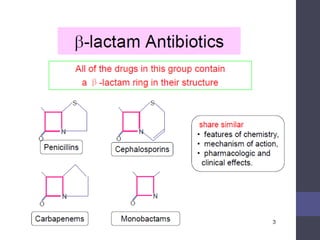
PENICILLINS
G Vijay Narasimha Kumar
Asst. Professor,
Dept.of. Pharmacology
Sri Padmavathi School of Pharmacy
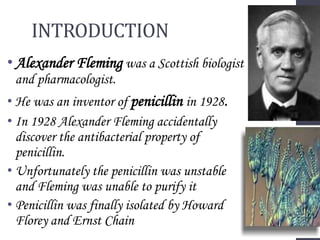
•Alexander Fleming was a Scottish biologist
and pharmacologist.
• He was an inventor of penicillin in 1928.
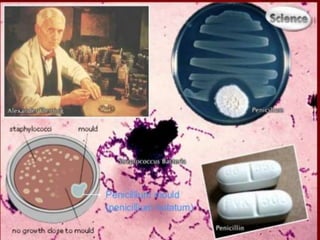
• In 1928 Alexander Fleming accidentally
discover the antibacterial property of
penicillin.
• Unfortunately the penicillin was unstable
and Fleming was unable to purify it
• Penicillin was finally isolated by Howard
Florey and Ernst Chain
INTRODUCTION
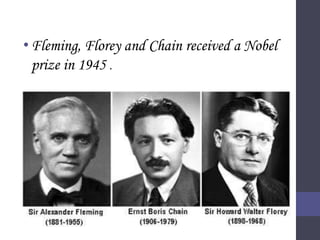
•Fleming, Florey and Chain received a Nobel
prize in 1945 .
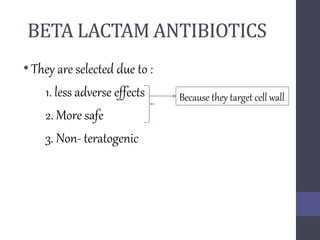
BETA LACTAM ANTIBIOTICS
•They are selected due to :
1. less adverse effects
2. More safe
3. Non- teratogenic
Because they target cell wall
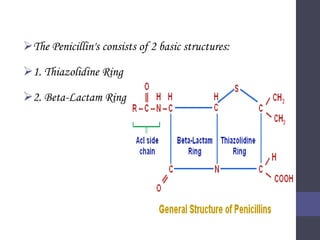
The Penicillin's consists of 2 basic structures:
1. Thiazolidine Ring
2. Beta-Lactam Ring
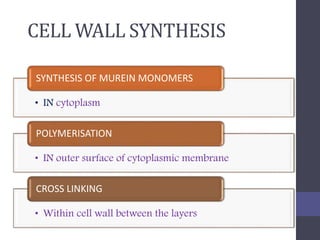
CELL WALL SYNTHESIS
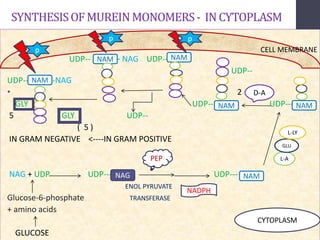
• IN cytoplasm
SYNTHESIS OF MUREIN MONOMERS
• IN outer surface of cytoplasmic membrane
POLYMERISATION
• Within cell wall between the layers
CROSS LINKING
SYNTHESISOFMUREINMONOMERS- INCYTOPLASM
• UDP-- - NAG – NAG UDP---
UDP--
UDP-- -NAG
• 2
GLY UDP-- UDP---
5 GLY UDP--
( 5 )
IN GRAM NEGATIVE <----IN GRAM POSITIVE
NAG + UDP UDP--- UDP---
ENOL PYRUVATE
Glucose-6-phosphate TRANSFERASE
+ amino acids
GLUCOSE
NAG
PEP
NADPH
NAM
L-A
GLU
L-LY
NAM
D-A
NAM
CELL MEMBRANE
NAM
pp
NAM
p
NAM
CYTOPLASM
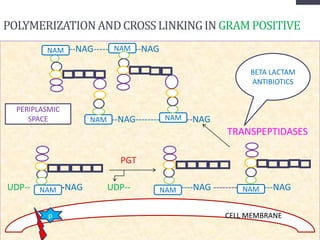
POLYMERIZATIONANDCROSSLINKINGINGRAM POSITIVE
--NAG----- --NAG
--NAG-------- --NAG
TRANSPEPTIDASES
PGT
UDP-- -NAG UDP-- -- ----NAG -------- ---NAG
CELL MEMBRANE
NAM
p
NAM NAM
NAMNAM
NAM
BETA LACTAM
ANTIBIOTICS
NAM
PERIPLASMIC
SPACE
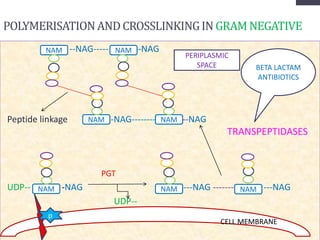
POLYMERISATIONANDCROSSLINKINGINGRAM NEGATIVE
CELL MEMBRANE
--NAG----- --NAG
Peptide linkage --NAG-------- --NAG
TRANSPEPTIDASES
PGT
UDP-- -NAG ----NAG -------- ---NAG
UDP--
CELL MEMBRANE
p
NAM NAM NAM
NAM NAM
NAM NAM
BETA LACTAM
ANTIBIOTICS
PERIPLASMIC
SPACE
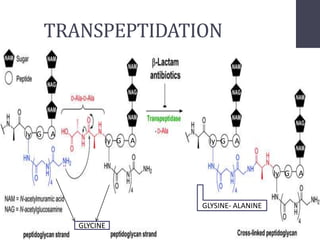
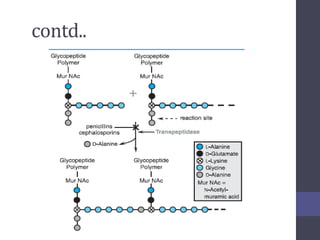
TRANSPEPTIDATION
GLYCINE
ly G A
ly G A ly G A
ly G A
GLYSINE- ALANINE
contd..
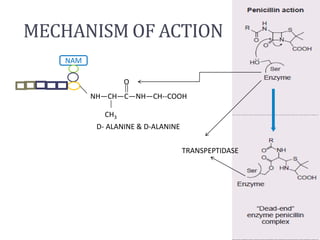
MECHANISM OF ACTION
NAM
NH—CH—C—NH—CH--COOH
CH3
O
D- ALANINE & D-ALANINE
TRANSPEPTIDASE
continued
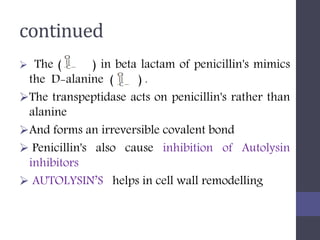
 The ( ) in beta lactam of penicillin's mimics
the D-alanine ( ) .
The transpeptidase acts on penicillin's rather than
alanine
And forms an irreversible covalent bond
 Penicillin's also cause inhibition of Autolysin
inhibitors
 AUTOLYSIN’S helps in cell wall remodelling
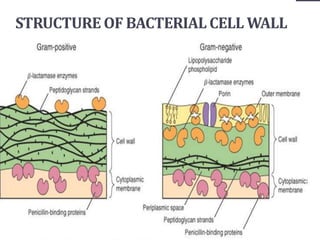
STRUCTURE OF BACTERIAL CELL WALL
peptidoglycan periplasmic
space
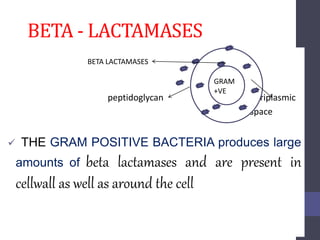
 THE GRAM POSITIVE BACTERIA produces large
amounts of beta lactamases and are present in
cellwall as well as around the cell
BETA - LACTAMASES
GRAM
+VE
BETA LACTAMASES
GRAM
-VE
PERIPLASMIC SPACE
BETA LACTAMASES
TRANSPEPTIDASES
OUTER LIPID LAYER
CELL CYTOPLASMIC MEMBRANE
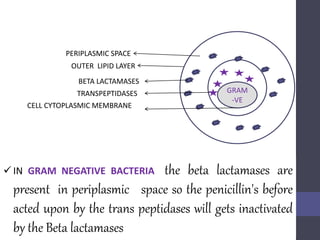
 IN GRAM NEGATIVE BACTERIA the beta lactamases are
present in periplasmic space so the penicillin's before
acted upon by the trans peptidases will gets inactivated
by the Beta lactamases
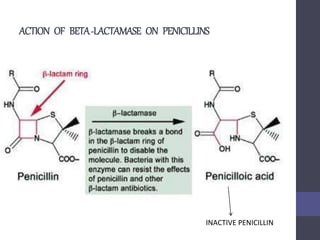
ACTION OF BETA-LACTAMASE ON PENICILLINS
INACTIVE PENICILLIN
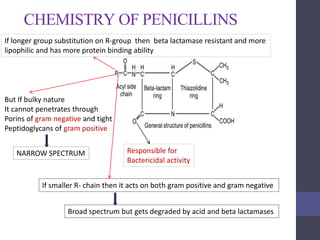
CHEMISTRY OF PENICILLINS
Responsible for
Bactericidal activity
If longer group substitution on R-group then beta lactamase resistant and more
lipophilic and has more protein binding ability
But If bulky nature
It cannot penetrates through
Porins of gram negative and tight
Peptidoglycans of gram positive
NARROW SPECTRUM
If smaller R- chain then it acts on both gram positive and gram negative
Broad spectrum but gets degraded by acid and beta lactamases
CLASSIFICATIONOFPENICILLINS
E.g.: penicillin-G
penicillin-V
Acts on gram
positive – cocci ,
bacilli and gram
negative -cocci
Moderate R-group
E.g.:
Methicillin,Nafcillin,
oxacillin, cloxacillin
,dicloxacilin
Acts on gram
positive – cocci ,
bacilli
Bulky R-group
AMOXYCILLIN,
AMPICILLIN
R- GROUP is
small
Acts on gram
positive and
gram negative
rods and cocci
AMINO
PENICILLINS
CARBENICILLIN,
PIPERACILLIN,
TICARCILLIN
Small R-Group
ANTI-
PSEUDOMONAL
NATURAL PENICILLINS
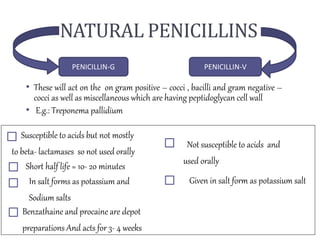
• These will act on the on gram positive – cocci , bacilli and gram negative –
cocci as well as miscellaneous which are having peptidoglycan cell wall
• E.g.: Treponema pallidium
PENICILLIN-G PENICILLIN-V
Susceptible to acids but not mostly
to beta- lactamases so not used orally
Short half life = 10- 20 minutes
In salt forms as potassium and
Sodium salts
Benzathaine and procaine are depot
preparations And acts for 3- 4 weeks
Not susceptible to acids and
used orally
Given in salt form as potassium salt
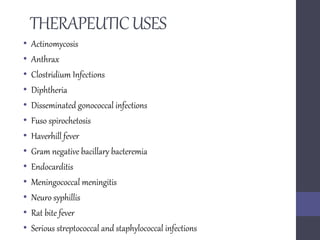
THERAPEUTICUSES
• Actinomycosis
• Anthrax
• Clostridium Infections
• Diphtheria
• Disseminated gonococcal infections
• Fuso spirochetosis
• Haverhill fever
• Gram negative bacillary bacteremia
• Endocarditis
• Meningococcal meningitis
• Neuro syphillis
• Rat bite fever
• Serious streptococcal and staphylococcal infections
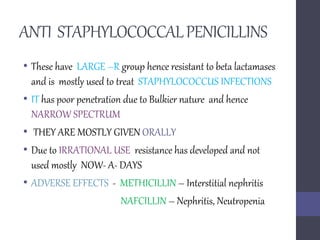
ANTI STAPHYLOCOCCALPENICILLINS
• These have LARGE –R group hence resistant to beta lactamases
and is mostly used to treat STAPHYLOCOCCUS INFECTIONS
• IT has poor penetration due to Bulkier nature and hence
NARROW SPECTRUM
• THEY ARE MOSTLY GIVEN ORALLY
• Due to IRRATIONAL USE resistance has developed and not
used mostly NOW- A- DAYS
• ADVERSE EFFECTS - METHICILLIN – Interstitial nephritis
NAFCILLIN – Nephritis, Neutropenia
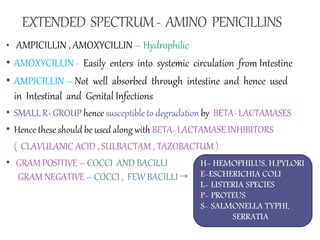
EXTENDED SPECTRUM- AMINO PENICILLINS
• AMPICILLIN , AMOXYCILLIN – Hydrophilic
• AMOXYCILLIN - Easily enters into systemic circulation from Intestine
• AMPICILLIN – Not well absorbed through intestine and hence used
in Intestinal and Genital Infections
• SMALL R- GROUP hence susceptible to degradation by BETA- LACTAMASES
• Hence these should be used along with BETA- LACTAMASE INHIBITORS
( CLAVULANIC ACID , SULBACTAM , TAZOBACTUM )
• GRAM POSITIVE – COCCI AND BACILLI
GRAM NEGATIVE – COCCI , FEW BACILLI
H- HEMOPHILUS, H.PYLORI
E-ESCHERICHIA COLI
L- LISTERIA SPECIES
P- PROTEUS
S- SALMONELLA TYPHI,
SERRATIA
INDICATIONS
• OTITIS MEDIS – DUE TO STREPTOCOCCUS
• SINUSITIS
• SKIN AND SOFT TISSUE INFECTIONS
• URINARY TRACT INFECTIONS
• COMMUNITY ACQUIRED PNEUMONIA
• KLEBSIELLA PNEUMONIA
• DENTAL ABSCESS
• HELICOBACTER PYLORI
ANTI-PSEUDOMONAL PENICILLINS
• CARBENICILLIN AND PIPERACILLIN ( MOST POTENT)
• SMALL- R GROUP and hence susceptible to beta- lactamases
• Hence they should be given along with beta- lactamase inhibitors
• COMBINATIONS = PIPERACILLIN + SULBACTAM AND PIPERACILLIN + TAZOBACTAM,
IV, COSTLY AND used
in severe infections such
as HEAD INJURY
• INDICATIONS - Appendicitis , Peritonitis , Septicemia, skin Infections
Endometritis , Catheter Related Blood Infections
PHARMACOKINETICS
• ORAL- ANTI- STAPHYLOCOCCAL
AMOXYCILLIN, PENICILLIN- V
• PARENTERAL – PENICILLIN- G, ANTI PSEUDOMONAL PENICILLINS,
AMOXYCILLIN
• DISTRIBUTION- Well Distributed In Extracellular Fluids But DONOT ENTER
Intracellular Fluids
• AS they are HYDROPHILIC they cannot CROSS BLOOD BRAIN BARRIER
• BUT in case of MENINGITIS THEY CAN CROSS BLOOD BRAIN BARRIER
they cross placental barrier.
• They are not metabolized mostly and hence dose adjustment is not required in
hepatic dysfunction
CONTD….
• PENICILLINS are Hydrophilic and undergoes renal excretion
10% glomerular 90% tubular secretion
• PROBENICID competes with PENICILLINS for ORGANIC
ACID TRANSPORTER and secretes into lumen.
• This decreases tubular secretion of penicillin and increased
penicillin Duration of action.
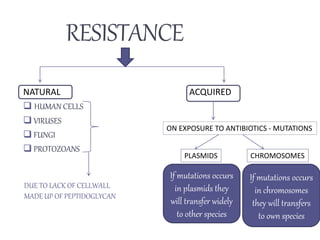
RESISTANCE
NATURAL ACQUIRED
 HUMAN CELLS
 VIRUSES
 FUNGI
 PROTOZOANS
DUE TO LACK OF CELLWALL
MADE UP OF PEPTIDOGLYCAN
ON EXPOSURE TO ANTIBIOTICS - MUTATIONS
PLASMIDS CHROMOSOMES
If mutations occurs
in plasmids they
will transfer widely
to other species
If mutations occurs
in chromosomes
they will transfers
to own species
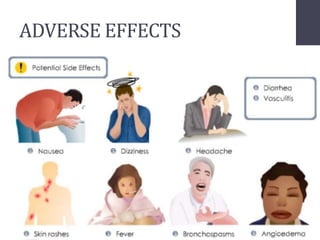
ADVERSE EFFECTS
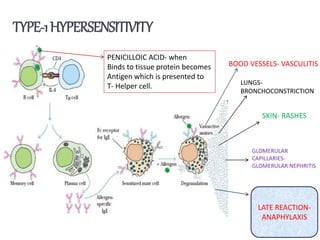
TYPE-1HYPERSENSITIVITY
BOOD VESSELS- VASCULITIS
LUNGS-
BRONCHOCONSTRICTION
SKIN- RASHES
GLOMERULAR
CAPILLARIES-
GLOMERULAR NEPHRITIS
PENICILLOIC ACID- when
Binds to tissue protein becomes
Antigen which is presented to
T- Helper cell.
LATE REACTION-
ANAPHYLAXIS
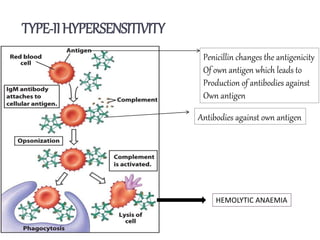
TYPE-IIHYPERSENSITIVITY
Penicillin changes the antigenicity
Of own antigen which leads to
Production of antibodies against
Own antigen
Antibodies against own antigen
HEMOLYTIC ANAEMIA
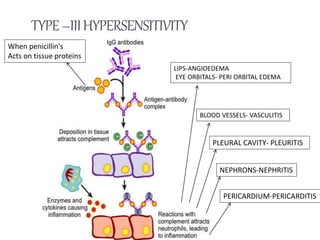
TYPE–IIIHYPERSENSITIVITY
When penicillin's
Acts on tissue proteins
LIPS-ANGIOEDEMA
EYE ORBITALS- PERI ORBITAL EDEMA
BLOOD VESSELS- VASCULITIS
NEPHRONS-NEPHRITIS
PLEURAL CAVITY- PLEURITIS
PERICARDIUM-PERICARDITIS
Contd…
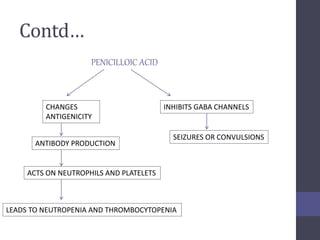
PENICILLOIC ACID
CHANGES
ANTIGENICITY
ANTIBODY PRODUCTION
ACTS ON NEUTROPHILS AND PLATELETS
LEADS TO NEUTROPENIA AND THROMBOCYTOPENIA
INHIBITS GABA CHANNELS
SEIZURES OR CONVULSIONS
Contd..
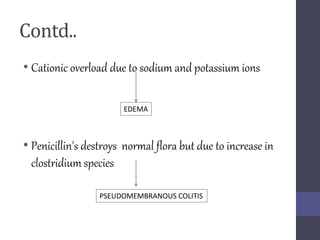
• Cationic overload due to sodium and potassium ions
• Penicillin's destroys normal flora but due to increase in
clostridium species
EDEMA
PSEUDOMEMBRANOUS COLITIS

Penicillins

  • 1.
    PENICILLINS G Vijay NarasimhaKumar Asst. Professor, Dept.of. Pharmacology Sri Padmavathi School of Pharmacy
  • 2.
    •Alexander Fleming wasa Scottish biologist and pharmacologist. • He was an inventor of penicillin in 1928. • In 1928 Alexander Fleming accidentally discover the antibacterial property of penicillin. • Unfortunately the penicillin was unstable and Fleming was unable to purify it • Penicillin was finally isolated by Howard Florey and Ernst Chain INTRODUCTION
  • 3.
    •Fleming, Florey andChain received a Nobel prize in 1945 .
  • 6.
    BETA LACTAM ANTIBIOTICS •Theyare selected due to : 1. less adverse effects 2. More safe 3. Non- teratogenic Because they target cell wall
  • 7.
    The Penicillin's consistsof 2 basic structures: 1. Thiazolidine Ring 2. Beta-Lactam Ring
  • 8.
    CELL WALL SYNTHESIS •IN cytoplasm SYNTHESIS OF MUREIN MONOMERS • IN outer surface of cytoplasmic membrane POLYMERISATION • Within cell wall between the layers CROSS LINKING
  • 9.
    SYNTHESISOFMUREINMONOMERS- INCYTOPLASM • UDP--- NAG – NAG UDP--- UDP-- UDP-- -NAG • 2 GLY UDP-- UDP--- 5 GLY UDP-- ( 5 ) IN GRAM NEGATIVE <----IN GRAM POSITIVE NAG + UDP UDP--- UDP--- ENOL PYRUVATE Glucose-6-phosphate TRANSFERASE + amino acids GLUCOSE NAG PEP NADPH NAM L-A GLU L-LY NAM D-A NAM CELL MEMBRANE NAM pp NAM p NAM CYTOPLASM
  • 10.
    POLYMERIZATIONANDCROSSLINKINGINGRAM POSITIVE --NAG----- --NAG --NAG----------NAG TRANSPEPTIDASES PGT UDP-- -NAG UDP-- -- ----NAG -------- ---NAG CELL MEMBRANE NAM p NAM NAM NAMNAM NAM BETA LACTAM ANTIBIOTICS NAM PERIPLASMIC SPACE
  • 11.
    POLYMERISATIONANDCROSSLINKINGINGRAM NEGATIVE CELL MEMBRANE --NAG-------NAG Peptide linkage --NAG-------- --NAG TRANSPEPTIDASES PGT UDP-- -NAG ----NAG -------- ---NAG UDP-- CELL MEMBRANE p NAM NAM NAM NAM NAM NAM NAM BETA LACTAM ANTIBIOTICS PERIPLASMIC SPACE
  • 12.
    TRANSPEPTIDATION GLYCINE ly G A lyG A ly G A ly G A GLYSINE- ALANINE
  • 13.
  • 14.
  • 15.
    continued  The () in beta lactam of penicillin's mimics the D-alanine ( ) . The transpeptidase acts on penicillin's rather than alanine And forms an irreversible covalent bond  Penicillin's also cause inhibition of Autolysin inhibitors  AUTOLYSIN’S helps in cell wall remodelling
  • 16.
  • 17.
    peptidoglycan periplasmic space  THEGRAM POSITIVE BACTERIA produces large amounts of beta lactamases and are present in cellwall as well as around the cell BETA - LACTAMASES GRAM +VE BETA LACTAMASES
  • 18.
    GRAM -VE PERIPLASMIC SPACE BETA LACTAMASES TRANSPEPTIDASES OUTERLIPID LAYER CELL CYTOPLASMIC MEMBRANE  IN GRAM NEGATIVE BACTERIA the beta lactamases are present in periplasmic space so the penicillin's before acted upon by the trans peptidases will gets inactivated by the Beta lactamases
  • 19.
    ACTION OF BETA-LACTAMASEON PENICILLINS INACTIVE PENICILLIN
  • 20.
    CHEMISTRY OF PENICILLINS Responsiblefor Bactericidal activity If longer group substitution on R-group then beta lactamase resistant and more lipophilic and has more protein binding ability But If bulky nature It cannot penetrates through Porins of gram negative and tight Peptidoglycans of gram positive NARROW SPECTRUM If smaller R- chain then it acts on both gram positive and gram negative Broad spectrum but gets degraded by acid and beta lactamases
  • 21.
    CLASSIFICATIONOFPENICILLINS E.g.: penicillin-G penicillin-V Acts ongram positive – cocci , bacilli and gram negative -cocci Moderate R-group E.g.: Methicillin,Nafcillin, oxacillin, cloxacillin ,dicloxacilin Acts on gram positive – cocci , bacilli Bulky R-group AMOXYCILLIN, AMPICILLIN R- GROUP is small Acts on gram positive and gram negative rods and cocci AMINO PENICILLINS CARBENICILLIN, PIPERACILLIN, TICARCILLIN Small R-Group ANTI- PSEUDOMONAL
  • 22.
    NATURAL PENICILLINS • Thesewill act on the on gram positive – cocci , bacilli and gram negative – cocci as well as miscellaneous which are having peptidoglycan cell wall • E.g.: Treponema pallidium PENICILLIN-G PENICILLIN-V Susceptible to acids but not mostly to beta- lactamases so not used orally Short half life = 10- 20 minutes In salt forms as potassium and Sodium salts Benzathaine and procaine are depot preparations And acts for 3- 4 weeks Not susceptible to acids and used orally Given in salt form as potassium salt
  • 23.
    THERAPEUTICUSES • Actinomycosis • Anthrax •Clostridium Infections • Diphtheria • Disseminated gonococcal infections • Fuso spirochetosis • Haverhill fever • Gram negative bacillary bacteremia • Endocarditis • Meningococcal meningitis • Neuro syphillis • Rat bite fever • Serious streptococcal and staphylococcal infections
  • 24.
    ANTI STAPHYLOCOCCALPENICILLINS • Thesehave LARGE –R group hence resistant to beta lactamases and is mostly used to treat STAPHYLOCOCCUS INFECTIONS • IT has poor penetration due to Bulkier nature and hence NARROW SPECTRUM • THEY ARE MOSTLY GIVEN ORALLY • Due to IRRATIONAL USE resistance has developed and not used mostly NOW- A- DAYS • ADVERSE EFFECTS - METHICILLIN – Interstitial nephritis NAFCILLIN – Nephritis, Neutropenia
  • 25.
    EXTENDED SPECTRUM- AMINOPENICILLINS • AMPICILLIN , AMOXYCILLIN – Hydrophilic • AMOXYCILLIN - Easily enters into systemic circulation from Intestine • AMPICILLIN – Not well absorbed through intestine and hence used in Intestinal and Genital Infections • SMALL R- GROUP hence susceptible to degradation by BETA- LACTAMASES • Hence these should be used along with BETA- LACTAMASE INHIBITORS ( CLAVULANIC ACID , SULBACTAM , TAZOBACTUM ) • GRAM POSITIVE – COCCI AND BACILLI GRAM NEGATIVE – COCCI , FEW BACILLI H- HEMOPHILUS, H.PYLORI E-ESCHERICHIA COLI L- LISTERIA SPECIES P- PROTEUS S- SALMONELLA TYPHI, SERRATIA
  • 26.
    INDICATIONS • OTITIS MEDIS– DUE TO STREPTOCOCCUS • SINUSITIS • SKIN AND SOFT TISSUE INFECTIONS • URINARY TRACT INFECTIONS • COMMUNITY ACQUIRED PNEUMONIA • KLEBSIELLA PNEUMONIA • DENTAL ABSCESS • HELICOBACTER PYLORI
  • 27.
    ANTI-PSEUDOMONAL PENICILLINS • CARBENICILLINAND PIPERACILLIN ( MOST POTENT) • SMALL- R GROUP and hence susceptible to beta- lactamases • Hence they should be given along with beta- lactamase inhibitors • COMBINATIONS = PIPERACILLIN + SULBACTAM AND PIPERACILLIN + TAZOBACTAM, IV, COSTLY AND used in severe infections such as HEAD INJURY • INDICATIONS - Appendicitis , Peritonitis , Septicemia, skin Infections Endometritis , Catheter Related Blood Infections
  • 28.
    PHARMACOKINETICS • ORAL- ANTI-STAPHYLOCOCCAL AMOXYCILLIN, PENICILLIN- V • PARENTERAL – PENICILLIN- G, ANTI PSEUDOMONAL PENICILLINS, AMOXYCILLIN • DISTRIBUTION- Well Distributed In Extracellular Fluids But DONOT ENTER Intracellular Fluids • AS they are HYDROPHILIC they cannot CROSS BLOOD BRAIN BARRIER • BUT in case of MENINGITIS THEY CAN CROSS BLOOD BRAIN BARRIER they cross placental barrier. • They are not metabolized mostly and hence dose adjustment is not required in hepatic dysfunction
  • 29.
    CONTD…. • PENICILLINS areHydrophilic and undergoes renal excretion 10% glomerular 90% tubular secretion • PROBENICID competes with PENICILLINS for ORGANIC ACID TRANSPORTER and secretes into lumen. • This decreases tubular secretion of penicillin and increased penicillin Duration of action.
  • 30.
    RESISTANCE NATURAL ACQUIRED  HUMANCELLS  VIRUSES  FUNGI  PROTOZOANS DUE TO LACK OF CELLWALL MADE UP OF PEPTIDOGLYCAN ON EXPOSURE TO ANTIBIOTICS - MUTATIONS PLASMIDS CHROMOSOMES If mutations occurs in plasmids they will transfer widely to other species If mutations occurs in chromosomes they will transfers to own species
  • 31.
  • 32.
    TYPE-1HYPERSENSITIVITY BOOD VESSELS- VASCULITIS LUNGS- BRONCHOCONSTRICTION SKIN-RASHES GLOMERULAR CAPILLARIES- GLOMERULAR NEPHRITIS PENICILLOIC ACID- when Binds to tissue protein becomes Antigen which is presented to T- Helper cell. LATE REACTION- ANAPHYLAXIS
  • 33.
    TYPE-IIHYPERSENSITIVITY Penicillin changes theantigenicity Of own antigen which leads to Production of antibodies against Own antigen Antibodies against own antigen HEMOLYTIC ANAEMIA
  • 34.
    TYPE–IIIHYPERSENSITIVITY When penicillin's Acts ontissue proteins LIPS-ANGIOEDEMA EYE ORBITALS- PERI ORBITAL EDEMA BLOOD VESSELS- VASCULITIS NEPHRONS-NEPHRITIS PLEURAL CAVITY- PLEURITIS PERICARDIUM-PERICARDITIS
  • 35.
    Contd… PENICILLOIC ACID CHANGES ANTIGENICITY ANTIBODY PRODUCTION ACTSON NEUTROPHILS AND PLATELETS LEADS TO NEUTROPENIA AND THROMBOCYTOPENIA INHIBITS GABA CHANNELS SEIZURES OR CONVULSIONS
  • 36.
    Contd.. • Cationic overloaddue to sodium and potassium ions • Penicillin's destroys normal flora but due to increase in clostridium species EDEMA PSEUDOMEMBRANOUS COLITIS