Jayendra N Chaudhary
M Pharm (Pharmacology)*
L M College of Pharmacy
Amadavad,Gujrat1,
Introduction
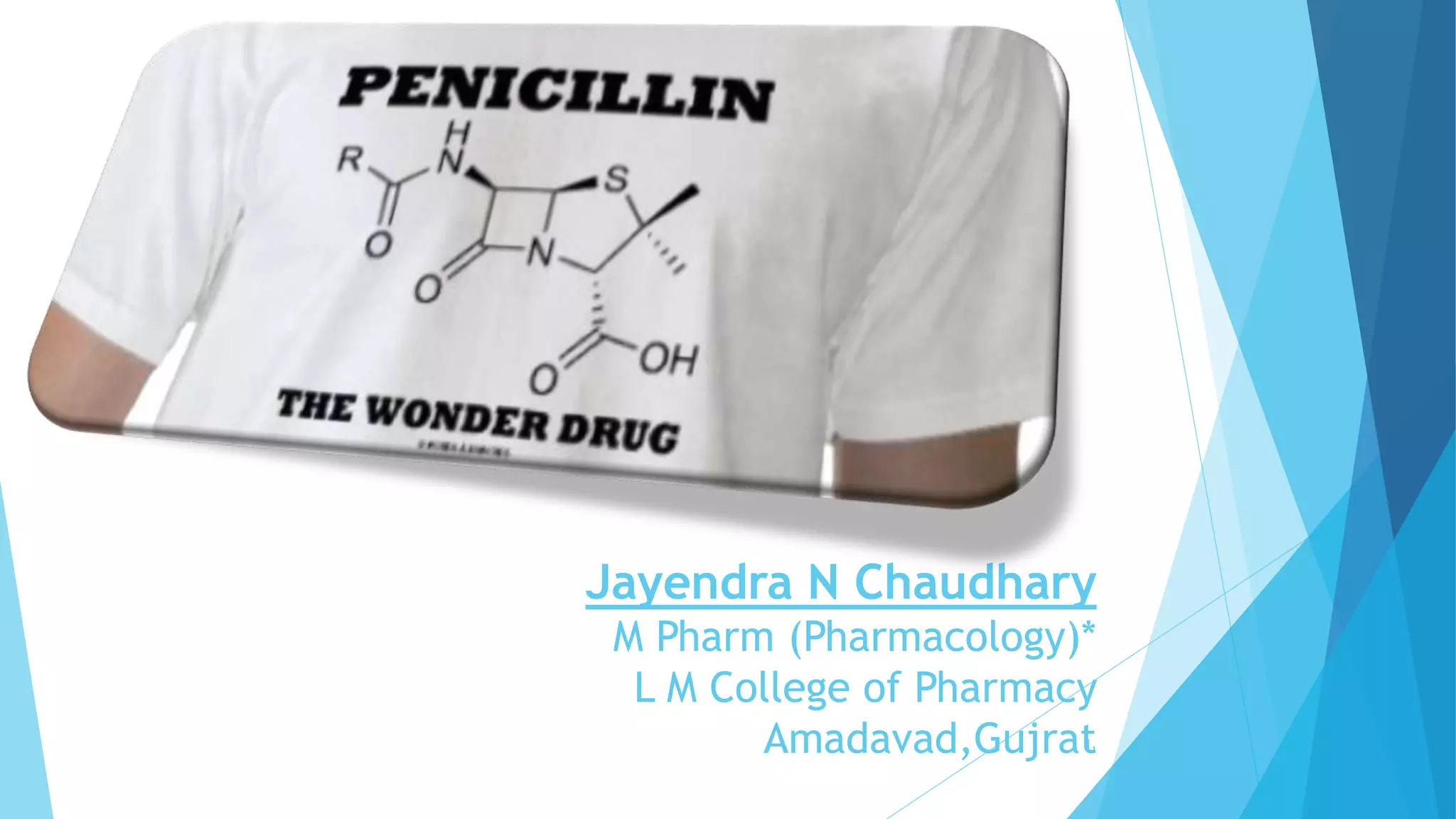
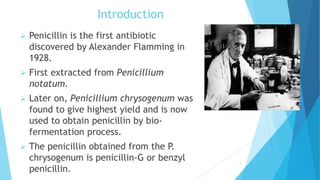
 Penicillin is the first antibiotic
discovered by Alexander Flamming in
1928.
 First extracted from Penicillium
notatum.
 Later on, Penicillium chrysogenum was
found to give highest yield and is now
used to obtain penicillin by bio-
fermentation process.
 The penicillin obtained from the P.
chrysogenum is penicillin-G or benzyl
penicillin.
2
 In 1930, Cecil George Paine, a pathologist treated
ophthalmia neonatorum, a gonococcal infection in
infants and achieved the first recorded cure with
penicillin.
 In 1939, Australian scientist Howard Florey and a team of
researchers made progress in showing the in vivo
bactericidal action of penicillin.
 In 1940 they showed that penicillin effectively cured
bacterial infection in mice.
 By late 1940, the Oxford team under Howard Florey had
devised a method of mass-producing the drug, but yields
remained low.
 Florey and Chain shared the 1945 Nobel Prize in Medicine
with Fleming for their work
3
4
5
MECHANISM OF ACTION
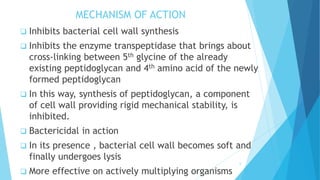
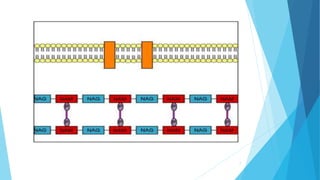
 Inhibits bacterial cell wall synthesis
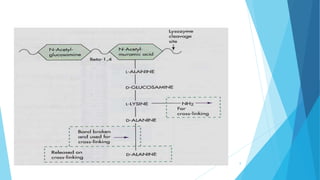
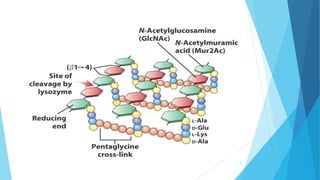
 Inhibits the enzyme transpeptidase that brings about
cross-linking between 5th glycine of the already
existing peptidoglycan and 4th amino acid of the newly
formed peptidoglycan
 In this way, synthesis of peptidoglycan, a component
of cell wall providing rigid mechanical stability, is
inhibited.
 Bactericidal in action
 In its presence , bacterial cell wall becomes soft and
finally undergoes lysis
 More effective on actively multiplying organisms
6
7
8
9
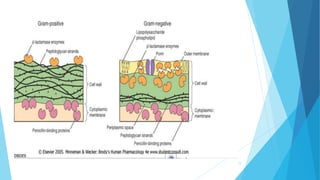
 There are additional, related targets for the action of
penicillin. These are collectively termed as Penicillin
Binding Proteins(PBPs).
 All bacteria have several such entities ;
for example S. aureus - 4 PBPs
E.coli- at least 7 PBPs
 The higher mol.wt.PBPs of E.coli include
transpeptidase while other include those that are
necessary for maintenance of rod-like shape of
bacterium and for septum formation at division.
 Hence inhibition of the activities of other PBPs may
cause delayed lysis or the production of long ,
filamentous forms of bacterium.
10
11
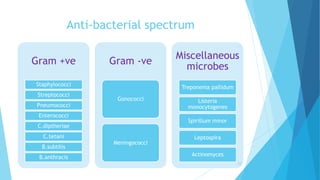
Anti-bacterial spectrum
Gram +ve
Staphylococci
Streptococci
Pneumococci
Enterococci
C.diptheriae
C.tetani
B.subtilis
B.anthracis
Gram -ve
Gonococci
Meningococci
Miscellaneous
microbes
Treponema pallidum
Listeria
monocytogenes
Spirillum minor
Leptospira
Actinomyces
12
PHARMACOKINETIC
 On oral administration, it is absorbed from duodenum.
 Easily destroyed by gastric acid and food interferes with its
absorption. Thus, it should be given 30 min prior or 2-3 hrs.
after meals.
 Peak concentrations are achieved within 30-60 min.
 If given through IM route, peak levels are achieved within 15-30
min.
 Plasma protein binding-60%
 High concentrations in kidney, liver, intestine and skin
 Better distribution in infected tissues
 Metabolism:30%in liver.70% is excreted unchanged by tubular
secretion
 Eliminated within 3-4 hrs. 13
THERAPEUTIC USES
 Pneumococcal infections-pneumonia ,emphysema ,pericarditis , meningitis
 Streptococcal infections-pharyngitis , scarlet fever , otitis media ,
mastoiditis ,subacute endocarditis
 Syphilis and gonorrhea
 Meningococcal infections
 Actinomycosis
 Anthrax
 Diphtheria
 Tetanus
 Gas-gangrene
 Rat-bite fever
 Prophylactic treatment of rheumatic fever and other infections mentioned
above. 14
ADVERSE EFFECTS
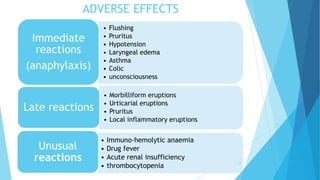
• Flushing
• Pruritus
• Hypotension
• Laryngeal edema
• Asthma
• Colic
• unconsciousness
Immediate
reactions
(anaphylaxis)
• Morbilliform eruptions
• Urticarial eruptions
• Pruritus
• Local inflammatory eruptions
Late reactions
• Immuno-hemolytic anaemia
• Drug fever
• Acute renal insufficiency
• thrombocytopenia
Unusual
reactions 15
Toxicity
 Usually free from toxic effects but deaths have
occurred due to anaphylaxis
 No toxic action on any organ or tissue of the body
 Allergic reactions are more common with
penicillin in oil of procaine penicillin
 These reactions are due to hypersensitivity or
altered reactivity of the patient
16
Penicillin reactions
1. Anaphylactic shock occurring within 1-6 minute after
inj. and at times fatal
2. Delayed reactions : occur after 15-20 minute and are
of a serious nature
3. Reactions at the site of injection after administration
of two or more injections at the same time. E.g.
exfoliative dermatitis
4. Agranulocytosis
 In allergic reactions and anaphylactic shock,
adrenaline, antihistaminics, corticosteroids and
calcium i.v. are drugs of choice.
17
Penicillin Sensitivity Test
 Carried out when pt. is receiving a dose of
penicillin for the first time.
 The pt. is injected slowly with 0.02 ml
(10,000units/ml)of penicillin intradermally and
site of inj. is watched for 15 min.
 There should not be a local reaction exceeding an
area of 10 mm or general reaction after the inj.
18
Repository Preparations of Penicillin-G
 Penicillin-G is rapidly excreted and the duration
of action is very short.
 Moreover, because of poor absorption and
destruction by gastric acid, it has to be given by
i.m. route.
 It is inconvenient to give injections 4 hourly
 To overcome this difficulty various repository
preparations are available
19
1. Procaine benzylpenicillin:12-14 hrs duration of
action.
2. Fortified benzylpenicillin : procaine
benzylpenicillin combined with benzylpenicillin. Its
duration of action is 24 hrs.
3. Procaine penicillin in oil with 2% aluminium
monostearate (PAM): produces action for 72 hrs.
4. Benzathine penicillin: dibenzylethylene diamine
salt of benzyl penicillin having action for 2-3 weeks.
5. Penicillin with probenecid,PAHA or
carinamide : these agents prevent tubular secretion
of pcn and hence increase duration of action.
20
Disadvantages of Penicillin-G
 Inactivated by gastric acid
 Rapidly excreted
 Shorter duration of action
 Inactivated by penicillinase enzyme and so
resistance develops quickly(particularly with
staphylococci)
 Poor distribution to brain
 Narrow anti-bacterial spectrum
 Anaphylaxis is common
o These disadvantages made it essential to have
certain semi-synthetic penicillins.
21
SEMI-SYNTHETIC PENICILLINS
1. Acid resistant penicillins (Oral penicillins):
o penicillin V
o Phenethicillin
o Propacillin
2. Penicillinase resistant penicillins:
o Methicillin
o Cloxacillin
o Oxacillin
o Dicloxacillin
o quinacillin
22
3. Extended spectrum penicillin:
a) Amino penicillins: ampicillin , amoxicillin ,
pivampicillin , bacampicillin , talampicillin
b) Carboxy penicillins: carbenicillin , ticarcillin
c) Ureidopenicillins: piperacillin , azlocillin
4. Reversed spectrum penicillins:
o Mecillinam
o Pivmecillinam
o Temocillin
23
1. Acid resistant Penicillins
 Less effective as compared to benzyl penicillin
but they can be given orally.
 Sensitive to penicillinase enzyme.
 Anti bacterial spectrum is similar to that of
benzyl penicillin.
 Used in less serious infections of pneumococci and
streptococci.
 E.g. Penicillin-V, Phenethicillin, Propacillin.
24
2. Penicillinase resistant Penicillins
 They are also acid resistant (except methicillin).
 Methicillin is less effective than penicillin-G. It is
however, used in staphylococal infections.
 Cloxacillin is 5-10 times more potent than
methicillin. It may, however, produce allergic
reactions.
 Mainly useful in staphylococcal infections.
25
3. Extended spectrum Penicillins
• All broad spectrum penicillins are sensitive to enzyme
penicillinase.
Ampicillin
 semi-synthetic antibiotic derived from 6-APA.
 Antimicrobial spectrum:
1. Gram +ve: Streptococcus faecalis, S. pneumoniae
and Haemolytic streptococci
2. Gram –ve: E. coli,H. influenza, Salmonella and
Shigella
3. Listeria monocytogenes – highly sensitive
 MIC is 0.02-6 mcg/ml
26
 Stable in gastric secretion and is well absorbed
from GI tract after oral administration.
 Food interferes with the absorption.
 Peak concentrations in the serum are obtained in
about 1-2 hrs and are reported to range from
0.8-8.5 mcg/ml
 Anhydrous ampicillin produce earlier and higher
serum levels.
27
Absorption and Fate:
Therapeutic Uses :
1. Respiratory tract infections : pneumonia, acute
and chronic bronchitis
2. Urinary tract infections : cystitis and other lower
infections, acute or chronic pyelonephriris,
gonorrhea; non specific urethritis
3. Typhoid and paratyphoid
4. Shigella infections
28
Amoxicillin
 It is d-8-amino-p-hydroxybenzyl penicillin.
 Resistant towards gastric acid but sensitive to
penicillinase.
 The absorption and penetration of amoxicillin is better
into certain body tissues and fluids as compared to
ampicillin.
 Food doesn’t interfere with absorption.
 Peak plasma concentration are achieved upto twice as
high as that from the same dose of ampicillin
 Effective against same range of microbes as
ampicillin, except shigellosis (less effective) 29
Therapeutic Uses
1. In haemolytic streptococcal, staphylococcal,
meningococcal, gonococcal,Treponema pallidium
and Pneumococcal infections, it is very effective.
2. As prophylactic against pyogenic complications of
viral diseases.
3. In major surgeries , for preparation of the field of
operation.
30
Pivampicillin
 Converted into ampicillin in the body and higher
ampicillin serum level is achieved as compared to
ampicillin alone.
 However, poorly absorbed on oral administration
Talampicillin
 It is also metabolized into ampicillin in the body
and highest level of the latter can be achieved in
the blood and thus bacterial resistance can be
minimized.
31
Bacampicillin
 1-ethoxycarbonyl oxyethyl ester of ampicillin
 Absorbed well after oral administration and is
hydrolyzed to ampicillin.
 Blood concentrations are 50% higher than those
achieved with amoxicillin.
 Effective when given twice a day.
32
Carbenicillin
 Penicillinase susceptible derivative of 6-APA.
 Major advantage of this agent is that it often
cures serious infections caused by Pseudomonas
and Proteus strains resistant to ampicillin.
 Gram –ve micro organisms like E. coli ,
Enterobacter and Salmonella are less sensitive.
 Klebsiella and Serratia are resistant.
 It is not absorbed from GIT and hence must be
given by parenteral route (IM route)
33
 It may cause adverse effects reported for
penicillin.
 In addition, congestive cardiac failure may result
from the administration of excessive Na+(as
carbenicillin is marketed as disodium salt).
 Ticarcillin, azlocillin and piperacillin are similar
to carbenicillin but give higher blood levels and
are effective against gram negative aerobes.
 They are, however, poorly absorbed from oral
route.
34
4. Reversed spectrum penicillins
 Mecilllinam :
 Not effective against Gram +ve cocci but highly
active against Gram –ve bacilli like E.coli,
Salmonella, Klebsiella and Enterobacter.
 Not active against Pseudomonas
 Used in typhoid, dysentery and UTIs.
 Pivmecillinam is prodrug converted to
mecillinam.
35
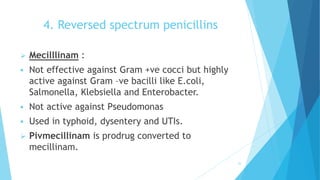
Resistance to penicillins
 Resistance to penicillins may develop due to
following reasons:
1. Decreased affinity between antibiotics and
the target PBPs. E.g. streptococcal species
36
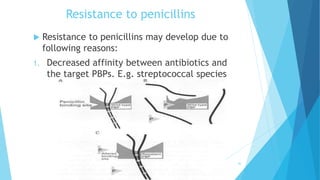
2. Decreased ability
to permeate the
outer membrane
of the bacteria,
thus reducing its
ability to gain
access to the
PBPs, which are
on the inner side
of the membrane
(E.g. Gram –ve
bacteria).
37
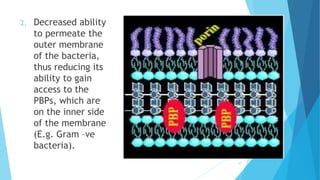
3. Production of beta-lactamases(penicillinase)
which destroy beta-lactam antibiotic before they
can interact with PBPs. E.g., S.aureus, E.coli,
Enterobecter spp, Haemophilus spp
38
39
Beta-lactamase Inhibitors
 They bind with beta-lactamase enzyme and inactive
them.
 Hence, they prevent destruction of beta-lactam
antibiotics.
 Clavulinic acid, sulbactam and tazobactam are the
examples
1. Clavulinic acid:
 Inhibits penicillinase
 Obtained from Streotomyces clavuligerus
 It is beta-lactam compound but devoid of antibacterial
activity.
40
 Enhances the activity of a number of beta-lactam
antibiotics against organisms like S.aureus,
H.influenza, N.gonorrhoea, E.coli, Shigella and
Salmonella.
 It is, however, not effective against penicillinase
produced by Pseudomonas aeruginosa, Serratia
marescen, Citrobact sp., Enterobacter and Proteus.
 Well absorbed orally.
 P’kinetic parameters matches with amoxicillin so it
is combined with amoxicillin.
 Combined with ticarcillin also.
41
2. Sulbactam:
 Semi-synthetic beta-lactamase inhibitor .
 Resembles chemically as well as in activity to
clavulanic acid.
 Can be given orally or parenterally in combination
with ampicillin.
3. Tazobactam:
 similar to sulbactam and combined with
piperacillin.
42
Any Questions ?
43
Thank You
44

Penicillins

  • 1.
    Jayendra N Chaudhary MPharm (Pharmacology)* L M College of Pharmacy Amadavad,Gujrat1,
  • 2.
    Introduction  Penicillin isthe first antibiotic discovered by Alexander Flamming in 1928.  First extracted from Penicillium notatum.  Later on, Penicillium chrysogenum was found to give highest yield and is now used to obtain penicillin by bio- fermentation process.  The penicillin obtained from the P. chrysogenum is penicillin-G or benzyl penicillin. 2
  • 3.
     In 1930,Cecil George Paine, a pathologist treated ophthalmia neonatorum, a gonococcal infection in infants and achieved the first recorded cure with penicillin.  In 1939, Australian scientist Howard Florey and a team of researchers made progress in showing the in vivo bactericidal action of penicillin.  In 1940 they showed that penicillin effectively cured bacterial infection in mice.  By late 1940, the Oxford team under Howard Florey had devised a method of mass-producing the drug, but yields remained low.  Florey and Chain shared the 1945 Nobel Prize in Medicine with Fleming for their work 3
  • 4.
  • 5.
  • 6.
    MECHANISM OF ACTION Inhibits bacterial cell wall synthesis  Inhibits the enzyme transpeptidase that brings about cross-linking between 5th glycine of the already existing peptidoglycan and 4th amino acid of the newly formed peptidoglycan  In this way, synthesis of peptidoglycan, a component of cell wall providing rigid mechanical stability, is inhibited.  Bactericidal in action  In its presence , bacterial cell wall becomes soft and finally undergoes lysis  More effective on actively multiplying organisms 6
  • 7.
  • 8.
  • 9.
  • 10.
     There areadditional, related targets for the action of penicillin. These are collectively termed as Penicillin Binding Proteins(PBPs).  All bacteria have several such entities ; for example S. aureus - 4 PBPs E.coli- at least 7 PBPs  The higher mol.wt.PBPs of E.coli include transpeptidase while other include those that are necessary for maintenance of rod-like shape of bacterium and for septum formation at division.  Hence inhibition of the activities of other PBPs may cause delayed lysis or the production of long , filamentous forms of bacterium. 10
  • 11.
  • 12.
    Anti-bacterial spectrum Gram +ve Staphylococci Streptococci Pneumococci Enterococci C.diptheriae C.tetani B.subtilis B.anthracis Gram-ve Gonococci Meningococci Miscellaneous microbes Treponema pallidum Listeria monocytogenes Spirillum minor Leptospira Actinomyces 12
  • 13.
    PHARMACOKINETIC  On oraladministration, it is absorbed from duodenum.  Easily destroyed by gastric acid and food interferes with its absorption. Thus, it should be given 30 min prior or 2-3 hrs. after meals.  Peak concentrations are achieved within 30-60 min.  If given through IM route, peak levels are achieved within 15-30 min.  Plasma protein binding-60%  High concentrations in kidney, liver, intestine and skin  Better distribution in infected tissues  Metabolism:30%in liver.70% is excreted unchanged by tubular secretion  Eliminated within 3-4 hrs. 13
  • 14.
    THERAPEUTIC USES  Pneumococcalinfections-pneumonia ,emphysema ,pericarditis , meningitis  Streptococcal infections-pharyngitis , scarlet fever , otitis media , mastoiditis ,subacute endocarditis  Syphilis and gonorrhea  Meningococcal infections  Actinomycosis  Anthrax  Diphtheria  Tetanus  Gas-gangrene  Rat-bite fever  Prophylactic treatment of rheumatic fever and other infections mentioned above. 14
  • 15.
    ADVERSE EFFECTS • Flushing •Pruritus • Hypotension • Laryngeal edema • Asthma • Colic • unconsciousness Immediate reactions (anaphylaxis) • Morbilliform eruptions • Urticarial eruptions • Pruritus • Local inflammatory eruptions Late reactions • Immuno-hemolytic anaemia • Drug fever • Acute renal insufficiency • thrombocytopenia Unusual reactions 15
  • 16.
    Toxicity  Usually freefrom toxic effects but deaths have occurred due to anaphylaxis  No toxic action on any organ or tissue of the body  Allergic reactions are more common with penicillin in oil of procaine penicillin  These reactions are due to hypersensitivity or altered reactivity of the patient 16
  • 17.
    Penicillin reactions 1. Anaphylacticshock occurring within 1-6 minute after inj. and at times fatal 2. Delayed reactions : occur after 15-20 minute and are of a serious nature 3. Reactions at the site of injection after administration of two or more injections at the same time. E.g. exfoliative dermatitis 4. Agranulocytosis  In allergic reactions and anaphylactic shock, adrenaline, antihistaminics, corticosteroids and calcium i.v. are drugs of choice. 17
  • 18.
    Penicillin Sensitivity Test Carried out when pt. is receiving a dose of penicillin for the first time.  The pt. is injected slowly with 0.02 ml (10,000units/ml)of penicillin intradermally and site of inj. is watched for 15 min.  There should not be a local reaction exceeding an area of 10 mm or general reaction after the inj. 18
  • 19.
    Repository Preparations ofPenicillin-G  Penicillin-G is rapidly excreted and the duration of action is very short.  Moreover, because of poor absorption and destruction by gastric acid, it has to be given by i.m. route.  It is inconvenient to give injections 4 hourly  To overcome this difficulty various repository preparations are available 19
  • 20.
    1. Procaine benzylpenicillin:12-14hrs duration of action. 2. Fortified benzylpenicillin : procaine benzylpenicillin combined with benzylpenicillin. Its duration of action is 24 hrs. 3. Procaine penicillin in oil with 2% aluminium monostearate (PAM): produces action for 72 hrs. 4. Benzathine penicillin: dibenzylethylene diamine salt of benzyl penicillin having action for 2-3 weeks. 5. Penicillin with probenecid,PAHA or carinamide : these agents prevent tubular secretion of pcn and hence increase duration of action. 20
  • 21.
    Disadvantages of Penicillin-G Inactivated by gastric acid  Rapidly excreted  Shorter duration of action  Inactivated by penicillinase enzyme and so resistance develops quickly(particularly with staphylococci)  Poor distribution to brain  Narrow anti-bacterial spectrum  Anaphylaxis is common o These disadvantages made it essential to have certain semi-synthetic penicillins. 21
  • 22.
    SEMI-SYNTHETIC PENICILLINS 1. Acidresistant penicillins (Oral penicillins): o penicillin V o Phenethicillin o Propacillin 2. Penicillinase resistant penicillins: o Methicillin o Cloxacillin o Oxacillin o Dicloxacillin o quinacillin 22
  • 23.
    3. Extended spectrumpenicillin: a) Amino penicillins: ampicillin , amoxicillin , pivampicillin , bacampicillin , talampicillin b) Carboxy penicillins: carbenicillin , ticarcillin c) Ureidopenicillins: piperacillin , azlocillin 4. Reversed spectrum penicillins: o Mecillinam o Pivmecillinam o Temocillin 23
  • 24.
    1. Acid resistantPenicillins  Less effective as compared to benzyl penicillin but they can be given orally.  Sensitive to penicillinase enzyme.  Anti bacterial spectrum is similar to that of benzyl penicillin.  Used in less serious infections of pneumococci and streptococci.  E.g. Penicillin-V, Phenethicillin, Propacillin. 24
  • 25.
    2. Penicillinase resistantPenicillins  They are also acid resistant (except methicillin).  Methicillin is less effective than penicillin-G. It is however, used in staphylococal infections.  Cloxacillin is 5-10 times more potent than methicillin. It may, however, produce allergic reactions.  Mainly useful in staphylococcal infections. 25
  • 26.
    3. Extended spectrumPenicillins • All broad spectrum penicillins are sensitive to enzyme penicillinase. Ampicillin  semi-synthetic antibiotic derived from 6-APA.  Antimicrobial spectrum: 1. Gram +ve: Streptococcus faecalis, S. pneumoniae and Haemolytic streptococci 2. Gram –ve: E. coli,H. influenza, Salmonella and Shigella 3. Listeria monocytogenes – highly sensitive  MIC is 0.02-6 mcg/ml 26
  • 27.
     Stable ingastric secretion and is well absorbed from GI tract after oral administration.  Food interferes with the absorption.  Peak concentrations in the serum are obtained in about 1-2 hrs and are reported to range from 0.8-8.5 mcg/ml  Anhydrous ampicillin produce earlier and higher serum levels. 27 Absorption and Fate:
  • 28.
    Therapeutic Uses : 1.Respiratory tract infections : pneumonia, acute and chronic bronchitis 2. Urinary tract infections : cystitis and other lower infections, acute or chronic pyelonephriris, gonorrhea; non specific urethritis 3. Typhoid and paratyphoid 4. Shigella infections 28
  • 29.
    Amoxicillin  It isd-8-amino-p-hydroxybenzyl penicillin.  Resistant towards gastric acid but sensitive to penicillinase.  The absorption and penetration of amoxicillin is better into certain body tissues and fluids as compared to ampicillin.  Food doesn’t interfere with absorption.  Peak plasma concentration are achieved upto twice as high as that from the same dose of ampicillin  Effective against same range of microbes as ampicillin, except shigellosis (less effective) 29
  • 30.
    Therapeutic Uses 1. Inhaemolytic streptococcal, staphylococcal, meningococcal, gonococcal,Treponema pallidium and Pneumococcal infections, it is very effective. 2. As prophylactic against pyogenic complications of viral diseases. 3. In major surgeries , for preparation of the field of operation. 30
  • 31.
    Pivampicillin  Converted intoampicillin in the body and higher ampicillin serum level is achieved as compared to ampicillin alone.  However, poorly absorbed on oral administration Talampicillin  It is also metabolized into ampicillin in the body and highest level of the latter can be achieved in the blood and thus bacterial resistance can be minimized. 31
  • 32.
    Bacampicillin  1-ethoxycarbonyl oxyethylester of ampicillin  Absorbed well after oral administration and is hydrolyzed to ampicillin.  Blood concentrations are 50% higher than those achieved with amoxicillin.  Effective when given twice a day. 32
  • 33.
    Carbenicillin  Penicillinase susceptiblederivative of 6-APA.  Major advantage of this agent is that it often cures serious infections caused by Pseudomonas and Proteus strains resistant to ampicillin.  Gram –ve micro organisms like E. coli , Enterobacter and Salmonella are less sensitive.  Klebsiella and Serratia are resistant.  It is not absorbed from GIT and hence must be given by parenteral route (IM route) 33
  • 34.
     It maycause adverse effects reported for penicillin.  In addition, congestive cardiac failure may result from the administration of excessive Na+(as carbenicillin is marketed as disodium salt).  Ticarcillin, azlocillin and piperacillin are similar to carbenicillin but give higher blood levels and are effective against gram negative aerobes.  They are, however, poorly absorbed from oral route. 34
  • 35.
    4. Reversed spectrumpenicillins  Mecilllinam :  Not effective against Gram +ve cocci but highly active against Gram –ve bacilli like E.coli, Salmonella, Klebsiella and Enterobacter.  Not active against Pseudomonas  Used in typhoid, dysentery and UTIs.  Pivmecillinam is prodrug converted to mecillinam. 35
  • 36.
    Resistance to penicillins Resistance to penicillins may develop due to following reasons: 1. Decreased affinity between antibiotics and the target PBPs. E.g. streptococcal species 36
  • 37.
    2. Decreased ability topermeate the outer membrane of the bacteria, thus reducing its ability to gain access to the PBPs, which are on the inner side of the membrane (E.g. Gram –ve bacteria). 37
  • 38.
    3. Production ofbeta-lactamases(penicillinase) which destroy beta-lactam antibiotic before they can interact with PBPs. E.g., S.aureus, E.coli, Enterobecter spp, Haemophilus spp 38
  • 39.
  • 40.
    Beta-lactamase Inhibitors  Theybind with beta-lactamase enzyme and inactive them.  Hence, they prevent destruction of beta-lactam antibiotics.  Clavulinic acid, sulbactam and tazobactam are the examples 1. Clavulinic acid:  Inhibits penicillinase  Obtained from Streotomyces clavuligerus  It is beta-lactam compound but devoid of antibacterial activity. 40
  • 41.
     Enhances theactivity of a number of beta-lactam antibiotics against organisms like S.aureus, H.influenza, N.gonorrhoea, E.coli, Shigella and Salmonella.  It is, however, not effective against penicillinase produced by Pseudomonas aeruginosa, Serratia marescen, Citrobact sp., Enterobacter and Proteus.  Well absorbed orally.  P’kinetic parameters matches with amoxicillin so it is combined with amoxicillin.  Combined with ticarcillin also. 41
  • 42.
    2. Sulbactam:  Semi-syntheticbeta-lactamase inhibitor .  Resembles chemically as well as in activity to clavulanic acid.  Can be given orally or parenterally in combination with ampicillin. 3. Tazobactam:  similar to sulbactam and combined with piperacillin. 42
  • 43.
  • 44.

Editor's Notes

  • #4 Neonatal conjunctivitis
  • #5 G. Raymond Rettew made a significant contribution to the American war effort by his techniques to produce commercial quantities of penicillin.[45] During World War II, penicillin made a major difference in the number of deaths and amputations caused by infected wounds among Allied forces, saving an estimated 12%–15% of lives.[
  • #6 In enzymology, a penicillin amidase (EC 3.5.1.11) is an enzyme that catalyzes the chemical reaction penicillin + H2O a carboxylate + 6-aminopenicillanate
  • #13 Treponema pallidum (spirochete of syphilis)is highly sensitive to penicillin G Spirochaetes (also spelled spirochetes) belong to a phylum of distinctive diderm (double-membrane) bacteria, most of which have long, helically coiled (corkscrew-shaped) cells. Actinomyces (from Greek "actis" ray, beam and "mykes", fungus) is a genus of the actinobacteria class of bacteria. They are all gram-positive. Actinomyces are facultatively anaerobic (except A. meyeri, a strict anaerobe Bacillus is a genus of Gram-positive, rod-shaped bacteria and a member of the phylum Firmicutes
  • #15 Emphysema is a chronic respiratory disease where there is over-inflation of the air sacs (alveoli) in the lungs, causing a decrease in lung function, and often, breathlessness A streptococcal infection, mainly occurring among children, that is characterized by a red skin rash, sore throat, and fever Otitis media is an ear infection of the middle ear, the area just behind the eardrum. It happens when the eustachian tubes, which connect the middle ear to the nose, get blocked with fluid. Mucus, pus, and bacteria can also pool behind the eardrum, causing pressure and pain. Mastoiditis is a serious bacterial infection that affects the mastoid bone behind the ear Actinomycosis is an infection primarily caused by the bacterium Actinomyces israelii. Infection most often occurs in the face and neck region and is characterized by the presence of a slowly enlarging, hard, red lump. The three major types are moist, dry, and gas gangrene. Moist and dry gangrene result from loss of blood circulation due to various causes; gas gangrene occurs in wounds infected by anaerobic bacteria, among which are various species of Clostridium, which break down tissue by gas production and by toxins. An acute febrile illness usually acquired from a rat bite that inoculates either Streptobacillus moniliformis (streptobacillary rat-bite fever) or Spirillium minor (spirillary rat-bite fever Rheumatic fever (RF) is an illness which arises as a complication of untreated or inadequately treated strep throat infection. Rheumatic fever can seriously damage the valves of the heart. Anthrax is an infection caused by the bacterium Bacillus anthracis that primarily affects livestock but that can occasionally spread to humans, affecting either the skin, intestines, or lungs. In humans, the infection can often be treated, but it is almost always fatal in animals Diphtheria (from Greek: διφθέρα diphthera, meaning leather) is an infection caused by the bacterium Corynebacterium diphtheriae.[1] Signs and symptoms may vary from mild to severe.[2] They usually start two to five days after exposure.[1] Symptoms often come on fairly gradually beginning with a sore throat and fever.[2] In severe cases a grey or white patch develops in the throat.[1][2] This can block the airway and create a barking cough as in croup Tetanus is caused by an infection with the bacterium Clostridium tetani,[1] which is commonly found in soil, dust and manure.[3] The bacteria generally enter through a break in the skin such as a cut or puncture wound by a contaminated object.[3] They produce toxins that interfere with muscle contractions, resulting in the typical symptoms
  • #16 The major adverse effect of penicillin G is possibility of allergic reactions…….superinfection with candida ,klebsiella and hyperkalemia Colic (from Greek κολικός kolikos, "relative to the colon") or cholic is a form of pain which starts and stops abruptly. It occurs due to muscular contractions of a hollow tube (colon, ureter, gall bladder, etc.) in attempt to relieve an obstruction by forcing content out. It may be accompanied by vomiting and sweating. Renal failure, also known as kidney failure or renal insufficiency, is a medical condition in which the kidneys fail to adequately filter waste products from the blood. Drug-induced fever is a symptom of an adverse drug reaction wherein the administration of drugs intended to help a patient causes a hypermetabolic state resulting in fever Autoimmune Hemolytic Anemia: Autoimmune hemolytic anemia is characterized by an abnormal immune system response which leads to the destruction of red blood cells and hence anemia.
  • #17 Anaphylaxis is a serious allergic reaction that is rapid in onset and may cause death
  • #18 Erythroderma (also known as "Exfoliative dermatitis," "Dermatitis exfoliativa) is an inflammatory skin disease with erythema and scaling that affects nearly the entire cutaneous surface.[1] Agranulocytosis, also known as agranulosis or granulopenia, is an acute condition involving a severe and dangerous leukopenia (lowered white blood cell count), most commonly of neutrophils causing a neutropenia in the circulating blood.[1][2] It is a severe lack of one major class of infection-fighting white blood cells. People with this condition are at very high risk of serious infections due to their suppressed immune system. In agranulocytosis, the concentration of granulocytes (a major class of white blood cells that includes neutrophils, basophils, and eosinophils) drops below 500 cells/mm³ of blood.
  • #19 Two drops of penicillin are put into conjunctiva and lachrymation ,if any is observed.
  • #27 Listeria monocytogenes is the bacterium that causes the infection listeriosis. It is a facultative anaerobic bacterium, capable of surviving in the presence or absence of oxygen . In microbiology, minimum inhibitory concentration (MIC) is the lowest concentration of an antimicrobial that will inhibit the visible growth of a microorganism after overnight incubation.
  • #29 Cystitis is defined as inflammation of the urinary bladder. Shigella (/ʃɪˈɡɛlə/) is a genus of Gram-negative, facultative anaerobic, nonspore-forming, nonmotile, rod-shaped bacteria closely related to Salmonella. The causative agent of human shigellosis, Shigella causes disease in primates, but not in other mammals.[2] It is only naturally found in humans and gorilla.[3][4] During infection, it typically causes dysentery.[5] Shigella is one of the leading bacterial causes of diarrhea worldwide.. Paratyphoid fever, also known simply as paratyphoid, is a bacterial infection caused by one of the three types of Salmonella enterica.[1] Symptoms usually begin six to thirty days after exposure and are the same as those of typhoid fever. Typhoid fever, also known simply as typhoid, is a symptomatic bacterial infection due to Salmonella typhi .[A similar term is "pyelitis" which means inflammation of the pelvis and calyces.[3][4] In other words, pyelitis together with nephritis is collectively known as pyelonephritis
  • #31 PYOGENIC : producing pus
  • #34 Pseudomonas is a genus of Gram-negative, aerobic gammaproteobacteria Proteus [pro´te-us] a genus of gram-negative, facultatively anaerobic, motile, rod-shaped bacteria. Klebsiella is a genus of nonmotile, Gram-negative, oxidase-negative, rod-shaped bacteria with a prominent polysaccharide-based capsule Serratia is a genus of Gram-negative, facultatively anaerobic, rod-shaped bacteria of the Enterobacteriaceae family
  • #37 MRSA acuire high mol.wt.PBPs via transposon –very low affinity for all anti biotics.
  • #38 Pseudomoas aeruginsa lacks high permeability porins
  • #40 Active efflux pump in p.aeruginosa,E.coli and Neisseria gonorrhoeae