G Vijay Narasimha Kumar
Asst. Professor,
Dept. of. Pharmacology
Sri Padmavathi School of Pharmacy
CLASSIFICATION OF POLYENES:
AMPHOTERICIN –B
NYSTATIN
HAMYCIN
CLASSIFICATION OF POLYPEPTIDES:
BACITRACIN
POLYMYXIN-B
COLISTIN/POLYMIXIN-E
DACTINOMYCIN/ACTINOMYCIN--D
 It is obtained from streptomyces Nodosus.
 It is amphoteric in nature.
 It is a polyene group of anti fungal antibiotic.
 It is composed of large lactone ring with several
conjugated double bonds
AMPHOTERICIN –B binds to ergosterol which is a fungal cell membrane
sterol
It alters the permeability of fungal cell membrane by forming pores.
CELL DEATH
leads to
 The sterol of mammalian cell membrane is cholesterol
for which amphotericin –b has less affinity.
 Therefore, drug shows selective toxicity to fungal cell.
 If it is binds to human membrane sterol then it may
cause drug toxicity.
 RESISTANCE to AMPHOTERICINE –B is associated with
a replacement of ergosterol by other sterols in fungal
plasma membrane
ABSORPTION:-
 It is poorly absorbed from GIT.
 Oral administration is effective only against fungal
infections of intestine, and not for the treatment of
SYSTEMIC FUNGAL INFECTIONS .
 It is therefore,administered by SLOW IV INFUSION.
DISTRIBUTION:-
 It is widely distributed throughout the body.
 It does not penetrate into CSF.
 It binds to sterols in tissue and lipoproteins in plasma.
 Plasma t1/2 --15 days.
METOBOLISM:-
Metabolised by LIVER.
EXCRETION:-
slowly excreted by both urine and bile.
ADVERSE EFFECTS:-
 Nephro toxicity ( Renal tubular necrosis, Hypokalaemia,
hypomagnesaemia, Azotemia)
 And even irreversible damage if, dose exceeds 5gms.
 Hypochromic normocytic anaemia - is common.
 Thrombocytopenia & Leukopenia – less common
 Intrathecal administration may cause arachnoiditis,
seizures, headache, nerve palsies.
 Hepatic impairment with jaundice rarely.
 Infusion related toxicity like chills,
fever,
vomiting,
hypotension.
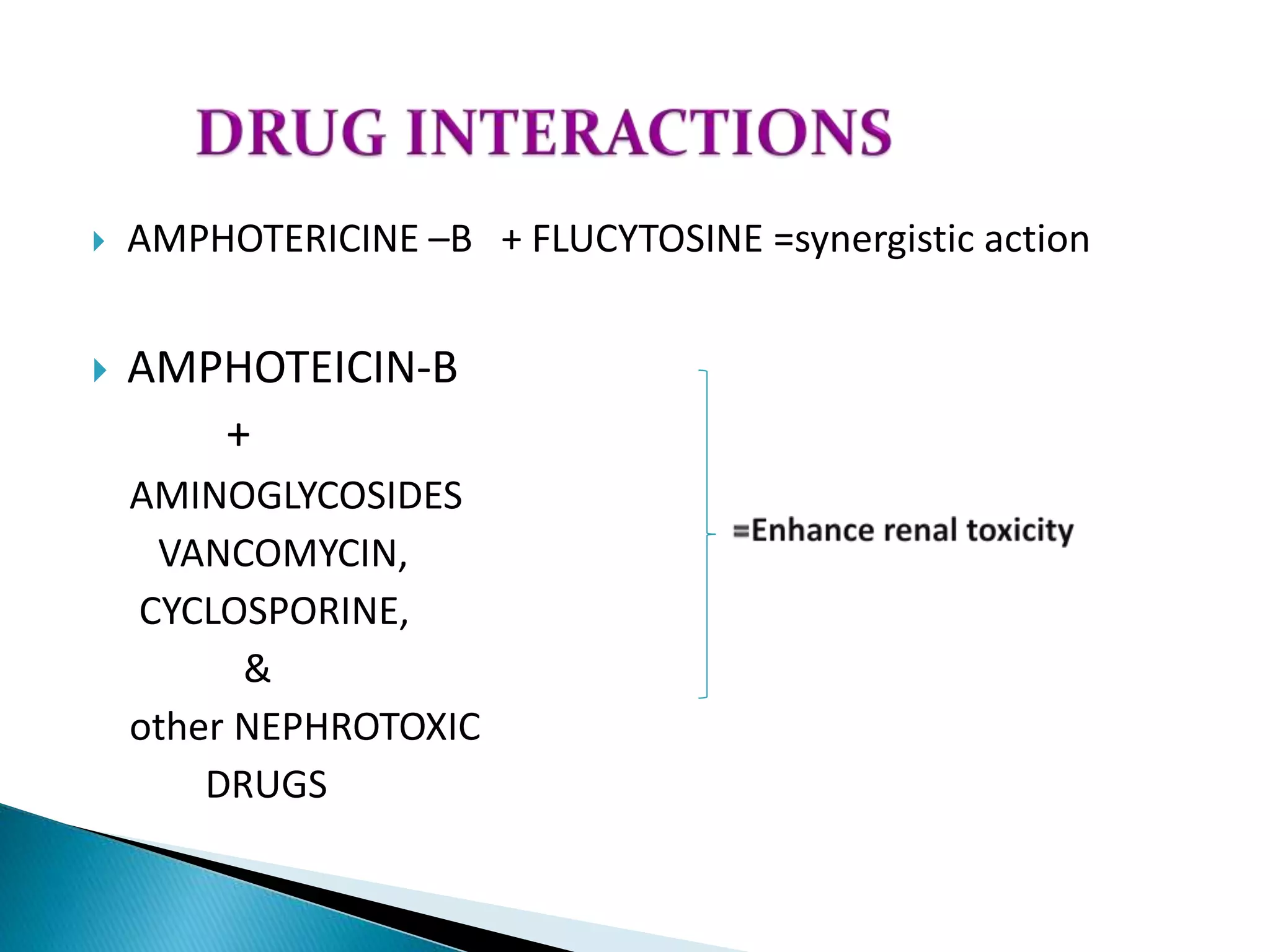
 AMPHOTERICINE –B + FLUCYTOSINE =synergistic action
 AMPHOTEICIN-B
+
AMINOGLYCOSIDES
VANCOMYCIN,
CYCLOSPORINE,
&
other NEPHROTOXIC
DRUGS
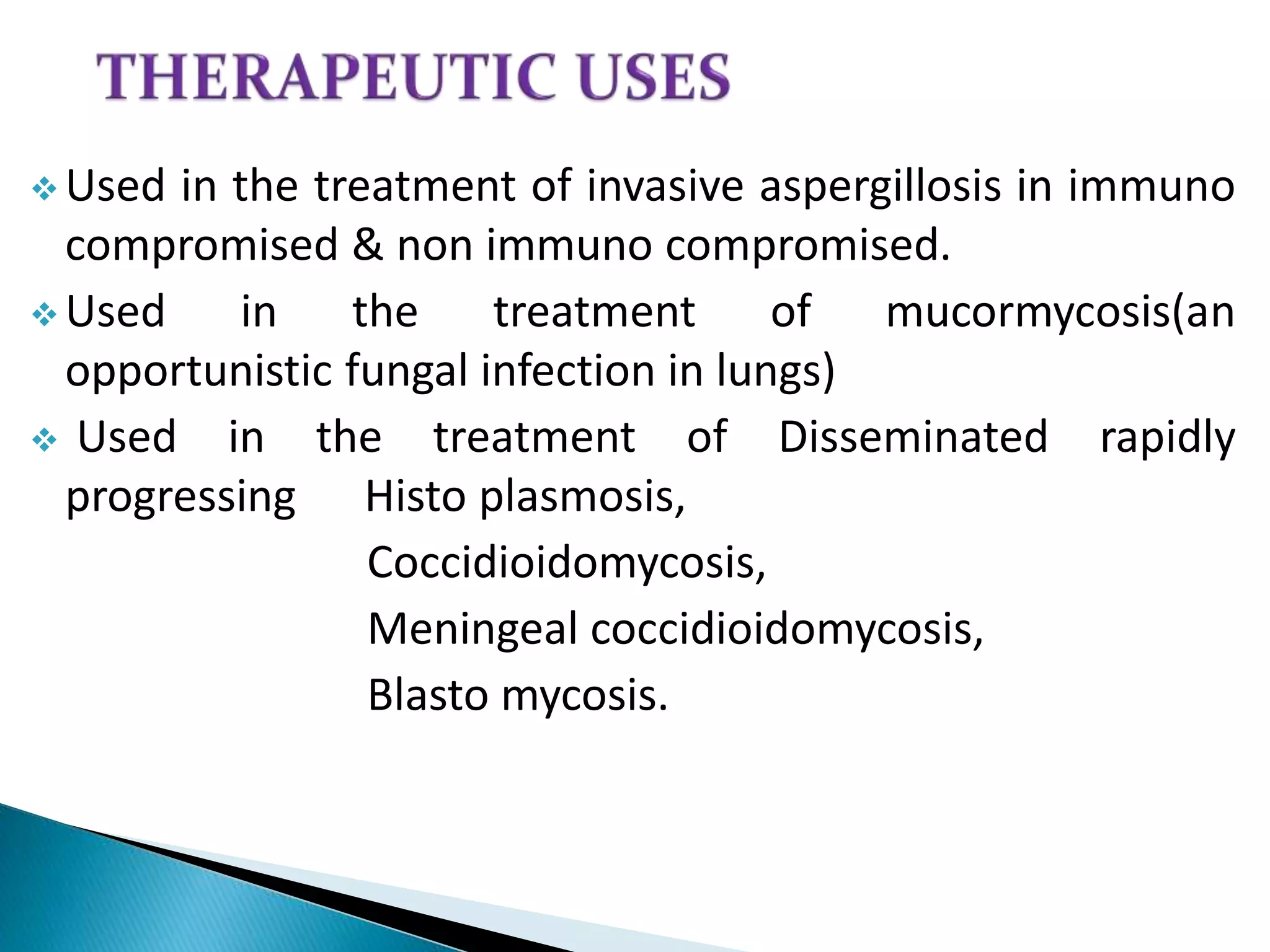
 Used in the treatment of invasive aspergillosis in immuno
compromised & non immuno compromised.
 Used in the treatment of mucormycosis(an
opportunistic fungal infection in lungs)
 Used in the treatment of Disseminated rapidly
progressing Histo plasmosis,
Coccidioidomycosis,
Meningeal coccidioidomycosis,
Blasto mycosis.
 It is also used TOPICALLY to treat oropharyngeal
candidiasis and cutaneous candidiasis.
 It is most effective dug for resistant cases of KALA AZAR
& MUCO CUTANEOS LEISHMANIASIS.
 DOSE:
1-2gms
o It is obtained from s.nouresi.
o It is similar to amphotericin –B in antifungal action and
other properties.
o Due to its higher systemic toxicity ,it is used only locally in
superficial candidiasis.
o It is not absorbed orally ,can be used for monilial diarrhoea.
THERAPEUTIC USES
 It is used in the treatment of monilial vaginitis.
 It is used in the treatment of oral candidiasis.
 It is used in the treatment of corneal conjunctival and
cutaneous candidiasis in the form of ointment.
SIDE EFFECTS
 Nausea
 Bad taste in the mouth.
 DOSE:
1 lacu b.d
 It was isolated from S.pimprina .
 It is similar to nystatin but more water soluble .
 Use is restricted to topical application for oral thrush
,cutaneous candidiasis, monilial & trichomonas vaginitis &
otomicosis by aspergillus.
 DOSE: 5 lac u/g oint ,
2 lac u/ml susp for topical use.
CLASSIFICATION OF POLYPEPTIDES:
 BACITRACIN
 POLYMYXIN-B
 COLISTIN/POLYMIXIN-E
 DACTINOMYCIN/ACTINOMYCIN-D
 It is obtained from bacillus subtilis.
 It is active mainly against GRAM POSITIVE ORGANISM
(Both cocci &Bacilli),NEISSERIA,H.INFUENZA & few other
bacteria also affected.
 BACITRACIN not absorbed orally.
 It is not given parenterally because of HIGH
TOXICITY especially to the kidneys.
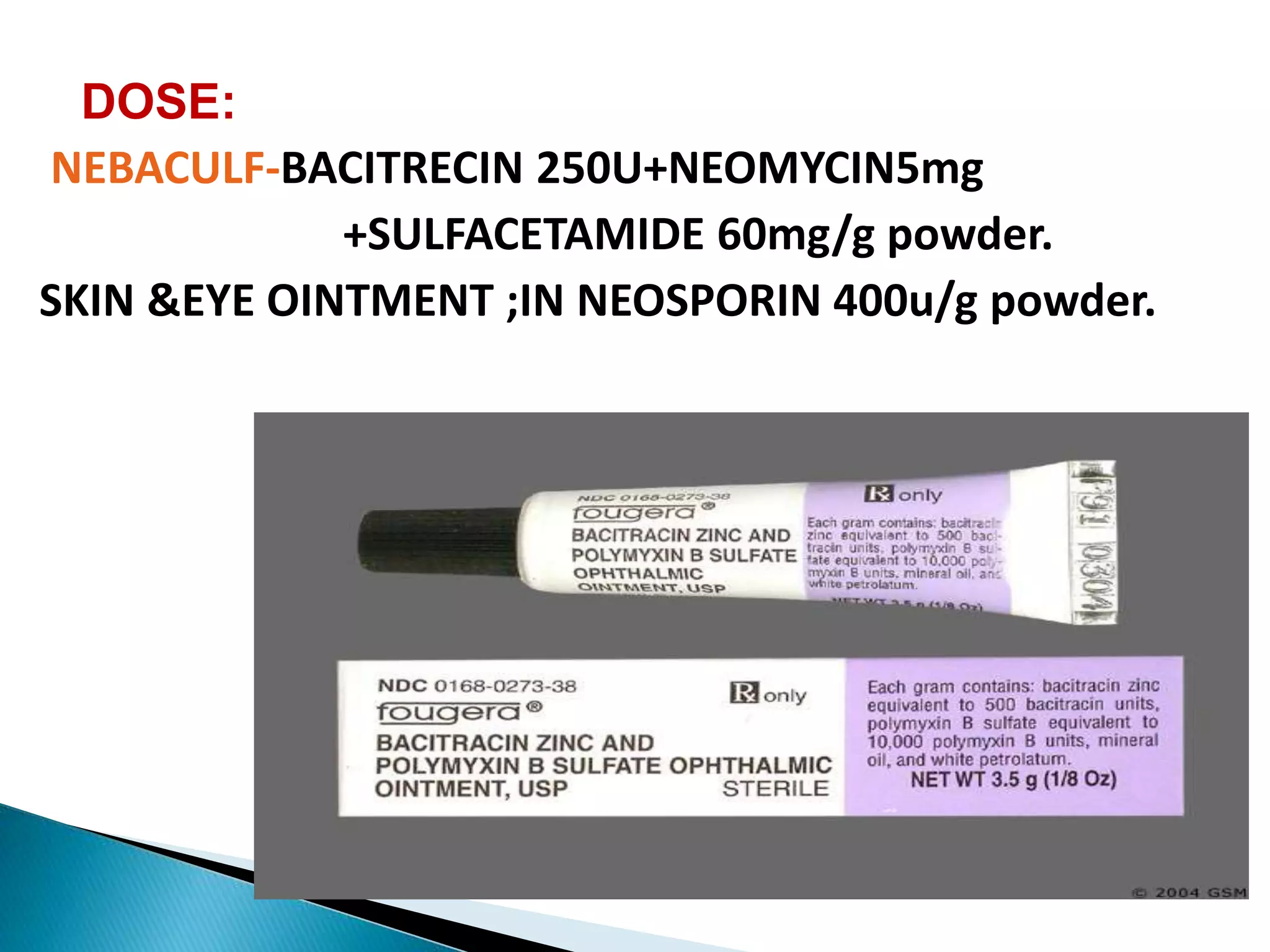
 It is used topically –skin and eye infections.
 Generally in combination with polymixin , neomycin
etc…
DOSE:
NEBACULF-BACITRECIN 250U+NEOMYCIN5mg
+SULFACETAMIDE 60mg/g powder.
SKIN &EYE OINTMENT ;IN NEOSPORIN 400u/g powder.
 The polymyxins are cation polypeptides that bind to
phospholipids on the bacterial cell membrane of gram-
negative bacteria.
 They have a detergent-like effect that disrupts cell
membrane integrity, leading to leakage of cellular
components and ultimately cell death.
Polymyxins are concentration-dependent bactericidal agents
with activity against most clinically important gram-negative
bacteria, including
P. aeruginosa,
E. coli,
K. pneumoniae,
Acinetobacter species
Enterobacter species.
Only two forms of polymyxin are in clinical use today,
Polymyxin B
Colistin (polymyxin E)
Polymyxin B is available in parenteral, ophthalmic,
otic, and topical preparations.
Colistin is only available as a prodrug, colistimethate
sodium, which is administered IV or inhaled via a
nebulizer.
The use of these drugs has been limited for a long time,
due to the increased risk of nephrotoxicity and
neurotoxicity (for example, slurred speech, muscle
weakness) when used systemically.
However, with the increase in gram-negative resistance,
they have seen a resurgence in use and are now
commonly used as salvage therapy for patients with
multidrug-resistant infections.
 POLYMIXIN -B SULFATE is used topically in
combination with other drugs in the treatment of
skin ear &eye infections.
 It can be given orally for oropharyngeal
decontamination or the suppression of intestinal
flora in patient with high risk of endogenous
infections.
 Colistin sulfate can be given orally for treating GIT
infection.
 Actinomycin D is a well-known antibiotic of the
actinomycin group that exhibits high ANTIBACTERIAL
and ANTITUMOR activity.
 Actinomycin are extracted from streptomyces.
 Dactinomycin binds to double stranded DNA through
intercalation between adjacent guanine-cytosine
base pairs.
 Inhibits the all forms of DNA dependent RNA synthesis.
 Actinomycin is a clear, yellow liquid administered
intravenously and most commonly used in treatment of
a variety of cancers, including
 Gestational trophoblastic neoplasia
 Wilms' tumor
 Rhabdomyosarcoma
 Ewing's sarcoma
 Sometimes it will be combined with other drugs
in Chemotherapy regimens, like the VAC regimen
(with Vincristine and Cyclophosphamide) for treating
Rhabdomyosarcoma and Ewing's Sarcoma.
ADVERSE EFFECTS :
 Bone marrow suppression,
 Fatigue,
 Hair loss,
 Mouth ulcer,
 Loss of appetite,
 Diarrhea.
DOSE:
15ug/kg i.v daily for 5days

Polyene and polypeptide antibiotics

  • 1.
    G Vijay NarasimhaKumar Asst. Professor, Dept. of. Pharmacology Sri Padmavathi School of Pharmacy
  • 2.
    CLASSIFICATION OF POLYENES: AMPHOTERICIN–B NYSTATIN HAMYCIN CLASSIFICATION OF POLYPEPTIDES: BACITRACIN POLYMYXIN-B COLISTIN/POLYMIXIN-E DACTINOMYCIN/ACTINOMYCIN--D
  • 3.
     It isobtained from streptomyces Nodosus.  It is amphoteric in nature.  It is a polyene group of anti fungal antibiotic.  It is composed of large lactone ring with several conjugated double bonds
  • 4.
    AMPHOTERICIN –B bindsto ergosterol which is a fungal cell membrane sterol It alters the permeability of fungal cell membrane by forming pores. CELL DEATH leads to
  • 5.
     The sterolof mammalian cell membrane is cholesterol for which amphotericin –b has less affinity.  Therefore, drug shows selective toxicity to fungal cell.  If it is binds to human membrane sterol then it may cause drug toxicity.  RESISTANCE to AMPHOTERICINE –B is associated with a replacement of ergosterol by other sterols in fungal plasma membrane
  • 6.
    ABSORPTION:-  It ispoorly absorbed from GIT.  Oral administration is effective only against fungal infections of intestine, and not for the treatment of SYSTEMIC FUNGAL INFECTIONS .  It is therefore,administered by SLOW IV INFUSION.
  • 7.
    DISTRIBUTION:-  It iswidely distributed throughout the body.  It does not penetrate into CSF.  It binds to sterols in tissue and lipoproteins in plasma.  Plasma t1/2 --15 days.
  • 8.
  • 9.
    EXCRETION:- slowly excreted byboth urine and bile.
  • 10.
    ADVERSE EFFECTS:-  Nephrotoxicity ( Renal tubular necrosis, Hypokalaemia, hypomagnesaemia, Azotemia)  And even irreversible damage if, dose exceeds 5gms.  Hypochromic normocytic anaemia - is common.  Thrombocytopenia & Leukopenia – less common
  • 11.
     Intrathecal administrationmay cause arachnoiditis, seizures, headache, nerve palsies.  Hepatic impairment with jaundice rarely.  Infusion related toxicity like chills, fever, vomiting, hypotension.
  • 12.
     AMPHOTERICINE –B+ FLUCYTOSINE =synergistic action  AMPHOTEICIN-B + AMINOGLYCOSIDES VANCOMYCIN, CYCLOSPORINE, & other NEPHROTOXIC DRUGS
  • 13.
     Used inthe treatment of invasive aspergillosis in immuno compromised & non immuno compromised.  Used in the treatment of mucormycosis(an opportunistic fungal infection in lungs)  Used in the treatment of Disseminated rapidly progressing Histo plasmosis, Coccidioidomycosis, Meningeal coccidioidomycosis, Blasto mycosis.
  • 14.
     It isalso used TOPICALLY to treat oropharyngeal candidiasis and cutaneous candidiasis.  It is most effective dug for resistant cases of KALA AZAR & MUCO CUTANEOS LEISHMANIASIS.  DOSE: 1-2gms
  • 15.
    o It isobtained from s.nouresi. o It is similar to amphotericin –B in antifungal action and other properties. o Due to its higher systemic toxicity ,it is used only locally in superficial candidiasis. o It is not absorbed orally ,can be used for monilial diarrhoea.
  • 16.
    THERAPEUTIC USES  Itis used in the treatment of monilial vaginitis.  It is used in the treatment of oral candidiasis.  It is used in the treatment of corneal conjunctival and cutaneous candidiasis in the form of ointment. SIDE EFFECTS  Nausea  Bad taste in the mouth.  DOSE: 1 lacu b.d
  • 17.
     It wasisolated from S.pimprina .  It is similar to nystatin but more water soluble .  Use is restricted to topical application for oral thrush ,cutaneous candidiasis, monilial & trichomonas vaginitis & otomicosis by aspergillus.  DOSE: 5 lac u/g oint , 2 lac u/ml susp for topical use.
  • 18.
    CLASSIFICATION OF POLYPEPTIDES: BACITRACIN  POLYMYXIN-B  COLISTIN/POLYMIXIN-E  DACTINOMYCIN/ACTINOMYCIN-D
  • 19.
     It isobtained from bacillus subtilis.  It is active mainly against GRAM POSITIVE ORGANISM (Both cocci &Bacilli),NEISSERIA,H.INFUENZA & few other bacteria also affected.
  • 21.
     BACITRACIN notabsorbed orally.  It is not given parenterally because of HIGH TOXICITY especially to the kidneys.  It is used topically –skin and eye infections.  Generally in combination with polymixin , neomycin etc…
  • 22.
    DOSE: NEBACULF-BACITRECIN 250U+NEOMYCIN5mg +SULFACETAMIDE 60mg/gpowder. SKIN &EYE OINTMENT ;IN NEOSPORIN 400u/g powder.
  • 23.
     The polymyxinsare cation polypeptides that bind to phospholipids on the bacterial cell membrane of gram- negative bacteria.  They have a detergent-like effect that disrupts cell membrane integrity, leading to leakage of cellular components and ultimately cell death.
  • 24.
    Polymyxins are concentration-dependentbactericidal agents with activity against most clinically important gram-negative bacteria, including P. aeruginosa, E. coli, K. pneumoniae, Acinetobacter species Enterobacter species.
  • 25.
    Only two formsof polymyxin are in clinical use today, Polymyxin B Colistin (polymyxin E) Polymyxin B is available in parenteral, ophthalmic, otic, and topical preparations. Colistin is only available as a prodrug, colistimethate sodium, which is administered IV or inhaled via a nebulizer.
  • 26.
    The use ofthese drugs has been limited for a long time, due to the increased risk of nephrotoxicity and neurotoxicity (for example, slurred speech, muscle weakness) when used systemically. However, with the increase in gram-negative resistance, they have seen a resurgence in use and are now commonly used as salvage therapy for patients with multidrug-resistant infections.
  • 27.
     POLYMIXIN -BSULFATE is used topically in combination with other drugs in the treatment of skin ear &eye infections.  It can be given orally for oropharyngeal decontamination or the suppression of intestinal flora in patient with high risk of endogenous infections.  Colistin sulfate can be given orally for treating GIT infection.
  • 29.
     Actinomycin Dis a well-known antibiotic of the actinomycin group that exhibits high ANTIBACTERIAL and ANTITUMOR activity.  Actinomycin are extracted from streptomyces.
  • 30.
     Dactinomycin bindsto double stranded DNA through intercalation between adjacent guanine-cytosine base pairs.  Inhibits the all forms of DNA dependent RNA synthesis.
  • 31.
     Actinomycin isa clear, yellow liquid administered intravenously and most commonly used in treatment of a variety of cancers, including  Gestational trophoblastic neoplasia  Wilms' tumor  Rhabdomyosarcoma  Ewing's sarcoma
  • 32.
     Sometimes itwill be combined with other drugs in Chemotherapy regimens, like the VAC regimen (with Vincristine and Cyclophosphamide) for treating Rhabdomyosarcoma and Ewing's Sarcoma. ADVERSE EFFECTS :  Bone marrow suppression,  Fatigue,  Hair loss,  Mouth ulcer,  Loss of appetite,  Diarrhea.
  • 33.