MOHD. MAZHAR
M.PHARMA
2nd semester
Amity University
1
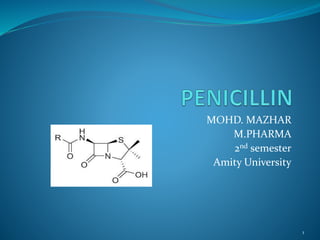
Penicillin
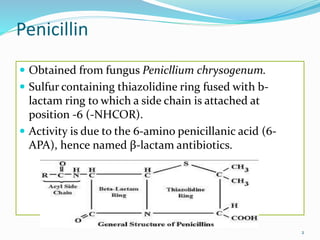
 Obtained from fungus Penicllium chrysogenum.
 Sulfur containing thiazolidine ring fused with b-
lactam ring to which a side chain is attached at
position -6 (-NHCOR).
 Activity is due to the 6-amino penicillanic acid (6-
APA), hence named β-lactam antibiotics.
2
Mechanism of action
 Interfere with synthesis of bacterial cell wall.
 Cell wall composed of peptidoglycan, glycon consist of two
amino sugars;
 1)N-acetylmuramic acid (NAcM).
 2)N-acetylglucosamine(NAcG).
 Peptidoglycan residues are linked together forming long strands
&UDP is split off.
 Final step is cleavage of terminal D-alanine of the peptide by
transpeptidase, process known as transpeptidation.
 This cross bridging provide neccessry strength to bacterial cell
wall.
 β-lactam ABs inhibit the transpeptidase so that cross-linking
does not take place.
 This will cause cell wall deficient forms of bacteria are produced
3
Cont…..
 This cross bridging provide neccessry strength to
bacterial cell wall.
 β-lactam ABs inhibit the transpeptidase so that cross-
linking does not take place.
 This will cause cell wall deficient forms of bacteria are
produced
 Thus shows bactericidal action.
4
Penicillin G
 Narrow spectrum antibiotic.
 Primarily to gram positive bacteria and few others,
active against….
 Cocci-Streptococci (except group D), Staph.aureus ;
gram negative N.gonorrheoe and N.meningitis.
 Bacilli-majority of B.anthracis, Corynebacterium
diptheriae etc
5
Uses
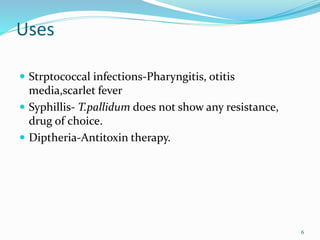
 Strptococcal infections-Pharyngitis, otitis
media,scarlet fever
 Syphillis- T.pallidum does not show any resistance,
drug of choice.
 Diptheria-Antitoxin therapy.
6
Adverse Effects
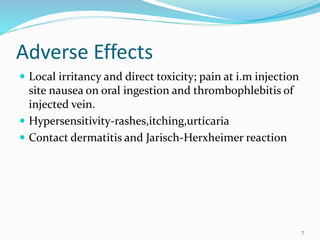
 Local irritancy and direct toxicity; pain at i.m injection
site nausea on oral ingestion and thrombophlebitis of
injected vein.
 Hypersensitivity-rashes,itching,urticaria
 Contact dermatitis and Jarisch-Herxheimer reaction
7
Drawbacks of Penicillin G
 Poor oral efficacy.
 Susceptibility to penicillinase
 Narrow spectrum of activity.
 Hypersensitivity.
 Destroyed by acid
 “To overcome these problems, developed new
penicillins and classified according to the anti
microbial spectrum”.
Refernce; K.D.Tripathi.pg.no 658,6th edition
8
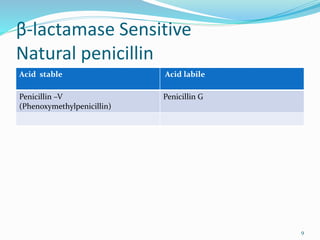
β-lactamase Sensitive
Natural penicillin
Acid stable Acid labile
Penicillin –V
(Phenoxymethylpenicillin)
Penicillin G
9
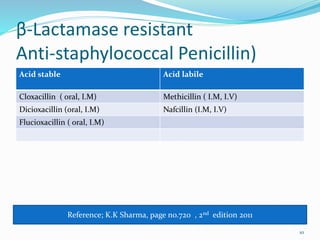
β-Lactamase resistant
Anti-staphylococcal Penicillin)
Acid stable Acid labile
Cloxacillin ( oral, I.M) Methicillin ( I.M, I.V)
Dicioxacillin (oral, I.M) Nafcillin (I.M, I.V)
Flucioxacillin ( oral, I.M)
Reference; K.K Sharma, page no.720 , 2nd edition 2011
10
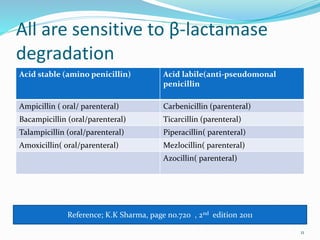
All are sensitive to β-lactamase
degradation
Acid stable (amino penicillin) Acid labile(anti-pseudomonal
penicillin
Ampicillin ( oral/ parenteral) Carbenicillin (parenteral)
Bacampicillin (oral/parenteral) Ticarcillin (parenteral)
Talampicillin (oral/parenteral) Piperacillin( parenteral)
Amoxicillin( oral/parenteral) Mezlocillin( parenteral)
Azocillin( parenteral)
Reference; K.K Sharma, page no.720 , 2nd edition 2011
11
β-lactamase inhibitors
 Clavulanic acid.
 Salbactam.
12
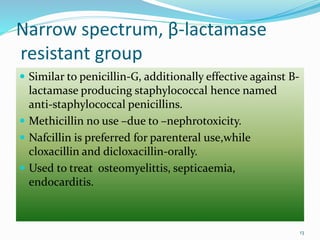
Narrow spectrum, β-lactamase
resistant group
 Similar to penicillin-G, additionally effective against B-
lactamase producing staphylococcal hence named
anti-staphylococcal penicillins.
 Methicillin no use –due to –nephrotoxicity.
 Nafcillin is preferred for parenteral use,while
cloxacillin and dicloxacillin-orally.
 Used to treat osteomyelittis, septicaemia,
endocarditis.
13
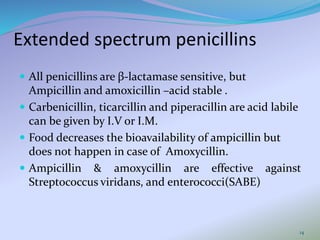
Extended spectrum penicillins
 All penicillins are β-lactamase sensitive, but
Ampicillin and amoxicillin –acid stable .
 Carbenicillin, ticarcillin and piperacillin are acid labile
can be given by I.V or I.M.
 Food decreases the bioavailability of ampicillin but
does not happen in case of Amoxycillin.
 Ampicillin & amoxycillin are effective against
Streptococcus viridans, and enterococci(SABE)
14
Penicillin Units
 Activity of natural penicillins (e.g penicillin) is defined
in terms of units.
 Crystalline sodium penicillin G contains 1600 units per
mg.
 Semi-synthetic penicillins are prescribed by weight
basis rather than units, e.g amoxycillin 500 mg 8
hourly orally.
15
Resistance to penicillins
 Inactivation of β-lactam ring by Beta-lactamase
 S.aureus, haemophilus influenza and E.coli
 These bacteria produce beta- lactamase which can
hydrolyze penicillins .
 Psedomonas, Enterbacter, Neisseria gonorrhoeae
and Moraxella catarrhalis have a broader degradative
activity
16
Cont…
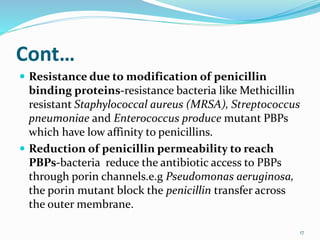
 Resistance due to modification of penicillin
binding proteins-resistance bacteria like Methicillin
resistant Staphylococcal aureus (MRSA), Streptococcus
pneumoniae and Enterococcus produce mutant PBPs
which have low affinity to penicillins.
 Reduction of penicillin permeability to reach
PBPs-bacteria reduce the antibiotic access to PBPs
through porin channels.e.g Pseudomonas aeruginosa,
the porin mutant block the penicillin transfer across
the outer membrane.
17
β- lactamase inhibitors
 Resemble to beta-lactam antibiotics only structurally
but do not possess any significant antimicrobial
action.
 Drug include –Clavulanic acid and sulbactam.
 Bind irreversibly to catalytic site of susceptible β-
lactamases ( produced by bacteria) to prevent
hydrolysis of penicillins.
 Can inhibit plasmid mediated β-lactamases which are
responsible for transferred drug resistance like MSRH.
 G.I intolerance,stomatitis and rashes are recorded
18
Drug interactions
 Antagonistic combination;
 Oral penicillins;
 antagonised by bacteriostatic antibiotics such
tetracyclines, chlramphenicol, erythromycin.
 Penicillin and aminoglycosides should not mixed in
the same syringe ,inactivate each other.
 Hydrocortisone inactivates ampicillin if mixed in the
I.V fluid.
19
Cont….
 Synergistic combinations;
 Probenecid prolongs the action of penicillin by
decreasing its tubular secretion.
 Beta –lactamase inhibitors extend the spectrum of
penicillins against beta lactamase producing bacteria.
 A fixed dose combination of ampicillin or amoxycillin
250 mg with cloxacillin 250 mg has been promoted as
synergistic combination useful in postoperative and
respiratory infection.
20
REFERNCE
 Sharma KK, “ Principle of Pharmacology” 2nd edition
2011 721-742
 Tripathi K.D. “ Essentials of Medical Pharmacology”,
6th edition, 2011
 www.wikipedia.com
21
22

Penicillin

  • 1.
  • 2.
    Penicillin  Obtained fromfungus Penicllium chrysogenum.  Sulfur containing thiazolidine ring fused with b- lactam ring to which a side chain is attached at position -6 (-NHCOR).  Activity is due to the 6-amino penicillanic acid (6- APA), hence named β-lactam antibiotics. 2
  • 3.
    Mechanism of action Interfere with synthesis of bacterial cell wall.  Cell wall composed of peptidoglycan, glycon consist of two amino sugars;  1)N-acetylmuramic acid (NAcM).  2)N-acetylglucosamine(NAcG).  Peptidoglycan residues are linked together forming long strands &UDP is split off.  Final step is cleavage of terminal D-alanine of the peptide by transpeptidase, process known as transpeptidation.  This cross bridging provide neccessry strength to bacterial cell wall.  β-lactam ABs inhibit the transpeptidase so that cross-linking does not take place.  This will cause cell wall deficient forms of bacteria are produced 3
  • 4.
    Cont…..  This crossbridging provide neccessry strength to bacterial cell wall.  β-lactam ABs inhibit the transpeptidase so that cross- linking does not take place.  This will cause cell wall deficient forms of bacteria are produced  Thus shows bactericidal action. 4
  • 5.
    Penicillin G  Narrowspectrum antibiotic.  Primarily to gram positive bacteria and few others, active against….  Cocci-Streptococci (except group D), Staph.aureus ; gram negative N.gonorrheoe and N.meningitis.  Bacilli-majority of B.anthracis, Corynebacterium diptheriae etc 5
  • 6.
    Uses  Strptococcal infections-Pharyngitis,otitis media,scarlet fever  Syphillis- T.pallidum does not show any resistance, drug of choice.  Diptheria-Antitoxin therapy. 6
  • 7.
    Adverse Effects  Localirritancy and direct toxicity; pain at i.m injection site nausea on oral ingestion and thrombophlebitis of injected vein.  Hypersensitivity-rashes,itching,urticaria  Contact dermatitis and Jarisch-Herxheimer reaction 7
  • 8.
    Drawbacks of PenicillinG  Poor oral efficacy.  Susceptibility to penicillinase  Narrow spectrum of activity.  Hypersensitivity.  Destroyed by acid  “To overcome these problems, developed new penicillins and classified according to the anti microbial spectrum”. Refernce; K.D.Tripathi.pg.no 658,6th edition 8
  • 9.
    β-lactamase Sensitive Natural penicillin Acidstable Acid labile Penicillin –V (Phenoxymethylpenicillin) Penicillin G 9
  • 10.
    β-Lactamase resistant Anti-staphylococcal Penicillin) Acidstable Acid labile Cloxacillin ( oral, I.M) Methicillin ( I.M, I.V) Dicioxacillin (oral, I.M) Nafcillin (I.M, I.V) Flucioxacillin ( oral, I.M) Reference; K.K Sharma, page no.720 , 2nd edition 2011 10
  • 11.
    All are sensitiveto β-lactamase degradation Acid stable (amino penicillin) Acid labile(anti-pseudomonal penicillin Ampicillin ( oral/ parenteral) Carbenicillin (parenteral) Bacampicillin (oral/parenteral) Ticarcillin (parenteral) Talampicillin (oral/parenteral) Piperacillin( parenteral) Amoxicillin( oral/parenteral) Mezlocillin( parenteral) Azocillin( parenteral) Reference; K.K Sharma, page no.720 , 2nd edition 2011 11
  • 12.
  • 13.
    Narrow spectrum, β-lactamase resistantgroup  Similar to penicillin-G, additionally effective against B- lactamase producing staphylococcal hence named anti-staphylococcal penicillins.  Methicillin no use –due to –nephrotoxicity.  Nafcillin is preferred for parenteral use,while cloxacillin and dicloxacillin-orally.  Used to treat osteomyelittis, septicaemia, endocarditis. 13
  • 14.
    Extended spectrum penicillins All penicillins are β-lactamase sensitive, but Ampicillin and amoxicillin –acid stable .  Carbenicillin, ticarcillin and piperacillin are acid labile can be given by I.V or I.M.  Food decreases the bioavailability of ampicillin but does not happen in case of Amoxycillin.  Ampicillin & amoxycillin are effective against Streptococcus viridans, and enterococci(SABE) 14
  • 15.
    Penicillin Units  Activityof natural penicillins (e.g penicillin) is defined in terms of units.  Crystalline sodium penicillin G contains 1600 units per mg.  Semi-synthetic penicillins are prescribed by weight basis rather than units, e.g amoxycillin 500 mg 8 hourly orally. 15
  • 16.
    Resistance to penicillins Inactivation of β-lactam ring by Beta-lactamase  S.aureus, haemophilus influenza and E.coli  These bacteria produce beta- lactamase which can hydrolyze penicillins .  Psedomonas, Enterbacter, Neisseria gonorrhoeae and Moraxella catarrhalis have a broader degradative activity 16
  • 17.
    Cont…  Resistance dueto modification of penicillin binding proteins-resistance bacteria like Methicillin resistant Staphylococcal aureus (MRSA), Streptococcus pneumoniae and Enterococcus produce mutant PBPs which have low affinity to penicillins.  Reduction of penicillin permeability to reach PBPs-bacteria reduce the antibiotic access to PBPs through porin channels.e.g Pseudomonas aeruginosa, the porin mutant block the penicillin transfer across the outer membrane. 17
  • 18.
    β- lactamase inhibitors Resemble to beta-lactam antibiotics only structurally but do not possess any significant antimicrobial action.  Drug include –Clavulanic acid and sulbactam.  Bind irreversibly to catalytic site of susceptible β- lactamases ( produced by bacteria) to prevent hydrolysis of penicillins.  Can inhibit plasmid mediated β-lactamases which are responsible for transferred drug resistance like MSRH.  G.I intolerance,stomatitis and rashes are recorded 18
  • 19.
    Drug interactions  Antagonisticcombination;  Oral penicillins;  antagonised by bacteriostatic antibiotics such tetracyclines, chlramphenicol, erythromycin.  Penicillin and aminoglycosides should not mixed in the same syringe ,inactivate each other.  Hydrocortisone inactivates ampicillin if mixed in the I.V fluid. 19
  • 20.
    Cont….  Synergistic combinations; Probenecid prolongs the action of penicillin by decreasing its tubular secretion.  Beta –lactamase inhibitors extend the spectrum of penicillins against beta lactamase producing bacteria.  A fixed dose combination of ampicillin or amoxycillin 250 mg with cloxacillin 250 mg has been promoted as synergistic combination useful in postoperative and respiratory infection. 20
  • 21.
    REFERNCE  Sharma KK,“ Principle of Pharmacology” 2nd edition 2011 721-742  Tripathi K.D. “ Essentials of Medical Pharmacology”, 6th edition, 2011  www.wikipedia.com 21
  • 22.

Editor's Notes