PRESENTED BY
SREYA. S
M. Pharmacy
DEPT OF PHARMACOLOGY
Introduction
Aminoglycosides are a group of bactericidal antibiotics,
Used to treat aerobic Gram –ve bacteria
 Aminoglycosides are called bactericidal antibiotics
because they kill bacteria directly. They accomplish this
by stopping bacteria from producing proteins needed for
their survival.
 Because aminoglycosides are normally used to treat
serious infections, they are typically administered into the
veins of the body (intravenously, or IV).
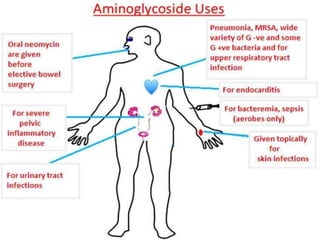
 However, some aminoglycosides can be taken orally, or as
ear or eye drops
History and Source
 Natural products or semisynthetic derivatives of
compounds produced by a variety of soil actinomycetes
 Streptomycin was first discovered in 1944 by waksman
 Isolated from a strain of Streptomyces griseus
 Gentamicin and netilmicin are derived from species of
the actinomycete Micromonospora
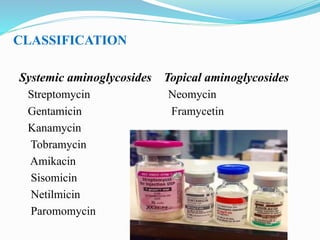
Systemic aminoglycosides Topical aminoglycosides
Streptomycin Neomycin
Gentamicin Framycetin
Kanamycin
Tobramycin
Amikacin
Sisomicin
Netilmicin
Paromomycin
CLASSIFICATION
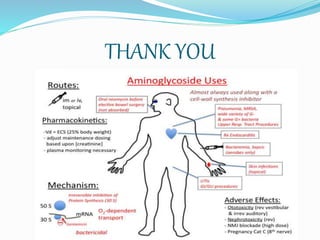
Mechanism of Action
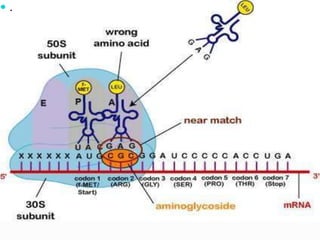
Aminoglycosides bind to 30s ribosomal units of
bacteria.An oxygen-dependent transport system is
necessary for aminoglycosides to reach their target site;
Pevents the formation of intiation complex,which is the
prerequisite for peptide synthesis
Lack of the formation of intiation complex causes the 30s
sub unit to MISREAD THE GENITIC CODE on mRNA
Incorrect aminoacids are thus incorporated into the
growing peptide chain,which are of no use for bacterial
growth
 LEADS TO BACTERIAL DEATH
 .
Aminoglycosides also act by Formed improper intiation
complex blocks the movement of ribosomes
Resulting in a mRNA chain attached with single
ribosomes (monosomes)
Thus amino glycoside also interfer in the assemble of poly
somes
Results in the accumulation of non functional ribosomes
PHARMACOKINETICS
 ABSORPTION:Aminoglycosides are highly polar , so
they have very poor oral bioavailability.
Therefore they are given parenterally or applied locally.
 DISTRIBUTION: These are poorly distributed and
poorly protein bound when given parenterally they failed
to reach intraoccular fluid or CSF.
 METABOLISM:As they do not penetrate more celluar
compartments they do not under go any significant
metabolism
EXCRETION:
Mainly by kidney through glomerular filtration.
Resulting in fairly high urinary concentration.
so they can be used in the treatment of URINARY
TRACT INFECTIONS .
 Their excetion is directly proportional to creatinine
clearence .
 Though normal half life varies from 1.5-3 hrs,it may
increased to 24-48 hrs in patients with renal insufficiency
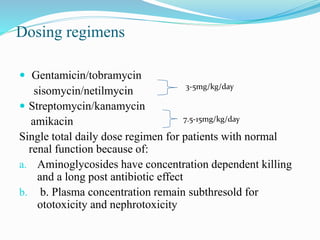
Dosing regimens
 Gentamicin/tobramycin
sisomycin/netilmycin
 Streptomycin/kanamycin
amikacin
Single total daily dose regimen for patients with normal
renal function because of:
a. Aminoglycosides have concentration dependent killing
and a long post antibiotic effect
b. b. Plasma concentration remain subthresold for
ototoxicity and nephrotoxicity
3-5mg/kg/day
7.5-15mg/kg/day
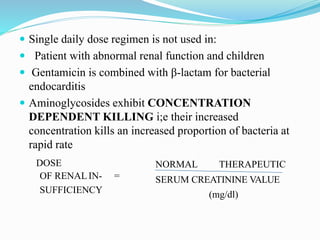
 Single daily dose regimen is not used in:
 Patient with abnormal renal function and children
 Gentamicin is combined with β-lactam for bacterial
endocarditis
 Aminoglycosides exhibit CONCENTRATION
DEPENDENT KILLING i;e their increased
concentration kills an increased proportion of bacteria at
rapid rate
DOSE
OF RENALIN- =
SUFFICIENCY
NORMAL THERAPEUTIC
SERUM CREATININE VALUE
(mg/dl)
Post antibiotic effect
 Aminoglycosides exhibit concentration dependent killing.
They also possess significant Post-antibiotic effect.
Postantibiotic effect (PAE) is the term used to describe
suppression of bacterial growth that persists after brief
exposure of organisms to antimicrobials. PAE have
clinical impact on antimicrobial dosing regimens.
 Single daily dosing at least as effective as and no more
toxic than multiple dosing
Mechanism of resistance
Aquisition of cell membrane bound inactivating enzymes
that adenylate/acetylate or phosphorylate drug
Mainly by conjugation and transfer of plasmids
Nosocomial microbes have become rich in such
plasmids, some of which encode for multidrug resistance
Decreased efficiency of transporting mechanismof the
aminoglycosides into bacterial cytosol
Less common • Found in pseudomonas: 2nd phase
active transport defective
Deletion/alteration of receptor protein on 30 S ribosomal
unit by mutation: prevents attachment
Less common , Specific for particular drug , Seen in E.coli
Antibacterial spectrum
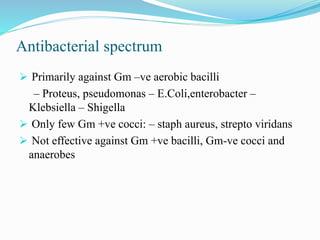
 Primarily against Gm –ve aerobic bacilli
– Proteus, pseudomonas – E.Coli,enterobacter –
Klebsiella – Shigella
 Only few Gm +ve cocci: – staph aureus, strepto viridans
 Not effective against Gm +ve bacilli, Gm-ve cocci and
anaerobes
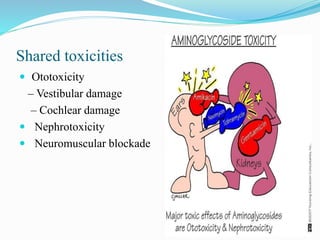
Shared toxicities
 Ototoxicity
– Vestibular damage
– Cochlear damage
 Nephrotoxicity
 Neuromuscular blockade
Ototoxicity
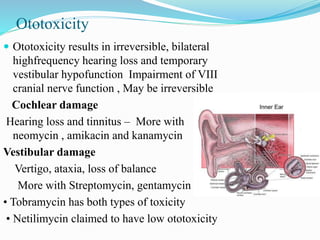
 Ototoxicity results in irreversible, bilateral
highfrequency hearing loss and temporary
vestibular hypofunction Impairment of VIII
cranial nerve function , May be irreversible
Cochlear damage
Hearing loss and tinnitus – More with
neomycin , amikacin and kanamycin
Vestibular damage
Vertigo, ataxia, loss of balance
More with Streptomycin, gentamycin
• Tobramycin has both types of toxicity
• Netilimycin claimed to have low ototoxicity
Nephrotoxicity
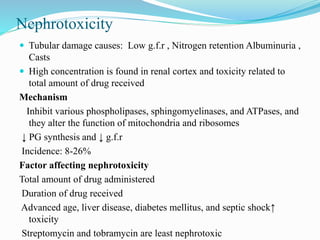
 Tubular damage causes: Low g.f.r , Nitrogen retention Albuminuria ,
Casts
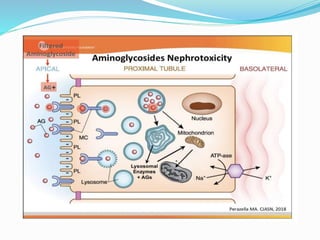
 High concentration is found in renal cortex and toxicity related to
total amount of drug received
Mechanism
Inhibit various phospholipases, sphingomyelinases, and ATPases, and
they alter the function of mitochondria and ribosomes
↓ PG synthesis and ↓ g.f.r
Incidence: 8-26%
Factor affecting nephrotoxicity
Total amount of drug administered
Duration of drug received
Advanced age, liver disease, diabetes mellitus, and septic shock↑
toxicity
Streptomycin and tobramycin are least nephrotoxic
Neuromuscular blockade
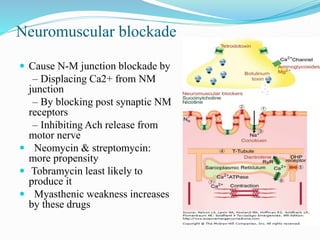
 Cause N-M junction blockade by
– Displacing Ca2+ from NM
junction
– By blocking post synaptic NM
receptors
– Inhibiting Ach release from
motor nerve
 Neomycin & streptomycin:
more propensity
 Tobramycin least likely to
produce it
 Myasthenic weakness increases
by these drugs
Contraindications
 Pregnancy: foetal ototoxicity
 With other ototoxic drugs: furosemide, minocycline
 With nephrotoxic drugs: vancomycin ,cisplatin
 Elderly patients
 Those with kidney disease
 Cautious use of muscle relaxants
 Do not mix with any other drug in same syringe
Gentamicin
 Cheapest and first line antibiotic
 3rd systemically antibiotic obtained from
micromonospora purpurea in 1964
Spectrum
Gram-ve bacilli like: E.coli, Klebsillea, Enterobacter,
H.Influenzae, proteus, serrratia, and pseudomonas
Many strain of brucella, campylobacter citrobacter,
Fransisella and yersinia are sensitive
Uses
USE
 Use restricted to serious Gm-ve bacillary infections
 Septicaemia, sepsis, fever in immunocompromised
patients – Used with penicillins
 Pelvic infections : with metronidazole
 SABE: with Penicillin G or ampicillin or vancomycin
 Coliform infection: with ampicillin or ceftriaxone
 Pseudomonal infections: with ticarcillin
 Meningitis by Gm-ve bacilli : III generation
cephalosporin alone or with gentamicin
Streptomycin
 Oldest aminoglycoside obtained from sreptomyces griseus
Spectrum
 H.Ducreyi, Brucella, Yersinia, Nocardia, Campylobacter
granulomatis, Francisella tularensis, M. Tuberculosis
Uses
Tuberculosis :Tuberculocidal
Acts only on extracellular bacilli
Use: in 2nd category T.B. for first two months
Dose:15 mg/kg i.m. thrice a week for 2 month
Subacute bacterial endocarditis
Plague: rapid cure within 7-12 days but tetracycline is drug of
choice
Tularemia: Streptomycin is drug
Streptomycin dependence:
 Certain mutant grown in presence of streptomycin
dependent on it
 Seen in tuberculosis
Toxicity
 Lowest nephrotoxicity
 Hypersensitivity reaction are rare: rashes, eosinophillia,
exfoliative dermatitis, and fever are reported
 Anaphylaxis is very rare
Kanamycin
 Obtained frorn S. kanamyceticus :in 1957
 Similar to streptomycin in all aspects
 Toxicity and narrow spectrum not used now
 Occasionally used in 2nd line drug in tuberculosis
Tobramycin
 Similar to gentamycin
 Used pseudomonas and proteus resistant to gentamycin
 Ototoxicty and nephrotoxicity is less
Sisomicin
 Identical to gentamicin
 More potent on pseudomonas and -hemolytic streptococci
 Used interchangeably with gentamicin
Amikacin
 Less toxic semisynthetic derivative of kanamycin
 Resistant to enzymes that inactivate gentamicin and
tobramcyin
 Widest spectrum of activity
Uses:
– Same as gentamicin
– Reserve drug for hospital acquired Gm-ve bacillary
infections
– Multidrug resistant TB along with other drugs Dose :
15mg/kg/day in 1-3 doses
Netilmicin
 Semisynthetic derivative of gentamycin
 Broader spectrum
 Relatively resistant to aminoglycoside inactivating
enzymes
 More active against klebsilla, Enterobacter and
styphylococcus
 Less active against pseudomonas
 Less ototoxic
Neomycin
 Wide spectrum
Use
Topically combine with polymixin and bacitacin) ,Infected
wound ,Ulcers , Burns , External ear infections
,Conjuctivitis
Orally
Preparation for bowel surgery:3 doses of 1g along with
metronidazole 0.5 g on day before surgery reduce
postoperative infection
Hepatic coma: By suppressing intestinal flora it decrease
NH3 production
Because of toxicity lactulose is used
Side effects
 Malabsorption syndrome with diarrhoea and
 stetorrhoea
 Hypersensitivity reactions, primarily skin rashes,
 occur in 6-8% of patients –with topical therapy
 Superinfection with candida
 Nephrotoxicity and ototoxicity
 Neuromuscular blockade with respiratory paralysis
Framycetin
Very similar to neomycin
Too toxic for systemic administration
Used topically on skin, eye ear
REFERENCES
• Tripathi K.D. Essentials Of Medical Pharmacology. 7th
ed. Jaypee Brothers Medical Publishers; 2014:[182-191]
• Rang H.P ,Dale M.M, Ritter J.M, Flower
R.J.Pharmacology. 6th ed.Elsevire: Churchill
livingstone;2008:[226-237
• http://www.medindia.net/articles/aminoglucosides.htm
• http://en.wikipedia.org/wiki/aminoglycosides
THANK YOU

Aminoglycosides

  • 1.
    PRESENTED BY SREYA. S M.Pharmacy DEPT OF PHARMACOLOGY
  • 2.
    Introduction Aminoglycosides are agroup of bactericidal antibiotics, Used to treat aerobic Gram –ve bacteria  Aminoglycosides are called bactericidal antibiotics because they kill bacteria directly. They accomplish this by stopping bacteria from producing proteins needed for their survival.  Because aminoglycosides are normally used to treat serious infections, they are typically administered into the veins of the body (intravenously, or IV).  However, some aminoglycosides can be taken orally, or as ear or eye drops
  • 3.
    History and Source Natural products or semisynthetic derivatives of compounds produced by a variety of soil actinomycetes  Streptomycin was first discovered in 1944 by waksman  Isolated from a strain of Streptomyces griseus  Gentamicin and netilmicin are derived from species of the actinomycete Micromonospora
  • 4.
    Systemic aminoglycosides Topicalaminoglycosides Streptomycin Neomycin Gentamicin Framycetin Kanamycin Tobramycin Amikacin Sisomicin Netilmicin Paromomycin CLASSIFICATION
  • 5.
    Mechanism of Action Aminoglycosidesbind to 30s ribosomal units of bacteria.An oxygen-dependent transport system is necessary for aminoglycosides to reach their target site; Pevents the formation of intiation complex,which is the prerequisite for peptide synthesis Lack of the formation of intiation complex causes the 30s sub unit to MISREAD THE GENITIC CODE on mRNA Incorrect aminoacids are thus incorporated into the growing peptide chain,which are of no use for bacterial growth  LEADS TO BACTERIAL DEATH
  • 6.
  • 7.
    Aminoglycosides also actby Formed improper intiation complex blocks the movement of ribosomes Resulting in a mRNA chain attached with single ribosomes (monosomes) Thus amino glycoside also interfer in the assemble of poly somes Results in the accumulation of non functional ribosomes
  • 8.
    PHARMACOKINETICS  ABSORPTION:Aminoglycosides arehighly polar , so they have very poor oral bioavailability. Therefore they are given parenterally or applied locally.  DISTRIBUTION: These are poorly distributed and poorly protein bound when given parenterally they failed to reach intraoccular fluid or CSF.  METABOLISM:As they do not penetrate more celluar compartments they do not under go any significant metabolism
  • 9.
    EXCRETION: Mainly by kidneythrough glomerular filtration. Resulting in fairly high urinary concentration. so they can be used in the treatment of URINARY TRACT INFECTIONS .  Their excetion is directly proportional to creatinine clearence .  Though normal half life varies from 1.5-3 hrs,it may increased to 24-48 hrs in patients with renal insufficiency
  • 10.
    Dosing regimens  Gentamicin/tobramycin sisomycin/netilmycin Streptomycin/kanamycin amikacin Single total daily dose regimen for patients with normal renal function because of: a. Aminoglycosides have concentration dependent killing and a long post antibiotic effect b. b. Plasma concentration remain subthresold for ototoxicity and nephrotoxicity 3-5mg/kg/day 7.5-15mg/kg/day
  • 11.
     Single dailydose regimen is not used in:  Patient with abnormal renal function and children  Gentamicin is combined with β-lactam for bacterial endocarditis  Aminoglycosides exhibit CONCENTRATION DEPENDENT KILLING i;e their increased concentration kills an increased proportion of bacteria at rapid rate DOSE OF RENALIN- = SUFFICIENCY NORMAL THERAPEUTIC SERUM CREATININE VALUE (mg/dl)
  • 12.
    Post antibiotic effect Aminoglycosides exhibit concentration dependent killing. They also possess significant Post-antibiotic effect. Postantibiotic effect (PAE) is the term used to describe suppression of bacterial growth that persists after brief exposure of organisms to antimicrobials. PAE have clinical impact on antimicrobial dosing regimens.  Single daily dosing at least as effective as and no more toxic than multiple dosing
  • 13.
    Mechanism of resistance Aquisitionof cell membrane bound inactivating enzymes that adenylate/acetylate or phosphorylate drug Mainly by conjugation and transfer of plasmids Nosocomial microbes have become rich in such plasmids, some of which encode for multidrug resistance Decreased efficiency of transporting mechanismof the aminoglycosides into bacterial cytosol Less common • Found in pseudomonas: 2nd phase active transport defective Deletion/alteration of receptor protein on 30 S ribosomal unit by mutation: prevents attachment Less common , Specific for particular drug , Seen in E.coli
  • 14.
    Antibacterial spectrum  Primarilyagainst Gm –ve aerobic bacilli – Proteus, pseudomonas – E.Coli,enterobacter – Klebsiella – Shigella  Only few Gm +ve cocci: – staph aureus, strepto viridans  Not effective against Gm +ve bacilli, Gm-ve cocci and anaerobes
  • 16.
    Shared toxicities  Ototoxicity –Vestibular damage – Cochlear damage  Nephrotoxicity  Neuromuscular blockade
  • 17.
    Ototoxicity  Ototoxicity resultsin irreversible, bilateral highfrequency hearing loss and temporary vestibular hypofunction Impairment of VIII cranial nerve function , May be irreversible Cochlear damage Hearing loss and tinnitus – More with neomycin , amikacin and kanamycin Vestibular damage Vertigo, ataxia, loss of balance More with Streptomycin, gentamycin • Tobramycin has both types of toxicity • Netilimycin claimed to have low ototoxicity
  • 18.
    Nephrotoxicity  Tubular damagecauses: Low g.f.r , Nitrogen retention Albuminuria , Casts  High concentration is found in renal cortex and toxicity related to total amount of drug received Mechanism Inhibit various phospholipases, sphingomyelinases, and ATPases, and they alter the function of mitochondria and ribosomes ↓ PG synthesis and ↓ g.f.r Incidence: 8-26% Factor affecting nephrotoxicity Total amount of drug administered Duration of drug received Advanced age, liver disease, diabetes mellitus, and septic shock↑ toxicity Streptomycin and tobramycin are least nephrotoxic
  • 20.
    Neuromuscular blockade  CauseN-M junction blockade by – Displacing Ca2+ from NM junction – By blocking post synaptic NM receptors – Inhibiting Ach release from motor nerve  Neomycin & streptomycin: more propensity  Tobramycin least likely to produce it  Myasthenic weakness increases by these drugs
  • 21.
    Contraindications  Pregnancy: foetalototoxicity  With other ototoxic drugs: furosemide, minocycline  With nephrotoxic drugs: vancomycin ,cisplatin  Elderly patients  Those with kidney disease  Cautious use of muscle relaxants  Do not mix with any other drug in same syringe
  • 22.
    Gentamicin  Cheapest andfirst line antibiotic  3rd systemically antibiotic obtained from micromonospora purpurea in 1964 Spectrum Gram-ve bacilli like: E.coli, Klebsillea, Enterobacter, H.Influenzae, proteus, serrratia, and pseudomonas Many strain of brucella, campylobacter citrobacter, Fransisella and yersinia are sensitive Uses
  • 23.
    USE  Use restrictedto serious Gm-ve bacillary infections  Septicaemia, sepsis, fever in immunocompromised patients – Used with penicillins  Pelvic infections : with metronidazole  SABE: with Penicillin G or ampicillin or vancomycin  Coliform infection: with ampicillin or ceftriaxone  Pseudomonal infections: with ticarcillin  Meningitis by Gm-ve bacilli : III generation cephalosporin alone or with gentamicin
  • 24.
    Streptomycin  Oldest aminoglycosideobtained from sreptomyces griseus Spectrum  H.Ducreyi, Brucella, Yersinia, Nocardia, Campylobacter granulomatis, Francisella tularensis, M. Tuberculosis Uses Tuberculosis :Tuberculocidal Acts only on extracellular bacilli Use: in 2nd category T.B. for first two months Dose:15 mg/kg i.m. thrice a week for 2 month Subacute bacterial endocarditis Plague: rapid cure within 7-12 days but tetracycline is drug of choice Tularemia: Streptomycin is drug
  • 25.
    Streptomycin dependence:  Certainmutant grown in presence of streptomycin dependent on it  Seen in tuberculosis Toxicity  Lowest nephrotoxicity  Hypersensitivity reaction are rare: rashes, eosinophillia, exfoliative dermatitis, and fever are reported  Anaphylaxis is very rare
  • 26.
    Kanamycin  Obtained frornS. kanamyceticus :in 1957  Similar to streptomycin in all aspects  Toxicity and narrow spectrum not used now  Occasionally used in 2nd line drug in tuberculosis Tobramycin  Similar to gentamycin  Used pseudomonas and proteus resistant to gentamycin  Ototoxicty and nephrotoxicity is less Sisomicin  Identical to gentamicin  More potent on pseudomonas and -hemolytic streptococci  Used interchangeably with gentamicin
  • 27.
    Amikacin  Less toxicsemisynthetic derivative of kanamycin  Resistant to enzymes that inactivate gentamicin and tobramcyin  Widest spectrum of activity Uses: – Same as gentamicin – Reserve drug for hospital acquired Gm-ve bacillary infections – Multidrug resistant TB along with other drugs Dose : 15mg/kg/day in 1-3 doses
  • 28.
    Netilmicin  Semisynthetic derivativeof gentamycin  Broader spectrum  Relatively resistant to aminoglycoside inactivating enzymes  More active against klebsilla, Enterobacter and styphylococcus  Less active against pseudomonas  Less ototoxic
  • 29.
    Neomycin  Wide spectrum Use Topicallycombine with polymixin and bacitacin) ,Infected wound ,Ulcers , Burns , External ear infections ,Conjuctivitis Orally Preparation for bowel surgery:3 doses of 1g along with metronidazole 0.5 g on day before surgery reduce postoperative infection Hepatic coma: By suppressing intestinal flora it decrease NH3 production Because of toxicity lactulose is used
  • 30.
    Side effects  Malabsorptionsyndrome with diarrhoea and  stetorrhoea  Hypersensitivity reactions, primarily skin rashes,  occur in 6-8% of patients –with topical therapy  Superinfection with candida  Nephrotoxicity and ototoxicity  Neuromuscular blockade with respiratory paralysis Framycetin Very similar to neomycin Too toxic for systemic administration Used topically on skin, eye ear
  • 31.
    REFERENCES • Tripathi K.D.Essentials Of Medical Pharmacology. 7th ed. Jaypee Brothers Medical Publishers; 2014:[182-191] • Rang H.P ,Dale M.M, Ritter J.M, Flower R.J.Pharmacology. 6th ed.Elsevire: Churchill livingstone;2008:[226-237 • http://www.medindia.net/articles/aminoglucosides.htm • http://en.wikipedia.org/wiki/aminoglycosides
  • 32.