By: Dr. Shruthi Rammohan
PG in Pharmacology
RRMCH
Penicillin Learning Objectives:
 History
 Classification (Natural Penicillins)
 Structure and Properties
 Mechanism of Action
 Antibacterial Spectrum
 Uses
 Adverse Effects
History
 Who discovered Penicillin?
Alexander Fleming
(1881-1955)
History
 Scottish biologist and pharmacologist
 After World War I  elected Professor of
Bacteriology at the University of London in
1928
 Accidentally discovered Penicillin while studying
properties of Staphylococci
 Described the mould as being from the genus
Penicillium
 Named the substance released as Penicillin
 PENICILLIN WAS BORN 7TH MARCH, 1929
History
 Mass production of
the new drug for use
in World War II
 Penicillin saved
many lives during
the war that may have been lost due to infected
wounds
 Penicillin was also said to treat diphtheria,
gangrene, pneumonia, syphilis and
tuberculosis
 Penicillin- first antibiotic to be used clinically
 Fleming received the Nobel Prize in 1945
Classification
Semisynthetic
Penicillins
Acid
Labile
• Penicillin- G
(Benzyl
Penicillin)
•Procaine
penicillin- G
•Benzathine
penicillin- G
• Penicillin- V
(Phenoxymethyl
penicillin)
Acid
Resistant
Penicillinase
Resistant
β-Lactamase
inhibitors
Natural
Extended
Spectrum
• Originally obtained from fungus Penicillium nonatum
• Present source from Penicillium chrysogenum
Preparations
 Sodium Penicillin G (crystalline penicillin)
◦ 0.5 – 5 MU i.m./i.v. 6-12 hourly
◦ Dry powder to be dissolved in sterile water
 Repository Penicillin G Injections
- Insoluble salts given deep i.m ONLY
1. Procaine Penicillin G
◦ 0.5 – 1 MU i.m. 12-24 hourly
2. Fortified Procaine Penicillin G
◦ 3 lac U Procaine Pen + 1 lac U Sod. Pen G
3. Benzathine Penicillin G
◦ 0.6 – 2.4 MU i.m. every 2-4 weeks
Structure
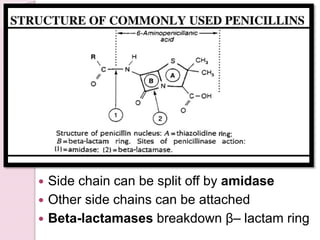
 Penicillin Nucleus
◦ β- Lactam Ring
◦ Thiazolidine Ring
◦ Side Chain
 Side chain can be split off by amidase
 Other side chains can be attached
 Beta-lactamases breakdown β– lactam ring
 Water soluble
 Acid Labile
 Thermolabile
 A- Rapid and complete absorption (i.m.)
 D- Distributed extracellularly
 E- Rapid renal excretion
◦ Tubular secretion
* What happens if PROBENECID is
given along with Penicillin?
 Tubular secretion is blocked by
probenecid, therefore higher and longer
lasting plasma concentrations of penicillin
Mechanism of Action
 Interferes with bacterial cell wall synthesis
PEPTIDOGLYCAN LAYER
N- ACETYL MURAMIC ACID
(NAM)
N- ACETYL GLUCOSAMINE
(NAG)
AMINO ACID CHAINS
β- Lactam Antibiotic
(Penicillin)
TRANSPEPTIDASE
CROSS-LINKING
PENICILLIN BINDING PROTEINS
(PBPs)
(ANIMATION)
β- Lactam Antibiotic
(Penicillin)
PENICILLIN BINDING PROTEINS
(PBPs)
X - Inhibition of cross-linking
(ANIMATION)
Mechanism of Action
 Cross-linking is blocked by:
◦ X- cleavage of terminal D-alanine
◦ X- transpeptidation of 5- glycine chain residues
 Inhibiting cell wall synthesis DAMAGES cell
 High osmotic pressure inside cell and low
osmotic pressure outside causes cell to BURST
due to a weak and unstable cell wall
 Bactericidal
 Autolysins released from penicillin-PBP
complex to digest remaining cell wall remnants
Antibacterial Spectrum
 Narrow spectrum
◦ Gram positive bacteria
 Cocci- Streptococci, Pneumococci
 Bacilli- B. anthracis, C. diphtheriae,
Clostridia and Listeria species
◦ Limited gram negative bacteria
 Cocci- Gonocci, Meningococci
◦ Actinomyces
◦ Spirochetes
 Treponema
 Leptospira
Uses
 Streptococcal Infections:
◦ Pharyngitis, Otitis Media, Scarlet Fever
◦ Rheumatic Fever
◦ Subacute Bacterial Endocarditis
 Pneumococcal Infections:
◦ Lobar Pneumonia
 Meningococcal Infections:
◦ Meningitis
 Gonococcal Infections:
◦ Ophthalmia Neonatorum
 Syphilis
 Leptospirosis
 Diphtheria
 Tetanus
 Anthrax
 Actinomycosis
 Rat bite fever
 Prophylaxis
◦ Rheumatic Fever
◦ Bacterial Endocarditis
◦ Agranulocytosis
Uses
Penicillin G- DRUG OF CHOICE IN:
 Subacute Bacterial Endocarditis
◦ Sodium PnG 10-20 MU i.v daily + Gentamicin
for 2-6 weeks
 Ophthalmia Neonatorum
◦ Saline irrigation
◦ Sodium PnG 10,000-20,000 U/mL
 1 drop in each eye every 1-3hours
 Syphilis
◦ Early/Latent Syphilis
 Procaine Pn 1.2 MU i.m. daily for 10 days OR
 Benzathine Pn 2.4 MU i.m. weekly for 4 weeks
◦ Late Syphilis
 Benzathine Pn 2.4 MU weekly for 4 weeks
◦ Cardiovascular/Neurosyphilis
 Sodium PnG 5 MU i.m. 6 hourly for 2 weeks
 Leptospirosis
◦ Sodium PnG 1.5 MU i.v. 6 hourly for 7 days
 Diphtheria
 Tetanus and Gas gangrene
 Anthrax
 Actinomycosis
 Rat bite fever
Prophylaxis
 Rheumatic Fever
◦ Benzathine Pn 1.2 MU every 4 weeks until 18
years of age or 5 years after attack
(whichever is more)
Adverse Effects
 Hypersensitivity-
◦ rash, itching, urticaria, fever
◦ wheezing, angioneurotic edema, serum sickness,
exfoliative dermatitis (less common)
◦ Anaphylaxis
(rare, but fatal)
Adverse Effects
 Hypersensitivity-
*Commonly seen after PARENTERAL
administration
*Incidence highest with PROCAINE pn
*History of penicillin allergy should be
elicited
*Scratch test or Intradermal Test dose
- negative test does not rule out
delayed hypersensitivity reactions!
Adverse Effects
 Superinfections
◦ Rare with PnG
◦ Bowel, respiratory and cutaneous microflora can
undergo changes
 Jarisch- Herxheimer Reaction
◦ Shivering, fever, myalgia, exacerbation of lesions,
vascular collapse
◦ Seen in syphilitic patients injected with Penicillin
◦ Due to sudden release of spirochetal lytic products
◦ Symptomatic treatment with aspirin and sedation
Adverse Effects
 Local irritation
◦ Pain at injection site
◦ Thrombophlebitis
 Neurotoxicity
◦ Mental confusion, muscular twitching,
convulsions, coma
 Bleeding
◦ Due to interference of platelet function
 Intrathecal PnG injections (not recommended)
◦ Arachnoiditis, degenerative changes in spinal cord
 Accidental IV procaine penicillin injection
◦ CNS stimulation, hallucinations, convulsions
Phenoxymethyl Penicillin
 Penicillin V
 Acid stable
 Given orally
 Plasma t½ = 30-60 min
 Antibacterial spectrum- same as PnG
 Not used for serious infections (preferred
only when oral drug is to be selected)
 Dose- 250-500mg 6 hourly
Semisynthetic Penicillins
Learning Objectives:
 Classification (Semisynthetic Penicillins)
 Structure and Properties
 Penicillinase- resistant penicillins
 Extended spectrum penicillins
 β-Lactamase inhibitors
 Bacterial Resistance
Why Semisynthetics?
Penicillin G has…
1. Poor oral efficacy
2. Susceptibility to penicillinase
3. Not stable in gastric acid; rapidly broken
down in stomach
4. Narrow spectrum of activity
5. Hypersensitivity reactions
Semisynthetic
Penicillins
Acid
Labile
• Penicillin- G
(Benzyl
Penicillin)
•Procaine
penicillin- G
•Benzathine
penicillin- G
• Penicillin- V
(Phenoxymethyl
penicillin)
Acid
Resistant
Penicillinase
Resistant
β-Lactamase
inhibitors
Natural
Extended
Spectrum
Semisynthetic Penicillins
Penicillinase
Resistant
β-Lactamase
inhibitors
Extended
Spectrum
• Methicillin
• Cloxacillin
• Dicloxacillin
• Ampicillin
• Bacampicillin
• Amoxicillin
• Carbenicillin • Piperacillin
• Mezlocillin
• Clavulanic acid
• Sulbactam
• Tazobactam
Aminopenicillins Carboxypenicillins Ureidopenicillins
Structural Difference
 Semisynthetic Pns - produced by chemically combining
specific side chains to 6-aminopenicillanic acid
6- aminopenicillanic
acid
Penicillinase Resistant:
 Methicillin
 Cloxacillin
 Dicloxacillin
• Side chains protect β– Lactam ring from penicillinase
(staphylococcal)
• Partially protects bacteria from β– Lactam ring.
 Oxacillin
 Flucloxacillin
 Nafcillin
Methicillin:
 Highly penicillinase resistant
 Acid Labile… should be administered parenterally
 Narrow spectrum- was used to treat certain Gram
positive bacteria
 Induces penicillinase production
 Adverse effects- interstitial nephritis, hematuria,
albuminuria
 Not in use due to resistance
 Replaced by other drugs in same group
MRSA:
 Methicillin Resistant
Staphylococcus Aureus
 Insensitive to penicillinase-
resistant penicillins, other
β–lactams as well as other antibiotics
 Evolved from horizontal gene transfer
 altered PBPs  do not bind to penicillins
 Drugs to be used in MRSA:
◦ Vancomycin
◦ Linezolid
◦ Ciprofloxacin
Cloxacillin/Dicloxacillin
 Highly penicillinase resistant
 Acid stable… can be given orally
 Used against staphylococcal infection EXCEPT MRSA
 Mostly binds to plasma proteins
 Dose: 0.25 – 0.5g every 6 hours
Oxacillin/Floxacillin
 Similar to cloxacillin
Nafcillin
 Given parenterally
 Other side effects- oral thrush, agranulocytosis,
neutropenia
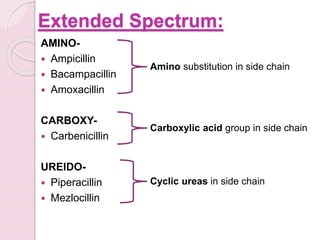
Extended Spectrum:
AMINO-
 Ampicillin
 Bacampacillin
 Amoxacillin
CARBOXY-
 Carbenicillin
UREIDO-
 Piperacillin
 Mezlocillin
Amino substitution in side chain
Carboxylic acid group in side chain
Cyclic ureas in side chain
AMPICILLIN AMOXICILLIN BACAMPACILLIN
• Acid Stable
• Incomplete oral
absorption
-Food interference
• t½ = 1 hour
• Spectrum similar to PnG
+ S. viridans, enterococci
and Listeria
• Partially excreted in bile
and reabsorbed
-Enterohepatic circulation
-Primary excretion via
kidney
• Acid Stable
• Not a prodrug
• Better oral absorption
-No food interference
• t½ = 1 hour
• Spectrum similar to
ampicillin + more active
against penicillin
resistant S. pneumoniae
• Similar to ampicillin
• Acid Stable
• Ester prodrug of ampicillin
• Complete GIT absorption
• t½ ≈ 1 hour
• Spectrum similar to
ampicillin
• Similar to ampicillin
AMPICILLIN AMOXICILLIN BACAMPACILLIN
Uses:
• UTI
• Respiratory tract
-Bronchitis
-Otitis media
-Sinusitis
• Meningitis
• Gonorrhea
(Single dose 3.5g + 1g of
probenecid)
• Cholecystitis
• SABE
(2g i.v. 6th hourly with
gentamicin)
• H. pylori
• Septicemia
• ANUG
Uses same as ampicillin
• Preferred over
ampicillin in many cases
- Bronchitis
- UTI
- SABE
- Gonorrhea
Uses same as ampicillin
AMPICILLIN AMOXICILLIN BACAMPACILLIN
Ampicillin + Cloxacillin
• Post operative infections
• Not synergistic
• Irrational and harmful
Adverse Effects:
• Diarrhea
• Rashes
- HIV
- EB virus infection
- Lymphatic leukemia
Dose
• 0.5 - 2g 6th hourly
(oral/i.m/i.v)
Coamoxiclav
• Lower incidence of
diarrhea
• 0.25 – 1g TID
(oral/i.m/slow i.v)
•Less incidence of diarrhea
• 400 – 800mg BD
(oral)
 Other prodrugs of ampicillin
◦ Talampicillin
◦ Pivampicillin
◦ Hetacillin
Carbenicillin:
 Has activity against Pseudomonas and
Proteus
 Acid Labile… should be administered parenterally
 t½= 1 hour
 Excreted rapidly in urine
 Uses- serious Pseudomonas or Proteus infections
 Can be combined with Gentamicin BUT SHOULD NOT
BE MIXED IN THE SAME SYRINGE
 Dose- 1-2g i.m or 1-5g i.v every 4-6 hours
 Adverse effects- fluid retention & CHF in patients with
borderline renal and cardiac function, bleeding
 Other carboxypenicillins
◦ Ticarcillin
◦ Temocillin
Piperacillin:
 Has more activity against Pseudomonas and
Klebsiella, Enterobacteriaceae and
Bacteroides
 Acid Labile… should be administered parenterally
 t½= 1 hour
 Excreted rapidly in urine
 Uses- serious Pseudomonas or Klebsiella infections like
UTI
 Concurrent use of Gentamicin or tobramycin is advised
 Dose- 100-150mg/kg/day i.m/i.v in 3 divided doses
 Adverse effects- diarrhea, nausea, headache
 Other ureidopenicillins
◦ Mezlocillin
◦ Azlocillin
β- Lactamase Inhibitors:
 Clavulanic Acid
 Sulbactam
 Tazobactam
CLAVULANIC
ACID
SULBACTAM TAZOBACTAM
• Streptomyces
clavuligerus
• β-Lactam ring present
but no antibacterial
activity
• Inhibits a wide variety
of β-Lactamases
• Inhibition increases
with time “progressive”
• “Suicide” inhibitor
Pharmacokinetics
• Rapid oral absorption
• t½= 1 hour
• Eiminated by
glomerular filtration
• Combined with Amox
• Related chemically to
clavulanic acid
• Some antibacterial activity
present; too weak
• Irreversible β-Lactamase
inhibitor
• Less potent than clavulanic
acid; same inhibition with
higher dose
• Inconsistent oral
absorption
• Combined with Ampicillin
• Similar to sulbactam
• Antipseudomonal
• Broadens spectrum of
Piperacillin
•Combined with Piperacillin
CLAVULANIC ACID SULBACTAM TAZOBACTAM
COAMOXICLAV
• Combined with Amox
•Does not potentiate
action of amox
Uses:
• Skin, intra-abdominal,
gynecological, urinary
tract, biliary tract and resp
tract infections
Dose:
250mg + 125mg tab
500mg + 125mg tab
1g + 0.2g vial deep i.m/i.v
Adverse Effects:
• Poor GI tolerance
• Candida infections
• Combined with Ampicillin
Uses:
• PPNG gonorrhea
• Intra-abdominal
infections
•Gynecological
•Skin/soft tissue infections
Dose:
1g + 0.5g vial (1-2 vials
Deep i.m/i.v 6-8th hourly
Adverse Effects:
• Pain at site of injection
• Thrombophlebitis
• Diarrhea
• Combined with
Piperacillin
• Combined with
ceftriaxone also
Dose:
4g + 0.5g iv over 30min,
8th hourly
Bacterial Resistance:
 Primarily due to production of penicillinase
 Mechanisms of resistance:
◦ Transformation
◦ Plasmid donor via Conjugation
 Bacteria resistant to penicillins
◦ Staphylococci
◦ S. pneumoniae
◦ Strains of Gonococci- PnG
◦ Strains of E. coli
 Penicillinase used to destroy PnG in blood samples
Bacterial Resistance:
https://www.youtube.com/watch?v=qBdYnRhdWcQ
THANK YOU!

Penicillin

  • 1.
    By: Dr. ShruthiRammohan PG in Pharmacology RRMCH
  • 2.
    Penicillin Learning Objectives: History  Classification (Natural Penicillins)  Structure and Properties  Mechanism of Action  Antibacterial Spectrum  Uses  Adverse Effects
  • 3.
    History  Who discoveredPenicillin? Alexander Fleming (1881-1955)
  • 4.
    History  Scottish biologistand pharmacologist  After World War I  elected Professor of Bacteriology at the University of London in 1928  Accidentally discovered Penicillin while studying properties of Staphylococci  Described the mould as being from the genus Penicillium  Named the substance released as Penicillin  PENICILLIN WAS BORN 7TH MARCH, 1929
  • 5.
    History  Mass productionof the new drug for use in World War II  Penicillin saved many lives during the war that may have been lost due to infected wounds  Penicillin was also said to treat diphtheria, gangrene, pneumonia, syphilis and tuberculosis  Penicillin- first antibiotic to be used clinically  Fleming received the Nobel Prize in 1945
  • 6.
  • 7.
    Semisynthetic Penicillins Acid Labile • Penicillin- G (Benzyl Penicillin) •Procaine penicillin-G •Benzathine penicillin- G • Penicillin- V (Phenoxymethyl penicillin) Acid Resistant Penicillinase Resistant β-Lactamase inhibitors Natural Extended Spectrum • Originally obtained from fungus Penicillium nonatum • Present source from Penicillium chrysogenum
  • 8.
    Preparations  Sodium PenicillinG (crystalline penicillin) ◦ 0.5 – 5 MU i.m./i.v. 6-12 hourly ◦ Dry powder to be dissolved in sterile water  Repository Penicillin G Injections - Insoluble salts given deep i.m ONLY 1. Procaine Penicillin G ◦ 0.5 – 1 MU i.m. 12-24 hourly 2. Fortified Procaine Penicillin G ◦ 3 lac U Procaine Pen + 1 lac U Sod. Pen G 3. Benzathine Penicillin G ◦ 0.6 – 2.4 MU i.m. every 2-4 weeks
  • 9.
    Structure  Penicillin Nucleus ◦β- Lactam Ring ◦ Thiazolidine Ring ◦ Side Chain
  • 10.
     Side chaincan be split off by amidase  Other side chains can be attached  Beta-lactamases breakdown β– lactam ring
  • 11.
     Water soluble Acid Labile  Thermolabile  A- Rapid and complete absorption (i.m.)  D- Distributed extracellularly  E- Rapid renal excretion ◦ Tubular secretion * What happens if PROBENECID is given along with Penicillin?  Tubular secretion is blocked by probenecid, therefore higher and longer lasting plasma concentrations of penicillin
  • 12.
    Mechanism of Action Interferes with bacterial cell wall synthesis PEPTIDOGLYCAN LAYER N- ACETYL MURAMIC ACID (NAM) N- ACETYL GLUCOSAMINE (NAG) AMINO ACID CHAINS
  • 13.
  • 14.
    β- Lactam Antibiotic (Penicillin) PENICILLINBINDING PROTEINS (PBPs) X - Inhibition of cross-linking (ANIMATION)
  • 15.
    Mechanism of Action Cross-linking is blocked by: ◦ X- cleavage of terminal D-alanine ◦ X- transpeptidation of 5- glycine chain residues  Inhibiting cell wall synthesis DAMAGES cell  High osmotic pressure inside cell and low osmotic pressure outside causes cell to BURST due to a weak and unstable cell wall  Bactericidal  Autolysins released from penicillin-PBP complex to digest remaining cell wall remnants
  • 16.
    Antibacterial Spectrum  Narrowspectrum ◦ Gram positive bacteria  Cocci- Streptococci, Pneumococci  Bacilli- B. anthracis, C. diphtheriae, Clostridia and Listeria species ◦ Limited gram negative bacteria  Cocci- Gonocci, Meningococci ◦ Actinomyces ◦ Spirochetes  Treponema  Leptospira
  • 17.
    Uses  Streptococcal Infections: ◦Pharyngitis, Otitis Media, Scarlet Fever ◦ Rheumatic Fever ◦ Subacute Bacterial Endocarditis  Pneumococcal Infections: ◦ Lobar Pneumonia  Meningococcal Infections: ◦ Meningitis  Gonococcal Infections: ◦ Ophthalmia Neonatorum  Syphilis  Leptospirosis
  • 18.
     Diphtheria  Tetanus Anthrax  Actinomycosis  Rat bite fever  Prophylaxis ◦ Rheumatic Fever ◦ Bacterial Endocarditis ◦ Agranulocytosis
  • 19.
    Uses Penicillin G- DRUGOF CHOICE IN:  Subacute Bacterial Endocarditis ◦ Sodium PnG 10-20 MU i.v daily + Gentamicin for 2-6 weeks  Ophthalmia Neonatorum ◦ Saline irrigation ◦ Sodium PnG 10,000-20,000 U/mL  1 drop in each eye every 1-3hours
  • 20.
     Syphilis ◦ Early/LatentSyphilis  Procaine Pn 1.2 MU i.m. daily for 10 days OR  Benzathine Pn 2.4 MU i.m. weekly for 4 weeks ◦ Late Syphilis  Benzathine Pn 2.4 MU weekly for 4 weeks ◦ Cardiovascular/Neurosyphilis  Sodium PnG 5 MU i.m. 6 hourly for 2 weeks  Leptospirosis ◦ Sodium PnG 1.5 MU i.v. 6 hourly for 7 days
  • 21.
     Diphtheria  Tetanusand Gas gangrene  Anthrax  Actinomycosis  Rat bite fever Prophylaxis  Rheumatic Fever ◦ Benzathine Pn 1.2 MU every 4 weeks until 18 years of age or 5 years after attack (whichever is more)
  • 22.
    Adverse Effects  Hypersensitivity- ◦rash, itching, urticaria, fever ◦ wheezing, angioneurotic edema, serum sickness, exfoliative dermatitis (less common) ◦ Anaphylaxis (rare, but fatal)
  • 23.
    Adverse Effects  Hypersensitivity- *Commonlyseen after PARENTERAL administration *Incidence highest with PROCAINE pn *History of penicillin allergy should be elicited *Scratch test or Intradermal Test dose - negative test does not rule out delayed hypersensitivity reactions!
  • 24.
    Adverse Effects  Superinfections ◦Rare with PnG ◦ Bowel, respiratory and cutaneous microflora can undergo changes  Jarisch- Herxheimer Reaction ◦ Shivering, fever, myalgia, exacerbation of lesions, vascular collapse ◦ Seen in syphilitic patients injected with Penicillin ◦ Due to sudden release of spirochetal lytic products ◦ Symptomatic treatment with aspirin and sedation
  • 25.
    Adverse Effects  Localirritation ◦ Pain at injection site ◦ Thrombophlebitis  Neurotoxicity ◦ Mental confusion, muscular twitching, convulsions, coma  Bleeding ◦ Due to interference of platelet function  Intrathecal PnG injections (not recommended) ◦ Arachnoiditis, degenerative changes in spinal cord  Accidental IV procaine penicillin injection ◦ CNS stimulation, hallucinations, convulsions
  • 26.
    Phenoxymethyl Penicillin  PenicillinV  Acid stable  Given orally  Plasma t½ = 30-60 min  Antibacterial spectrum- same as PnG  Not used for serious infections (preferred only when oral drug is to be selected)  Dose- 250-500mg 6 hourly
  • 27.
  • 28.
    Learning Objectives:  Classification(Semisynthetic Penicillins)  Structure and Properties  Penicillinase- resistant penicillins  Extended spectrum penicillins  β-Lactamase inhibitors  Bacterial Resistance
  • 29.
    Why Semisynthetics? Penicillin Ghas… 1. Poor oral efficacy 2. Susceptibility to penicillinase 3. Not stable in gastric acid; rapidly broken down in stomach 4. Narrow spectrum of activity 5. Hypersensitivity reactions
  • 30.
    Semisynthetic Penicillins Acid Labile • Penicillin- G (Benzyl Penicillin) •Procaine penicillin-G •Benzathine penicillin- G • Penicillin- V (Phenoxymethyl penicillin) Acid Resistant Penicillinase Resistant β-Lactamase inhibitors Natural Extended Spectrum
  • 31.
    Semisynthetic Penicillins Penicillinase Resistant β-Lactamase inhibitors Extended Spectrum • Methicillin •Cloxacillin • Dicloxacillin • Ampicillin • Bacampicillin • Amoxicillin • Carbenicillin • Piperacillin • Mezlocillin • Clavulanic acid • Sulbactam • Tazobactam Aminopenicillins Carboxypenicillins Ureidopenicillins
  • 32.
    Structural Difference  SemisyntheticPns - produced by chemically combining specific side chains to 6-aminopenicillanic acid 6- aminopenicillanic acid
  • 34.
    Penicillinase Resistant:  Methicillin Cloxacillin  Dicloxacillin • Side chains protect β– Lactam ring from penicillinase (staphylococcal) • Partially protects bacteria from β– Lactam ring.  Oxacillin  Flucloxacillin  Nafcillin
  • 35.
    Methicillin:  Highly penicillinaseresistant  Acid Labile… should be administered parenterally  Narrow spectrum- was used to treat certain Gram positive bacteria  Induces penicillinase production  Adverse effects- interstitial nephritis, hematuria, albuminuria  Not in use due to resistance  Replaced by other drugs in same group
  • 36.
    MRSA:  Methicillin Resistant StaphylococcusAureus  Insensitive to penicillinase- resistant penicillins, other β–lactams as well as other antibiotics  Evolved from horizontal gene transfer  altered PBPs  do not bind to penicillins  Drugs to be used in MRSA: ◦ Vancomycin ◦ Linezolid ◦ Ciprofloxacin
  • 37.
    Cloxacillin/Dicloxacillin  Highly penicillinaseresistant  Acid stable… can be given orally  Used against staphylococcal infection EXCEPT MRSA  Mostly binds to plasma proteins  Dose: 0.25 – 0.5g every 6 hours Oxacillin/Floxacillin  Similar to cloxacillin Nafcillin  Given parenterally  Other side effects- oral thrush, agranulocytosis, neutropenia
  • 38.
    Extended Spectrum: AMINO-  Ampicillin Bacampacillin  Amoxacillin CARBOXY-  Carbenicillin UREIDO-  Piperacillin  Mezlocillin Amino substitution in side chain Carboxylic acid group in side chain Cyclic ureas in side chain
  • 39.
    AMPICILLIN AMOXICILLIN BACAMPACILLIN •Acid Stable • Incomplete oral absorption -Food interference • t½ = 1 hour • Spectrum similar to PnG + S. viridans, enterococci and Listeria • Partially excreted in bile and reabsorbed -Enterohepatic circulation -Primary excretion via kidney • Acid Stable • Not a prodrug • Better oral absorption -No food interference • t½ = 1 hour • Spectrum similar to ampicillin + more active against penicillin resistant S. pneumoniae • Similar to ampicillin • Acid Stable • Ester prodrug of ampicillin • Complete GIT absorption • t½ ≈ 1 hour • Spectrum similar to ampicillin • Similar to ampicillin
  • 40.
    AMPICILLIN AMOXICILLIN BACAMPACILLIN Uses: •UTI • Respiratory tract -Bronchitis -Otitis media -Sinusitis • Meningitis • Gonorrhea (Single dose 3.5g + 1g of probenecid) • Cholecystitis • SABE (2g i.v. 6th hourly with gentamicin) • H. pylori • Septicemia • ANUG Uses same as ampicillin • Preferred over ampicillin in many cases - Bronchitis - UTI - SABE - Gonorrhea Uses same as ampicillin
  • 41.
    AMPICILLIN AMOXICILLIN BACAMPACILLIN Ampicillin+ Cloxacillin • Post operative infections • Not synergistic • Irrational and harmful Adverse Effects: • Diarrhea • Rashes - HIV - EB virus infection - Lymphatic leukemia Dose • 0.5 - 2g 6th hourly (oral/i.m/i.v) Coamoxiclav • Lower incidence of diarrhea • 0.25 – 1g TID (oral/i.m/slow i.v) •Less incidence of diarrhea • 400 – 800mg BD (oral)
  • 42.
     Other prodrugsof ampicillin ◦ Talampicillin ◦ Pivampicillin ◦ Hetacillin
  • 43.
    Carbenicillin:  Has activityagainst Pseudomonas and Proteus  Acid Labile… should be administered parenterally  t½= 1 hour  Excreted rapidly in urine  Uses- serious Pseudomonas or Proteus infections  Can be combined with Gentamicin BUT SHOULD NOT BE MIXED IN THE SAME SYRINGE  Dose- 1-2g i.m or 1-5g i.v every 4-6 hours  Adverse effects- fluid retention & CHF in patients with borderline renal and cardiac function, bleeding
  • 44.
     Other carboxypenicillins ◦Ticarcillin ◦ Temocillin
  • 45.
    Piperacillin:  Has moreactivity against Pseudomonas and Klebsiella, Enterobacteriaceae and Bacteroides  Acid Labile… should be administered parenterally  t½= 1 hour  Excreted rapidly in urine  Uses- serious Pseudomonas or Klebsiella infections like UTI  Concurrent use of Gentamicin or tobramycin is advised  Dose- 100-150mg/kg/day i.m/i.v in 3 divided doses  Adverse effects- diarrhea, nausea, headache
  • 46.
     Other ureidopenicillins ◦Mezlocillin ◦ Azlocillin
  • 47.
    β- Lactamase Inhibitors: Clavulanic Acid  Sulbactam  Tazobactam
  • 48.
    CLAVULANIC ACID SULBACTAM TAZOBACTAM • Streptomyces clavuligerus •β-Lactam ring present but no antibacterial activity • Inhibits a wide variety of β-Lactamases • Inhibition increases with time “progressive” • “Suicide” inhibitor Pharmacokinetics • Rapid oral absorption • t½= 1 hour • Eiminated by glomerular filtration • Combined with Amox • Related chemically to clavulanic acid • Some antibacterial activity present; too weak • Irreversible β-Lactamase inhibitor • Less potent than clavulanic acid; same inhibition with higher dose • Inconsistent oral absorption • Combined with Ampicillin • Similar to sulbactam • Antipseudomonal • Broadens spectrum of Piperacillin •Combined with Piperacillin
  • 49.
    CLAVULANIC ACID SULBACTAMTAZOBACTAM COAMOXICLAV • Combined with Amox •Does not potentiate action of amox Uses: • Skin, intra-abdominal, gynecological, urinary tract, biliary tract and resp tract infections Dose: 250mg + 125mg tab 500mg + 125mg tab 1g + 0.2g vial deep i.m/i.v Adverse Effects: • Poor GI tolerance • Candida infections • Combined with Ampicillin Uses: • PPNG gonorrhea • Intra-abdominal infections •Gynecological •Skin/soft tissue infections Dose: 1g + 0.5g vial (1-2 vials Deep i.m/i.v 6-8th hourly Adverse Effects: • Pain at site of injection • Thrombophlebitis • Diarrhea • Combined with Piperacillin • Combined with ceftriaxone also Dose: 4g + 0.5g iv over 30min, 8th hourly
  • 50.
    Bacterial Resistance:  Primarilydue to production of penicillinase  Mechanisms of resistance: ◦ Transformation ◦ Plasmid donor via Conjugation  Bacteria resistant to penicillins ◦ Staphylococci ◦ S. pneumoniae ◦ Strains of Gonococci- PnG ◦ Strains of E. coli  Penicillinase used to destroy PnG in blood samples
  • 51.
  • 52.