PENICILLINS,
CEPHALOSPORINS
&
OTHER BETA
LACTAM
ANTIBIOTICS
LEARNING
OBJECTIVES
1. The general mechanism of action of beta lactam group of
antibiotics.
2. The mechanism of bacterial resistance to penicillins &
cephalosporins
3. About Penicillins-
a) Classification & pharmacological properties
b) PnG & PnV
c) Penicillinase resistant penicillins
d) Aminopenicillins: Ampicillin & Amoxicillin
e) Antipseudomonal penicillins: Carboxypenicillins &
Ureidopenicillins
4. About Cephalosporins
a) Classification & pharmacological properties
b) Therapeutic Uses
5. Other β Lactams
a) Carbapenems & Monobactam
6. β Lactamase inhibitors
By the end of this chapter you
should be able to know:-
2
BETA LACTAM ANTIBIOTICS
 It includes:-
 Penicillins
 Cephalosporins
 Carbapenems
 Monobactams
 These antibiotics share a common structure (β lactam ring) & mechanism of
action (inhibition of bacterial peptidoglycan cell wall).
 β lactamase inhibitors extends the spectrum of these antibiotics.
3
BACTERIAL CELL WALL SYNTHESIS & MECHANISM OF ACTION OF
BETA LACTAM ANTIBIOTICS
Cytoplas
m
• Synthesis of Aminosugars: N-acetyl-glucosamine (NAG) & N-acetyl-muramic
(NAM)
• Addition of pentapeptide to NAM
• Formation peptidoglycan precursor [NAG-NAM(pentapeptide)]
Periplasm
• Elongation of peptidoglycan chain (transglycosylation)
•
• Cross linking of peptide chain (transpeptidation)
Beta Lactams
4
MECHANISM OF ACTION OF BETA LACTAM ANTIBIOTICS
 Inhibition of Peptidoglycan synthesis
 Inhibits the last step in peptidoglycan synthesis i.e,
transpeptidation
 Targets of beta lactam antibiotics are collectively called penicillin
binding protein (PBPs)
 Transpeptidase is one of the PBP
5
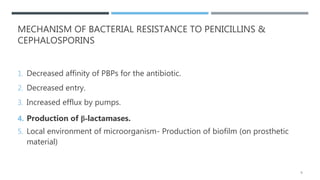
MECHANISM OF BACTERIAL RESISTANCE TO PENICILLINS &
CEPHALOSPORINS
1. Decreased affinity of PBPs for the antibiotic.
2. Decreased entry.
3. Increased efflux by pumps.
4. Production of β-lactamases.
5. Local environment of microorganism- Production of biofilm (on prosthetic
material)
6
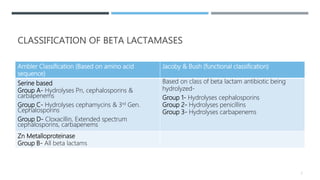
CLASSIFICATION OF BETA LACTAMASES
Ambler Classification (Based on amino acid
sequence)
Jacoby & Bush (functional classification)
Serine based
Group A- Hydrolyses Pn, cephalosporins &
carbapenems
Group C- Hydrolyses cephamycins & 3rd Gen.
Cephalosporins
Group D- Cloxacillin, Extended spectrum
cephalosporins, carbapenems
Based on class of beta lactam antibiotic being
hydrolyzed-
Group 1- Hydrolyses cephalosporins
Group 2- Hydrolyses penicillins
Group 3- Hydrolyses carbapenems
Zn Metalloproteinase
Group B- All beta lactams
7
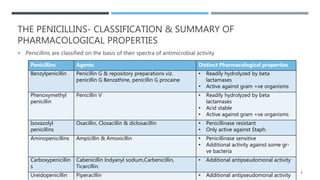
THE PENICILLINS- CLASSIFICATION & SUMMARY OF
PHARMACOLOGICAL PROPERTIES
 Penicillins are classified on the basis of their spectra of antimicrobial activity
Penicillins Agents Distinct Pharmacological properties
Benzylpenicillin Penicillin G & repository preparations viz.
penicillin G Benzathine, penicillin G procaine
• Readily hydrolyzed by beta
lactamases
• Active against gram +ve organisms
Phenoxymethyl
penicillin
Penicillin V • Readily hydrolyzed by beta
lactamases
• Acid stable
• Active against gram +ve organisms
Isoxazolyl
penicillins
Oxacillin, Cloxacillin & dicloxacillin • Penicillinase resistant
• Only active against Staph.
Aminopenicillins Ampicillin & Amoxicillin • Penicillinase sensitive
• Additional activity against some gr-
ve bacteria
Carboxypenicillin
s
Cabenicillin Indyanyl sodium,Carbenicillin,
Ticarcillin.
• Additional antipseudomonal activity
Ureidopenicillin Piperacillin • Additional antipseudomonal activity
8
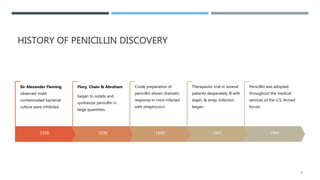
HISTORY OF PENICILLIN DISCOVERY
1928
Sir Alexander Fleming
observed mold
contaminated bacterial
culture were inhibited.
1939
Flory, Chain & Abraham
began to isolate and
synthesize penicillin in
large quantities.
1940
Crude preparation of
penicillin shown dramatic
response in mice infected
with streptococci.
1941
Therapeutic trial in several
patients desperately ill with
staph. & strep. Infection
began.
1944
Penicillin was adopted
throughout the medical
services of the U.S. Armed
forces.
9
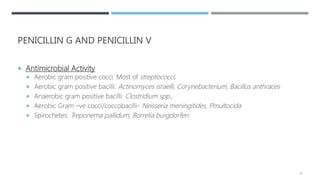
PENICILLIN G AND PENICILLIN V
 Antimicrobial Activity
 Aerobic gram positive cocci: Most of streptococci,
 Aerobic gram positive bacilli: Actinomyces israelli, Corynebacterium, Bacillus anthraces
 Anaerobic gram positive bacilli: Clostridium spp.,
 Aerobic Gram –ve cocci/coccobacilli- Neisseria meningitides, P.multocida
 Spirochetes: Treponema pallidum, Borrelia burgdorferi
10
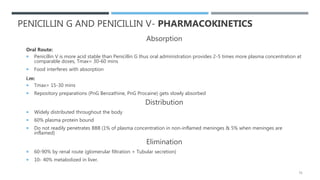
PENICILLIN G AND PENICILLIN V- PHARMACOKINETICS
Absorption
Oral Route:
 Penicillin V is more acid stable than Penicillin G thus oral administration provides 2-5 times more plasma concentration at
comparable doses, Tmax= 30-60 mins
 Food interferes with absorption
i.m:
 Tmax= 15-30 mins
 Repository preparations (PnG Benzathine, PnG Procaine) gets slowly absorbed
Distribution
 Widely distributed throughout the body
 60% plasma protein bound
 Do not readily penetrates BBB (1% of plasma concentration in non-inflamed meninges & 5% when meninges are
inflamed)
Elimination
 60-90% by renal route (glomerular filtration + Tubular secretion)
 10- 40% metabolized in liver.
11
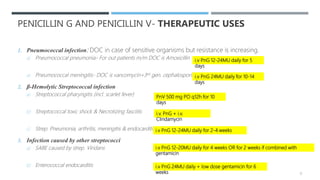
PENICILLIN G AND PENICILLIN V- THERAPEUTIC USES
1. Pneumococcal infection: DOC in case of sensitive organisms but resistance is increasing.
a) Pneumococcal pneumonia- For out patients m/m DOC is Amoxicillin
a) Pneumococcal meningitis- DOC is vancomycin+3rd gen. cephalosporin
2. β-Hemolytic Streptococcal infection
a) Streptococcal pharyngitis (incl. scarlet fever)
b) Streptococcal toxic shock & Necrotizing fasciitis
c) Strep. Pneumonia, arthritis, meningitis & endocarditis
3. Infection caused by other streptococci
a) SABE caused by strep. Viridans
b) Enterococcal endocarditis
PnV 500 mg PO q12h for 10
days
i.v. PnG + i.v.
Clindamycin
i.v PnG 12-24MU daily for 2-4 weeks
i.v PnG 12-20MU daily for 4 weeks OR for 2 weeks if combined with
gentamicin
i.v PnG 24MU daily + low dose gentamicin for 6
weeks
i.v PnG 12-24MU daily for 5
days
i.v PnG 24MU daily for 10-14
days
12
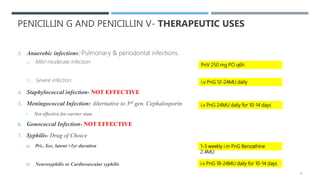
PENICILLIN G AND PENICILLIN V- THERAPEUTIC USES
3. Anaerobic infections: Pulmonary & periodontal infections.
a) Mild-moderate infection
b) Severe infection
4. Staphylococcal infection- NOT EFFECTIVE
5. Meningococcal Infection: Alternative to 3rd gen. Cephalosporin
• Not effective for carrier state
6. Gonococcal Infection- NOT EFFECTIVE
7. Syphilis- Drug of Choice
a) Pri., Sec, latent <1yr duration
b) Neurosyphilis or Cardiovascular syphilis
i.v PnG 24MU daily for 10-14 days
1-3 weekly i.m PnG Benzathine
2.4MU
i.v PnG 18-24MU daily for 10-14 days
PnV 250 mg PO q6h
i.v PnG 12-24MU daily
13
PENICILLIN G AND PENICILLIN V- THERAPEUTIC USES
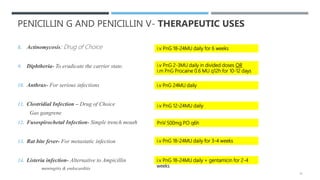
8. Actinomycosis: Drug of Choice
9. Diphtheria- To eradicate the carrier state.
10. Anthrax- For serious infections
11. Clostridial Infection – Drug of Choice
Gas gangrene
12. Fusospirochetal Infection- Simple trench mouth
13. Rat bite fever- For metastatic infection
14. Listeria infection- Alternative to Ampicillin
meningitis & endocarditis
i.v PnG 2-3MU daily in divided doses OR
i.m PnG Procaine 0.6 MU q12h for 10-12 days
PnV 500mg PO q6h
i.v PnG 18-24MU daily for 3-4 weeks
i.v PnG 18-24MU daily for 6 weeks
i.v PnG 24MU daily
i.v PnG 12-24MU daily
i.v PnG 18-24MU daily + gentamicin for 2-4
weeks
14
PENICILLIN G AND PENICILLIN V- THERAPEUTIC USES
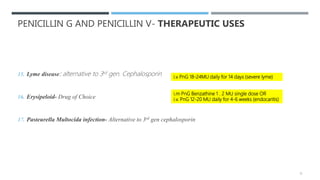
15. Lyme disease: alternative to 3rd gen. Cephalosporin
16. Erysipeloid- Drug of Choice
17. Pasteurella Multocida infection- Alternative to 3rd gen cephalosporin
i.m PnG Benzathine 1 . 2 MU single dose OR
i.v. PnG 12-20 MU daily for 4-6 weeks (endocaritis)
i.v PnG 18-24MU daily for 14 days (severe lyme)
15
PENICILLIN G AND PENICILLIN V- PROPHYLACTIC USES
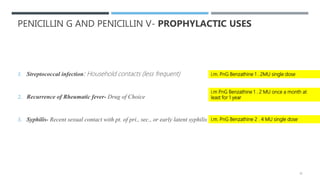
1. Streptococcal infection: Household contacts (less frequent)
2. Recurrence of Rheumatic fever- Drug of Choice
3. Syphilis- Recent sexual contact with pt. of pri., sec., or early latent syphilis
i.m PnG Benzathine 1 . 2 MU once a month at
least for 1 year
i.m. PnG Benzathine 1 . 2MU single dose
i.m. PnG Benzathine 2 . 4 MU single dose
16
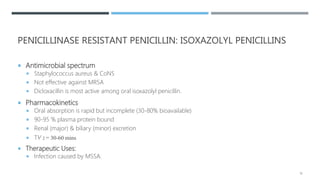
PENICILLINASE RESISTANT PENICILLIN: ISOXAZOLYL PENICILLINS
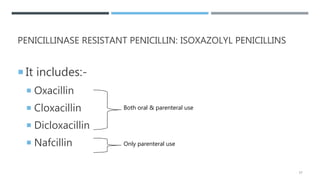
 It includes:-
 Oxacillin
 Cloxacillin
 Dicloxacillin
 Nafcillin
Both oral & parenteral use
Only parenteral use
17
PENICILLINASE RESISTANT PENICILLIN: ISOXAZOLYL PENICILLINS
 Antimicrobial spectrum
 Staphylococcus aureus & CoNS
 Not effective against MRSA
 Dicloxacillin is most active among oral isoxazolyl penicillin.
 Pharmacokinetics
 Oral absorption is rapid but incomplete (30-80% bioavailable)
 90-95 % plasma protein bound
 Renal (major) & biliary (minor) excretion
 T⅟2 = 30-60 mins
 Therapeutic Uses:
 Infection caused by MSSA.
18
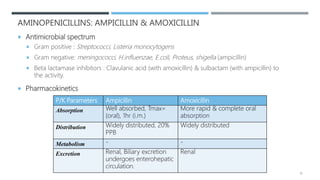
AMINOPENICILLINS: AMPICILLIN & AMOXICILLIN
 Antimicrobial spectrum
 Gram positive : Streptococci, Listeria monocytogens
 Gram negative: meningococci, H.influenzae, E.coli, Proteus, shigella (ampicillin)
 Beta lactamase inhibitors : Clavulanic acid (with amoxicillin) & sulbactam (with ampicillin) to
the activity.
 Pharmacokinetics
P/K Parameters Ampicillin Amoxicillin
Absorption Well absorbed, Tmax=
(oral), 1hr (i.m.)
More rapid & complete oral
absorption
Distribution Widely distributed, 20%
PPB
Widely distributed
Metabolism - -
Excretion Renal, Biliary excretion
undergoes enterohepatic
circulation.
Renal
19
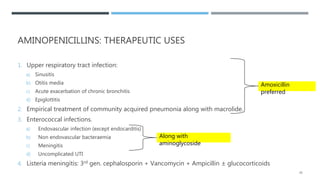
AMINOPENICILLINS: THERAPEUTIC USES
1. Upper respiratory tract infection:
a) Sinusitis
b) Otitis media
c) Acute exacerbation of chronic bronchitis
d) Epiglottitis
2. Empirical treatment of community acquired pneumonia along with macrolide.
3. Enterococcal infections.
a) Endovascular infection (except endocarditis)
b) Non endovascular bacteraemia
c) Meningitis
d) Uncomplicated UTI
4. Listeria meningitis: 3rd gen. cephalosporin + Vancomycin + Ampicillin ± glucocorticoids
Amoxicillin
preferred
Along with
aminoglycoside
20
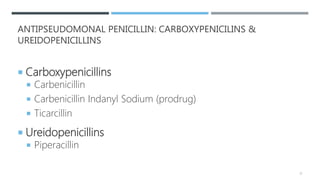
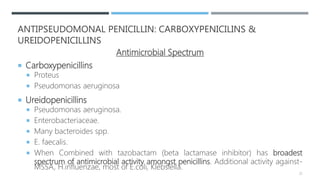
ANTIPSEUDOMONAL PENICILLIN: CARBOXYPENICILINS &
UREIDOPENICILLINS
 Carboxypenicillins
 Carbenicillin
 Carbenicillin Indanyl Sodium (prodrug)
 Ticarcillin
 Ureidopenicillins
 Piperacillin
21
ANTIPSEUDOMONAL PENICILLIN: CARBOXYPENICILINS &
UREIDOPENICILLINS
Antimicrobial Spectrum
 Carboxypenicillins
 Proteus
 Pseudomonas aeruginosa
 Ureidopenicillins
 Pseudomonas aeruginosa.
 Enterobacteriaceae.
 Many bacteroides spp.
 E. faecalis.
 When Combined with tazobactam (beta lactamase inhibitor) has broadest
spectrum of antimicrobial activity amongst penicillins. Additional activity against-
MSSA, H.influenzae, most of E.coli, Klebsiella.
22
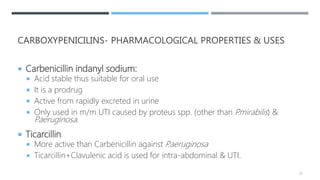
CARBOXYPENICILINS- PHARMACOLOGICAL PROPERTIES & USES
 Carbenicillin indanyl sodium:
 Acid stable thus suitable for oral use
 It is a prodrug
 Active from rapidly excreted in urine
 Only used in m/m UTI caused by proteus spp. (other than P.mirabilis) &
P.aeruginosa.
 Ticarcillin
 More active than Carbenicillin against P.aeruginosa
 Ticarcillin+Clavulenic acid is used for intra-abdominal & UTI.
23
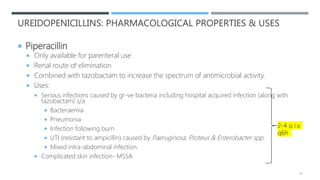
UREIDOPENICILLINS: PHARMACOLOGICAL PROPERTIES & USES
 Piperacillin
 Only available for parenteral use
 Renal route of elimination
 Combined with tazobactam to increase the spectrum of antimicrobial activity.
 Uses:
 Serious infections caused by gr-ve bacteria including hospital acquired infection (along with
tazobactam) s/a
 Bacteraemia
 Pneumonia
 Infection following burn
 UTI (resistant to ampicillin) caused by P.aeruginosa, Proteus & Enterobacter spp.
 Mixed intra-abdominal infection.
 Complicated skin infection- MSSA
24
2-4 g i.v.
q6h
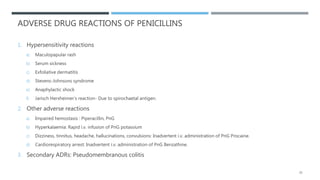
ADVERSE DRUG REACTIONS OF PENICILLINS
1. Hypersensitivity reactions
a) Maculopapular rash
b) Serum sickness
c) Exfoliative dermatitis
d) Stevens-Johnsons syndrome
e) Anaphylactic shock
f) Jarisch Herxheimer’s reaction- Due to spirochaetal antigen.
2. Other adverse reactions
a) Impaired hemostasis : Piperacillin, PnG
b) Hyperkalaemia: Rapid i.v. infusion of PnG potassium
c) Dizziness, tinnitus, headache, hallucinations, convulsions: Inadvertent i.v. administration of PnG Procaine.
d) Cardiorespiratory arrest: Inadvertent i.v. administration of PnG Benzathine.
3. Secondary ADRs: Pseudomembranous colitis
25
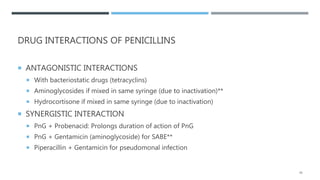
DRUG INTERACTIONS OF PENICILLINS
 ANTAGONISTIC INTERACTIONS
 With bacteriostatic drugs (tetracyclins)
 Aminoglycosides if mixed in same syringe (due to inactivation)**
 Hydrocortisone if mixed in same syringe (due to inactivation)
 SYNERGISTIC INTERACTION
 PnG + Probenacid: Prolongs duration of action of PnG
 PnG + Gentamicin (aminoglycoside) for SABE**
 Piperacillin + Gentamicin for pseudomonal infection
26
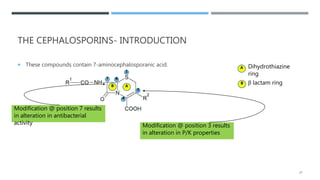
THE CEPHALOSPORINS- INTRODUCTION
 These compounds contain 7-aminocephalosporanic acid.
1
3
4
67
Modification @ position 7 results
in alteration in antibacterial
activity Modification @ position 3 results
in alteration in P/K properties
AB
A
B
Dihydrothiazine
ring
β lactam ring
27
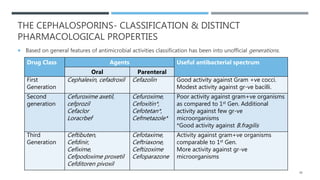
THE CEPHALOSPORINS- CLASSIFICATION & DISTINCT
PHARMACOLOGICAL PROPERTIES
 Based on general features of antimicrobial activities classification has been into unofficial generations.
Drug Class Agents Useful antibacterial spectrum
Oral Parenteral
First
Generation
Cephalexin, cefadroxil Cefazolin Good activity against Gram +ve cocci.
Modest activity against gr-ve bacilli.
Second
generation
Cefuroxime axetil,
cefprozil
Cefaclor
Loracrbef
Cefuroxime,
Cefoxitin*,
Cefotetan*,
Cefmetazole*
Poor activity against gram+ve organisms
as compared to 1st Gen. Additional
activity against few gr-ve
microorganisms
*Good activity against B.fragilis
Third
Generation
Ceftibuten,
Cefdinir,
Cefixime,
Cefpodoxime proxetil
Cefditoren pivoxil
Cefotaxime,
Ceftriaxone,
Ceftizoxime
Cefoparazone
Activity against gram+ve organisms
comparable to 1st Gen.
More activity against gr-ve
microorganisms
28
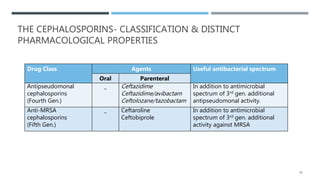
THE CEPHALOSPORINS- CLASSIFICATION & DISTINCT
PHARMACOLOGICAL PROPERTIES
Drug Class Agents Useful antibacterial spectrum
Oral Parenteral
Antipseudomonal
cephalosporins
(Fourth Gen.)
_ Ceftazidime
Ceftazidime/avibactam
Ceftolozane/tazobactam
In addition to antimicrobial
spectrum of 3rd gen. additional
antipseudomonal activity.
Anti-MRSA
cephalosporins
(Fifth Gen.)
_ Ceftaroline
Ceftobiprole
In addition to antimicrobial
spectrum of 3rd gen. additional
activity against MRSA
29
THE CEPHALOSPORINS- MECHANISM OF ACTION
 Inhibits bacterial cell wall synthesis similar to penicillins
30
THE CEPHALOSPORINS- MECHANISM OF BACTERIAL RESISTANCE
1.Decreased entry into microorganism
2.Alterations in PBPs
3.Destruction by beta lactamases (most prevalent)
31
THE CEPHALOSPORINS- PHARMACOKINETICS
 Cephalosporins are excreted primarily by kidney EXCEPT
Cefoparazone (biliary excretion) & Ceftriaxone (mixed
renal/nonrenal excretion)
 Several cephalosporins (ceftriaxone, cefotaxime,
ceftazidime & cefepime) has good penetration into CSF.
32
THE CEPHALOSPORINS- FIRST GENERATION
 Antimicrobial spectrum
 Good activity against most of gram positive cocci (except enterococci, MRSA & CoNS)
 Modest activity against Moraxella catarrhalis, E.Coli, Klebsiella pneumoniae, & P. mirabilis.
 Specific Agents:
 Cefazolin:
 Given i.m. or i.v.
 Preferred agent for surgical prophylaxis for procedures where skin flora are the likely pathogens.
 Cephalaxin, Cephradine & cefadroxil:
 Oral agents
 Used for skin & soft tissue infection.
33
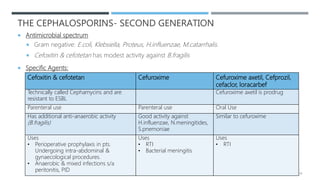
THE CEPHALOSPORINS- SECOND GENERATION
 Antimicrobial spectrum
 Gram negative: E.coli, Klebsiella, Proteus, H.influenzae, M.catarrhalis.
 Cefoxitin & cefotetan has modest activity against B.fragilis
 Specific Agents:
Cefoxitin & cefotetan Cefuroxime Cefuroxime axetil, Cefprozil,
cefaclor, loracarbef
Technically called Cephamycins and are
resistant to ESBL
Cefuroxime axetil is prodrug
Parenteral use Parenteral use Oral Use
Has additional anti-anaerobic activity
(B.fragilis)
Good activity against
H.influenzae, N.meningitides,
S.pnemoniae
Similar to cefuroxime
Uses
• Perioperative prophylaxis in pts.
Undergoing intra-abdominal &
gynaecological procedures.
• Anaerobic & mixed infections s/a
peritonitis, PID
Uses
• RTI
• Bacterial meningitis
Uses
• RTI
34
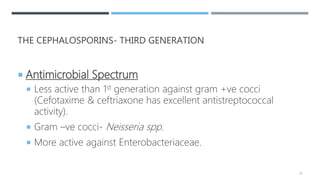
THE CEPHALOSPORINS- THIRD GENERATION
 Antimicrobial Spectrum
 Less active than 1st generation against gram +ve cocci
(Cefotaxime & ceftriaxone has excellent antistreptococcal
activity).
 Gram –ve cocci- Neisseria spp.
 More active against Enterobacteriaceae.
35
THE CEPHALOSPORIN- THIRD GENERATION
 Specific Agents
Agent Salient features Uses
Cefotaxime • Good activity against
gr+ve & gr-ve aerobic
organisms
• T1/2= 1hr
• Concentration in CSF if
good
• Community acquired pneumonia (serious infection)
[2 g IV q4-8hr]
• Bacterial meningitis [50 to 180 mg/kg IM or IV q4-
6h]
• Gonococcal urethritis, cervicitis, rectal gonorrhoea
[0.5/1.0 g IM once]
Ceftriaxone • Antibacterial activity
similar to cefotaxime
• Long T1/2= 8hr
• Both renal & biliary
excretion
• Gonococcal urethritis, cervicitis, rectal gonorrhoea
[250 mg IM once]
• Bacterial meningitis [1-2 g IV q12hr]
• Community acquired pneumonia (serious infection)
[1-2 g IV q12hr]
• UTI [1-2 g IV q12hr]
• Enteric fever [2 g IV q12hr]
36
THE CEPHALOSPORIN- THIRD GENERATION
 Specific Agents
Agent Salient features Uses
Ceftizoxime • Antibacterial activity similar to
cefotaxime
• Less active against S.pneumoniae
• More active against B.fragilis
• T1/2= 1.8hr
• Similar to cefotaxime
Cefpodoxime
proxetil,
cefditoren
pivoxil
• Prodrug
• Orally active
• Activity against streptococci,
H.influenzae & M.catarrhalis similar to
cefotaxime
• Respiratory tract infection [100-
200 mg or 5mg/kg/dose PO q12h]
• Uncomplicated skin & soft tissue
infection
37
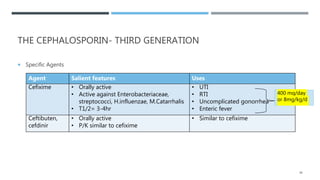
THE CEPHALOSPORIN- THIRD GENERATION
 Specific Agents
Agent Salient features Uses
Cefixime • Orally active
• Active against Enterobacteriaceae,
streptococci, H.influenzae, M.Catarrhalis
• T1/2= 3-4hr
• UTI
• RTI
• Uncomplicated gonorrhea
• Enteric fever
Ceftibuten,
cefdinir
• Orally active
• P/K similar to cefixime
• Similar to cefixime
38
400 mg/day
or 8mg/kg/d
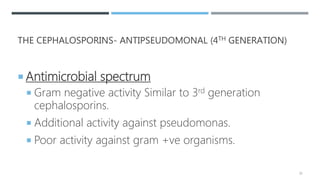
THE CEPHALOSPORINS- ANTIPSEUDOMONAL (4TH GENERATION)
 Antimicrobial spectrum
 Gram negative activity Similar to 3rd generation
cephalosporins.
 Additional activity against pseudomonas.
 Poor activity against gram +ve organisms.
39
THE CEPHALOSPORINS- ANTIPSEUDOMONAL (4TH GENERATION)
 Specific Agents
40
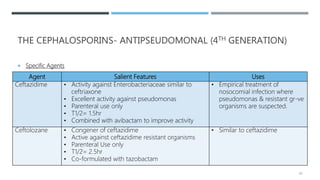
Agent Salient Features Uses
Ceftazidime • Activity against Enterobacteriaceae similar to
ceftriaxone
• Excellent activity against pseudomonas
• Parenteral use only
• T1/2= 1.5hr
• Combined with avibactam to improve activity
• Empirical treatment of
nosocomial infection where
pseudomonas & resistant gr-ve
organisms are suspected.
Ceftolozane • Congener of ceftazidime
• Active against ceftazidime resistant organisms
• Parenteral Use only
• T1/2= 2.5hr
• Co-formulated with tazobactam
• Similar to ceftazidime
THE CEPHALOSPORINS- ANTIPSEUDOMONAL (4TH GENERATION)
 Specific Agents
41
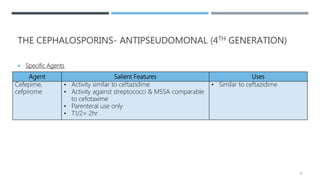
Agent Salient Features Uses
Cefepime,
cefpirome
• Activity similar to ceftazidime
• Activity against streptococci & MSSA comparable
to cefotaxime
• Parenteral use only
• T1/2= 2hr
• Similar to ceftazidime
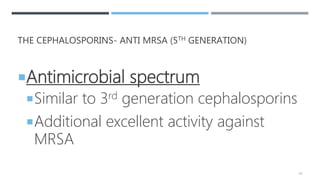
THE CEPHALOSPORINS- ANTI MRSA (5TH GENERATION)
Antimicrobial spectrum
Similar to 3rd generation cephalosporins
Additional excellent activity against
MRSA
42
THE CEPHALOSPORINS- ANTI MRSA (5TH GENERATION)
 Specific Agents
43
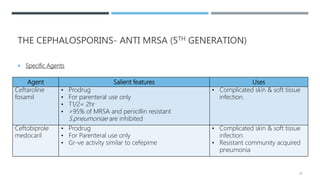
Agent Salient features Uses
Ceftaroline
fosamil
• Prodrug
• For parenteral use only
• T1/2= 2hr
• >95% of MRSA and penicillin resistant
S.pneumoniae are inhibited
• Complicated skin & soft tissue
infection.
Ceftobiprole
medocaril
• Prodrug
• For Parenteral use only
• Gr-ve activity similar to cefepime
• Complicated skin & soft tissue
infection.
• Resistant community acquired
pneumonia
ADVERSE DRUG REACTIONS OF CEPHALOSPORINS
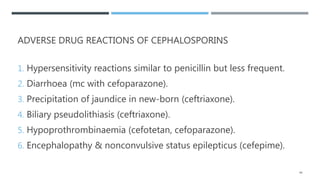
1. Hypersensitivity reactions similar to penicillin but less frequent.
2. Diarrhoea (mc with cefoparazone).
3. Precipitation of jaundice in new-born (ceftriaxone).
4. Biliary pseudolithiasis (ceftriaxone).
5. Hypoprothrombinaemia (cefotetan, cefoparazone).
6. Encephalopathy & nonconvulsive status epilepticus (cefepime).
44
THE CARBAPENEMS- AGENTS & PHARMACOLOGICAL PROPERTIES
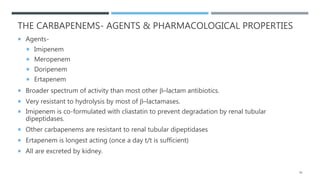
 Agents-
 Imipenem
 Meropenem
 Doripenem
 Ertapenem
 Broader spectrum of activity than most other β–lactam antibiotics.
 Very resistant to hydrolysis by most of β–lactamases.
 Imipenem is co-formulated with cliastatin to prevent degradation by renal tubular
dipeptidases.
 Other carbapenems are resistant to renal tubular dipeptidases
 Ertapenem is longest acting (once a day t/t is sufficient)
 All are excreted by kidney.
45
THE CARBAPENEMS- ANTIMICROBIAL SPECTRUM
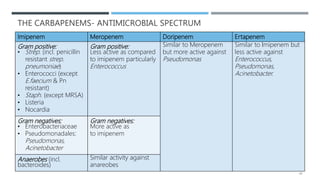
Imipenem Meropenem Doripenem Ertapenem
Gram positive:
• Strep. (incl. penicillin
resistant strep.
pneumoniae)
• Enterococci (except
E.faecium & Pn
resistant)
• Staph. (except MRSA)
• Listeria
• Nocardia
Gram positive:
Less active as compared
to imipenem particularly
Enterococcus
Similar to Meropenem
but more active against
Pseudomonas
Similar to Imipenem but
less active against
Enterococcus,
Pseudomonas,
Acinetobacter.
Gram negatives:
• Enterobacteriaceae
• Pseudomonadales:
Pseudomonas,
Acinetobacter
Gram negatives:
More active as
to imipenem
Anaerobes (incl.
bacteroides)
Similar activity against
anareobes
46
THE CARBAPENEMS- THERAPEUTIC USES
47
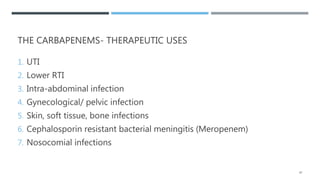
1. UTI
2. Lower RTI
3. Intra-abdominal infection
4. Gynecological/ pelvic infection
5. Skin, soft tissue, bone infections
6. Cephalosporin resistant bacterial meningitis (Meropenem)
7. Nosocomial infections
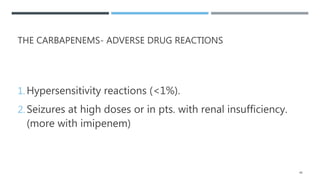
THE CARBAPENEMS- ADVERSE DRUG REACTIONS
1. Hypersensitivity reactions (<1%).
2. Seizures at high doses or in pts. with renal insufficiency.
(more with imipenem)
48
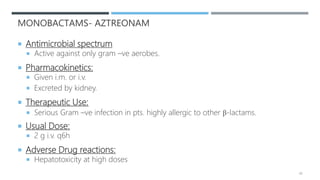
MONOBACTAMS- AZTREONAM
 Antimicrobial spectrum
 Active against only gram –ve aerobes.
 Pharmacokinetics:
 Given i.m. or i.v.
 Excreted by kidney.
 Therapeutic Use:
 Serious Gram –ve infection in pts. highly allergic to other β-lactams.
 Usual Dose:
 2 g i.v. q6h
 Adverse Drug reactions:
 Hepatotoxicity at high doses
49
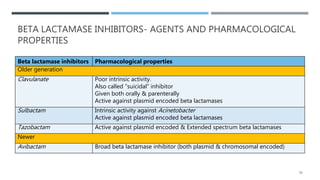
BETA LACTAMASE INHIBITORS- AGENTS AND PHARMACOLOGICAL
PROPERTIES
50
Beta lactamase inhibitors Pharmacological properties
Older generation
Clavulanate Poor intrinsic activity.
Also called “suicidal” inhibitor
Given both orally & parenterally
Active against plasmid encoded beta lactamases
Sulbactam Intrinsic activity against Acinetobacter
Active against plasmid encoded beta lactamases
Tazobactam Active against plasmid encoded & Extended spectrum beta lactamases
Newer
Avibactam Broad beta lactamase inhibitor (both plasmid & chromosomal encoded)
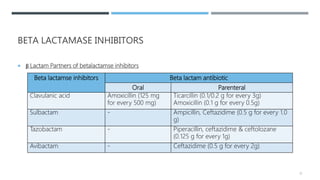
BETA LACTAMASE INHIBITORS
 β Lactam Partners of betalactamse inhibitors
51
Beta lactamse inhibitors Beta lactam antibiotic
Oral Parenteral
Clavulanic acid Amoxicillin (125 mg
for every 500 mg)
Ticarcillin (0.1/0.2 g for every 3g)
Amoxicillin (0.1 g for every 0.5g)
Sulbactam - Ampicillin, Ceftazidime (0.5 g for every 1.0
g)
Tazobactam - Piperacillin, ceftazidime & ceftolozane
(0.125 g for every 1g)
Avibactam - Ceftazidime (0.5 g for every 2g)
52

Beta lactam antibiotics

  • 1.
  • 2.
    LEARNING OBJECTIVES 1. The generalmechanism of action of beta lactam group of antibiotics. 2. The mechanism of bacterial resistance to penicillins & cephalosporins 3. About Penicillins- a) Classification & pharmacological properties b) PnG & PnV c) Penicillinase resistant penicillins d) Aminopenicillins: Ampicillin & Amoxicillin e) Antipseudomonal penicillins: Carboxypenicillins & Ureidopenicillins 4. About Cephalosporins a) Classification & pharmacological properties b) Therapeutic Uses 5. Other β Lactams a) Carbapenems & Monobactam 6. β Lactamase inhibitors By the end of this chapter you should be able to know:- 2
  • 3.
    BETA LACTAM ANTIBIOTICS It includes:-  Penicillins  Cephalosporins  Carbapenems  Monobactams  These antibiotics share a common structure (β lactam ring) & mechanism of action (inhibition of bacterial peptidoglycan cell wall).  β lactamase inhibitors extends the spectrum of these antibiotics. 3
  • 4.
    BACTERIAL CELL WALLSYNTHESIS & MECHANISM OF ACTION OF BETA LACTAM ANTIBIOTICS Cytoplas m • Synthesis of Aminosugars: N-acetyl-glucosamine (NAG) & N-acetyl-muramic (NAM) • Addition of pentapeptide to NAM • Formation peptidoglycan precursor [NAG-NAM(pentapeptide)] Periplasm • Elongation of peptidoglycan chain (transglycosylation) • • Cross linking of peptide chain (transpeptidation) Beta Lactams 4
  • 5.
    MECHANISM OF ACTIONOF BETA LACTAM ANTIBIOTICS  Inhibition of Peptidoglycan synthesis  Inhibits the last step in peptidoglycan synthesis i.e, transpeptidation  Targets of beta lactam antibiotics are collectively called penicillin binding protein (PBPs)  Transpeptidase is one of the PBP 5
  • 6.
    MECHANISM OF BACTERIALRESISTANCE TO PENICILLINS & CEPHALOSPORINS 1. Decreased affinity of PBPs for the antibiotic. 2. Decreased entry. 3. Increased efflux by pumps. 4. Production of β-lactamases. 5. Local environment of microorganism- Production of biofilm (on prosthetic material) 6
  • 7.
    CLASSIFICATION OF BETALACTAMASES Ambler Classification (Based on amino acid sequence) Jacoby & Bush (functional classification) Serine based Group A- Hydrolyses Pn, cephalosporins & carbapenems Group C- Hydrolyses cephamycins & 3rd Gen. Cephalosporins Group D- Cloxacillin, Extended spectrum cephalosporins, carbapenems Based on class of beta lactam antibiotic being hydrolyzed- Group 1- Hydrolyses cephalosporins Group 2- Hydrolyses penicillins Group 3- Hydrolyses carbapenems Zn Metalloproteinase Group B- All beta lactams 7
  • 8.
    THE PENICILLINS- CLASSIFICATION& SUMMARY OF PHARMACOLOGICAL PROPERTIES  Penicillins are classified on the basis of their spectra of antimicrobial activity Penicillins Agents Distinct Pharmacological properties Benzylpenicillin Penicillin G & repository preparations viz. penicillin G Benzathine, penicillin G procaine • Readily hydrolyzed by beta lactamases • Active against gram +ve organisms Phenoxymethyl penicillin Penicillin V • Readily hydrolyzed by beta lactamases • Acid stable • Active against gram +ve organisms Isoxazolyl penicillins Oxacillin, Cloxacillin & dicloxacillin • Penicillinase resistant • Only active against Staph. Aminopenicillins Ampicillin & Amoxicillin • Penicillinase sensitive • Additional activity against some gr- ve bacteria Carboxypenicillin s Cabenicillin Indyanyl sodium,Carbenicillin, Ticarcillin. • Additional antipseudomonal activity Ureidopenicillin Piperacillin • Additional antipseudomonal activity 8
  • 9.
    HISTORY OF PENICILLINDISCOVERY 1928 Sir Alexander Fleming observed mold contaminated bacterial culture were inhibited. 1939 Flory, Chain & Abraham began to isolate and synthesize penicillin in large quantities. 1940 Crude preparation of penicillin shown dramatic response in mice infected with streptococci. 1941 Therapeutic trial in several patients desperately ill with staph. & strep. Infection began. 1944 Penicillin was adopted throughout the medical services of the U.S. Armed forces. 9
  • 10.
    PENICILLIN G ANDPENICILLIN V  Antimicrobial Activity  Aerobic gram positive cocci: Most of streptococci,  Aerobic gram positive bacilli: Actinomyces israelli, Corynebacterium, Bacillus anthraces  Anaerobic gram positive bacilli: Clostridium spp.,  Aerobic Gram –ve cocci/coccobacilli- Neisseria meningitides, P.multocida  Spirochetes: Treponema pallidum, Borrelia burgdorferi 10
  • 11.
    PENICILLIN G ANDPENICILLIN V- PHARMACOKINETICS Absorption Oral Route:  Penicillin V is more acid stable than Penicillin G thus oral administration provides 2-5 times more plasma concentration at comparable doses, Tmax= 30-60 mins  Food interferes with absorption i.m:  Tmax= 15-30 mins  Repository preparations (PnG Benzathine, PnG Procaine) gets slowly absorbed Distribution  Widely distributed throughout the body  60% plasma protein bound  Do not readily penetrates BBB (1% of plasma concentration in non-inflamed meninges & 5% when meninges are inflamed) Elimination  60-90% by renal route (glomerular filtration + Tubular secretion)  10- 40% metabolized in liver. 11
  • 12.
    PENICILLIN G ANDPENICILLIN V- THERAPEUTIC USES 1. Pneumococcal infection: DOC in case of sensitive organisms but resistance is increasing. a) Pneumococcal pneumonia- For out patients m/m DOC is Amoxicillin a) Pneumococcal meningitis- DOC is vancomycin+3rd gen. cephalosporin 2. β-Hemolytic Streptococcal infection a) Streptococcal pharyngitis (incl. scarlet fever) b) Streptococcal toxic shock & Necrotizing fasciitis c) Strep. Pneumonia, arthritis, meningitis & endocarditis 3. Infection caused by other streptococci a) SABE caused by strep. Viridans b) Enterococcal endocarditis PnV 500 mg PO q12h for 10 days i.v. PnG + i.v. Clindamycin i.v PnG 12-24MU daily for 2-4 weeks i.v PnG 12-20MU daily for 4 weeks OR for 2 weeks if combined with gentamicin i.v PnG 24MU daily + low dose gentamicin for 6 weeks i.v PnG 12-24MU daily for 5 days i.v PnG 24MU daily for 10-14 days 12
  • 13.
    PENICILLIN G ANDPENICILLIN V- THERAPEUTIC USES 3. Anaerobic infections: Pulmonary & periodontal infections. a) Mild-moderate infection b) Severe infection 4. Staphylococcal infection- NOT EFFECTIVE 5. Meningococcal Infection: Alternative to 3rd gen. Cephalosporin • Not effective for carrier state 6. Gonococcal Infection- NOT EFFECTIVE 7. Syphilis- Drug of Choice a) Pri., Sec, latent <1yr duration b) Neurosyphilis or Cardiovascular syphilis i.v PnG 24MU daily for 10-14 days 1-3 weekly i.m PnG Benzathine 2.4MU i.v PnG 18-24MU daily for 10-14 days PnV 250 mg PO q6h i.v PnG 12-24MU daily 13
  • 14.
    PENICILLIN G ANDPENICILLIN V- THERAPEUTIC USES 8. Actinomycosis: Drug of Choice 9. Diphtheria- To eradicate the carrier state. 10. Anthrax- For serious infections 11. Clostridial Infection – Drug of Choice Gas gangrene 12. Fusospirochetal Infection- Simple trench mouth 13. Rat bite fever- For metastatic infection 14. Listeria infection- Alternative to Ampicillin meningitis & endocarditis i.v PnG 2-3MU daily in divided doses OR i.m PnG Procaine 0.6 MU q12h for 10-12 days PnV 500mg PO q6h i.v PnG 18-24MU daily for 3-4 weeks i.v PnG 18-24MU daily for 6 weeks i.v PnG 24MU daily i.v PnG 12-24MU daily i.v PnG 18-24MU daily + gentamicin for 2-4 weeks 14
  • 15.
    PENICILLIN G ANDPENICILLIN V- THERAPEUTIC USES 15. Lyme disease: alternative to 3rd gen. Cephalosporin 16. Erysipeloid- Drug of Choice 17. Pasteurella Multocida infection- Alternative to 3rd gen cephalosporin i.m PnG Benzathine 1 . 2 MU single dose OR i.v. PnG 12-20 MU daily for 4-6 weeks (endocaritis) i.v PnG 18-24MU daily for 14 days (severe lyme) 15
  • 16.
    PENICILLIN G ANDPENICILLIN V- PROPHYLACTIC USES 1. Streptococcal infection: Household contacts (less frequent) 2. Recurrence of Rheumatic fever- Drug of Choice 3. Syphilis- Recent sexual contact with pt. of pri., sec., or early latent syphilis i.m PnG Benzathine 1 . 2 MU once a month at least for 1 year i.m. PnG Benzathine 1 . 2MU single dose i.m. PnG Benzathine 2 . 4 MU single dose 16
  • 17.
    PENICILLINASE RESISTANT PENICILLIN:ISOXAZOLYL PENICILLINS  It includes:-  Oxacillin  Cloxacillin  Dicloxacillin  Nafcillin Both oral & parenteral use Only parenteral use 17
  • 18.
    PENICILLINASE RESISTANT PENICILLIN:ISOXAZOLYL PENICILLINS  Antimicrobial spectrum  Staphylococcus aureus & CoNS  Not effective against MRSA  Dicloxacillin is most active among oral isoxazolyl penicillin.  Pharmacokinetics  Oral absorption is rapid but incomplete (30-80% bioavailable)  90-95 % plasma protein bound  Renal (major) & biliary (minor) excretion  T⅟2 = 30-60 mins  Therapeutic Uses:  Infection caused by MSSA. 18
  • 19.
    AMINOPENICILLINS: AMPICILLIN &AMOXICILLIN  Antimicrobial spectrum  Gram positive : Streptococci, Listeria monocytogens  Gram negative: meningococci, H.influenzae, E.coli, Proteus, shigella (ampicillin)  Beta lactamase inhibitors : Clavulanic acid (with amoxicillin) & sulbactam (with ampicillin) to the activity.  Pharmacokinetics P/K Parameters Ampicillin Amoxicillin Absorption Well absorbed, Tmax= (oral), 1hr (i.m.) More rapid & complete oral absorption Distribution Widely distributed, 20% PPB Widely distributed Metabolism - - Excretion Renal, Biliary excretion undergoes enterohepatic circulation. Renal 19
  • 20.
    AMINOPENICILLINS: THERAPEUTIC USES 1.Upper respiratory tract infection: a) Sinusitis b) Otitis media c) Acute exacerbation of chronic bronchitis d) Epiglottitis 2. Empirical treatment of community acquired pneumonia along with macrolide. 3. Enterococcal infections. a) Endovascular infection (except endocarditis) b) Non endovascular bacteraemia c) Meningitis d) Uncomplicated UTI 4. Listeria meningitis: 3rd gen. cephalosporin + Vancomycin + Ampicillin ± glucocorticoids Amoxicillin preferred Along with aminoglycoside 20
  • 21.
    ANTIPSEUDOMONAL PENICILLIN: CARBOXYPENICILINS& UREIDOPENICILLINS  Carboxypenicillins  Carbenicillin  Carbenicillin Indanyl Sodium (prodrug)  Ticarcillin  Ureidopenicillins  Piperacillin 21
  • 22.
    ANTIPSEUDOMONAL PENICILLIN: CARBOXYPENICILINS& UREIDOPENICILLINS Antimicrobial Spectrum  Carboxypenicillins  Proteus  Pseudomonas aeruginosa  Ureidopenicillins  Pseudomonas aeruginosa.  Enterobacteriaceae.  Many bacteroides spp.  E. faecalis.  When Combined with tazobactam (beta lactamase inhibitor) has broadest spectrum of antimicrobial activity amongst penicillins. Additional activity against- MSSA, H.influenzae, most of E.coli, Klebsiella. 22
  • 23.
    CARBOXYPENICILINS- PHARMACOLOGICAL PROPERTIES& USES  Carbenicillin indanyl sodium:  Acid stable thus suitable for oral use  It is a prodrug  Active from rapidly excreted in urine  Only used in m/m UTI caused by proteus spp. (other than P.mirabilis) & P.aeruginosa.  Ticarcillin  More active than Carbenicillin against P.aeruginosa  Ticarcillin+Clavulenic acid is used for intra-abdominal & UTI. 23
  • 24.
    UREIDOPENICILLINS: PHARMACOLOGICAL PROPERTIES& USES  Piperacillin  Only available for parenteral use  Renal route of elimination  Combined with tazobactam to increase the spectrum of antimicrobial activity.  Uses:  Serious infections caused by gr-ve bacteria including hospital acquired infection (along with tazobactam) s/a  Bacteraemia  Pneumonia  Infection following burn  UTI (resistant to ampicillin) caused by P.aeruginosa, Proteus & Enterobacter spp.  Mixed intra-abdominal infection.  Complicated skin infection- MSSA 24 2-4 g i.v. q6h
  • 25.
    ADVERSE DRUG REACTIONSOF PENICILLINS 1. Hypersensitivity reactions a) Maculopapular rash b) Serum sickness c) Exfoliative dermatitis d) Stevens-Johnsons syndrome e) Anaphylactic shock f) Jarisch Herxheimer’s reaction- Due to spirochaetal antigen. 2. Other adverse reactions a) Impaired hemostasis : Piperacillin, PnG b) Hyperkalaemia: Rapid i.v. infusion of PnG potassium c) Dizziness, tinnitus, headache, hallucinations, convulsions: Inadvertent i.v. administration of PnG Procaine. d) Cardiorespiratory arrest: Inadvertent i.v. administration of PnG Benzathine. 3. Secondary ADRs: Pseudomembranous colitis 25
  • 26.
    DRUG INTERACTIONS OFPENICILLINS  ANTAGONISTIC INTERACTIONS  With bacteriostatic drugs (tetracyclins)  Aminoglycosides if mixed in same syringe (due to inactivation)**  Hydrocortisone if mixed in same syringe (due to inactivation)  SYNERGISTIC INTERACTION  PnG + Probenacid: Prolongs duration of action of PnG  PnG + Gentamicin (aminoglycoside) for SABE**  Piperacillin + Gentamicin for pseudomonal infection 26
  • 27.
    THE CEPHALOSPORINS- INTRODUCTION These compounds contain 7-aminocephalosporanic acid. 1 3 4 67 Modification @ position 7 results in alteration in antibacterial activity Modification @ position 3 results in alteration in P/K properties AB A B Dihydrothiazine ring β lactam ring 27
  • 28.
    THE CEPHALOSPORINS- CLASSIFICATION& DISTINCT PHARMACOLOGICAL PROPERTIES  Based on general features of antimicrobial activities classification has been into unofficial generations. Drug Class Agents Useful antibacterial spectrum Oral Parenteral First Generation Cephalexin, cefadroxil Cefazolin Good activity against Gram +ve cocci. Modest activity against gr-ve bacilli. Second generation Cefuroxime axetil, cefprozil Cefaclor Loracrbef Cefuroxime, Cefoxitin*, Cefotetan*, Cefmetazole* Poor activity against gram+ve organisms as compared to 1st Gen. Additional activity against few gr-ve microorganisms *Good activity against B.fragilis Third Generation Ceftibuten, Cefdinir, Cefixime, Cefpodoxime proxetil Cefditoren pivoxil Cefotaxime, Ceftriaxone, Ceftizoxime Cefoparazone Activity against gram+ve organisms comparable to 1st Gen. More activity against gr-ve microorganisms 28
  • 29.
    THE CEPHALOSPORINS- CLASSIFICATION& DISTINCT PHARMACOLOGICAL PROPERTIES Drug Class Agents Useful antibacterial spectrum Oral Parenteral Antipseudomonal cephalosporins (Fourth Gen.) _ Ceftazidime Ceftazidime/avibactam Ceftolozane/tazobactam In addition to antimicrobial spectrum of 3rd gen. additional antipseudomonal activity. Anti-MRSA cephalosporins (Fifth Gen.) _ Ceftaroline Ceftobiprole In addition to antimicrobial spectrum of 3rd gen. additional activity against MRSA 29
  • 30.
    THE CEPHALOSPORINS- MECHANISMOF ACTION  Inhibits bacterial cell wall synthesis similar to penicillins 30
  • 31.
    THE CEPHALOSPORINS- MECHANISMOF BACTERIAL RESISTANCE 1.Decreased entry into microorganism 2.Alterations in PBPs 3.Destruction by beta lactamases (most prevalent) 31
  • 32.
    THE CEPHALOSPORINS- PHARMACOKINETICS Cephalosporins are excreted primarily by kidney EXCEPT Cefoparazone (biliary excretion) & Ceftriaxone (mixed renal/nonrenal excretion)  Several cephalosporins (ceftriaxone, cefotaxime, ceftazidime & cefepime) has good penetration into CSF. 32
  • 33.
    THE CEPHALOSPORINS- FIRSTGENERATION  Antimicrobial spectrum  Good activity against most of gram positive cocci (except enterococci, MRSA & CoNS)  Modest activity against Moraxella catarrhalis, E.Coli, Klebsiella pneumoniae, & P. mirabilis.  Specific Agents:  Cefazolin:  Given i.m. or i.v.  Preferred agent for surgical prophylaxis for procedures where skin flora are the likely pathogens.  Cephalaxin, Cephradine & cefadroxil:  Oral agents  Used for skin & soft tissue infection. 33
  • 34.
    THE CEPHALOSPORINS- SECONDGENERATION  Antimicrobial spectrum  Gram negative: E.coli, Klebsiella, Proteus, H.influenzae, M.catarrhalis.  Cefoxitin & cefotetan has modest activity against B.fragilis  Specific Agents: Cefoxitin & cefotetan Cefuroxime Cefuroxime axetil, Cefprozil, cefaclor, loracarbef Technically called Cephamycins and are resistant to ESBL Cefuroxime axetil is prodrug Parenteral use Parenteral use Oral Use Has additional anti-anaerobic activity (B.fragilis) Good activity against H.influenzae, N.meningitides, S.pnemoniae Similar to cefuroxime Uses • Perioperative prophylaxis in pts. Undergoing intra-abdominal & gynaecological procedures. • Anaerobic & mixed infections s/a peritonitis, PID Uses • RTI • Bacterial meningitis Uses • RTI 34
  • 35.
    THE CEPHALOSPORINS- THIRDGENERATION  Antimicrobial Spectrum  Less active than 1st generation against gram +ve cocci (Cefotaxime & ceftriaxone has excellent antistreptococcal activity).  Gram –ve cocci- Neisseria spp.  More active against Enterobacteriaceae. 35
  • 36.
    THE CEPHALOSPORIN- THIRDGENERATION  Specific Agents Agent Salient features Uses Cefotaxime • Good activity against gr+ve & gr-ve aerobic organisms • T1/2= 1hr • Concentration in CSF if good • Community acquired pneumonia (serious infection) [2 g IV q4-8hr] • Bacterial meningitis [50 to 180 mg/kg IM or IV q4- 6h] • Gonococcal urethritis, cervicitis, rectal gonorrhoea [0.5/1.0 g IM once] Ceftriaxone • Antibacterial activity similar to cefotaxime • Long T1/2= 8hr • Both renal & biliary excretion • Gonococcal urethritis, cervicitis, rectal gonorrhoea [250 mg IM once] • Bacterial meningitis [1-2 g IV q12hr] • Community acquired pneumonia (serious infection) [1-2 g IV q12hr] • UTI [1-2 g IV q12hr] • Enteric fever [2 g IV q12hr] 36
  • 37.
    THE CEPHALOSPORIN- THIRDGENERATION  Specific Agents Agent Salient features Uses Ceftizoxime • Antibacterial activity similar to cefotaxime • Less active against S.pneumoniae • More active against B.fragilis • T1/2= 1.8hr • Similar to cefotaxime Cefpodoxime proxetil, cefditoren pivoxil • Prodrug • Orally active • Activity against streptococci, H.influenzae & M.catarrhalis similar to cefotaxime • Respiratory tract infection [100- 200 mg or 5mg/kg/dose PO q12h] • Uncomplicated skin & soft tissue infection 37
  • 38.
    THE CEPHALOSPORIN- THIRDGENERATION  Specific Agents Agent Salient features Uses Cefixime • Orally active • Active against Enterobacteriaceae, streptococci, H.influenzae, M.Catarrhalis • T1/2= 3-4hr • UTI • RTI • Uncomplicated gonorrhea • Enteric fever Ceftibuten, cefdinir • Orally active • P/K similar to cefixime • Similar to cefixime 38 400 mg/day or 8mg/kg/d
  • 39.
    THE CEPHALOSPORINS- ANTIPSEUDOMONAL(4TH GENERATION)  Antimicrobial spectrum  Gram negative activity Similar to 3rd generation cephalosporins.  Additional activity against pseudomonas.  Poor activity against gram +ve organisms. 39
  • 40.
    THE CEPHALOSPORINS- ANTIPSEUDOMONAL(4TH GENERATION)  Specific Agents 40 Agent Salient Features Uses Ceftazidime • Activity against Enterobacteriaceae similar to ceftriaxone • Excellent activity against pseudomonas • Parenteral use only • T1/2= 1.5hr • Combined with avibactam to improve activity • Empirical treatment of nosocomial infection where pseudomonas & resistant gr-ve organisms are suspected. Ceftolozane • Congener of ceftazidime • Active against ceftazidime resistant organisms • Parenteral Use only • T1/2= 2.5hr • Co-formulated with tazobactam • Similar to ceftazidime
  • 41.
    THE CEPHALOSPORINS- ANTIPSEUDOMONAL(4TH GENERATION)  Specific Agents 41 Agent Salient Features Uses Cefepime, cefpirome • Activity similar to ceftazidime • Activity against streptococci & MSSA comparable to cefotaxime • Parenteral use only • T1/2= 2hr • Similar to ceftazidime
  • 42.
    THE CEPHALOSPORINS- ANTIMRSA (5TH GENERATION) Antimicrobial spectrum Similar to 3rd generation cephalosporins Additional excellent activity against MRSA 42
  • 43.
    THE CEPHALOSPORINS- ANTIMRSA (5TH GENERATION)  Specific Agents 43 Agent Salient features Uses Ceftaroline fosamil • Prodrug • For parenteral use only • T1/2= 2hr • >95% of MRSA and penicillin resistant S.pneumoniae are inhibited • Complicated skin & soft tissue infection. Ceftobiprole medocaril • Prodrug • For Parenteral use only • Gr-ve activity similar to cefepime • Complicated skin & soft tissue infection. • Resistant community acquired pneumonia
  • 44.
    ADVERSE DRUG REACTIONSOF CEPHALOSPORINS 1. Hypersensitivity reactions similar to penicillin but less frequent. 2. Diarrhoea (mc with cefoparazone). 3. Precipitation of jaundice in new-born (ceftriaxone). 4. Biliary pseudolithiasis (ceftriaxone). 5. Hypoprothrombinaemia (cefotetan, cefoparazone). 6. Encephalopathy & nonconvulsive status epilepticus (cefepime). 44
  • 45.
    THE CARBAPENEMS- AGENTS& PHARMACOLOGICAL PROPERTIES  Agents-  Imipenem  Meropenem  Doripenem  Ertapenem  Broader spectrum of activity than most other β–lactam antibiotics.  Very resistant to hydrolysis by most of β–lactamases.  Imipenem is co-formulated with cliastatin to prevent degradation by renal tubular dipeptidases.  Other carbapenems are resistant to renal tubular dipeptidases  Ertapenem is longest acting (once a day t/t is sufficient)  All are excreted by kidney. 45
  • 46.
    THE CARBAPENEMS- ANTIMICROBIALSPECTRUM Imipenem Meropenem Doripenem Ertapenem Gram positive: • Strep. (incl. penicillin resistant strep. pneumoniae) • Enterococci (except E.faecium & Pn resistant) • Staph. (except MRSA) • Listeria • Nocardia Gram positive: Less active as compared to imipenem particularly Enterococcus Similar to Meropenem but more active against Pseudomonas Similar to Imipenem but less active against Enterococcus, Pseudomonas, Acinetobacter. Gram negatives: • Enterobacteriaceae • Pseudomonadales: Pseudomonas, Acinetobacter Gram negatives: More active as to imipenem Anaerobes (incl. bacteroides) Similar activity against anareobes 46
  • 47.
    THE CARBAPENEMS- THERAPEUTICUSES 47 1. UTI 2. Lower RTI 3. Intra-abdominal infection 4. Gynecological/ pelvic infection 5. Skin, soft tissue, bone infections 6. Cephalosporin resistant bacterial meningitis (Meropenem) 7. Nosocomial infections
  • 48.
    THE CARBAPENEMS- ADVERSEDRUG REACTIONS 1. Hypersensitivity reactions (<1%). 2. Seizures at high doses or in pts. with renal insufficiency. (more with imipenem) 48
  • 49.
    MONOBACTAMS- AZTREONAM  Antimicrobialspectrum  Active against only gram –ve aerobes.  Pharmacokinetics:  Given i.m. or i.v.  Excreted by kidney.  Therapeutic Use:  Serious Gram –ve infection in pts. highly allergic to other β-lactams.  Usual Dose:  2 g i.v. q6h  Adverse Drug reactions:  Hepatotoxicity at high doses 49
  • 50.
    BETA LACTAMASE INHIBITORS-AGENTS AND PHARMACOLOGICAL PROPERTIES 50 Beta lactamase inhibitors Pharmacological properties Older generation Clavulanate Poor intrinsic activity. Also called “suicidal” inhibitor Given both orally & parenterally Active against plasmid encoded beta lactamases Sulbactam Intrinsic activity against Acinetobacter Active against plasmid encoded beta lactamases Tazobactam Active against plasmid encoded & Extended spectrum beta lactamases Newer Avibactam Broad beta lactamase inhibitor (both plasmid & chromosomal encoded)
  • 51.
    BETA LACTAMASE INHIBITORS β Lactam Partners of betalactamse inhibitors 51 Beta lactamse inhibitors Beta lactam antibiotic Oral Parenteral Clavulanic acid Amoxicillin (125 mg for every 500 mg) Ticarcillin (0.1/0.2 g for every 3g) Amoxicillin (0.1 g for every 0.5g) Sulbactam - Ampicillin, Ceftazidime (0.5 g for every 1.0 g) Tazobactam - Piperacillin, ceftazidime & ceftolozane (0.125 g for every 1g) Avibactam - Ceftazidime (0.5 g for every 2g)
  • 52.