Antibiotics Affecting Cell Wall
Synthesis
1
PRESENTED BY :
DR ANWESHA
DR DEBOSMITAA SANYAL
DR MANVI AGARWAL
Cell Wall Inhibitors
• Some antimicrobial drugs selectively interfere
with synthesis of the bacterial cell wall-a
structure that mammalian cells do not possess.
• The cell wall is composed of a polymer called
peptidoglycan that consists of glycan units
joined to each other by peptide cross-links.
2
Cell Wall Inhibitors
• To be maximally effective, inhibitors of cell wall
synthesis require actively proliferating
microorganisms; they have little or no effect on
bacteria that are not growing and dividing.
• The most important members of this group of
drugs are the beta-lactam antibiotics (named
after the beta-lactam ring that is essential to
their activity) and vancomycin.
3
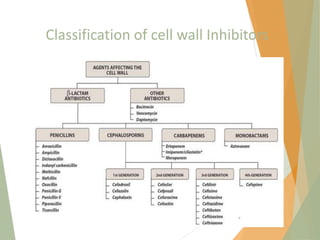
Classification of cell wall Inhibitors
4
5
Penicillin Learning Objectives:
 History
 Classification (Natural Penicillins)
 Structure and Properties
 Mechanism of Action
 Antibacterial Spectrum
 Uses
 Adverse Effects
6
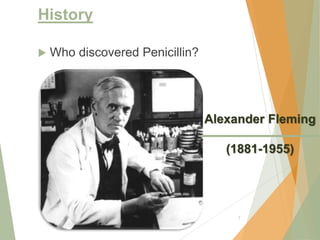
History
 Who discovered Penicillin?
7
Alexander Fleming
(1881-1955)
History
 Scottish biologist and pharmacologist
 After World War I  elected Professor of
Bacteriology at the University of London in
1928
 Accidentally discovered Penicillin while studying
properties of Staphylococci
 Penicillin- first antibiotic to be used clinically
 Mass production of the new drug for use
in World War II
8
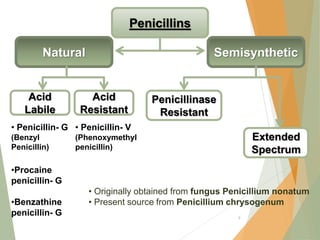
Semisynthetic
Penicillins
Acid
Labile
• Penicillin- G
(Benzyl
Penicillin)
•Procaine
penicillin- G
•Benzathine
penicillin- G
• Penicillin- V
(Phenoxymethyl
penicillin)
Acid
Resistant
Penicillinase
Resistant
Natural
Extended
Spectrum
• Originally obtained from fungus Penicillium nonatum
• Present source from Penicillium chrysogenum
9
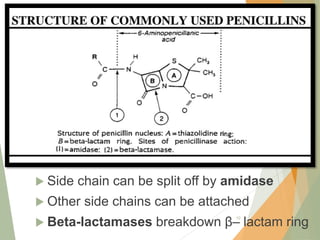
 Side chain can be split off by amidase
 Other side chains can be attached
 Beta-lactamases breakdown β– lactam ring
10
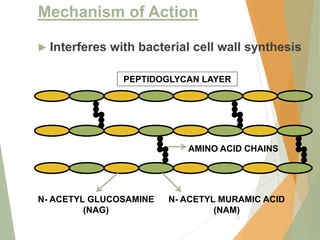
Mechanism of Action
 Interferes with bacterial cell wall synthesis
11
PEPTIDOGLYCAN LAYER
N- ACETYL MURAMIC ACID
(NAM)
N- ACETYL GLUCOSAMINE
(NAG)
AMINO ACID CHAINS
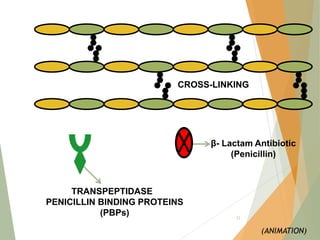
β- Lactam Antibiotic
(Penicillin)
TRANSPEPTIDASE
CROSS-LINKING
PENICILLIN BINDING PROTEINS
(PBPs)
(ANIMATION)
12
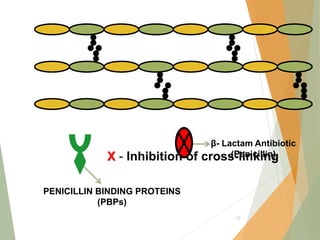
β- Lactam Antibiotic
(Penicillin)
PENICILLIN BINDING PROTEINS
(PBPs)
X - Inhibition of cross-linking
13
Mechanism of Action
 Cross-linking is blocked by:
 X- cleavage of terminal D-alanine
 X- transpeptidation of 5- glycine chain residues
 Inhibiting cell wall synthesis DAMAGES cell
 High osmotic pressure inside cell and low
osmotic pressure outside causes cell to BURST
due to a weak and unstable cell wall
 Bactericidal
 Autolysins released from penicillin-PBP complex
to digest remaining cell wall remnants
14
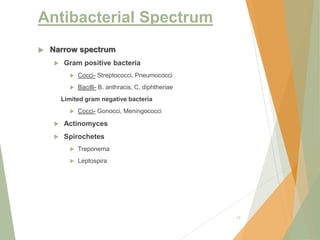
Antibacterial Spectrum
 Narrow spectrum
 Gram positive bacteria
 Cocci- Streptococci, Pneumococci
 Bacilli- B. anthracis, C. diphtheriae
Limited gram negative bacteria
 Cocci- Gonocci, Meningococci
 Actinomyces
 Spirochetes
 Treponema
 Leptospira
15
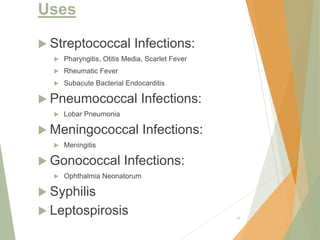
Uses
 Streptococcal Infections:
 Pharyngitis, Otitis Media, Scarlet Fever
 Rheumatic Fever
 Subacute Bacterial Endocarditis
 Pneumococcal Infections:
 Lobar Pneumonia
 Meningococcal Infections:
 Meningitis
 Gonococcal Infections:
 Ophthalmia Neonatorum
 Syphilis
 Leptospirosis 16
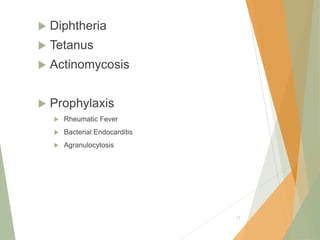
 Diphtheria
 Tetanus
 Actinomycosis
 Prophylaxis
 Rheumatic Fever
 Bacterial Endocarditis
 Agranulocytosis
17
Uses
Penicillin G- DRUG OF CHOICE IN:
 Subacute Bacterial Endocarditis
 Sodium PnG 10-20 MU i.v daily + Gentamicin for 2-6 weeks
 Ophthalmia Neonatorum
 Saline irrigation
 Sodium PnG 10,000-20,000 U/mL
 1 drop in each eye every 1-3hours
18
 Syphilis
 Early/Latent Syphilis
 Procaine Pn 1.2 MU i.m. daily for 10 days OR
 Benzathine Pn 2.4 MU i.m. weekly for 4 weeks
 Late Syphilis
 Benzathine Pn 2.4 MU weekly for 4 weeks
 Cardiovascular/Neurosyphilis
 Sodium PnG 5 MU i.m. 6 hourly for 2 weeks
 Leptospirosis
 Sodium PnG 1.5 MU i.v. 6 hourly for 7 days
19
 Diphtheria
 Tetanus and Gas gangrene
Prophylaxis
 Rheumatic Fever
 Benzathine Pn 1.2 MU every 4 weeks until 18 years of age or 5 years after
attack (whichever is more)
20
Adverse Effects
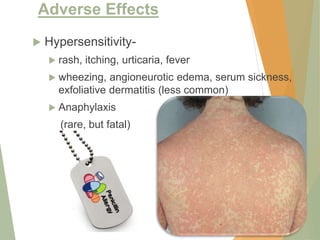
 Hypersensitivity-
 rash, itching, urticaria, fever
 wheezing, angioneurotic edema, serum sickness,
exfoliative dermatitis (less common)
 Anaphylaxis
(rare, but fatal)
21
Adverse Effects
 Hypersensitivity-
*Commonly seen after PARENTERAL administration
*Incidence highest with PROCAINE pn
*History of penicillin allergy should be elicited
*Scratch test or Intradermal Test dose
- negative test does not rule out delayed hypersensitivity
reactions
22
Adverse Effects
 Superinfections
 Rare with PnG
 Bowel, respiratory and cutaneous microflora can
undergo changes
 Jarisch- Herxheimer Reaction
 Shivering, fever, myalgia, exacerbation of lesions,
vascular collapse
 Seen in syphilitic patients injected with Penicillin
 Due to sudden release of spirochetal lytic products
 Symptomatic treatment with aspirin and sedation
23
Adverse Effects
 Local irritation
 Pain at injection site
 Thrombophlebitis
 Neurotoxicity
 Mental confusion, muscular twitching, convulsions, coma
 Bleeding
 Due to interference of platelet function
 Accidental IV procaine penicillin injection
 CNS stimulation, hallucinations, convulsions
24
Phenoxymethyl Penicillin
 Penicillin V
 Acid stable
 Given orally
 Plasma t½ = 30-60 min
 Antibacterial spectrum- same as PnG
 Not used for serious infections (preferred only when oral drug is to be
selected)
 Dose- 250-500mg 6 hourly
25
Semisynthetic Penicillins
26
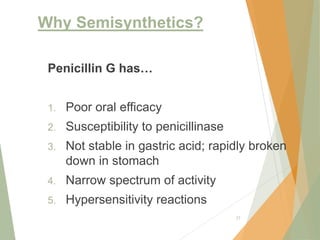
Why Semisynthetics?
27
Penicillin G has…
1. Poor oral efficacy
2. Susceptibility to penicillinase
3. Not stable in gastric acid; rapidly broken
down in stomach
4. Narrow spectrum of activity
5. Hypersensitivity reactions
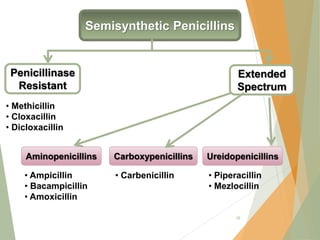
Semisynthetic Penicillins
Penicillinase
Resistant
Extended
Spectrum
• Methicillin
• Cloxacillin
• Dicloxacillin
• Ampicillin
• Bacampicillin
• Amoxicillin
• Carbenicillin • Piperacillin
• Mezlocillin
Aminopenicillins Carboxypenicillins Ureidopenicillins
28
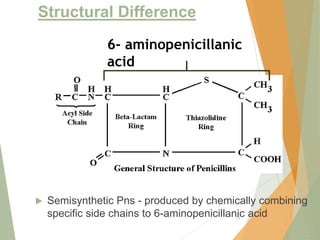
Structural Difference
29
 Semisynthetic Pns - produced by chemically combining
specific side chains to 6-aminopenicillanic acid
6- aminopenicillanic
acid
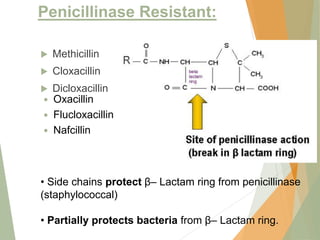
Penicillinase Resistant:
 Methicillin
 Cloxacillin
 Dicloxacillin
30
• Side chains protect β– Lactam ring from penicillinase
(staphylococcal)
• Partially protects bacteria from β– Lactam ring.
 Oxacillin
 Flucloxacillin
 Nafcillin
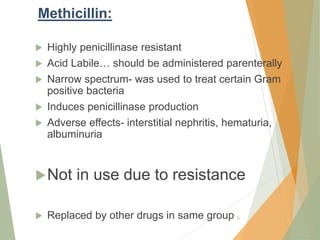
Methicillin:
 Highly penicillinase resistant
 Acid Labile… should be administered parenterally
 Narrow spectrum- was used to treat certain Gram
positive bacteria
 Induces penicillinase production
 Adverse effects- interstitial nephritis, hematuria,
albuminuria
Not in use due to resistance
 Replaced by other drugs in same group 31
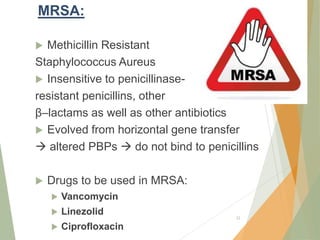
MRSA:
 Methicillin Resistant
Staphylococcus Aureus
 Insensitive to penicillinase-
resistant penicillins, other
β–lactams as well as other antibiotics
 Evolved from horizontal gene transfer
 altered PBPs  do not bind to penicillins
 Drugs to be used in MRSA:
 Vancomycin
 Linezolid
 Ciprofloxacin
32
Cloxacillin/Dicloxacillin
 Highly penicillinase resistant
 Acid stable… can be given orally
 Used against staphylococcal infection EXCEPT MRSA
 Mostly binds to plasma proteins
 Dose: 0.25 – 0.5g every 6 hours
33
Oxacillin/Floxacillin
 Similar to cloxacillin
Nafcillin
 Given parenterally
 Other side effects- oral thrush, agranulocytosis,
neutropenia
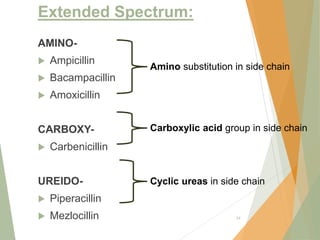
Extended Spectrum:
AMINO-
 Ampicillin
 Bacampacillin
 Amoxicillin
CARBOXY-
 Carbenicillin
UREIDO-
 Piperacillin
 Mezlocillin 34
Amino substitution in side chain
Carboxylic acid group in side chain
Cyclic ureas in side chain
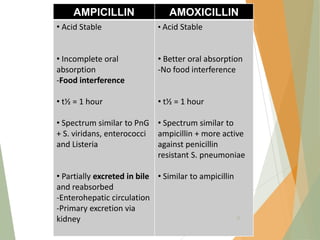
AMPICILLIN AMOXICILLIN
• Acid Stable
• Incomplete oral
absorption
-Food interference
• t½ = 1 hour
• Spectrum similar to PnG
+ S. viridans, enterococci
and Listeria
• Partially excreted in bile
and reabsorbed
-Enterohepatic circulation
-Primary excretion via
kidney
• Acid Stable
• Better oral absorption
-No food interference
• t½ = 1 hour
• Spectrum similar to
ampicillin + more active
against penicillin
resistant S. pneumoniae
• Similar to ampicillin
35
AMPICILLIN AMOXICILLIN
Uses:
• UTI
• Respiratory tract
-Bronchitis
-Otitis media
-Sinusitis
• Meningitis
• Gonorrhea
(Single dose 3.5g + 1g of
probenecid)
• Cholecystitis
• SABE
(2g i.v. 6th hourly with
gentamicin)
• H. pylori
• Septicemia
• ANUG
Uses same as ampicillin
• Preferred over
ampicillin in many cases
- Bronchitis
- UTI
- SABE
- Gonorrhea
36
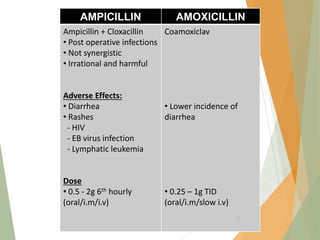
AMPICILLIN AMOXICILLIN
Ampicillin + Cloxacillin
• Post operative infections
• Not synergistic
• Irrational and harmful
Adverse Effects:
• Diarrhea
• Rashes
- HIV
- EB virus infection
- Lymphatic leukemia
Dose
• 0.5 - 2g 6th hourly
(oral/i.m/i.v)
Coamoxiclav
• Lower incidence of
diarrhea
• 0.25 – 1g TID
(oral/i.m/slow i.v)
37
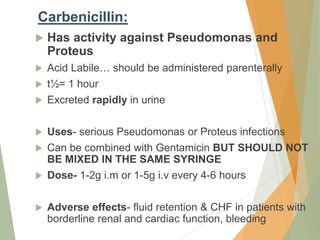
Carbenicillin:
 Has activity against Pseudomonas and
Proteus
 Acid Labile… should be administered parenterally
 t½= 1 hour
 Excreted rapidly in urine
 Uses- serious Pseudomonas or Proteus infections
 Can be combined with Gentamicin BUT SHOULD NOT
BE MIXED IN THE SAME SYRINGE
 Dose- 1-2g i.m or 1-5g i.v every 4-6 hours
 Adverse effects- fluid retention & CHF in patients with
borderline renal and cardiac function, bleeding
38
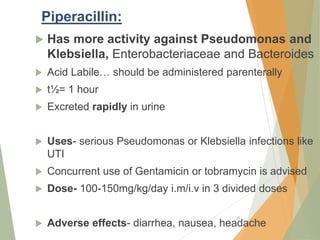
Piperacillin:
 Has more activity against Pseudomonas and
Klebsiella, Enterobacteriaceae and Bacteroides
 Acid Labile… should be administered parenterally
 t½= 1 hour
 Excreted rapidly in urine
 Uses- serious Pseudomonas or Klebsiella infections like
UTI
 Concurrent use of Gentamicin or tobramycin is advised
 Dose- 100-150mg/kg/day i.m/i.v in 3 divided doses
 Adverse effects- diarrhea, nausea, headache
39
 Other ureidopenicillins
Mezlocillin
Azlocillin
40
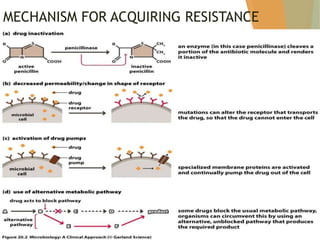
MECHANISM FOR ACQUIRING RESISTANCE
 Reistance to penicillins and other beta lactams are due
to one of four general mechanism :
• Inactivation of the antibiotic by beta lactamase
• Modification of target PBP’S
• Impaired penetration of drugs to target PBP’S
• The presence of an efflux pump.
41
CEPHALOSPORINS
• Cephalosporins, closely akin to penicillins structurally
and functionally, are beta-lactam antibiotics.
• Most are synthesized semi-synthetically by attaching
side chains to 7-aminocephalosporanic acid.
• They share the same mode of action and resistance
mechanisms with penicillins but exhibit greater
resistance to certain beta-lactamases.
42
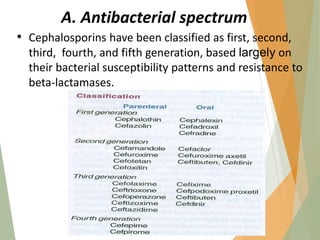
A. Antibacterial spectrum
• Cephalosporins have been classified as first, second,
third, fourth, and fifth generation, based largely on
their bacterial susceptibility patterns and resistance to
beta-lactamases.
43
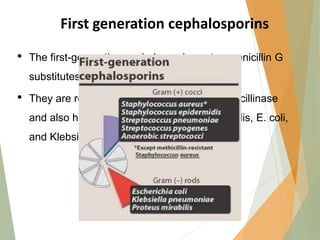
First generation cephalosporins
• The first-generation cephalosporins act as penicillin G
substitutes.
• They are resistant to the staphylococcal penicillinase
and also have activity against Proteus mirabilis, E. coli,
and Klebsiella pneumoniae.
44
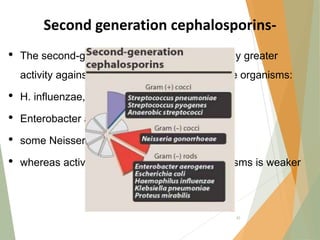
Second generation cephalosporins-
• The second-generation cephalosporins display greater
activity against three additional gram-negative organisms:
• H. influenzae,
• Enterobacter aerogenes, and
• some Neisseria species,
• whereas activity against gram-positive organisms is weaker
45
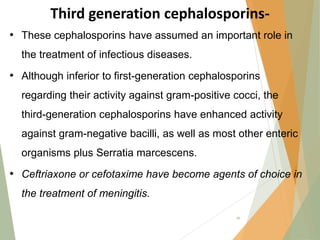
Third generation cephalosporins-
• These cephalosporins have assumed an important role in
the treatment of infectious diseases.
• Although inferior to first-generation cephalosporins
regarding their activity against gram-positive cocci, the
third-generation cephalosporins have enhanced activity
against gram-negative bacilli, as well as most other enteric
organisms plus Serratia marcescens.
• Ceftriaxone or cefotaxime have become agents of choice in
the treatment of meningitis.
46
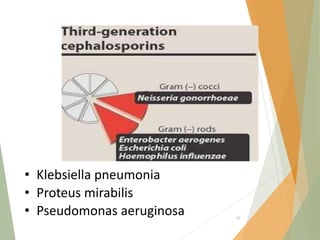
• Klebsiella pneumonia
• Proteus mirabilis
• Pseudomonas aeruginosa 47
Fourth generation cephalosporins
• Cefepime is classified as a fourth-generation
cephalosporin and must be administered
parenterally.
• Cefepime has a wide antibacterial spectrum, being
active against streptococci and staphylococci.
• Cefepime is also effective against aerobic gram-
negative organisms, such as enterobacter, E. coli, K.
pneumoniae, P. mirabilis, and P. aeruginosa.
48
Fifth generation cephalosporins
 Ceftaroline is a novel fifth-generation
cephalosporin, that exhibits broad-spectrum
activity against Gram-positive bacteria,
including MRSA and extensively-resistant
strains, such as vancomycin-intermediate S.
aureus (VISA), heteroresistant VISA (hVISA),
and vancomycin-resistant S. aureus (VRSA).
49
B. Resistance
• Mechanisms of bacterial resistance to the
cephalosporins are essentially the same as
those described for the penicillins.
50
C. Pharmacokinetics
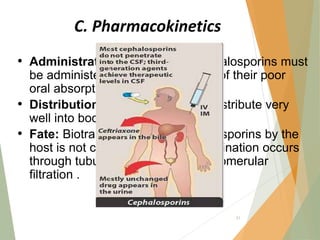
• Administration: Many of the cephalosporins must
be administered IV or IM because of their poor
oral absorption.
• Distribution: All cephalosporins distribute very
well into body fluids except CSF.
• Fate: Biotransformation of cephalosporins by the
host is not clinically important. Elimination occurs
through tubular secretion and/or glomerular
filtration .
51
D. Adverse effects
• Allergic manifestations: Patients who have had
an anaphylactic response to penicillins should not
receive cephalosporins. The cephalosporins
should be avoided or used with caution in
individuals who are allergic to penicillins (about 5-
15 percent show cross-sensitivity).
• In contrast, the incidence of allergic reactions to
cephalosporins is one to two percent in patients
without a history of allergy to penicillins.
52
• Nephrotoxicity may develop with prolonged
administration, dosages should be adjusted in the
presence of renal diseases.
• Alcohol intolerance (a disulfiram-like reaction)
has been noted with cephalosporins that contain the
methyl-acetaldehyde (MTT) group, including
cefamandole (no longer available in the United
States), cefotetan, moxalactam, and cefoperazone.
• Bleeding is also associated with agents that
contain the MTT group because of anti-vitamin k
effects. Administration of the vitamin corrects the
problem. 53
CARBAPENEMS
• Carbapenems are a class of
beta‐lactam antibiotics with a
broad spectrum of antibacterial
activity. They have a structure
that renders them highly resistant
to most
beta‐lactamases.
54
• Carbapenems are one of the antibiotics of
last resort for many bacterial infections,
such as
Escherichia coli (E. coli) and Klebsiella
pneumoniae.
• Recently, alarm has been raised over the
spread of drug resistance to carbapenem
antibiotics among these coliforms, due to
production of an enzyme named NDM‐1
(New Delhi metallo‐beta‐lactamase).
55
Carbapenems
The following drugs belong to the
carbapenem class:
• Imipenem
• Meropenem
• Ertapenem
• Doripenem
• Panipenem/betamipron
• Biapenem 56
• There are currently no new
antibiotics in the
pipeline to combat bacteria
resistant to
carbapenems
57
MONOBACTAMS
• The monobactams, also disrupt bacterial cell
wall synthesis.
• Aztreonam, which is the only commercially
available monobactam, has antimicrobial
activity directed primarily against the
enterobacteriaceae, but it also acts against
aerobic gram‐negative rods, including
P.aeruginosa.
• It lacks activity against gram‐positive
organisms and anaerobes. This narrow
antimicrobial spectrum prevent its use alone
in empiric therapy.
58
• Aztreonam is resistant to the action of
betalactamases.
• It is administered either IV or IM and is
excreted in the urine. It can accumulate
in patients with renal failure.
• Aztreonam is relatively nontoxic, but it may
cause phlebitis.
59
• this drug may offer a safe
alternative for
treating patients who are allergic
to penicillins
and/or cephalosporins.
60
BETA‐LACTAMASE INHIBITORS
• Hydrolysis of the beta‐lactam ring, either by
enzymatic cleavage with a beta‐lactamase or by
acid, destroys the antimicrobial activity of a
beta‐lactam antibiotic.
• Beta‐Lactamase inhibitors, such as clavulanic acid,
sulbactam , and tazobactam, contain a
beta‐lactam ring but, by themselves, do not have
significant antibacterial activity.
• Instead, they bind to and inactivate
beta‐lactamases, thereby protecting the antibiotics
that are normally substrates for these enzymes.
61
• The beta‐lactamase inhibitors are
therefore formulated in combination
with betalactamase sensitive antibiotics.
• For example, the effect of clavulanic acid
and amoxicillin on the growth of
betalactamase producing E. coli.
62
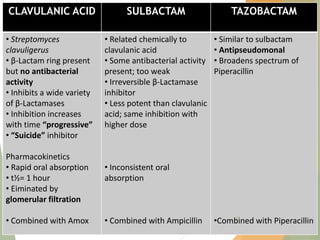
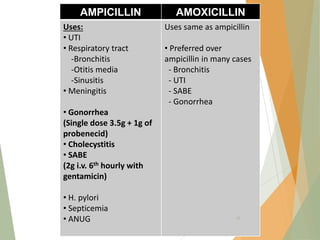
CLAVULANIC ACID SULBACTAM TAZOBACTAM
• Streptomyces
clavuligerus
• β-Lactam ring present
but no antibacterial
activity
• Inhibits a wide variety
of β-Lactamases
• Inhibition increases
with time “progressive”
• “Suicide” inhibitor
Pharmacokinetics
• Rapid oral absorption
• t½= 1 hour
• Eiminated by
glomerular filtration
• Combined with Amox
• Related chemically to
clavulanic acid
• Some antibacterial activity
present; too weak
• Irreversible β-Lactamase
inhibitor
• Less potent than clavulanic
acid; same inhibition with
higher dose
• Inconsistent oral
absorption
• Combined with Ampicillin
• Similar to sulbactam
• Antipseudomonal
• Broadens spectrum of
Piperacillin
•Combined with Piperacillin
63
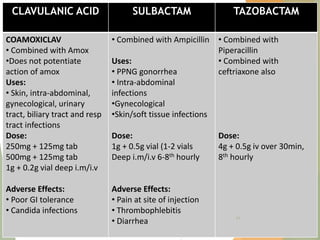
CLAVULANIC ACID SULBACTAM TAZOBACTAM
COAMOXICLAV
• Combined with Amox
•Does not potentiate
action of amox
Uses:
• Skin, intra-abdominal,
gynecological, urinary
tract, biliary tract and resp
tract infections
Dose:
250mg + 125mg tab
500mg + 125mg tab
1g + 0.2g vial deep i.m/i.v
Adverse Effects:
• Poor GI tolerance
• Candida infections
• Combined with Ampicillin
Uses:
• PPNG gonorrhea
• Intra-abdominal
infections
•Gynecological
•Skin/soft tissue infections
Dose:
1g + 0.5g vial (1-2 vials
Deep i.m/i.v 6-8th hourly
Adverse Effects:
• Pain at site of injection
• Thrombophlebitis
• Diarrhea
• Combined with
Piperacillin
• Combined with
ceftriaxone also
Dose:
4g + 0.5g iv over 30min,
8th hourly
64
VI. Vancomycin
• Vancomycin is a tricyclic glycopeptide
• It has become increasingly important
because of its effectiveness against
multiple drug‐resistant organisms, such
as Methicillin-resistant Staphylococcus
aureus(MRSA )and enterococci.
65
A. Mode of action
• Vancomycin inhibits synthesis of bacterial
cell wall phospholipids as well as
peptidoglycan polymerization,
• This weakens the cell wall
and damages the underlying cell
membrane.
66
B. Antibacterial spectrum
• Vancomycin is effective primarily
against gram‐positive organisms .
• It has been lifesaving in the treatment
of MRSA and methicillin‐resistant
Staphylococcus epidermidis (MRSE)
infections as well as enterococcal
infections.
67
Antibacterial spectrum
• Vancomycin acts synergistically with the
aminoglycosides, and this combination
can be used in the treatment of
enterococcal
endocarditis.
68
C. Resistance
• Vancomycin resistance can be
caused by
plasmid‐mediated changes in
permeability to
the drug or by decreased binding
of vancomycin to receptor
molecules.
69
D. Pharmacokinetics
• Slow IV infusion is employed for
treatment of systemic infections or for
prophylaxis.
• Metabolism of the drug is minimal, and
90 to 100 percent is excreted by
glomerular filtration.
• The normal half‐life of vancomycin is 6
to 10 hours
70
E. Adverse effects
• Side effects are a serious problem with
vancomycin and include local pain and/or
phlebitis at the infusion site.
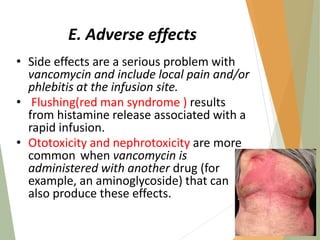
• Flushing(red man syndrome ) results
from histamine release associated with a
rapid infusion.
• Ototoxicity and nephrotoxicity are more
common when vancomycin is
administered with another drug (for
example, an aminoglycoside) that can
also produce these effects.
71
CONCLUSION
 Antibiotics that target cell wall inhibition play a
crucial role in the treatment of bacterial infections.
 These antibiotics exert their effects by interfering
with the synthesis or integrity of the bacterial cell
wall, which is essential for bacterial survival.
 The most common class of cell wall inhibitors is
the beta-lactam antibiotics, which includes
penicillins, cephalosporins, and carbapenems.
72
 These antibiotics are effective against a wide range
of bacteria, including both gram-positive and some
gram-negative bacteria.
 They are commonly used to treat infections such as
pneumonia, skin infections, and urinary tract
infections.
 However, it is important to note that bacteria can
develop resistance to these antibiotics through
various mechanisms
73

Antibiotics affecting cell wall synthesis

  • 1.
    Antibiotics Affecting CellWall Synthesis 1 PRESENTED BY : DR ANWESHA DR DEBOSMITAA SANYAL DR MANVI AGARWAL
  • 2.
    Cell Wall Inhibitors •Some antimicrobial drugs selectively interfere with synthesis of the bacterial cell wall-a structure that mammalian cells do not possess. • The cell wall is composed of a polymer called peptidoglycan that consists of glycan units joined to each other by peptide cross-links. 2
  • 3.
    Cell Wall Inhibitors •To be maximally effective, inhibitors of cell wall synthesis require actively proliferating microorganisms; they have little or no effect on bacteria that are not growing and dividing. • The most important members of this group of drugs are the beta-lactam antibiotics (named after the beta-lactam ring that is essential to their activity) and vancomycin. 3
  • 4.
    Classification of cellwall Inhibitors 4
  • 5.
  • 6.
    Penicillin Learning Objectives: History  Classification (Natural Penicillins)  Structure and Properties  Mechanism of Action  Antibacterial Spectrum  Uses  Adverse Effects 6
  • 7.
    History  Who discoveredPenicillin? 7 Alexander Fleming (1881-1955)
  • 8.
    History  Scottish biologistand pharmacologist  After World War I  elected Professor of Bacteriology at the University of London in 1928  Accidentally discovered Penicillin while studying properties of Staphylococci  Penicillin- first antibiotic to be used clinically  Mass production of the new drug for use in World War II 8
  • 9.
    Semisynthetic Penicillins Acid Labile • Penicillin- G (Benzyl Penicillin) •Procaine penicillin-G •Benzathine penicillin- G • Penicillin- V (Phenoxymethyl penicillin) Acid Resistant Penicillinase Resistant Natural Extended Spectrum • Originally obtained from fungus Penicillium nonatum • Present source from Penicillium chrysogenum 9
  • 10.
     Side chaincan be split off by amidase  Other side chains can be attached  Beta-lactamases breakdown β– lactam ring 10
  • 11.
    Mechanism of Action Interferes with bacterial cell wall synthesis 11 PEPTIDOGLYCAN LAYER N- ACETYL MURAMIC ACID (NAM) N- ACETYL GLUCOSAMINE (NAG) AMINO ACID CHAINS
  • 12.
  • 13.
    β- Lactam Antibiotic (Penicillin) PENICILLINBINDING PROTEINS (PBPs) X - Inhibition of cross-linking 13
  • 14.
    Mechanism of Action Cross-linking is blocked by:  X- cleavage of terminal D-alanine  X- transpeptidation of 5- glycine chain residues  Inhibiting cell wall synthesis DAMAGES cell  High osmotic pressure inside cell and low osmotic pressure outside causes cell to BURST due to a weak and unstable cell wall  Bactericidal  Autolysins released from penicillin-PBP complex to digest remaining cell wall remnants 14
  • 15.
    Antibacterial Spectrum  Narrowspectrum  Gram positive bacteria  Cocci- Streptococci, Pneumococci  Bacilli- B. anthracis, C. diphtheriae Limited gram negative bacteria  Cocci- Gonocci, Meningococci  Actinomyces  Spirochetes  Treponema  Leptospira 15
  • 16.
    Uses  Streptococcal Infections: Pharyngitis, Otitis Media, Scarlet Fever  Rheumatic Fever  Subacute Bacterial Endocarditis  Pneumococcal Infections:  Lobar Pneumonia  Meningococcal Infections:  Meningitis  Gonococcal Infections:  Ophthalmia Neonatorum  Syphilis  Leptospirosis 16
  • 17.
     Diphtheria  Tetanus Actinomycosis  Prophylaxis  Rheumatic Fever  Bacterial Endocarditis  Agranulocytosis 17
  • 18.
    Uses Penicillin G- DRUGOF CHOICE IN:  Subacute Bacterial Endocarditis  Sodium PnG 10-20 MU i.v daily + Gentamicin for 2-6 weeks  Ophthalmia Neonatorum  Saline irrigation  Sodium PnG 10,000-20,000 U/mL  1 drop in each eye every 1-3hours 18
  • 19.
     Syphilis  Early/LatentSyphilis  Procaine Pn 1.2 MU i.m. daily for 10 days OR  Benzathine Pn 2.4 MU i.m. weekly for 4 weeks  Late Syphilis  Benzathine Pn 2.4 MU weekly for 4 weeks  Cardiovascular/Neurosyphilis  Sodium PnG 5 MU i.m. 6 hourly for 2 weeks  Leptospirosis  Sodium PnG 1.5 MU i.v. 6 hourly for 7 days 19
  • 20.
     Diphtheria  Tetanusand Gas gangrene Prophylaxis  Rheumatic Fever  Benzathine Pn 1.2 MU every 4 weeks until 18 years of age or 5 years after attack (whichever is more) 20
  • 21.
    Adverse Effects  Hypersensitivity- rash, itching, urticaria, fever  wheezing, angioneurotic edema, serum sickness, exfoliative dermatitis (less common)  Anaphylaxis (rare, but fatal) 21
  • 22.
    Adverse Effects  Hypersensitivity- *Commonlyseen after PARENTERAL administration *Incidence highest with PROCAINE pn *History of penicillin allergy should be elicited *Scratch test or Intradermal Test dose - negative test does not rule out delayed hypersensitivity reactions 22
  • 23.
    Adverse Effects  Superinfections Rare with PnG  Bowel, respiratory and cutaneous microflora can undergo changes  Jarisch- Herxheimer Reaction  Shivering, fever, myalgia, exacerbation of lesions, vascular collapse  Seen in syphilitic patients injected with Penicillin  Due to sudden release of spirochetal lytic products  Symptomatic treatment with aspirin and sedation 23
  • 24.
    Adverse Effects  Localirritation  Pain at injection site  Thrombophlebitis  Neurotoxicity  Mental confusion, muscular twitching, convulsions, coma  Bleeding  Due to interference of platelet function  Accidental IV procaine penicillin injection  CNS stimulation, hallucinations, convulsions 24
  • 25.
    Phenoxymethyl Penicillin  PenicillinV  Acid stable  Given orally  Plasma t½ = 30-60 min  Antibacterial spectrum- same as PnG  Not used for serious infections (preferred only when oral drug is to be selected)  Dose- 250-500mg 6 hourly 25
  • 26.
  • 27.
    Why Semisynthetics? 27 Penicillin Ghas… 1. Poor oral efficacy 2. Susceptibility to penicillinase 3. Not stable in gastric acid; rapidly broken down in stomach 4. Narrow spectrum of activity 5. Hypersensitivity reactions
  • 28.
    Semisynthetic Penicillins Penicillinase Resistant Extended Spectrum • Methicillin •Cloxacillin • Dicloxacillin • Ampicillin • Bacampicillin • Amoxicillin • Carbenicillin • Piperacillin • Mezlocillin Aminopenicillins Carboxypenicillins Ureidopenicillins 28
  • 29.
    Structural Difference 29  SemisyntheticPns - produced by chemically combining specific side chains to 6-aminopenicillanic acid 6- aminopenicillanic acid
  • 30.
    Penicillinase Resistant:  Methicillin Cloxacillin  Dicloxacillin 30 • Side chains protect β– Lactam ring from penicillinase (staphylococcal) • Partially protects bacteria from β– Lactam ring.  Oxacillin  Flucloxacillin  Nafcillin
  • 31.
    Methicillin:  Highly penicillinaseresistant  Acid Labile… should be administered parenterally  Narrow spectrum- was used to treat certain Gram positive bacteria  Induces penicillinase production  Adverse effects- interstitial nephritis, hematuria, albuminuria Not in use due to resistance  Replaced by other drugs in same group 31
  • 32.
    MRSA:  Methicillin Resistant StaphylococcusAureus  Insensitive to penicillinase- resistant penicillins, other β–lactams as well as other antibiotics  Evolved from horizontal gene transfer  altered PBPs  do not bind to penicillins  Drugs to be used in MRSA:  Vancomycin  Linezolid  Ciprofloxacin 32
  • 33.
    Cloxacillin/Dicloxacillin  Highly penicillinaseresistant  Acid stable… can be given orally  Used against staphylococcal infection EXCEPT MRSA  Mostly binds to plasma proteins  Dose: 0.25 – 0.5g every 6 hours 33 Oxacillin/Floxacillin  Similar to cloxacillin Nafcillin  Given parenterally  Other side effects- oral thrush, agranulocytosis, neutropenia
  • 34.
    Extended Spectrum: AMINO-  Ampicillin Bacampacillin  Amoxicillin CARBOXY-  Carbenicillin UREIDO-  Piperacillin  Mezlocillin 34 Amino substitution in side chain Carboxylic acid group in side chain Cyclic ureas in side chain
  • 35.
    AMPICILLIN AMOXICILLIN • AcidStable • Incomplete oral absorption -Food interference • t½ = 1 hour • Spectrum similar to PnG + S. viridans, enterococci and Listeria • Partially excreted in bile and reabsorbed -Enterohepatic circulation -Primary excretion via kidney • Acid Stable • Better oral absorption -No food interference • t½ = 1 hour • Spectrum similar to ampicillin + more active against penicillin resistant S. pneumoniae • Similar to ampicillin 35
  • 36.
    AMPICILLIN AMOXICILLIN Uses: • UTI •Respiratory tract -Bronchitis -Otitis media -Sinusitis • Meningitis • Gonorrhea (Single dose 3.5g + 1g of probenecid) • Cholecystitis • SABE (2g i.v. 6th hourly with gentamicin) • H. pylori • Septicemia • ANUG Uses same as ampicillin • Preferred over ampicillin in many cases - Bronchitis - UTI - SABE - Gonorrhea 36
  • 37.
    AMPICILLIN AMOXICILLIN Ampicillin +Cloxacillin • Post operative infections • Not synergistic • Irrational and harmful Adverse Effects: • Diarrhea • Rashes - HIV - EB virus infection - Lymphatic leukemia Dose • 0.5 - 2g 6th hourly (oral/i.m/i.v) Coamoxiclav • Lower incidence of diarrhea • 0.25 – 1g TID (oral/i.m/slow i.v) 37
  • 38.
    Carbenicillin:  Has activityagainst Pseudomonas and Proteus  Acid Labile… should be administered parenterally  t½= 1 hour  Excreted rapidly in urine  Uses- serious Pseudomonas or Proteus infections  Can be combined with Gentamicin BUT SHOULD NOT BE MIXED IN THE SAME SYRINGE  Dose- 1-2g i.m or 1-5g i.v every 4-6 hours  Adverse effects- fluid retention & CHF in patients with borderline renal and cardiac function, bleeding 38
  • 39.
    Piperacillin:  Has moreactivity against Pseudomonas and Klebsiella, Enterobacteriaceae and Bacteroides  Acid Labile… should be administered parenterally  t½= 1 hour  Excreted rapidly in urine  Uses- serious Pseudomonas or Klebsiella infections like UTI  Concurrent use of Gentamicin or tobramycin is advised  Dose- 100-150mg/kg/day i.m/i.v in 3 divided doses  Adverse effects- diarrhea, nausea, headache 39
  • 40.
  • 41.
    MECHANISM FOR ACQUIRINGRESISTANCE  Reistance to penicillins and other beta lactams are due to one of four general mechanism : • Inactivation of the antibiotic by beta lactamase • Modification of target PBP’S • Impaired penetration of drugs to target PBP’S • The presence of an efflux pump. 41
  • 42.
    CEPHALOSPORINS • Cephalosporins, closelyakin to penicillins structurally and functionally, are beta-lactam antibiotics. • Most are synthesized semi-synthetically by attaching side chains to 7-aminocephalosporanic acid. • They share the same mode of action and resistance mechanisms with penicillins but exhibit greater resistance to certain beta-lactamases. 42
  • 43.
    A. Antibacterial spectrum •Cephalosporins have been classified as first, second, third, fourth, and fifth generation, based largely on their bacterial susceptibility patterns and resistance to beta-lactamases. 43
  • 44.
    First generation cephalosporins •The first-generation cephalosporins act as penicillin G substitutes. • They are resistant to the staphylococcal penicillinase and also have activity against Proteus mirabilis, E. coli, and Klebsiella pneumoniae. 44
  • 45.
    Second generation cephalosporins- •The second-generation cephalosporins display greater activity against three additional gram-negative organisms: • H. influenzae, • Enterobacter aerogenes, and • some Neisseria species, • whereas activity against gram-positive organisms is weaker 45
  • 46.
    Third generation cephalosporins- •These cephalosporins have assumed an important role in the treatment of infectious diseases. • Although inferior to first-generation cephalosporins regarding their activity against gram-positive cocci, the third-generation cephalosporins have enhanced activity against gram-negative bacilli, as well as most other enteric organisms plus Serratia marcescens. • Ceftriaxone or cefotaxime have become agents of choice in the treatment of meningitis. 46
  • 47.
    • Klebsiella pneumonia •Proteus mirabilis • Pseudomonas aeruginosa 47
  • 48.
    Fourth generation cephalosporins •Cefepime is classified as a fourth-generation cephalosporin and must be administered parenterally. • Cefepime has a wide antibacterial spectrum, being active against streptococci and staphylococci. • Cefepime is also effective against aerobic gram- negative organisms, such as enterobacter, E. coli, K. pneumoniae, P. mirabilis, and P. aeruginosa. 48
  • 49.
    Fifth generation cephalosporins Ceftaroline is a novel fifth-generation cephalosporin, that exhibits broad-spectrum activity against Gram-positive bacteria, including MRSA and extensively-resistant strains, such as vancomycin-intermediate S. aureus (VISA), heteroresistant VISA (hVISA), and vancomycin-resistant S. aureus (VRSA). 49
  • 50.
    B. Resistance • Mechanismsof bacterial resistance to the cephalosporins are essentially the same as those described for the penicillins. 50
  • 51.
    C. Pharmacokinetics • Administration:Many of the cephalosporins must be administered IV or IM because of their poor oral absorption. • Distribution: All cephalosporins distribute very well into body fluids except CSF. • Fate: Biotransformation of cephalosporins by the host is not clinically important. Elimination occurs through tubular secretion and/or glomerular filtration . 51
  • 52.
    D. Adverse effects •Allergic manifestations: Patients who have had an anaphylactic response to penicillins should not receive cephalosporins. The cephalosporins should be avoided or used with caution in individuals who are allergic to penicillins (about 5- 15 percent show cross-sensitivity). • In contrast, the incidence of allergic reactions to cephalosporins is one to two percent in patients without a history of allergy to penicillins. 52
  • 53.
    • Nephrotoxicity maydevelop with prolonged administration, dosages should be adjusted in the presence of renal diseases. • Alcohol intolerance (a disulfiram-like reaction) has been noted with cephalosporins that contain the methyl-acetaldehyde (MTT) group, including cefamandole (no longer available in the United States), cefotetan, moxalactam, and cefoperazone. • Bleeding is also associated with agents that contain the MTT group because of anti-vitamin k effects. Administration of the vitamin corrects the problem. 53
  • 54.
    CARBAPENEMS • Carbapenems area class of beta‐lactam antibiotics with a broad spectrum of antibacterial activity. They have a structure that renders them highly resistant to most beta‐lactamases. 54
  • 55.
    • Carbapenems areone of the antibiotics of last resort for many bacterial infections, such as Escherichia coli (E. coli) and Klebsiella pneumoniae. • Recently, alarm has been raised over the spread of drug resistance to carbapenem antibiotics among these coliforms, due to production of an enzyme named NDM‐1 (New Delhi metallo‐beta‐lactamase). 55
  • 56.
    Carbapenems The following drugsbelong to the carbapenem class: • Imipenem • Meropenem • Ertapenem • Doripenem • Panipenem/betamipron • Biapenem 56
  • 57.
    • There arecurrently no new antibiotics in the pipeline to combat bacteria resistant to carbapenems 57
  • 58.
    MONOBACTAMS • The monobactams,also disrupt bacterial cell wall synthesis. • Aztreonam, which is the only commercially available monobactam, has antimicrobial activity directed primarily against the enterobacteriaceae, but it also acts against aerobic gram‐negative rods, including P.aeruginosa. • It lacks activity against gram‐positive organisms and anaerobes. This narrow antimicrobial spectrum prevent its use alone in empiric therapy. 58
  • 59.
    • Aztreonam isresistant to the action of betalactamases. • It is administered either IV or IM and is excreted in the urine. It can accumulate in patients with renal failure. • Aztreonam is relatively nontoxic, but it may cause phlebitis. 59
  • 60.
    • this drugmay offer a safe alternative for treating patients who are allergic to penicillins and/or cephalosporins. 60
  • 61.
    BETA‐LACTAMASE INHIBITORS • Hydrolysisof the beta‐lactam ring, either by enzymatic cleavage with a beta‐lactamase or by acid, destroys the antimicrobial activity of a beta‐lactam antibiotic. • Beta‐Lactamase inhibitors, such as clavulanic acid, sulbactam , and tazobactam, contain a beta‐lactam ring but, by themselves, do not have significant antibacterial activity. • Instead, they bind to and inactivate beta‐lactamases, thereby protecting the antibiotics that are normally substrates for these enzymes. 61
  • 62.
    • The beta‐lactamaseinhibitors are therefore formulated in combination with betalactamase sensitive antibiotics. • For example, the effect of clavulanic acid and amoxicillin on the growth of betalactamase producing E. coli. 62
  • 63.
    CLAVULANIC ACID SULBACTAMTAZOBACTAM • Streptomyces clavuligerus • β-Lactam ring present but no antibacterial activity • Inhibits a wide variety of β-Lactamases • Inhibition increases with time “progressive” • “Suicide” inhibitor Pharmacokinetics • Rapid oral absorption • t½= 1 hour • Eiminated by glomerular filtration • Combined with Amox • Related chemically to clavulanic acid • Some antibacterial activity present; too weak • Irreversible β-Lactamase inhibitor • Less potent than clavulanic acid; same inhibition with higher dose • Inconsistent oral absorption • Combined with Ampicillin • Similar to sulbactam • Antipseudomonal • Broadens spectrum of Piperacillin •Combined with Piperacillin 63
  • 64.
    CLAVULANIC ACID SULBACTAMTAZOBACTAM COAMOXICLAV • Combined with Amox •Does not potentiate action of amox Uses: • Skin, intra-abdominal, gynecological, urinary tract, biliary tract and resp tract infections Dose: 250mg + 125mg tab 500mg + 125mg tab 1g + 0.2g vial deep i.m/i.v Adverse Effects: • Poor GI tolerance • Candida infections • Combined with Ampicillin Uses: • PPNG gonorrhea • Intra-abdominal infections •Gynecological •Skin/soft tissue infections Dose: 1g + 0.5g vial (1-2 vials Deep i.m/i.v 6-8th hourly Adverse Effects: • Pain at site of injection • Thrombophlebitis • Diarrhea • Combined with Piperacillin • Combined with ceftriaxone also Dose: 4g + 0.5g iv over 30min, 8th hourly 64
  • 65.
    VI. Vancomycin • Vancomycinis a tricyclic glycopeptide • It has become increasingly important because of its effectiveness against multiple drug‐resistant organisms, such as Methicillin-resistant Staphylococcus aureus(MRSA )and enterococci. 65
  • 66.
    A. Mode ofaction • Vancomycin inhibits synthesis of bacterial cell wall phospholipids as well as peptidoglycan polymerization, • This weakens the cell wall and damages the underlying cell membrane. 66
  • 67.
    B. Antibacterial spectrum •Vancomycin is effective primarily against gram‐positive organisms . • It has been lifesaving in the treatment of MRSA and methicillin‐resistant Staphylococcus epidermidis (MRSE) infections as well as enterococcal infections. 67
  • 68.
    Antibacterial spectrum • Vancomycinacts synergistically with the aminoglycosides, and this combination can be used in the treatment of enterococcal endocarditis. 68
  • 69.
    C. Resistance • Vancomycinresistance can be caused by plasmid‐mediated changes in permeability to the drug or by decreased binding of vancomycin to receptor molecules. 69
  • 70.
    D. Pharmacokinetics • SlowIV infusion is employed for treatment of systemic infections or for prophylaxis. • Metabolism of the drug is minimal, and 90 to 100 percent is excreted by glomerular filtration. • The normal half‐life of vancomycin is 6 to 10 hours 70
  • 71.
    E. Adverse effects •Side effects are a serious problem with vancomycin and include local pain and/or phlebitis at the infusion site. • Flushing(red man syndrome ) results from histamine release associated with a rapid infusion. • Ototoxicity and nephrotoxicity are more common when vancomycin is administered with another drug (for example, an aminoglycoside) that can also produce these effects. 71
  • 72.
    CONCLUSION  Antibiotics thattarget cell wall inhibition play a crucial role in the treatment of bacterial infections.  These antibiotics exert their effects by interfering with the synthesis or integrity of the bacterial cell wall, which is essential for bacterial survival.  The most common class of cell wall inhibitors is the beta-lactam antibiotics, which includes penicillins, cephalosporins, and carbapenems. 72
  • 73.
     These antibioticsare effective against a wide range of bacteria, including both gram-positive and some gram-negative bacteria.  They are commonly used to treat infections such as pneumonia, skin infections, and urinary tract infections.  However, it is important to note that bacteria can develop resistance to these antibiotics through various mechanisms 73