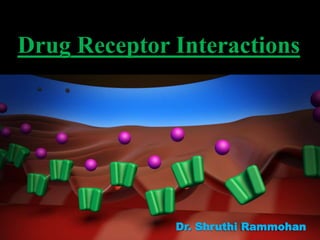
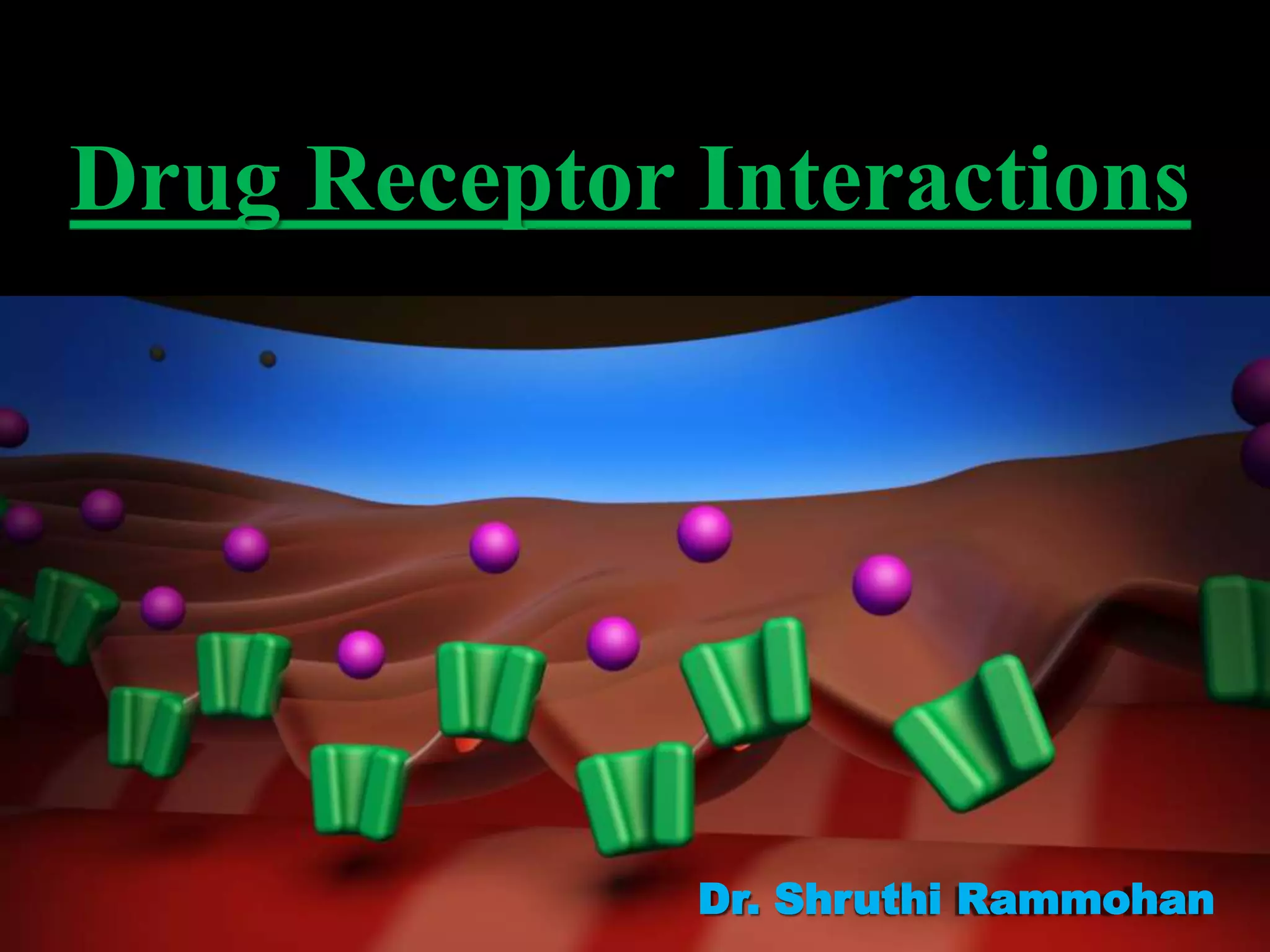
Drug Receptor Interactions
Dr. Shruthi Rammohan
Overview:
• History
• Theories
• Definitions
• Types of Receptors
• Receptor Regulation
• Applied Pharmacology
What is a Receptor
• Receptor- a binding site located on the
surface/inside the effector cell that
serves to recognize the signal
molecule/drug and initiate the response
to it, but has no other function itself
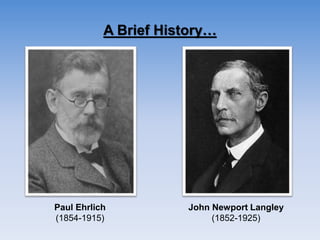
A Brief History…
Paul Ehrlich
(1854-1915)
John Newport Langley
(1852-1925)
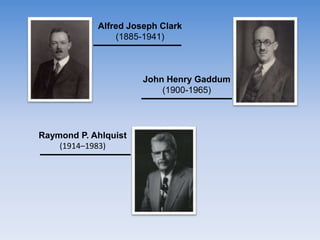
John Henry Gaddum
(1900-1965)
Alfred Joseph Clark
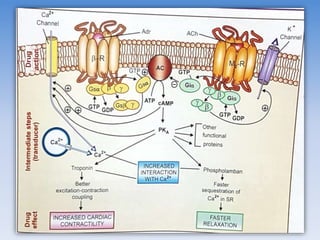
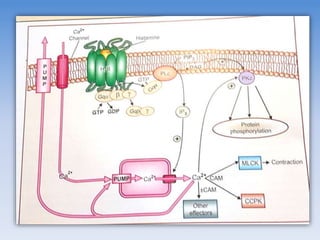
(1885-1941)
Raymond P. Ahlquist
(1914–1983)
Drug-Receptor Theories
• Hypothesis of Clark
“ The Pharmacologic effect of the drug depends on
the percentage of the receptors occupied”
If receptors are occupied, maximum effect is obtained.
It is also called as the Occupation Theory
Drug-Receptor Theories
• Hypothesis of Ariens and Stephenson
“ Effectiveness of a drug lasts as long as the
receptor is occupied.”
-Intensity of effect is directly proportional to the number
of receptors occupied
Drug-Receptor Theories
• Hypothesis of Paton
“ Effectiveness of a drug does not depend on the
actual occupation of the receptor but by obtaining
proper stimulus”
-Response is proportional to the rate of Drug-Receptor
Complex formation
-Duration of receptor occupation determines if a
drug is an agonist, partial agonist, or antagonist
This is also known as the Rate Theory
Drug-Receptor Theories
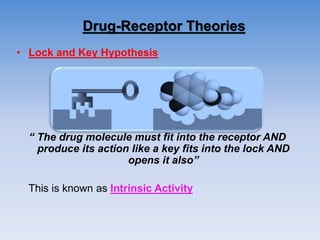
• Lock and Key Hypothesis
“ The drug molecule must fit into the receptor AND
produce its action like a key fits into the lock AND
opens it also”
This is known as Intrinsic Activity
Terminology
Receptor- a binding site located on the surface/inside
the effector cell that serves to recognize the
signal molecule/drug and initiate the response
to it, but has no other function itself
Efficacy- potential maximum therapeutic response
that a drug can produce
Potency- amount of drug needed to produce an effect
Ligand- a molecule which binds selectively to a
receptor or site
Affinity- the ability to bind with the receptor
Terminology
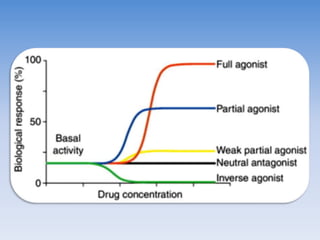
Agonist- activates a receptor to produce an effect similar to
that of the physiological signal molecule
Partial activates a receptor to produce a submaximal effect
Agonist- but antagonizes the action of a full agonist
Inverse activates a receptor to produce an effect in the
Agonist- opposite direction to that of the agonist
Antagonist- prevents the action of an agonist on a receptor or the
subsequent response but does not have an effect of its own
Terminology
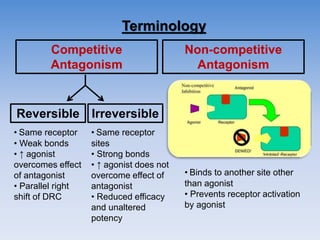
Competitive
Antagonism
Non-competitive
Antagonism
Reversible Irreversible
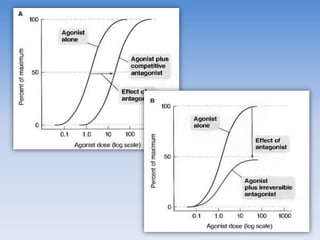
• Same receptor
• Weak bonds
• ↑ agonist
overcomes effect
of antagonist
• Parallel right
shift of DRC
• Same receptor
sites
• Strong bonds
• ↑ agonist does not
overcome effect of
antagonist
• Reduced efficacy
and unaltered
potency
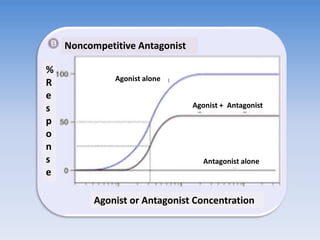
• Binds to another site other
than agonist
• Prevents receptor activation
by agonist
Agonist + Antagonist
Agonist alone
Antagonist alone
Noncompetitive Antagonist
Agonist or Antagonist Concentration
%
R
e
s
p
o
n
s
e
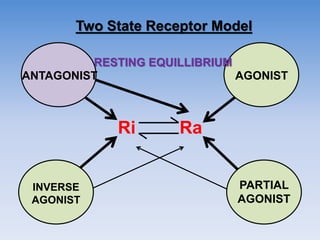
Two State Receptor Model
Ri Ra
AGONIST
PARTIAL
AGONIST
INVERSE
AGONIST
ANTAGONIST
RESTING EQUILLIBRIUM
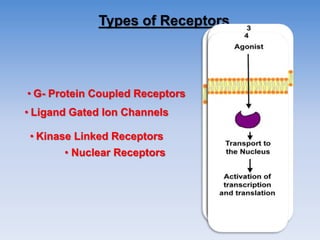
Types of Receptors
• Ligand Gated Ion Channels
• G- Protein Coupled Receptors
• Kinase Linked Receptors
• Nuclear Receptors
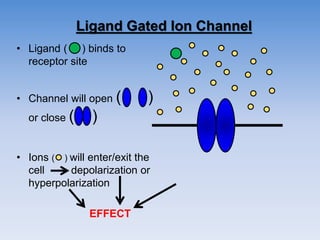
Ligand Gated Ion Channel
• Ligand ( ) binds to
receptor site
• Channel will open ( )
or close ( )
• Ions ( ) will enter/exit the
cell depolarization or
hyperpolarization
EFFECT
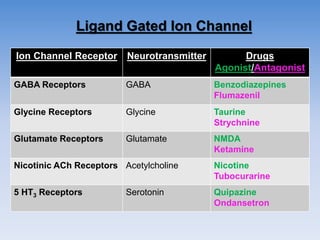
Ligand Gated Ion Channel
Ion Channel Receptor Neurotransmitter Drugs
Agonist/Antagonist
GABA Receptors GABA Benzodiazepines
Flumazenil
Glycine Receptors Glycine Taurine
Strychnine
Glutamate Receptors Glutamate NMDA
Ketamine
Nicotinic ACh Receptors Acetylcholine Nicotine
Tubocurarine
5 HT3 Receptors Serotonin Quipazine
Ondansetron
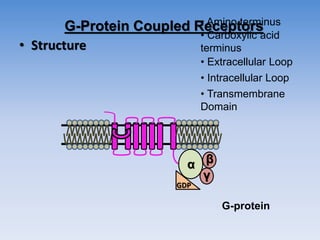
G-Protein Coupled Receptors
• Structure
α β
γ
• Amino terminus
• Carboxylic acid
terminus
• Extracellular Loop
• Intracellular Loop
• Transmembrane
Domain
G-protein
GDP
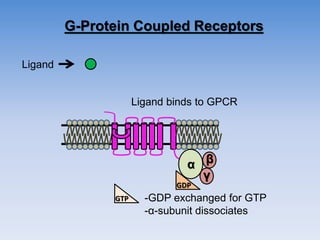
G-Protein Coupled Receptors
α β
γ
GDP
GTP
Ligand
Ligand binds to GPCR
-GDP exchanged for GTP
-α-subunit dissociates
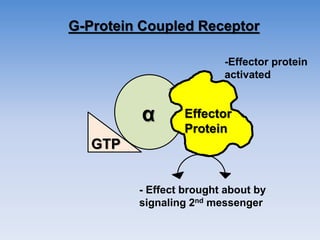
G-Protein Coupled Receptor
α
GTP
Effector
Protein
-Effector protein
activated
- Effect brought about by
signaling 2nd messenger
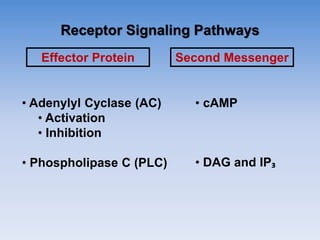
Receptor Signaling Pathways
Effector Protein Second Messenger
• Adenylyl Cyclase (AC)
• Activation
• Inhibition
• Phospholipase C (PLC)
• cAMP
• DAG and IP₃
Adenylyl Cyclase Pathway
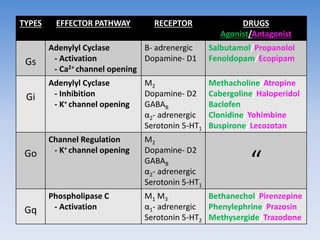
TYPES EFFECTOR PATHWAY RECEPTOR DRUGS
Agonist/Antagonist
Gs
Adenylyl Cyclase
- Activation
- Ca2+ channel opening
Β- adrenergic
Dopamine- D1
Salbutamol/Propanolol
Fenoldopam/Ecopipam
Gi
Adenylyl Cyclase
- Inhibition
- K+ channel opening
M2
Dopamine- D2
GABAB
α2- adrenergic
Serotonin 5-HT1
Methacholine/Atropine
Cabergoline/Haloperidol
Baclofen
Clonidine/Yohimbine
Buspirone/Lecozotan
Go
Channel Regulation
- K+ channel opening
M2
Dopamine- D2
GABAB
α2- adrenergic
Serotonin 5-HT1
“
Gq
Phospholipase C
- Activation
M1 M3
α1- adrenergic
Serotonin 5-HT2
Bethanechol/Pirenzepine
Phenylephrine/Prazosin
Methysergide/Trazodone
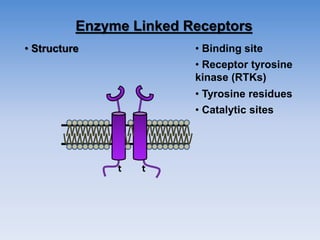
Enzyme Linked Receptors
• Structure
t t
• Binding site
• Receptor tyrosine
kinase (RTKs)
• Catalytic sites
• Tyrosine residues
Enzyme Linked Receptor
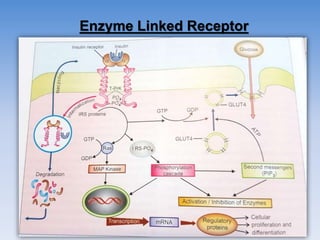
• Ligand Examples:
- Insulin
- Epidermal Growth Factor
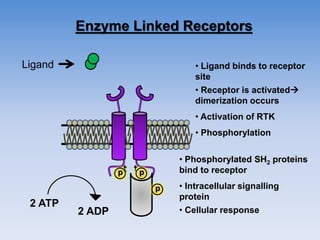
Enzyme Linked Receptors
Ligand
t t
2 ATP
2 ADP
p p
p
• Ligand binds to receptor
site
• Receptor is activated
dimerization occurs
• Phosphorylation
• Activation of RTK
• Phosphorylated SH2 proteins
bind to receptor
• Intracellular signalling
protein
• Cellular response
Enzyme Linked Receptor
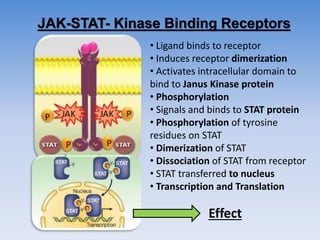
JAK-STAT- Kinase Binding Receptors
• Ligand binds to receptor
• Induces receptor dimerization
• Activates intracellular domain to
bind to Janus Kinase protein
• Phosphorylation
• Signals and binds to STAT protein
• Phosphorylation of tyrosine
residues on STAT
• Dimerization of STAT
• Dissociation of STAT from receptor
• STAT transferred to nucleus
• Transcription and Translation
Effect
Jak-STAT Receptor
• Ligand Examples:
- Cytokines
- Interferons
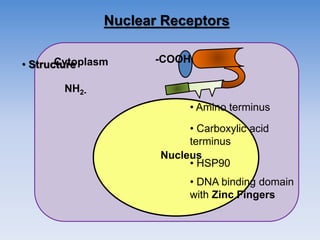
Nuclear Receptors
Cytoplasm
NH2-
• Amino terminus
• Carboxylic acid
terminus
• HSP90
• DNA binding domain
with Zinc Fingers
• Structure
Nucleus
-COOH
Nuclear Receptors
• Ligand Examples:
- Steroid Hormones
- Thyroxine
- Vitamin D
- Vitamin A
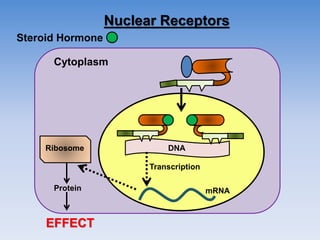
Nuclear Receptors
Cytoplasm
DNA
mRNA
Transcription
Ribosome
Protein
EFFECT
Steroid Hormone
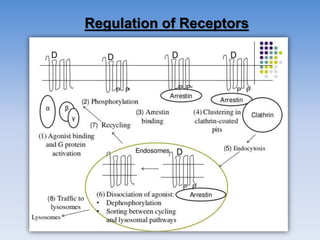
Regulation of Receptors
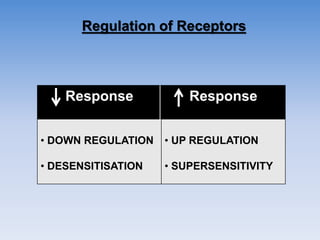
Response Response
• DOWN REGULATION
• DESENSITISATION
• UP REGULATION
• SUPERSENSITIVITY
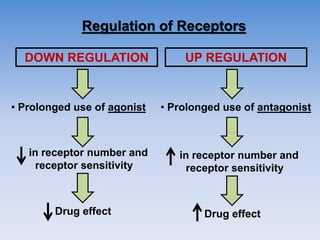
Regulation of Receptors
DOWN REGULATION UP REGULATION
• Prolonged use of agonist • Prolonged use of antagonist
in receptor number and
receptor sensitivity
Drug effect
in receptor number and
receptor sensitivity
Drug effect
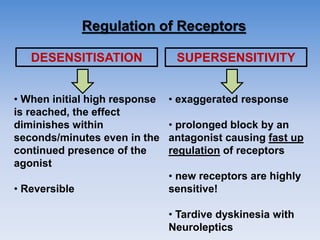
Regulation of Receptors
DESENSITISATION SUPERSENSITIVITY
• When initial high response
is reached, the effect
diminishes within
seconds/minutes even in the
continued presence of the
agonist
• Reversible
• exaggerated response
• prolonged block by an
antagonist causing fast up
regulation of receptors
• new receptors are highly
sensitive!
• Tardive dyskinesia with
Neuroleptics
Regulation of Receptors
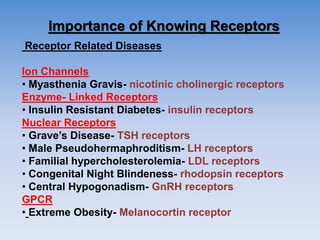
Importance of Knowing Receptors
Receptor Related Diseases
Ion Channels
• Myasthenia Gravis- nicotinic cholinergic receptors
Enzyme- Linked Receptors
• Insulin Resistant Diabetes- insulin receptors
Nuclear Receptors
• Grave’s Disease- TSH receptors
• Male Pseudohermaphroditism- LH receptors
• Familial hypercholesterolemia- LDL receptors
• Congenital Night Blindeness- rhodopsin receptors
• Central Hypogonadism- GnRH receptors
GPCR
• Extreme Obesity- Melanocortin receptor
References
• Essentials of Medical Pharmacology, 7th Edition. KD
Tripathi
• Principles of Pharmacology, 2nd Edition. HL Sharma,
KK Sharma
• Rang & Dale’s Pharmacology, 8th Edition. HP Rang,
JM Ritter, RJ Flower, G Henderson
• Basic and Clinical Pharmacology, 13th Edition. BG
Katsung, AJ Trevor
• Maehle AH. A binding question: the evolution of the
receptor concept. Endeavour. 2009;33(4):135-140.
Thank You

Drug Receptor Interactions

  • 1.
  • 2.
    Overview: • History • Theories •Definitions • Types of Receptors • Receptor Regulation • Applied Pharmacology
  • 3.
    What is aReceptor • Receptor- a binding site located on the surface/inside the effector cell that serves to recognize the signal molecule/drug and initiate the response to it, but has no other function itself
  • 4.
    A Brief History… PaulEhrlich (1854-1915) John Newport Langley (1852-1925)
  • 5.
    John Henry Gaddum (1900-1965) AlfredJoseph Clark (1885-1941) Raymond P. Ahlquist (1914–1983)
  • 6.
    Drug-Receptor Theories • Hypothesisof Clark “ The Pharmacologic effect of the drug depends on the percentage of the receptors occupied” If receptors are occupied, maximum effect is obtained. It is also called as the Occupation Theory
  • 7.
    Drug-Receptor Theories • Hypothesisof Ariens and Stephenson “ Effectiveness of a drug lasts as long as the receptor is occupied.” -Intensity of effect is directly proportional to the number of receptors occupied
  • 8.
    Drug-Receptor Theories • Hypothesisof Paton “ Effectiveness of a drug does not depend on the actual occupation of the receptor but by obtaining proper stimulus” -Response is proportional to the rate of Drug-Receptor Complex formation -Duration of receptor occupation determines if a drug is an agonist, partial agonist, or antagonist This is also known as the Rate Theory
  • 9.
    Drug-Receptor Theories • Lockand Key Hypothesis “ The drug molecule must fit into the receptor AND produce its action like a key fits into the lock AND opens it also” This is known as Intrinsic Activity
  • 10.
    Terminology Receptor- a bindingsite located on the surface/inside the effector cell that serves to recognize the signal molecule/drug and initiate the response to it, but has no other function itself Efficacy- potential maximum therapeutic response that a drug can produce Potency- amount of drug needed to produce an effect Ligand- a molecule which binds selectively to a receptor or site Affinity- the ability to bind with the receptor
  • 11.
    Terminology Agonist- activates areceptor to produce an effect similar to that of the physiological signal molecule Partial activates a receptor to produce a submaximal effect Agonist- but antagonizes the action of a full agonist Inverse activates a receptor to produce an effect in the Agonist- opposite direction to that of the agonist Antagonist- prevents the action of an agonist on a receptor or the subsequent response but does not have an effect of its own
  • 13.
    Terminology Competitive Antagonism Non-competitive Antagonism Reversible Irreversible • Samereceptor • Weak bonds • ↑ agonist overcomes effect of antagonist • Parallel right shift of DRC • Same receptor sites • Strong bonds • ↑ agonist does not overcome effect of antagonist • Reduced efficacy and unaltered potency • Binds to another site other than agonist • Prevents receptor activation by agonist
  • 15.
    Agonist + Antagonist Agonistalone Antagonist alone Noncompetitive Antagonist Agonist or Antagonist Concentration % R e s p o n s e
  • 16.
    Two State ReceptorModel Ri Ra AGONIST PARTIAL AGONIST INVERSE AGONIST ANTAGONIST RESTING EQUILLIBRIUM
  • 17.
    Types of Receptors •Ligand Gated Ion Channels • G- Protein Coupled Receptors • Kinase Linked Receptors • Nuclear Receptors
  • 18.
    Ligand Gated IonChannel • Ligand ( ) binds to receptor site • Channel will open ( ) or close ( ) • Ions ( ) will enter/exit the cell depolarization or hyperpolarization EFFECT
  • 19.
    Ligand Gated IonChannel Ion Channel Receptor Neurotransmitter Drugs Agonist/Antagonist GABA Receptors GABA Benzodiazepines Flumazenil Glycine Receptors Glycine Taurine Strychnine Glutamate Receptors Glutamate NMDA Ketamine Nicotinic ACh Receptors Acetylcholine Nicotine Tubocurarine 5 HT3 Receptors Serotonin Quipazine Ondansetron
  • 20.
    G-Protein Coupled Receptors •Structure α β γ • Amino terminus • Carboxylic acid terminus • Extracellular Loop • Intracellular Loop • Transmembrane Domain G-protein GDP
  • 21.
    G-Protein Coupled Receptors αβ γ GDP GTP Ligand Ligand binds to GPCR -GDP exchanged for GTP -α-subunit dissociates
  • 22.
    G-Protein Coupled Receptor α GTP Effector Protein -Effectorprotein activated - Effect brought about by signaling 2nd messenger
  • 23.
    Receptor Signaling Pathways EffectorProtein Second Messenger • Adenylyl Cyclase (AC) • Activation • Inhibition • Phospholipase C (PLC) • cAMP • DAG and IP₃
  • 24.
  • 26.
    TYPES EFFECTOR PATHWAYRECEPTOR DRUGS Agonist/Antagonist Gs Adenylyl Cyclase - Activation - Ca2+ channel opening Β- adrenergic Dopamine- D1 Salbutamol/Propanolol Fenoldopam/Ecopipam Gi Adenylyl Cyclase - Inhibition - K+ channel opening M2 Dopamine- D2 GABAB α2- adrenergic Serotonin 5-HT1 Methacholine/Atropine Cabergoline/Haloperidol Baclofen Clonidine/Yohimbine Buspirone/Lecozotan Go Channel Regulation - K+ channel opening M2 Dopamine- D2 GABAB α2- adrenergic Serotonin 5-HT1 “ Gq Phospholipase C - Activation M1 M3 α1- adrenergic Serotonin 5-HT2 Bethanechol/Pirenzepine Phenylephrine/Prazosin Methysergide/Trazodone
  • 27.
    Enzyme Linked Receptors •Structure t t • Binding site • Receptor tyrosine kinase (RTKs) • Catalytic sites • Tyrosine residues
  • 28.
    Enzyme Linked Receptor •Ligand Examples: - Insulin - Epidermal Growth Factor
  • 29.
    Enzyme Linked Receptors Ligand tt 2 ATP 2 ADP p p p • Ligand binds to receptor site • Receptor is activated dimerization occurs • Phosphorylation • Activation of RTK • Phosphorylated SH2 proteins bind to receptor • Intracellular signalling protein • Cellular response
  • 30.
  • 31.
    JAK-STAT- Kinase BindingReceptors • Ligand binds to receptor • Induces receptor dimerization • Activates intracellular domain to bind to Janus Kinase protein • Phosphorylation • Signals and binds to STAT protein • Phosphorylation of tyrosine residues on STAT • Dimerization of STAT • Dissociation of STAT from receptor • STAT transferred to nucleus • Transcription and Translation Effect
  • 32.
    Jak-STAT Receptor • LigandExamples: - Cytokines - Interferons
  • 33.
    Nuclear Receptors Cytoplasm NH2- • Aminoterminus • Carboxylic acid terminus • HSP90 • DNA binding domain with Zinc Fingers • Structure Nucleus -COOH
  • 34.
    Nuclear Receptors • LigandExamples: - Steroid Hormones - Thyroxine - Vitamin D - Vitamin A
  • 35.
  • 36.
    Regulation of Receptors ResponseResponse • DOWN REGULATION • DESENSITISATION • UP REGULATION • SUPERSENSITIVITY
  • 37.
    Regulation of Receptors DOWNREGULATION UP REGULATION • Prolonged use of agonist • Prolonged use of antagonist in receptor number and receptor sensitivity Drug effect in receptor number and receptor sensitivity Drug effect
  • 38.
    Regulation of Receptors DESENSITISATIONSUPERSENSITIVITY • When initial high response is reached, the effect diminishes within seconds/minutes even in the continued presence of the agonist • Reversible • exaggerated response • prolonged block by an antagonist causing fast up regulation of receptors • new receptors are highly sensitive! • Tardive dyskinesia with Neuroleptics
  • 39.
  • 40.
    Importance of KnowingReceptors Receptor Related Diseases Ion Channels • Myasthenia Gravis- nicotinic cholinergic receptors Enzyme- Linked Receptors • Insulin Resistant Diabetes- insulin receptors Nuclear Receptors • Grave’s Disease- TSH receptors • Male Pseudohermaphroditism- LH receptors • Familial hypercholesterolemia- LDL receptors • Congenital Night Blindeness- rhodopsin receptors • Central Hypogonadism- GnRH receptors GPCR • Extreme Obesity- Melanocortin receptor
  • 41.
    References • Essentials ofMedical Pharmacology, 7th Edition. KD Tripathi • Principles of Pharmacology, 2nd Edition. HL Sharma, KK Sharma • Rang & Dale’s Pharmacology, 8th Edition. HP Rang, JM Ritter, RJ Flower, G Henderson • Basic and Clinical Pharmacology, 13th Edition. BG Katsung, AJ Trevor • Maehle AH. A binding question: the evolution of the receptor concept. Endeavour. 2009;33(4):135-140.
  • 42.