CLASS- B-PHARM- III SEM V
SUBJECT - INDUSTRIAL PHARMACY-I
TOPIC NAME : PELLETS
Mr Nandakishor B Deshmukh.
Assistant Professor
Department Of Pharmaceutics
Shraddha Institute Of Pharmacy, Kondala Zambre,
Washim
PELLETS
 Definition: Small free flowing spherical units
ranging in size, prepared by agglomeration of fine
powders are called pellets.
 An ideal pellet should have the following
properties:
 It should be spherical in shape.
 It should have a smooth surface texture.
 Its particle size should range between 500-
1500µm.
 It should hold maximum quantity of active
ingredient to maintain its size.
Advantages of Pelletization
 Pelletisation reduces variations in gastric emptying rates and overall
transit times, thus reduces intra- and inter-subject variability of plasma
profiles.
 It also produces spheroids with high loading capacity of active ingredient
without producing large particles. Pellets when formulated as modified
release dosage forms are less susceptible to dose dumping than compared
to reservoir type single unit formulations.
 Incompatible drugs processed separately and mixed later, or pellets with
diffe rent release mechanisms can be mixed to obtain a new modified
release profile.
 They can be given to patients having difficulty in swallowing and
dysphagia.
 They exhibit better roundness and have excellent flow and packing
properties.
 .
Disadvantages of Pelletization
The disadvantages of pelletisation technique
are given below:
Higher Processing Costs: Use of a binder and
the drying step results in higher processing
costs when compared to compaction
granulation.
Requirement of a Skilled Operator: For
producing pellets with desired quality and
characteristics and to keep the pelletisation
process running smoothly, well -trained and
skilled operators are required
Formulation Requirement
 Formulation aids or excipients are added to
pharmaceutical dosage forms for
satisfactory delivery of the drug to the
target site, to impart favourable features to
the dosage form, and to facilitate product
manufacture.
 Since pellets are meant for oral
administration, the excipients used are the
same as those used in the formulation of
tablets or capsules.
 Excipients,
 Disintegrants
• Surfactants,
• Ph Adjuste
• Separating Agents,
• Spheronis Ation Enhancers,
Glidants,
• Release Modifiers, Etc. Are Some
Of The Excipients
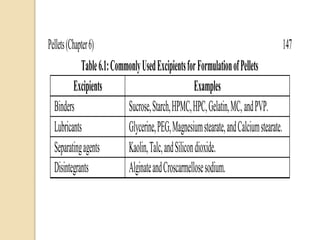
Pellets(Chapter6) 147
Table6.1:CommonlyUsedExcipientsforFormulationofPellets
Excipients Examples
Binders Sucrose,Starch,HPMC,HPC,Gelatin,MC,andPVP.
Lubricants Glycerine,PEG,Magnesiumstearate,andCalciumstearate.
Separatingagents Kaolin,Talc,andSilicondioxide.
Disintegrants AlginateandCroscarmellosesodium.
pH adjusters Citrate, Phosphate, and Meglumine.
Surfactants SLS and Polysorbate.
Spheronisation
enhancers
MCC and Sodium CMC.
Glidants Talc, Starch, and Magnesium stearate.
Release modifiers Ethyl cellulose, Shellac, and Carnauba wax.
Pelletization Processes
 Pelletisation is an agglomeration process in
which the fine powders or particles of bulk drugs
and excipients are converted into small, free -
flowing, and roughly spherical units called pellets.
 Pelletisation is often referred to as asize-
enlargement process that involves the
manufacture of agglomerates or pellets having a
relatively narrow size range (mean size from 0.5 -
2.0mm).
 Pellets have free -flowing properties and a low
porosity (about 10%).
The different types of pelletisation techniques are:
i. Direct pelletisation,
ii. Pelletisation by drug layering,
iii. Pelletisation by powder layering,
iv. Pelletisation by suspension or solution layering,
v. Pelletisation by extrusion and spheronization,
vi. Spherical agglomeration/balling,
vii. Cryopelletisation,
viii.Hot-melt extrusion technology (HME),
ix. Globulation or droplet formation,
x. Compression,
xi. Freeze pelletisation,
xii. Fluid bed coating, and
xiii. Tangential spray coating (rotor pellet coating).
Direct Pelletization
In direct pelletisation technique, pellets are
manufactured directly from powder with a
binder or solvent.
This process is fast and requires less auxiliary
materials. By this technique, compact and
round pellets of diameter between 0.2 -1.2mm
are obtained. Such pellets are ide al for
automatic dosing and uniform coating.
Pellets have a density higher than the spray
granulates and agglomerates.
Principles
Powder is mixed and moistened with a solvent or binder. The
obtained powder bed is subjected to centrifugation.
The resultant impact and acceleration forces lead to the
formation of agglomerates, which become rounder into
uniform and dense pellets.
The rotation speed directly influences the density and size of
pellets.
The moist pellets are dried in the fluid bed.
Direct pelletisation can also be carried out by spray
granulation. With the addition of suitable excipients, pellets
are either compressed into tablets or filled into capsules.
The round shape of pellets makes them ideal for uniform
coating, and they are also good for automatic dosing.
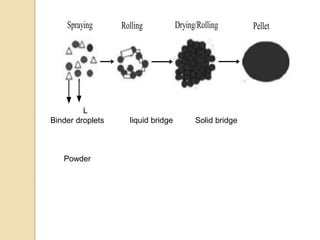
Spraying Rolling Drying/Rolling Pellet
Binder droplets
Powder
L
liquid bridge Solid bridge
Pelletization by Drug Layering
In the process of drug layering, successive
layers of drug entities from solution,
suspension, or dry pow der are deposited on
nuclei (crystals or granules of the same
material or inert starter seeds ).
In solution or suspension layering, drug
particles are dissolved or suspended in the
binding liquid; while in powder layering, first a
binder solution is sprayed on previously
prepared inert seeds, and then the powder is
added
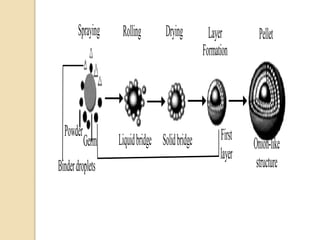
Pelletization by Powder Layering
In the process of powder layering , dry powders of
drugs and excipients are deposited with the help of
binding liquids on pre -formed nuclei or cores. Since
powder layering involves simultaneous application of
binding agents and dry powders, it requires
specialised equipment like spheroniser.
The principal requirement of this process is that the
product container should have solid walls with no p
erforations so that powder is not lost from beneath the
product chute before the powder is picked -off by the
wet mass of pellets being layered.
Spraying Rolling Drying Layer
Formation
Pellet
Powder
Germ
Binderdroplets
Liquidbridge Solidbridge First
layer
Onion-like
structure
Pelletization by Suspension or Solution Layering
 In the process of solution or suspension layering
successive layers of solution and/or suspensions of
drug substances and binder are deposited over the
starter non-peril seeds (inert material or crystals or
granules of the same drug).
 Since the general coating process is involved in
solution or suspension layering, conventional
coating pans, fluidised beds, centrifugal granulators,
and Wurster coaters are used for manufacturing
pellets.
 The efficiency of this process and the quality of
obtained pellets are partially related to the type of
equipment used
Pelletization by Extrusion and Spheronization
In the process of extrusion and spheronis ation, first extrudes are
made from the powder material using the extruder and then
converted into beads (as fine as 0.6mm) using the s pheroniser.
The powder material could be a drug powder, Ayurvedic powder,
food ingredient powder, detergent powder, nuclear powder, etc.
The capsule filling method has to be gentle enough on the pellets
to retain the integrity of coating; while in case of powder filling,
the filling of pellets into capsules can be dependent or
independent.
In the dependent method , a modified augur type machine is
used, and the pellets are poured in the capsule shells under
gravity.
The formulation aspect of this approach i s to ensure that the
required dosage of active substance is present in the volume of
pellets taken to fill the capsule body. In the independent method
, a volumetric fill by a modified dosator method is used.
Spherical Agglomeration/Balling
In spherical agglomeration process, powders are
added with a suitable quantity of liquid or subjected
to high temperatures to convert into spherical particles
by a continuous rolling or tumbling action.
Spherical agglomeration can be divided into liquid-
induced and melt- induced agglomeration. Since
many years spherical a gglomeration is c arried out
in horizontal drum pelletiser, inclined dish p elletiser,
and tumbling blenders. However in the recent
technologies, rotary fluid bed granulators and high
shear mixers are used.
Cryopelletization
In the process of cryo pelletisation, liquid nitrogen is used as a
fixing medium to convert the droplets of liquid formulations
into solid spherical particles or pellets. The technology initially
developed for lyophilisation of viscous bacterial suspension
can be used to produce drug -loaded pellets in liquid nitrogen
at 160°C temperature.
The procedure allows instantaneous and uniform freezing of
the processed material due to the rapid heat transfer between
the droplets, and thus the large surface area facilitates the
drying process.
The a mount of liquid nitrogen required for manufacturing a
given quantity depends on the solid content and temperature of
the solution or suspension being processed. It is usually
between 3-5kg per kilogram of finished pellets.
Hot-Melt Extrusion Technology
(HME)
In the process of HME, the raw materials
are pumped through a die (with a rotating
screw under elevated temperature) into a
uniformly -shaped product.
Rotating screw facilitates mixing and
agitation de -aggregates the suspended
particles in the molten po lymer, thus
forming a more uniform dispersion
Globulation or Droplet Formation
In the process of globulation, two related
processes, i.e., spray drying and spray
congealing are involved.
In spray drying, the drugs in the suspension or
solution without excipients are sprayed into a
hot stream to produce dry and more spherical
particles.
This process is used for improving the
dissolution rates, and hence the bioavailability
of poorly soluble drugs.
Compression
In the process of compression (a type of
compaction technique for preparing pellets),
mixtures or blends of active ingredients and
excipients are compacted under pressure to
obtain pellets of definite sizes and shapes.
The formulation and process variables
controlling the quality of the obtained pellets
are similar to those used in tablet
manufacturing.
Freeze Pelletization
In the process of freeze pelletisation, a
molten -solid carrier/matrix is introduced in
the form of droplets into an inert column of
liquid in which the molten solid is
immiscible.
The molten solid droplets move either
upward or downward in the liquid column
(depending on the droplet’s density with
respect to the liquid in the column) and
solidify as spherical pellets.
Fluid Bed Coating.
Fluid bed coating for preparing pellets is of
the following Three types:
Top Spray Coating
Bottom Spray Coating (Wurster Coating
Bottom Spray Coating (Continuous
Fluid Bed):
Tangential Spray Coating (Rotor
Pellet Coating)
In the process of tangential spray coating the
product is set into a spiral motion by means of
a rotating base plate which has air fed into the
powder bed at its edge.
The spray nozzle is arranged tangentially to the
rotor disc and is sprayed simultaneously into
the powder bed.
This method is ideal for coatings with high
solid content, and for applying thick film
layers.
Equipments for Manufacture of
Pellets
I. Supply Bins
II. Pellet Mills
III. Pelleting Dies
IV. Coolers
V. Crumble Rolls
VI. Shaker
VII. Pellet Elevating Systems
The following types of dies are generally used in the
pelleting system:
Standard Die: In this type, all the holes have the same
effective thickness.
Standard Relieved Die: In this type also, the holes have the
same effective thickness, but the discharge side of the hole is
enlarged to a depth of 1/4” (relieved). This die is used for
adding strength to the die without increasing the thickness of
the hole depth.
Standard Variable Relief Die: In this type, all the holes are
same except the two or three outside rows of the die, which
are relieved by 1/4”. Some products while being pelleted
squeeze out to the side of the die, thus plugging the two or
three outside rows. This loses 25% of the die effectiveness.
Staggered Relief Die: This type serves as the standard
variable relief die, except that the two or three outside rows
are relieved by 1/2” and the next two or three rows are
relieved by 1/4”.
PELLETS  AND  PELLETIZATION TECHNIQUES

PELLETS AND PELLETIZATION TECHNIQUES

  • 1.
    CLASS- B-PHARM- IIISEM V SUBJECT - INDUSTRIAL PHARMACY-I TOPIC NAME : PELLETS Mr Nandakishor B Deshmukh. Assistant Professor Department Of Pharmaceutics Shraddha Institute Of Pharmacy, Kondala Zambre, Washim
  • 2.
    PELLETS  Definition: Smallfree flowing spherical units ranging in size, prepared by agglomeration of fine powders are called pellets.  An ideal pellet should have the following properties:  It should be spherical in shape.  It should have a smooth surface texture.  Its particle size should range between 500- 1500µm.  It should hold maximum quantity of active ingredient to maintain its size.
  • 3.
    Advantages of Pelletization Pelletisation reduces variations in gastric emptying rates and overall transit times, thus reduces intra- and inter-subject variability of plasma profiles.  It also produces spheroids with high loading capacity of active ingredient without producing large particles. Pellets when formulated as modified release dosage forms are less susceptible to dose dumping than compared to reservoir type single unit formulations.  Incompatible drugs processed separately and mixed later, or pellets with diffe rent release mechanisms can be mixed to obtain a new modified release profile.  They can be given to patients having difficulty in swallowing and dysphagia.  They exhibit better roundness and have excellent flow and packing properties.  .
  • 4.
    Disadvantages of Pelletization Thedisadvantages of pelletisation technique are given below: Higher Processing Costs: Use of a binder and the drying step results in higher processing costs when compared to compaction granulation. Requirement of a Skilled Operator: For producing pellets with desired quality and characteristics and to keep the pelletisation process running smoothly, well -trained and skilled operators are required
  • 5.
    Formulation Requirement  Formulationaids or excipients are added to pharmaceutical dosage forms for satisfactory delivery of the drug to the target site, to impart favourable features to the dosage form, and to facilitate product manufacture.  Since pellets are meant for oral administration, the excipients used are the same as those used in the formulation of tablets or capsules.
  • 6.
     Excipients,  Disintegrants •Surfactants, • Ph Adjuste • Separating Agents, • Spheronis Ation Enhancers, Glidants, • Release Modifiers, Etc. Are Some Of The Excipients
  • 7.
    Pellets(Chapter6) 147 Table6.1:CommonlyUsedExcipientsforFormulationofPellets Excipients Examples BindersSucrose,Starch,HPMC,HPC,Gelatin,MC,andPVP. Lubricants Glycerine,PEG,Magnesiumstearate,andCalciumstearate. Separatingagents Kaolin,Talc,andSilicondioxide. Disintegrants AlginateandCroscarmellosesodium.
  • 8.
    pH adjusters Citrate,Phosphate, and Meglumine. Surfactants SLS and Polysorbate. Spheronisation enhancers MCC and Sodium CMC. Glidants Talc, Starch, and Magnesium stearate. Release modifiers Ethyl cellulose, Shellac, and Carnauba wax.
  • 9.
    Pelletization Processes  Pelletisationis an agglomeration process in which the fine powders or particles of bulk drugs and excipients are converted into small, free - flowing, and roughly spherical units called pellets.  Pelletisation is often referred to as asize- enlargement process that involves the manufacture of agglomerates or pellets having a relatively narrow size range (mean size from 0.5 - 2.0mm).  Pellets have free -flowing properties and a low porosity (about 10%).
  • 10.
    The different typesof pelletisation techniques are: i. Direct pelletisation, ii. Pelletisation by drug layering, iii. Pelletisation by powder layering, iv. Pelletisation by suspension or solution layering, v. Pelletisation by extrusion and spheronization, vi. Spherical agglomeration/balling, vii. Cryopelletisation, viii.Hot-melt extrusion technology (HME), ix. Globulation or droplet formation, x. Compression, xi. Freeze pelletisation, xii. Fluid bed coating, and xiii. Tangential spray coating (rotor pellet coating).
  • 11.
    Direct Pelletization In directpelletisation technique, pellets are manufactured directly from powder with a binder or solvent. This process is fast and requires less auxiliary materials. By this technique, compact and round pellets of diameter between 0.2 -1.2mm are obtained. Such pellets are ide al for automatic dosing and uniform coating. Pellets have a density higher than the spray granulates and agglomerates.
  • 12.
    Principles Powder is mixedand moistened with a solvent or binder. The obtained powder bed is subjected to centrifugation. The resultant impact and acceleration forces lead to the formation of agglomerates, which become rounder into uniform and dense pellets. The rotation speed directly influences the density and size of pellets. The moist pellets are dried in the fluid bed. Direct pelletisation can also be carried out by spray granulation. With the addition of suitable excipients, pellets are either compressed into tablets or filled into capsules. The round shape of pellets makes them ideal for uniform coating, and they are also good for automatic dosing.
  • 13.
    Spraying Rolling Drying/RollingPellet Binder droplets Powder L liquid bridge Solid bridge
  • 14.
    Pelletization by DrugLayering In the process of drug layering, successive layers of drug entities from solution, suspension, or dry pow der are deposited on nuclei (crystals or granules of the same material or inert starter seeds ). In solution or suspension layering, drug particles are dissolved or suspended in the binding liquid; while in powder layering, first a binder solution is sprayed on previously prepared inert seeds, and then the powder is added
  • 15.
    Pelletization by PowderLayering In the process of powder layering , dry powders of drugs and excipients are deposited with the help of binding liquids on pre -formed nuclei or cores. Since powder layering involves simultaneous application of binding agents and dry powders, it requires specialised equipment like spheroniser. The principal requirement of this process is that the product container should have solid walls with no p erforations so that powder is not lost from beneath the product chute before the powder is picked -off by the wet mass of pellets being layered.
  • 16.
    Spraying Rolling DryingLayer Formation Pellet Powder Germ Binderdroplets Liquidbridge Solidbridge First layer Onion-like structure
  • 17.
    Pelletization by Suspensionor Solution Layering  In the process of solution or suspension layering successive layers of solution and/or suspensions of drug substances and binder are deposited over the starter non-peril seeds (inert material or crystals or granules of the same drug).  Since the general coating process is involved in solution or suspension layering, conventional coating pans, fluidised beds, centrifugal granulators, and Wurster coaters are used for manufacturing pellets.  The efficiency of this process and the quality of obtained pellets are partially related to the type of equipment used
  • 18.
    Pelletization by Extrusionand Spheronization In the process of extrusion and spheronis ation, first extrudes are made from the powder material using the extruder and then converted into beads (as fine as 0.6mm) using the s pheroniser. The powder material could be a drug powder, Ayurvedic powder, food ingredient powder, detergent powder, nuclear powder, etc. The capsule filling method has to be gentle enough on the pellets to retain the integrity of coating; while in case of powder filling, the filling of pellets into capsules can be dependent or independent. In the dependent method , a modified augur type machine is used, and the pellets are poured in the capsule shells under gravity. The formulation aspect of this approach i s to ensure that the required dosage of active substance is present in the volume of pellets taken to fill the capsule body. In the independent method , a volumetric fill by a modified dosator method is used.
  • 19.
    Spherical Agglomeration/Balling In sphericalagglomeration process, powders are added with a suitable quantity of liquid or subjected to high temperatures to convert into spherical particles by a continuous rolling or tumbling action. Spherical agglomeration can be divided into liquid- induced and melt- induced agglomeration. Since many years spherical a gglomeration is c arried out in horizontal drum pelletiser, inclined dish p elletiser, and tumbling blenders. However in the recent technologies, rotary fluid bed granulators and high shear mixers are used.
  • 20.
    Cryopelletization In the processof cryo pelletisation, liquid nitrogen is used as a fixing medium to convert the droplets of liquid formulations into solid spherical particles or pellets. The technology initially developed for lyophilisation of viscous bacterial suspension can be used to produce drug -loaded pellets in liquid nitrogen at 160°C temperature. The procedure allows instantaneous and uniform freezing of the processed material due to the rapid heat transfer between the droplets, and thus the large surface area facilitates the drying process. The a mount of liquid nitrogen required for manufacturing a given quantity depends on the solid content and temperature of the solution or suspension being processed. It is usually between 3-5kg per kilogram of finished pellets.
  • 21.
    Hot-Melt Extrusion Technology (HME) Inthe process of HME, the raw materials are pumped through a die (with a rotating screw under elevated temperature) into a uniformly -shaped product. Rotating screw facilitates mixing and agitation de -aggregates the suspended particles in the molten po lymer, thus forming a more uniform dispersion
  • 22.
    Globulation or DropletFormation In the process of globulation, two related processes, i.e., spray drying and spray congealing are involved. In spray drying, the drugs in the suspension or solution without excipients are sprayed into a hot stream to produce dry and more spherical particles. This process is used for improving the dissolution rates, and hence the bioavailability of poorly soluble drugs.
  • 23.
    Compression In the processof compression (a type of compaction technique for preparing pellets), mixtures or blends of active ingredients and excipients are compacted under pressure to obtain pellets of definite sizes and shapes. The formulation and process variables controlling the quality of the obtained pellets are similar to those used in tablet manufacturing.
  • 24.
    Freeze Pelletization In theprocess of freeze pelletisation, a molten -solid carrier/matrix is introduced in the form of droplets into an inert column of liquid in which the molten solid is immiscible. The molten solid droplets move either upward or downward in the liquid column (depending on the droplet’s density with respect to the liquid in the column) and solidify as spherical pellets.
  • 25.
    Fluid Bed Coating. Fluidbed coating for preparing pellets is of the following Three types: Top Spray Coating Bottom Spray Coating (Wurster Coating Bottom Spray Coating (Continuous Fluid Bed):
  • 26.
    Tangential Spray Coating(Rotor Pellet Coating) In the process of tangential spray coating the product is set into a spiral motion by means of a rotating base plate which has air fed into the powder bed at its edge. The spray nozzle is arranged tangentially to the rotor disc and is sprayed simultaneously into the powder bed. This method is ideal for coatings with high solid content, and for applying thick film layers.
  • 27.
    Equipments for Manufactureof Pellets I. Supply Bins II. Pellet Mills III. Pelleting Dies IV. Coolers V. Crumble Rolls VI. Shaker VII. Pellet Elevating Systems
  • 28.
    The following typesof dies are generally used in the pelleting system: Standard Die: In this type, all the holes have the same effective thickness. Standard Relieved Die: In this type also, the holes have the same effective thickness, but the discharge side of the hole is enlarged to a depth of 1/4” (relieved). This die is used for adding strength to the die without increasing the thickness of the hole depth. Standard Variable Relief Die: In this type, all the holes are same except the two or three outside rows of the die, which are relieved by 1/4”. Some products while being pelleted squeeze out to the side of the die, thus plugging the two or three outside rows. This loses 25% of the die effectiveness. Staggered Relief Die: This type serves as the standard variable relief die, except that the two or three outside rows are relieved by 1/2” and the next two or three rows are relieved by 1/4”.