PHARMACEUTICAL
ENGINEERING
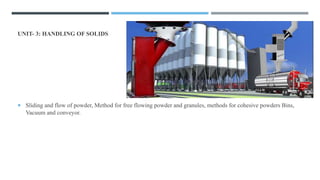
UNIT- 3: HANDLING OF SOLIDS (2 HOURS)
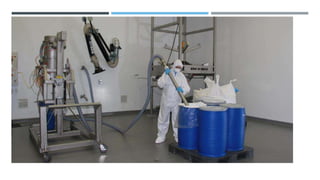
 Sliding and flow of powder, Method for free flowing powder and granules, methods for cohesive powders Bins,
Vacuum and conveyor.
PRINCIPLES OF MATERIAL HANDLING
 Primarily concerned with the storage and movement of material
 Used in warehouses, distribution centers, cross-docks, container terminals, airports, hospitals, and similar
mission-oriented facilities.
 Material handling is ‘‘providing the right amount of the right material, in the right condition, at the right
place, at the right time, in the right position, in the right sequence, and for the right cost, by using the
right method.
 Note that using the ‘‘right method(s)’’ includes safety and ergonomic considerations
 This is true in manufacturing, logistics, distribution, and any other process where products or materials have to
be placed, assembled, or moved. Material-handling challenges provide an excellent opportunity for an
industrial engineer to access and use a set of tools that allow for the development of a new material-handling
system or an improvement in an existing system
 Simplifying processes by reducing, combining, shortening, or eliminating unnecessary moves will reduce work
 The shortest possible distance between two points.
 Good industrial engineering uses process method charts; operation sequences and process equipment
layouts should be used to support the work minimization objective.
 Standardization Principle:
 Material-handling methods,
 equipment,
 controls, and software
 Results on- flexibility, modularity and high throughput.
SOLID PROPERTIES
 Resist distortion
 The particles interlock and can not slide past one another that is why they resist distortion when subjected to moderate force. When the force is large
enough, failure may occur and one layer of particle slide over other.
 Non-uniform pressure distribution
 Pressure is not same in all directions. Pressure applied in one direction may create some pressure in other, but it is always smaller than the applied
perpendicular to the applied pressure.
 Shear stress in solids
 Shear stress in solids is transmitted throughout the static mass of the particles unless failure / distortion occurs.
 Solids density/ Bulk Density
 The mass of the particles divided by the volume they occupy. Density of mass vary depending upon the degree of packing of the grains. It is min. when
maximum when particles are packed under pressure.
 Dilation required for flow
 The tightly packed solid particles must expand or increase in volume to permit interlocking grains to move past one another to start flow. Without
TYPES OF SOLIDS
 Depending on flow properties, particulate solids are of two classes
 Cohesive • For example; wet clay
 Non-cohesive • For example; dry sand, sugar crystals, grains etc.
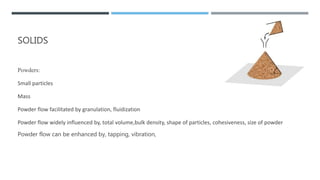
SOLIDS
Powders:
Small particles
Mass
Powder flow facilitated by granulation, fluidization
Powder flow widely influenced by, total volume,bulk density, shape of particles, cohesiveness, size of powder
Powder flow can be enhanced by, tapping, vibration,
FLOW OF POWDERS
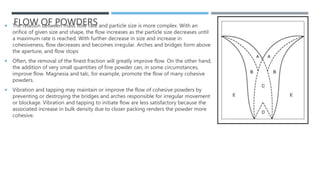
 The gravity flow of powders in chutes and hoppers and the movement of powders
through a constriction occur in tabletting, encapsulation, and many processes in
which a powder is subdivided for packing into final containers. In many cases, the
accuracy of weight and dose depends on the regularity of flow. The flow of powders
is extremely complex and is influenced by many factors. A profile, in two dimensions,
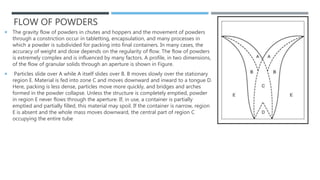
of the flow of granular solids through an aperture is shown in Figure.
 Particles slide over A while A itself slides over B. B moves slowly over the stationary
region E. Material is fed into zone C and moves downward and inward to a tongue D.
Here, packing is less dense, particles move more quickly, and bridges and arches
formed in the powder collapse. Unless the structure is completely emptied, powder
in region E never flows through the aperture. If, in use, a container is partially
emptied and partially filled, this material may spoil. If the container is narrow, region
E is absent and the whole mass moves downward, the central part of region C
occupying the entire tube
FLOW OF POWDERS
 The relation between mass flow rate and particle size is more complex. With an
orifice of given size and shape, the flow increases as the particle size decreases until
a maximum rate is reached. With further decrease in size and increase in
cohesiveness, flow decreases and becomes irregular. Arches and bridges form above
the aperture, and flow stops
 Often, the removal of the finest fraction will greatly improve flow. On the other hand,
the addition of very small quantities of fine powder can, in some circumstances,
improve flow. Magnesia and talc, for example, promote the flow of many cohesive
powders.
 Vibration and tapping may maintain or improve the flow of cohesive powders by
preventing or destroying the bridges and arches responsible for irregular movement
or blockage. Vibration and tapping to initiate flow are less satisfactory because the
associated increase in bulk density due to closer packing renders the powder more
cohesive.
FACTORS INFLUENCING POWDER FLOW
 Under stress condition powder can flow like a liquids, they don’t flow if the stresses are to small.
 Many manufacturing problems are attributed to powder flow, including non-uniformity (segregation) in
blending, under-or0over dosage, inaccurate filling, and stoppages.
 Storage, handling, production, packing, distribution and end use can all be negatively affected by common
powder flow problems.
 The factors associated with the nature of the particles and their surface area.
 Particle size, particle size distribution & specific area.
 Particle shape
 Moisture content
 Adhesion and cohesion
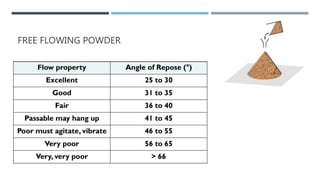
FREE FLOWING POWDER
FREE FLOWING
 Generally, a free-flowing material will tend to flow steadily and consistently.
 Conversely, a non-free-flowing material will tend to flow as agglomerated particles.
 A free-flowing powder is recognised by its ability to flow under the influence of the gravitational force in the
absence of externally applied stresses
 Free-flowing powders enable uniform blends, continuous and reproducible material discharge from the
hopper into the die, and the possibility of rearrangement in-die during tableting. It should be noted, however,
that free-flowing powders have a higher tendency to segregate during handling
 Nevertheless, solid oral dosage forms of high uniformity of content and mass are usually prepared from free-
flowing powders
FACTORS AFFECTING FREE FLOWING
 Nature of the particles and their surface area.
 Particle size, particle size distribution & specific area.
 Particle shape
 Moisture content
 Adhesion and cohesion
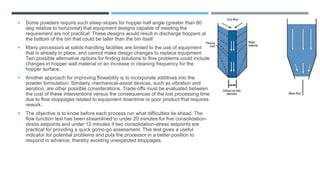
 Some powders require such steep slopes for hopper half angle (greater than 80
deg relative to horizontal) that equipment designs capable of meeting the
requirement are not practical. These designs would result in discharge hoppers at
the bottom of the bin that could be taller than the bin itself.
 Many processors at solids-handling facilities are limited to the use of equipment
that is already in place, and cannot make design changes to replace equipment.
Two possible alternative options for finding solutions to flow problems could include
changes in hopper wall material or an increase in cleaning frequency for the
hopper surface.
 Another approach for improving flowability is to incorporate additives into the
powder formulation. Similarly, mechanical-assist devices, such as vibration and
aeration, are other possible considerations. Trade-offs must be evaluated between
the cost of these interventions versus the consequences of the lost processing time
due to flow stoppages related to equipment downtime or poor product that requires
rework.
 The objective is to know before each process run what difficulties lie ahead. The
flow function test has been streamlined to under 20 minutes for five consolidation-
stress setpoints and under 12 minutes if two consolidation-stress setpoints are
practical for providing a quick go/no-go assessment. This test gives a useful
indicator for potential problems and puts the processor in a better position to
respond in advance, thereby avoiding unexpected stoppages.
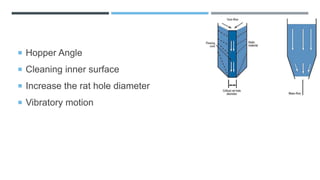
 Hopper Angle
 Cleaning inner surface
 Increase the rat hole diameter
 Vibratory motion
CONVEYORS
 The term 'conveying' is also applied to the transportation of solids. The transportation of liquids is much
simpler, cheaper and less troublesome than handling solids. In many operations, solids are handling in a finely
divided state, so that they remain suspended in a stream of fluid .However, such a system is not suitable for
handling all types of solids. Therefore, it may be necessary to transport solids as such. This unit operation is
important in the storage and handling of raw materials finished products and packed goods.
CONVEYORS:ADVANTAGE
 Decreases processing time and conservation of energy
 Efficient and Effective Conveying
 Decreases cost of raw material
 High degree of uniformity, reproducibility of the process and compliance with the cGMP regulations
 Minimum contamination and dust formation.
 Increases employee safety and reduces labour costs
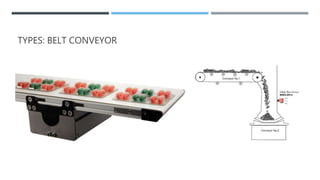
TYPES: BELT CONVEYOR
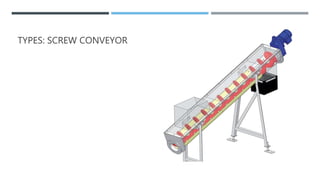
TYPES: SCREW CONVEYOR
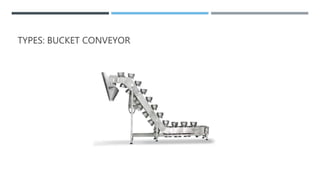
TYPES: BUCKET CONVEYOR
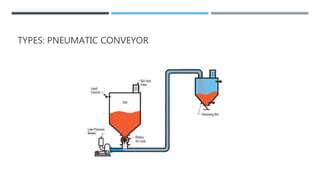
TYPES: PNEUMATIC CONVEYOR
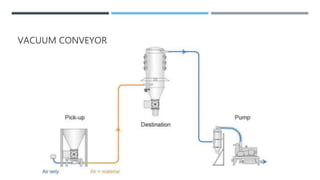
VACUUM CONVEYOR
REFERENCE
1. Pharmaceutical Engineering –principles and practices by CVS Subrahamanyam, J T Setty, S Suresh and V K
Devi. Vallabh Prakashan Delhi.
2. Pharmaceutical Engineering by K Sambamurthy – New age international publisher.
3. Theory and Practice of industrial Pharmacy by Lacman and Lieberman.
4. Unit Operation by Anthony J Hiki
5. Pharmaceutical Process scale-up: by Michel Levin- Marcel Dekker.
6. Pharmaceutical production facilities; design and application by Cole G- 2nd edition Taylor Francis, 1998.
7. Pharmaceutical Process Engineering - Anthony J Hickey, Marcel Dekker 2001.

Handling of solids

  • 1.
  • 2.
    UNIT- 3: HANDLINGOF SOLIDS (2 HOURS)  Sliding and flow of powder, Method for free flowing powder and granules, methods for cohesive powders Bins, Vacuum and conveyor.
  • 4.
    PRINCIPLES OF MATERIALHANDLING  Primarily concerned with the storage and movement of material  Used in warehouses, distribution centers, cross-docks, container terminals, airports, hospitals, and similar mission-oriented facilities.  Material handling is ‘‘providing the right amount of the right material, in the right condition, at the right place, at the right time, in the right position, in the right sequence, and for the right cost, by using the right method.  Note that using the ‘‘right method(s)’’ includes safety and ergonomic considerations  This is true in manufacturing, logistics, distribution, and any other process where products or materials have to be placed, assembled, or moved. Material-handling challenges provide an excellent opportunity for an industrial engineer to access and use a set of tools that allow for the development of a new material-handling system or an improvement in an existing system
  • 5.
     Simplifying processesby reducing, combining, shortening, or eliminating unnecessary moves will reduce work  The shortest possible distance between two points.  Good industrial engineering uses process method charts; operation sequences and process equipment layouts should be used to support the work minimization objective.  Standardization Principle:  Material-handling methods,  equipment,  controls, and software  Results on- flexibility, modularity and high throughput.
  • 6.
    SOLID PROPERTIES  Resistdistortion  The particles interlock and can not slide past one another that is why they resist distortion when subjected to moderate force. When the force is large enough, failure may occur and one layer of particle slide over other.  Non-uniform pressure distribution  Pressure is not same in all directions. Pressure applied in one direction may create some pressure in other, but it is always smaller than the applied perpendicular to the applied pressure.  Shear stress in solids  Shear stress in solids is transmitted throughout the static mass of the particles unless failure / distortion occurs.  Solids density/ Bulk Density  The mass of the particles divided by the volume they occupy. Density of mass vary depending upon the degree of packing of the grains. It is min. when maximum when particles are packed under pressure.  Dilation required for flow  The tightly packed solid particles must expand or increase in volume to permit interlocking grains to move past one another to start flow. Without
  • 7.
    TYPES OF SOLIDS Depending on flow properties, particulate solids are of two classes  Cohesive • For example; wet clay  Non-cohesive • For example; dry sand, sugar crystals, grains etc.
  • 8.
    SOLIDS Powders: Small particles Mass Powder flowfacilitated by granulation, fluidization Powder flow widely influenced by, total volume,bulk density, shape of particles, cohesiveness, size of powder Powder flow can be enhanced by, tapping, vibration,
  • 9.
    FLOW OF POWDERS The gravity flow of powders in chutes and hoppers and the movement of powders through a constriction occur in tabletting, encapsulation, and many processes in which a powder is subdivided for packing into final containers. In many cases, the accuracy of weight and dose depends on the regularity of flow. The flow of powders is extremely complex and is influenced by many factors. A profile, in two dimensions, of the flow of granular solids through an aperture is shown in Figure.  Particles slide over A while A itself slides over B. B moves slowly over the stationary region E. Material is fed into zone C and moves downward and inward to a tongue D. Here, packing is less dense, particles move more quickly, and bridges and arches formed in the powder collapse. Unless the structure is completely emptied, powder in region E never flows through the aperture. If, in use, a container is partially emptied and partially filled, this material may spoil. If the container is narrow, region E is absent and the whole mass moves downward, the central part of region C occupying the entire tube
  • 10.
    FLOW OF POWDERS The relation between mass flow rate and particle size is more complex. With an orifice of given size and shape, the flow increases as the particle size decreases until a maximum rate is reached. With further decrease in size and increase in cohesiveness, flow decreases and becomes irregular. Arches and bridges form above the aperture, and flow stops  Often, the removal of the finest fraction will greatly improve flow. On the other hand, the addition of very small quantities of fine powder can, in some circumstances, improve flow. Magnesia and talc, for example, promote the flow of many cohesive powders.  Vibration and tapping may maintain or improve the flow of cohesive powders by preventing or destroying the bridges and arches responsible for irregular movement or blockage. Vibration and tapping to initiate flow are less satisfactory because the associated increase in bulk density due to closer packing renders the powder more cohesive.
  • 11.
    FACTORS INFLUENCING POWDERFLOW  Under stress condition powder can flow like a liquids, they don’t flow if the stresses are to small.  Many manufacturing problems are attributed to powder flow, including non-uniformity (segregation) in blending, under-or0over dosage, inaccurate filling, and stoppages.  Storage, handling, production, packing, distribution and end use can all be negatively affected by common powder flow problems.  The factors associated with the nature of the particles and their surface area.  Particle size, particle size distribution & specific area.  Particle shape  Moisture content  Adhesion and cohesion
  • 12.
  • 13.
    FREE FLOWING  Generally,a free-flowing material will tend to flow steadily and consistently.  Conversely, a non-free-flowing material will tend to flow as agglomerated particles.  A free-flowing powder is recognised by its ability to flow under the influence of the gravitational force in the absence of externally applied stresses  Free-flowing powders enable uniform blends, continuous and reproducible material discharge from the hopper into the die, and the possibility of rearrangement in-die during tableting. It should be noted, however, that free-flowing powders have a higher tendency to segregate during handling  Nevertheless, solid oral dosage forms of high uniformity of content and mass are usually prepared from free- flowing powders
  • 14.
    FACTORS AFFECTING FREEFLOWING  Nature of the particles and their surface area.  Particle size, particle size distribution & specific area.  Particle shape  Moisture content  Adhesion and cohesion
  • 15.
     Some powdersrequire such steep slopes for hopper half angle (greater than 80 deg relative to horizontal) that equipment designs capable of meeting the requirement are not practical. These designs would result in discharge hoppers at the bottom of the bin that could be taller than the bin itself.  Many processors at solids-handling facilities are limited to the use of equipment that is already in place, and cannot make design changes to replace equipment. Two possible alternative options for finding solutions to flow problems could include changes in hopper wall material or an increase in cleaning frequency for the hopper surface.  Another approach for improving flowability is to incorporate additives into the powder formulation. Similarly, mechanical-assist devices, such as vibration and aeration, are other possible considerations. Trade-offs must be evaluated between the cost of these interventions versus the consequences of the lost processing time due to flow stoppages related to equipment downtime or poor product that requires rework.  The objective is to know before each process run what difficulties lie ahead. The flow function test has been streamlined to under 20 minutes for five consolidation- stress setpoints and under 12 minutes if two consolidation-stress setpoints are practical for providing a quick go/no-go assessment. This test gives a useful indicator for potential problems and puts the processor in a better position to respond in advance, thereby avoiding unexpected stoppages.
  • 16.
     Hopper Angle Cleaning inner surface  Increase the rat hole diameter  Vibratory motion
  • 17.
    CONVEYORS  The term'conveying' is also applied to the transportation of solids. The transportation of liquids is much simpler, cheaper and less troublesome than handling solids. In many operations, solids are handling in a finely divided state, so that they remain suspended in a stream of fluid .However, such a system is not suitable for handling all types of solids. Therefore, it may be necessary to transport solids as such. This unit operation is important in the storage and handling of raw materials finished products and packed goods.
  • 18.
    CONVEYORS:ADVANTAGE  Decreases processingtime and conservation of energy  Efficient and Effective Conveying  Decreases cost of raw material  High degree of uniformity, reproducibility of the process and compliance with the cGMP regulations  Minimum contamination and dust formation.  Increases employee safety and reduces labour costs
  • 19.
  • 20.
  • 21.
  • 22.
  • 23.
  • 24.
    REFERENCE 1. Pharmaceutical Engineering–principles and practices by CVS Subrahamanyam, J T Setty, S Suresh and V K Devi. Vallabh Prakashan Delhi. 2. Pharmaceutical Engineering by K Sambamurthy – New age international publisher. 3. Theory and Practice of industrial Pharmacy by Lacman and Lieberman. 4. Unit Operation by Anthony J Hiki 5. Pharmaceutical Process scale-up: by Michel Levin- Marcel Dekker. 6. Pharmaceutical production facilities; design and application by Cole G- 2nd edition Taylor Francis, 1998. 7. Pharmaceutical Process Engineering - Anthony J Hickey, Marcel Dekker 2001.