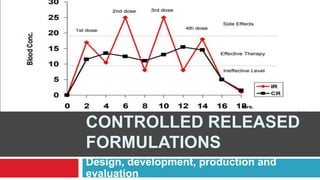
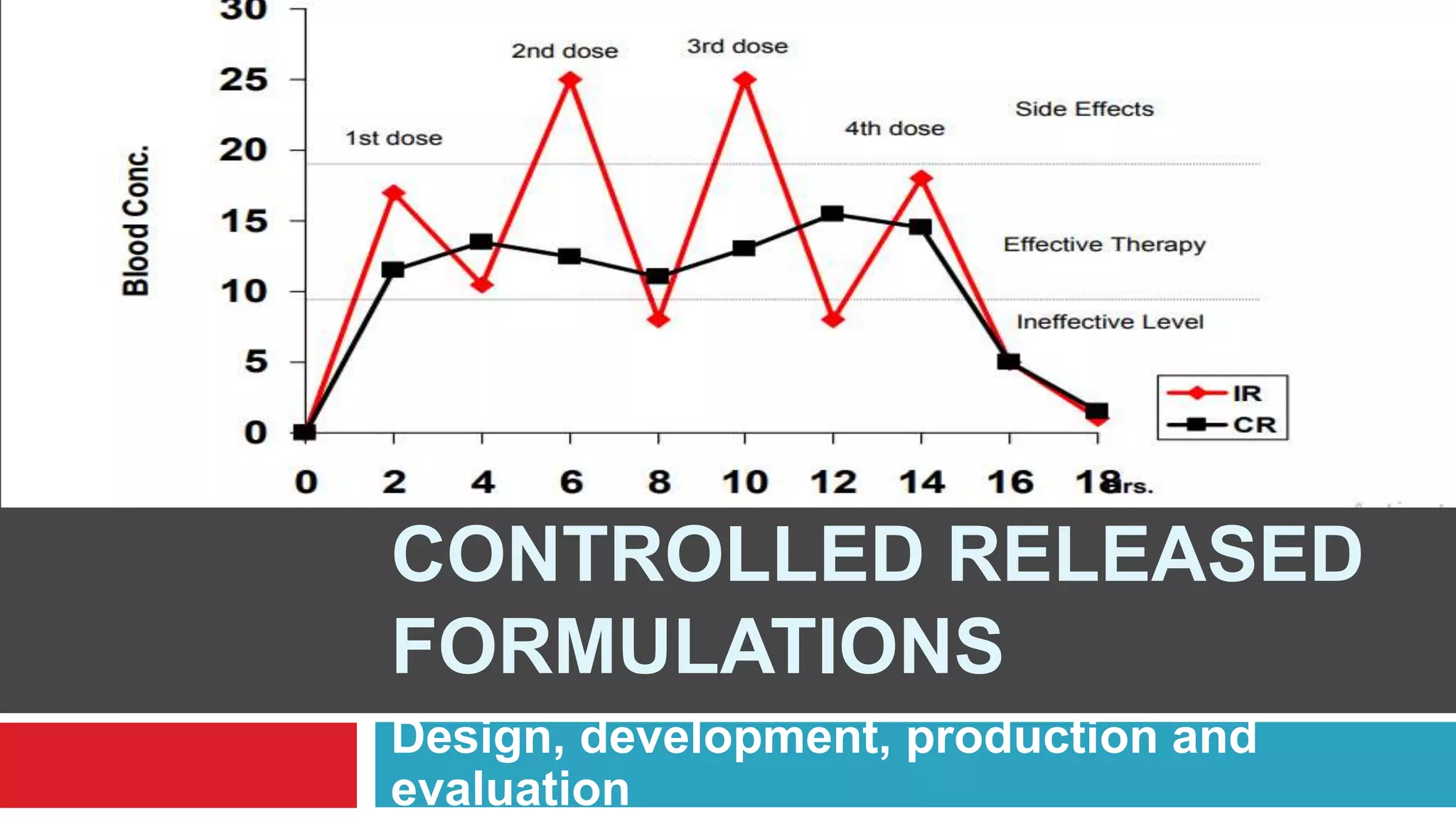

CONTROLLED RELEASED
FORMULATIONS
Design, development, production and
evaluation
Syllabus
 Introduction to CR/SR preparations, concept of controlled release formulation, challenges of
CR drug delivery system, advantages and disadvantages, Factors influencing the design and
performance of CR products (physiochemical properties: molecular size and diffusivity,
aqueous solubility, ionization constant, partition coefficient, stability, pharmacokinetic and
pharmacodynamic considerations: release rate and dose, Biological factors: Absorption,
distribution, metabolism and elimination half life, therapeutic index, duration of action.
 Kinetics of drug release from CRDS: Zero order, first order, Hixson-Crowell Release Model,
Higuchi Release Model and Korsmeyer-Peppas Release Model
 Oral controlled release systems: Dissolution controlled release (Matrix and encapsulated
dissolution), diffusion controlled release (Reservoir and matrix system), dissolution and
diffusion controlled release, Osmotically controlled release, pH independent formulations, Ion
exchange resins.
 Evaluation of CR formulations: Quality control methods( Identity, purity, strength, stability of
the dosage form and drug in the dosage form, disintegration and dissolution, dosage form
appearance, bioavailability of the drug from dosage form.
Introduction
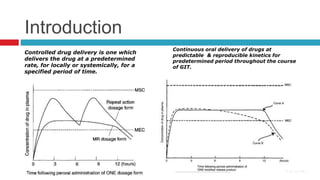
Controlled drug delivery is one which
delivers the drug at a predetermined
rate, for locally or systemically, for a
specified period of time.
Continuous oral delivery of drugs at
predictable & reproducible kinetics for
predetermined period throughout the course
of GIT.
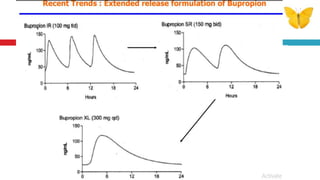
Concept
Concept
Advantages
1. Improved control over the maintenance of therapeutic plasma drug
concentration of drugs permits:
(a) improved treatment of many chronic illnesses where symptom breakthrough
occurs if the plasma concentration of drug drops below the minimum
effective concentration, e.g. asthma, depressive illnesses;
(b) maintenance of the therapeutic action of a drug during overnight no-dose
periods, e.g. overnight management of pain in terminally ill patients permits
improved sleep;
(c) a reduction in the incidence and severity of untoward systemic side-effects
related to high peak plasma drug concentrations;
(d) a reduction in the total amount of drug administered over the period of
treatment. This contributes to the reduced incidence of systemic and local
side-effects observed in the cases of many drugs administered in MR
formulations.
Advantages
2. Improved patient compliance, resulting from the reduction in the number and
frequency of doses required to maintain the desired therapeutic response, e.g.
one peroral MR product every 12 hours contributes to the improved control of
therapeutic drug concentration achieved with such products.
3. There is a reduction in the incidence and severity of localized gastrointestinal
side-effects produced by 'dose dumping' of irritant drugs from conventional
dosage forms, e.g. potassium chloride. The more controlled, slower release of
potassium chloride from its peroral MR formulations minimizes the build-up of
localized irritant concentrations in the gastrointestinal tract. Consequently,
potassium chloride is now administered perorally almost exclusively in MR form.
4. It is claimed that cost savings are made from the better disease management
that can be achieved with MR products.
Advantages
a. Increased patient compliance less frequent dosing more “acceptable” (eg,
needle-less)
b. Safety can control PK to remain within Therapeu t Index “window”
c. Improved therapy can time release environmentally-responsive systems
d. Decreased cost lower doses->more efficient use of drug
e. Greater profits
patent extension for drug controlled release feature more profitable
Therapeutic controlled release feature more profitable
Glucophage (Bristol Meyer)- Glucophage XR- Patent extended for 3 years(2003)
Disadvantages
1. Variable physiological factors, such as gastrointestinal pH, enzyme activities, gastric and
intestinal transit rates, food and severity of disease, which often influence drug bioavailability from
conventional peroral dosage forms, may also interfere with the precision of control of release and
absorption of drugs from peroral CR dosage forms. The achievement and maintenance of
prolonged drug action depends on such control.
2. The rate of transit of CR peroral products along the gastrointestinal tract limits the maximum
period for which a therapeutic response can be maintained following administration of a 'single
dose' to approximately 12 hours, plus the length of time that absorbed drug continues to exert its
therapeutic activity.
3. CR products, which tend to remain intact, may become lodged at some site along the
gastrointestinal tract. If this occurs, slow release of the drug may produce a high localized
concentration that causes local irritation to the gastrointestinal mucosa. CR products which are
formulated to disperse in the gastrointestinal fluids are less likely to cause such problems.
4. Not suitable for short or High Biological half life molecule
5. Dose Dumping (Specially for narrow therapeutics window drugs)
6. Expensive per unit dosage form
Challenges
1. Oral delivery of proteins
2. Effective delivery of low solubility drugs
3. Feedback DDS using body signals to stimulate delivery of specific
amount of drug
4. Chrono-DDS, delivery based on known circadian rhythms of body
organs (perhaps combined with Feedback DDS)
5. Pharmacogenomics, drug indications and prescriptions based on
one’s genetic makeup (many ethical issues)
Important to know before
development
How much?
Delivery Rate?
Duration?
What
Bioavaliability?
At which site?
 - Dose of Drug
 -Loading and Maintenance Dose
 Biological half life and Dose
Regimen
 Site where drug is going to act or
release
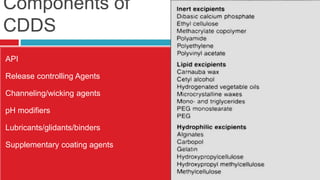
Components of
CDDS
API
Release controlling Agents
Channeling/wicking agents
pH modifiers
Lubricants/glidants/binders
Supplementary coating agents
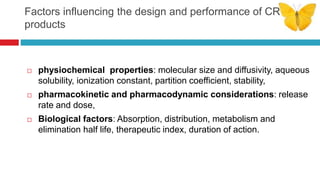
Factors influencing the design and performance of CR
products
 physiochemical properties: molecular size and diffusivity, aqueous
solubility, ionization constant, partition coefficient, stability,
 pharmacokinetic and pharmacodynamic considerations: release
rate and dose,
 Biological factors: Absorption, distribution, metabolism and
elimination half life, therapeutic index, duration of action.
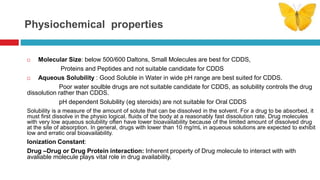
Physiochemical properties
 Molecular Size: below 500/600 Daltons, Small Molecules are best for CDDS,
Proteins and Peptides and not suitable candidate for CDDS
 Aqueous Solubility : Good Soluble in Water in wide pH range are best suited for CDDS.
Poor water soulble drugs are not suitable candidate for CDDS, as solubility controls the drug
dissolution rather than CDDS.
pH dependent Solubility (eg steroids) are not suitable for Oral CDDS
Solubility is a measure of the amount of solute that can be dissolved in the solvent. For a drug to be absorbed, it
must first dissolve in the physio logical. fluids of the body at a reasonably fast dissolution rate. Drug molecules
with very low aqueous solubility often have lower bioavailability because of the limited amount of dissolved drug
at the site of absorption. In general, drugs with lower than 10 mg/mL in aqueous solutions are expected to exhibit
low and erratic oral bioavailability.
Ionization Constant:
Drug –Drug or Drug Protein interaction: Inherent property of Drug molecule to interact with with
avaliable molecule plays vital role in drug availability.
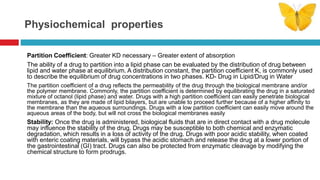
Physiochemical properties
Partition Coefficient: Greater KD necessary – Greater extent of absorption
The ability of a drug to partition into a lipid phase can be evaluated by the distribution of drug between
lipid and water phase at equilibrium. A distribution constant, the partition coefficient K, is commonly used
to describe the equilibrium of drug concentrations in two phases. KD- Drug in Lipid/Drug in Water
The partition coefficient of a drug reflects the permeability of the drug through the biological membrane and/or
the polymer membrane. Commonly, the partition coefficient is determined by equilibrating the drug in a saturated
mixture of octanol (lipid phase) and water. Drugs with a high partition coefficient can easily penetrate biological
membranes, as they are made of lipid bilayers, but are unable to proceed further because of a higher affinity to
the membrane than the aqueous surroundings. Drugs with a low partition coefficient can easily move around the
aqueous areas of the body, but will not cross the biological membranes easily
Stability: Once the drug is administered, biological fluids that are in direct contact with a drug molecule
may influence the stability of the drug. Drugs may be susceptible to both chemical and enzymatic
degradation, which results in a loss of activity of the drug. Drugs with poor acidic stability, when coated
with enteric coating materials, will bypass the acidic stomach and release the drug at a lower portion of
the gastrointestinal (GI) tract. Drugs can also be protected from enzymatic cleavage by modifying the
chemical structure to form prodrugs.
pharmacokinetic and pharmacodynamic
considerations
 Rate of Release: Less the rate of Absorption
 Dose: Not more than 300-400 mg
 Route of Drug Absorption: Oral- Because- Easy and Wide
absorption surface area( 200m2) and microvilli- 4500m2 .
Environment (Acid/Enzyme/Food), Biotransformation
 Skin
 Parenteral
Biological factors
 Absorption :
 Distribution
 Metabolism and elimination half life
 Therapeutic index
 Duration of action
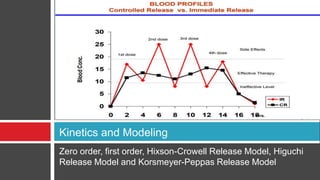
Zero order, first order, Hixson-Crowell Release Model, Higuchi
Release Model and Korsmeyer-Peppas Release Model
Kinetics and Modeling
Kinetics of drug release
 The mathematical models are used to
evaluate the kinetics and mechanism of drug
release from the tablets.
 The model that best fits the release data is
selected based on the correlation coefficient
(r) value in various models.
 The model that gives high ‘r’ value is
considered as the best fit of the release data.
1)Zero order release model
2)First order release model
3)Hixson-crowell release
model
4)Higuchi release model
5)Korsmeyer – peppas
release model
Kinetics of drug
release
Zero Order
Kinetics
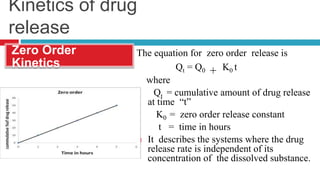
The equation for zero order release is
Qt = Q0 + K0 t
where
Qt = cumulative amount of drug release
at time “t”
K0 = zero order release constant
t = time in hours
 It describes the systems where the drug
release rate is independent of its
concentration of the dissolved substance.
Kinetics of drug
release
First Order
Kinetics
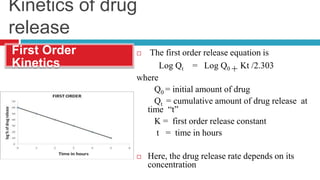
 The first order release equation is
Log Qt = Log Q0 + Kt /2.303
where
Q0 = initial amount of drug
Qt = cumulative amount of drug release at
time “t”
K = first order release constant
t = time in hours
 Here, the drug release rate depends on its
concentration
Kinetics of drug
release
HIXSON - CROWELL
RELEASE EQUATION
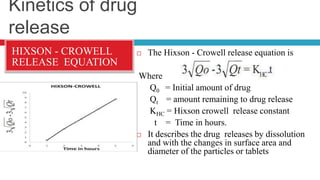
 The Hixson - Crowell release equation is
Where
Q0 = Initial amount of drug
Qt = amount remaining to drug release
KHC = Hixson crowell release constant
t = Time in hours.
 It describes the drug releases by dissolution
and with the changes in surface area and
diameter of the particles or tablets
Kinetics of drug
release
HIGUCHI RELEASE
EQUATION
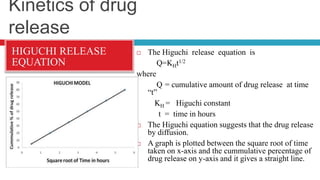
 The Higuchi release equation is
Q=KHt1/2
where
Q = cumulative amount of drug release at time
“t”
KH = Higuchi constant
t = time in hours
 The Higuchi equation suggests that the drug release
by diffusion.
 A graph is plotted between the square root of time
taken on x-axis and the cummulative percentage of
drug release on y-axis and it gives a straight line.
Kinetics of drug
release
KORSMEYER-PEPPAS
EQUATION
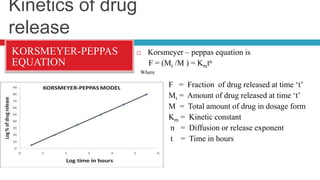
 Korsmeyer – peppas equation is
F = (Mt /M ) = Kmtn
Where
F = Fraction of drug released at time ‘t’
Mt = Amount of drug released at time ‘t’
M = Total amount of drug in dosage form
Km = Kinetic constant
n = Diffusion or release exponent
t = Time in hours
Kinetics of drug
release
KORSMEYER-PEPPAS
EQUATION
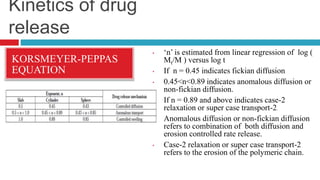
• ‘n’ is estimated from linear regression of log (
Mt/M ) versus log t
• If n = 0.45 indicates fickian diffusion
• 0.45<n<0.89 indicates anomalous diffusion or
non-fickian diffusion.
• If n = 0.89 and above indicates case-2
relaxation or super case transport-2.
• Anomalous diffusion or non-fickian diffusion
refers to combination of both diffusion and
erosion controlled rate release.
• Case-2 relaxation or super case transport-2
refers to the erosion of the polymeric chain.
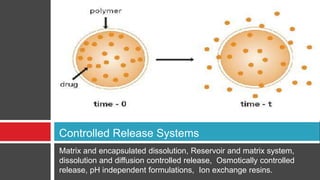
Matrix and encapsulated dissolution, Reservoir and matrix system,
dissolution and diffusion controlled release, Osmotically controlled
release, pH independent formulations, Ion exchange resins.
Controlled Release Systems
Types
1. Matrix and encapsulated dissolution,
2. Reservoir and matrix system,
3. Dissolution and diffusion controlled release,
4. Osmotically controlled release,
5. pH independent formulations,
6. Ion exchange resins.
Topic End
Kabin Maleku
16x9
4x3

Controlled released formulations

  • 1.
  • 2.
    Syllabus  Introduction toCR/SR preparations, concept of controlled release formulation, challenges of CR drug delivery system, advantages and disadvantages, Factors influencing the design and performance of CR products (physiochemical properties: molecular size and diffusivity, aqueous solubility, ionization constant, partition coefficient, stability, pharmacokinetic and pharmacodynamic considerations: release rate and dose, Biological factors: Absorption, distribution, metabolism and elimination half life, therapeutic index, duration of action.  Kinetics of drug release from CRDS: Zero order, first order, Hixson-Crowell Release Model, Higuchi Release Model and Korsmeyer-Peppas Release Model  Oral controlled release systems: Dissolution controlled release (Matrix and encapsulated dissolution), diffusion controlled release (Reservoir and matrix system), dissolution and diffusion controlled release, Osmotically controlled release, pH independent formulations, Ion exchange resins.  Evaluation of CR formulations: Quality control methods( Identity, purity, strength, stability of the dosage form and drug in the dosage form, disintegration and dissolution, dosage form appearance, bioavailability of the drug from dosage form.
  • 3.
    Introduction Controlled drug deliveryis one which delivers the drug at a predetermined rate, for locally or systemically, for a specified period of time. Continuous oral delivery of drugs at predictable & reproducible kinetics for predetermined period throughout the course of GIT.
  • 4.
  • 5.
  • 6.
    Advantages 1. Improved controlover the maintenance of therapeutic plasma drug concentration of drugs permits: (a) improved treatment of many chronic illnesses where symptom breakthrough occurs if the plasma concentration of drug drops below the minimum effective concentration, e.g. asthma, depressive illnesses; (b) maintenance of the therapeutic action of a drug during overnight no-dose periods, e.g. overnight management of pain in terminally ill patients permits improved sleep; (c) a reduction in the incidence and severity of untoward systemic side-effects related to high peak plasma drug concentrations; (d) a reduction in the total amount of drug administered over the period of treatment. This contributes to the reduced incidence of systemic and local side-effects observed in the cases of many drugs administered in MR formulations.
  • 7.
    Advantages 2. Improved patientcompliance, resulting from the reduction in the number and frequency of doses required to maintain the desired therapeutic response, e.g. one peroral MR product every 12 hours contributes to the improved control of therapeutic drug concentration achieved with such products. 3. There is a reduction in the incidence and severity of localized gastrointestinal side-effects produced by 'dose dumping' of irritant drugs from conventional dosage forms, e.g. potassium chloride. The more controlled, slower release of potassium chloride from its peroral MR formulations minimizes the build-up of localized irritant concentrations in the gastrointestinal tract. Consequently, potassium chloride is now administered perorally almost exclusively in MR form. 4. It is claimed that cost savings are made from the better disease management that can be achieved with MR products.
  • 8.
    Advantages a. Increased patientcompliance less frequent dosing more “acceptable” (eg, needle-less) b. Safety can control PK to remain within Therapeu t Index “window” c. Improved therapy can time release environmentally-responsive systems d. Decreased cost lower doses->more efficient use of drug e. Greater profits patent extension for drug controlled release feature more profitable Therapeutic controlled release feature more profitable Glucophage (Bristol Meyer)- Glucophage XR- Patent extended for 3 years(2003)
  • 9.
    Disadvantages 1. Variable physiologicalfactors, such as gastrointestinal pH, enzyme activities, gastric and intestinal transit rates, food and severity of disease, which often influence drug bioavailability from conventional peroral dosage forms, may also interfere with the precision of control of release and absorption of drugs from peroral CR dosage forms. The achievement and maintenance of prolonged drug action depends on such control. 2. The rate of transit of CR peroral products along the gastrointestinal tract limits the maximum period for which a therapeutic response can be maintained following administration of a 'single dose' to approximately 12 hours, plus the length of time that absorbed drug continues to exert its therapeutic activity. 3. CR products, which tend to remain intact, may become lodged at some site along the gastrointestinal tract. If this occurs, slow release of the drug may produce a high localized concentration that causes local irritation to the gastrointestinal mucosa. CR products which are formulated to disperse in the gastrointestinal fluids are less likely to cause such problems. 4. Not suitable for short or High Biological half life molecule 5. Dose Dumping (Specially for narrow therapeutics window drugs) 6. Expensive per unit dosage form
  • 10.
    Challenges 1. Oral deliveryof proteins 2. Effective delivery of low solubility drugs 3. Feedback DDS using body signals to stimulate delivery of specific amount of drug 4. Chrono-DDS, delivery based on known circadian rhythms of body organs (perhaps combined with Feedback DDS) 5. Pharmacogenomics, drug indications and prescriptions based on one’s genetic makeup (many ethical issues)
  • 11.
    Important to knowbefore development How much? Delivery Rate? Duration? What Bioavaliability? At which site?  - Dose of Drug  -Loading and Maintenance Dose  Biological half life and Dose Regimen  Site where drug is going to act or release
  • 12.
    Components of CDDS API Release controllingAgents Channeling/wicking agents pH modifiers Lubricants/glidants/binders Supplementary coating agents
  • 13.
    Factors influencing thedesign and performance of CR products  physiochemical properties: molecular size and diffusivity, aqueous solubility, ionization constant, partition coefficient, stability,  pharmacokinetic and pharmacodynamic considerations: release rate and dose,  Biological factors: Absorption, distribution, metabolism and elimination half life, therapeutic index, duration of action.
  • 14.
    Physiochemical properties  MolecularSize: below 500/600 Daltons, Small Molecules are best for CDDS, Proteins and Peptides and not suitable candidate for CDDS  Aqueous Solubility : Good Soluble in Water in wide pH range are best suited for CDDS. Poor water soulble drugs are not suitable candidate for CDDS, as solubility controls the drug dissolution rather than CDDS. pH dependent Solubility (eg steroids) are not suitable for Oral CDDS Solubility is a measure of the amount of solute that can be dissolved in the solvent. For a drug to be absorbed, it must first dissolve in the physio logical. fluids of the body at a reasonably fast dissolution rate. Drug molecules with very low aqueous solubility often have lower bioavailability because of the limited amount of dissolved drug at the site of absorption. In general, drugs with lower than 10 mg/mL in aqueous solutions are expected to exhibit low and erratic oral bioavailability. Ionization Constant: Drug –Drug or Drug Protein interaction: Inherent property of Drug molecule to interact with with avaliable molecule plays vital role in drug availability.
  • 15.
    Physiochemical properties Partition Coefficient:Greater KD necessary – Greater extent of absorption The ability of a drug to partition into a lipid phase can be evaluated by the distribution of drug between lipid and water phase at equilibrium. A distribution constant, the partition coefficient K, is commonly used to describe the equilibrium of drug concentrations in two phases. KD- Drug in Lipid/Drug in Water The partition coefficient of a drug reflects the permeability of the drug through the biological membrane and/or the polymer membrane. Commonly, the partition coefficient is determined by equilibrating the drug in a saturated mixture of octanol (lipid phase) and water. Drugs with a high partition coefficient can easily penetrate biological membranes, as they are made of lipid bilayers, but are unable to proceed further because of a higher affinity to the membrane than the aqueous surroundings. Drugs with a low partition coefficient can easily move around the aqueous areas of the body, but will not cross the biological membranes easily Stability: Once the drug is administered, biological fluids that are in direct contact with a drug molecule may influence the stability of the drug. Drugs may be susceptible to both chemical and enzymatic degradation, which results in a loss of activity of the drug. Drugs with poor acidic stability, when coated with enteric coating materials, will bypass the acidic stomach and release the drug at a lower portion of the gastrointestinal (GI) tract. Drugs can also be protected from enzymatic cleavage by modifying the chemical structure to form prodrugs.
  • 16.
    pharmacokinetic and pharmacodynamic considerations Rate of Release: Less the rate of Absorption  Dose: Not more than 300-400 mg  Route of Drug Absorption: Oral- Because- Easy and Wide absorption surface area( 200m2) and microvilli- 4500m2 . Environment (Acid/Enzyme/Food), Biotransformation  Skin  Parenteral
  • 17.
    Biological factors  Absorption:  Distribution  Metabolism and elimination half life  Therapeutic index  Duration of action
  • 18.
    Zero order, firstorder, Hixson-Crowell Release Model, Higuchi Release Model and Korsmeyer-Peppas Release Model Kinetics and Modeling
  • 19.
    Kinetics of drugrelease  The mathematical models are used to evaluate the kinetics and mechanism of drug release from the tablets.  The model that best fits the release data is selected based on the correlation coefficient (r) value in various models.  The model that gives high ‘r’ value is considered as the best fit of the release data. 1)Zero order release model 2)First order release model 3)Hixson-crowell release model 4)Higuchi release model 5)Korsmeyer – peppas release model
  • 20.
    Kinetics of drug release ZeroOrder Kinetics The equation for zero order release is Qt = Q0 + K0 t where Qt = cumulative amount of drug release at time “t” K0 = zero order release constant t = time in hours  It describes the systems where the drug release rate is independent of its concentration of the dissolved substance.
  • 21.
    Kinetics of drug release FirstOrder Kinetics  The first order release equation is Log Qt = Log Q0 + Kt /2.303 where Q0 = initial amount of drug Qt = cumulative amount of drug release at time “t” K = first order release constant t = time in hours  Here, the drug release rate depends on its concentration
  • 22.
    Kinetics of drug release HIXSON- CROWELL RELEASE EQUATION  The Hixson - Crowell release equation is Where Q0 = Initial amount of drug Qt = amount remaining to drug release KHC = Hixson crowell release constant t = Time in hours.  It describes the drug releases by dissolution and with the changes in surface area and diameter of the particles or tablets
  • 23.
    Kinetics of drug release HIGUCHIRELEASE EQUATION  The Higuchi release equation is Q=KHt1/2 where Q = cumulative amount of drug release at time “t” KH = Higuchi constant t = time in hours  The Higuchi equation suggests that the drug release by diffusion.  A graph is plotted between the square root of time taken on x-axis and the cummulative percentage of drug release on y-axis and it gives a straight line.
  • 24.
    Kinetics of drug release KORSMEYER-PEPPAS EQUATION Korsmeyer – peppas equation is F = (Mt /M ) = Kmtn Where F = Fraction of drug released at time ‘t’ Mt = Amount of drug released at time ‘t’ M = Total amount of drug in dosage form Km = Kinetic constant n = Diffusion or release exponent t = Time in hours
  • 25.
    Kinetics of drug release KORSMEYER-PEPPAS EQUATION •‘n’ is estimated from linear regression of log ( Mt/M ) versus log t • If n = 0.45 indicates fickian diffusion • 0.45<n<0.89 indicates anomalous diffusion or non-fickian diffusion. • If n = 0.89 and above indicates case-2 relaxation or super case transport-2. • Anomalous diffusion or non-fickian diffusion refers to combination of both diffusion and erosion controlled rate release. • Case-2 relaxation or super case transport-2 refers to the erosion of the polymeric chain.
  • 26.
    Matrix and encapsulateddissolution, Reservoir and matrix system, dissolution and diffusion controlled release, Osmotically controlled release, pH independent formulations, Ion exchange resins. Controlled Release Systems
  • 27.
    Types 1. Matrix andencapsulated dissolution, 2. Reservoir and matrix system, 3. Dissolution and diffusion controlled release, 4. Osmotically controlled release, 5. pH independent formulations, 6. Ion exchange resins.
  • 28.