RADIO
PHARMACEUTICALS
Definition, Isotopes, Radioactive decay particles, Half life,
precaution, Application, Preparation, Clinical use,
Definition
 Radiopharmacy –branch of pharmacy that deals with
radiopharmaceuticals.
 Radiopharmaceutical- a radioactive pharmaceutical agent that is
used for diagnostic or therapeutic procedures
 A radiopharmaceutical consists of a drug/ chemical component(
carrier) and a radioactive component (radionuclide)
 Some carriers such as peptides and monoclonal antibodies are
more specific and are used to target tumor sites-
◦ a desired localization property useful in radio-immunotherapy
◦ Reference
Background
 Currently over 100 radiopharmaceuticals available worldwide
◦ radio-nuclides mostly produced from nuclear reactors and cyclotrons
 Radiopharmaceutical production involves handling of large
quantities of radioactive substances and chemical processing
 Radiopharmaceutical production
◦ relatively small scale
◦ requires well qualified personnel
◦ uses controlled materials and procedures
 procedures are technically demanding to ensure both radiological
and pharmaceutical safety.
Background
 The radioactivity in radiopharmaceutical allows non-invasive
external monitoring or targeted therapeutic irradiation with very little
effect on the biologic processes in the body
 Imaging techniques e.g gamma camera are then used to monitor
activity
 Generally , radiopharmaceuticals have an excellent safety record
and their incidences of adverse effects is extremely low.
Isotopes
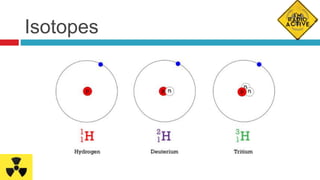
Isotopes
 Isotopes are variants of a particular chemical element which differ
in neutron number, and consequently in nucleon number.
All isotopes of a given element have the same number of protons
but different numbers of neutrons in each atom.
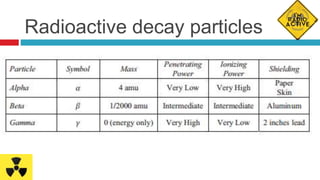
Radioactive decay particles
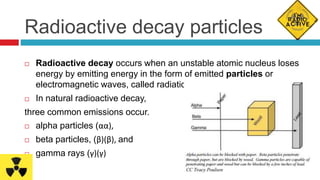
 Radioactive decay occurs when an unstable atomic nucleus loses
energy by emitting energy in the form of emitted particles or
electromagnetic waves, called radiation.
 In natural radioactive decay,
three common emissions occur.
 alpha particles (αα),
 beta particles, (β)(β), and
 gamma rays (γ)(γ)
Radioactive decay particles
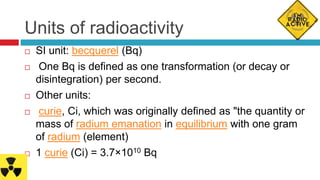
Units of radioactivity
 SI unit: becquerel (Bq)
 One Bq is defined as one transformation (or decay or
disintegration) per second.
 Other units:
 curie, Ci, which was originally defined as "the quantity or
mass of radium emanation in equilibrium with one gram
of radium (element)
 1 curie (Ci) = 3.7×10¹⁰ Bq
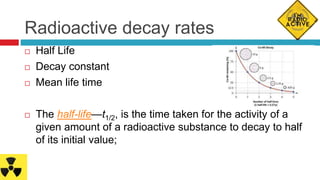
Radioactive decay rates
 Half Life
 Decay constant
 Mean life time
 The half-life—t1/2, is the time taken for the activity of a
given amount of a radioactive substance to decay to half
of its initial value;
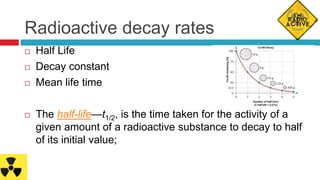
Radioactive decay rates
 Half Life
 Decay constant
 Mean life time
 The half-life—t1/2, is the time taken for the activity of a
given amount of a radioactive substance to decay to half
of its initial value;
Handling of Radio pharmaceuticals
 Great care needs to be taken in handling and storage of radioactive materials for protecting people
and personnel who handle it, from the harmful radiation they emit.
 Certain precautions have to be taken while working with detectors, tracer equipment, radio assay
manufacturing or handling of radioactive materials.
 In order to have protection from hazards of radiation, radioactive materials must be stored in an
area not frequently visited by people.
 Shielding may be required.
 Thick glass or Perspex containers provide sufficient shielding.
 To protect from gamma rays (high penetration power), lead shielding has to be used.
 The storage area must be regularly checked for radioactivity.
RADIOACTIVE LIQUIDS.
 Working area should not get contaminated with radioactive material.
 If radioactive liquid is to be handled, it must be carried in trays with absorbent tissue paper, so that
any spillage will get absorbed by the paper.
Storage of Radio pharmaceuticals
 Radiopharmaceuticals should be kept in well-closed
containers and stored in an area assigned for the
purpose. The storage conditions should be such that the
maximum radiation dose rate to which persons may be
exposed is reduced to an acceptable level. Care should
be taken to comply with national regulations for protection
against ionizing radiation.
 Radiopharmaceutical preparations that are intended for
parenteral use should be kept in a glass vial, ampoule or
syringe that is sufficiently transparent to permit the visual
Radiopharmaceutical
 A Radiopharmaceutical is a drug that can be used
either for diagnostic or therapeutic purposes. It is
composed of a radioisotope bond to an organic
molecule. The organic molecule conveys the
radioisotope to specific organs, tissues or cells.
 Radioactive element - 133Xe
 Labeled compounds - 131I iodinated proteins

99mTc labeled compounds
 [18F]FDG
Idea Properties of
Radiopharmaceutical
• Easy availability
• Short effective Half-Life
• Particle Emission
• Decay by Electron Capture or Isomeric Transition
• High Target-to Nontarget Activity Ratio
Type of radiopharmaceutical
for diagnostic and therapy
 Parenteral pharmaceuticals (solutions or colloid
suspenses),
 peroral pharmaceuticals
 inhalation pharmaceuticals
 topical pharmaceuticals
USE
 Radioisotopes in Therapy (Emitted radiations used to
destroy cells in condition like cancer)
 Radioisotopes in Diagnosis (Radioactive tracers)
 Research (Biological and medicinal studies by use of
radioactive isotopes as tracers)
 Sterilization (For sterilization of pharmaceuticals and
surgical instruments)
Clinical Application
 Therapeutic radiopharmaceuticals are designed to deliver
therapeutic doses of ionising radiation to specific diseased sites for
curative or palliative purposes by destruction of diseased tissues
 May be used internally as tissue implants in sealed capsules
(mainly used in radiation oncology)or externally as unsealed
administered orally, intravenously (IV) or placed directly into a body
cavity (such as a knee joint) or peritoneum.
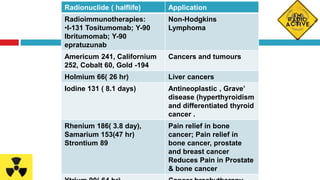
Radionuclide ( halflife) Application
Radioimmunotherapies:
•I-131 Tositumomab; Y-90
Ibritumomab; Y-90
epratuzunab
Non-Hodgkins
Lymphoma
Americum 241, Californium
252, Cobalt 60, Gold -194
Cancers and tumours
Holmium 66( 26 hr) Liver cancers
Iodine 131 ( 8.1 days) Antineoplastic , Grave’
disease (hyperthyroidism
and differentiated thyroid
cancer .
Rhenium 186( 3.8 day),
Samarium 153(47 hr)
Strontium 89
Pain relief in bone
cancer; Pain relief in
bone cancer, prostate
and breast cancer
Reduces Pain in Prostate
& bone cancer
Uses of Cobalt -57 & 60
 Co 57- Diagnosis of pernicious anemia – cynocobalamine
 Cynocobalamine solution: Co 60- Absorption and deposition of Vit
B12
Uses of Gold – 198
 Estimation of recticulo endothelial activity
Uses of Iodine- 125 & 131
 Used as a diagnostic aid for studying the functioning of the thyroid
gland.
 Used in scanning the thyroid for determining the size, position and
possible tumour location.
 Used in the treatment of severe cardiac disease (Sodium iodide I-
131), which reduces work load on heart.
 Radioactive iodine in thyroid carcinoma (cancer): The isotope is
used most frequently after the surgical removal of cancer to treat
any residual tumour tissues.

Radio pharmaceuticals.pptx

  • 1.
    RADIO PHARMACEUTICALS Definition, Isotopes, Radioactivedecay particles, Half life, precaution, Application, Preparation, Clinical use,
  • 2.
    Definition  Radiopharmacy –branchof pharmacy that deals with radiopharmaceuticals.  Radiopharmaceutical- a radioactive pharmaceutical agent that is used for diagnostic or therapeutic procedures  A radiopharmaceutical consists of a drug/ chemical component( carrier) and a radioactive component (radionuclide)  Some carriers such as peptides and monoclonal antibodies are more specific and are used to target tumor sites- ◦ a desired localization property useful in radio-immunotherapy ◦ Reference
  • 3.
    Background  Currently over100 radiopharmaceuticals available worldwide ◦ radio-nuclides mostly produced from nuclear reactors and cyclotrons  Radiopharmaceutical production involves handling of large quantities of radioactive substances and chemical processing  Radiopharmaceutical production ◦ relatively small scale ◦ requires well qualified personnel ◦ uses controlled materials and procedures  procedures are technically demanding to ensure both radiological and pharmaceutical safety.
  • 4.
    Background  The radioactivityin radiopharmaceutical allows non-invasive external monitoring or targeted therapeutic irradiation with very little effect on the biologic processes in the body  Imaging techniques e.g gamma camera are then used to monitor activity  Generally , radiopharmaceuticals have an excellent safety record and their incidences of adverse effects is extremely low.
  • 5.
  • 6.
    Isotopes  Isotopes arevariants of a particular chemical element which differ in neutron number, and consequently in nucleon number. All isotopes of a given element have the same number of protons but different numbers of neutrons in each atom.
  • 7.
    Radioactive decay particles Radioactive decay occurs when an unstable atomic nucleus loses energy by emitting energy in the form of emitted particles or electromagnetic waves, called radiation.  In natural radioactive decay, three common emissions occur.  alpha particles (αα),  beta particles, (β)(β), and  gamma rays (γ)(γ)
  • 8.
  • 9.
    Units of radioactivity SI unit: becquerel (Bq)  One Bq is defined as one transformation (or decay or disintegration) per second.  Other units:  curie, Ci, which was originally defined as "the quantity or mass of radium emanation in equilibrium with one gram of radium (element)  1 curie (Ci) = 3.7×10¹⁰ Bq
  • 10.
    Radioactive decay rates Half Life  Decay constant  Mean life time  The half-life—t1/2, is the time taken for the activity of a given amount of a radioactive substance to decay to half of its initial value;
  • 11.
    Radioactive decay rates Half Life  Decay constant  Mean life time  The half-life—t1/2, is the time taken for the activity of a given amount of a radioactive substance to decay to half of its initial value;
  • 12.
    Handling of Radiopharmaceuticals  Great care needs to be taken in handling and storage of radioactive materials for protecting people and personnel who handle it, from the harmful radiation they emit.  Certain precautions have to be taken while working with detectors, tracer equipment, radio assay manufacturing or handling of radioactive materials.  In order to have protection from hazards of radiation, radioactive materials must be stored in an area not frequently visited by people.  Shielding may be required.  Thick glass or Perspex containers provide sufficient shielding.  To protect from gamma rays (high penetration power), lead shielding has to be used.  The storage area must be regularly checked for radioactivity. RADIOACTIVE LIQUIDS.  Working area should not get contaminated with radioactive material.  If radioactive liquid is to be handled, it must be carried in trays with absorbent tissue paper, so that any spillage will get absorbed by the paper.
  • 13.
    Storage of Radiopharmaceuticals  Radiopharmaceuticals should be kept in well-closed containers and stored in an area assigned for the purpose. The storage conditions should be such that the maximum radiation dose rate to which persons may be exposed is reduced to an acceptable level. Care should be taken to comply with national regulations for protection against ionizing radiation.  Radiopharmaceutical preparations that are intended for parenteral use should be kept in a glass vial, ampoule or syringe that is sufficiently transparent to permit the visual
  • 14.
    Radiopharmaceutical  A Radiopharmaceuticalis a drug that can be used either for diagnostic or therapeutic purposes. It is composed of a radioisotope bond to an organic molecule. The organic molecule conveys the radioisotope to specific organs, tissues or cells.  Radioactive element - 133Xe  Labeled compounds - 131I iodinated proteins  99mTc labeled compounds  [18F]FDG
  • 15.
    Idea Properties of Radiopharmaceutical •Easy availability • Short effective Half-Life • Particle Emission • Decay by Electron Capture or Isomeric Transition • High Target-to Nontarget Activity Ratio
  • 16.
    Type of radiopharmaceutical fordiagnostic and therapy  Parenteral pharmaceuticals (solutions or colloid suspenses),  peroral pharmaceuticals  inhalation pharmaceuticals  topical pharmaceuticals
  • 17.
    USE  Radioisotopes inTherapy (Emitted radiations used to destroy cells in condition like cancer)  Radioisotopes in Diagnosis (Radioactive tracers)  Research (Biological and medicinal studies by use of radioactive isotopes as tracers)  Sterilization (For sterilization of pharmaceuticals and surgical instruments)
  • 18.
    Clinical Application  Therapeuticradiopharmaceuticals are designed to deliver therapeutic doses of ionising radiation to specific diseased sites for curative or palliative purposes by destruction of diseased tissues  May be used internally as tissue implants in sealed capsules (mainly used in radiation oncology)or externally as unsealed administered orally, intravenously (IV) or placed directly into a body cavity (such as a knee joint) or peritoneum.
  • 19.
    Radionuclide ( halflife)Application Radioimmunotherapies: •I-131 Tositumomab; Y-90 Ibritumomab; Y-90 epratuzunab Non-Hodgkins Lymphoma Americum 241, Californium 252, Cobalt 60, Gold -194 Cancers and tumours Holmium 66( 26 hr) Liver cancers Iodine 131 ( 8.1 days) Antineoplastic , Grave’ disease (hyperthyroidism and differentiated thyroid cancer . Rhenium 186( 3.8 day), Samarium 153(47 hr) Strontium 89 Pain relief in bone cancer; Pain relief in bone cancer, prostate and breast cancer Reduces Pain in Prostate & bone cancer
  • 20.
    Uses of Cobalt-57 & 60  Co 57- Diagnosis of pernicious anemia – cynocobalamine  Cynocobalamine solution: Co 60- Absorption and deposition of Vit B12
  • 21.
    Uses of Gold– 198  Estimation of recticulo endothelial activity
  • 22.
    Uses of Iodine-125 & 131  Used as a diagnostic aid for studying the functioning of the thyroid gland.  Used in scanning the thyroid for determining the size, position and possible tumour location.  Used in the treatment of severe cardiac disease (Sodium iodide I- 131), which reduces work load on heart.  Radioactive iodine in thyroid carcinoma (cancer): The isotope is used most frequently after the surgical removal of cancer to treat any residual tumour tissues.