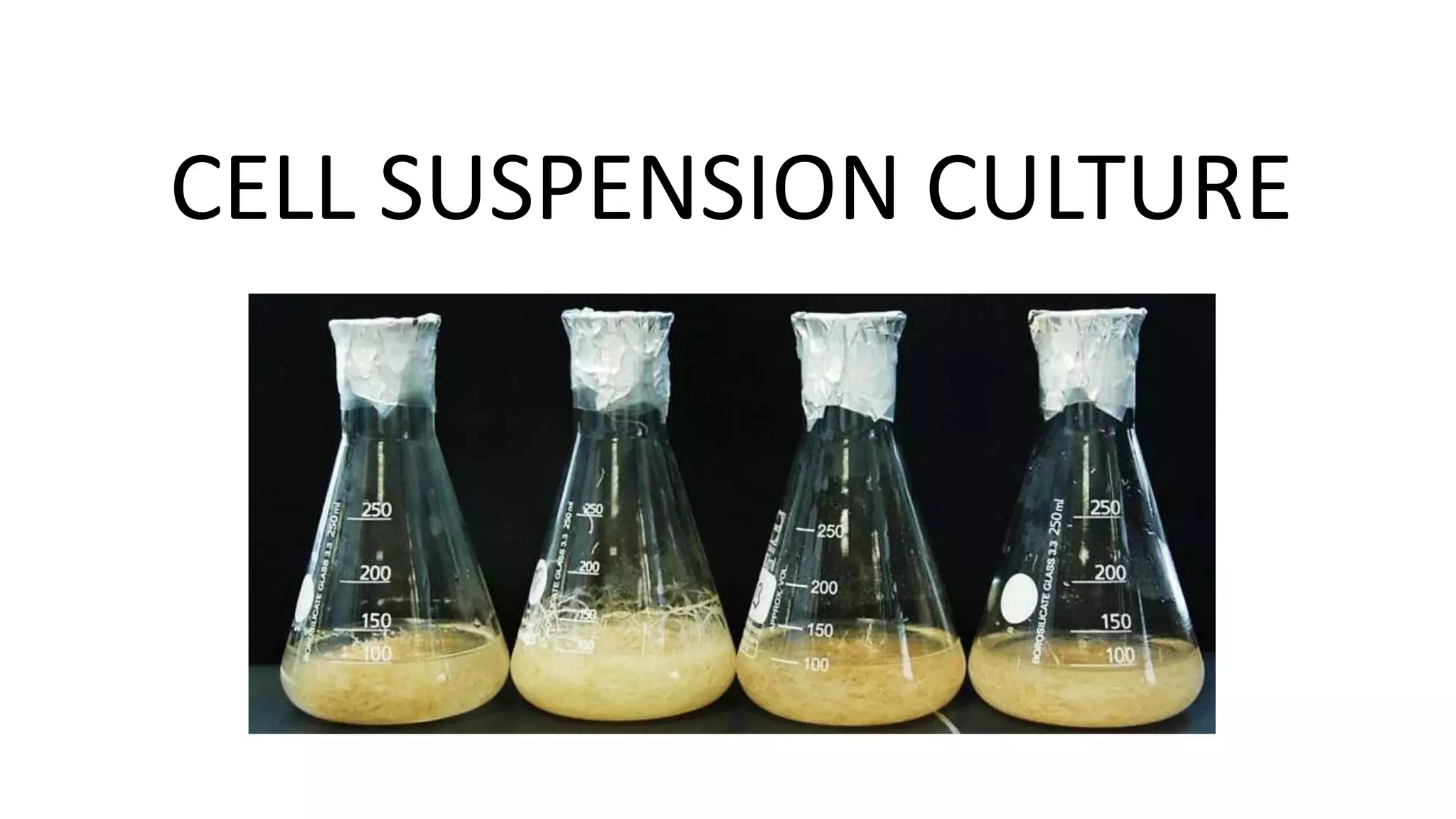
CELL SUSPENSION CULTURE
DEFINITION
Suspension culture is a type of culture in which single cell or
small aggregates of cells multiply while suspended in agitated
liquid medium .
It is also referred to as cell culture or cell suspension culture
The cell suspension culture requires optimization of the cell
line, the cultivation media and the bioreactor system.
SHORT HISTORY
• W H Muir 1953---First Reported Fragments of
Callus could be cultured in the form of Cell
Suspension.
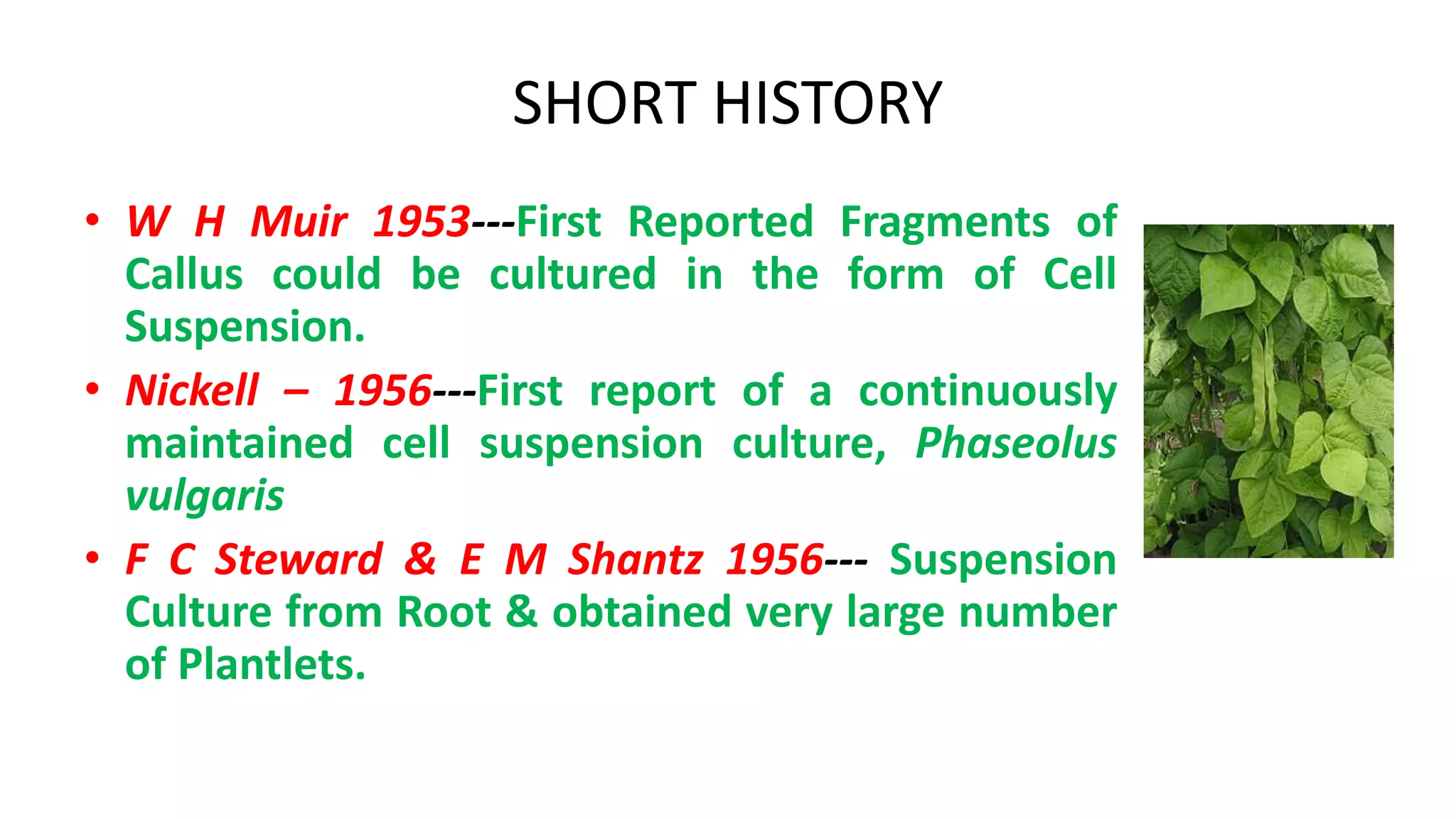
• Nickell – 1956---First report of a continuously
maintained cell suspension culture, Phaseolus
vulgaris
• F C Steward & E M Shantz 1956--- Suspension
Culture from Root & obtained very large number
of Plantlets.
TYPE OF CELL SUSPENSION CULTURES
• There are two type of cell suspension cultures :
1. Batch Culture
2. Continuous culture
BATCH CULTURE
A batch culture is a cell suspension culture grown in a fixed
volume of nutrient culture medium.
Cell suspension increases in biomass by cell division and cell
growth until a factor in the culture environnent (nutrient or
oxygen availability) becomes limiting and the growth ceases.
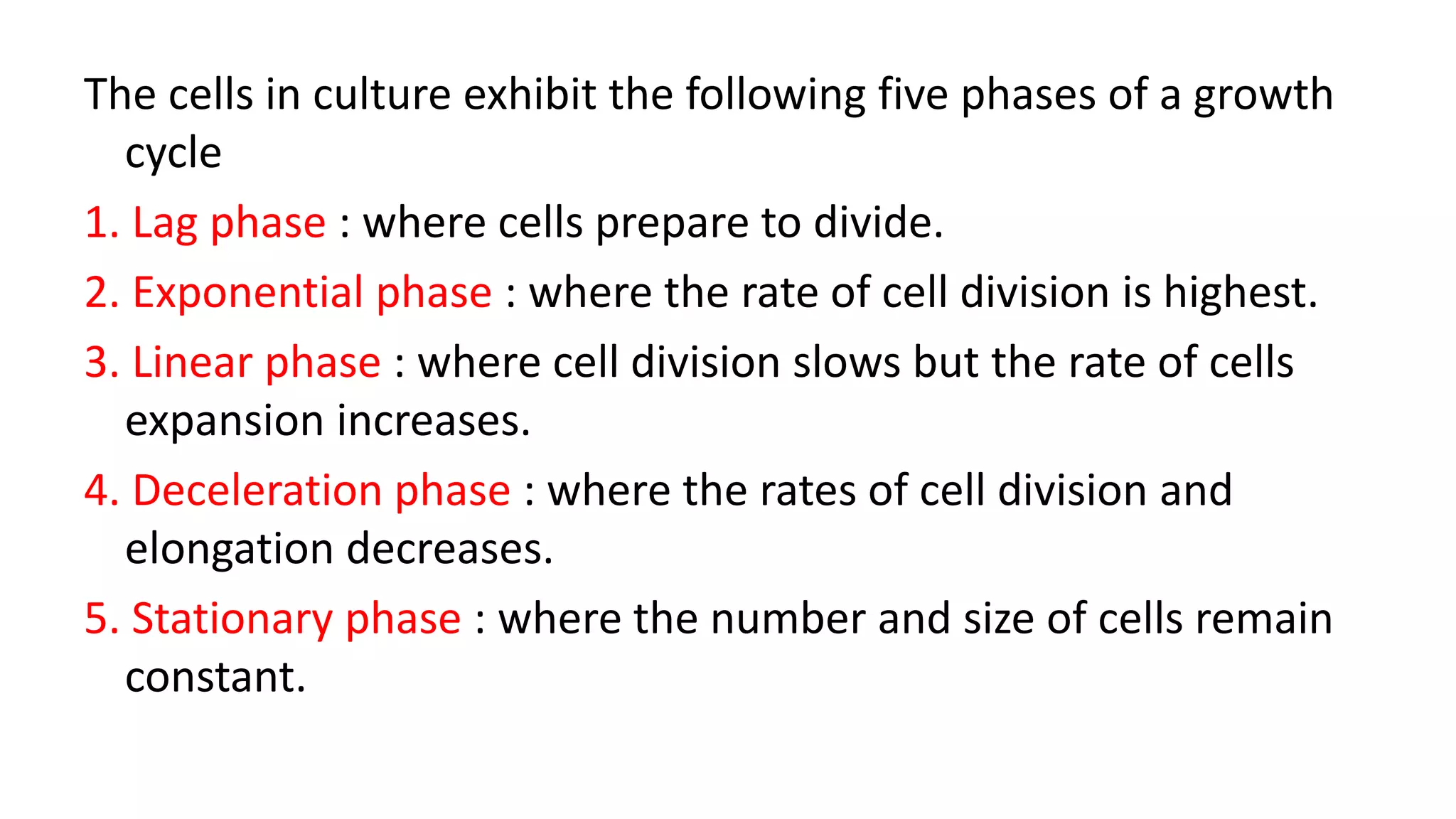
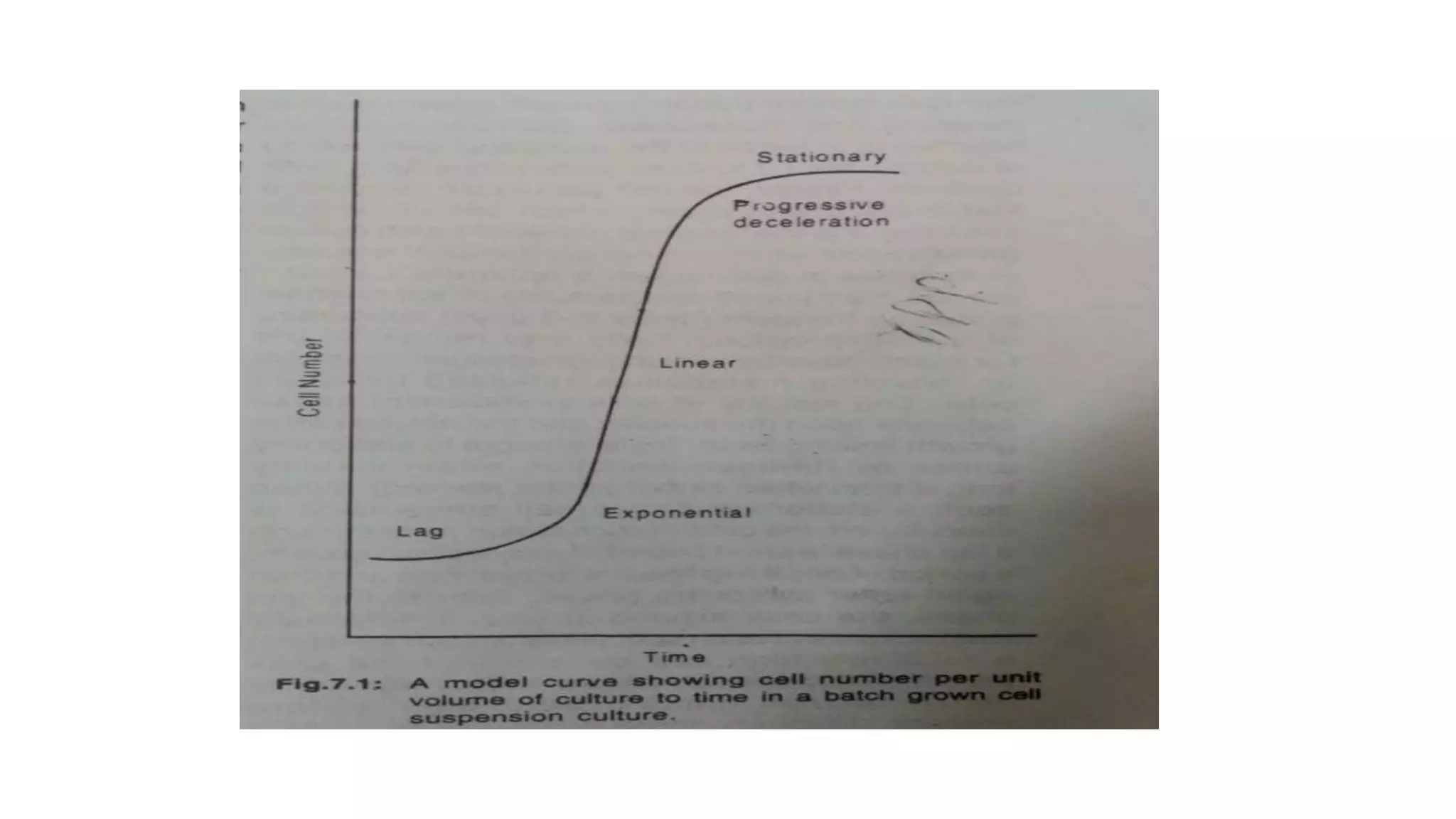
The cells in culture exhibit the following five phases of a growth
cycle
1. Lag phase : where cells prepare to divide.
2. Exponential phase : where the rate of cell division is highest.
3. Linear phase : where cell division slows but the rate of cells
expansion increases.
4. Deceleration phase : where the rates of cell division and
elongation decreases.
5. Stationary phase : where the number and size of cells remain
constant.
CONTINUOUS CULTURE
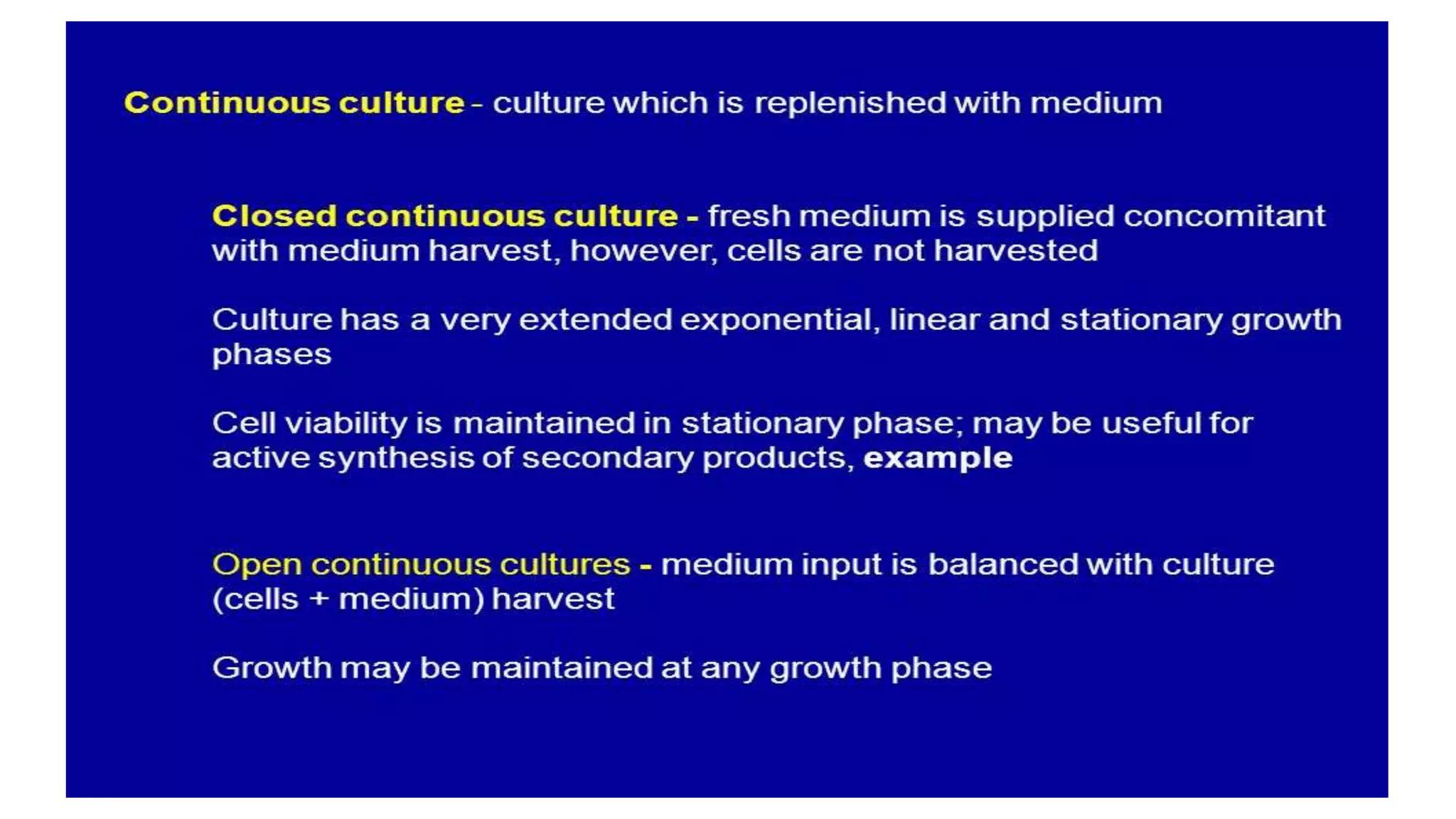
• A culture is continuously supplied with nutrients by the inflow
of fresh medium but the culture volume is normally constant.
• Continuous culture is further divided into two types :
1. Close continuous culture
2. Open continuous culture
Open continuous culture
• In open continuous culture both the cells and used medium
are replaced with fresh medium thus maintaining culture at
constant and sub maximal growth rate.
• Open continuous cell suspension culture is of two types
1. Chemostat
2. Turbidostats
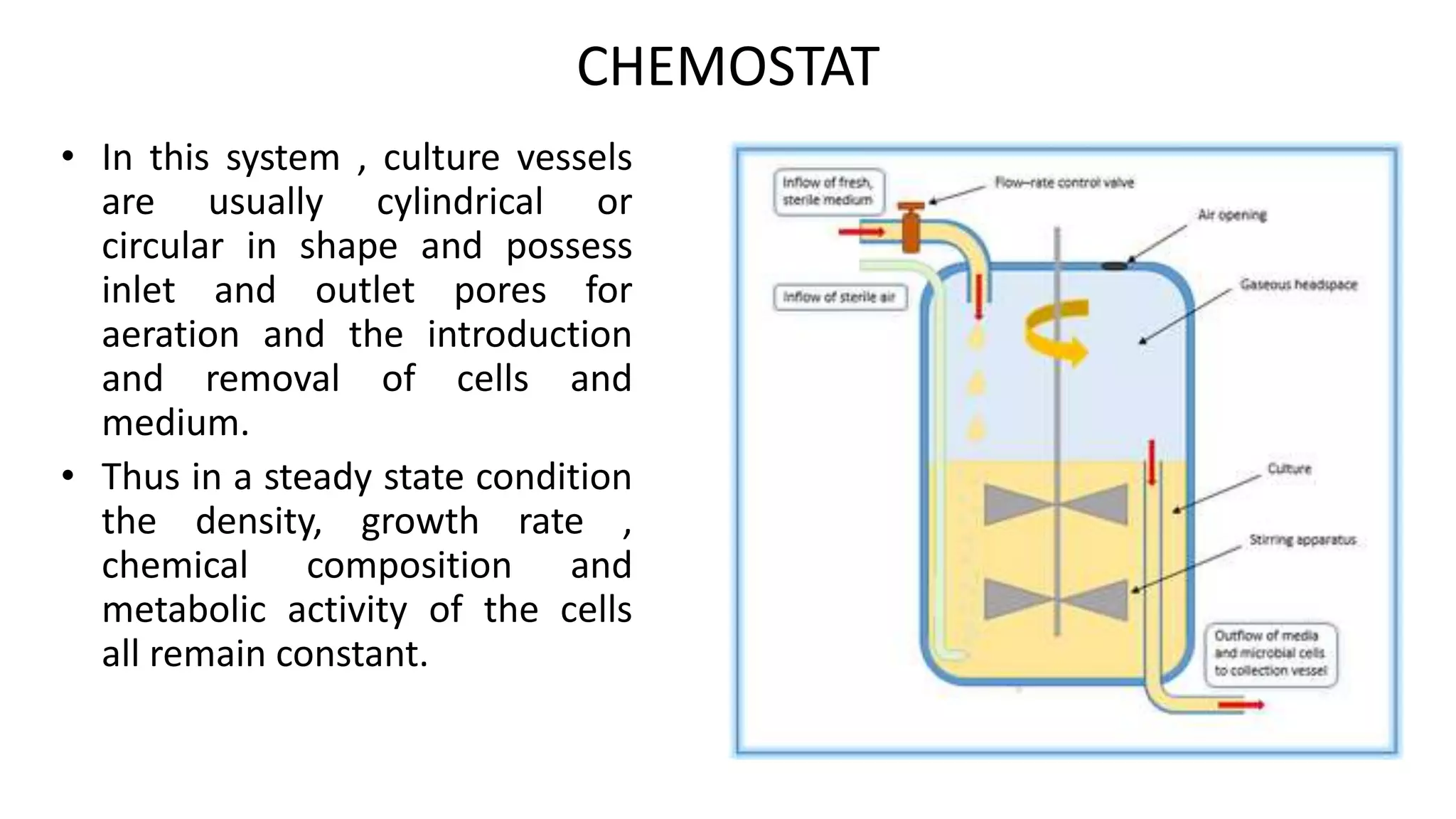
CHEMOSTAT
• In this system , culture vessels
are usually cylindrical or
circular in shape and possess
inlet and outlet pores for
aeration and the introduction
and removal of cells and
medium.
• Thus in a steady state condition
the density, growth rate ,
chemical composition and
metabolic activity of the cells
all remain constant.
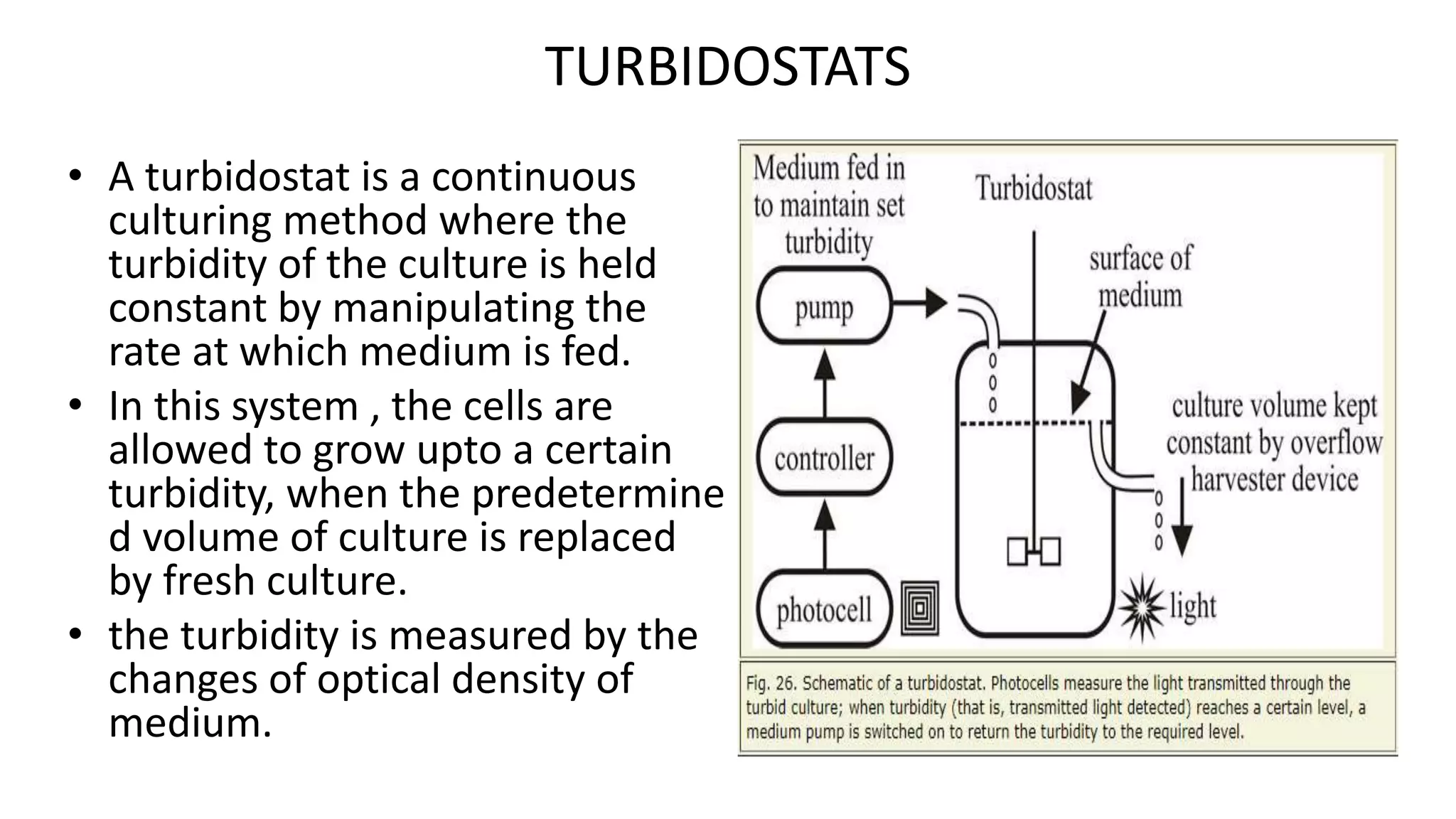
TURBIDOSTATS
• A turbidostat is a continuous
culturing method where the
turbidity of the culture is held
constant by manipulating the
rate at which medium is fed.
• In this system , the cells are
allowed to grow upto a certain
turbidity, when the predetermine
d volume of culture is replaced
by fresh culture.
• the turbidity is measured by the
changes of optical density of
medium.
Comparison of CHEMOSTAT AND TURBIDOSTAT
PRINCIPLE
 Callus proliferates as an unorganized mass of cells. So it is very difficult to follow many
cellular events during its growth and development phases.
 To overcome such limitations of callus culture, the cultivation of free cells as well as
small cell aggregates in a chemically defined liquid medium as a suspension was
initiated to study the morphological and biochemical changes during their growth and
development phases.
 To achieve an ideal cell suspension, most commonly a friable callus is transferred to
agitated liquid medium where it breaks up and readily disperses.
 After eliminating the large callus pieces, only single cells and small cell aggregates are
again transferred to fresh medium and after two or three weeks a suspension of actively
growing cells is produced.
 This suspension can then be propagated by regular sub-culture of an aliquot to fresh
medium. Ideally suspension culture should consist of only single cells which are
physiologically and biochemically uniform.
PROTOCOL
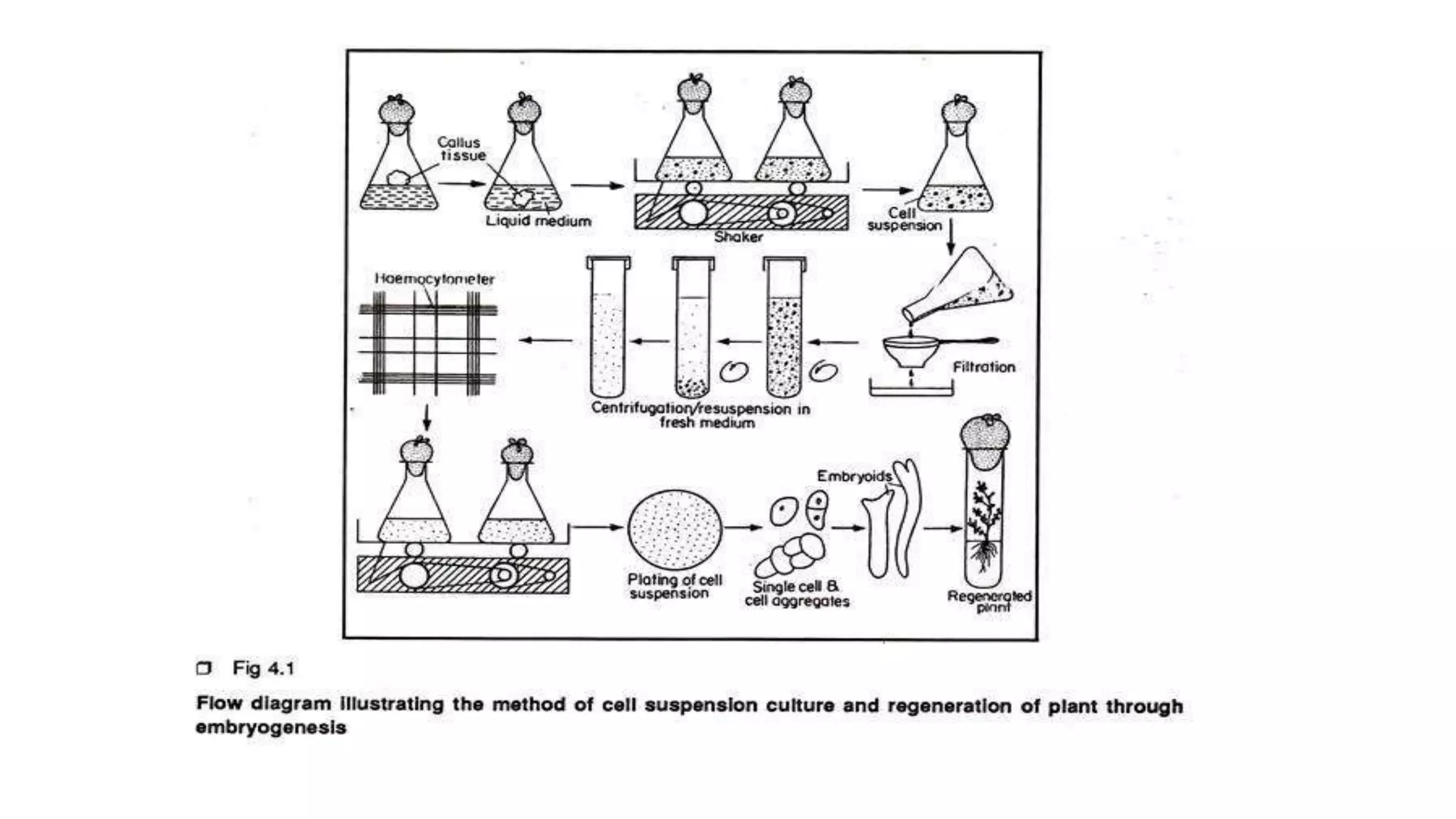
1. Take 150/250 ml conical flask containing autoclaved 40-60 ml liquid medium.
2. Transfer 3-4 pieces of pre-established callus tissue (approx. wt. 1 gm. each) from the
culture tube using the spoon headed spatula to conical flasks.
3. Flame the neck of conical flask, close the mouth of the flask with a piece of
aluminum foil or a cotton plug. Cover the closure with a piece of brown paper.
4. Place the flasks within the clamps of a rotary shaker moving at the 80-120 rpm
(revolution per minute)
5. After 7 days, pour the contents of each flask through the sterilized sieve pore
diameter -60µ-100µ and collect the filtrate in a big sterilized container. The filtrate
contains only free cells and cell aggregates.
6. Allow the filtrate to settle for 10-15 min. or centrifuge the filtrate at 500 to 1,000
rpm and finally pour off the supernatant.
7. Re-suspend the residue cells in a requisite volume of fresh liquid medium and
dispense the cell suspension equally in several sterilized flasks (150-250 ml). Place the
flasks on shaker and allow the free cells and cell aggregates to grow.
8. At the next subculture, repeat the previous steps but take only one-fifth of the
residual cells as the inoculum and dispense equally in flasks and again place them on
shaker.
9. After 3-4 subcultures, transfer 10 ml of cell suspension from each flask into new flask
containing 30 ml fresh liquid medium.
10. To prepare a growth curve of cells in suspension, transfer a definite number of cells
measured accurately by a haemocytometer to a definite volume of liquid medium and
incubates on shaker.
• Pipette out very little aliquot of cell suspension at short intervals of time (1 or 2 days
interval) and count the cell number. Plot the cell count data of a passage on a graph
paper and the curve will indicate the growth pattern of suspension culture.
IMPORTANCE OF CELL SUSPENSION CULTURE
 This system is capable of contributing many significant information’s about cell
physiology, biochemistry, metabolic events at the level of individual cells and small
cell aggregates.
 It is also important to build up an understanding of an organ formation or embryoid
formation starting from single cell or small cell aggregates.
 The technique of plating out cell suspension on agar plates is of particular value
where attempts are being made to obtain single cell clones.
 Suspension culture derived from medicinally important plants can be studied for the
production of secondary metabolites such as alkaloids
 Mutagenesis studies may be facilitated by the use of cell suspension cultures to
produce mutant cell clones from which mutant plants can be raised. Cell population
in a suspension can be subjected to a range of mutagenic chemicals e.g. ethyl
methane-sulphonate (EMS), N-nitroso-N- methyl urea, etc.
Disadvantages
• The productivity of suspension cultures decreases over
extended subculture periods.
• Slow growth and low productivity of plant cells.
• Cells may get damaged by shear conditions.
THANK YOU

Cell suspension culture

  • 1.
  • 2.
    DEFINITION Suspension culture isa type of culture in which single cell or small aggregates of cells multiply while suspended in agitated liquid medium . It is also referred to as cell culture or cell suspension culture The cell suspension culture requires optimization of the cell line, the cultivation media and the bioreactor system.
  • 3.
    SHORT HISTORY • WH Muir 1953---First Reported Fragments of Callus could be cultured in the form of Cell Suspension. • Nickell – 1956---First report of a continuously maintained cell suspension culture, Phaseolus vulgaris • F C Steward & E M Shantz 1956--- Suspension Culture from Root & obtained very large number of Plantlets.
  • 4.
    TYPE OF CELLSUSPENSION CULTURES • There are two type of cell suspension cultures : 1. Batch Culture 2. Continuous culture
  • 5.
    BATCH CULTURE A batchculture is a cell suspension culture grown in a fixed volume of nutrient culture medium. Cell suspension increases in biomass by cell division and cell growth until a factor in the culture environnent (nutrient or oxygen availability) becomes limiting and the growth ceases.
  • 6.
    The cells inculture exhibit the following five phases of a growth cycle 1. Lag phase : where cells prepare to divide. 2. Exponential phase : where the rate of cell division is highest. 3. Linear phase : where cell division slows but the rate of cells expansion increases. 4. Deceleration phase : where the rates of cell division and elongation decreases. 5. Stationary phase : where the number and size of cells remain constant.
  • 8.
    CONTINUOUS CULTURE • Aculture is continuously supplied with nutrients by the inflow of fresh medium but the culture volume is normally constant. • Continuous culture is further divided into two types : 1. Close continuous culture 2. Open continuous culture
  • 10.
    Open continuous culture •In open continuous culture both the cells and used medium are replaced with fresh medium thus maintaining culture at constant and sub maximal growth rate. • Open continuous cell suspension culture is of two types 1. Chemostat 2. Turbidostats
  • 11.
    CHEMOSTAT • In thissystem , culture vessels are usually cylindrical or circular in shape and possess inlet and outlet pores for aeration and the introduction and removal of cells and medium. • Thus in a steady state condition the density, growth rate , chemical composition and metabolic activity of the cells all remain constant.
  • 12.
    TURBIDOSTATS • A turbidostatis a continuous culturing method where the turbidity of the culture is held constant by manipulating the rate at which medium is fed. • In this system , the cells are allowed to grow upto a certain turbidity, when the predetermine d volume of culture is replaced by fresh culture. • the turbidity is measured by the changes of optical density of medium.
  • 13.
    Comparison of CHEMOSTATAND TURBIDOSTAT
  • 17.
    PRINCIPLE  Callus proliferatesas an unorganized mass of cells. So it is very difficult to follow many cellular events during its growth and development phases.  To overcome such limitations of callus culture, the cultivation of free cells as well as small cell aggregates in a chemically defined liquid medium as a suspension was initiated to study the morphological and biochemical changes during their growth and development phases.  To achieve an ideal cell suspension, most commonly a friable callus is transferred to agitated liquid medium where it breaks up and readily disperses.  After eliminating the large callus pieces, only single cells and small cell aggregates are again transferred to fresh medium and after two or three weeks a suspension of actively growing cells is produced.  This suspension can then be propagated by regular sub-culture of an aliquot to fresh medium. Ideally suspension culture should consist of only single cells which are physiologically and biochemically uniform.
  • 18.
    PROTOCOL 1. Take 150/250ml conical flask containing autoclaved 40-60 ml liquid medium. 2. Transfer 3-4 pieces of pre-established callus tissue (approx. wt. 1 gm. each) from the culture tube using the spoon headed spatula to conical flasks. 3. Flame the neck of conical flask, close the mouth of the flask with a piece of aluminum foil or a cotton plug. Cover the closure with a piece of brown paper. 4. Place the flasks within the clamps of a rotary shaker moving at the 80-120 rpm (revolution per minute) 5. After 7 days, pour the contents of each flask through the sterilized sieve pore diameter -60µ-100µ and collect the filtrate in a big sterilized container. The filtrate contains only free cells and cell aggregates. 6. Allow the filtrate to settle for 10-15 min. or centrifuge the filtrate at 500 to 1,000 rpm and finally pour off the supernatant.
  • 19.
    7. Re-suspend theresidue cells in a requisite volume of fresh liquid medium and dispense the cell suspension equally in several sterilized flasks (150-250 ml). Place the flasks on shaker and allow the free cells and cell aggregates to grow. 8. At the next subculture, repeat the previous steps but take only one-fifth of the residual cells as the inoculum and dispense equally in flasks and again place them on shaker. 9. After 3-4 subcultures, transfer 10 ml of cell suspension from each flask into new flask containing 30 ml fresh liquid medium. 10. To prepare a growth curve of cells in suspension, transfer a definite number of cells measured accurately by a haemocytometer to a definite volume of liquid medium and incubates on shaker. • Pipette out very little aliquot of cell suspension at short intervals of time (1 or 2 days interval) and count the cell number. Plot the cell count data of a passage on a graph paper and the curve will indicate the growth pattern of suspension culture.
  • 21.
    IMPORTANCE OF CELLSUSPENSION CULTURE  This system is capable of contributing many significant information’s about cell physiology, biochemistry, metabolic events at the level of individual cells and small cell aggregates.  It is also important to build up an understanding of an organ formation or embryoid formation starting from single cell or small cell aggregates.  The technique of plating out cell suspension on agar plates is of particular value where attempts are being made to obtain single cell clones.  Suspension culture derived from medicinally important plants can be studied for the production of secondary metabolites such as alkaloids  Mutagenesis studies may be facilitated by the use of cell suspension cultures to produce mutant cell clones from which mutant plants can be raised. Cell population in a suspension can be subjected to a range of mutagenic chemicals e.g. ethyl methane-sulphonate (EMS), N-nitroso-N- methyl urea, etc.
  • 23.
    Disadvantages • The productivityof suspension cultures decreases over extended subculture periods. • Slow growth and low productivity of plant cells. • Cells may get damaged by shear conditions.
  • 24.