RNA Interference (RNAi)
Antre Suresh H.
Ph. D. Ist Year
PALB-8086
1Department of Plant Biotechnology12/1/2019
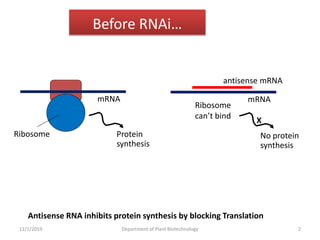
Before RNAi…
Ribosome
mRNA
Protein
synthesis
No protein
synthesis
mRNA
antisense mRNA
Ribosome
can’t bind
X
Antisense RNA inhibits protein synthesis by blocking Translation
2Department of Plant Biotechnology12/1/2019
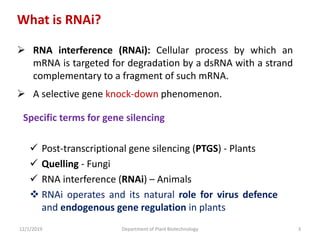
What is RNAi?
 RNA interference (RNAi): Cellular process by which an
mRNA is targeted for degradation by a dsRNA with a strand
complementary to a fragment of such mRNA.
 A selective gene knock-down phenomenon.
Specific terms for gene silencing
 Post-transcriptional gene silencing (PTGS) - Plants
 Quelling - Fungi
 RNA interference (RNAi) – Animals
 RNAi operates and its natural role for virus defence
and endogenous gene regulation in plants
3Department of Plant Biotechnology12/1/2019
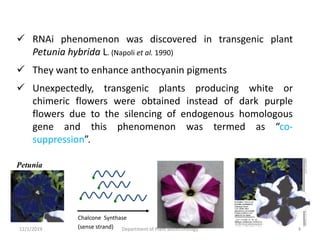
 RNAi phenomenon was discovered in transgenic plant
Petunia hybrida L. (Napoli et al. 1990)
 They want to enhance anthocyanin pigments
 Unexpectedly, transgenic plants producing white or
chimeric flowers were obtained instead of dark purple
flowers due to the silencing of endogenous homologous
gene and this phenomenon was termed as “co-
suppression”.
Petunia
Chalcone Synthase
(sense strand) 4Department of Plant Biotechnology12/1/2019
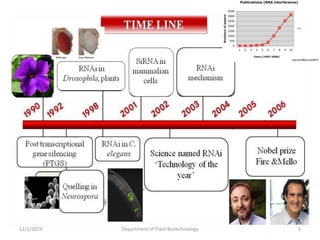
5Department of Plant Biotechnology12/1/2019
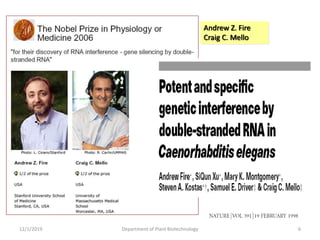
12/1/2019 Department of Plant Biotechnology 6
Andrew Z. Fire
Craig C. Mello
RNA silencing works on at least three different levels in plants
viz.
1. Cytoplasmic silencing by dsRNA results in cleavage of mRNA
2. Endogenous mRNAs are silenced by micro-RNAs (miRNAs),
which negatively regulate gene expression by base-pairing
to specific mRNAs, resulting in either RNA cleavage or
blocking protein translation called PTGS.
3. RNA silencing is associated with sequence-specific
methylation of DNA and the consequent suppression of
transcription called transcriptional gene silencing [TGS].
7Department of Plant Biotechnology12/1/2019
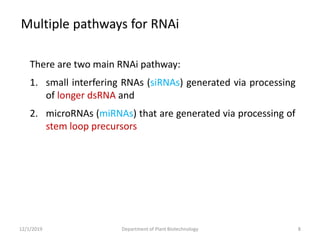
There are two main RNAi pathway:
1. small interfering RNAs (siRNAs) generated via processing
of longer dsRNA and
2. microRNAs (miRNAs) that are generated via processing of
stem loop precursors
Multiple pathways for RNAi
8Department of Plant Biotechnology12/1/2019
There are four component for siRNAs generation
1. Dicer
2. small Interfering RNA (siRNA )
3. RNA-Induced Silencing Complex (RISC)
4. RNA-Dependent RNA Polymerase (RdRP)
Main component of RNAi machinery for siRNA
generation
9Department of Plant Biotechnology12/1/2019
Dicer
 First discovered by Bernstein et al. (2001) in Drosophila.
 Enzyme belonging to the RNase III ribonuclease family.
 Cutting mechanism of the Dicer enzyme is ATP-independent
(Kuznetsov 2003).
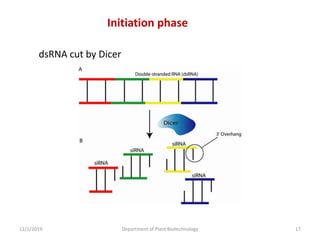
 Responsible for the processing of dsRNA into siRNAs
 Cleaves dsRNA or pre-miRNA-leaves 3’ overhangs and 5’
phosphate groups.
 Initiates RNAi.
10Department of Plant Biotechnology12/1/2019
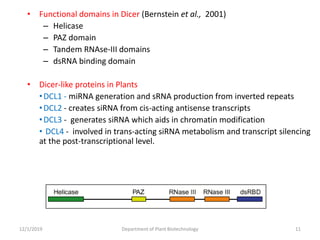
• Functional domains in Dicer (Bernstein et al., 2001)
– Helicase
– PAZ domain
– Tandem RNAse-III domains
– dsRNA binding domain
• Dicer-like proteins in Plants
•DCL1 - miRNA generation and sRNA production from inverted repeats
•DCL2 - creates siRNA from cis-acting antisense transcripts
•DCL3 - generates siRNA which aids in chromatin modification
• DCL4 - involved in trans-acting siRNA metabolism and transcript silencing
at the post-transcriptional level.
11Department of Plant Biotechnology12/1/2019
 First discovered in Drosophila, by Hammond et al. (2000)
 Nuclease complex composed of proteins and siRNA
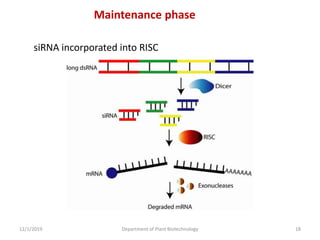
 Targets and destroys endogenous mRNAs complementary to the
siRNA
 RISC consists of both protein and RNA
 RNAi effector complex
 Critical for target mRNA degredation or tranlslation inhibition
 Activities associated with RISC
 Helicase
 Endonuclease and exonuclease “Slicer”
 “homology seeking”/RNA binding
RNA-Induced Silencing Complex (RISC)
12Department of Plant Biotechnology12/1/2019
12/1/2019 Department of Plant Biotechnology 13
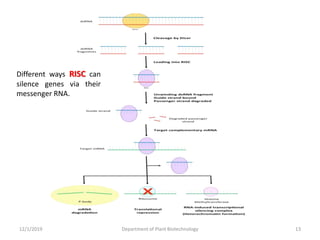
Different ways RISC can
silence genes via their
messenger RNA.
RNA-dependent RNA Polymerase (RdRP)
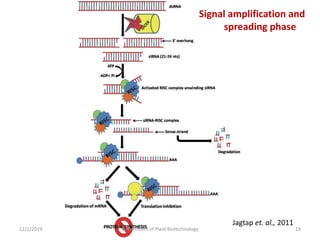
 RdRP – Triggering and amplifying the silencing effect
 Systemic nature of RNAi
 RdRP activity found in plants and C. elegans
 May explain efficiency of RNAi
14Department of Plant Biotechnology12/1/2019
siRNA
 21-23 nucleotide dsRNA that mediate PTGS
 Produced in vivo by cleavage of dsRNA
 Amplification by an RNA-dependent RNA polymerase (RdRP)
may occur
 Incorporated into the RISC guiding it to mRNA
 Complementary to a specific sequence of target mRNA for
degradation.
15Department of Plant Biotechnology12/1/2019
Mechanism of RNAi
 Initiation phase
 Maintenance phase
 Signal amplification and spreading phase
16Department of Plant Biotechnology12/1/2019
dsRNA cut by Dicer
Initiation phase
17Department of Plant Biotechnology12/1/2019
siRNA incorporated into RISC
Maintenance phase
18Department of Plant Biotechnology12/1/2019
Jagtap et. al., 2011
19Department of Plant Biotechnology12/1/2019
Signal amplification and
spreading phase
a. Short distance movement :
 Exogenous ds RNA is processed by Dicer like enzymes into
21nt and 24nt Primary SiRNAs.
 24nt SiRNA was shown to be dispensable for local
movement.
 21nt SiRNA may spread over 10-15 adjacent cells in the
absence of relay amplification.
Cell to cell movement of RNA silencing…..
20Department of Plant Biotechnology12/1/2019
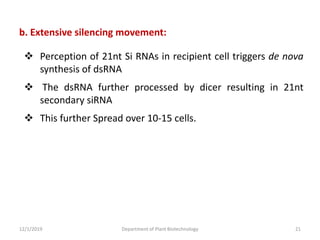
b. Extensive silencing movement:
 Perception of 21nt Si RNAs in recipient cell triggers de nova
synthesis of dsRNA
 The dsRNA further processed by dicer resulting in 21nt
secondary siRNA
 This further Spread over 10-15 cells.
21Department of Plant Biotechnology12/1/2019
Main component of RNAi machinery for
miRNA generation
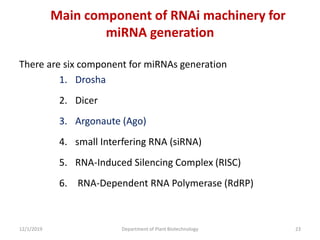
There are six component for miRNAs generation
1. Drosha
2. Dicer
3. Argonaute (Ago)
4. small Interfering RNA (siRNA)
5. RNA-Induced Silencing Complex (RISC)
6. RNA-Dependent RNA Polymerase (RdRP)
23Department of Plant Biotechnology12/1/2019
Drosha
 Processes pri-miRNA into pre-miRNA
– Leaves 3’ overhangs on pre-miRNA
 Nuclear RNAse-III enzyme [Lee at al., 2003]
– Tandem RNAse-III domains
 How does it identify pri-miRNA?
– Hairpin terminal loop size
– Stem structure
– Hairpin flanking sequences
 Not yet found in plants
– Maybe Dicer does its job?
24Department of Plant Biotechnology12/1/2019
Argonaute (Ago)
 Consistently co-purifies with RISC [Hammond et al., 2001]
 “Homology seeking” activity?
– Binds siRNA and miRNA [Ekwall, 2004]
– Distinguishes antisense strand [Novina and Sharp, 2004]
 Multiple Ago family proteins
– Different RISCs
– Tissue specific, Developmentally regulated
 Evidence for different RISCs [Tijsterman et al., 2004]
– Drosophila Dicer1 vs Dicer2/R2D2
– Inhibition vs. degradation [Lee et al., 2004]
26Department of Plant Biotechnology12/1/2019
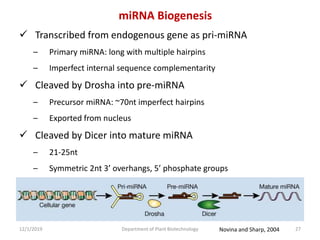
miRNA Biogenesis
 Transcribed from endogenous gene as pri-miRNA
– Primary miRNA: long with multiple hairpins
– Imperfect internal sequence complementarity
 Cleaved by Drosha into pre-miRNA
– Precursor miRNA: ~70nt imperfect hairpins
– Exported from nucleus
 Cleaved by Dicer into mature miRNA
– 21-25nt
– Symmetric 2nt 3’ overhangs, 5’ phosphate groups
27Department of Plant Biotechnology12/1/2019 Novina and Sharp, 2004
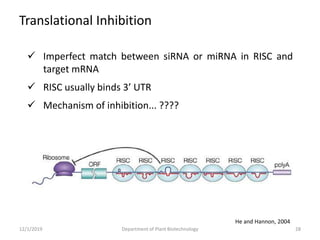
Translational Inhibition
 Imperfect match between siRNA or miRNA in RISC and
target mRNA
 RISC usually binds 3’ UTR
 Mechanism of inhibition... ????
He and Hannon, 2004
28Department of Plant Biotechnology12/1/2019
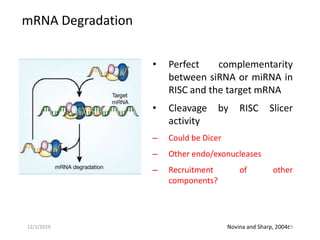
mRNA Degradation
• Perfect complementarity
between siRNA or miRNA in
RISC and the target mRNA
• Cleavage by RISC Slicer
activity
– Could be Dicer
– Other endo/exonucleases
– Recruitment of other
components?
Novina and Sharp, 2004c2912/1/2019
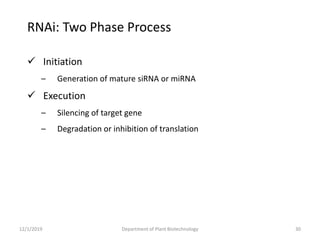
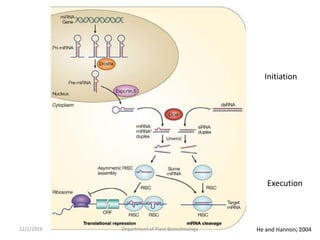
RNAi: Two Phase Process
 Initiation
– Generation of mature siRNA or miRNA
 Execution
– Silencing of target gene
– Degradation or inhibition of translation
30Department of Plant Biotechnology12/1/2019
He and Hannon, 2004
Initiation
Execution
33Department of Plant Biotechnology12/1/2019
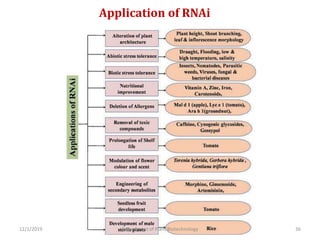
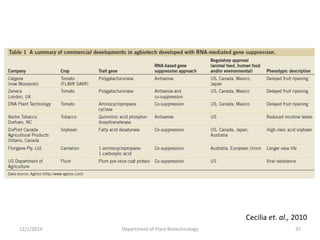
Application of RNAi
36Department of Plant Biotechnology12/1/2019
Cecilia et. al., 2010
37Department of Plant Biotechnology12/1/2019
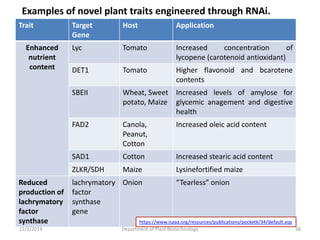
Trait Target
Gene
Host Application
Enhanced
nutrient
content
Lyc Tomato Increased concentration of
lycopene (carotenoid antioxidant)
DET1 Tomato Higher flavonoid and bcarotene
contents
SBEII Wheat, Sweet
potato, Maize
Increased levels of amylose for
glycemic anagement and digestive
health
FAD2 Canola,
Peanut,
Cotton
Increased oleic acid content
SAD1 Cotton Increased stearic acid content
ZLKR/SDH Maize Lysinefortified maize
Reduced
production of
lachrymatory
factor
synthase
lachrymatory
factor
synthase
gene
Onion “Tearless” onion
Examples of novel plant traits engineered through RNAi.
38Department of Plant Biotechnology12/1/2019
https://www.isaaa.org/resources/publications/pocketk/34/default.asp
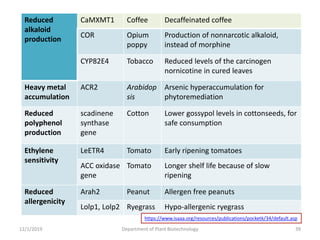
Reduced
alkaloid
production
CaMXMT1 Coffee Decaffeinated coffee
COR Opium
poppy
Production of nonnarcotic alkaloid,
instead of morphine
CYP82E4 Tobacco Reduced levels of the carcinogen
nornicotine in cured leaves
Heavy metal
accumulation
ACR2 Arabidop
sis
Arsenic hyperaccumulation for
phytoremediation
Reduced
polyphenol
production
scadinene
synthase
gene
Cotton Lower gossypol levels in cottonseeds, for
safe consumption
Ethylene
sensitivity
LeETR4 Tomato Early ripening tomatoes
ACC oxidase
gene
Tomato Longer shelf life because of slow
ripening
Reduced
allergenicity
Arah2 Peanut Allergen free peanuts
Lolp1, Lolp2 Ryegrass Hypo-allergenic ryegrass
39Department of Plant Biotechnology12/1/2019
https://www.isaaa.org/resources/publications/pocketk/34/default.asp
12/1/2019 Department of Plant Biotechnology 42
 Sprayable RNAi technology to control fusarium disease in barley were
published by BASF
 BioDirect is the brand name coined by Monsanto for its sprayable RNAi
platform.
Research focus
12/1/2019 Department of Plant Biotechnology 43
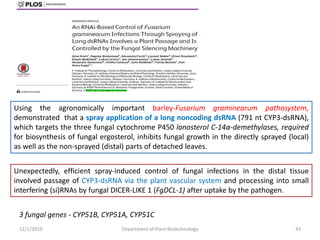
Using the agronomically important barley-Fusarium graminearum pathosystem,
demonstrated that a spray application of a long noncoding dsRNA (791 nt CYP3-dsRNA),
which targets the three fungal cytochrome P450 lanosterol C-14α-demethylases, required
for biosynthesis of fungal ergosterol, inhibits fungal growth in the directly sprayed (local)
as well as the non-sprayed (distal) parts of detached leaves.
Unexpectedly, efficient spray-induced control of fungal infections in the distal tissue
involved passage of CYP3-dsRNA via the plant vascular system and processing into small
interfering (si)RNAs by fungal DICER-LIKE 1 (FgDCL-1) after uptake by the pathogen.
3 fungal genes - CYP51B, CYP51A, CYP51C
12/1/2019 Department of Plant Biotechnology 44
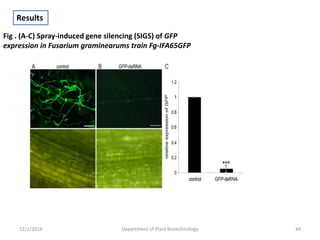
Fig . (A-C) Spray-induced gene silencing (SIGS) of GFP
expression in Fusarium graminearums train Fg-IFA65GFP
Results
12/1/2019 Department of Plant Biotechnology 45
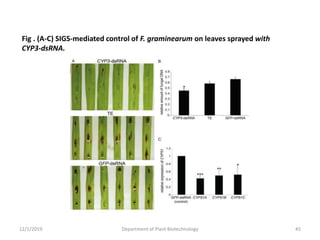
Fig . (A-C) SIGS-mediated control of F. graminearum on leaves sprayed with
CYP3-dsRNA.
12/1/2019 Department of Plant Biotechnology 46
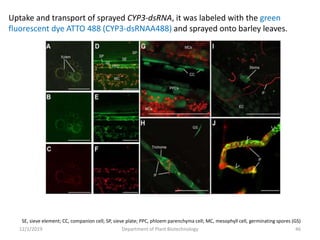
Uptake and transport of sprayed CYP3-dsRNA, it was labeled with the green
fluorescent dye ATTO 488 (CYP3-dsRNAA488) and sprayed onto barley leaves.
SE, sieve element; CC, companion cell; SP, sieve plate; PPC, phloem parenchyma cell; MC, mesophyll cell, germinating spores (GS)
12/1/2019 Department of Plant Biotechnology 47
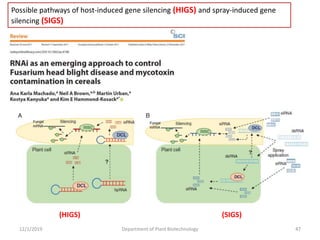
Possible pathways of host-induced gene silencing (HIGS) and spray-induced gene
silencing (SIGS)
(HIGS) (SIGS)
12/1/2019 Department of Plant Biotechnology 48
12/1/2019 Department of Plant Biotechnology 49
R & D pipeline
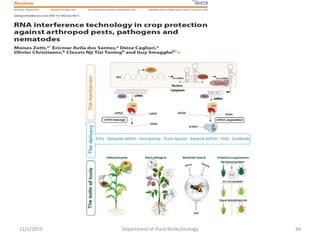
Dow AgroSciences with Monsanto
 SmartStax Pro, which incorporates RNAi technology to counter
resistance to Bt (Bacillus thuringiensis) proteins used as insecticides, will be
introduced in 2018-20.
 The main target is western corn rootworm (Diabrotica virgifera
virgifera).
 Coleoptera, such as western corn rootworm and Colorado potato beetle
(Leptinotarsa decemlineata), have proved to be very promising targets for
control by RNAi and much commercial development of the technology has
been focused on these pests.
50Department of Plant Biotechnology12/1/2019

RNA Interference (RNAi)

  • 1.
    RNA Interference (RNAi) AntreSuresh H. Ph. D. Ist Year PALB-8086 1Department of Plant Biotechnology12/1/2019
  • 2.
    Before RNAi… Ribosome mRNA Protein synthesis No protein synthesis mRNA antisensemRNA Ribosome can’t bind X Antisense RNA inhibits protein synthesis by blocking Translation 2Department of Plant Biotechnology12/1/2019
  • 3.
    What is RNAi? RNA interference (RNAi): Cellular process by which an mRNA is targeted for degradation by a dsRNA with a strand complementary to a fragment of such mRNA.  A selective gene knock-down phenomenon. Specific terms for gene silencing  Post-transcriptional gene silencing (PTGS) - Plants  Quelling - Fungi  RNA interference (RNAi) – Animals  RNAi operates and its natural role for virus defence and endogenous gene regulation in plants 3Department of Plant Biotechnology12/1/2019
  • 4.
     RNAi phenomenonwas discovered in transgenic plant Petunia hybrida L. (Napoli et al. 1990)  They want to enhance anthocyanin pigments  Unexpectedly, transgenic plants producing white or chimeric flowers were obtained instead of dark purple flowers due to the silencing of endogenous homologous gene and this phenomenon was termed as “co- suppression”. Petunia Chalcone Synthase (sense strand) 4Department of Plant Biotechnology12/1/2019
  • 5.
    5Department of PlantBiotechnology12/1/2019
  • 6.
    12/1/2019 Department ofPlant Biotechnology 6 Andrew Z. Fire Craig C. Mello
  • 7.
    RNA silencing workson at least three different levels in plants viz. 1. Cytoplasmic silencing by dsRNA results in cleavage of mRNA 2. Endogenous mRNAs are silenced by micro-RNAs (miRNAs), which negatively regulate gene expression by base-pairing to specific mRNAs, resulting in either RNA cleavage or blocking protein translation called PTGS. 3. RNA silencing is associated with sequence-specific methylation of DNA and the consequent suppression of transcription called transcriptional gene silencing [TGS]. 7Department of Plant Biotechnology12/1/2019
  • 8.
    There are twomain RNAi pathway: 1. small interfering RNAs (siRNAs) generated via processing of longer dsRNA and 2. microRNAs (miRNAs) that are generated via processing of stem loop precursors Multiple pathways for RNAi 8Department of Plant Biotechnology12/1/2019
  • 9.
    There are fourcomponent for siRNAs generation 1. Dicer 2. small Interfering RNA (siRNA ) 3. RNA-Induced Silencing Complex (RISC) 4. RNA-Dependent RNA Polymerase (RdRP) Main component of RNAi machinery for siRNA generation 9Department of Plant Biotechnology12/1/2019
  • 10.
    Dicer  First discoveredby Bernstein et al. (2001) in Drosophila.  Enzyme belonging to the RNase III ribonuclease family.  Cutting mechanism of the Dicer enzyme is ATP-independent (Kuznetsov 2003).  Responsible for the processing of dsRNA into siRNAs  Cleaves dsRNA or pre-miRNA-leaves 3’ overhangs and 5’ phosphate groups.  Initiates RNAi. 10Department of Plant Biotechnology12/1/2019
  • 11.
    • Functional domainsin Dicer (Bernstein et al., 2001) – Helicase – PAZ domain – Tandem RNAse-III domains – dsRNA binding domain • Dicer-like proteins in Plants •DCL1 - miRNA generation and sRNA production from inverted repeats •DCL2 - creates siRNA from cis-acting antisense transcripts •DCL3 - generates siRNA which aids in chromatin modification • DCL4 - involved in trans-acting siRNA metabolism and transcript silencing at the post-transcriptional level. 11Department of Plant Biotechnology12/1/2019
  • 12.
     First discoveredin Drosophila, by Hammond et al. (2000)  Nuclease complex composed of proteins and siRNA  Targets and destroys endogenous mRNAs complementary to the siRNA  RISC consists of both protein and RNA  RNAi effector complex  Critical for target mRNA degredation or tranlslation inhibition  Activities associated with RISC  Helicase  Endonuclease and exonuclease “Slicer”  “homology seeking”/RNA binding RNA-Induced Silencing Complex (RISC) 12Department of Plant Biotechnology12/1/2019
  • 13.
    12/1/2019 Department ofPlant Biotechnology 13 Different ways RISC can silence genes via their messenger RNA.
  • 14.
    RNA-dependent RNA Polymerase(RdRP)  RdRP – Triggering and amplifying the silencing effect  Systemic nature of RNAi  RdRP activity found in plants and C. elegans  May explain efficiency of RNAi 14Department of Plant Biotechnology12/1/2019
  • 15.
    siRNA  21-23 nucleotidedsRNA that mediate PTGS  Produced in vivo by cleavage of dsRNA  Amplification by an RNA-dependent RNA polymerase (RdRP) may occur  Incorporated into the RISC guiding it to mRNA  Complementary to a specific sequence of target mRNA for degradation. 15Department of Plant Biotechnology12/1/2019
  • 16.
    Mechanism of RNAi Initiation phase  Maintenance phase  Signal amplification and spreading phase 16Department of Plant Biotechnology12/1/2019
  • 17.
    dsRNA cut byDicer Initiation phase 17Department of Plant Biotechnology12/1/2019
  • 18.
    siRNA incorporated intoRISC Maintenance phase 18Department of Plant Biotechnology12/1/2019
  • 19.
    Jagtap et. al.,2011 19Department of Plant Biotechnology12/1/2019 Signal amplification and spreading phase
  • 20.
    a. Short distancemovement :  Exogenous ds RNA is processed by Dicer like enzymes into 21nt and 24nt Primary SiRNAs.  24nt SiRNA was shown to be dispensable for local movement.  21nt SiRNA may spread over 10-15 adjacent cells in the absence of relay amplification. Cell to cell movement of RNA silencing….. 20Department of Plant Biotechnology12/1/2019
  • 21.
    b. Extensive silencingmovement:  Perception of 21nt Si RNAs in recipient cell triggers de nova synthesis of dsRNA  The dsRNA further processed by dicer resulting in 21nt secondary siRNA  This further Spread over 10-15 cells. 21Department of Plant Biotechnology12/1/2019
  • 22.
    Main component ofRNAi machinery for miRNA generation There are six component for miRNAs generation 1. Drosha 2. Dicer 3. Argonaute (Ago) 4. small Interfering RNA (siRNA) 5. RNA-Induced Silencing Complex (RISC) 6. RNA-Dependent RNA Polymerase (RdRP) 23Department of Plant Biotechnology12/1/2019
  • 23.
    Drosha  Processes pri-miRNAinto pre-miRNA – Leaves 3’ overhangs on pre-miRNA  Nuclear RNAse-III enzyme [Lee at al., 2003] – Tandem RNAse-III domains  How does it identify pri-miRNA? – Hairpin terminal loop size – Stem structure – Hairpin flanking sequences  Not yet found in plants – Maybe Dicer does its job? 24Department of Plant Biotechnology12/1/2019
  • 24.
    Argonaute (Ago)  Consistentlyco-purifies with RISC [Hammond et al., 2001]  “Homology seeking” activity? – Binds siRNA and miRNA [Ekwall, 2004] – Distinguishes antisense strand [Novina and Sharp, 2004]  Multiple Ago family proteins – Different RISCs – Tissue specific, Developmentally regulated  Evidence for different RISCs [Tijsterman et al., 2004] – Drosophila Dicer1 vs Dicer2/R2D2 – Inhibition vs. degradation [Lee et al., 2004] 26Department of Plant Biotechnology12/1/2019
  • 25.
    miRNA Biogenesis  Transcribedfrom endogenous gene as pri-miRNA – Primary miRNA: long with multiple hairpins – Imperfect internal sequence complementarity  Cleaved by Drosha into pre-miRNA – Precursor miRNA: ~70nt imperfect hairpins – Exported from nucleus  Cleaved by Dicer into mature miRNA – 21-25nt – Symmetric 2nt 3’ overhangs, 5’ phosphate groups 27Department of Plant Biotechnology12/1/2019 Novina and Sharp, 2004
  • 26.
    Translational Inhibition  Imperfectmatch between siRNA or miRNA in RISC and target mRNA  RISC usually binds 3’ UTR  Mechanism of inhibition... ???? He and Hannon, 2004 28Department of Plant Biotechnology12/1/2019
  • 27.
    mRNA Degradation • Perfectcomplementarity between siRNA or miRNA in RISC and the target mRNA • Cleavage by RISC Slicer activity – Could be Dicer – Other endo/exonucleases – Recruitment of other components? Novina and Sharp, 2004c2912/1/2019
  • 28.
    RNAi: Two PhaseProcess  Initiation – Generation of mature siRNA or miRNA  Execution – Silencing of target gene – Degradation or inhibition of translation 30Department of Plant Biotechnology12/1/2019
  • 29.
    He and Hannon,2004 Initiation Execution 33Department of Plant Biotechnology12/1/2019
  • 30.
    Application of RNAi 36Departmentof Plant Biotechnology12/1/2019
  • 31.
    Cecilia et. al.,2010 37Department of Plant Biotechnology12/1/2019
  • 32.
    Trait Target Gene Host Application Enhanced nutrient content LycTomato Increased concentration of lycopene (carotenoid antioxidant) DET1 Tomato Higher flavonoid and bcarotene contents SBEII Wheat, Sweet potato, Maize Increased levels of amylose for glycemic anagement and digestive health FAD2 Canola, Peanut, Cotton Increased oleic acid content SAD1 Cotton Increased stearic acid content ZLKR/SDH Maize Lysinefortified maize Reduced production of lachrymatory factor synthase lachrymatory factor synthase gene Onion “Tearless” onion Examples of novel plant traits engineered through RNAi. 38Department of Plant Biotechnology12/1/2019 https://www.isaaa.org/resources/publications/pocketk/34/default.asp
  • 33.
    Reduced alkaloid production CaMXMT1 Coffee Decaffeinatedcoffee COR Opium poppy Production of nonnarcotic alkaloid, instead of morphine CYP82E4 Tobacco Reduced levels of the carcinogen nornicotine in cured leaves Heavy metal accumulation ACR2 Arabidop sis Arsenic hyperaccumulation for phytoremediation Reduced polyphenol production scadinene synthase gene Cotton Lower gossypol levels in cottonseeds, for safe consumption Ethylene sensitivity LeETR4 Tomato Early ripening tomatoes ACC oxidase gene Tomato Longer shelf life because of slow ripening Reduced allergenicity Arah2 Peanut Allergen free peanuts Lolp1, Lolp2 Ryegrass Hypo-allergenic ryegrass 39Department of Plant Biotechnology12/1/2019 https://www.isaaa.org/resources/publications/pocketk/34/default.asp
  • 34.
    12/1/2019 Department ofPlant Biotechnology 42  Sprayable RNAi technology to control fusarium disease in barley were published by BASF  BioDirect is the brand name coined by Monsanto for its sprayable RNAi platform. Research focus
  • 35.
    12/1/2019 Department ofPlant Biotechnology 43 Using the agronomically important barley-Fusarium graminearum pathosystem, demonstrated that a spray application of a long noncoding dsRNA (791 nt CYP3-dsRNA), which targets the three fungal cytochrome P450 lanosterol C-14α-demethylases, required for biosynthesis of fungal ergosterol, inhibits fungal growth in the directly sprayed (local) as well as the non-sprayed (distal) parts of detached leaves. Unexpectedly, efficient spray-induced control of fungal infections in the distal tissue involved passage of CYP3-dsRNA via the plant vascular system and processing into small interfering (si)RNAs by fungal DICER-LIKE 1 (FgDCL-1) after uptake by the pathogen. 3 fungal genes - CYP51B, CYP51A, CYP51C
  • 36.
    12/1/2019 Department ofPlant Biotechnology 44 Fig . (A-C) Spray-induced gene silencing (SIGS) of GFP expression in Fusarium graminearums train Fg-IFA65GFP Results
  • 37.
    12/1/2019 Department ofPlant Biotechnology 45 Fig . (A-C) SIGS-mediated control of F. graminearum on leaves sprayed with CYP3-dsRNA.
  • 38.
    12/1/2019 Department ofPlant Biotechnology 46 Uptake and transport of sprayed CYP3-dsRNA, it was labeled with the green fluorescent dye ATTO 488 (CYP3-dsRNAA488) and sprayed onto barley leaves. SE, sieve element; CC, companion cell; SP, sieve plate; PPC, phloem parenchyma cell; MC, mesophyll cell, germinating spores (GS)
  • 39.
    12/1/2019 Department ofPlant Biotechnology 47 Possible pathways of host-induced gene silencing (HIGS) and spray-induced gene silencing (SIGS) (HIGS) (SIGS)
  • 40.
    12/1/2019 Department ofPlant Biotechnology 48
  • 41.
    12/1/2019 Department ofPlant Biotechnology 49 R & D pipeline Dow AgroSciences with Monsanto  SmartStax Pro, which incorporates RNAi technology to counter resistance to Bt (Bacillus thuringiensis) proteins used as insecticides, will be introduced in 2018-20.  The main target is western corn rootworm (Diabrotica virgifera virgifera).  Coleoptera, such as western corn rootworm and Colorado potato beetle (Leptinotarsa decemlineata), have proved to be very promising targets for control by RNAi and much commercial development of the technology has been focused on these pests.
  • 42.
    50Department of PlantBiotechnology12/1/2019

Editor's Notes

  • #46 (C) Successful fungal colonization (green) on TE-sprayed leaves. Profuse hyphal growth is seen inside the cells (plasma membrane stained with RH414 is highlighted in red) (D) Hyphal formation is strongly reduced and confined to the inoculated leaf area on CYP3-dsRNA-sprayed leaves. Impaired spore germination was observed in the area around the inoculation site while the surrounding cells remained free of colonization.
  • #48 Figure 1. Possible pathways of host-induced gene silencing (HIGS) and spray-induced gene silencing (SIGS). (A) HIGS. Transgenic plant (introduction of transgenic hairpin RNA structure into plant genome). Long double-stranded RNAs (dsRNAs) produced by the transgenic plant cells. These long dsRNAs could be cleaved into small interfering RNAs (siRNAs) by either the plant Dicer-like proteins (DCL) or filamentous organism DCL proteins.Once plant siRNAs are present in the filamentous organism, the guide siRNA strand binds with Argonaute and other proteins to form a RNA-induced silencing complex (RISC). The siRNA/RISC binds the complementary sequence of the target mRNA in the filamentous organism, resulting in degradation of the target transcript or inhibition of translation. (B) SIGS. Non-transgenic organism (ectopic spray application of silencing molecules). External long dsRNAs and siRNAs are sprayed and can be taken up by both plant cells and filamentous organisms. The long dsRNAs in the plant cell could be processed into siRNAs by the plant DCL proteins or taken up by the filamentous organism. Long dsRNAs in the filamentous organism are processed into siRNA by the filamentous organism DCL protein. The guide siRNA strand binds to Argonaute and other proteins to form a RISC. The siRNA/RISC binds the complementary sequence of the target mRNA in the filamentous organism, resulting in degradation of the target transcript or inhibition of translation.