PHARMACEUTICAL
BIOTECHNOLOGY
By :Ishika Choudhary
Topic: POLYMERASE CHAIN REACTION (PCR)
& ITS
APPLICATIONS
Introduction:
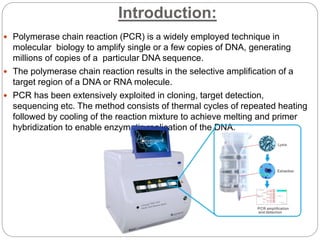
 Polymerase chain reaction (PCR) is a widely employed technique in
molecular biology to amplify single or a few copies of DNA, generating
millions of copies of a particular DNA sequence.
 The polymerase chain reaction results in the selective amplification of a
target region of a DNA or RNA molecule.
 PCR has been extensively exploited in cloning, target detection,
sequencing etc. The method consists of thermal cycles of repeated heating
followed by cooling of the reaction mixture to achieve melting and primer
hybridization to enable enzymatic replication of the DNA.
Basic Protocol for Polymerase Chain
Reaction
Components and reagents:
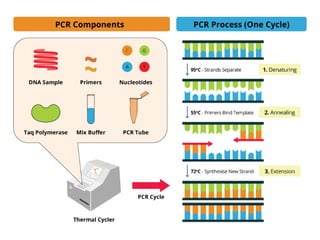
A basic PCR set up requires the following essential components and
reagents :
1. Template DNA containing the DNA region (target) to be amplified.
2. Primers that are complementary to the 5' ends of each of the sense
(Forward primer)
and anti-sense strand of the DNA target (Reverse primer).
3. Taq polymerase or other thermostable, high fidelity DNA polymerase
(Pfu polymerase
isolated from Pyrococcus furiosus).
4. Deoxyribonucleotide triphosphates (dNTPs), which are the building-
blocks for a newly
synthesized DNA strand.
5. Buffer solutions to provide a suitable chemical condition for optimum
activity and
stability of the DNA polymerases.
6. Divalent cations (eg. magnesium or manganese ions). They act as a co-
factor for Taq
Procedure:
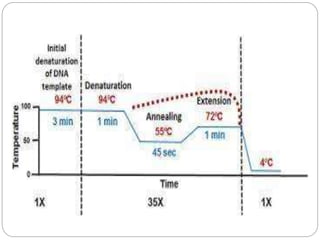
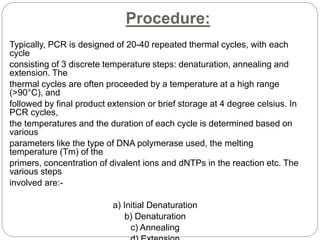
Typically, PCR is designed of 20-40 repeated thermal cycles, with each
cycle
consisting of 3 discrete temperature steps: denaturation, annealing and
extension. The
thermal cycles are often proceeded by a temperature at a high range
(>90°C), and
followed by final product extension or brief storage at 4 degree celsius. In
PCR cycles,
the temperatures and the duration of each cycle is determined based on
various
parameters like the type of DNA polymerase used, the melting
temperature (Tm) of the
primers, concentration of divalent ions and dNTPs in the reaction etc. The
various steps
involved are:-
a) Initial Denaturation
b) Denaturation
c) Annealing
Initial denaturation:
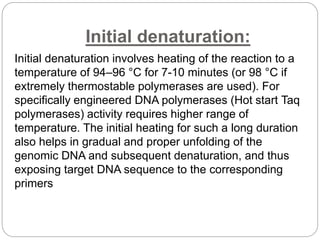
Initial denaturation involves heating of the reaction to a
temperature of 94–96 °C for 7-10 minutes (or 98 °C if
extremely thermostable polymerases are used). For
specifically engineered DNA polymerases (Hot start Taq
polymerases) activity requires higher range of
temperature. The initial heating for such a long duration
also helps in gradual and proper unfolding of the
genomic DNA and subsequent denaturation, and thus
exposing target DNA sequence to the corresponding
primers
Denaturation:
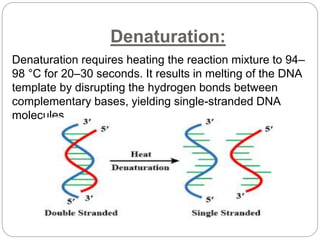
Denaturation requires heating the reaction mixture to 94–
98 °C for 20–30 seconds. It results in melting of the DNA
template by disrupting the hydrogen bonds between
complementary bases, yielding single-stranded DNA
molecules
Annealing:
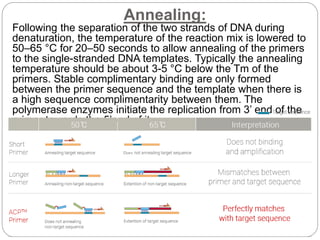
Following the separation of the two strands of DNA during
denaturation, the temperature of the reaction mix is lowered to
50–65 °C for 20–50 seconds to allow annealing of the primers
to the single-stranded DNA templates. Typically the annealing
temperature should be about 3-5 °C below the Tm of the
primers. Stable complimentary binding are only formed
between the primer sequence and the template when there is
a high sequence complimentarity between them. The
polymerase enzymes initiate the replication from 3’ end of the
primer towards the 5’end of it.
Extension/Elongation:
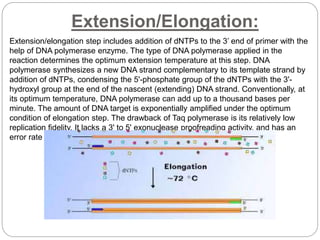
Extension/elongation step includes addition of dNTPs to the 3’ end of primer with the
help of DNA polymerase enzyme. The type of DNA polymerase applied in the
reaction determines the optimum extension temperature at this step. DNA
polymerase synthesizes a new DNA strand complementary to its template strand by
addition of dNTPs, condensing the 5'-phosphate group of the dNTPs with the 3'-
hydroxyl group at the end of the nascent (extending) DNA strand. Conventionally, at
its optimum temperature, DNA polymerase can add up to a thousand bases per
minute. The amount of DNA target is exponentially amplified under the optimum
condition of elongation step. The drawback of Taq polymerase is its relatively low
replication fidelity. It lacks a 3' to 5' exonuclease proofreading activity, and has an
error rate measured at about 1 in 9,000 nucleotides
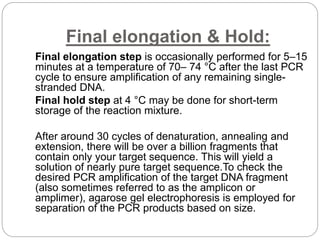
Final elongation & Hold:
Final elongation step is occasionally performed for 5–15
minutes at a temperature of 70– 74 °C after the last PCR
cycle to ensure amplification of any remaining single-
stranded DNA.
Final hold step at 4 °C may be done for short-term
storage of the reaction mixture.
After around 30 cycles of denaturation, annealing and
extension, there will be over a billion fragments that
contain only your target sequence. This will yield a
solution of nearly pure target sequence.To check the
desired PCR amplification of the target DNA fragment
(also sometimes referred to as the amplicon or
amplimer), agarose gel electrophoresis is employed for
separation of the PCR products based on size.
Key factor affecting the polymerase
chain reaction:
Designing of Primers The specificity of the PCR
depends crucially upon the primers. The following
factors are important in choosing effective primers.
a) Primers should be 17 to 30 nucleotides in length.
However for certain studies the RAPD primer length
might be of 10-12 nucleotides.
b) Ideally GC content of the primers is 50% .For
primers with a low GC content, it is desirable to
choose a long primer so as to avoid a low melting
temperature.
c) Sequences with long runs (i.e. more than three or
four) of a single nucleotide should be avoided.
d) Primers with significant secondary structures (self –
hair pin, loop formation) are undesirable
Applications
1. Infectious disease diagnosis, progression and response to
therapy: PCR technology facilitates the detection of DNA or
RNA of pathogenic organisms and, as such, helps in clinical
diagnostic tests for a range of infectious agents like viruses,
bacteria, protozoa etc. These PCR-based tests have numerous
advantages over conventional antibody-based diagnostic
methods that determine the body's immune response to a
pathogen.
2. Diagnosis of genetic diseases: The use of PCR in diagnosing
genetic diseases, whether due to innate genetic changes or as
a result of a natural genetic mutations, is becoming more
common. Abnormality can be diagnosed even prior to birth.
3. Genetic counselling : done for the parents to check the
account of genetic disease beforehand to make a decision on
having children.
4. Forensic sciences: Genetic fingerprint is one of the most
exploited application of PCR (also known as DNA profiling).
5. Research in Molecular Biology: PCR is an essential
technique in cloning procedure which allows generation of large
Development of high-speed nanoPCR technology
for point-of-care diagnosis of COVID-19
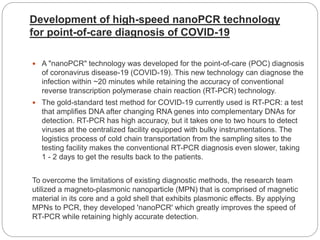
 A "nanoPCR" technology was developed for the point-of-care (POC) diagnosis
of coronavirus disease-19 (COVID-19). This new technology can diagnose the
infection within ~20 minutes while retaining the accuracy of conventional
reverse transcription polymerase chain reaction (RT-PCR) technology.
 The gold-standard test method for COVID-19 currently used is RT-PCR: a test
that amplifies DNA after changing RNA genes into complementary DNAs for
detection. RT-PCR has high accuracy, but it takes one to two hours to detect
viruses at the centralized facility equipped with bulky instrumentations. The
logistics process of cold chain transportation from the sampling sites to the
testing facility makes the conventional RT-PCR diagnosis even slower, taking
1 - 2 days to get the results back to the patients.
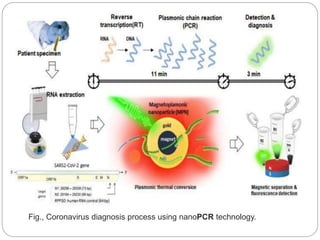
To overcome the limitations of existing diagnostic methods, the research team
utilized a magneto-plasmonic nanoparticle (MPN) that is comprised of magnetic
material in its core and a gold shell that exhibits plasmonic effects. By applying
MPNs to PCR, they developed 'nanoPCR' which greatly improves the speed of
RT-PCR while retaining highly accurate detection.
Fig., Coronavirus diagnosis process using nanoPCR technology.
PCR.pptx

PCR.pptx

  • 1.
    PHARMACEUTICAL BIOTECHNOLOGY By :Ishika Choudhary Topic:POLYMERASE CHAIN REACTION (PCR) & ITS APPLICATIONS
  • 2.
    Introduction:  Polymerase chainreaction (PCR) is a widely employed technique in molecular biology to amplify single or a few copies of DNA, generating millions of copies of a particular DNA sequence.  The polymerase chain reaction results in the selective amplification of a target region of a DNA or RNA molecule.  PCR has been extensively exploited in cloning, target detection, sequencing etc. The method consists of thermal cycles of repeated heating followed by cooling of the reaction mixture to achieve melting and primer hybridization to enable enzymatic replication of the DNA.
  • 3.
    Basic Protocol forPolymerase Chain Reaction Components and reagents: A basic PCR set up requires the following essential components and reagents : 1. Template DNA containing the DNA region (target) to be amplified. 2. Primers that are complementary to the 5' ends of each of the sense (Forward primer) and anti-sense strand of the DNA target (Reverse primer). 3. Taq polymerase or other thermostable, high fidelity DNA polymerase (Pfu polymerase isolated from Pyrococcus furiosus). 4. Deoxyribonucleotide triphosphates (dNTPs), which are the building- blocks for a newly synthesized DNA strand. 5. Buffer solutions to provide a suitable chemical condition for optimum activity and stability of the DNA polymerases. 6. Divalent cations (eg. magnesium or manganese ions). They act as a co- factor for Taq
  • 5.
    Procedure: Typically, PCR isdesigned of 20-40 repeated thermal cycles, with each cycle consisting of 3 discrete temperature steps: denaturation, annealing and extension. The thermal cycles are often proceeded by a temperature at a high range (>90°C), and followed by final product extension or brief storage at 4 degree celsius. In PCR cycles, the temperatures and the duration of each cycle is determined based on various parameters like the type of DNA polymerase used, the melting temperature (Tm) of the primers, concentration of divalent ions and dNTPs in the reaction etc. The various steps involved are:- a) Initial Denaturation b) Denaturation c) Annealing
  • 7.
    Initial denaturation: Initial denaturationinvolves heating of the reaction to a temperature of 94–96 °C for 7-10 minutes (or 98 °C if extremely thermostable polymerases are used). For specifically engineered DNA polymerases (Hot start Taq polymerases) activity requires higher range of temperature. The initial heating for such a long duration also helps in gradual and proper unfolding of the genomic DNA and subsequent denaturation, and thus exposing target DNA sequence to the corresponding primers
  • 8.
    Denaturation: Denaturation requires heatingthe reaction mixture to 94– 98 °C for 20–30 seconds. It results in melting of the DNA template by disrupting the hydrogen bonds between complementary bases, yielding single-stranded DNA molecules
  • 9.
    Annealing: Following the separationof the two strands of DNA during denaturation, the temperature of the reaction mix is lowered to 50–65 °C for 20–50 seconds to allow annealing of the primers to the single-stranded DNA templates. Typically the annealing temperature should be about 3-5 °C below the Tm of the primers. Stable complimentary binding are only formed between the primer sequence and the template when there is a high sequence complimentarity between them. The polymerase enzymes initiate the replication from 3’ end of the primer towards the 5’end of it.
  • 10.
    Extension/Elongation: Extension/elongation step includesaddition of dNTPs to the 3’ end of primer with the help of DNA polymerase enzyme. The type of DNA polymerase applied in the reaction determines the optimum extension temperature at this step. DNA polymerase synthesizes a new DNA strand complementary to its template strand by addition of dNTPs, condensing the 5'-phosphate group of the dNTPs with the 3'- hydroxyl group at the end of the nascent (extending) DNA strand. Conventionally, at its optimum temperature, DNA polymerase can add up to a thousand bases per minute. The amount of DNA target is exponentially amplified under the optimum condition of elongation step. The drawback of Taq polymerase is its relatively low replication fidelity. It lacks a 3' to 5' exonuclease proofreading activity, and has an error rate measured at about 1 in 9,000 nucleotides
  • 11.
    Final elongation &Hold: Final elongation step is occasionally performed for 5–15 minutes at a temperature of 70– 74 °C after the last PCR cycle to ensure amplification of any remaining single- stranded DNA. Final hold step at 4 °C may be done for short-term storage of the reaction mixture. After around 30 cycles of denaturation, annealing and extension, there will be over a billion fragments that contain only your target sequence. This will yield a solution of nearly pure target sequence.To check the desired PCR amplification of the target DNA fragment (also sometimes referred to as the amplicon or amplimer), agarose gel electrophoresis is employed for separation of the PCR products based on size.
  • 12.
    Key factor affectingthe polymerase chain reaction: Designing of Primers The specificity of the PCR depends crucially upon the primers. The following factors are important in choosing effective primers. a) Primers should be 17 to 30 nucleotides in length. However for certain studies the RAPD primer length might be of 10-12 nucleotides. b) Ideally GC content of the primers is 50% .For primers with a low GC content, it is desirable to choose a long primer so as to avoid a low melting temperature. c) Sequences with long runs (i.e. more than three or four) of a single nucleotide should be avoided. d) Primers with significant secondary structures (self – hair pin, loop formation) are undesirable
  • 13.
    Applications 1. Infectious diseasediagnosis, progression and response to therapy: PCR technology facilitates the detection of DNA or RNA of pathogenic organisms and, as such, helps in clinical diagnostic tests for a range of infectious agents like viruses, bacteria, protozoa etc. These PCR-based tests have numerous advantages over conventional antibody-based diagnostic methods that determine the body's immune response to a pathogen. 2. Diagnosis of genetic diseases: The use of PCR in diagnosing genetic diseases, whether due to innate genetic changes or as a result of a natural genetic mutations, is becoming more common. Abnormality can be diagnosed even prior to birth. 3. Genetic counselling : done for the parents to check the account of genetic disease beforehand to make a decision on having children. 4. Forensic sciences: Genetic fingerprint is one of the most exploited application of PCR (also known as DNA profiling). 5. Research in Molecular Biology: PCR is an essential technique in cloning procedure which allows generation of large
  • 14.
    Development of high-speednanoPCR technology for point-of-care diagnosis of COVID-19  A "nanoPCR" technology was developed for the point-of-care (POC) diagnosis of coronavirus disease-19 (COVID-19). This new technology can diagnose the infection within ~20 minutes while retaining the accuracy of conventional reverse transcription polymerase chain reaction (RT-PCR) technology.  The gold-standard test method for COVID-19 currently used is RT-PCR: a test that amplifies DNA after changing RNA genes into complementary DNAs for detection. RT-PCR has high accuracy, but it takes one to two hours to detect viruses at the centralized facility equipped with bulky instrumentations. The logistics process of cold chain transportation from the sampling sites to the testing facility makes the conventional RT-PCR diagnosis even slower, taking 1 - 2 days to get the results back to the patients. To overcome the limitations of existing diagnostic methods, the research team utilized a magneto-plasmonic nanoparticle (MPN) that is comprised of magnetic material in its core and a gold shell that exhibits plasmonic effects. By applying MPNs to PCR, they developed 'nanoPCR' which greatly improves the speed of RT-PCR while retaining highly accurate detection.
  • 15.
    Fig., Coronavirus diagnosisprocess using nanoPCR technology.