
Chloroplast Transformation and its
Applications to Plant Improvement
Presented by
Jajati Keshari Nayak
Dept of MBGE
ID-55493 jajatikesharinayak00@gmail.com
What is organell transformation.??
• Chloroplast and mitochondria are semi autonomous
organ.They have their own DNA and produces protein. So
transfer of gene of interest to these targated organelle is
called organell transformation.
WHY CHLOROPLAST..??
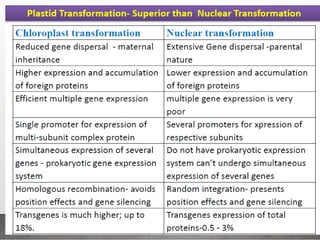
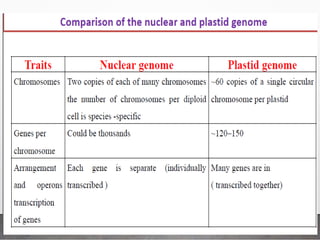
Nuclear genome is large and contains several copies of the
same gene.
Presence of introns,
Cis-elements
Purification of protein is quite diificult I nuclear genome.
Absence of epigenetic effects
 Uni-parental inheritance is commercially favored
Easy transgene stacking in operons
Absence of position effects due to lack of a compact
chromatin structure
Contd…
High level of transgene expression and protein
accumulation
The possibility of co-expressing several transgenes in
operons
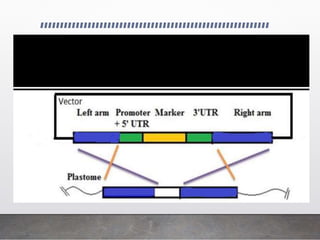
The precise transgene integration by homologous
recombination .
The feasibility of expressing multiple proteins from
polycistronic mRNAs
 Regeneration of crop plants with higher resistance to
biotic and abiotic stresses and molecular pharming.
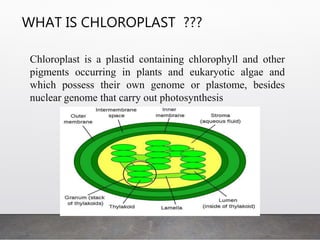
WHAT IS CHLOROPLAST ???
Chloroplast is a plastid containing chlorophyll and other
pigments occurring in plants and eukaryotic algae and
which possess their own genome or plastome, besides
nuclear genome that carry out photosynthesis
Why Chloroplast is a Unique
Transformation tools..???
Protein accumulator - soluble proteins and intrinsic
membrane proteins.
 Cellular location for valuable recombinant products
 Own genetic systems and genomes, high copy
number, transcription translation machinery.
Plastid posses prokaryotic gene expression machinery.
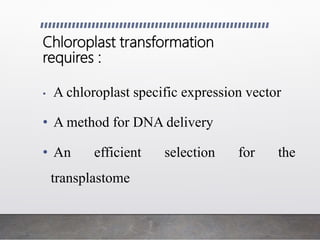
Chloroplast transformation
requires :
• A chloroplast specific expression vector
• A method for DNA delivery
• An efficient selection for the
transplastome
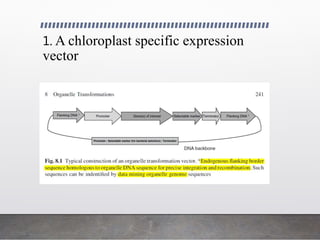
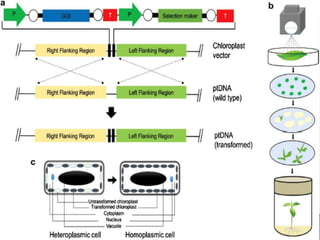
1. A chloroplast specific expression
vector
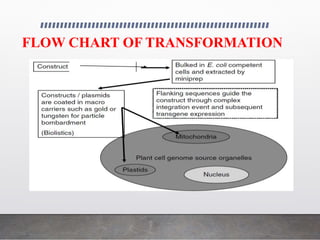
FLOW CHART OF TRANSFORMATION
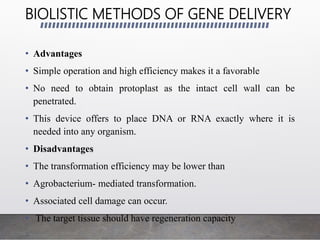
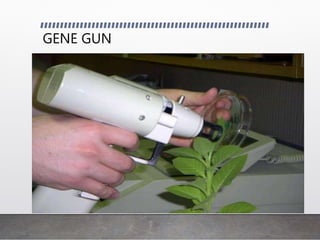
BIOLISTIC METHODS OF GENE DELIVERY
• Advantages
• Simple operation and high efficiency makes it a favorable
• No need to obtain protoplast as the intact cell wall can be
penetrated.
• This device offers to place DNA or RNA exactly where it is
needed into any organism.
• Disadvantages
• The transformation efficiency may be lower than
• Agrobacterium- mediated transformation.
• Associated cell damage can occur.
• The target tissue should have regeneration capacity
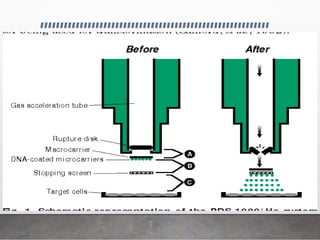
GENE GUN
PEG METHODS OF GENE DELIVERY
• PEG-mediated transformation of plastids requires enzymatically
• removing the cell wall to obtain protoplasts, then exposing the
protoplasts to purified DNA in the presence of PEG.
• The protoplasts first shrink in the presence of PEG, then lyse due to
disintegration of the cell membrane.
• Removing PEG before the membrane is irreversibly damaged reverses
the process.
• Treatment of freshly isolated protoplasts with PEG allows
permeabilization of the plasma membrane and facilitates uptake of DNA.
• A relatively small number of species have been transformed using this
approach, mainly because it requires efficient isolation, culture and
regeneration of protoplasts, a tedious and technically demanding in vitro
technology
Vector Design for Chloroplast
Transformation
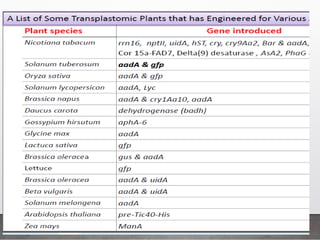
• Spectinomycin resistance- The most efficient and routinely used
• 16S rRNA (rrn16) gene- Initially used and selected by spectinomycin
resistance with low efficiency.
• aadA (aminoglycoside 3′ adenylyltransferase) gene- Dominant
• marker gene that confers resistance to streptomycin and spectinomycin
by inactivation of antibiotics.
• Plastid expressed GFP (green fluorescent protein)- a visual marker
• for identification of plastid transformants at the early stage of selection and
shoot regeneration.
• The npt II- Transformation efficiency was low, i.e. about one
transplastomic line per 25 bombarded samples
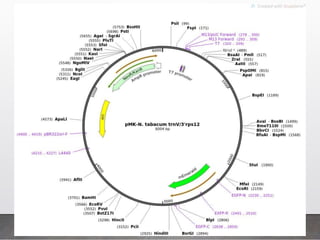
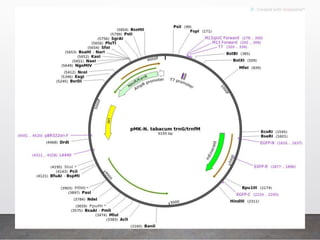
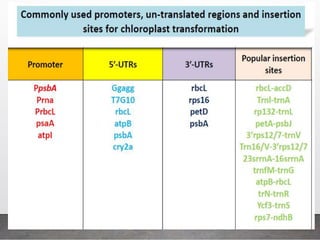
Insertion sites
• Insertion of foreign DNA in intergenic regions of the plastid
genome had been accomplished at 16 sites, most commonly
used insertion sites are - trnV-3'rps12 ,trnI-trnA and trnfM-
trnG
• The trnV-3'rps12 and trnI-trnA sites- located in the 25 kb
inverted repeat (IR) region of ptDNA and a gene inserted
into these sites would be rapidly copied into two copies in
the IR region
Regulatory sequences
• The level of gene expression in plastids is predominately determined
by regulatory sequences such as promoter as well as 5′ UTR elements
.
• Strong promoter is required to ensure high mRNA level for highlevel
of protein accumulation e.g. rRNA operon (rrn) promoter (Prrn).
• Most commonly used promoter is CaMV 35S promoter cauliflower
mosaic virus which drives high level of transgene expression in dicots.
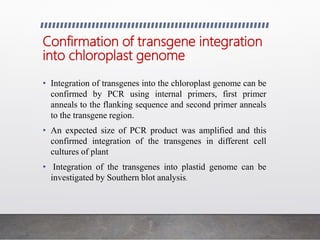
Confirmation of transgene integration
into chloroplast genome
• Integration of transgenes into the chloroplast genome can be
confirmed by PCR using internal primers, first primer
anneals to the flanking sequence and second primer anneals
to the transgene region.
• An expected size of PCR product was amplified and this
confirmed integration of the transgenes in different cell
cultures of plant
• Integration of the transgenes into plastid genome can be
investigated by Southern blot analysis.
APPLICATION
Production of biopharmaceuticals and
vaccines in plants
• Protein drugs made by plant chloroplasts overcome most of these
challenges like expensive fermentation systems, prohibitively
expensive purification from host proteins, the need for refrigerated
storage and transport.
• E7 HPV type 16 protein is an attractive candidate for anticancer
vaccine development in Tobacco.
• Plastid transformation systems became successful in the oral delivery
of vaccine antigens against cholera, tetanus, anthrax, plague, and
canine parvovirus.
• Above 7.6% Protein accumulation . Example- OspA
PHYTOREMADIATION
• Phytoremediation is a safe and cost-effective system for
cleaning up contaminated environments using plants.
• Two bacterial genes encoding two enzymes, mercuric ion
reductase (merA) and organomercurial lyase (merB), were
expressed as an operon in transgenic tobacco chloroplasts.
• Phytoremediation of toxic mercury was achieved by
engineering of tobacco chloroplast with metallothionein
enzyme
Production of industrial enzymes and
biomaterials
• To produced the highest level of the poly (p-
hydroxybenzoic acid (pHBA) polymer (25% dry
weight) in normal healthy plants poly hydroxy
butyrate (PHB) was designed using an operon
extension strategy
• To date, the highest levels of PHB have been achieved
in plastids due to the high flux of the PHB pathway
substrate acetyl-CoA through this organelle during
fatty acid biosynthesis
Chloroplast transformation

Chloroplast transformation

  • 1.
    Chloroplast Transformation andits Applications to Plant Improvement Presented by Jajati Keshari Nayak Dept of MBGE ID-55493 jajatikesharinayak00@gmail.com
  • 2.
    What is organelltransformation.?? • Chloroplast and mitochondria are semi autonomous organ.They have their own DNA and produces protein. So transfer of gene of interest to these targated organelle is called organell transformation.
  • 3.
    WHY CHLOROPLAST..?? Nuclear genomeis large and contains several copies of the same gene. Presence of introns, Cis-elements Purification of protein is quite diificult I nuclear genome. Absence of epigenetic effects  Uni-parental inheritance is commercially favored Easy transgene stacking in operons Absence of position effects due to lack of a compact chromatin structure
  • 4.
    Contd… High level oftransgene expression and protein accumulation The possibility of co-expressing several transgenes in operons The precise transgene integration by homologous recombination . The feasibility of expressing multiple proteins from polycistronic mRNAs  Regeneration of crop plants with higher resistance to biotic and abiotic stresses and molecular pharming.
  • 6.
    WHAT IS CHLOROPLAST??? Chloroplast is a plastid containing chlorophyll and other pigments occurring in plants and eukaryotic algae and which possess their own genome or plastome, besides nuclear genome that carry out photosynthesis
  • 7.
    Why Chloroplast isa Unique Transformation tools..??? Protein accumulator - soluble proteins and intrinsic membrane proteins.  Cellular location for valuable recombinant products  Own genetic systems and genomes, high copy number, transcription translation machinery. Plastid posses prokaryotic gene expression machinery.
  • 10.
    Chloroplast transformation requires : •A chloroplast specific expression vector • A method for DNA delivery • An efficient selection for the transplastome
  • 11.
    1. A chloroplastspecific expression vector
  • 12.
    FLOW CHART OFTRANSFORMATION
  • 14.
    BIOLISTIC METHODS OFGENE DELIVERY • Advantages • Simple operation and high efficiency makes it a favorable • No need to obtain protoplast as the intact cell wall can be penetrated. • This device offers to place DNA or RNA exactly where it is needed into any organism. • Disadvantages • The transformation efficiency may be lower than • Agrobacterium- mediated transformation. • Associated cell damage can occur. • The target tissue should have regeneration capacity
  • 16.
  • 17.
    PEG METHODS OFGENE DELIVERY • PEG-mediated transformation of plastids requires enzymatically • removing the cell wall to obtain protoplasts, then exposing the protoplasts to purified DNA in the presence of PEG. • The protoplasts first shrink in the presence of PEG, then lyse due to disintegration of the cell membrane. • Removing PEG before the membrane is irreversibly damaged reverses the process. • Treatment of freshly isolated protoplasts with PEG allows permeabilization of the plasma membrane and facilitates uptake of DNA. • A relatively small number of species have been transformed using this approach, mainly because it requires efficient isolation, culture and regeneration of protoplasts, a tedious and technically demanding in vitro technology
  • 19.
    Vector Design forChloroplast Transformation • Spectinomycin resistance- The most efficient and routinely used • 16S rRNA (rrn16) gene- Initially used and selected by spectinomycin resistance with low efficiency. • aadA (aminoglycoside 3′ adenylyltransferase) gene- Dominant • marker gene that confers resistance to streptomycin and spectinomycin by inactivation of antibiotics. • Plastid expressed GFP (green fluorescent protein)- a visual marker • for identification of plastid transformants at the early stage of selection and shoot regeneration. • The npt II- Transformation efficiency was low, i.e. about one transplastomic line per 25 bombarded samples
  • 20.
    Insertion sites • Insertionof foreign DNA in intergenic regions of the plastid genome had been accomplished at 16 sites, most commonly used insertion sites are - trnV-3'rps12 ,trnI-trnA and trnfM- trnG • The trnV-3'rps12 and trnI-trnA sites- located in the 25 kb inverted repeat (IR) region of ptDNA and a gene inserted into these sites would be rapidly copied into two copies in the IR region
  • 23.
    Regulatory sequences • Thelevel of gene expression in plastids is predominately determined by regulatory sequences such as promoter as well as 5′ UTR elements . • Strong promoter is required to ensure high mRNA level for highlevel of protein accumulation e.g. rRNA operon (rrn) promoter (Prrn). • Most commonly used promoter is CaMV 35S promoter cauliflower mosaic virus which drives high level of transgene expression in dicots.
  • 25.
    Confirmation of transgeneintegration into chloroplast genome • Integration of transgenes into the chloroplast genome can be confirmed by PCR using internal primers, first primer anneals to the flanking sequence and second primer anneals to the transgene region. • An expected size of PCR product was amplified and this confirmed integration of the transgenes in different cell cultures of plant • Integration of the transgenes into plastid genome can be investigated by Southern blot analysis.
  • 26.
    APPLICATION Production of biopharmaceuticalsand vaccines in plants • Protein drugs made by plant chloroplasts overcome most of these challenges like expensive fermentation systems, prohibitively expensive purification from host proteins, the need for refrigerated storage and transport. • E7 HPV type 16 protein is an attractive candidate for anticancer vaccine development in Tobacco. • Plastid transformation systems became successful in the oral delivery of vaccine antigens against cholera, tetanus, anthrax, plague, and canine parvovirus. • Above 7.6% Protein accumulation . Example- OspA
  • 27.
    PHYTOREMADIATION • Phytoremediation isa safe and cost-effective system for cleaning up contaminated environments using plants. • Two bacterial genes encoding two enzymes, mercuric ion reductase (merA) and organomercurial lyase (merB), were expressed as an operon in transgenic tobacco chloroplasts. • Phytoremediation of toxic mercury was achieved by engineering of tobacco chloroplast with metallothionein enzyme
  • 28.
    Production of industrialenzymes and biomaterials • To produced the highest level of the poly (p- hydroxybenzoic acid (pHBA) polymer (25% dry weight) in normal healthy plants poly hydroxy butyrate (PHB) was designed using an operon extension strategy • To date, the highest levels of PHB have been achieved in plastids due to the high flux of the PHB pathway substrate acetyl-CoA through this organelle during fatty acid biosynthesis