
PCR
Polymerase Chain Reaction
Thermocycler.
Typies & Applications
BY: AQEEL HADITHE
osmania university
BIOCHEMISTRY
sem. III
1007-13-514-005
20-9-2014
( Very good mind behind
this techniques )
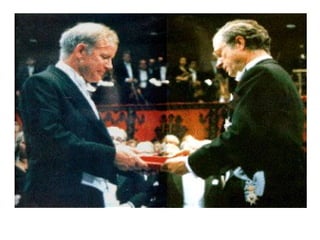
Kary Banks Mullis - 1983
a scientist working for the ( Cetus Corporation )
A Biotech Company of USA - northern California
when he came up with the idea for the polymerase chain
reaction.
-----------------------------------------------------------------
Polymerase Chain Reaction
• Polymerase chain reaction (PCR) :- Is nucleic acid amplification
technology , that allows small amounts of genetic material to be
amplified into billions of copies in just a few hours .
---( enzymatically replicating of DNA without using a living
organism, such as E. coli or yeast )
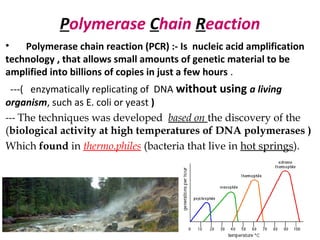
--- The techniques was developed based on the discovery of the
(biological activity at high temperatures of DNA polymerases )
Which found in thermo.philes (bacteria that live in hot springs).
Materials needed for PCR
(Reaction Components)Reaction Components)
--------------------------------------------------------------------------------------
1- Target DNA (the DNA you want to copy)
( DNA region to be amplified )
The DNA can be from - animals
- plants
- viruses
- bacteria.
Range concentration - 1-2 µl ( for a total reaction mixture of 10 µl)
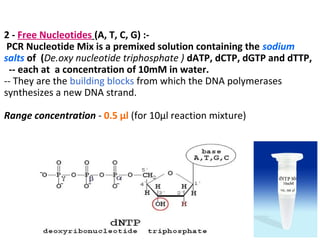
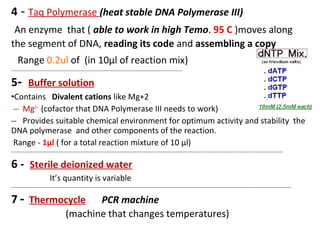
2 - Free Nucleotides (A, T, C, G) :-
PCR Nucleotide Mix is a premixed solution containing the sodium
salts of (De.oxy nucleotide triphosphate ) dATP, dCTP, dGTP and dTTP,
-- each at a concentration of 10mM in water.
-- They are the building blocks from which the DNA polymerases
synthesizes a new DNA strand.
Range concentration - 0.5 µl (for 10µl reaction mixture)
3- DNA Primers ( not RNA Primes )
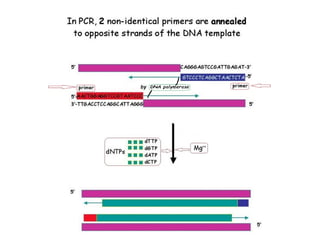
-- Two primers ( forward & reverse )
-- short.long -20 nucleotides sd –DNA ( oligonucleotides )
that are synthesized to correspond to the ( beginning and
ending ) of the DNA stretch to be copied .
-- They are complementary to the 5' or 3' ends of the DNA region
-- Optimal length of PCR primers is ( 18-22 bp )
Range conc. - 1 µl ( for a total reaction mixture of 10 µl)
------------------------------------------------------------------------------------------------------------------------------------
* We can also use RNA primer in PCR But There are two main
reason why we are not using it :-
-- first point :- is ( tability )
DNA primer is more stable than RNA
-- second point :- is ( hybridi.zation )
DNA primer bind to template more efficient than RNA primer.
• Primers: Short artificial DNA sequences which define the DNA sequence to be
amplified as they bind (anneal) to the DNA template and act as starting
points for the DNA polymerase.
• - specificity and the temperature of annealing are ----- ( partly dependent )on
primer length
• The primers should be ~20 bases ( long enough for adequate thespecificity ),
and short enough to bind easily to the template at the annealing temperature.
• the primers should not be too short ----- ( as specificity decreases )
Primer length
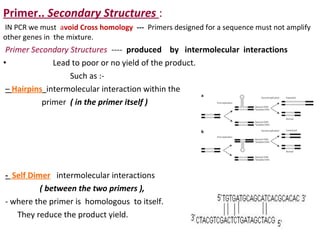
Primer.. Secondary Structures :
IN PCR we must avoid Cross homology --- Primers designed for a sequence must not amplify
other genes in the mixture.
Primer Secondary Structures ---- produced by intermolecular interactions
• Lead to poor or no yield of the product.
Such as :-
– Hairpins intermolecular interaction within the
primer ( in the primer itself )
- Self Dimer intermolecular interactions
( between the two primers ),
- where the primer is homologous to itself.
They reduce the product yield.
4 - Taq Polymerase (heat stable DNA Polymerase III)
An enzyme that ( able to work in high Temo. 95 C )moves along
the segment of DNA, reading its code and assembling a copy
Range 0.2ul of (in 10µl of reaction mix)
-------------------------------------------------------------------------------------------------------------------
5- Buffer solution
•Contains Divalent cations like Mg+2
-- Mg2+
(cofactor that DNA Polymerase III needs to work)
-- Provides suitable chemical environment for optimum activity and stability the
DNA polymerase and other components of the reaction.
Range - 1µl ( for a total reaction mixture of 10 µl)
---------------------------------------------------------------------------------------------------------------------------------------------------------------------
6 - Sterile deionized water
It’s quantity is variable
--------------------------------------------------------------------------------------------------------------------------------------------------------------------------
7 - Thermocycle PCR machine
(machine that changes temperatures)
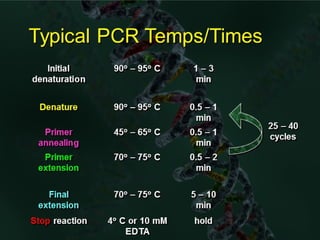
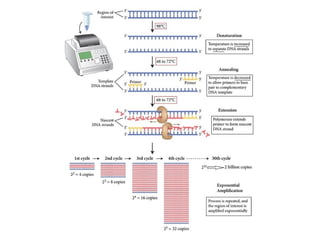
PCR is repeated cycling of three steps:
1. Denature DNA
The DNA is heated to 95° C. This breaks the weak hydrogen bonds that hold
DNA strands together in a helix, allowing the strands to separate creating single
stranded DNA.
2. Primer Annealing
The mixture is cooled to 50° C. This allows the primers to bind (anneal) to their
complementary sequence in the template DNA.
3. Extension
The reaction is then heated to 72° C, the optimal temperature for DNA
polymerase to act. DNA polymerase extends the primers, adding nucleotides onto
the primer in a sequential manner, using the target DNA as a template.
4. Go to Step 1  ( 20 - 35 X )
--------------------------------------------------------------------------------------
- These steps are repeated 20-35 times.
- In PCR, amplification is exponential because for each cycle, the DNA made in
the previous cycles can also serve as template .
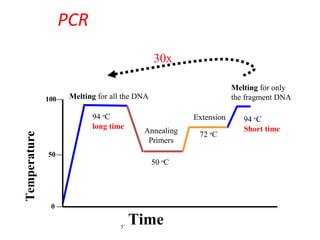
PCR
Melting for all the DNA
94 o
C
long time
Melting for only
the fragment DNA
94 o
C
Short timeAnnealing
Primers
50 o
C
Extension
72 o
C
Temperature
100
0
50
Time
30x
5’
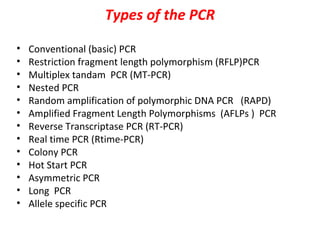
Types of the PCR
• Conventional (basic) PCR
• Restriction fragment length polymorphism (RFLP)PCR
• Multiplex tandam PCR (MT-PCR)
• Nested PCR
• Random amplification of polymorphic DNA PCR (RAPD)
• Amplified Fragment Length Polymorphisms (AFLPs ) PCR
• Reverse Transcriptase PCR (RT-PCR)
• Real time PCR (Rtime-PCR)
• Colony PCR
• Hot Start PCR
• Asymmetric PCR
• Long PCR
• Allele specific PCR
Some of PCR application
1 - DNA fingerprinting
2 - Production of DNA for sequencing
3 - Mapping the human genome
4 - The isolation of a particular gene
5 - Generation of probes
6 - Cloning a Gene encoding a known protein
7 - Amplification of ( old DNA - cloned DNA from Vectors )
8 - Detecting Bacterial or Viral Infection
a- AIDS infection
b- Tuberculosis (Mycobacterium tuberculosis)
9 - Genetics Diagnosis
a - Diagnosing inherited disorders
- Cystic fibrosis
- Muscular dystrophy
- Haemophilia A and B
- Sickle cell anaemia
b- Diagnosing cancer
c- Blood group typing
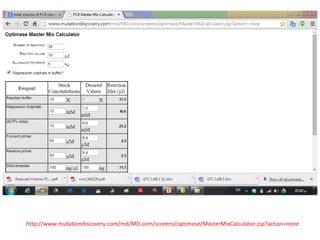
http://www.mutationdiscovery.com/md/MD.com/screens/optimase/MasterMixCalculator.jsp?action=none
PCR by AQEEL hadithe

PCR by AQEEL hadithe

  • 1.
    PCR Polymerase Chain Reaction Thermocycler. Typies& Applications BY: AQEEL HADITHE osmania university BIOCHEMISTRY sem. III 1007-13-514-005 20-9-2014
  • 2.
    ( Very goodmind behind this techniques ) Kary Banks Mullis - 1983 a scientist working for the ( Cetus Corporation ) A Biotech Company of USA - northern California when he came up with the idea for the polymerase chain reaction. -----------------------------------------------------------------
  • 4.
    Polymerase Chain Reaction •Polymerase chain reaction (PCR) :- Is nucleic acid amplification technology , that allows small amounts of genetic material to be amplified into billions of copies in just a few hours . ---( enzymatically replicating of DNA without using a living organism, such as E. coli or yeast ) --- The techniques was developed based on the discovery of the (biological activity at high temperatures of DNA polymerases ) Which found in thermo.philes (bacteria that live in hot springs).
  • 5.
    Materials needed forPCR (Reaction Components)Reaction Components) -------------------------------------------------------------------------------------- 1- Target DNA (the DNA you want to copy) ( DNA region to be amplified ) The DNA can be from - animals - plants - viruses - bacteria. Range concentration - 1-2 µl ( for a total reaction mixture of 10 µl)
  • 6.
    2 - FreeNucleotides (A, T, C, G) :- PCR Nucleotide Mix is a premixed solution containing the sodium salts of (De.oxy nucleotide triphosphate ) dATP, dCTP, dGTP and dTTP, -- each at a concentration of 10mM in water. -- They are the building blocks from which the DNA polymerases synthesizes a new DNA strand. Range concentration - 0.5 µl (for 10µl reaction mixture)
  • 7.
    3- DNA Primers( not RNA Primes ) -- Two primers ( forward & reverse ) -- short.long -20 nucleotides sd –DNA ( oligonucleotides ) that are synthesized to correspond to the ( beginning and ending ) of the DNA stretch to be copied . -- They are complementary to the 5' or 3' ends of the DNA region -- Optimal length of PCR primers is ( 18-22 bp ) Range conc. - 1 µl ( for a total reaction mixture of 10 µl) ------------------------------------------------------------------------------------------------------------------------------------ * We can also use RNA primer in PCR But There are two main reason why we are not using it :- -- first point :- is ( tability ) DNA primer is more stable than RNA -- second point :- is ( hybridi.zation ) DNA primer bind to template more efficient than RNA primer.
  • 9.
    • Primers: Shortartificial DNA sequences which define the DNA sequence to be amplified as they bind (anneal) to the DNA template and act as starting points for the DNA polymerase. • - specificity and the temperature of annealing are ----- ( partly dependent )on primer length • The primers should be ~20 bases ( long enough for adequate thespecificity ), and short enough to bind easily to the template at the annealing temperature. • the primers should not be too short ----- ( as specificity decreases ) Primer length
  • 10.
    Primer.. Secondary Structures: IN PCR we must avoid Cross homology --- Primers designed for a sequence must not amplify other genes in the mixture. Primer Secondary Structures ---- produced by intermolecular interactions • Lead to poor or no yield of the product. Such as :- – Hairpins intermolecular interaction within the primer ( in the primer itself ) - Self Dimer intermolecular interactions ( between the two primers ), - where the primer is homologous to itself. They reduce the product yield.
  • 11.
    4 - TaqPolymerase (heat stable DNA Polymerase III) An enzyme that ( able to work in high Temo. 95 C )moves along the segment of DNA, reading its code and assembling a copy Range 0.2ul of (in 10µl of reaction mix) ------------------------------------------------------------------------------------------------------------------- 5- Buffer solution •Contains Divalent cations like Mg+2 -- Mg2+ (cofactor that DNA Polymerase III needs to work) -- Provides suitable chemical environment for optimum activity and stability the DNA polymerase and other components of the reaction. Range - 1µl ( for a total reaction mixture of 10 µl) --------------------------------------------------------------------------------------------------------------------------------------------------------------------- 6 - Sterile deionized water It’s quantity is variable -------------------------------------------------------------------------------------------------------------------------------------------------------------------------- 7 - Thermocycle PCR machine (machine that changes temperatures)
  • 12.
    PCR is repeatedcycling of three steps: 1. Denature DNA The DNA is heated to 95° C. This breaks the weak hydrogen bonds that hold DNA strands together in a helix, allowing the strands to separate creating single stranded DNA. 2. Primer Annealing The mixture is cooled to 50° C. This allows the primers to bind (anneal) to their complementary sequence in the template DNA. 3. Extension The reaction is then heated to 72° C, the optimal temperature for DNA polymerase to act. DNA polymerase extends the primers, adding nucleotides onto the primer in a sequential manner, using the target DNA as a template. 4. Go to Step 1  ( 20 - 35 X ) -------------------------------------------------------------------------------------- - These steps are repeated 20-35 times. - In PCR, amplification is exponential because for each cycle, the DNA made in the previous cycles can also serve as template .
  • 14.
    PCR Melting for allthe DNA 94 o C long time Melting for only the fragment DNA 94 o C Short timeAnnealing Primers 50 o C Extension 72 o C Temperature 100 0 50 Time 30x 5’
  • 16.
    Types of thePCR • Conventional (basic) PCR • Restriction fragment length polymorphism (RFLP)PCR • Multiplex tandam PCR (MT-PCR) • Nested PCR • Random amplification of polymorphic DNA PCR (RAPD) • Amplified Fragment Length Polymorphisms (AFLPs ) PCR • Reverse Transcriptase PCR (RT-PCR) • Real time PCR (Rtime-PCR) • Colony PCR • Hot Start PCR • Asymmetric PCR • Long PCR • Allele specific PCR
  • 17.
    Some of PCRapplication 1 - DNA fingerprinting 2 - Production of DNA for sequencing 3 - Mapping the human genome 4 - The isolation of a particular gene 5 - Generation of probes 6 - Cloning a Gene encoding a known protein 7 - Amplification of ( old DNA - cloned DNA from Vectors ) 8 - Detecting Bacterial or Viral Infection a- AIDS infection b- Tuberculosis (Mycobacterium tuberculosis) 9 - Genetics Diagnosis a - Diagnosing inherited disorders - Cystic fibrosis - Muscular dystrophy - Haemophilia A and B - Sickle cell anaemia b- Diagnosing cancer c- Blood group typing
  • 18.