CLASSICAL 
CONDITIONING 
P A V L O V ’ S E X P E R I M E N T 
Pisharody Manoj Balakrishnan (33) 
Prateek Gupta (36) 
Priyanka Pillai (38) 
Samuel Deepak Srinivasan (44)
WHAT IS CONDITIONING?
CONDITIONING IS… 
• Learning which has been acquired 
through experience. 
“It is not accidental that all phenomena of 
human life are dominated by the search for 
daily bread, the oldest link connecting all 
living things, man included, surrounding 
nature.”
WHAT IS CLASSICAL CONDITIONING? 
• Classical Conditioning can be defined as a type of 
learning in which a stimulus acquires the capacity to 
evoke a reflexive response that was originally evoked 
by a different stimulus. 
• This occurs when the two stimuli have been 
associated with each other.
KEY CONCEPTS OF CLASSICAL 
CONDITIONING 
• Unconditioned Stimulus (UCS) : A stimulus that elicits a 
response without conditioning. 
• Unconditioned Response (UCR) : Automatic response 
elicited by the unconditioned stimulus. 
• Conditioned Stimulus (CS) : A neutral stimulus that when 
paired with an unconditioned stimulus (UCS) elicits a similar 
response. 
• Conditioned Response (CR) : A response that is learned by 
pairing the originally neutral conditioned stimulus (CS) with 
the unconditioned stimulus (UCS).
Let’s watch a video...
IVAN PAVLOV 
IVAN PAVLOV 
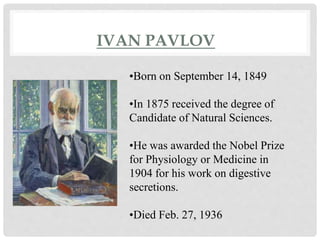
•Born on September 14, 1849 
•In 1875 received the degree of 
Candidate of Natural Sciences. 
•He was awarded the Nobel Prize 
for Physiology or Medicine in 
1904 for his work on digestive 
secretions. 
•Died Feb. 27, 1936
Don’t become a mere 
recorder of facts, but try to 
penetrate the mystery of 
their origin.
PAVLOV’S EXPERIMENT
CONDITIONING EXERCISE: 
• Close your eyes. 
• Think about your favorite food. 
• Is your mouth watering? 
• If so, it’s because you are conditioned.
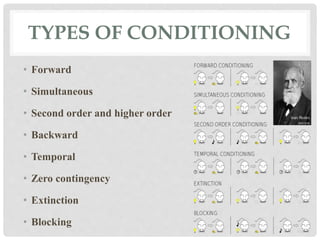
TYPES OF CONDITIONING 
• Forward 
• Simultaneous 
• Second order and higher order 
• Backward 
• Temporal 
• Zero contingency 
• Extinction 
• Blocking
KEY PROCESSES INVOLVED 
• Acquisition 
• External Inhibition 
• Recovery from extinction 
• Stimulus generalization 
• Stimulus discrimination 
• Latent inhibition 
• Conditional suppression 
• Conditioned inhibition
THEORIES 
• Data sources 
• Stimulus substitution 
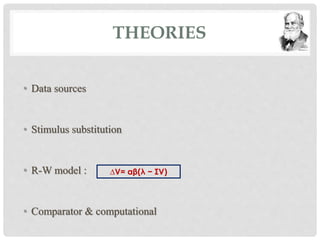
• R-W model : 
ΔV= αβ(λ − ΣV) 
• Comparator & computational
APPLICATIONS 
P A V L O V ’ S E X P E R I M E N T
NEURAL BASIS OF LEARNING AND 
MEMORY
CONDITIONED HUNGER
BEHAVIOURAL THERAPIES 
Flooding 
Aversion therapy 
Systematic 
desensitization
CONDITIONAL DRUG RESPONSE
CONDITIONAL EMOTIONAL 
RESPONSE
Some more 
applications…
THE AXE EFFECT
ENTERTAINMENT
EMOTIONAL LABOUR
AT RESTAURANT
CONCLUSION 
• According to Pavlov, conditioned reflexes were 
temporary or unstable. 
• Pavlov himself said that it is not an ideal education 
theory. 
• Classical conditioning is not a change in the 
behaviour but a similar response to a different 
stimulus. 
• Classical conditioning = Ineffective for classroom 
purposes.
JOHN WATSON’S LITTLE ALBERT 
EXPERIMENT
BIBLIOGRAPHY 
• http://en.wikipedia.org/wiki/Classical_conditioning 
• http://psychology.about.com/od/behavioralpsyhol 
ogy/a/classcond.htm 
• http://www.youtube.com (For content)
Thank you !!

Pavlov's experiment

  • 1.
    CLASSICAL CONDITIONING PA V L O V ’ S E X P E R I M E N T Pisharody Manoj Balakrishnan (33) Prateek Gupta (36) Priyanka Pillai (38) Samuel Deepak Srinivasan (44)
  • 2.
  • 3.
    CONDITIONING IS… •Learning which has been acquired through experience. “It is not accidental that all phenomena of human life are dominated by the search for daily bread, the oldest link connecting all living things, man included, surrounding nature.”
  • 4.
    WHAT IS CLASSICALCONDITIONING? • Classical Conditioning can be defined as a type of learning in which a stimulus acquires the capacity to evoke a reflexive response that was originally evoked by a different stimulus. • This occurs when the two stimuli have been associated with each other.
  • 5.
    KEY CONCEPTS OFCLASSICAL CONDITIONING • Unconditioned Stimulus (UCS) : A stimulus that elicits a response without conditioning. • Unconditioned Response (UCR) : Automatic response elicited by the unconditioned stimulus. • Conditioned Stimulus (CS) : A neutral stimulus that when paired with an unconditioned stimulus (UCS) elicits a similar response. • Conditioned Response (CR) : A response that is learned by pairing the originally neutral conditioned stimulus (CS) with the unconditioned stimulus (UCS).
  • 6.
  • 7.
    IVAN PAVLOV IVANPAVLOV •Born on September 14, 1849 •In 1875 received the degree of Candidate of Natural Sciences. •He was awarded the Nobel Prize for Physiology or Medicine in 1904 for his work on digestive secretions. •Died Feb. 27, 1936
  • 8.
    Don’t become amere recorder of facts, but try to penetrate the mystery of their origin.
  • 9.
  • 10.
    CONDITIONING EXERCISE: •Close your eyes. • Think about your favorite food. • Is your mouth watering? • If so, it’s because you are conditioned.
  • 12.
    TYPES OF CONDITIONING • Forward • Simultaneous • Second order and higher order • Backward • Temporal • Zero contingency • Extinction • Blocking
  • 13.
    KEY PROCESSES INVOLVED • Acquisition • External Inhibition • Recovery from extinction • Stimulus generalization • Stimulus discrimination • Latent inhibition • Conditional suppression • Conditioned inhibition
  • 14.
    THEORIES • Datasources • Stimulus substitution • R-W model : ΔV= αβ(λ − ΣV) • Comparator & computational
  • 15.
    APPLICATIONS P AV L O V ’ S E X P E R I M E N T
  • 16.
    NEURAL BASIS OFLEARNING AND MEMORY
  • 17.
  • 18.
    BEHAVIOURAL THERAPIES Flooding Aversion therapy Systematic desensitization
  • 19.
  • 21.
  • 22.
  • 23.
  • 24.
  • 25.
  • 26.
  • 27.
    CONCLUSION • Accordingto Pavlov, conditioned reflexes were temporary or unstable. • Pavlov himself said that it is not an ideal education theory. • Classical conditioning is not a change in the behaviour but a similar response to a different stimulus. • Classical conditioning = Ineffective for classroom purposes.
  • 28.
    JOHN WATSON’S LITTLEALBERT EXPERIMENT
  • 29.
    BIBLIOGRAPHY • http://en.wikipedia.org/wiki/Classical_conditioning • http://psychology.about.com/od/behavioralpsyhol ogy/a/classcond.htm • http://www.youtube.com (For content)
  • 30.