Lecture Slides 
Chapter Five 
Learning 
By Glenn Meyer 
Trinity University
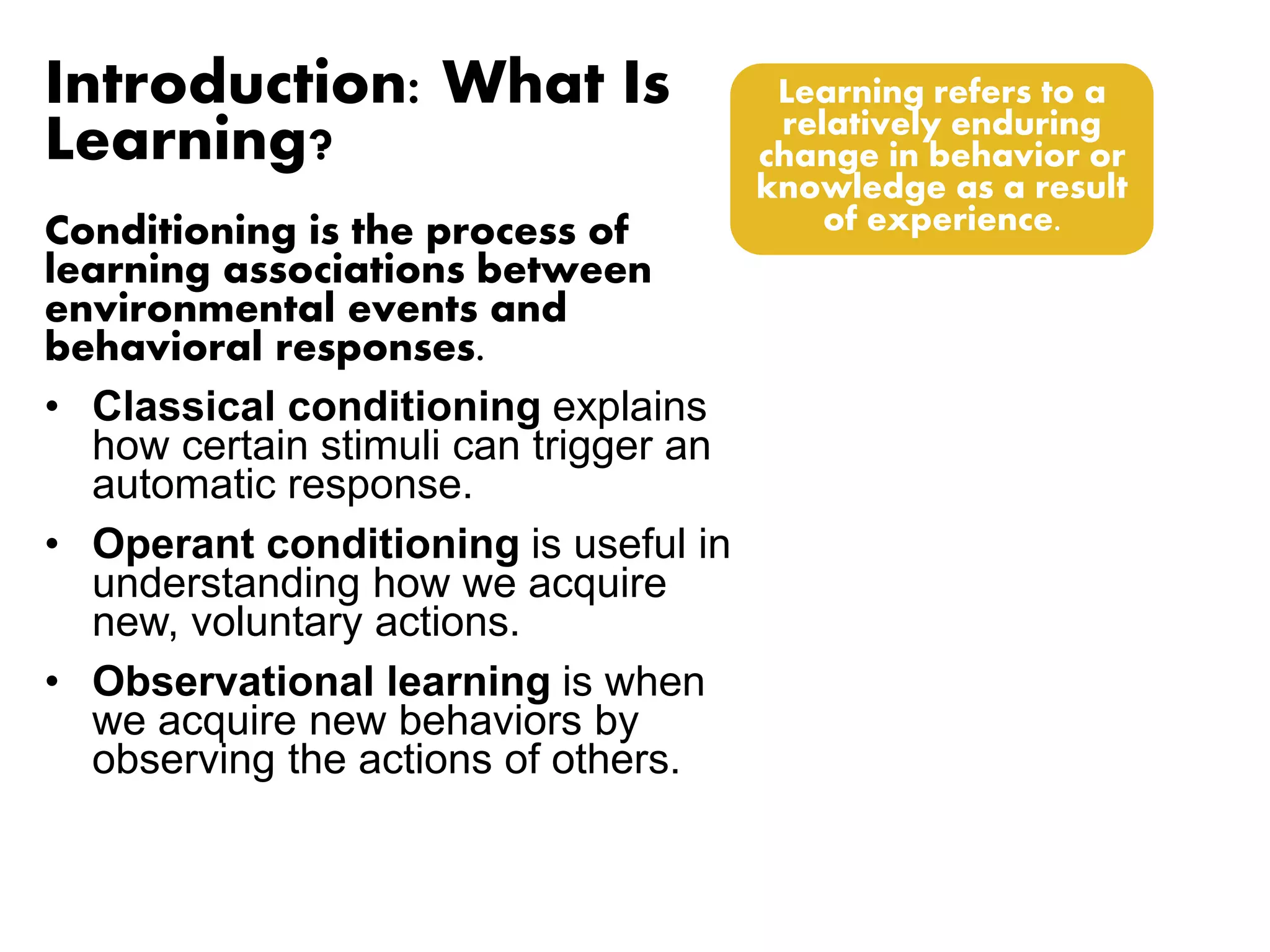
Introduction: What Is 
Learning? 
Conditioning is the process of 
learning associations between 
environmental events and 
behavioral responses. 
• Classical conditioning explains 
how certain stimuli can trigger an 
automatic response. 
• Operant conditioning is useful in 
understanding how we acquire 
new, voluntary actions. 
• Observational learning is when 
we acquire new behaviors by 
observing the actions of others. 
Learning refers to a 
relatively enduring 
change in behavior or 
knowledge as a result 
of experience.
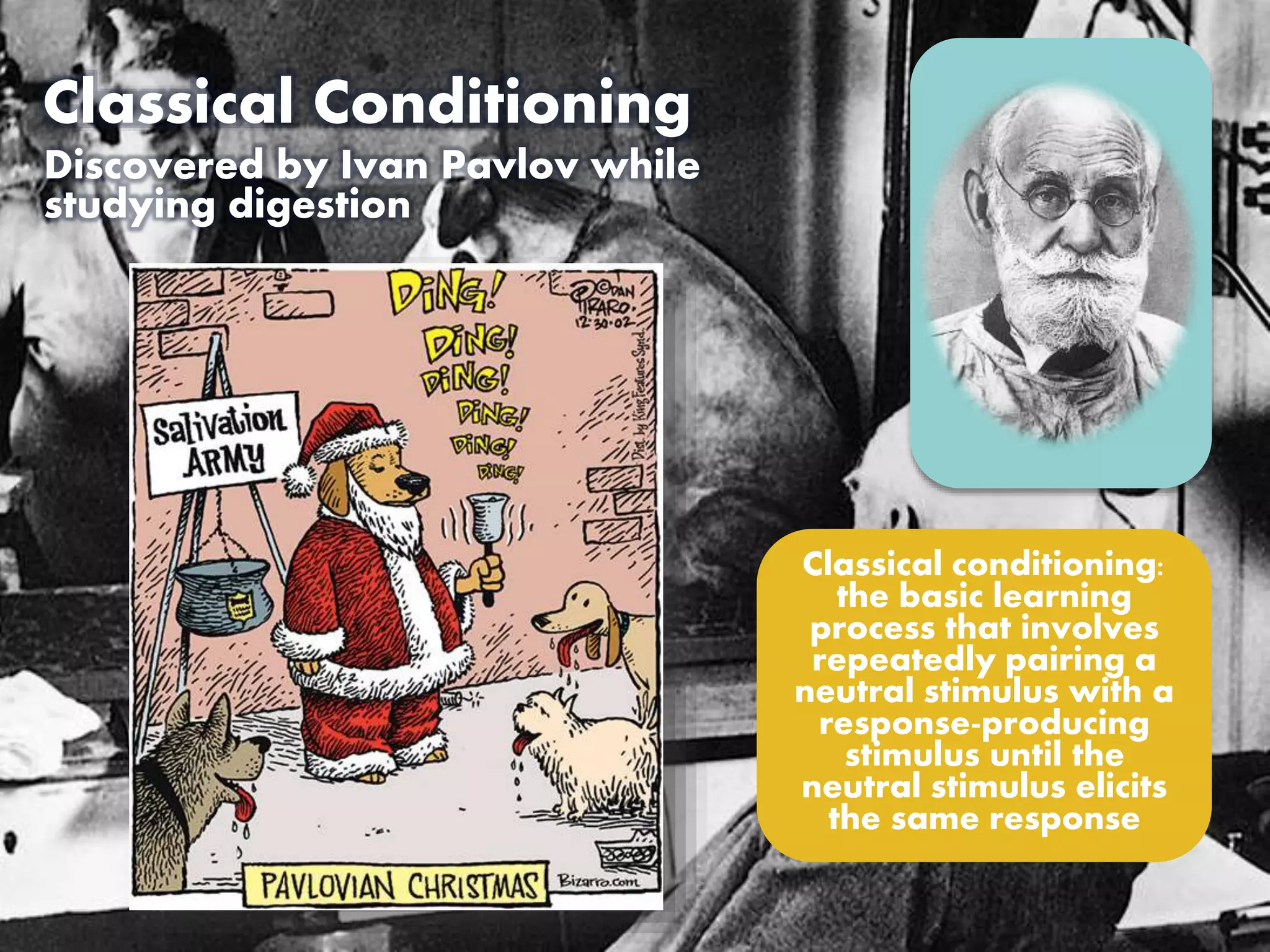
Classical Conditioning 
Discovered by Ivan Pavlov while 
studying digestion 
Classical conditioning: 
the basic learning 
process that involves 
repeatedly pairing a 
neutral stimulus with a 
response-producing 
stimulus until the 
neutral stimulus elicits 
the same response
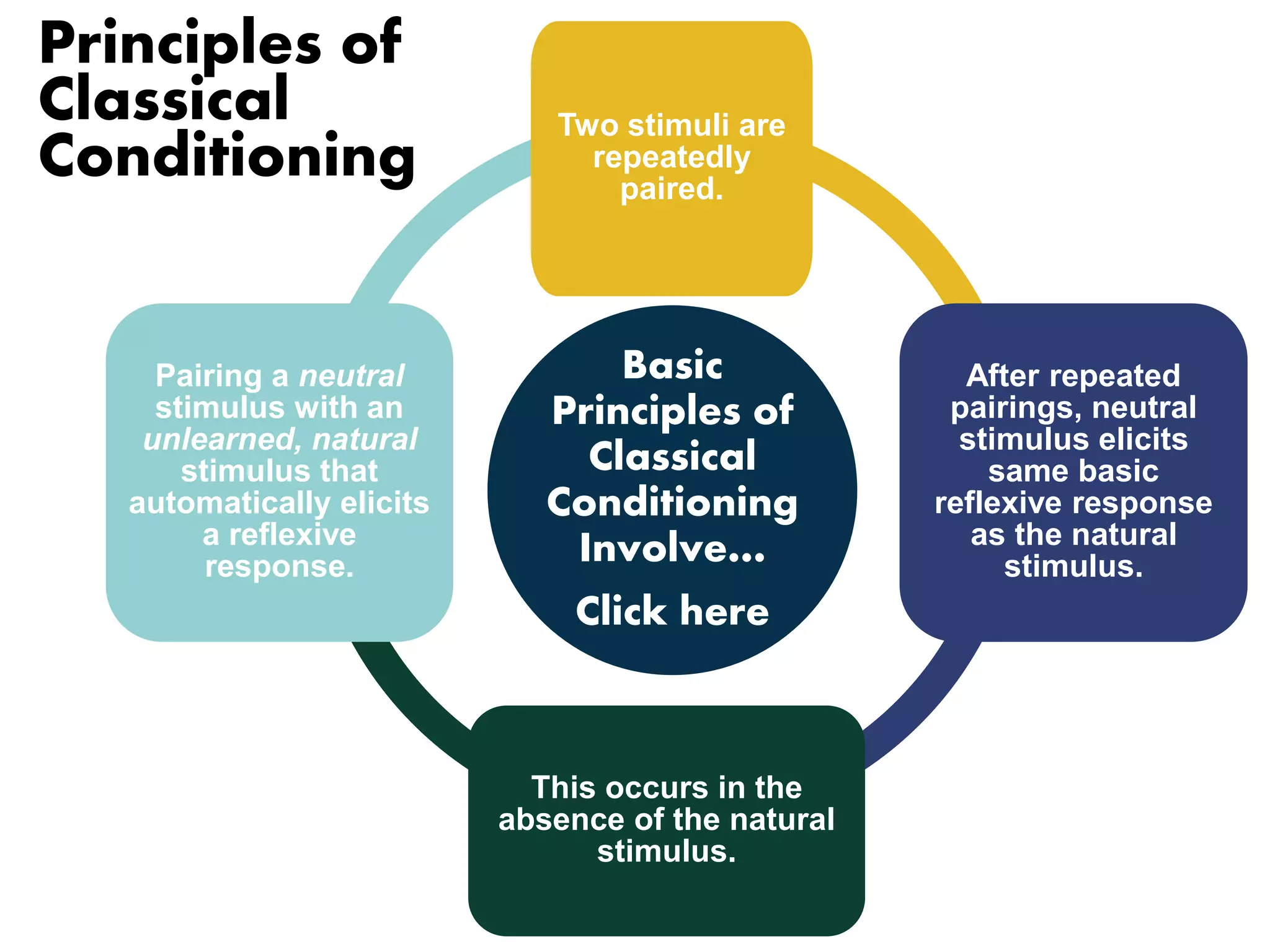
Principles of 
Classical 
Conditioning 
Two stimuli are 
repeatedly 
paired. 
Basic 
Principles of 
Classical 
Conditioning 
Involve… 
Click here 
After repeated 
pairings, neutral 
stimulus elicits 
same basic 
reflexive response 
as the natural 
stimulus. 
This occurs in the 
absence of the natural 
stimulus. 
Pairing a neutral 
stimulus with an 
unlearned, natural 
stimulus that 
automatically elicits 
a reflexive 
response.
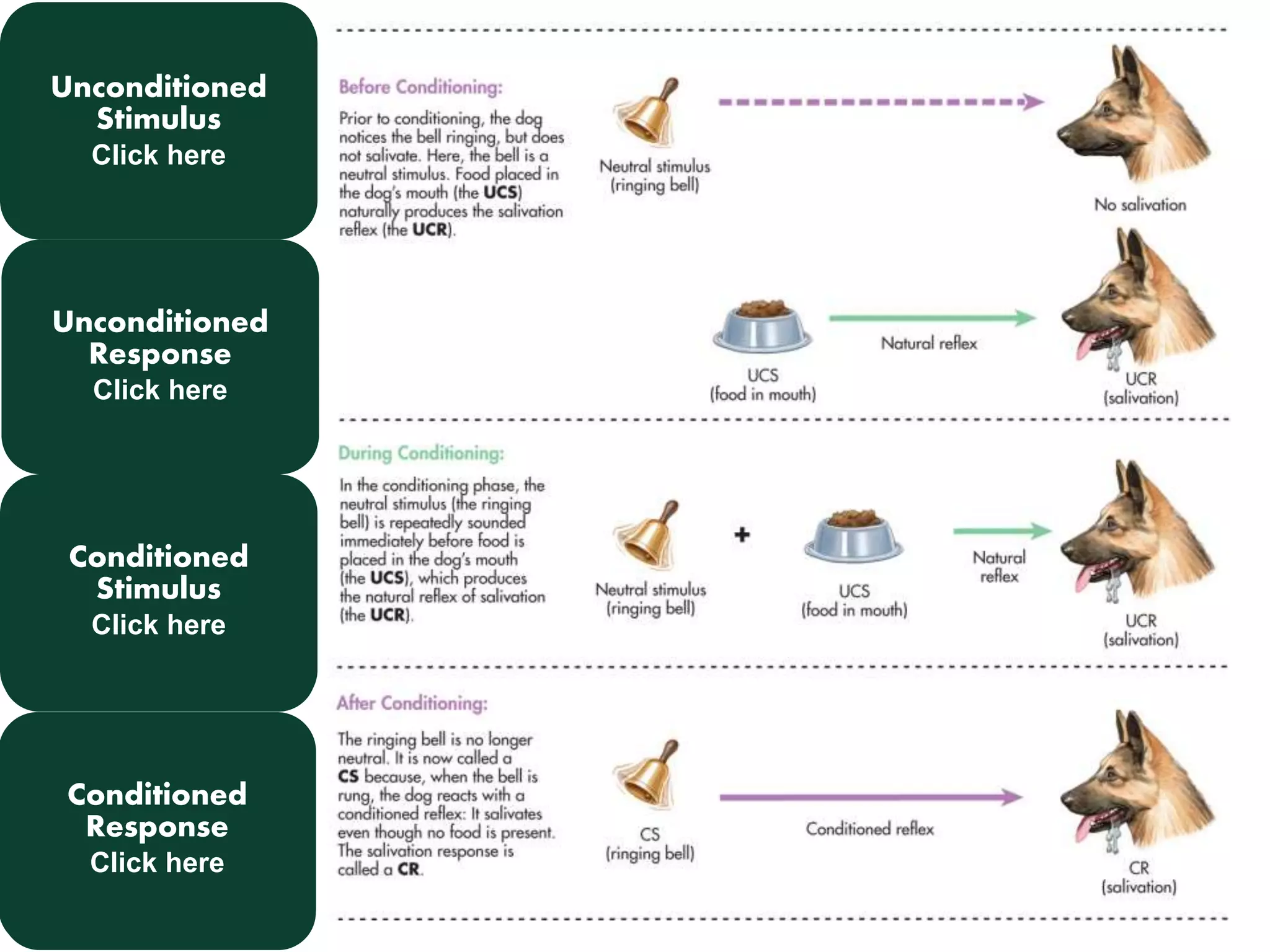
Unconditioned 
stimulus (UCS): 
natural Unconditioned 
stimulus that 
reflexively Stimulus 
elicits a 
response without 
need for Click prior 
here 
learning. Meat 
Unconditioned 
response (UCR): 
unlearned, Unconditioned 
reflexive 
response Response 
that is 
elicited by an 
unconditioned 
Click here 
stimulus. Salivating 
to meat 
Conditioned 
stimulus (CS): a 
formerly Conditioned 
neutral 
stimulus Stimulus 
that acquires 
the capacity to elicit a 
reflexive Click response. 
here 
Bell presented 
before meat 
Conditioned 
response learned, Conditioned 
(CR): 
reflexive 
response Response 
to a 
conditioned Click here 
stimulus. 
Salivating to bell 
alone
Factors that 
Affect 
Conditioning 
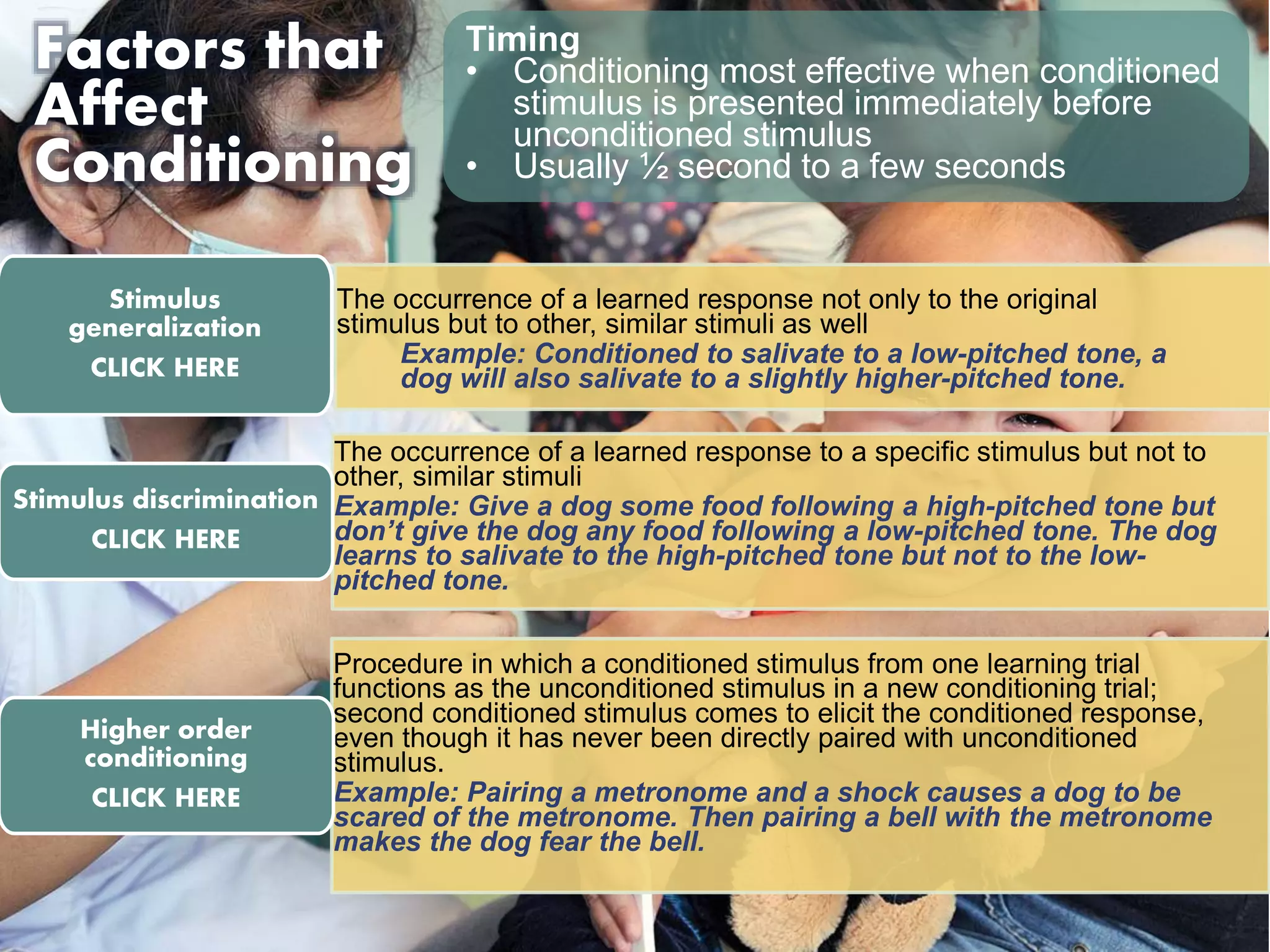
The occurrence of a learned response not only to the original 
stimulus but to other, similar stimuli as well 
Example: Conditioned to salivate to a low-pitched tone, a 
dog will also salivate to a slightly higher-pitched tone. 
Stimulus 
generalization 
CLICK HERE 
The occurrence of a learned response to a specific stimulus but not to 
other, similar stimuli 
Example: Give a dog some food following a high-pitched tone but 
don’t give the dog any food following a low-pitched tone. The dog 
learns to salivate to the high-pitched tone but not to the low-pitched 
tone. 
Stimulus discrimination 
CLICK HERE 
Procedure in which a conditioned stimulus from one learning trial 
functions as the unconditioned stimulus in a new conditioning trial; 
second conditioned stimulus comes to elicit the conditioned response, 
even though it has never been directly paired with unconditioned 
stimulus. 
Example: Pairing a metronome and a shock causes a dog to be 
scared of the metronome. Then pairing a bell with the metronome 
makes the dog fear the bell. 
Higher order 
conditioning 
CLICK HERE 
Timing 
• Conditioning most effective when conditioned 
stimulus is presented immediately before 
unconditioned stimulus 
• Usually ½ second to a few seconds
Extinction and Spontaneous Recovery 
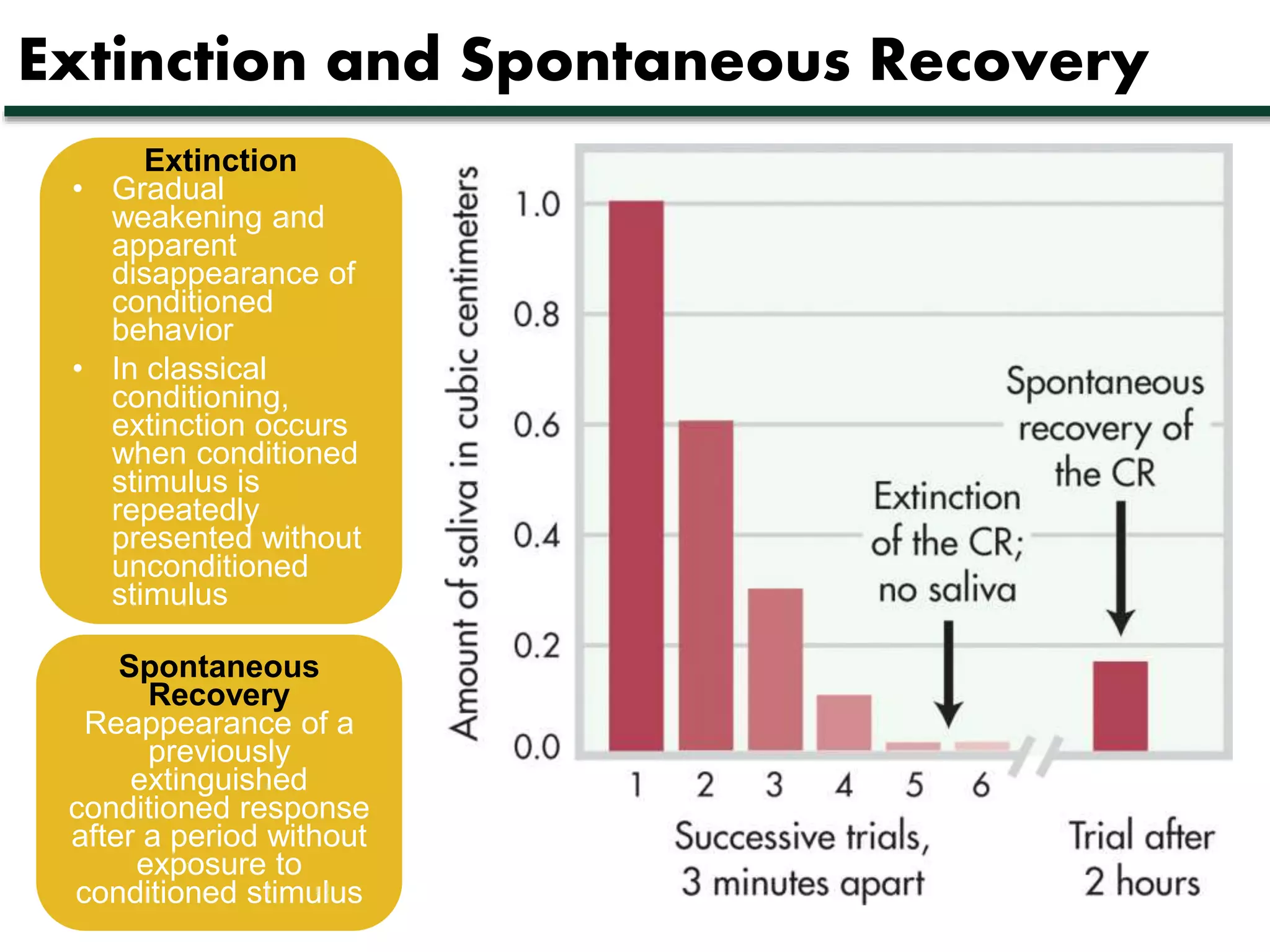
Extinction 
• Gradual 
weakening and 
apparent 
disappearance of 
conditioned 
behavior 
• In classical 
conditioning, 
extinction occurs 
when conditioned 
stimulus is 
repeatedly 
presented without 
unconditioned 
stimulus 
Spontaneous 
Recovery 
Reappearance of a 
previously 
extinguished 
conditioned response 
after a period without 
exposure to 
conditioned stimulus
From Pavlov to 
Watson 
The Founding of Behaviorism 
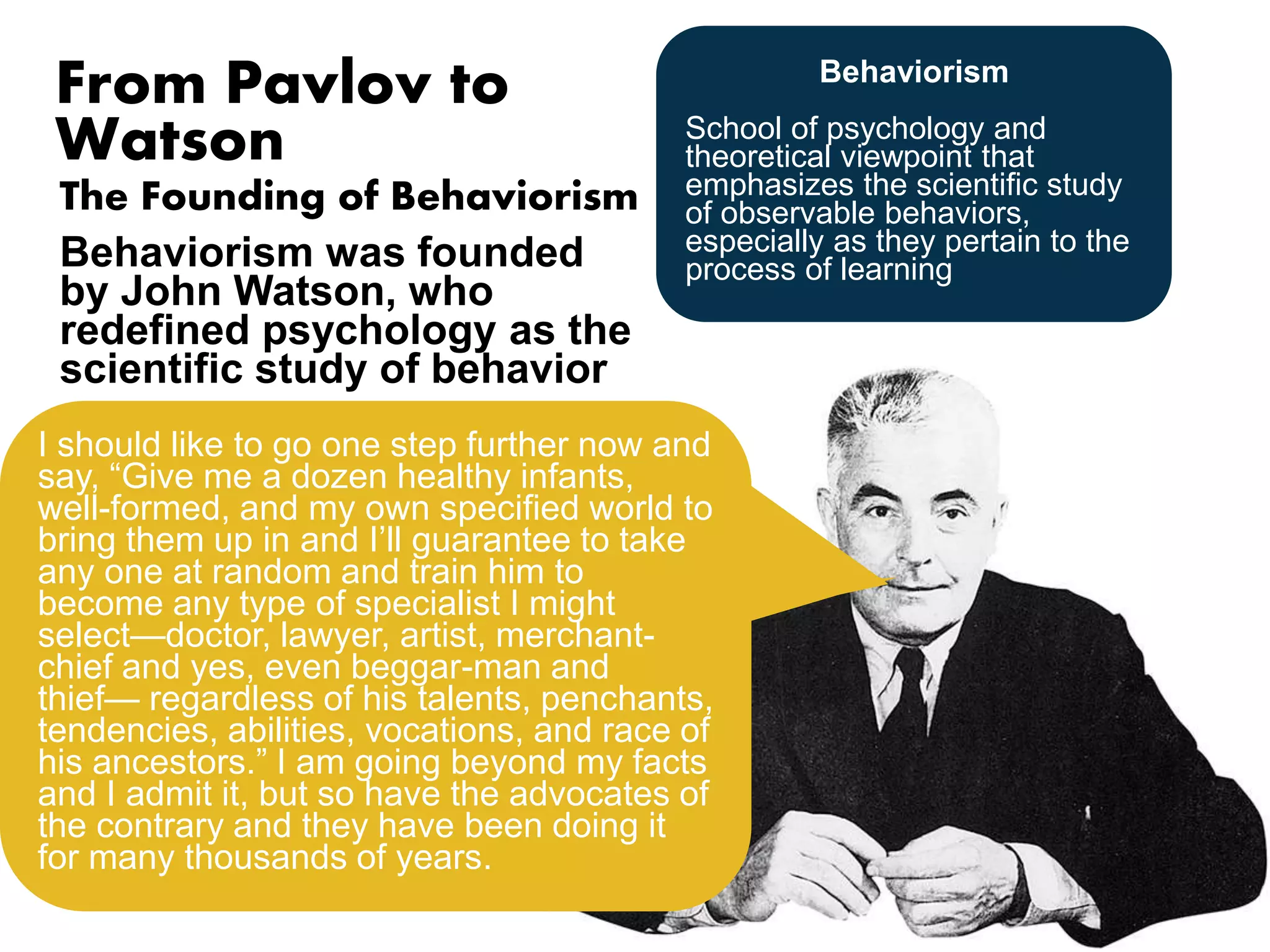
Behaviorism was founded 
by John Watson, who 
redefined psychology as the 
scientific study of behavior 
Behaviorism 
School of psychology and 
theoretical viewpoint that 
emphasizes the scientific study 
of observable behaviors, 
especially as they pertain to the 
process of learning 
I should like to go one step further now and 
say, “Give me a dozen healthy infants, 
well-formed, and my own specified world to 
bring them up in and I’ll guarantee to take 
any one at random and train him to 
become any type of specialist I might 
select—doctor, lawyer, artist, merchant-chief 
Psychology as the behaviorist 
views it is a purely objective 
experimental branch of natural 
science. Its theoretical goal is 
the prediction and control of 
behavior. Introspection forms no 
essential part of its methods, nor 
is the scientific value of its data 
dependent upon the readiness 
with which they lend themselves 
to interpretation in terms of 
consciousness. 
Let us limit ourselves to things 
that can be observed, and 
formulate laws concerning only 
those things. Now what can we 
observe? We can observe 
behavior—what the organism 
does or says. 
and yes, even beggar-man and 
thief— regardless of his talents, penchants, 
tendencies, abilities, vocations, and race of 
his ancestors.” I am going beyond my facts 
and I admit it, but so have the advocates of 
the contrary and they have been doing it 
for many thousands of years.
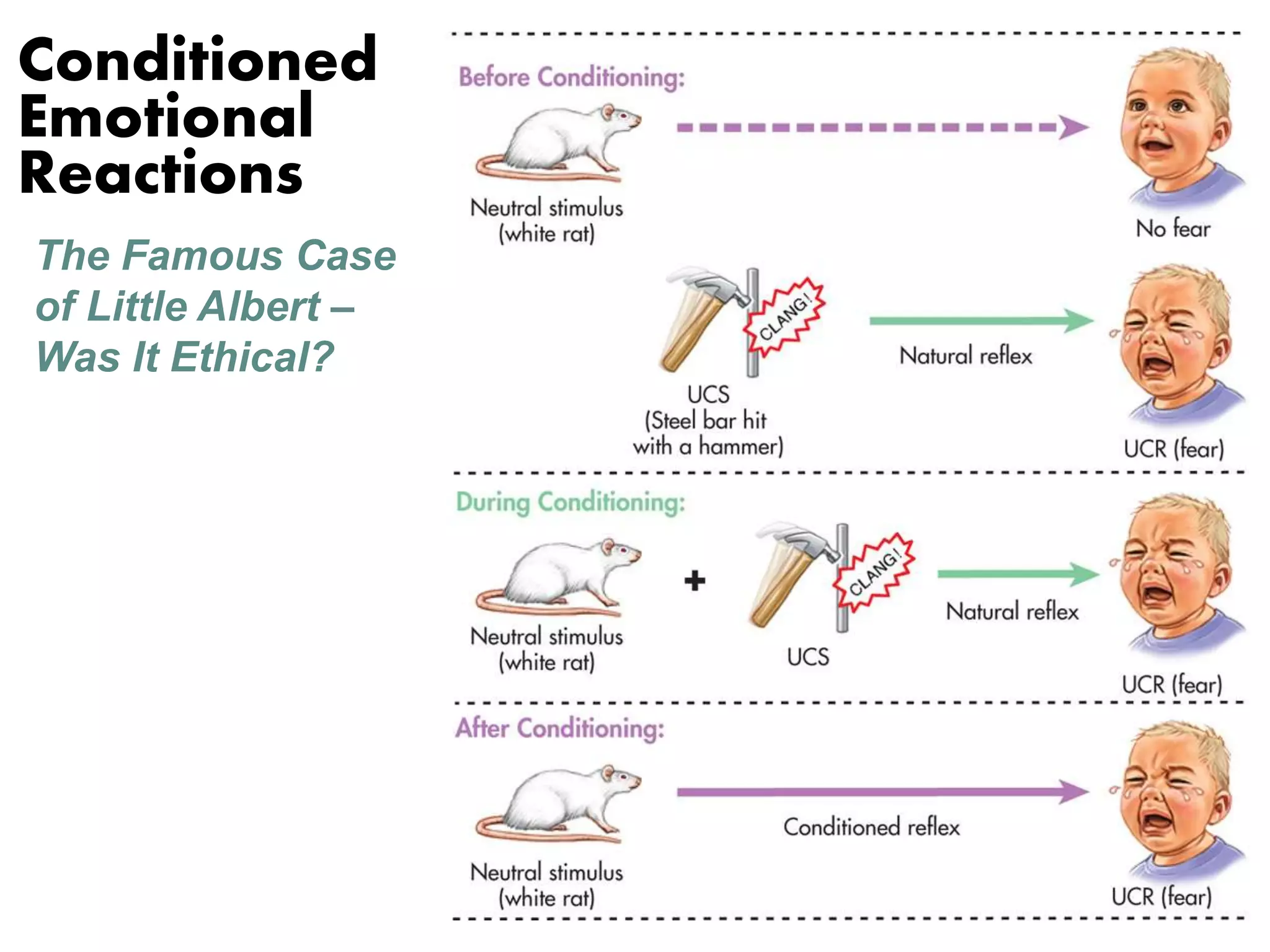
Conditioned 
Emotional 
Reactions 
The Famous Case 
of Little Albert – 
Was It Ethical?
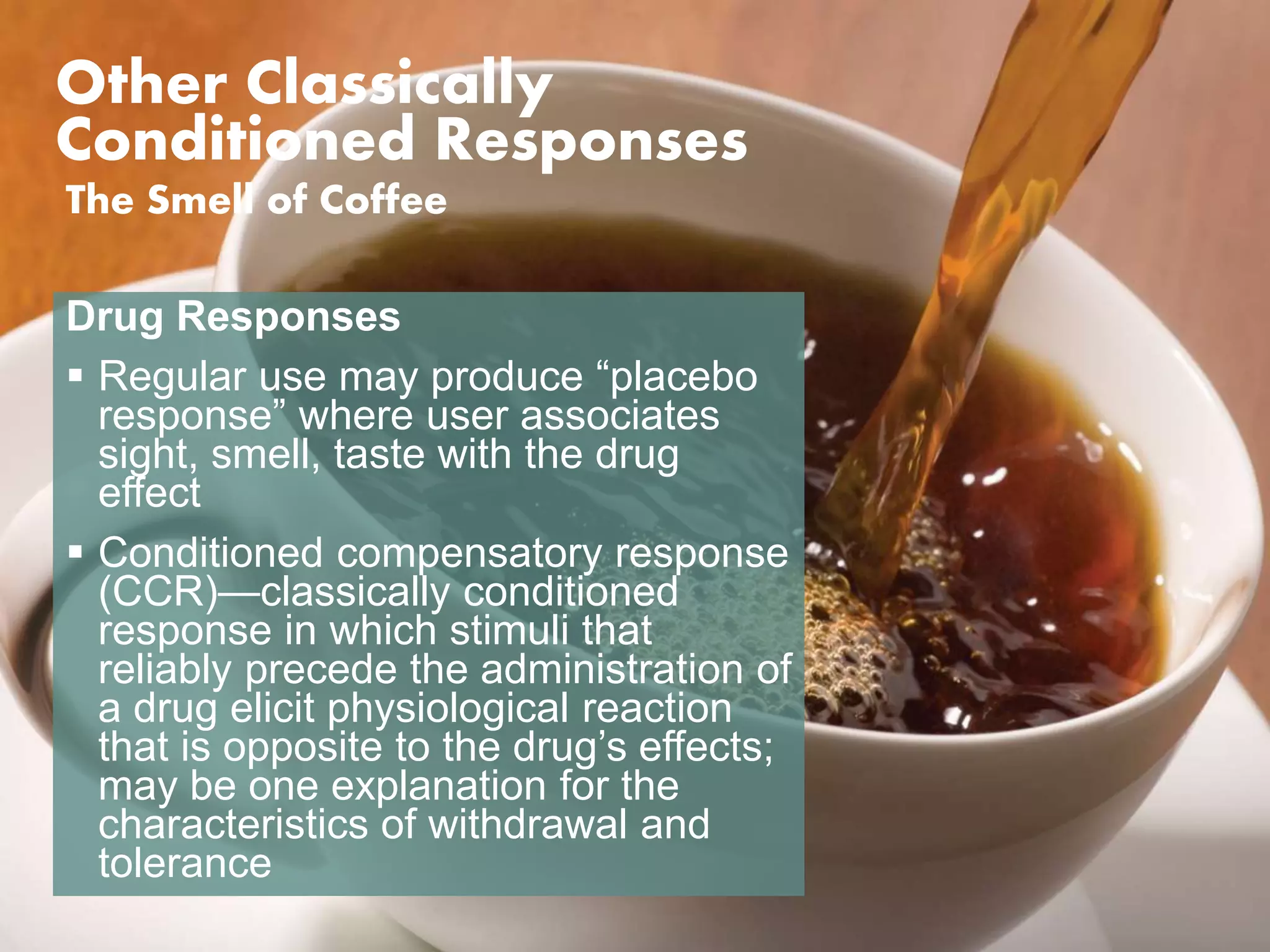
Other Classically 
Conditioned Responses 
The Smell of Coffee 
Drug Responses 
 Regular use may produce “placebo 
response” where user associates 
sight, smell, taste with the drug 
effect 
 Conditioned compensatory response 
(CCR)—classically conditioned 
response in which stimuli that 
reliably precede the administration of 
a drug elicit physiological reaction 
that is opposite to the drug’s effects; 
may be one explanation for the 
characteristics of withdrawal and 
tolerance
Contemporary Views of 
Classical Conditioning 
Cognitive Aspects of Classical 
Conditioning 
Rescorla’s view 
Pavlovian conditioning is a 
sophisticated and sensible 
mechanism by which organisms 
represent the world. Pavlovian 
conditioning leads to its 
characterization as a mechanism 
by which the organism encodes 
relationships between events in 
the world. The conditioned 
stimulus and the unconditioned 
stimulus are simply two events, 
and the organism can be seen as 
trying to determine the 
relationship between them. 
Contemporary learning 
researchers 
acknowledge the 
importance of both 
cognitive factors and 
evolutionary influences 
in classical conditioning. 
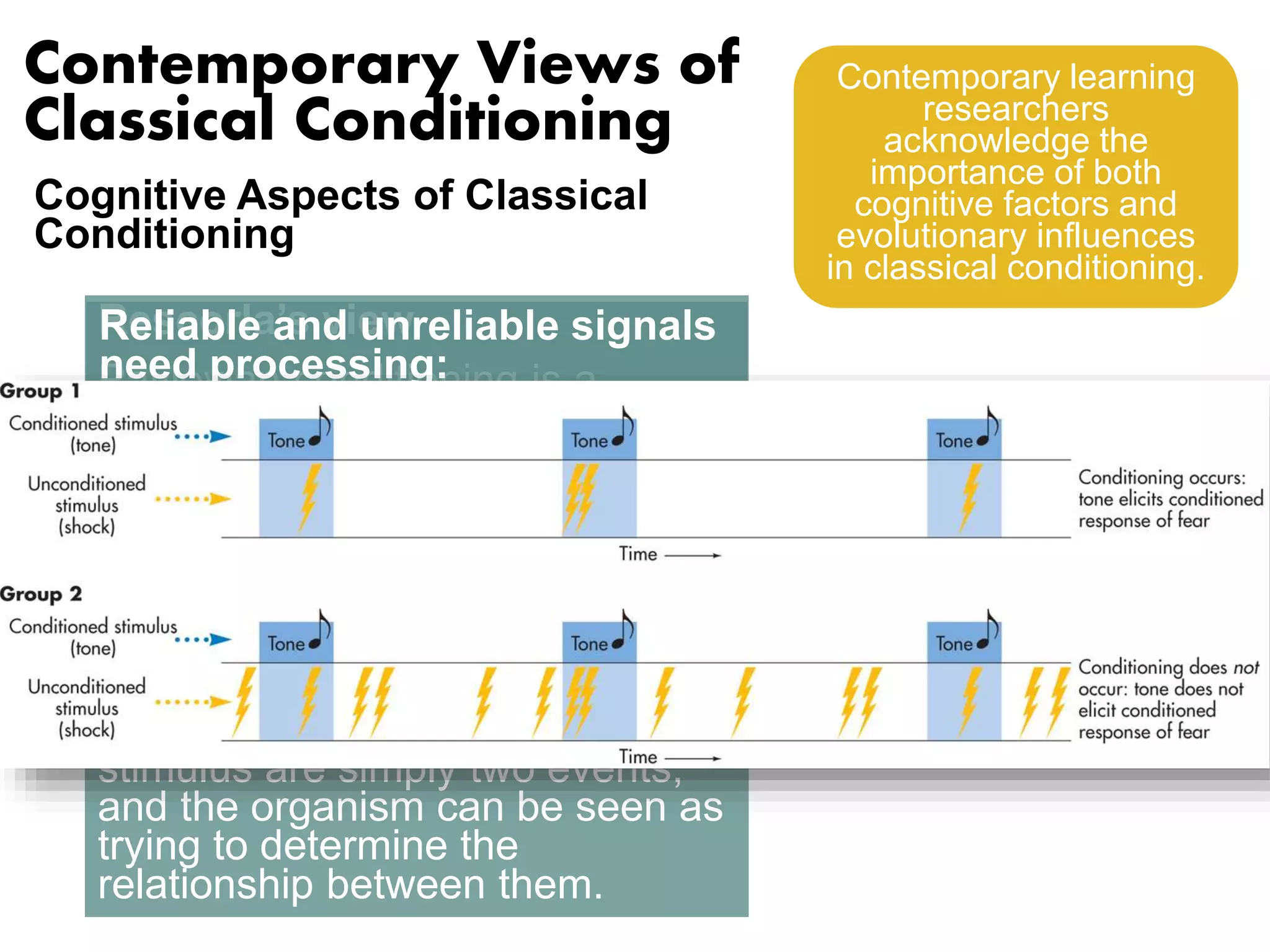
Reliable and unreliable signals 
need processing: 
• Conditioned stimulus must be 
a reliable signal that predicts 
presentations of unconditioned 
stimulus. 
• Active processing of 
information: animals assess 
the predictive value of stimuli.
Evolutionary Aspects of Classical 
Conditioning 
• Behaviorists originally argued that 
learning principles applied to all species 
in the 1960s. 
• Conditioned taste aversions 
demonstrated the importance of natural 
behavior patterns influenced by 
evolution. 
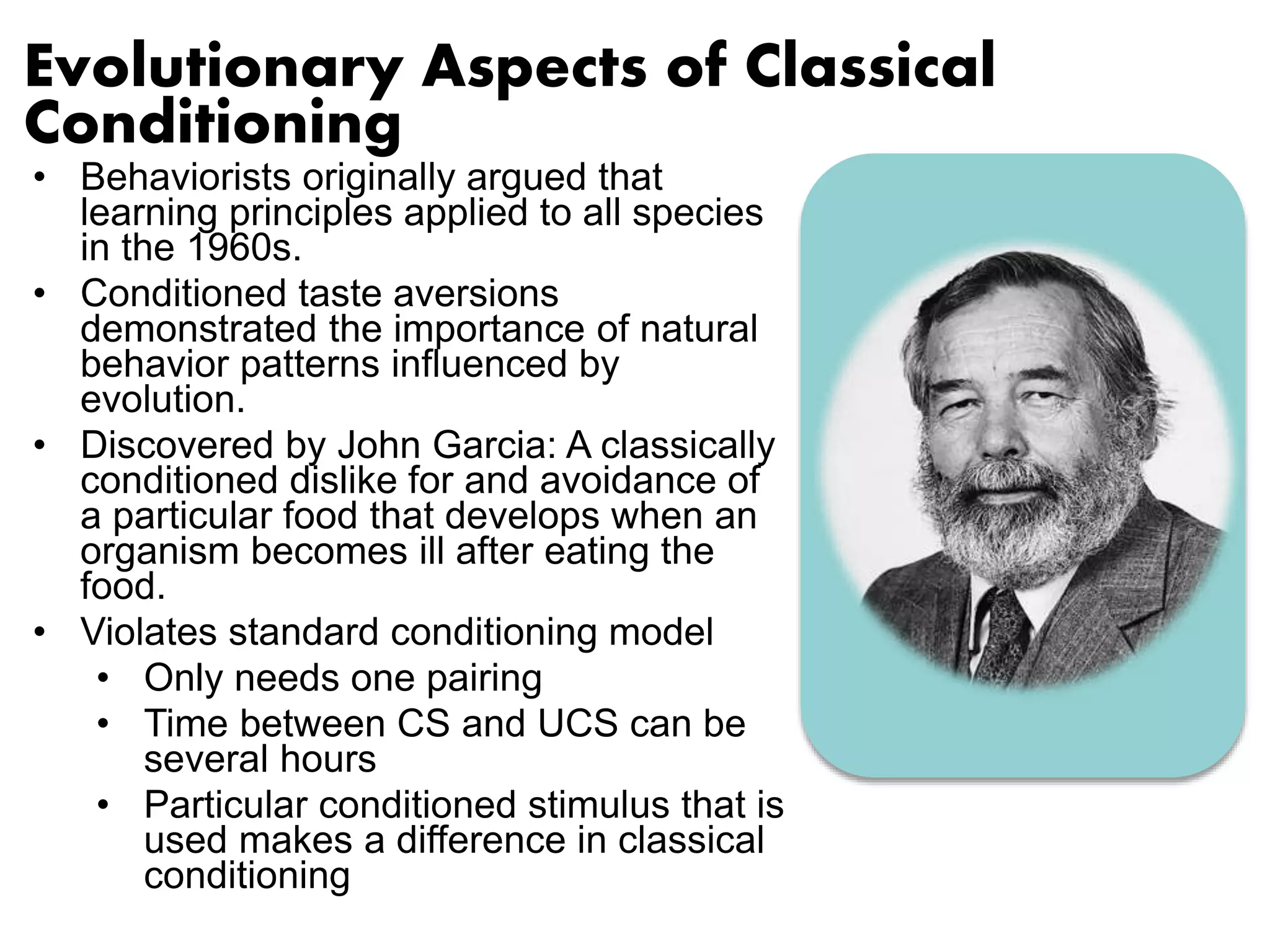
• Discovered by John Garcia: A classically 
conditioned dislike for and avoidance of 
a particular food that develops when an 
organism becomes ill after eating the 
food. 
• Violates standard conditioning model 
• Only needs one pairing 
• Time between CS and UCS can be 
several hours 
• Particular conditioned stimulus that is 
used makes a difference in classical 
conditioning
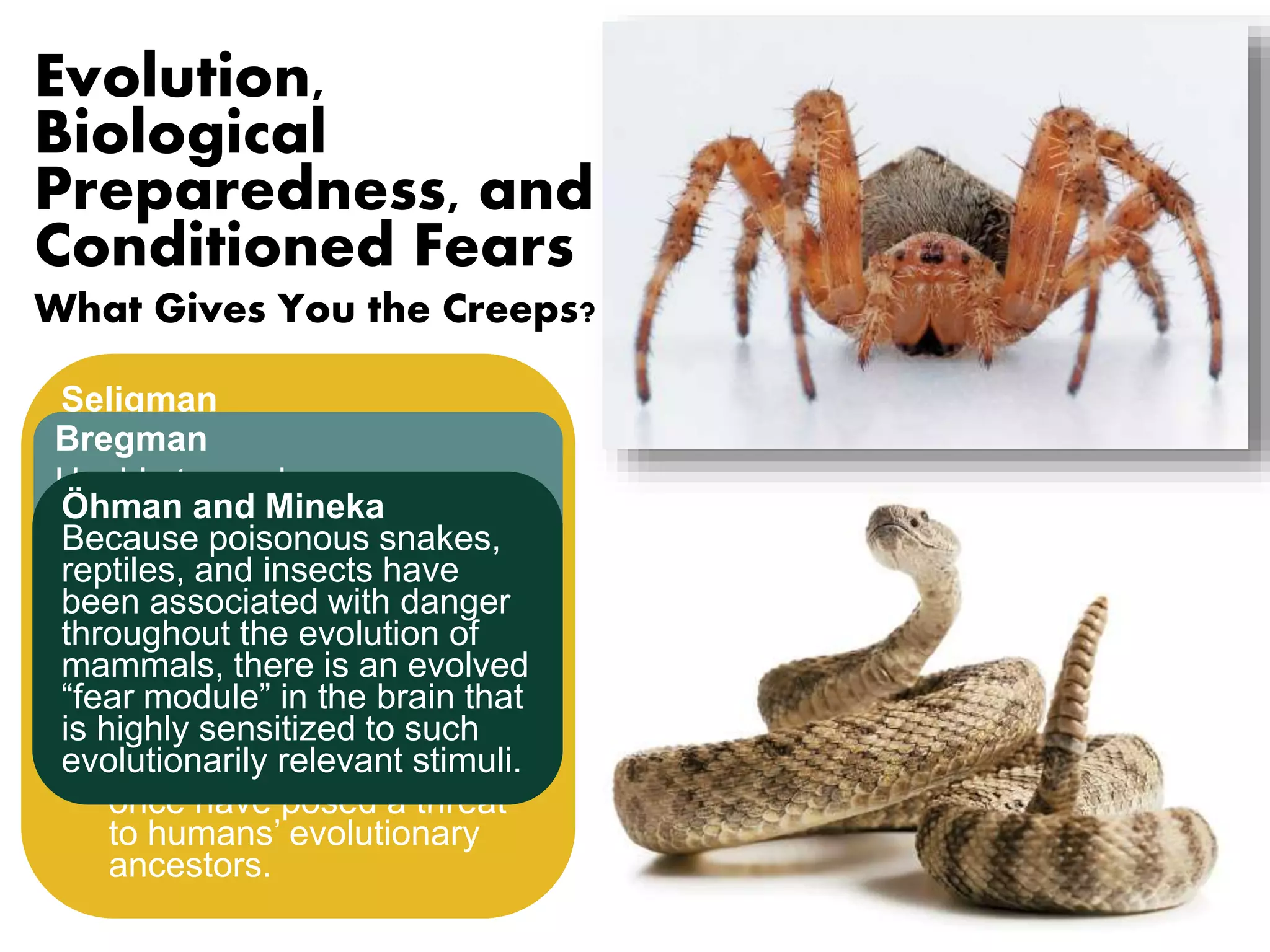
Evolution, 
Biological 
Preparedness, and 
Conditioned Fears 
What Gives You the Creeps? 
Seligman 
• Phobias seem to be quite 
Bregman 
Unable to produce a 
conditioned fear response to 
wooden blocks and curtains. 
Biological 
preparedness—the 
idea that an organism 
is innately predisposed 
to form associations 
between certain stimuli 
and responses. 
selective. Extreme, 
irrational fears of snakes, 
spiders, heights, and small 
enclosed places are 
relatively common. 
Öhman and Mineka 
Because poisonous snakes, 
reptiles, and insects have 
been associated with danger 
throughout the evolution of 
mammals, there is an evolved 
“fear module” in the brain that 
is highly sensitized to such 
evolutionarily relevant stimuli. 
• Humans biologically 
prepared to develop fears 
of objects or situations 
such as snakes, spiders, 
and heights—that may 
once have posed a threat 
to humans’ evolutionary 
ancestors.
Operant Conditioning—Associating 
Behaviors and Consequences 
Operant conditioning deals with the learning of active, voluntary 
behaviors that are shaped and maintained by their 
consequences. 
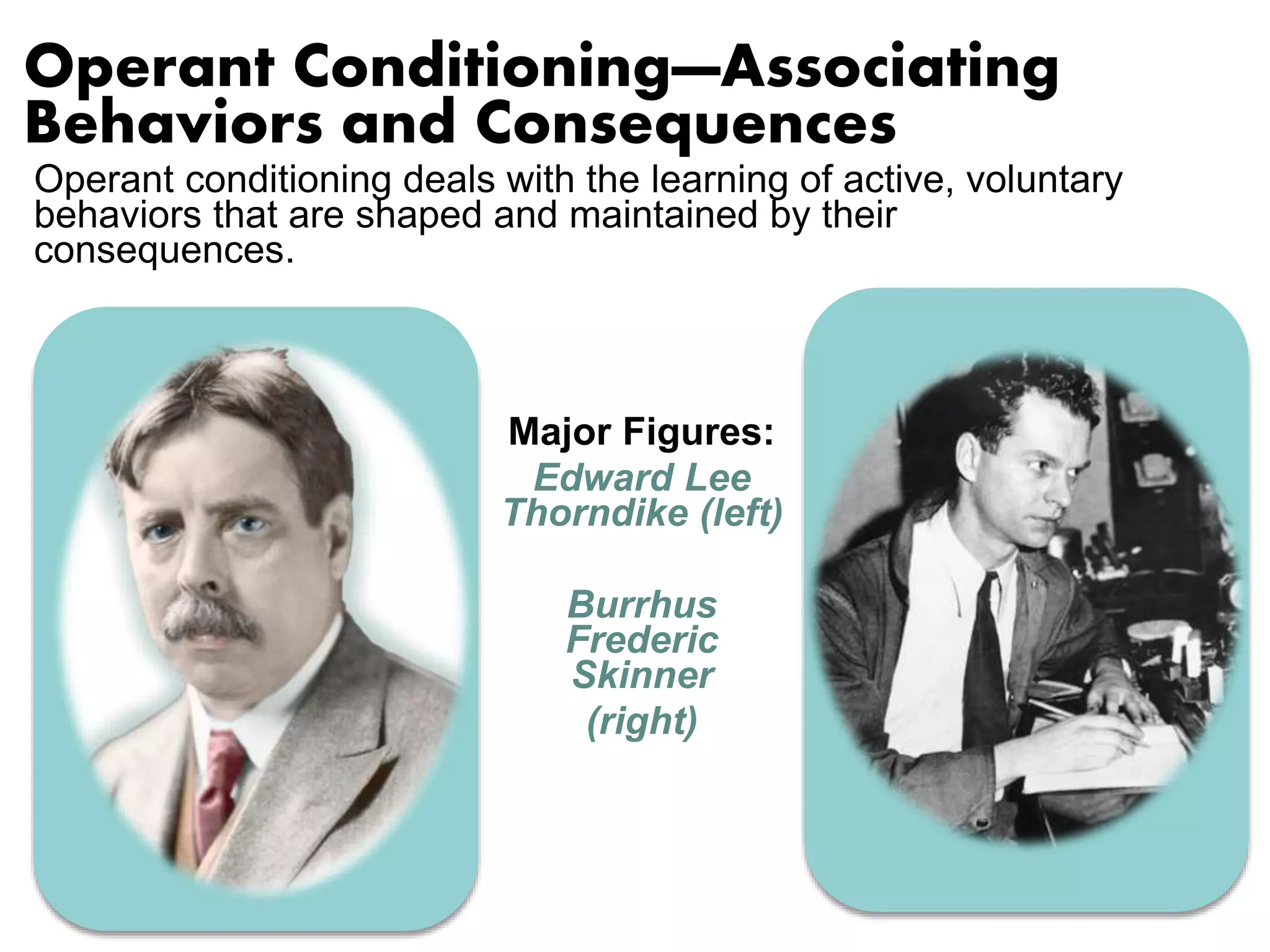
Major Figures: 
Edward Lee 
Thorndike (left) 
Burrhus 
Frederic 
Skinner 
(right)
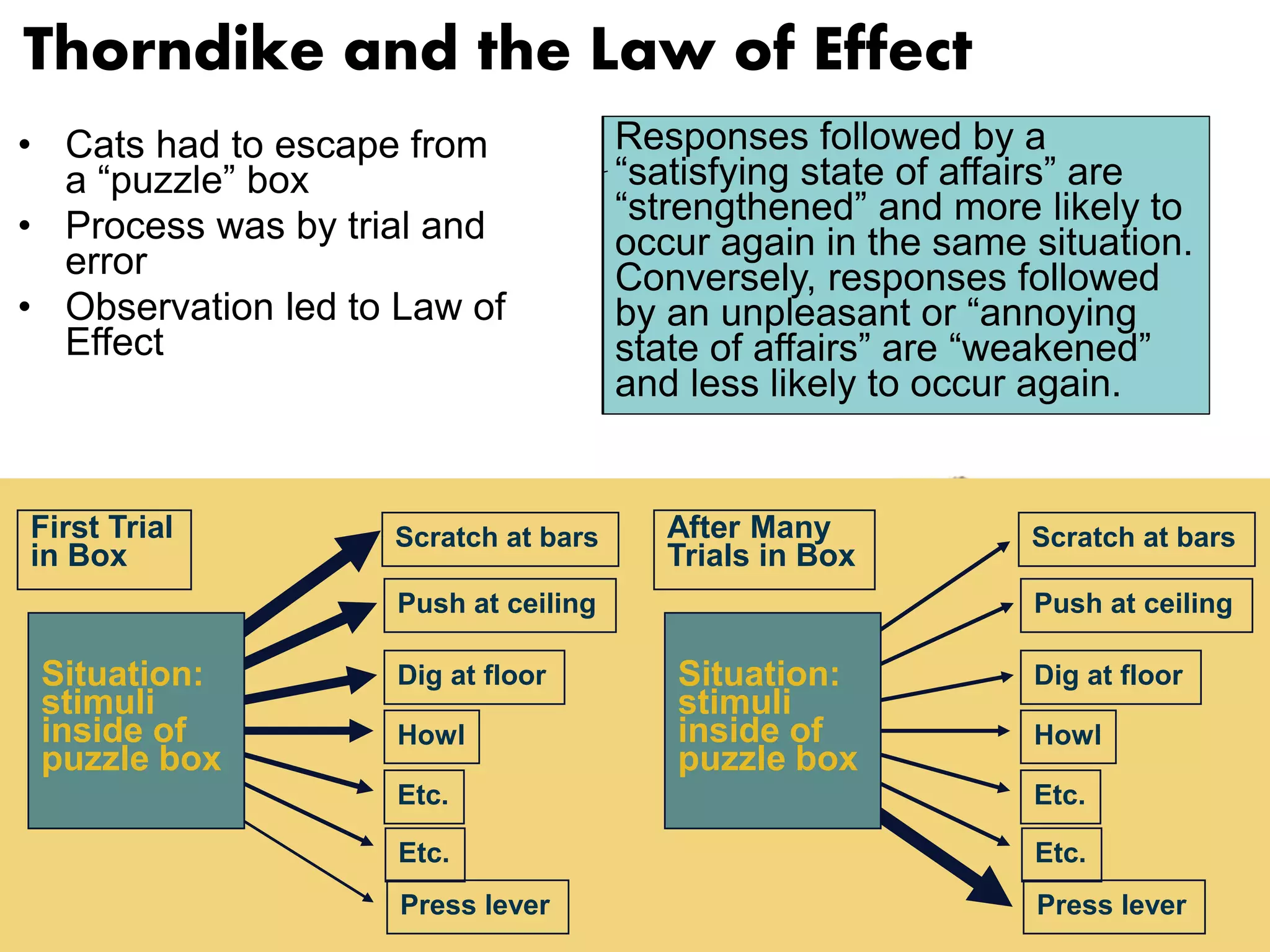
Thorndike and the Law of Effect 
• Cats had to escape from 
a “puzzle” box 
• Process was by trial and 
error 
• Observation led to Law of 
Effect 
Responses followed by a 
“satisfying state of affairs” are 
“strengthened” and more likely to 
occur again in the same situation. 
Conversely, responses followed 
by an unpleasant or “annoying 
state of affairs” are “weakened” 
and less likely to occur again. 
Scratch at bars 
Push at ceiling 
Situation: Dig at floor 
stimuli 
inside of 
Howl 
puzzle box 
Etc. 
Etc. 
Press lever 
First Trial 
in Box 
Scratch at bars 
Push at ceiling 
Situation: Dig at floor 
stimuli 
inside of 
Howl 
puzzle box 
Etc. 
Etc. 
Press lever 
After Many 
Trials in Box
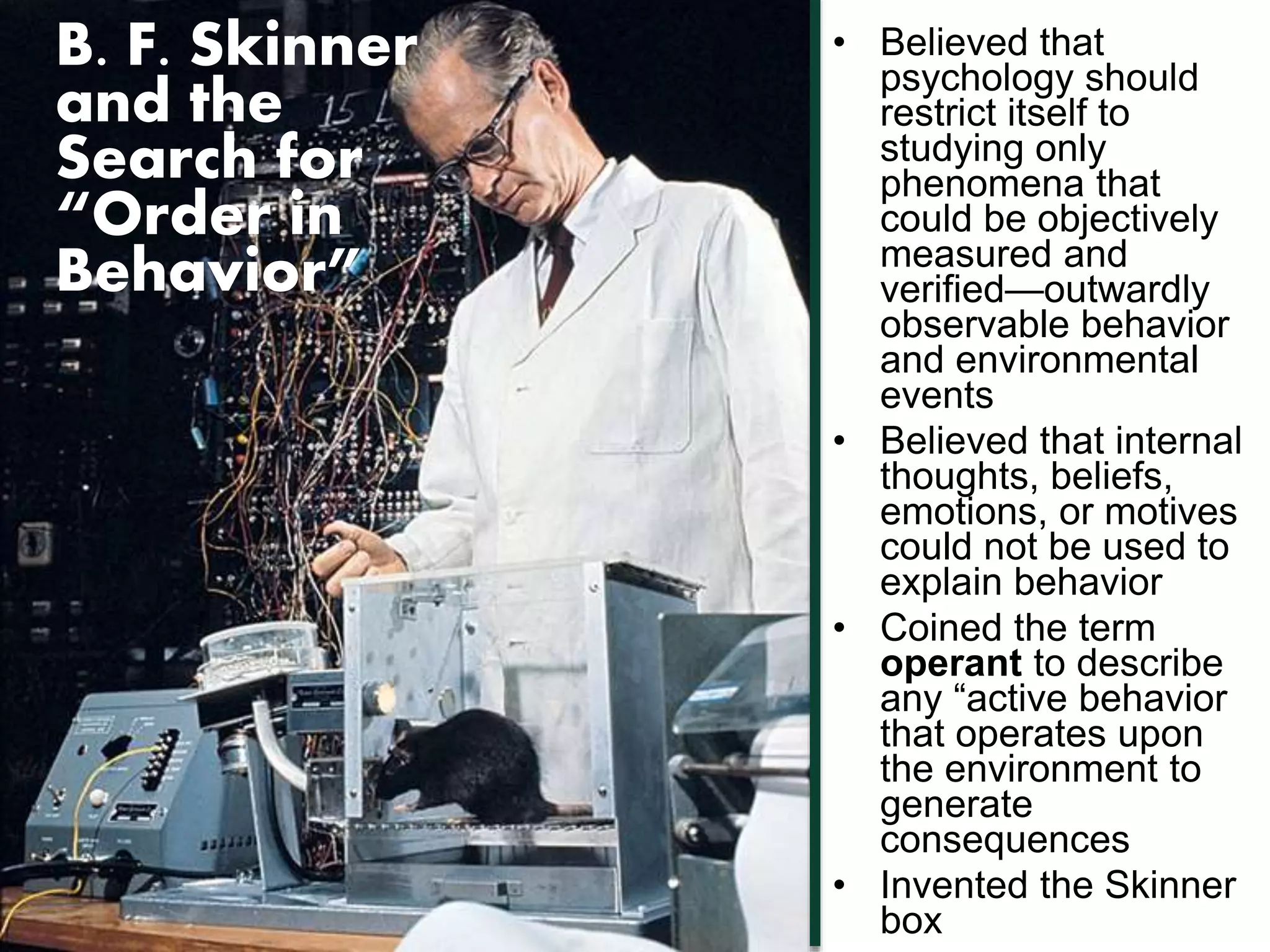
B. F. Skinner 
and the 
Search for 
“Order in 
Behavior” 
• Believed that 
psychology should 
restrict itself to 
studying only 
phenomena that 
could be objectively 
measured and 
verified—outwardly 
observable behavior 
and environmental 
events 
• Believed that internal 
thoughts, beliefs, 
emotions, or motives 
could not be used to 
explain behavior 
• Coined the term 
operant to describe 
any “active behavior 
that operates upon 
the environment to 
generate 
consequences 
• Invented the Skinner 
box
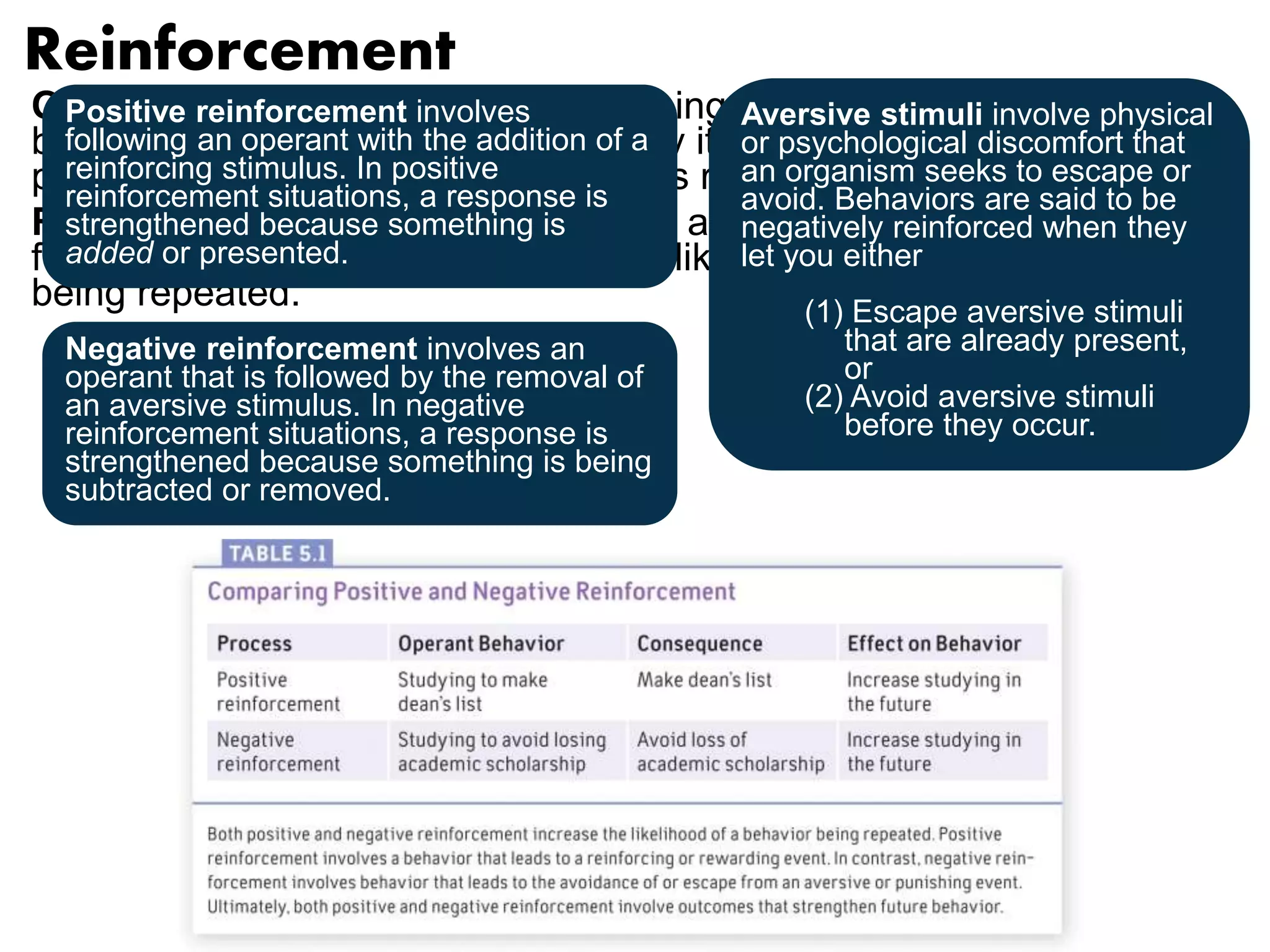
Reinforcement 
Operant Positive conditioning reinforcement involves 
explains learning as a process in which 
behavior following is an shaped operant with and the maintained addition of a 
by its consequences. One 
possible reinforcing consequence stimulus. In positive 
of a behavior is reinforcement. 
reinforcement situations, a response is 
Reinforcement strengthened because is said something to occur is 
when a stimulus or an event 
follows added an or presented. 
operant and increases the likelihood of the operant 
being repeated. 
Negative reinforcement involves an 
operant that is followed by the removal of 
an aversive stimulus. In negative 
reinforcement situations, a response is 
strengthened because something is being 
subtracted or removed. 
Aversive stimuli involve physical 
or psychological discomfort that 
an organism seeks to escape or 
avoid. Behaviors are said to be 
negatively reinforced when they 
let you either 
(1) Escape aversive stimuli 
that are already present, 
or 
(2) Avoid aversive stimuli 
before they occur.
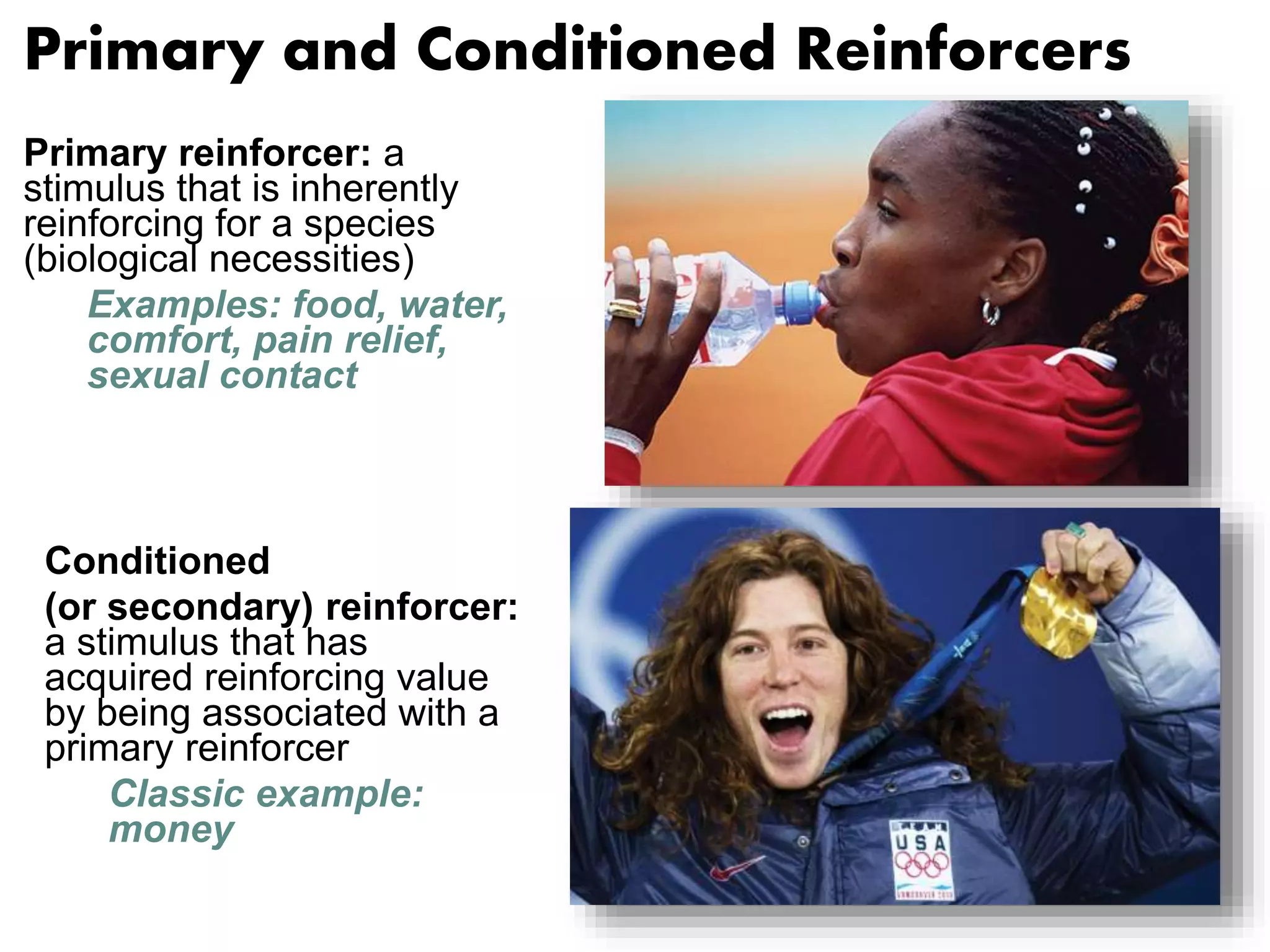
Primary and Conditioned Reinforcers 
Primary reinforcer: a 
stimulus that is inherently 
reinforcing for a species 
(biological necessities) 
Examples: food, water, 
comfort, pain relief, 
sexual contact 
Conditioned 
(or secondary) reinforcer: 
a stimulus that has 
acquired reinforcing value 
by being associated with a 
primary reinforcer 
Classic example: 
money
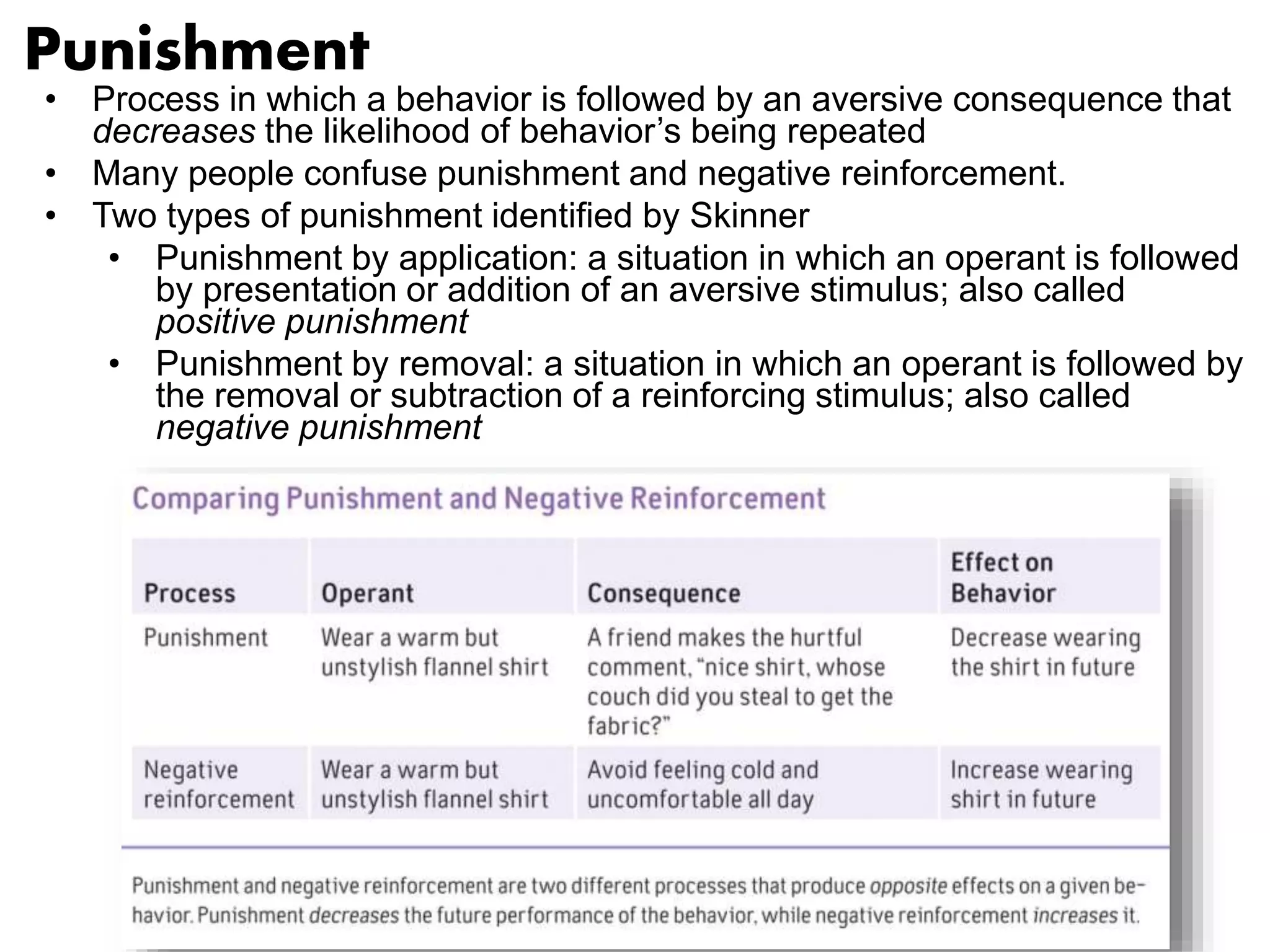
Punishment 
• Process in which a behavior is followed by an aversive consequence that 
decreases the likelihood of behavior’s being repeated 
• Many people confuse punishment and negative reinforcement. 
• Two types of punishment identified by Skinner 
• Punishment by application: a situation in which an operant is followed 
by presentation or addition of an aversive stimulus; also called 
positive punishment 
• Punishment by removal: a situation in which an operant is followed by 
the removal or subtraction of a reinforcing stimulus; also called 
negative punishment
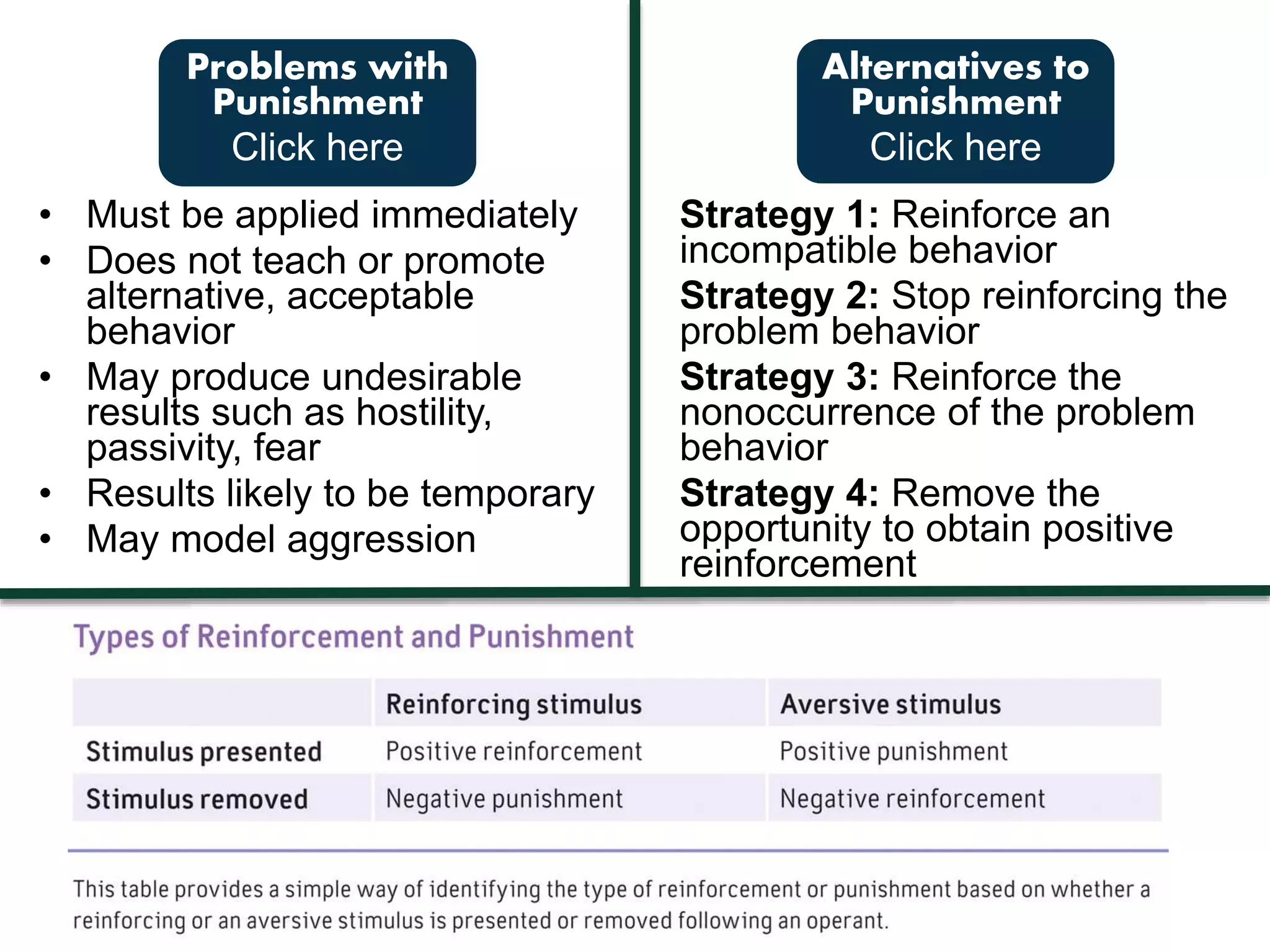
Problems with 
Punishment 
Click here 
• Must be applied immediately 
• Does not teach or promote 
alternative, acceptable 
behavior 
• May produce undesirable 
results such as hostility, 
passivity, fear 
• Results likely to be temporary 
• May model aggression 
Alternatives to 
Punishment 
Click here 
Strategy 1: Reinforce an 
incompatible behavior 
Strategy 2: Stop reinforcing the 
problem behavior 
Strategy 3: Reinforce the 
nonoccurrence of the problem 
behavior 
Strategy 4: Remove the 
opportunity to obtain positive 
reinforcement
Operant Conditioning Terms 
Shaping 
Discriminative 
Stimuli 
Extinction 
Schedules of 
Reinforcement
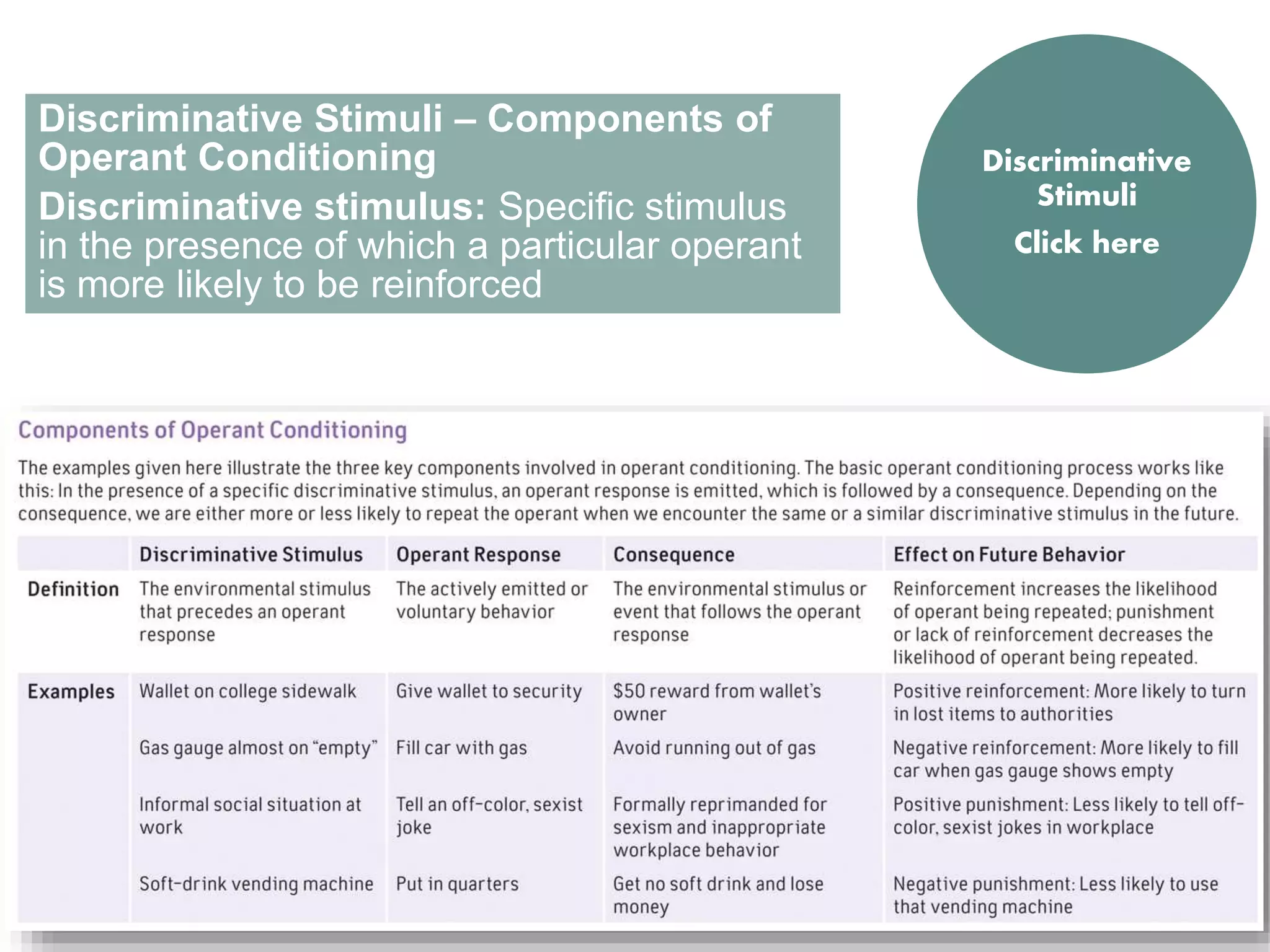
Discriminative Stimuli – Components of 
Operant Conditioning 
Discriminative stimulus: Specific stimulus 
in the presence of which a particular operant 
is more likely to be reinforced 
Discriminative 
Stimuli 
Click here
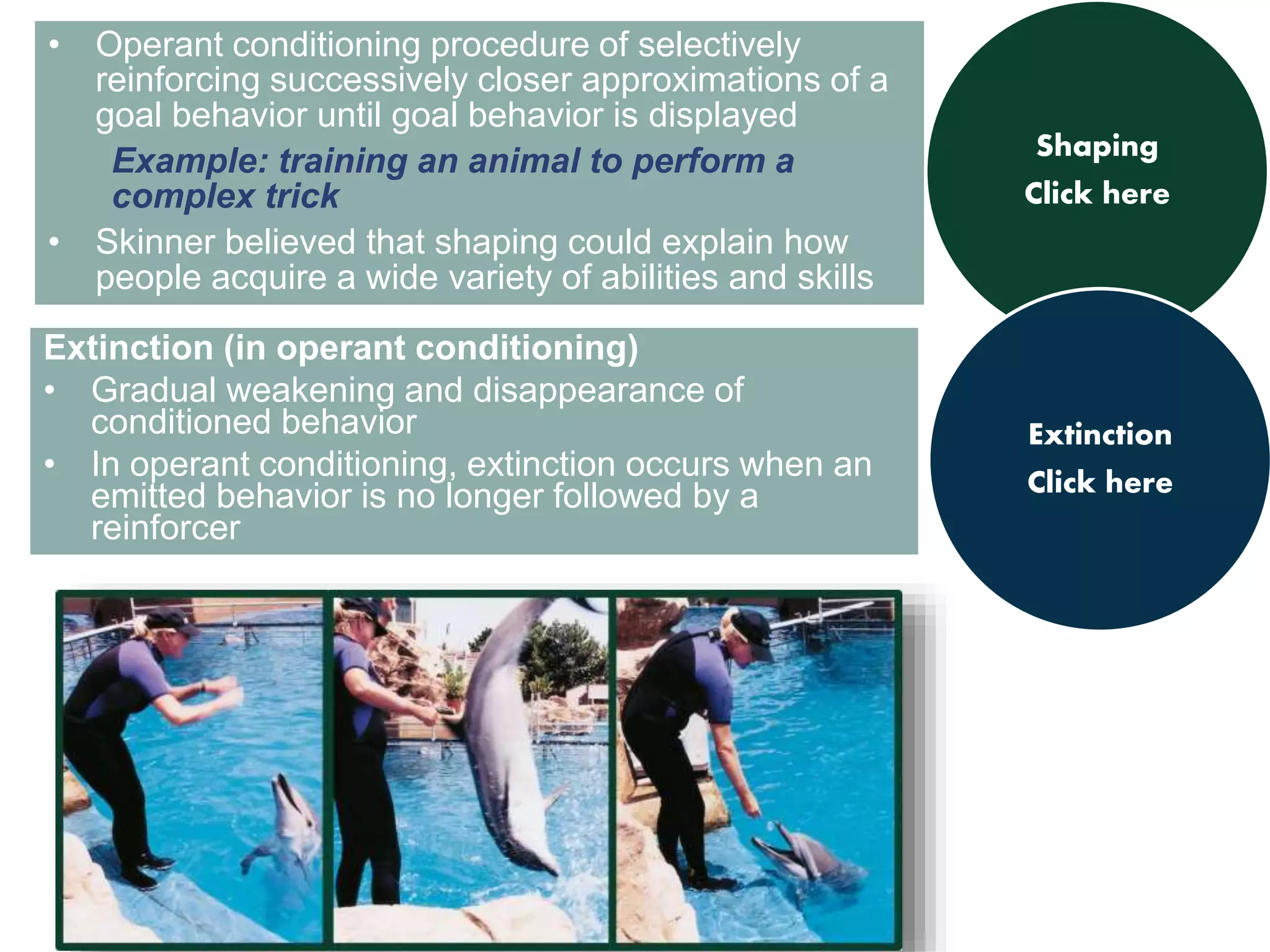
• Operant conditioning procedure of selectively 
reinforcing successively closer approximations of a 
goal behavior until goal behavior is displayed 
Example: training an animal to perform a 
complex trick 
• Skinner believed that shaping could explain how 
people acquire a wide variety of abilities and skills 
Shaping 
Click here 
Extinction (in operant conditioning) 
• Gradual weakening and disappearance of 
conditioned behavior 
• In operant conditioning, extinction occurs when an 
emitted behavior is no longer followed by a 
reinforcer 
Extinction 
Click here
The Partial Reinforcement Effect and 
Schedules of Reinforcement 
• Early work by Skinner used continuous reinforcement: 
a schedule of reinforcement in which every occurrence of 
a particular response is reinforced. 
• Running out of food for his rats – Skinner stretched out 
the pellets by not rewarding every trial and discovered 
the partial reinforcement effect. 
• Partial reinforcement effect: Behaviors that are 
conditioned using partial reinforcement are more 
resistant to extinction than behaviors that are 
conditioned using continuous reinforcement.
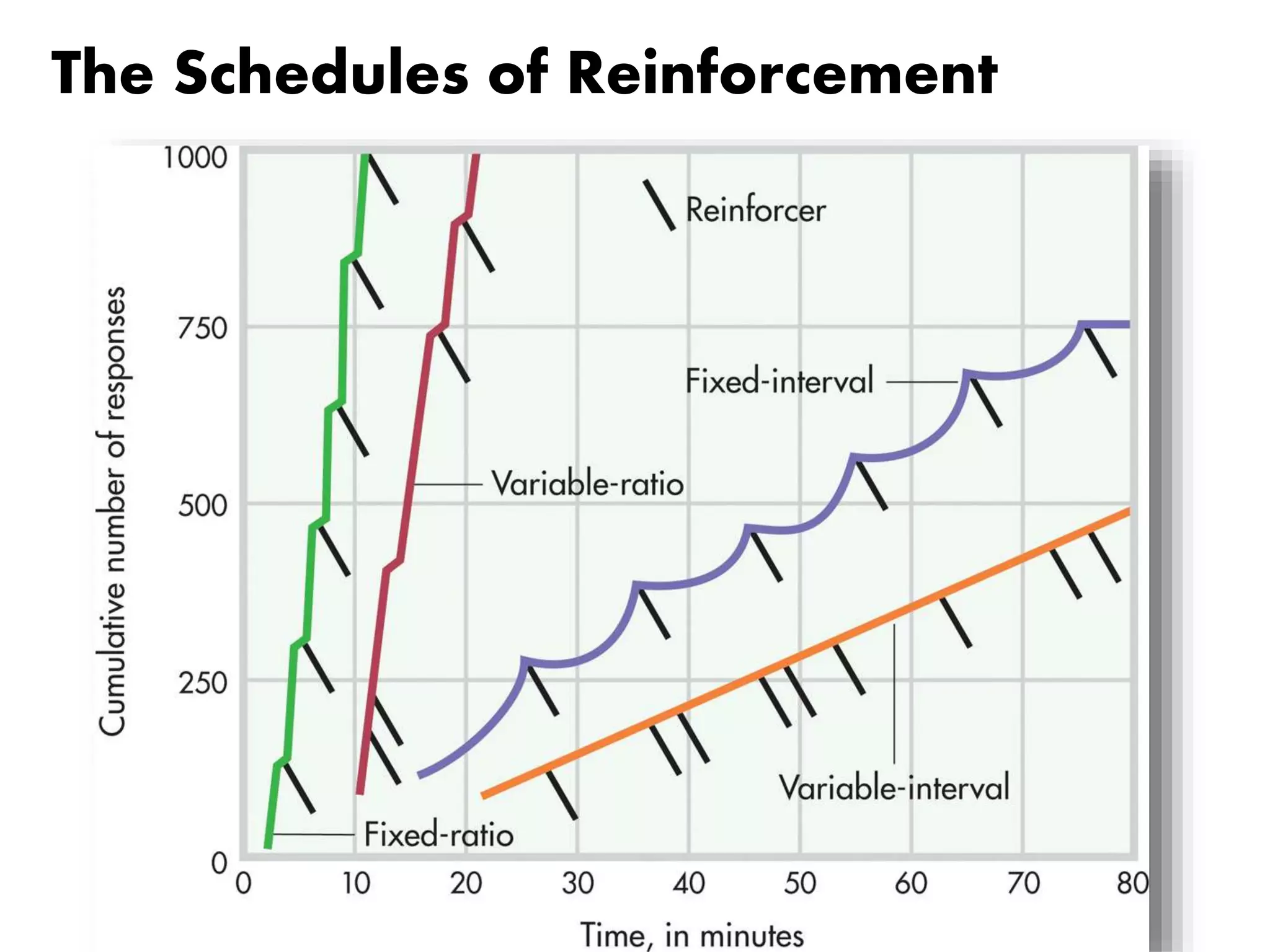
The Schedules of Reinforcement 
Skinner (1956) found that specific preset 
arrangements of partial reinforcement produced 
different patterns and rates of responding and delaying 
of extinction. 
Ratio schedules are 
based on number of 
responses emitted 
• Fixed ratio (FR)—a 
reinforcer is delivered 
after a certain (fixed) 
number of correct 
responses. 
• Variable ratio (VR)—a 
reinforcer is delivered 
after an average 
number of responses, 
but varies from trial to 
trial. 
Interval schedules are 
based on time 
• Fixed interval (FI)— 
reinforcer is delivered 
for the first response 
after a fixed period 
has elapsed. 
• Variable interval (VI)— 
reinforcer is delivered 
for the first response 
after an average time 
has elapsed; differs 
between trials.
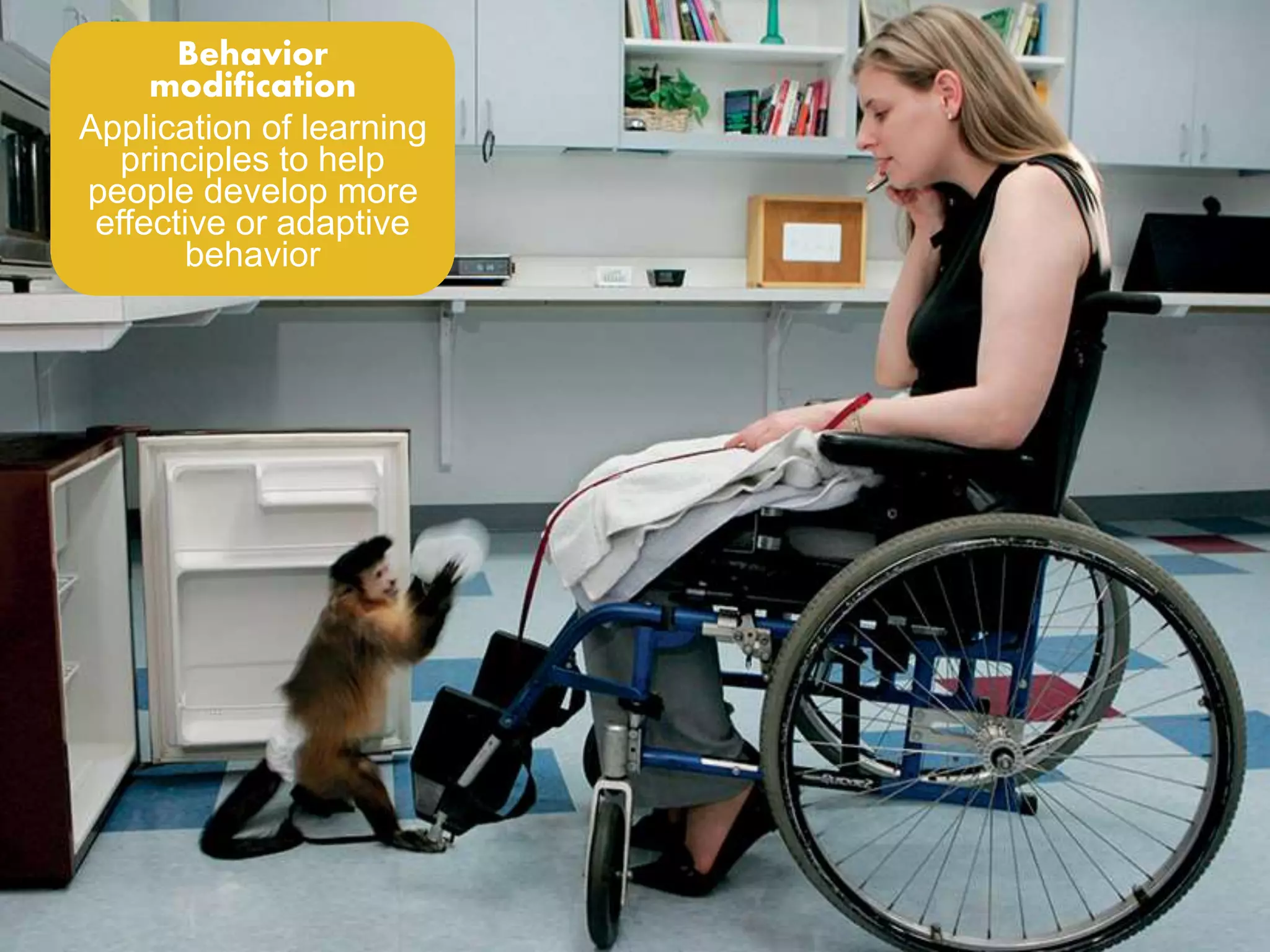
Behavior 
modification 
Application of learning 
principles to help 
people develop more 
effective or adaptive 
behavior
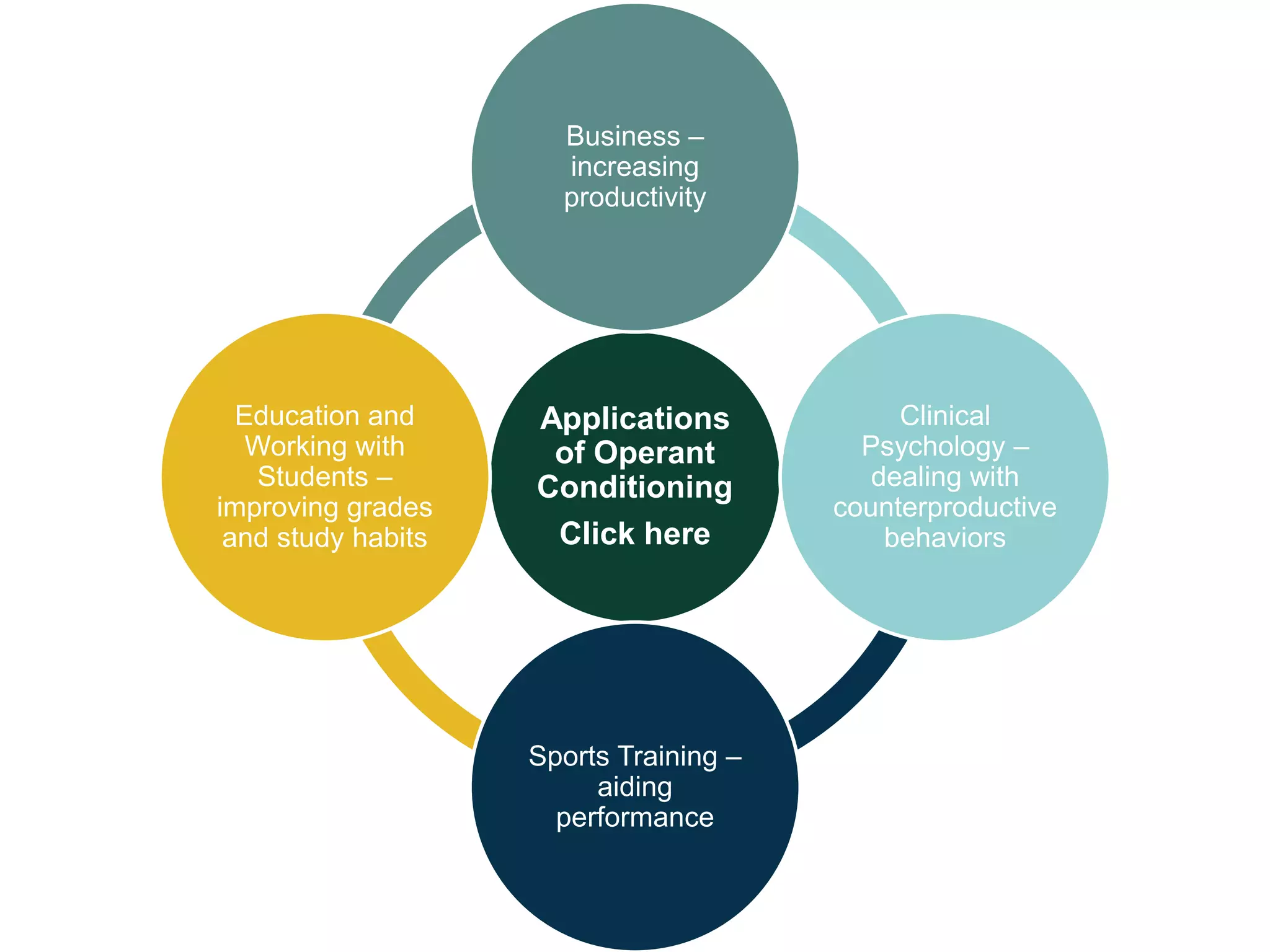
Business – 
increasing 
productivity 
Applications 
of Operant 
Conditioning 
Click here 
Clinical 
Psychology – 
dealing with 
counterproductive 
behaviors 
Sports Training – 
aiding 
performance 
Education and 
Working with 
Students – 
improving grades 
and study habits
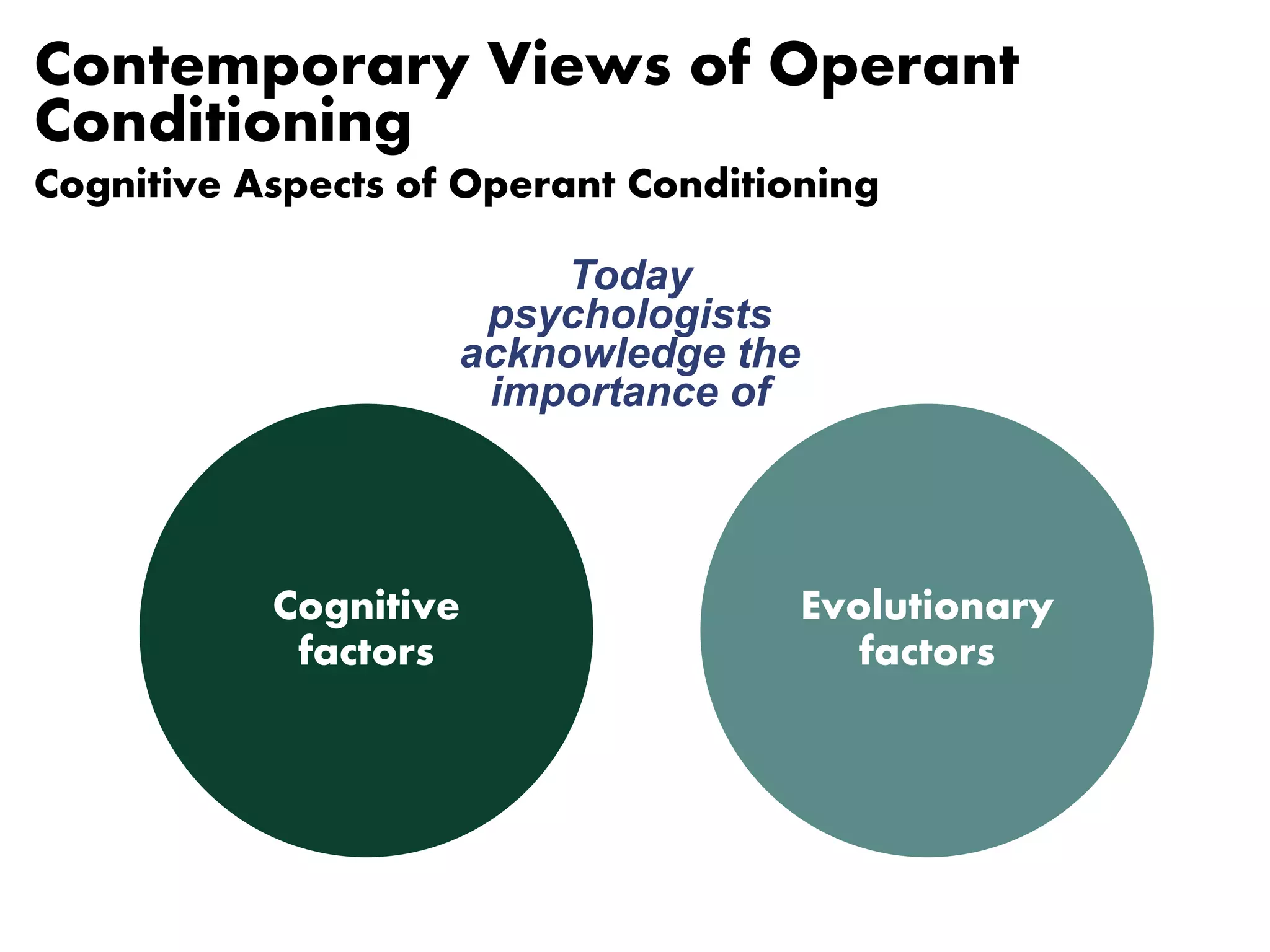
Contemporary Views of Operant 
Conditioning 
Cognitive Aspects of Operant Conditioning 
Today 
psychologists 
acknowledge the 
importance of 
Cognitive 
factors 
Evolutionary 
factors
Cognitive Factors – 
Tolman’s Work 
Cognitive Maps and Latent Learning 
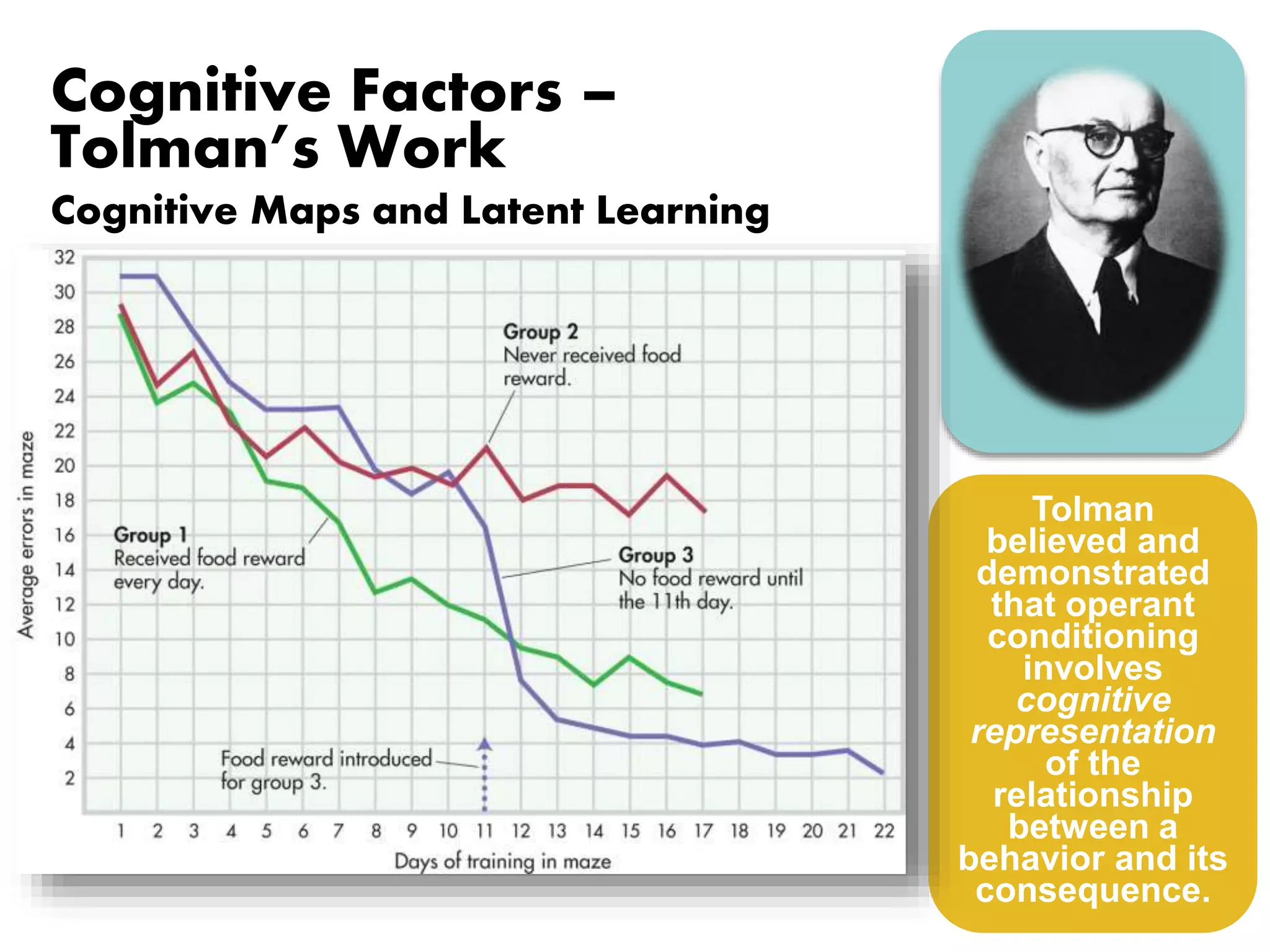
Demonstrated that animals learn a 
cognitive map of a maze instead of a series 
of responses. 
• Cognitive map—term for a mental 
representation of the layout of a familiar 
environment. 
• Latent learning—learning that occurs in 
the absence of reinforcement, but is not 
demonstrated until a reinforcer is 
available. 
Tolman 
believed and 
demonstrated 
that operant 
conditioning 
involves 
cognitive 
representation 
of the 
relationship 
between a 
behavior and its 
consequence.
Cognitive Aspects Continued 
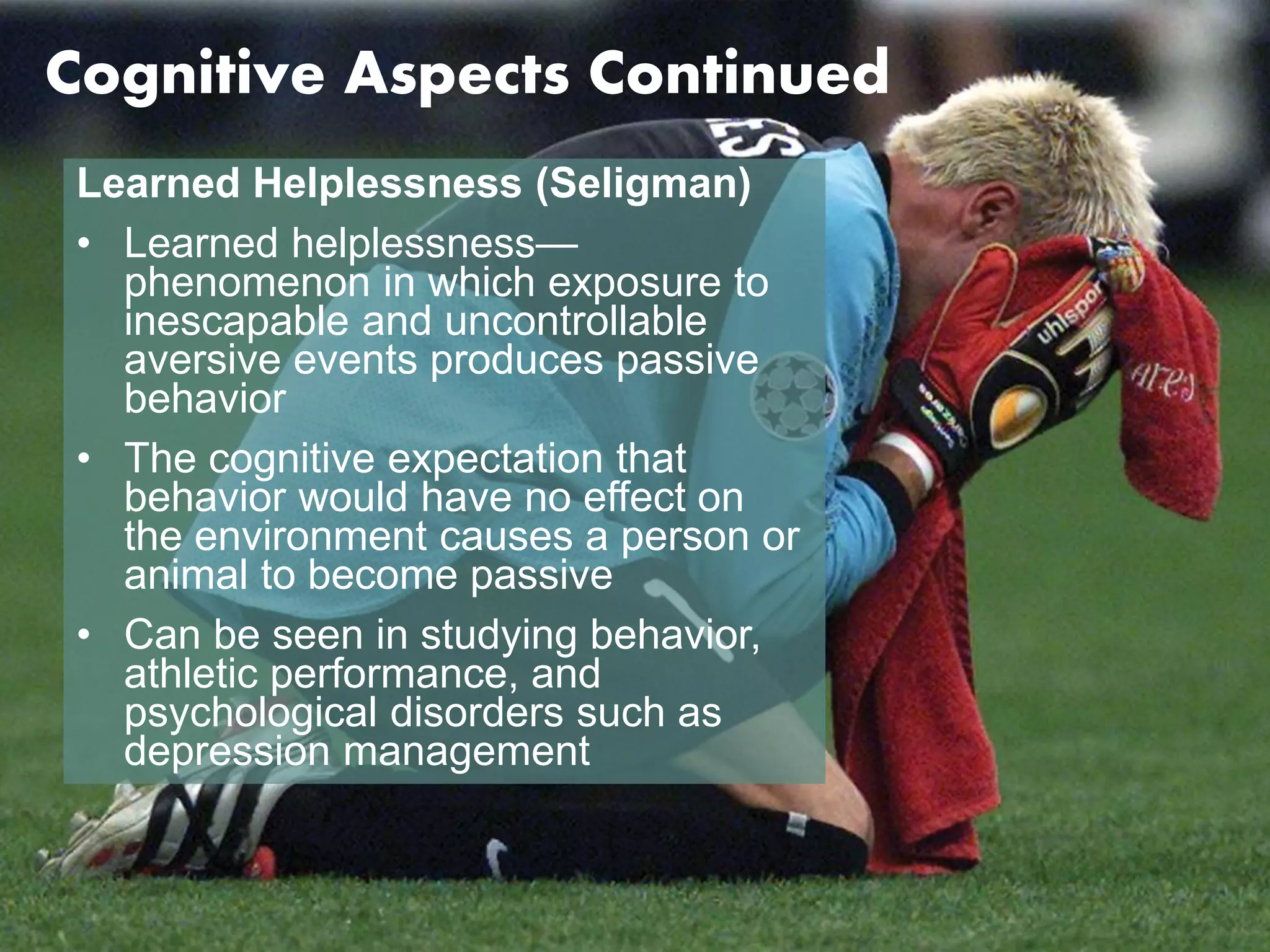
Learned Helplessness (Seligman) 
• Learned helplessness— 
phenomenon in which exposure to 
inescapable and uncontrollable 
aversive events produces passive 
behavior 
• The cognitive expectation that 
behavior would have no effect on 
the environment causes a person or 
animal to become passive 
• Can be seen in studying behavior, 
athletic performance, and 
psychological disorders such as 
depression management
Operant Conditioning and Biological 
Predispositions 
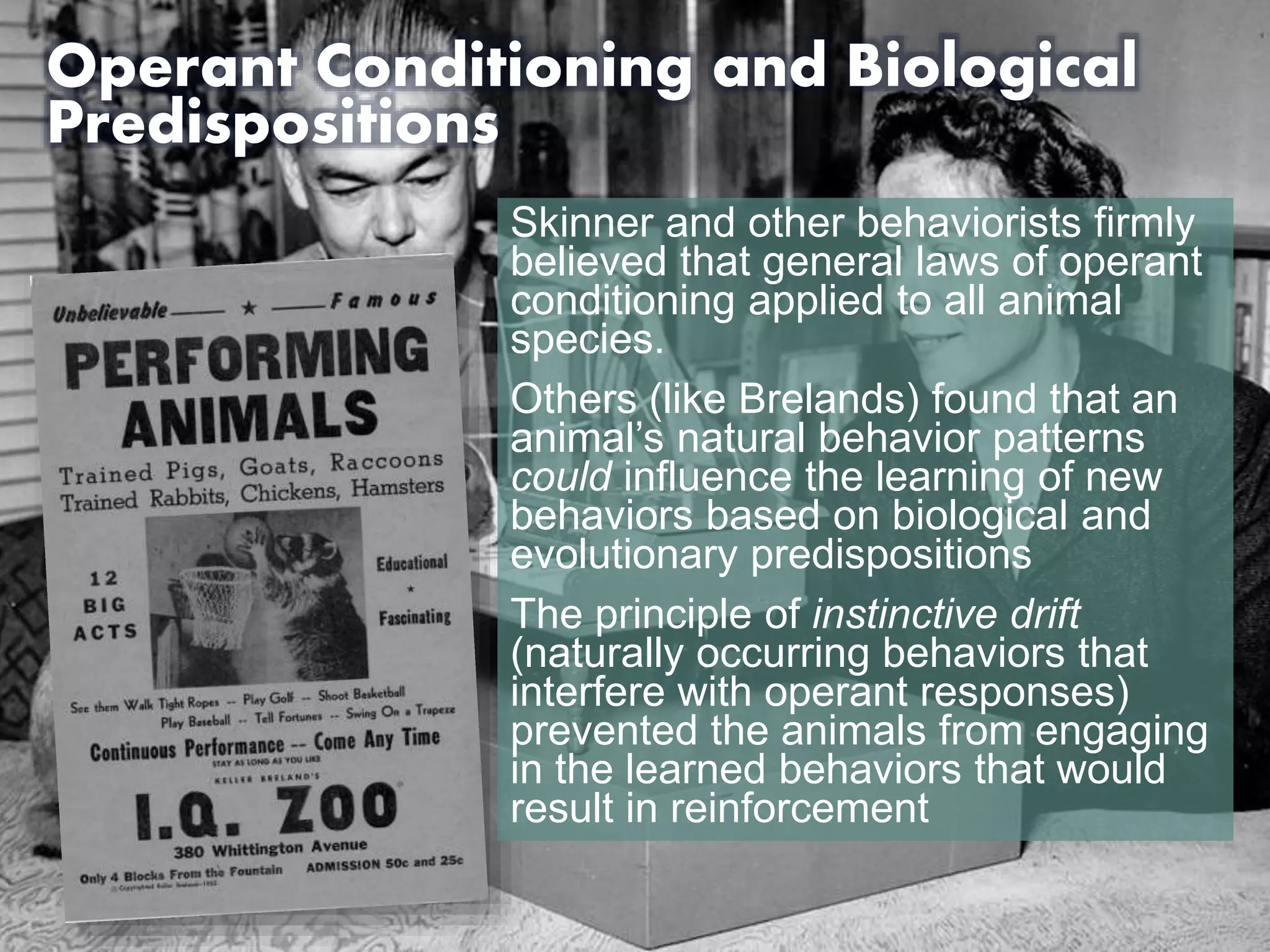
Skinner and other behaviorists firmly 
believed that general laws of operant 
conditioning applied to all animal 
species. 
Others (like Brelands) found that an 
animal’s natural behavior patterns 
could influence the learning of new 
behaviors based on biological and 
evolutionary predispositions 
The principle of instinctive drift 
(naturally occurring behaviors that 
interfere with operant responses) 
prevented the animals from engaging 
in the learned behaviors that would 
result in reinforcement
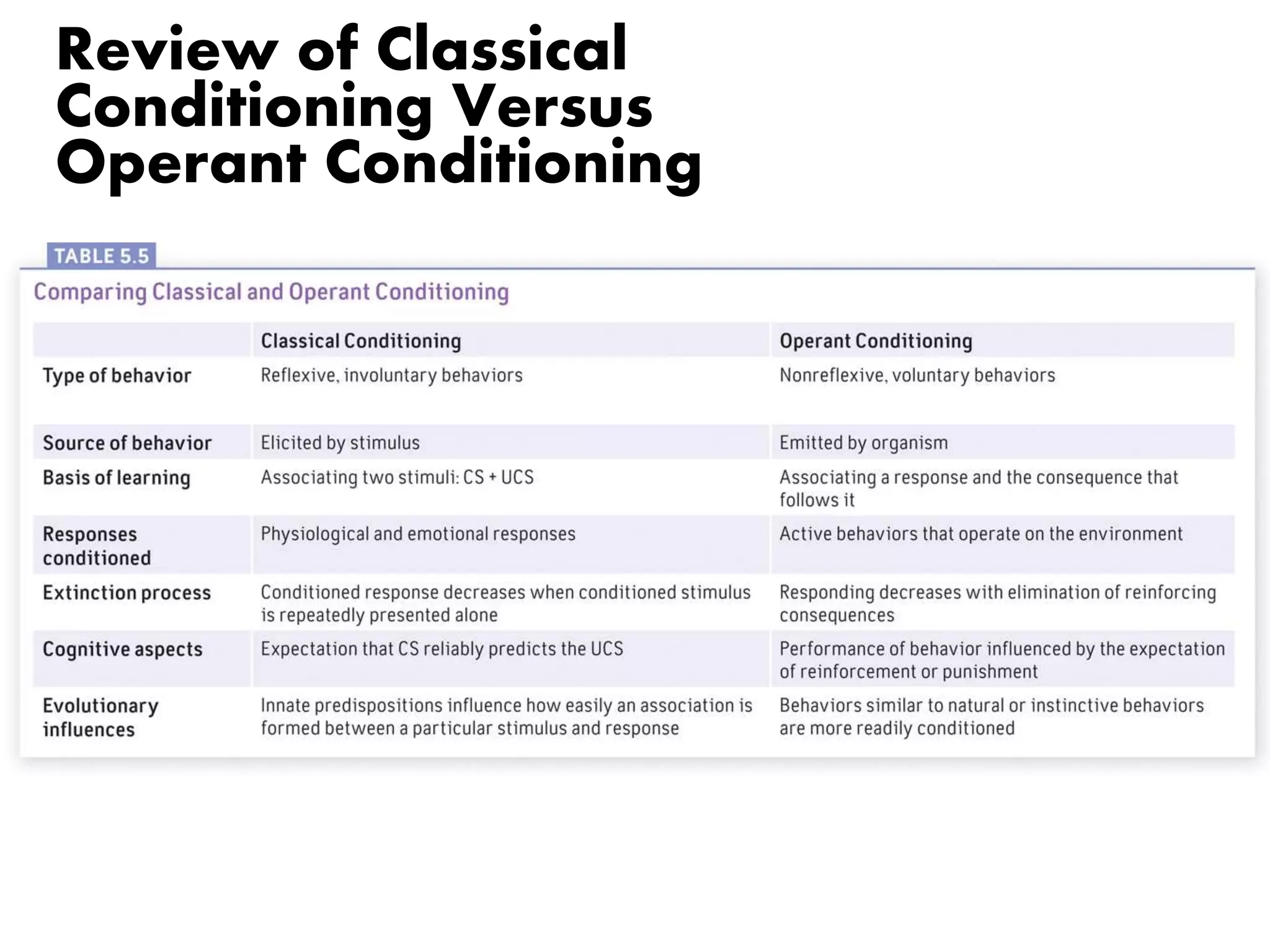
Review of Classical 
Conditioning Versus 
Operant Conditioning
Observational Learning 
Learning through 
watching and imitating 
the behaviors of others 
Albert Bandura strongly identified with observational 
learning 
The Bobo Doll Study 
• Bandura demonstrated the influence of 
observational learning in a series of experiments 
conducted in the early 1960s. Children watching a 
violent video clip seemed to imitate aggressive 
behavior. 
• Demonstrated the principle that expectation of 
reinforcement (by watching someone being 
rewarded) can act to reinforce a behavior.
Mirror Neurons: 
Imitation in the Brain? 
Giacomo Rizzolatti—The major discovery: 
• Record from monkey motor cortex cells as monkey 
watched a lab assistant pick up a peanut, a neuron fired 
in the monkey’s brain—the same neuron that fired when 
monkey itself picked up a peanut. 
• Mirror neurons have been found in many brain regions. 
• MRI and direct recording indicate the existence of mirror 
neurons in people. 
A type of neuron that 
activates both when an action 
is performed and when the 
same action is perceived
Observational Learning in 
Animals 
Demonstrated in 
• Puppies learning how to detect 
drugs from German shepherd 
mothers 
• Hamsters, crows, lemurs, guppies 
• Rats learn food preferences from 
others 
• Chimps and apes 
• Macaques learn how to order photos 
through observing others
Applications of 
Observational 
Learning 
 Adolescents may engage in 
sexual behavior earlier if 
they watch shows with 
sexual contact. 
 Adolescents who view 
pornographic sites may 
have more sexual partners 
and engage in substance 
abuse. 
 TV shows about literacy in 
Mexico increased 
enrollment in literacy 
groups. 
Do you remember 
the difference 
between correlation 
and causality? 
Does media violence 
promote violence? 
 Some studies and major 
medical and 
psychological 
organizations say it 
does. 
 Other researchers argue 
the data is correlational 
and lab research does 
not address the complex 
causes of violence in 
society.
Chapter05

Chapter05

  • 1.
    Lecture Slides ChapterFive Learning By Glenn Meyer Trinity University
  • 2.
    Introduction: What Is Learning? Conditioning is the process of learning associations between environmental events and behavioral responses. • Classical conditioning explains how certain stimuli can trigger an automatic response. • Operant conditioning is useful in understanding how we acquire new, voluntary actions. • Observational learning is when we acquire new behaviors by observing the actions of others. Learning refers to a relatively enduring change in behavior or knowledge as a result of experience.
  • 3.
    Classical Conditioning Discoveredby Ivan Pavlov while studying digestion Classical conditioning: the basic learning process that involves repeatedly pairing a neutral stimulus with a response-producing stimulus until the neutral stimulus elicits the same response
  • 4.
    Principles of Classical Conditioning Two stimuli are repeatedly paired. Basic Principles of Classical Conditioning Involve… Click here After repeated pairings, neutral stimulus elicits same basic reflexive response as the natural stimulus. This occurs in the absence of the natural stimulus. Pairing a neutral stimulus with an unlearned, natural stimulus that automatically elicits a reflexive response.
  • 6.
    Unconditioned stimulus (UCS): natural Unconditioned stimulus that reflexively Stimulus elicits a response without need for Click prior here learning. Meat Unconditioned response (UCR): unlearned, Unconditioned reflexive response Response that is elicited by an unconditioned Click here stimulus. Salivating to meat Conditioned stimulus (CS): a formerly Conditioned neutral stimulus Stimulus that acquires the capacity to elicit a reflexive Click response. here Bell presented before meat Conditioned response learned, Conditioned (CR): reflexive response Response to a conditioned Click here stimulus. Salivating to bell alone
  • 7.
    Factors that Affect Conditioning The occurrence of a learned response not only to the original stimulus but to other, similar stimuli as well Example: Conditioned to salivate to a low-pitched tone, a dog will also salivate to a slightly higher-pitched tone. Stimulus generalization CLICK HERE The occurrence of a learned response to a specific stimulus but not to other, similar stimuli Example: Give a dog some food following a high-pitched tone but don’t give the dog any food following a low-pitched tone. The dog learns to salivate to the high-pitched tone but not to the low-pitched tone. Stimulus discrimination CLICK HERE Procedure in which a conditioned stimulus from one learning trial functions as the unconditioned stimulus in a new conditioning trial; second conditioned stimulus comes to elicit the conditioned response, even though it has never been directly paired with unconditioned stimulus. Example: Pairing a metronome and a shock causes a dog to be scared of the metronome. Then pairing a bell with the metronome makes the dog fear the bell. Higher order conditioning CLICK HERE Timing • Conditioning most effective when conditioned stimulus is presented immediately before unconditioned stimulus • Usually ½ second to a few seconds
  • 8.
    Extinction and SpontaneousRecovery Extinction • Gradual weakening and apparent disappearance of conditioned behavior • In classical conditioning, extinction occurs when conditioned stimulus is repeatedly presented without unconditioned stimulus Spontaneous Recovery Reappearance of a previously extinguished conditioned response after a period without exposure to conditioned stimulus
  • 9.
    From Pavlov to Watson The Founding of Behaviorism Behaviorism was founded by John Watson, who redefined psychology as the scientific study of behavior Behaviorism School of psychology and theoretical viewpoint that emphasizes the scientific study of observable behaviors, especially as they pertain to the process of learning I should like to go one step further now and say, “Give me a dozen healthy infants, well-formed, and my own specified world to bring them up in and I’ll guarantee to take any one at random and train him to become any type of specialist I might select—doctor, lawyer, artist, merchant-chief Psychology as the behaviorist views it is a purely objective experimental branch of natural science. Its theoretical goal is the prediction and control of behavior. Introspection forms no essential part of its methods, nor is the scientific value of its data dependent upon the readiness with which they lend themselves to interpretation in terms of consciousness. Let us limit ourselves to things that can be observed, and formulate laws concerning only those things. Now what can we observe? We can observe behavior—what the organism does or says. and yes, even beggar-man and thief— regardless of his talents, penchants, tendencies, abilities, vocations, and race of his ancestors.” I am going beyond my facts and I admit it, but so have the advocates of the contrary and they have been doing it for many thousands of years.

  • 10.
    Conditioned Emotional Reactions The Famous Case of Little Albert – Was It Ethical?
  • 11.
    Other Classically ConditionedResponses The Smell of Coffee Drug Responses  Regular use may produce “placebo response” where user associates sight, smell, taste with the drug effect  Conditioned compensatory response (CCR)—classically conditioned response in which stimuli that reliably precede the administration of a drug elicit physiological reaction that is opposite to the drug’s effects; may be one explanation for the characteristics of withdrawal and tolerance
  • 12.
    Contemporary Views of Classical Conditioning Cognitive Aspects of Classical Conditioning Rescorla’s view Pavlovian conditioning is a sophisticated and sensible mechanism by which organisms represent the world. Pavlovian conditioning leads to its characterization as a mechanism by which the organism encodes relationships between events in the world. The conditioned stimulus and the unconditioned stimulus are simply two events, and the organism can be seen as trying to determine the relationship between them. Contemporary learning researchers acknowledge the importance of both cognitive factors and evolutionary influences in classical conditioning. Reliable and unreliable signals need processing: • Conditioned stimulus must be a reliable signal that predicts presentations of unconditioned stimulus. • Active processing of information: animals assess the predictive value of stimuli.
  • 13.
    Evolutionary Aspects ofClassical Conditioning • Behaviorists originally argued that learning principles applied to all species in the 1960s. • Conditioned taste aversions demonstrated the importance of natural behavior patterns influenced by evolution. • Discovered by John Garcia: A classically conditioned dislike for and avoidance of a particular food that develops when an organism becomes ill after eating the food. • Violates standard conditioning model • Only needs one pairing • Time between CS and UCS can be several hours • Particular conditioned stimulus that is used makes a difference in classical conditioning
  • 14.
    Evolution, Biological Preparedness,and Conditioned Fears What Gives You the Creeps? Seligman • Phobias seem to be quite Bregman Unable to produce a conditioned fear response to wooden blocks and curtains. Biological preparedness—the idea that an organism is innately predisposed to form associations between certain stimuli and responses. selective. Extreme, irrational fears of snakes, spiders, heights, and small enclosed places are relatively common. Öhman and Mineka Because poisonous snakes, reptiles, and insects have been associated with danger throughout the evolution of mammals, there is an evolved “fear module” in the brain that is highly sensitized to such evolutionarily relevant stimuli. • Humans biologically prepared to develop fears of objects or situations such as snakes, spiders, and heights—that may once have posed a threat to humans’ evolutionary ancestors.
  • 15.
    Operant Conditioning—Associating Behaviorsand Consequences Operant conditioning deals with the learning of active, voluntary behaviors that are shaped and maintained by their consequences. Major Figures: Edward Lee Thorndike (left) Burrhus Frederic Skinner (right)
  • 16.
    Thorndike and theLaw of Effect • Cats had to escape from a “puzzle” box • Process was by trial and error • Observation led to Law of Effect Responses followed by a “satisfying state of affairs” are “strengthened” and more likely to occur again in the same situation. Conversely, responses followed by an unpleasant or “annoying state of affairs” are “weakened” and less likely to occur again. Scratch at bars Push at ceiling Situation: Dig at floor stimuli inside of Howl puzzle box Etc. Etc. Press lever First Trial in Box Scratch at bars Push at ceiling Situation: Dig at floor stimuli inside of Howl puzzle box Etc. Etc. Press lever After Many Trials in Box
  • 17.
    B. F. Skinner and the Search for “Order in Behavior” • Believed that psychology should restrict itself to studying only phenomena that could be objectively measured and verified—outwardly observable behavior and environmental events • Believed that internal thoughts, beliefs, emotions, or motives could not be used to explain behavior • Coined the term operant to describe any “active behavior that operates upon the environment to generate consequences • Invented the Skinner box
  • 18.
    Reinforcement Operant Positiveconditioning reinforcement involves explains learning as a process in which behavior following is an shaped operant with and the maintained addition of a by its consequences. One possible reinforcing consequence stimulus. In positive of a behavior is reinforcement. reinforcement situations, a response is Reinforcement strengthened because is said something to occur is when a stimulus or an event follows added an or presented. operant and increases the likelihood of the operant being repeated. Negative reinforcement involves an operant that is followed by the removal of an aversive stimulus. In negative reinforcement situations, a response is strengthened because something is being subtracted or removed. Aversive stimuli involve physical or psychological discomfort that an organism seeks to escape or avoid. Behaviors are said to be negatively reinforced when they let you either (1) Escape aversive stimuli that are already present, or (2) Avoid aversive stimuli before they occur.
  • 19.
    Primary and ConditionedReinforcers Primary reinforcer: a stimulus that is inherently reinforcing for a species (biological necessities) Examples: food, water, comfort, pain relief, sexual contact Conditioned (or secondary) reinforcer: a stimulus that has acquired reinforcing value by being associated with a primary reinforcer Classic example: money
  • 20.
    Punishment • Processin which a behavior is followed by an aversive consequence that decreases the likelihood of behavior’s being repeated • Many people confuse punishment and negative reinforcement. • Two types of punishment identified by Skinner • Punishment by application: a situation in which an operant is followed by presentation or addition of an aversive stimulus; also called positive punishment • Punishment by removal: a situation in which an operant is followed by the removal or subtraction of a reinforcing stimulus; also called negative punishment
  • 21.
    Problems with Punishment Click here • Must be applied immediately • Does not teach or promote alternative, acceptable behavior • May produce undesirable results such as hostility, passivity, fear • Results likely to be temporary • May model aggression Alternatives to Punishment Click here Strategy 1: Reinforce an incompatible behavior Strategy 2: Stop reinforcing the problem behavior Strategy 3: Reinforce the nonoccurrence of the problem behavior Strategy 4: Remove the opportunity to obtain positive reinforcement
  • 22.
    Operant Conditioning Terms Shaping Discriminative Stimuli Extinction Schedules of Reinforcement
  • 23.
    Discriminative Stimuli –Components of Operant Conditioning Discriminative stimulus: Specific stimulus in the presence of which a particular operant is more likely to be reinforced Discriminative Stimuli Click here
  • 24.
    • Operant conditioningprocedure of selectively reinforcing successively closer approximations of a goal behavior until goal behavior is displayed Example: training an animal to perform a complex trick • Skinner believed that shaping could explain how people acquire a wide variety of abilities and skills Shaping Click here Extinction (in operant conditioning) • Gradual weakening and disappearance of conditioned behavior • In operant conditioning, extinction occurs when an emitted behavior is no longer followed by a reinforcer Extinction Click here
  • 25.
    The Partial ReinforcementEffect and Schedules of Reinforcement • Early work by Skinner used continuous reinforcement: a schedule of reinforcement in which every occurrence of a particular response is reinforced. • Running out of food for his rats – Skinner stretched out the pellets by not rewarding every trial and discovered the partial reinforcement effect. • Partial reinforcement effect: Behaviors that are conditioned using partial reinforcement are more resistant to extinction than behaviors that are conditioned using continuous reinforcement.
  • 26.
    The Schedules ofReinforcement Skinner (1956) found that specific preset arrangements of partial reinforcement produced different patterns and rates of responding and delaying of extinction. Ratio schedules are based on number of responses emitted • Fixed ratio (FR)—a reinforcer is delivered after a certain (fixed) number of correct responses. • Variable ratio (VR)—a reinforcer is delivered after an average number of responses, but varies from trial to trial. Interval schedules are based on time • Fixed interval (FI)— reinforcer is delivered for the first response after a fixed period has elapsed. • Variable interval (VI)— reinforcer is delivered for the first response after an average time has elapsed; differs between trials.
  • 27.
    Behavior modification Applicationof learning principles to help people develop more effective or adaptive behavior
  • 28.
    Business – increasing productivity Applications of Operant Conditioning Click here Clinical Psychology – dealing with counterproductive behaviors Sports Training – aiding performance Education and Working with Students – improving grades and study habits
  • 29.
    Contemporary Views ofOperant Conditioning Cognitive Aspects of Operant Conditioning Today psychologists acknowledge the importance of Cognitive factors Evolutionary factors
  • 30.
    Cognitive Factors – Tolman’s Work Cognitive Maps and Latent Learning Demonstrated that animals learn a cognitive map of a maze instead of a series of responses. • Cognitive map—term for a mental representation of the layout of a familiar environment. • Latent learning—learning that occurs in the absence of reinforcement, but is not demonstrated until a reinforcer is available. Tolman believed and demonstrated that operant conditioning involves cognitive representation of the relationship between a behavior and its consequence.
  • 31.
    Cognitive Aspects Continued Learned Helplessness (Seligman) • Learned helplessness— phenomenon in which exposure to inescapable and uncontrollable aversive events produces passive behavior • The cognitive expectation that behavior would have no effect on the environment causes a person or animal to become passive • Can be seen in studying behavior, athletic performance, and psychological disorders such as depression management
  • 32.
    Operant Conditioning andBiological Predispositions Skinner and other behaviorists firmly believed that general laws of operant conditioning applied to all animal species. Others (like Brelands) found that an animal’s natural behavior patterns could influence the learning of new behaviors based on biological and evolutionary predispositions The principle of instinctive drift (naturally occurring behaviors that interfere with operant responses) prevented the animals from engaging in the learned behaviors that would result in reinforcement
  • 33.
    Review of Classical Conditioning Versus Operant Conditioning
  • 34.
    Observational Learning Learningthrough watching and imitating the behaviors of others Albert Bandura strongly identified with observational learning The Bobo Doll Study • Bandura demonstrated the influence of observational learning in a series of experiments conducted in the early 1960s. Children watching a violent video clip seemed to imitate aggressive behavior. • Demonstrated the principle that expectation of reinforcement (by watching someone being rewarded) can act to reinforce a behavior.
  • 35.
    Mirror Neurons: Imitationin the Brain? Giacomo Rizzolatti—The major discovery: • Record from monkey motor cortex cells as monkey watched a lab assistant pick up a peanut, a neuron fired in the monkey’s brain—the same neuron that fired when monkey itself picked up a peanut. • Mirror neurons have been found in many brain regions. • MRI and direct recording indicate the existence of mirror neurons in people. A type of neuron that activates both when an action is performed and when the same action is perceived
  • 36.
    Observational Learning in Animals Demonstrated in • Puppies learning how to detect drugs from German shepherd mothers • Hamsters, crows, lemurs, guppies • Rats learn food preferences from others • Chimps and apes • Macaques learn how to order photos through observing others
  • 37.
    Applications of Observational Learning  Adolescents may engage in sexual behavior earlier if they watch shows with sexual contact.  Adolescents who view pornographic sites may have more sexual partners and engage in substance abuse.  TV shows about literacy in Mexico increased enrollment in literacy groups. Do you remember the difference between correlation and causality? Does media violence promote violence?  Some studies and major medical and psychological organizations say it does.  Other researchers argue the data is correlational and lab research does not address the complex causes of violence in society.

Editor's Notes

  • #3 Click to reveal bullets and definition.
  • #4 Click to show Classical Conditioning definition. Click to show cartoon.
  • #5 Click to reveal boxes.
  • #6 Video starts automatically.
  • #7 Click on each basic term to reveal the definition.
  • #8 Click each button on the left to reveal the details about each.
  • #9 Automatic animation.
  • #10 Click to reveal three Watson quotes.
  • #11 No animation.
  • #12 Click to reveal bullets.
  • #13 Click to reveal information and example.
  • #14 Click to reveal bullets.
  • #15 Click to reveal information about Seligman, Bregman and Öhman and Mineka.
  • #16 Click to reveal Thorndike and Skinner.
  • #17 Click to reveal bullets and results.
  • #18 Click to reveal bullets.
  • #19 Click to reveal bullets, example and positive reinforcement, negative reinforcement and aversive stimuli boxes.
  • #20 Click to reveal bullets.
  • #21 Click to reveal bullets and example.
  • #22 Click on each button at the top to reveal more information.
  • #23 Automatic animation.
  • #24 Click the Discriminative Stimuli button to reveal more details.
  • #25 Click the Shaping button to reveal more details. Click the Extinction button to reveal more details.
  • #26 Click to reveal bullets.
  • #27 Click to show text, then click to show the figure with different response patterns.
  • #28 No animation.
  • #29 Click on center circle to reveal additional circles of text.
  • #30 Click to start animation.
  • #31 Click to reveal bullets and example.
  • #32 Click to reveal bullets.
  • #33 Click to reveal bullets and graphic.
  • #34 No animation.
  • #35 Click to reveal bullets. Video starts automatically on the next slide.
  • #36 Click to reveal bullets and example.
  • #37 Click to reveal bullets.
  • #38 Click to reveal bullets.
  • #39 Video starts automatically.