Classical conditioning
Presented by Asima Lenka
Classical conditioning
• A learning process that occurs when two stimuli are repeatedly paired: a response
which is at first elicited by the second stimulus is eventually elicited by the first
stimulus alone
• classical conditioning is a type of unconscious or automatic learning. This
learning process creates a conditioned response through associations between an
unconditioned stimulus and a neutral stimulus
• This behavioral learning method was first studied in the late 19th century by
Russian physiologist Ivan Pavlov
• Other name is respondent conditioning.
Ivan pavlov
• Ivan Petrovitch Pavlov (1849 - 1936) was a Russian physiologist.
• Ivan Petrovitch Pavlov was born on September 14, 1849 at Ryazan,
where his father, Peter Dmitrievich Pavlov, was a village priest. He
was educated first at the church school in Ryazan and then at the
theological seminary there.
• His work had a major influence on the field, particularly on the
development of behaviorism.
• He was awarded nobel prize for this..
To be continue…….
• Pavlov was studying digestive system of dog .During his study he
noticed that his dog started secreting salivate the empty plate in
which the food was served.
• Ideally the plate was not stimuli that is sufficient to activate hunger
drive and secrete saliva. So he designed the experiment to see if other
neutral stimuli can also do the same job.
• For the sake of precision of measurement, Pavlov had arranged to
give a signal of light or sound of bell just before placing the meat
powder in the animal’s mouth. However, after a few trials,
unexpectedly, the dog started salivating in anticipation of meat
powder. It began to salivate at the signal - light or sound, even before
the meat powder had been given
THE EXPERIMENT
• SETUP
Dog is kept hungry on experimental table fitted with
mechanically controlled devices observer is hidden from dog
but he can see the dog through mirror.
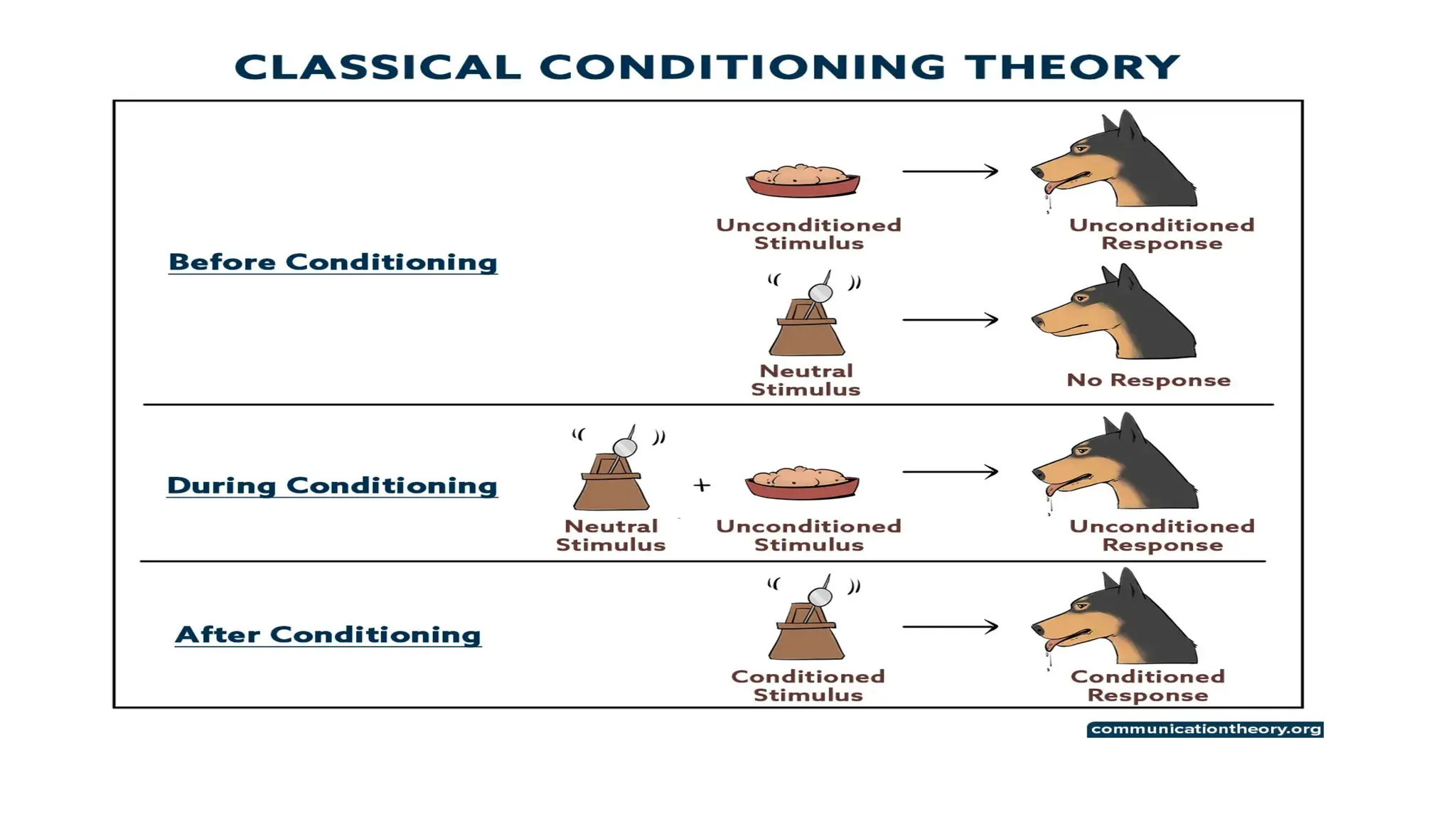
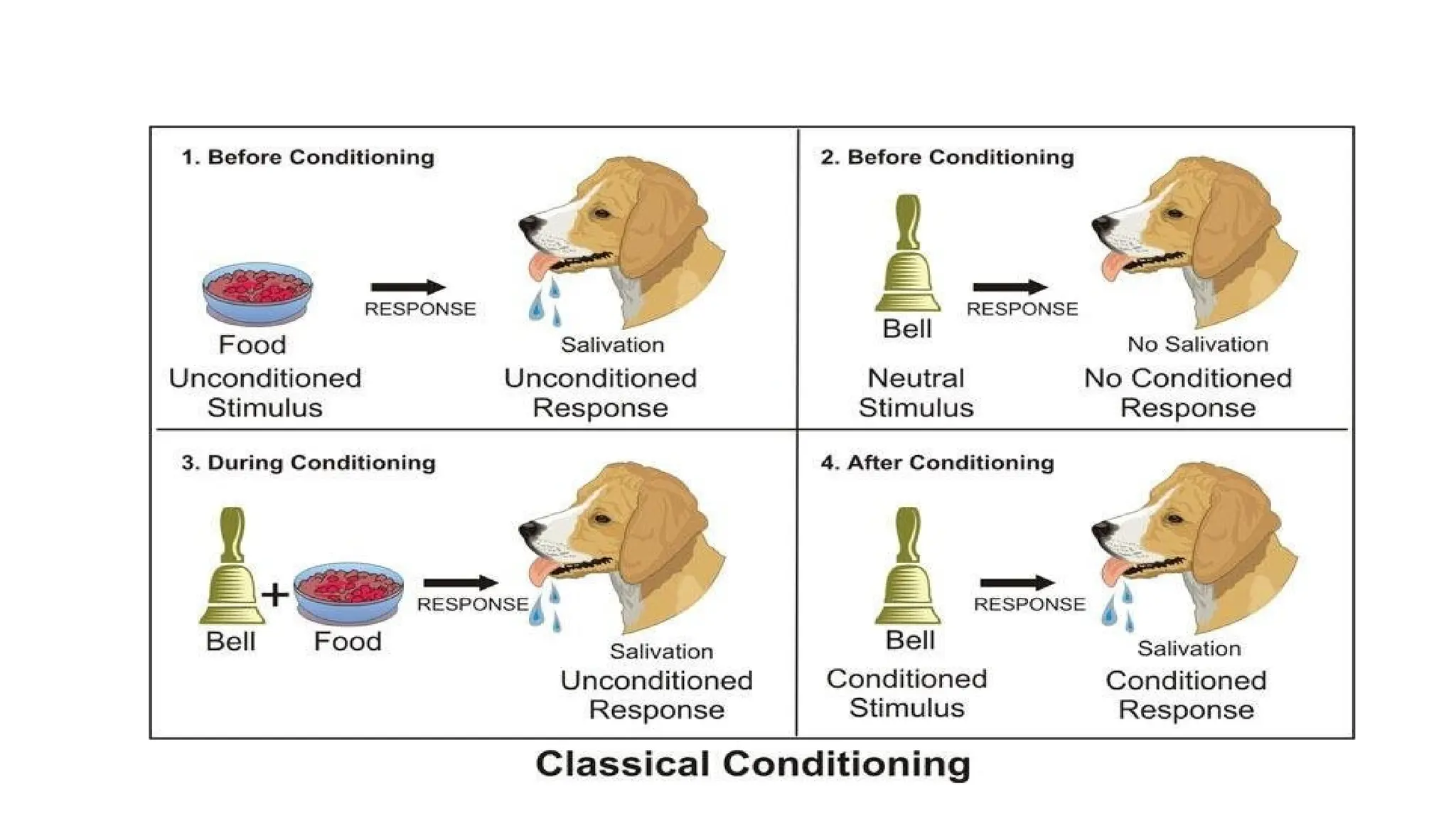
Before conditioning
Food being shown to the dog ——— The dog salivates Ring a bell
—————non-salivating dog
During conditioning
Ring the bell ——— Give the food —— Dog salivates (Repeat this many
times so that the dog is able to associate the bell with the food and salivate)
After conditioning
Ring the bell ————Dog salivates
• Before conditioning:
UCS (food) ————UCR (salivation) NS (bell) ———
————No salivation
• During conditioning
CS (bell) ———— UCS (food) ————UCR
(salivation)
• After conditioning
CS (bell) ————CR (salivation)
Interpretation of result
• Unconditioned stimulus (UCS): The natural stimulus that elicits a natural response. In
Pavlov’s experiment, the meat powder was the UCS
• Unconditioned response (UCR):The natural response elicited to the natural stimulus. In
Pavlov’s experiment, the salivation was the UCR
• Conditioned stimulus (CS):The neutral stimulus that does not naturally elicit the target
response, but may do so after being associated with the UCS for a number of times. In
Pavlov’s experiment, the light or the sound of the bell was the CS
• Conditioned response (CR): The target response similar to the UCR that originally
occurred to the UCS only, but after conditioning occurred to CS, even in absence of the
UCS. In Pavlov’s experiment, the salivation that occurred in response to the light or bell
was the CR. You must remember here that the UCR and the CR are similar but not the
same. Pavlov noticed that the amount of salivation was less in response to the light / bell
in comparison to the original salivation in response to meat powder
Classical conditioning b.ed notes by pavlov pptx(1).pptx

Classical conditioning b.ed notes by pavlov pptx(1).pptx

  • 1.
  • 2.
    Classical conditioning • Alearning process that occurs when two stimuli are repeatedly paired: a response which is at first elicited by the second stimulus is eventually elicited by the first stimulus alone • classical conditioning is a type of unconscious or automatic learning. This learning process creates a conditioned response through associations between an unconditioned stimulus and a neutral stimulus • This behavioral learning method was first studied in the late 19th century by Russian physiologist Ivan Pavlov • Other name is respondent conditioning.
  • 3.
    Ivan pavlov • IvanPetrovitch Pavlov (1849 - 1936) was a Russian physiologist. • Ivan Petrovitch Pavlov was born on September 14, 1849 at Ryazan, where his father, Peter Dmitrievich Pavlov, was a village priest. He was educated first at the church school in Ryazan and then at the theological seminary there. • His work had a major influence on the field, particularly on the development of behaviorism. • He was awarded nobel prize for this..
  • 4.
    To be continue……. •Pavlov was studying digestive system of dog .During his study he noticed that his dog started secreting salivate the empty plate in which the food was served. • Ideally the plate was not stimuli that is sufficient to activate hunger drive and secrete saliva. So he designed the experiment to see if other neutral stimuli can also do the same job. • For the sake of precision of measurement, Pavlov had arranged to give a signal of light or sound of bell just before placing the meat powder in the animal’s mouth. However, after a few trials, unexpectedly, the dog started salivating in anticipation of meat powder. It began to salivate at the signal - light or sound, even before the meat powder had been given
  • 5.
    THE EXPERIMENT • SETUP Dogis kept hungry on experimental table fitted with mechanically controlled devices observer is hidden from dog but he can see the dog through mirror.
  • 10.
    Before conditioning Food beingshown to the dog ——— The dog salivates Ring a bell —————non-salivating dog During conditioning Ring the bell ——— Give the food —— Dog salivates (Repeat this many times so that the dog is able to associate the bell with the food and salivate) After conditioning Ring the bell ————Dog salivates
  • 11.
    • Before conditioning: UCS(food) ————UCR (salivation) NS (bell) ——— ————No salivation • During conditioning CS (bell) ———— UCS (food) ————UCR (salivation) • After conditioning CS (bell) ————CR (salivation)
  • 12.
    Interpretation of result •Unconditioned stimulus (UCS): The natural stimulus that elicits a natural response. In Pavlov’s experiment, the meat powder was the UCS • Unconditioned response (UCR):The natural response elicited to the natural stimulus. In Pavlov’s experiment, the salivation was the UCR • Conditioned stimulus (CS):The neutral stimulus that does not naturally elicit the target response, but may do so after being associated with the UCS for a number of times. In Pavlov’s experiment, the light or the sound of the bell was the CS • Conditioned response (CR): The target response similar to the UCR that originally occurred to the UCS only, but after conditioning occurred to CS, even in absence of the UCS. In Pavlov’s experiment, the salivation that occurred in response to the light or bell was the CR. You must remember here that the UCR and the CR are similar but not the same. Pavlov noticed that the amount of salivation was less in response to the light / bell in comparison to the original salivation in response to meat powder